

Quick Overview
- Wait until grass reaches 3 to 3.5 inches tall before the first spring cut – not by the calendar date
- Soil temperature matters more than air temperature: cool-season grasses need soil above 50-55°F, warm-season grasses above 65-70°F at a 2-inch depth (Penn State Extension, 2023)
- Never mow wet or frozen ground – it compacts soil and tears grass roots
- Set your mower blade higher than normal for the first cut: 3.5 to 4 inches for most cool-season lawns
- Across the US, first mow timing ranges from late February in Georgia to late April or early May in Minnesota
Every spring, I do the same thing. I pull on my boots, walk out to the backyard, and sink into mud I wasn’t expecting. The lawn looks half-dead – yellow patches from snow mold, matted clippings from last fall, a few green shoots starting to push through. And all I want to do is fire up the mower and make it look normal again.
I used to do exactly that. I’d mow too early, scalp the crown of the grass, and spend the next six weeks watching bare patches spread while my neighbor’s lawn filled in thick and green. I’ve made that mistake enough times to finally understand why it happens – and how to avoid it.
This guide is for homeowners across the US who want to know when to cut grass in spring for the first time without wrecking the lawn in the process. The right timing depends on your grass type, your region, and a few simple signals your lawn sends before you ever start the engine.
Why the First Spring Cut Matters More Than You Think
The first mow of spring sets the direction for the whole growing season. Get it right and the grass fills in dense, crowds out weeds, and recovers fast. Get it wrong and you start the season fixing damage instead of growing.
What Happens If You Mow Too Early
Grass that looks green isn’t always ready to cut. In early spring, many lawns are still partially dormant. The roots haven’t fully anchored back into the soil after winter contraction. The crowns – the part of the plant that actually regrows the blade – are still soft and exposed.
Run a mower over that ground too soon and a few things happen:
- Mower wheels compact wet, soft soil and restrict oxygen to roots
- Blades tear grass tissue instead of cutting cleanly, leaving ragged edges that turn brown within days
- Crown damage can kill entire grass plants, leaving bare spots that weeds fill by summer
I scalped a section of my front lawn in late March one year. Six weeks later, I was overseeding a patch the size of a dining room table while dandelions moved in on the edges.
What Happens If You Wait Too Long
Waiting is safer than rushing, but going too long without mowing has a cost too.
Grass that grows past 4 or 5 inches before the first cut develops a layered canopy. The lower blades get shaded out and die. When you finally mow, you remove too much at once – which shocks the plant. The lawn ends up looking matted and uneven, and you have to do two passes just to reach a normal height.
Waiting too long also gives cool-season weeds like henbit and annual bluegrass a head start. Taller uncut turf shades the soil less evenly, and those weeds push through the gaps.
The Real Signals Your Lawn Is Ready to Mow
Forget the calendar. Your lawn will tell you when it’s ready. These are the four signals I check every spring before touching the mower.
Grass Height – The Most Reliable Indicator
The grass blade is the clearest signal. Cool-season lawns – Kentucky bluegrass, fescue, ryegrass – should reach 3 to 3.5 inches before the first cut. Warm-season grasses – Bermuda, Zoysia, St. Augustine – should reach 2 to 2.5 inches.
At those heights, the root system has generally had enough time to re-establish after winter dormancy. You’re cutting from a position of strength, not desperation.
Soil Temperature and Ground Firmness
Soil temperature drives spring green-up, and it’s more reliable than air temperature as a mowing signal. Cool-season grasses begin active growth when soil temperature hits 50-55°F at a 2-inch depth. Warm-season grasses need soil at 65-70°F to be fully out of dormancy (Penn State Extension, 2023).
A basic probe thermometer costs about $15 at any garden center. Or check your state’s agricultural university extension site – many publish real-time soil temperature maps by county.
Ground firmness matters just as much. If your boots sink when you walk across the lawn, the soil is too soft to handle mower weight without compaction. Wait for a few dry days.
How to Tell If the Ground Is Still Too Wet
Step test: walk to the lowest, shadiest corner of your yard and press down with your heel. If the ground gives more than half an inch and water seeps up around your shoe, don’t mow. You’ll leave ruts, compact the root zone, and tear grass crowns with the mower deck.
Drainage usually improves within 2 to 3 dry days after the last rain. In the Pacific Northwest, where March and April can bring week-long drizzles, this step matters more than anywhere else.
Ready vs. Not Ready Checklist by Grass Type
| Signal | Cool-Season Grass (Bluegrass, Fescue) | Warm-Season Grass (Bermuda, Zoysia, St. Augustine) |
|---|---|---|
| Grass height | 3 to 3.5 inches | 2 to 2.5 inches |
| Soil temp at 2-inch depth | 50-55°F | 65-70°F |
| Ground firmness (step test) | Heel sinks less than 0.5 inch | Same |
| Grass color | Consistent green, no yellow patches | Green throughout – no tan or brown dormancy zones |
| Frost forecast | No frost within 48 hours | No frost in the 7-day forecast |
When to Cut Grass in Spring by US Climate Zone
Timing the first mow is not one-size-fits-all. A Georgia homeowner with Bermuda grass and 60°F soil in mid-February is working from a completely different starting point than someone in Minnesota where the ground may still freeze at night in April.
Warm-Season Grasses (South, Southeast, Texas, Arizona)
If you’re in Georgia, the Carolinas, Florida, Texas, or Arizona, warm-season grasses are the norm. Bermuda, Zoysia, and St. Augustine are the most common.
These grasses go fully dormant in winter and stay brown until soil temperatures hold consistently at 65°F or above. In Atlanta, that usually happens in late March to early April. In Houston or Phoenix, it can be February or early March.
The first mow in these regions typically falls between late February and mid-April, depending on the year. Don’t go by how the lawn looks from the driveway. A Bermuda lawn that appears green in early March might still have soil at 58°F – mowing it then does more harm than good.
Cool-Season Grasses (Midwest, Northeast, Pacific Northwest)
In Minnesota, Wisconsin, upstate New York, or western Oregon, cool-season grasses are the standard – Kentucky bluegrass, tall fescue, fine fescue, and perennial ryegrass.
These grasses grow best at air temperatures of 60-75°F and can handle a first cut earlier than warm-season types – as long as the soil is firm and not frozen. In milder parts of the Pacific Northwest, that can mean late February or early March. In Minnesota, the first safe mow is often late April, sometimes early May.
Cool-season grasses look deceptively ready early. The blades go green before the roots fully stabilize. Even if the grass looks ready, check soil temperature and firmness before mowing.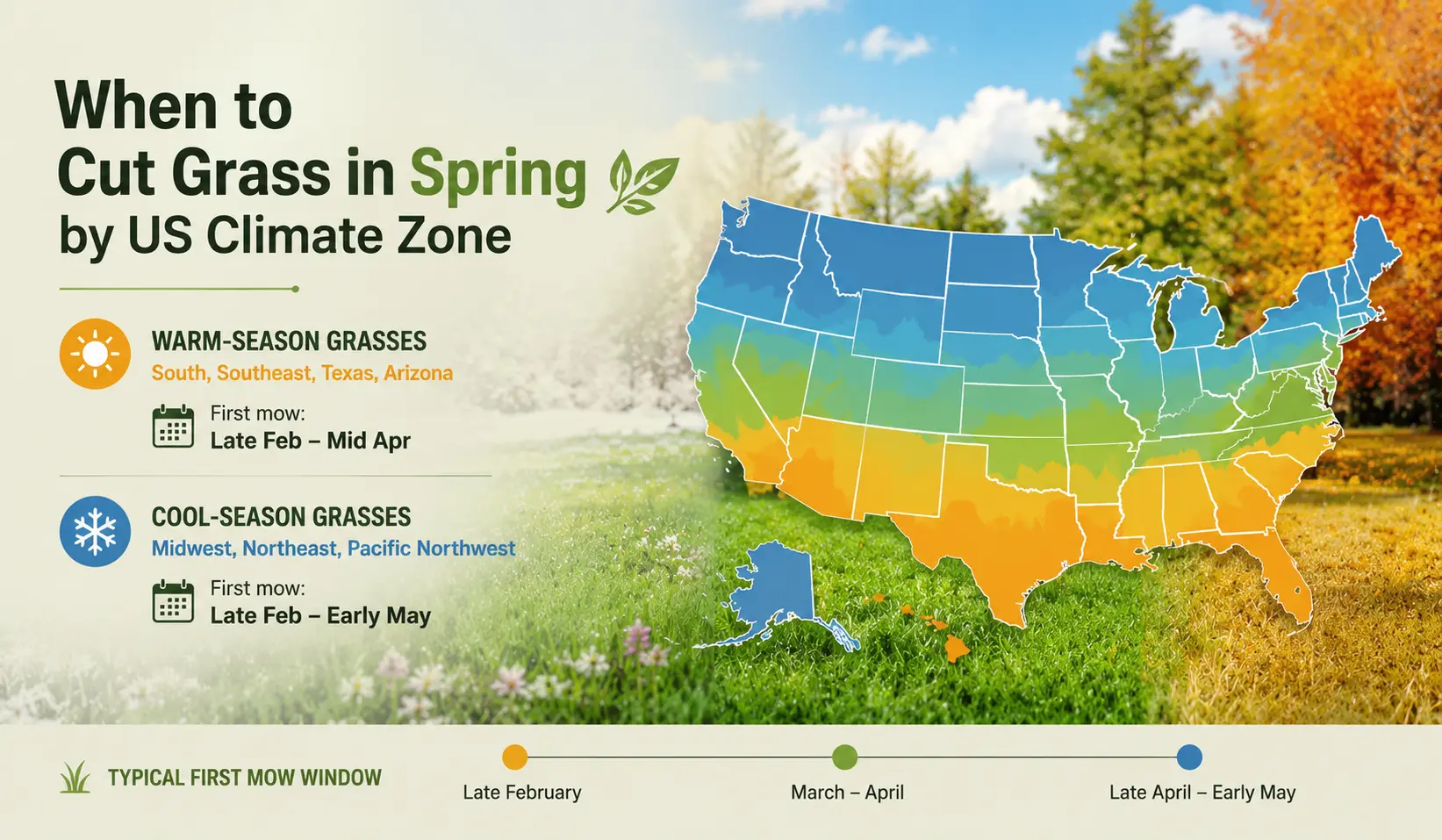
Transition Zone Lawns (Virginia, Kansas, Missouri – the Tricky Middle)
The transition zone runs roughly from Virginia through Tennessee, Kansas, and Missouri. It’s the hardest climate for lawn timing because warm-season and cool-season grasses both exist here, and neither thrives perfectly year-round.
Bermuda or Zoysia in this zone: wait until consistent soil warmth arrives – usually April. Fescue or bluegrass: you can often start earlier, in late March, as long as there’s no late freeze in the forecast.
The transition zone also gets late cold snaps that can push mowing timelines back by two or three weeks. I’ve seen Virginia lawns that looked perfect for mowing in late March get hit by a hard frost in early April. When in doubt here, wait.
First Mow Timing by Region and Grass Type
| Region | Common Grass Types | Typical First Mow Window |
|---|---|---|
| Southeast (GA, FL, SC) | Bermuda, Zoysia, St. Augustine | Late February – early April |
| Texas / Arizona | Bermuda, St. Augustine, Buffalo | Late February – mid-March |
| Midwest (OH, IL, MN) | Kentucky bluegrass, tall fescue | Late April – early May |
| Northeast (NY, PA, MA) | Fescue, bluegrass, ryegrass | Early to mid-April |
| Pacific Northwest (OR, WA) | Fescue, ryegrass | Late February – late March |
| Transition Zone (VA, KS, MO) | Mixed: Bermuda, fescue, bluegrass | Late March – late April |
These windows assume average spring conditions. A late freeze or wet spring can push every region back 2 to 3 weeks.
What Grass Type You Have Changes Everything
If you don’t know what grass you have, identifying it is the first step. Grass type determines when to mow, how short to cut, and how much stress the lawn can handle in early spring.
Bermuda and Zoysia – Don’t Rush It
Bermuda and Zoysia are slow to wake up. Both stay tan and dormant until soil temperatures hold steadily above 65°F. Mow them before that and you’re cutting into dormant tissue that can’t heal properly.
Once they do come out of dormancy, they green up fast and grow aggressively. Bermuda is often kept at 1 to 1.5 inches at full maintenance height; Zoysia at 1 to 2 inches. For the first spring mow, start higher – around 2.5 inches – and work down over two or three sessions. Dropping straight to maintenance height in one pass shocks the plant.
Kentucky Bluegrass and Fescue – Earlier Is Fine, But Be Careful
Kentucky bluegrass and tall fescue tolerate an earlier first cut than warm-season grasses. They go green faster after winter and their root systems stabilize at lower soil temperatures.
Still, “earlier” doesn’t mean “any time the grass looks green.” These grasses can show green growth at soil temperatures of 45°F, but roots aren’t well-anchored below 50°F. Mower wheel pressure at that stage can still compact soft soil and pull shallow roots free.
For these grasses, the signal is 3 to 3.5 inches of blade height combined with soil that doesn’t sink under foot pressure. First cut height: 3 to 3.5 inches.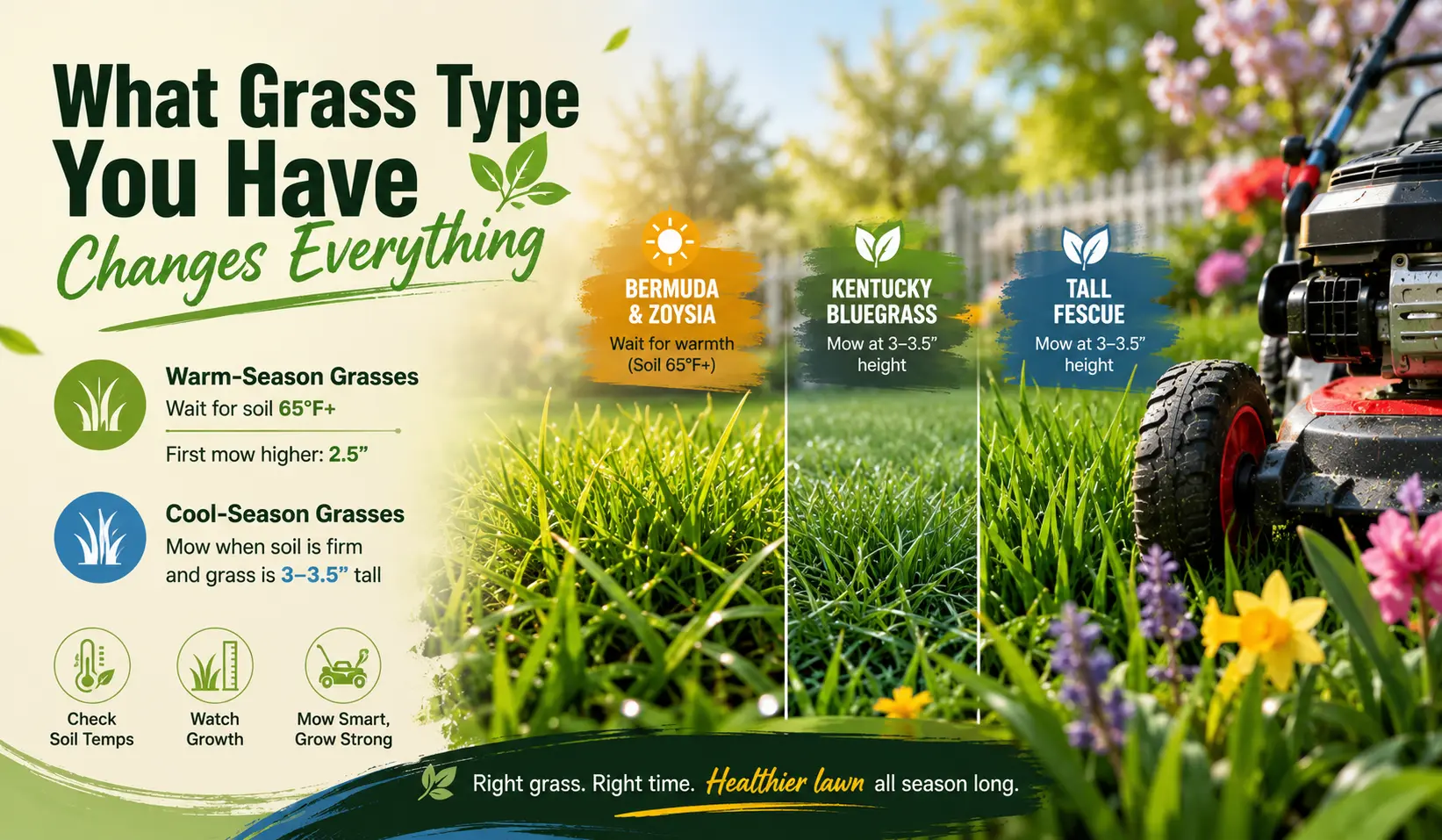
St. Augustine – Watch the Soil, Not the Calendar
St. Augustine is common in Florida, coastal Texas, and the Gulf Coast. It greens up based on soil warmth, not day length – so calendar dates are even less useful here than with other grass types.
St. Augustine needs consistent soil temperatures at 65°F before mowing. It’s also more sensitive to scalping than Bermuda or Zoysia. First cut height is typically 3.5 to 4 inches, which is higher than most homeowners expect.
Something I’ve noticed along the Gulf Coast: the lawn can look fully green in late February during a warm spell, then get hit with cold soil from a front moving through. Mowing during those warm windows can leave it exposed. Check the 10-day forecast and soil temp before committing.
Grass Types and Ideal First Cut Timing
| Grass Type | Dormancy Type | Soil Temp Trigger | First Cut Height | Typical First Mow Month |
|---|---|---|---|---|
| Bermuda | Warm-season | 65-70°F | Start at 2.5 inches, work down | March – April |
| Zoysia | Warm-season | 65-70°F | Start at 2.5 inches, work down | March – April |
| St. Augustine | Warm-season | 65°F | 3.5-4 inches | March – April |
| Kentucky Bluegrass | Cool-season | 50-55°F | 3 to 3.5 inches | April – early May |
| Tall Fescue | Cool-season | 50-55°F | 3 to 3.5 inches | Late March – April |
| Perennial Ryegrass | Cool-season | 50°F | 2.5 to 3 inches | Late March – April |
How to Do the First Cut Right
Getting the timing right is half the job. The actual cut matters just as much.
Set Your Blade Higher Than You Think
Most people mow too short. Always. And the first mow of spring is the worst time to go low.
For the first cut, raise your deck to the highest setting you’re comfortable maintaining – 3.5 to 4 inches for cool-season grasses, 2 to 2.5 inches for warm-season types. Work down to your preferred height over the next few sessions. Starting low and scalping on the first pass is one of the most common spring mistakes I see on the block.
Never Cut More Than One-Third of the Blade at Once
This is the one-third rule, and it matters year-round but especially in spring. If your grass is 4 inches tall, cut it to 2.7 inches or higher – not to 2 inches. Removing more than one-third of the blade at once takes too much leaf area away, limits the plant’s ability to photosynthesize, and causes visible stress browning within a day or two (University of Minnesota Extension, 2022).
If the lawn grew past 5 or 6 inches over winter, bring it down in two or three passes over separate days rather than trying to fix it in one session.
Mower Prep After Winter – Blade, Deck, and Battery Check
The first mow of the year is when dull blades do the most damage. A sharp blade cuts cleanly. A dull blade shreds and tears, leaving ragged tips that turn brown and invite disease.
Before that first mow:
- Sharpen or replace the blade – dull blades are the most common cause of post-mow browning
- Clean dried clippings and surface rust off the mowing deck
- Check the oil on gas mowers – change it if you skipped that step last fall
- For battery mowers, charge fully and check the connection points for corrosion
Most local hardware stores sharpen a mower blade for $10 to $15. It’s worth doing every spring.
Morning vs. Afternoon – When Is the Best Time of Day to Mow?
Mid-morning is the best time – generally between 9 and 11 AM. The dew has dried off the grass, which means cleaner cuts and less disease risk. The heat of the afternoon hasn’t set in yet, which reduces stress on both the lawn and you.
Avoid early morning when dew is still on the blades. Wet grass clumps under the deck, cuts unevenly, and spreads fungal spores. Avoid peak afternoon heat if you’re in a hot climate – freshly cut grass is more stressed by heat than uncut grass.
Common Mistakes I See Every Spring
These come up every year without fail. I’ve made most of them myself.
Mowing Wet or Frozen Ground
This is the single most damaging thing you can do in early spring. Wet soil compacts under mower wheels, cutting off oxygen to roots. Frozen ground is rigid, and mower weight can crack the crown zone of the grass plant.
Wait until the ground passes the step test – heel pressure sinks less than half an inch. If you’re impatient by late March (I always am), check the forecast for a 3-day dry stretch and use that window.
Scalping the Lawn on the First Pass
Scalping means cutting low enough to expose the crown. You can see it right away – tan or white stems where green blade used to be. Recovery from scalping is slow. Where the crown is actually damaged, the plant may not come back at all.
The temptation is to “clean up” a shaggy winter lawn in one aggressive pass. Don’t. Two or three shorter sessions over a week or two is always safer.
Skipping the Mower Tune-Up
A dull blade, low oil, or a clogged air filter won’t destroy your lawn in one session, but they make every problem worse and slow recovery. Start the season with a sharp blade and a clean machine. You’ll see the difference in how the lawn looks the next morning.
My Final Recommendation
If I had to give a neighbor one piece of advice about timing the first spring mow, it’s this: trust the grass, not the date.
I spent years going by what “late March” or “early April” felt like. Now I check soil temperature, do the step test, and look at blade height. Those three signals together have never misled me. The lawn always tells you when it’s ready – you just have to slow down and look for it.
There will be years when everything lines up in late February and you mow early without problems. There will be other years – cold, wet springs – that keep you waiting until May. Both are fine. Patience in early spring is real skill, not just personality. The first mow sets the pattern for the whole season, and it’s worth doing on the lawn’s schedule instead of yours.
The best lawn I ever had – thick, even, almost no weeds all summer – came from a year when I held off until early May because the spring was cold and wet. My neighbor mowed in late March and spent June filling in bare patches. That one season taught me more than anything else about spring lawn timing.
Pros and Cons of Early vs. Late First Mowing
| Factor | Mowing Too Early | Mowing Too Late |
|---|---|---|
| Lawn health | Crown damage, root stress, bare patches | Leaf shading, overcrowding, cutting-shock from one-third-rule violation |
| Weed pressure | Opens bare soil for weed germination | Canopy gaps invite some weeds; dense uncut turf delays others |
| Root development | Disrupts early root anchoring | Minimal effect if grass stays under 5 inches |
| Appearance | Browning and thin patches after the cut | Matted, uneven surface; harder to cut cleanly |
| Recovery speed | Slow – damaged crowns may not come back | Fast – lawn rebounds within 1 to 2 mowing sessions |
| Overall risk | High when soil is wet or still soft | Low to moderate if grass is under 5 inches |
Frequently Asked Questions About When to Cut Grass in Spring for the First Time
When is it safe to cut grass in spring for the first time?
It’s safe when three conditions line up: grass is 3 to 3.5 inches tall for cool-season types or 2 to 2.5 inches for warm-season, soil temperature at a 2-inch depth is above 50°F for cool-season or 65°F for warm-season grass, and the ground doesn’t sink more than half an inch under heel pressure. That combination – not the calendar – is the reliable trigger.
What happens if you mow too early in spring?
Mowing too early compacts wet soil, tears grass crowns that haven’t hardened after winter dormancy, and creates bare patches that fill slowly. In the worst cases – mowing frozen or saturated ground – you can damage the root zone enough that sections of lawn don’t recover by summer.
What soil temperature is needed before the first spring mow?
Cool-season grasses need soil above 50-55°F at a 2-inch depth. Warm-season grasses need soil above 65°F. Air temperature can be misleading – a 65°F afternoon in early March doesn’t mean the soil beneath has warmed to those levels. Use a probe thermometer or your state extension service’s soil temperature map.
How high should you cut grass for the first time in spring?
Set the blade higher than your normal mowing height. For cool-season grasses like fescue and bluegrass, start at 3.5 to 4 inches. For warm-season grasses, start at 2 to 2.5 inches and work down over two or three sessions. Never remove more than one-third of the blade height in a single pass.
Should I wait until after the last frost to mow in spring?
For warm-season grasses, yes – wait until frost risk has passed and soil has warmed consistently. For cool-season grasses, you don’t need to wait for the absolute last frost date, but avoid mowing within 48 hours of a forecast frost. Freshly cut grass with open leaf tissue is more exposed to frost damage than uncut grass.
Can I mow wet grass in spring?
Technically yes, but it causes real problems. Wet grass clumps under the mower deck, cuts unevenly, and spreads fungal disease. More importantly, wet soil compacts under mower weight and restricts root oxygen. Wait 2 to 3 dry days after heavy rain before mowing in spring, especially for the first cut of the season.