
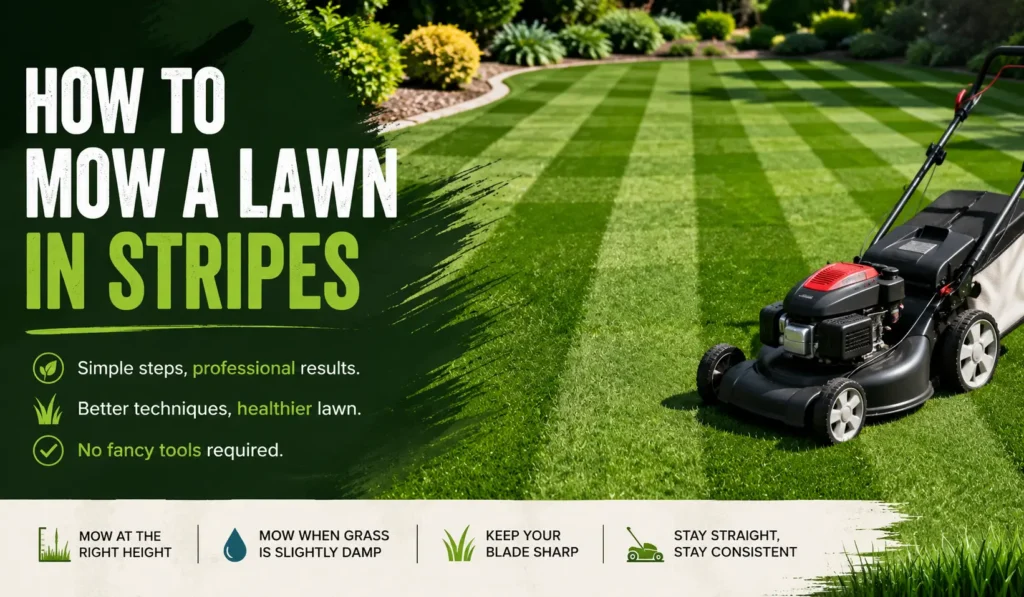
Quick Overview
- Lawn stripes are made by bending grass blades in opposite directions – light reflects differently off each row, creating the pattern.
- Any rotary mower can stripe. A roller attachment or striping kit makes stripes sharper and longer-lasting, but neither is required for beginners.
- The most important step is your first straight pass. Get that wrong and everything after it is crooked.
- Cool-season grasses like Kentucky Bluegrass and Tall Fescue stripe better than warm-season grasses like Bermuda or St. Augustine.
- Mow at the right height for your grass type – scalping kills stripes before they start.
I still remember the first time I pulled off a clean set of stripes in a backyard in Minneapolis. It was a Tuesday morning, dew still on the grass, and when I made that last pass and stepped back to look – I just stood there for a second. The homeowner came out with coffee and didn’t say a word. She just nodded.
That’s what stripes do to people.
I’ve been mowing lawns professionally for over 20 years. I’ve worked on baseball fields, golf course fairways, and more suburban backyards than I can count. I’ve mowed at Wrigley Field during a grounds crew rotation and I’ve crawled around Florida HOA lawns trying to coax stripes out of St. Augustine grass that did not want to cooperate.
This guide is for homeowners who want that clean, professional look without hiring a crew. I’ll walk you through how to mow a lawn in stripes – from picking the right starting line to finishing the edges clean. No fluff. Just what actually works.
Why Lawn Stripes Look So Good (The Science Behind It)
The effect is simpler than most people think. It’s basic optics, and once you understand it, you’ll stop overthinking the process.
How Light and Grass Bending Create the Pattern
When you mow, the roller or deck of your mower bends the grass blades in the direction you’re traveling. Blades bent toward you reflect more light – those rows look lighter. Blades bent away from you absorb more light – those look darker.
That’s it. No special paint. No trick of the camera. Just grass bending in two directions.
The sharper the bend, the more dramatic the contrast. That’s why a heavy lawn roller creates bolder stripes than a standard mower deck alone – more weight means more bend.
Does Grass Type Matter for Striping?
Yes – and this is something a lot of homeowners find out the hard way.
Cool-season grasses are the best candidates for striping. Kentucky Bluegrass, Tall Fescue, and Perennial Ryegrass have longer, flexible blades that bend easily and hold their position for days.
Warm-season grasses are stiffer and shorter. Bermuda, Zoysia, and St. Augustine grass can still be striped, but the contrast is much less dramatic and the pattern fades faster – sometimes within 24 hours in Florida heat.
If your lawn is in Phoenix or South Texas, manage your expectations. You can get faint stripes, but you won’t get the Fenway Park look on Bermuda.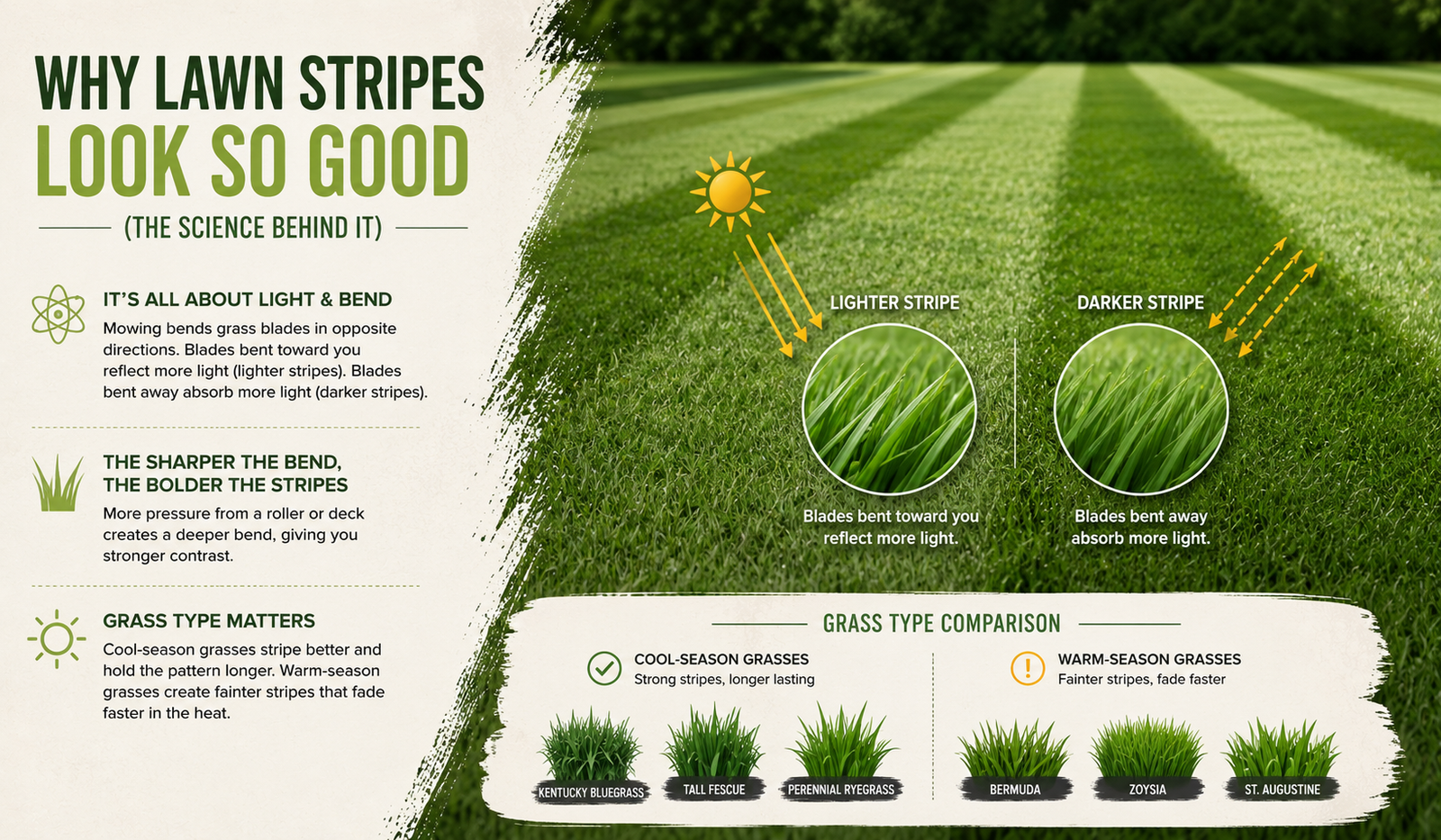
What You Need Before You Start
You don’t need a lot of equipment to start striping. You need the right setup – and that includes your mower, your kit (or lack of one), and the condition of your lawn.
Mower Type – Does It Have to Be a Reel Mower?
No. A standard rotary mower works fine.
Reel mowers – the kind used on golf course greens – cut at very low heights and create precise, even stripes. But you don’t need one for a residential lawn. Most homeowners get excellent results with a regular walk-behind or riding mower.
The one thing that helps is a rear roller. Some mowers come with one built in (many Honda and Husqvarna walk-behind models do). If yours doesn’t have one, you can add a striping kit or pull-behind roller.
Do You Need a Striping Kit?
For a small or medium yard, no. Honest answer.
If your mower has a rear discharge or a decent deck weight, you’ll get stripes without spending an extra $50–$150 on a kit. I’ve done plenty of clean striping jobs with nothing but a standard push mower and a straight line.
Where a striping kit earns its money is on large lawns where you want high-contrast, long-lasting stripes – or when you’re working on thin grass that needs extra help bending. For a 5,000-square-foot suburban lawn, skip the kit and save the money.
Lawn Condition: Mowing Height, Moisture, and Grass Health
This matters more than any kit you buy.
Mow at the right height for your grass type. Cool-season grasses should be cut at 3–4 inches. Warm-season grasses do better at 1.5–2.5 inches. Cutting too short – especially under 2.5 inches on fescue or bluegrass – removes the blade length you need to create visible stripes.
Slight moisture helps. Mowing in the early morning, when there’s still some dew on the blades, gives you better bend and better stripe visibility. Mowing a dry, stressed lawn in the afternoon heat gives you almost nothing.
Thin, patchy, or drought-stressed grass won’t stripe well no matter what you do. Fix the lawn first.
Comparison Table: Striping Kit vs. No Striping Kit vs. Roller Attachment
| Option | Best For | Stripe Contrast | Cost | Extra Setup |
|---|---|---|---|---|
| No kit (stock mower) | Small lawns, beginners | Low to medium | $0 | None |
| Striping kit | Medium to large lawns | Medium to high | $50–$150 | 20 min install |
| Pull-behind roller | Large lawns, high contrast | High | $80–$200 | Separate pass needed |
How to Mow a Lawn in Stripes – Step by Step
Here’s the part most guides rush through. Each step below matters. Do them in order.
Step 1 – Pick Your Starting Line
Your reference point is everything. A bad starting line means every row after it is off.
Find a straight edge to follow: a fence, a sidewalk, a driveway. Mow your first pass directly alongside it. Don’t freehand the first stripe – use the hardest, straightest edge you have.
If your yard has no straight edges, use a string line. Stake it across the yard and follow it for your first pass. I’ve done this on oddly shaped lots in Minnesota where nothing was parallel to anything else. Takes five extra minutes. Saves you from mowing a diagonal lawn.
Pick a mowing direction that makes stripes visible from the street or your most-used outdoor space – a deck, patio, or driveway. Most people stand at the street and look in. Mow stripes that run toward them, not parallel.
Step 2 – Mow the Border First
Before any striping, mow a single perimeter pass around the entire yard.
This gives you room to turn at the end of each stripe without going off the lawn. It also means your turns stay off the striped area – which keeps the pattern clean.
Mow the border at the same height as your stripes. One pass around the outside is enough.
Step 3 – Make Your First Straight Pass
Start at one edge of the lawn – right up against the border you just cut.
Pick a fixed point at the far end of the yard and drive toward it. Don’t look at the mower deck. Look at the far point the whole time. This is the same technique used on sports fields – pick a landmark and walk to it. A tree, a corner post, a fence panel.
Keep your speed consistent. Speeding up or slowing down mid-stripe can affect the depth of the bend and create uneven contrast.
Step 4 – Turn and Overlap Correctly
At the end of each stripe, turn around in your border area and line up for the next pass going the opposite direction.
Overlap each pass by about 2–3 inches on the edge of the previous stripe. This covers any gap between rows and keeps lines tight.
On the return pass, you’re bending the grass in the opposite direction – which creates the contrast. Light stripe going one way, dark stripe coming back.
Don’t rush the turn. A wide, sloppy turn that digs into your striped area leaves marks. Take the turn wide in the border strip.
Step 5 – Finish and Clean the Edges
Once all stripes are done, go back and edge the perimeter.
Use a string trimmer or lawn edger along sidewalks, driveways, and beds. Crisp edges are what separate a good stripe job from a great one. The stripes can be perfect – but if the borders look ragged, the whole lawn looks sloppy.
Blow or rake any clippings off hard surfaces. Don’t leave them sitting on the lawn either – heavy clumps of clippings on top of your stripes will mat down the grass and ruin the effect.
Visual Reference Table: Common Mistakes at Each Step
| Step | Common Mistake | What It Looks Like | Fix |
|---|---|---|---|
| Step 1 | No reference line | Diagonal stripes | Use fence or string line |
| Step 2 | No border pass | Torn turf at turns | Always mow perimeter first |
| Step 3 | Looking at deck, not endpoint | Curved stripes | Eyes on far point only |
| Step 4 | Overlapping too much or too little | Gaps or double-dark rows | 2–3 inch overlap, consistent |
| Step 5 | Skipping edging | Messy border kills the look | Always finish with trimmer |
Stripe Patterns You Can Try (Beyond Basic Lines)
Once you can do a straight set of parallel stripes without thinking too hard, these patterns are worth trying. Each one is just a variation of the same bending principle.
Checkerboard Pattern
This is the classic baseball field look.
Mow parallel stripes in one direction across the whole lawn. Then mow the same pattern again at 90 degrees – perpendicular to the first set.
The result is a grid of alternating light and dark squares. It takes twice as long. It also looks twice as good.
Diagonal Stripes
Instead of striping parallel to your house or fence, angle your first line at 45 degrees.
The challenge is picking your reference line. I usually use a corner stake and measure the diagonal myself before starting. Once the first line is set, the rest follows the same overlapping technique as standard stripes.
Diagonal stripes look particularly good on square or rectangular lawns – they add visual movement that straight stripes don’t.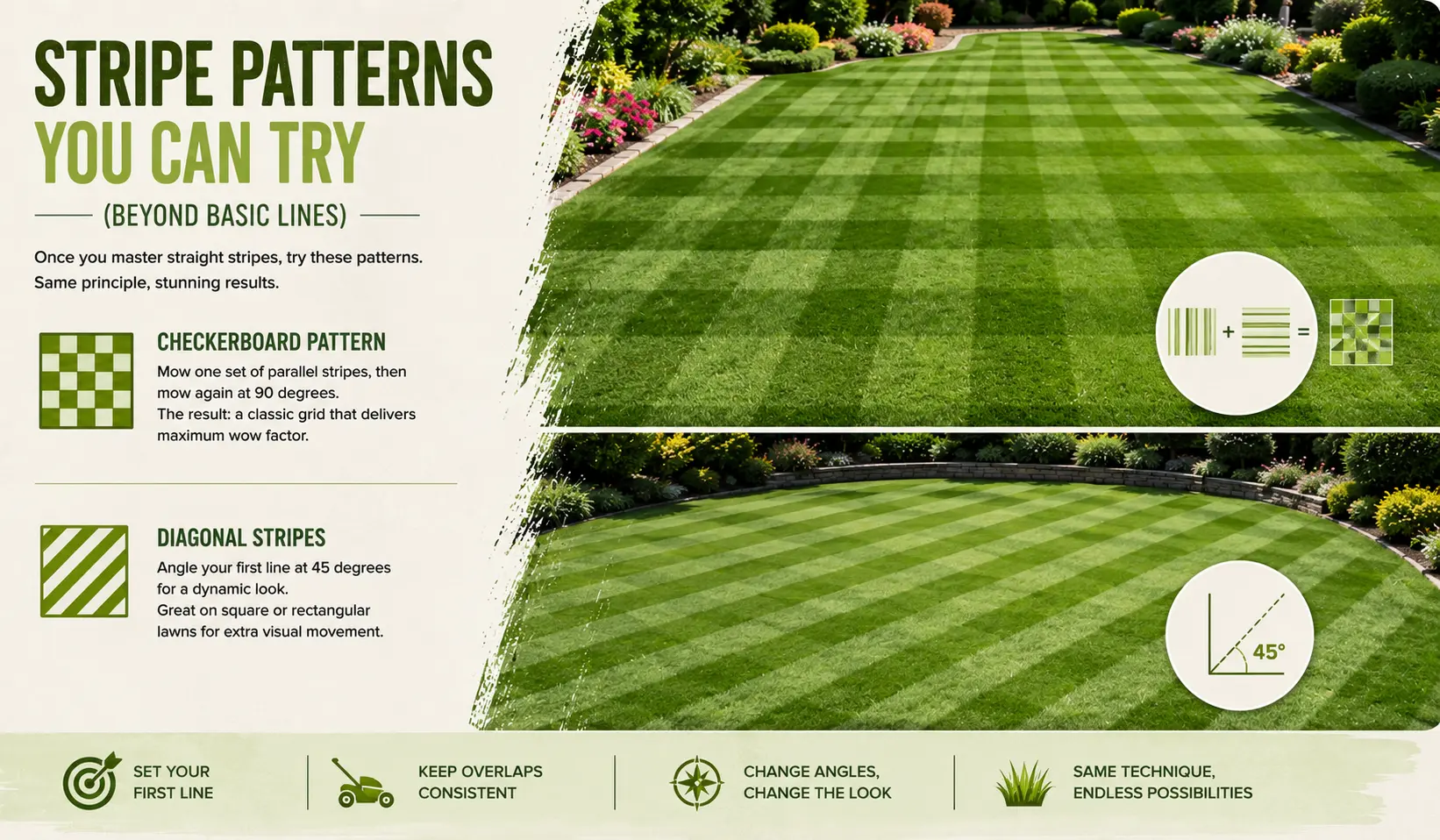
Diamond Pattern
This combines diagonal stripes in both directions – the same way a checkerboard combines perpendicular passes.
Mow your 45-degree stripes first, let the pattern set, then mow the opposite diagonal over the top. The result is a diamond grid.
This is harder to execute consistently and takes real practice. Don’t try it until your straight stripes are solid.
Circles and Curves
These are for advanced work – and I’ll be straight with you: they’re frustrating on a standard residential mower.
The concept is the same (bend grass in alternating directions), but the execution requires slow, deliberate turns and a lot of judgment. Works best on large open lawns with no obstacles. I’ve seen them done beautifully on golf course practice areas, but I wouldn’t recommend them as a weekend project for most homeowners.
Difficulty and Mower Requirement Table for Each Pattern
| Pattern | Difficulty | Mower Type Needed | Time vs. Standard Stripes |
|---|---|---|---|
| Parallel stripes | Easy | Any | 1x |
| Checkerboard | Medium | Any | 2x |
| Diagonal stripes | Medium | Any | 1.2x |
| Diamond | Hard | Any with good maneuverability | 2.2x |
| Circles/Curves | Very hard | Riding mower preferred | 2.5x+ |
How Professional Groundskeepers Do It Differently
There are a few habits that separate sports field crews from weekend mowers. Most of them are about preparation and consistency – not special equipment.
Stadium and Baseball Field Techniques
At the major league level, crews mow stripes using fixed reference points on the field itself – the foul lines, the warning track edge, the pitcher’s mound. Everything is measured off a grid.
They also mow at very precise heights, calibrated by species and season. A groundskeeper at a stadium doesn’t guess at blade height – it’s measured with a gauge before every mow.
What makes the patterns at places like Wrigley or Petco Park so sharp isn’t a magic machine. It’s the consistency of every single pass – same speed, same overlap, same height, every time.
Golf Course Fairway Methods
Golf course superintendents use triplex reel mowers with heavy rear rollers. They mow fairways at around 0.5–0.75 inches – far lower than any home lawn.
That low height, combined with multiple passes in opposite directions over the season, trains the grass to bend more easily over time. You can actually “condition” a lawn to stripe better just by mowing it consistently in the same alternating pattern every week.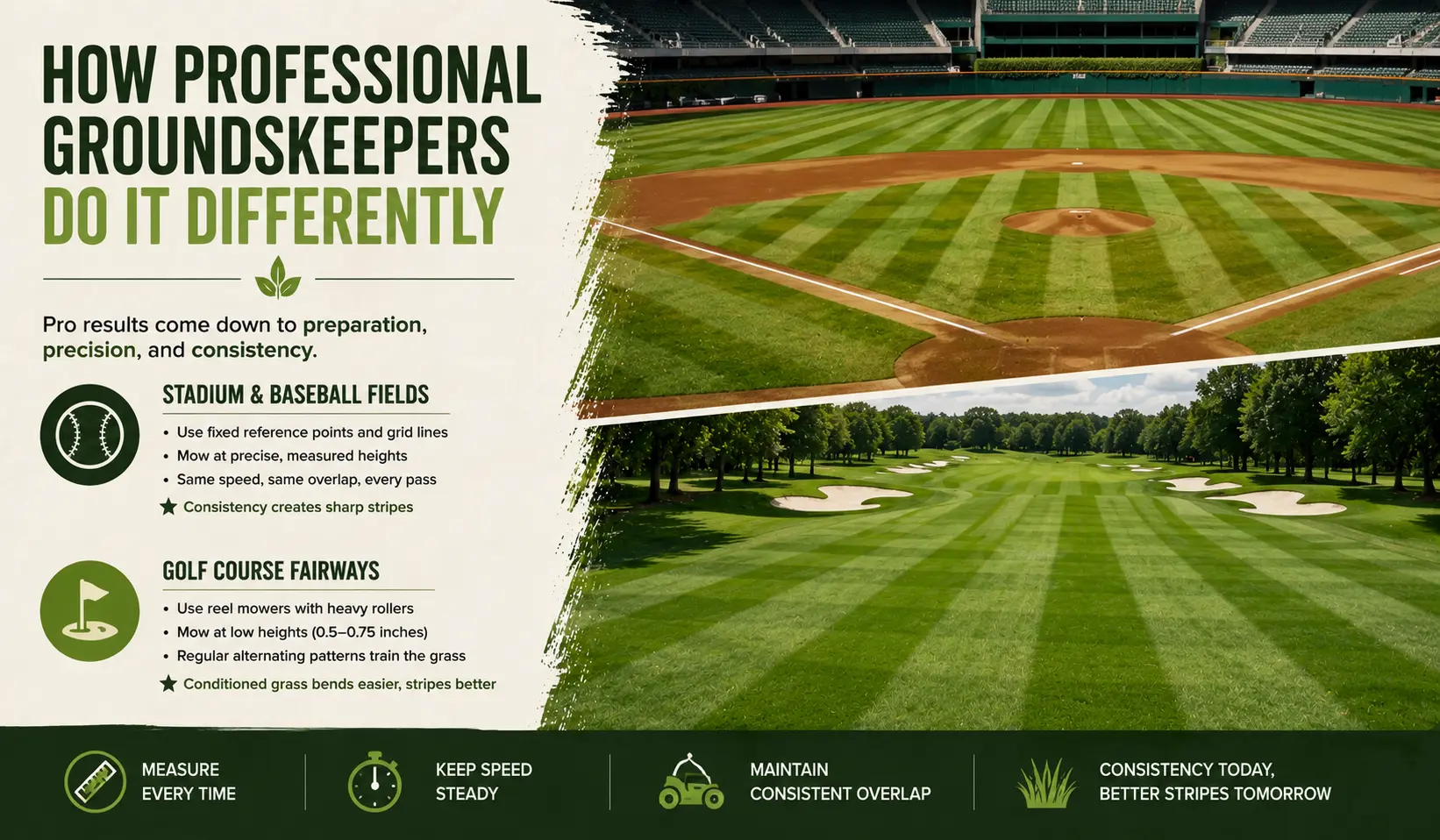
What Pros Do That Most Homeowners Skip
The two biggest things I see homeowners skip:
First, sharpening the blade. A dull blade tears grass instead of cutting it. Torn grass tips turn brown, the cut looks ragged, and the bend in the blade is uneven. Sharpen your blade at least once a season – more if you mow frequently or have a large yard.
Second, cleaning the deck. Built-up clippings under the deck affect airflow and cut quality. I clean mine after every mow during growing season. Takes two minutes.
How Different Grass Types and Climates Affect Your Stripes
Where you live changes what’s possible. Here’s a plain breakdown by region.
Cool-Season Grasses (Kentucky Bluegrass, Fescue – Midwest, Northeast)
These are the best striping grasses in the country – full stop.
Kentucky Bluegrass, in particular, has long, flexible blades that bend dramatically and hold the position for three to five days. A Minnesota lawn with healthy bluegrass and a good roller will look like an outfield for days after mowing.
Tall Fescue works nearly as well. Perennial Ryegrass is slightly less dramatic but still stripes well.
Mow these at 3–4 inches for best stripe visibility. Going lower sacrifices the blade length you need.
Warm-Season Grasses (Bermuda, St. Augustine – Florida, Texas, Southeast)
Bermuda grass can stripe, but the contrast is faint and fades within a day in hot, humid climates. St. Augustine is even harder – the blades are wide and stiffer, and they don’t hold a bend well.
If you’re mowing a Florida HOA lawn with St. Augustine, you can get a visible pattern right after mowing. By the next morning, it’s mostly gone.
My advice: don’t invest in an expensive striping kit for a Bermuda or St. Augustine lawn. It’s not worth the money.
Dry Climate Lawns (Arizona, Southwest)
Drought-stressed grass doesn’t stripe. A lawn that’s running dry is too rigid to bend and too patchy to show consistent contrast.
In dry climates, the best you can do is mow in consistent alternating directions each week. Over time, this creates faint directional patterns – but nothing like what you see in the Midwest.
If you’re irrigating well and have Buffalo grass or a cool-season variety, you can get decent results. But manage your expectations.
Climate and Grass Stripe Performance Table
| Region | Common Grass | Stripe Visibility | Duration After Mowing |
|---|---|---|---|
| Midwest, Northeast | Kentucky Bluegrass, Fescue | High | 3–5 days |
| Pacific Northwest | Ryegrass, Fescue blends | High | 2–4 days |
| Southeast, Florida | St. Augustine, Bermuda | Low | Less than 1 day |
| Texas, South | Bermuda, Zoysia | Low to medium | 1–2 days |
| Southwest | Bermuda, Buffalo grass | Very low | Hours |
Common Striping Mistakes and How to Fix Them
Most problems come down to three things. Here’s how to diagnose and fix each one.
Uneven Lines and How to Straighten Them
If your stripes are wavy or diagonal, the cause is almost always the starting line.
Go back to Step 1. Use a string line across the full length of the yard before your next mow. Stake it, mow your first pass alongside it, then remove the string and continue from there.
Also check your eye line. If you’re looking down at the mower deck instead of at a far point, you will drift. Every time.
Stripes That Disappear After a Day
Two likely causes: grass type or mowing height.
Warm-season grasses naturally lose their bend faster – there’s not much you can do beyond mowing more frequently in the same pattern.
If your grass should hold stripes but doesn’t, you may be cutting too short. More blade length means more surface area to catch light and show contrast. Try raising your cut height by half an inch and see what happens after the next mow.
A lawn roller used after mowing also extends stripe life – the extra downward pressure holds the bend longer.
Scalping the Lawn While Turning
Scalping happens when the mower deck drops into the lawn on a tight turn – taking a chunk out of the grass at the edge of a stripe.
The fix is simple: mow your border strip first (Step 2). This gives you flat, already-cut turf to turn on instead of uncut grass. Turn wide, stay in the border area, and let the deck float freely during the turn.
If scalping still happens, your deck height may not be set evenly side to side. Check both blade side skids and adjust until the deck is level.
My Final Thoughts
After 20 years of this, I still think striping is one of the most satisfying things you can do with a mower and an afternoon. It’s not complicated – but it does require patience on the first few tries.
If you have cool-season grass and a standard walk-behind mower, start with parallel stripes this weekend. Just use a straight edge, pick a far point, and keep your overlap consistent. You’ll see results on the first mow. They won’t be perfect. But they’ll be yours, and they’ll get better every time.
If you want sharper, longer-lasting stripes, add a roller attachment before you buy a dedicated striping kit. For most residential lawns, a basic pull-behind roller costs less, works on any mower, and gives you more flexibility than a fixed kit.
One honest note: if you have Bermuda or St. Augustine grass, don’t let anyone sell you on dramatic stripes. You can mow in consistent patterns and get faint contrast – and that still looks clean and intentional. That’s enough.
Quick Reference Table – Tools, Patterns, and Grass Types at a Glance
| Category | Option | Works Well For | Notes |
|---|---|---|---|
| Equipment | Standard mower | Small/medium lawns, beginners | No extra cost |
| Equipment | Roller attachment | Any lawn size | Best value upgrade |
| Equipment | Striping kit | Medium to large lawns | Install required |
| Pattern | Parallel stripes | All skill levels | Start here |
| Pattern | Checkerboard | Intermediate | Takes 2x the time |
| Pattern | Diagonal / Diamond | Intermediate to advanced | Need good reference line |
| Grass | Kentucky Bluegrass | Best stripe grass | 3–4 inch cut height |
| Grass | Tall Fescue | Excellent stripe candidate | 3–4 inch cut height |
| Grass | Bermuda | Low contrast possible | Fades fast in heat |
| Grass | St. Augustine | Poor stripe candidate | Wide blades resist bending |
| Climate | Midwest / Northeast | Best for striping | Cool, moist conditions |
| Climate | Southeast / Southwest | Difficult | Drought and heat reduce effect |
Frequently Asked Questions About Lawn Striping
What is the best way to mow a lawn in stripes for beginners?
Start with parallel stripes and a straight reference edge – a fence, sidewalk, or string line. Mow a perimeter pass first to give yourself turning room. Then mow your first stripe alongside the reference line, fix your eyes on a far point, and maintain a consistent overlap of 2–3 inches on each return pass. Don’t buy extra equipment until you’ve done a few mows by hand.
Do I need a striping kit to get visible stripes?
No. A striping kit adds contrast and helps stripes last longer, but it’s not required – especially on cool-season grasses like Kentucky Bluegrass or Fescue. If you want to upgrade, a pull-behind roller attachment is a better first investment than a fixed striping kit for most residential lawns.
How long do lawn stripes last after mowing?
On cool-season grasses in moderate climates (Midwest, Northeast), stripes typically last three to five days. On warm-season grasses in hot climates (Florida, Texas), stripes may fade within 24 hours or less. Mowing more frequently in the same alternating pattern each week can improve stripe visibility over time.
Why do my lawn stripes look curved instead of straight?
Curved stripes almost always mean you were looking at the mower deck instead of a fixed point at the far end of the yard. Pick a stationary landmark – a fence post, a corner of the house, a stake – and keep your eyes on it for the entire pass. Adjust your starting line using a straight fence or string if your reference edges are curved or irregular.
Can you stripe any type of grass?
You can stripe most grass types, but results vary a lot by species. Kentucky Bluegrass, Tall Fescue, and Perennial Ryegrass stripe best – they have long, flexible blades that hold a bend for days. Warm-season grasses like Bermuda, St. Augustine, and Zoysia have shorter, stiffer blades and produce much lower contrast that fades faster. Drought-stressed grass of any type will not stripe well until it’s healthy and well-watered.
What mowing height is best for lawn stripes?
For cool-season grasses, mow at 3–4 inches. More blade length means more surface area to bend and catch light – which means better contrast. For warm-season grasses, mow at the recommended height for the species (usually 1.5–2.5 inches) and don’t go lower, as scalping removes the blade length needed for any visible stripe effect.
What is the checkerboard lawn pattern and how do I do it?
A checkerboard pattern is created by mowing one full set of parallel stripes across the lawn, then mowing the same pattern again at 90 degrees over the top. The perpendicular passes bend the previously bent grass in two directions, creating alternating light and dark squares. It takes twice as long as standard stripes, requires the same technique for each pass, and works best on flat lawns with cool-season grass.