
Key Takeaways
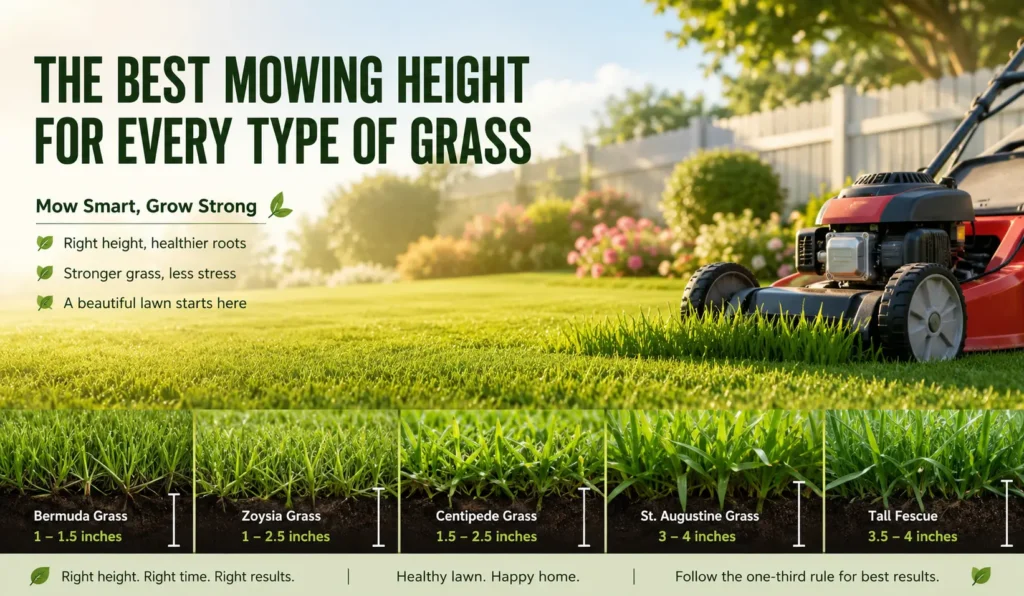
- The best mowing height depends entirely on your grass type – Bermuda stays healthy at 1-1.5 inches, St. Augustine needs 3-4 inches, and tall fescue does best at 3.5-4 inches
- Cutting more than one-third of the blade in a single mow causes stress that halts root growth for days to weeks (Purdue University Turfgrass Science, 2022)
- Raising your mowing height by 0.5-1 inch during summer is the single easiest way to reduce watering needs and prevent heat damage
- Most lawn problems blamed on watering or fertilizer trace back to mowing height errors
- Measure your actual cut height with a ruler on flat ground – deck position numbers are not accurate
I scalped my first St. Augustine lawn in central Florida the summer after I moved there from Minnesota. I set my mower to what worked perfectly on Kentucky bluegrass back home – about 2 inches – and mowed across the yard feeling pretty confident.
Two weeks later, half the lawn was brown, thin, and not recovering. My neighbor walked over and said, “You cut it too short.” She was right.
That one mistake cost me an entire growing season and about $300 in lawn treatments trying to get the grass back. The St. Augustine never fully filled in until the following spring.
That’s the thing about the best mowing height for every type of grass – it’s not a minor detail you can skip. It’s one of the biggest factors in whether your lawn stays thick and green or slowly falls apart. This guide covers every major grass type with the actual height ranges that work, the science behind why they work, and what happens when you ignore them. It’s written for homeowners who want a healthy lawn, not just a mowed one.
Why Mowing Height Matters More Than You Think
Mowing height directly controls how deep your grass roots grow and how well your lawn handles heat, drought, and foot traffic. Leave a taller blade and you get deeper roots. Deeper roots reach water and nutrients that shallow-rooted grass simply can’t access.
The One-Third Rule (and Why Breaking It Hurts Your Lawn)
Never cut off more than one-third of the grass blade in a single mow. If your target height is 3 inches, mow when the grass hits 4.5 inches – not when it reaches 6.
When you remove more than one-third, the grass plant goes into stress mode. It redirects all its energy from root growth to replacing the lost leaf tissue. Roots stop growing for days or even weeks. During that window, the lawn is far more vulnerable to drought, disease, and heat damage (Purdue University Turfgrass Science, 2022).
I saw this play out on a Georgia zoysia lawn I managed. The client wanted to mow every two weeks. One spring he pushed it to three weeks before calling me. The zoysia had hit 6 inches. We had to cut it back hard to 1.5 inches. The lawn looked rough for a full month afterward.
The rule isn’t fussy. It’s just about keeping roots alive.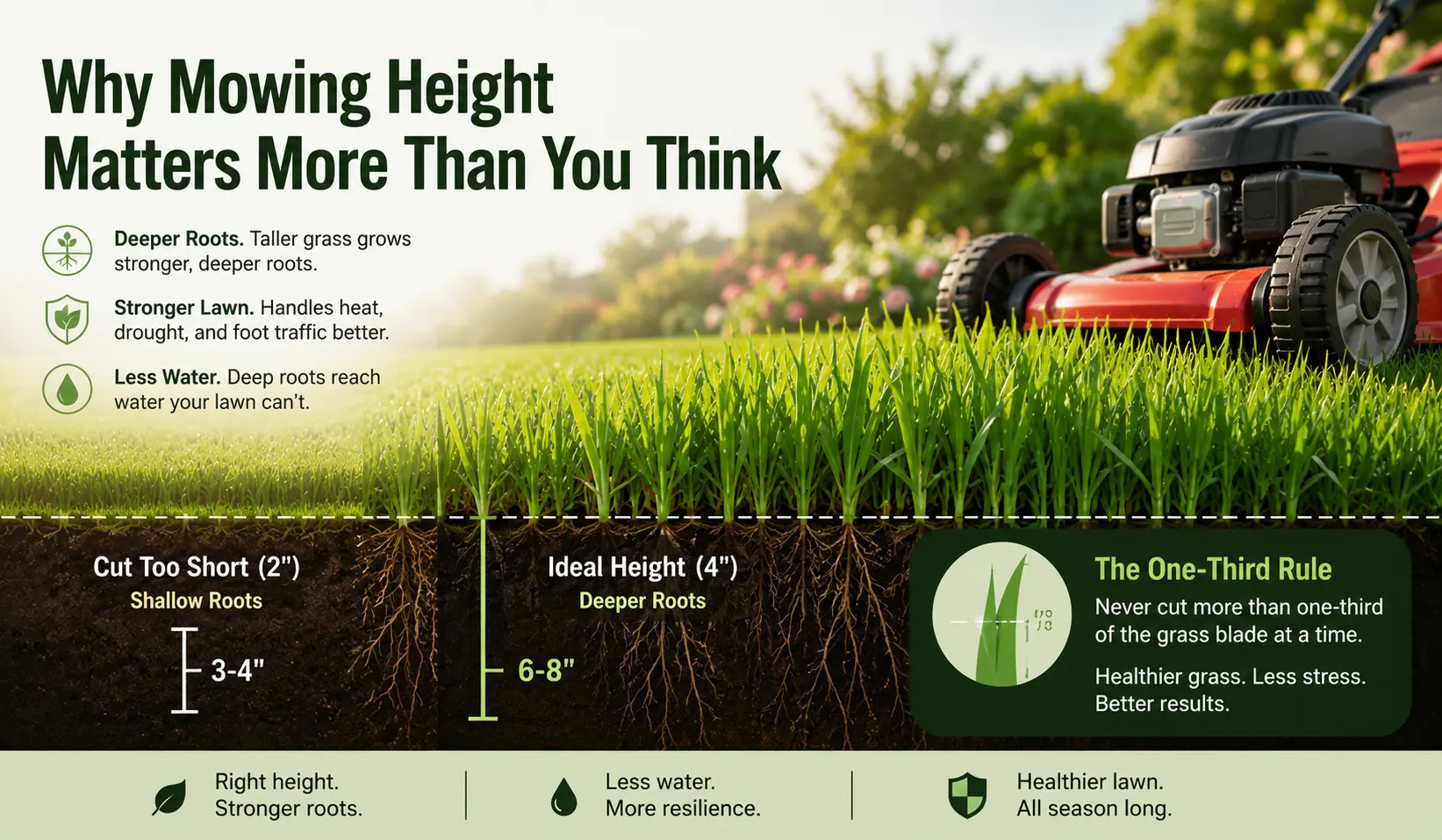
How Cutting Height Affects Root Depth and Drought Resistance
Grass roots tend to grow as deep as the leaf blade is tall. Cut your tall fescue to 2 inches and the roots stay shallow – maybe 3-4 inches down. Keep it at 4 inches and those roots push 6-8 inches into the soil.
That depth is what keeps lawns alive in summer.
A Minnesota fescue lawn kept at 4 inches during July can go 10-12 days between waterings. That same lawn cut at 2 inches may need water every 4-5 days just to survive (University of Minnesota Extension, 2023). The connection is direct: blade height controls root depth, and root depth controls drought resistance.
Warm-Season Grasses: Ideal Mowing Heights
Warm-season grasses grow actively from late spring through early fall and go dormant in winter. They generally prefer lower mowing heights than cool-season grasses, but the right range varies more than most people expect.
Bermuda Grass
Mow Bermuda grass between 1 and 1.5 inches for a home lawn. Golf courses push it to 0.5 inches or lower, but that requires reel mowers, daily monitoring, and high-input management most homeowners don’t need.
I managed a Bermuda lawn in Scottsdale, Arizona for three summers. At 1.5 inches, it stayed dense and bounced back fast from heavy foot traffic. One summer I tried 2 inches. Within six weeks, the lawn started to thin. Bermuda at higher heights develops a thick thatch layer that blocks water and fertilizer from reaching the soil.
During peak summer growth, Bermuda needs mowing every 5-7 days. It grows fast in Arizona heat.
St. Augustine Grass
St. Augustine does best at 3 to 4 inches – taller than most people expect. This thick-bladed grass needs that height to shade the soil and protect the stolons (the above-ground runners) from Florida’s summer sun.
Cut St. Augustine below 2.5 inches and you expose those stolons to heat stress. The lawn thins and weeds move in fast. I watched it happen on a Tampa lawn where the new owner kept mowing at 2 inches trying to make it look “neat.” By August, it was more weeds than grass.
For floratam St. Augustine – the most common variety along the Gulf Coast – 3.5 inches is the sweet spot (University of Florida IFAS, 2023).
Zoysia Grass
Zoysia works best at 1 to 2.5 inches, depending on variety. Fine-textured types like Zeon or Emerald can go as low as 0.5-1 inch. Coarser varieties like Meyer or Zenith hold up better at 1.5-2.5 inches.
I genuinely enjoy managing zoysia. It’s dense, wear-tolerant, and has a satisfying firmness underfoot when it’s healthy and cut right. I kept a Meyer zoysia in Savannah, Georgia at 2 inches through the whole summer. Best-looking yard on the block with almost no irrigation beyond natural rainfall.
One thing to avoid: don’t scalp it in spring to clean up winter’s dead top-growth. Remove no more than half an inch at the first mow of the season.
Centipede Grass
Centipede grass belongs between 1.5 and 2.5 inches. It’s a slow-growing, low-maintenance grass that doesn’t handle stress well. Cut it too short and recovery can take the entire season.
It’s also sensitive to over-fertilizing. If your centipede lawn looks thin, don’t assume it needs more nutrients. It often just needs the right height and some time.
Bahiagrass
Bahia should stay at 3 to 4 inches. It has a coarse texture, a deep root system, and it performs best when left on the taller side. It’s common on Florida roadsides and low-input lawns precisely because it tolerates drought well at proper height.
Comparison Table for Warm-Season Grasses
| Grass Type | Ideal Height Range | Mowing Frequency (Summer) | Worth Knowing |
|---|---|---|---|
| Bermuda | 1-1.5 in | Every 5-7 days | Thins above 2 in |
| St. Augustine | 3-4 in | Every 7-10 days | Never below 2.5 in |
| Zoysia | 1-2.5 in | Every 7-14 days | Variety-dependent |
| Centipede | 1.5-2.5 in | Every 10-14 days | Slow to recover from stress |
| Bahiagrass | 3-4 in | Every 7-14 days | Deep roots, drought tolerant |
Cool-Season Grasses: Ideal Mowing Heights
Cool-season grasses grow actively in spring and fall and slow down significantly in summer heat. As a rule, they need higher mowing heights than warm-season grasses – and that height becomes even more important as temperatures climb.
Kentucky Bluegrass
Keep Kentucky bluegrass between 2.5 and 3.5 inches. During summer in Minnesota, Wisconsin, or Michigan, push it to the top of that range – 3 to 3.5 inches. The extra blade length shades the soil, holds moisture longer, and protects the root zone through the worst of summer.
I had a bluegrass lawn in Edina, Minnesota for four years. Summers there hit 95°F with stretches of no rain. Neighbors cutting at 2 inches were watering every three days and still dealing with brown patches. At 3.5 inches, I watered once a week and the lawn stayed mostly green through July.
Tall Fescue
Tall fescue does best at 3.5 to 4 inches. It’s a deep-rooting grass – those roots can push 2-3 feet down when conditions are right – and it needs blade height to support that root depth.
Don’t cut tall fescue below 3 inches. I’ve seen lawns scalped to 2 inches in early summer during a misguided “cleanup,” and the results are predictable: yellowed tips, thinning density, and disease problems by August (Penn State Extension, 2022).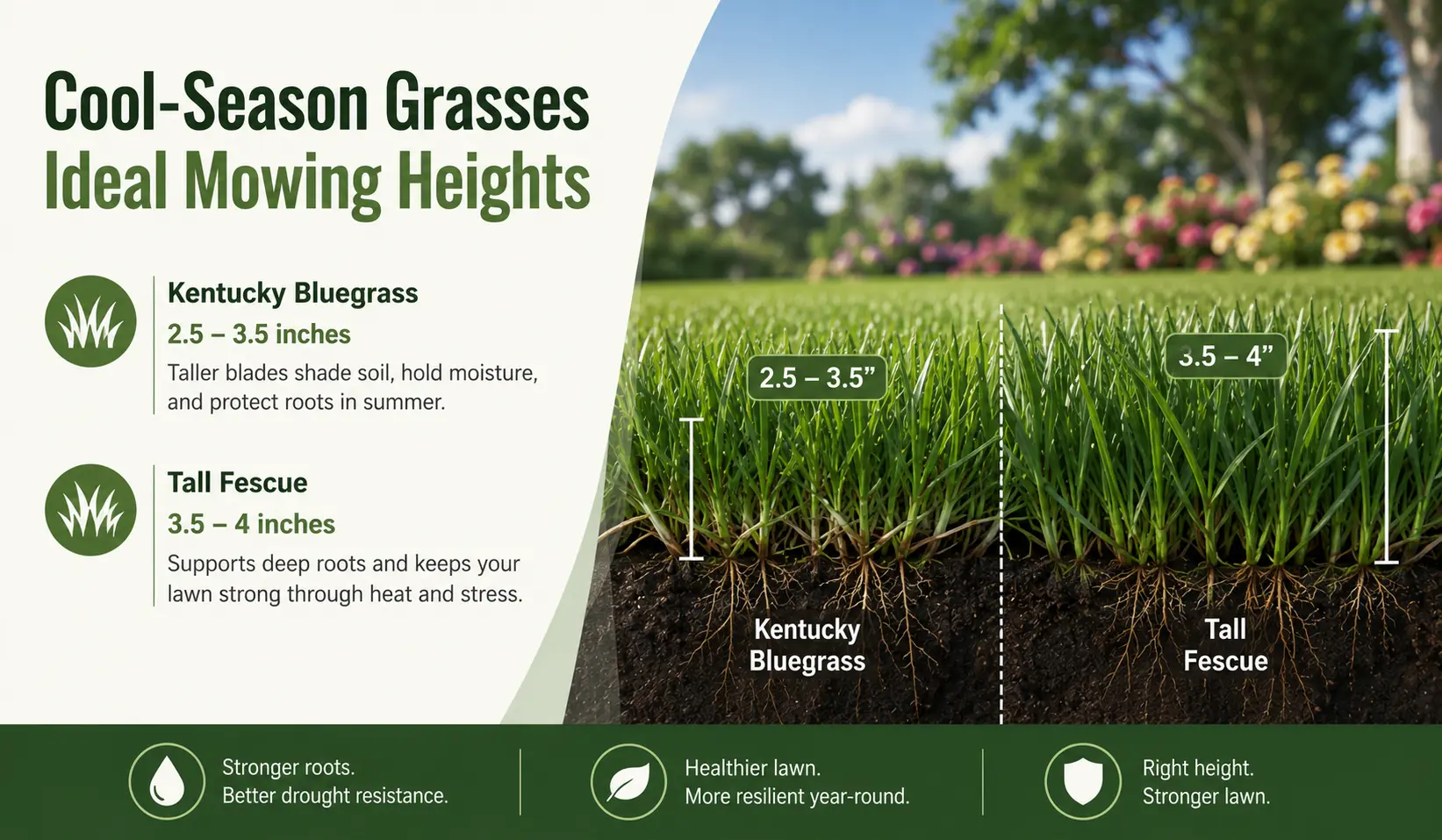
Fine Fescue
Fine fescues – creeping red, chewings, hard fescue – grow well at 2.5 to 3.5 inches. They’re used in shade mixes and low-maintenance lawns across the northern US and tolerate drought and low fertility better than most cool-season grasses when kept at the right height.
Perennial Ryegrass
Perennial ryegrass works at 2 to 3 inches. It germinates fast and is a common component in overseeding mixes across the transition zone – Kansas, Missouri, Tennessee – where neither warm- nor cool-season grass clearly dominates.
Comparison Table for Cool-Season Grasses
| Grass Type | Ideal Height Range | Mowing Frequency (Spring/Fall) | Summer Adjustment |
|---|---|---|---|
| Kentucky Bluegrass | 2.5-3.5 in | Every 5-7 days | Raise to 3-3.5 in |
| Tall Fescue | 3.5-4 in | Every 7-10 days | Stay at 4 in |
| Fine Fescue | 2.5-3.5 in | Every 10-14 days | Raise to top of range |
| Perennial Ryegrass | 2-3 in | Every 5-7 days | Raise to 3 in |
How Climate and Season Change the Right Height
The ideal height for your grass type is a starting point – not a fixed number you set once and forget. Season and regional climate should push that number up or down throughout the year.
Summer Stress – Raise the Blade
In summer heat, raise your mowing height by 0.5 to 1 inch above your normal setting. Every grass type benefits from this. The extra leaf surface reduces soil temperature, holds soil moisture longer, and cuts down on water loss through evaporation (Clemson Cooperative Extension, 2023).
This is the most impactful seasonal adjustment you can make. After I started doing this consistently on the Arizona Bermuda lawns I managed, I saw immediate reductions in irrigation needs through July and August. The grass looked better and cost less to maintain.
Spring Green-Up – Start Low, Then Adjust
In spring, drop your mowing height by about half an inch for the first one or two mows. This removes dead or discolored top-growth and encourages fresh lateral growth.
After those first two mows, bring the height back up to your normal target. Don’t stay low through spring. The soil is still cold and root systems are recovering from winter. Staying at a low cut during root recovery slows the whole spring green-up process.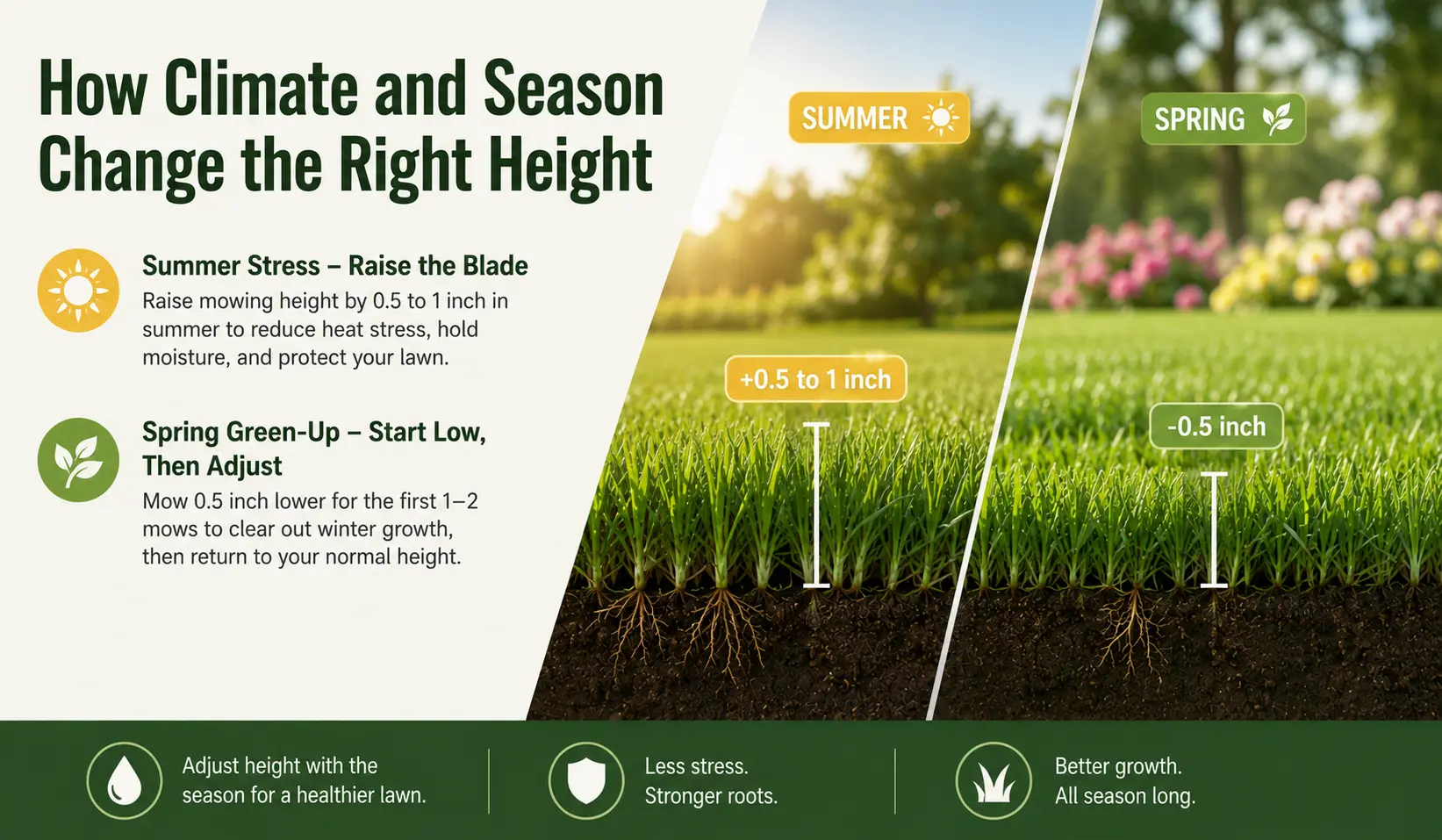
Fall Mowing Before Winter Dormancy
For cool-season grasses, drop the height by about 0.5 inches for the last two or three mows of fall. Shorter grass going into winter means less snow mold risk and less matted dead grass to clear in spring (University of Wisconsin Extension, 2022).
For warm-season grasses, keep mowing at your regular summer height until the grass stops growing actively. There’s no need to scalp it before winter.
Comparison Table by Season and Region
| Season | Cool-Season Adjustment | Warm-Season Adjustment |
|---|---|---|
| Early spring | Lower 0.5 in for first 1-2 mows | Light cleanup only |
| Late spring and summer | Raise 0.5-1 in above normal | Raise 0.5 in above normal |
| Early fall | Return to normal height | Continue normal height |
| Late fall, pre-dormancy | Lower 0.5 in for last 2-3 mows | No change needed |
Common Mowing Height Mistakes and How to Fix Them
Most lawn problems I’ve diagnosed trace back to mowing errors, not soil chemistry or irrigation schedules. Here are the three I see most often.
Scalping – Cutting Too Short
Scalping means cutting so low that you remove most of the green leaf tissue and expose the brown thatch layer underneath. It shocks the grass plant, stops root growth, and opens the lawn to weeds and disease.
Recovery from scalping takes 3-6 weeks, depending on the grass type and time of year. In summer heat, recovery can take the whole season – or the grass may not fully fill back in until the following spring.
If you’ve scalped your lawn: stop mowing for 2-3 weeks, water consistently, hold off on fertilizer for at least three weeks, and let the grass rebuild its leaf tissue before you mow again.
Leaving It Too Long Before Mowing
Letting grass grow too tall before mowing is almost as damaging as cutting too short. When you finally cut back to the correct height, you’ll inevitably remove more than one-third of the blade in a single pass.
The result is a brown, stressed-looking lawn for about a week. That yellowed or brown appearance after a delayed mow is called “shock response” – the cut surface exposes the dry, colorless inner blade rather than the green outer tissue.
Mow on a schedule, not when the lawn looks like it needs it. For most lawns during active growing season, that means every 7-10 days.
Using the Same Height Year-Round
A lot of homeowners pick a deck setting in May and never touch it again. That one setting that’s fine in spring becomes too low in August and too high going into October.
Seasonal adjustments take two minutes. Raise the deck before summer, lower it slightly in fall. Your lawn will respond noticeably within two or three mowing cycles.
How to Set Your Mower to the Right Height
Most rotary mowers have height adjustments on each wheel. Getting to the right cut height takes a little calibration – the dial position does not reliably equal actual cut height.
Deck Height Settings Explained
Most residential rotary mowers label height positions from 1 through 5 or 1 through 7. These are relative settings, not inch measurements. Position 3 on one mower might cut at 2 inches. Position 3 on a different brand might cut at 2.75 inches.
Don’t trust the number on the dial. Measure it yourself.
Measuring Actual Cutting Height vs. Deck Position
To find your true cut height:
- Park the mower on a hard, flat surface – a concrete driveway works well
- Place a ruler from the ground to the bottom of the mowing deck
- That measurement is your actual cutting height
Do this once for every height position you plan to use, then write the numbers on a piece of tape stuck to the mower handle. It takes five minutes and removes all the guesswork.
One more thing: mower blades dull faster than most people realize. A sharp blade makes a clean cut. A dull blade tears the grass tips, leaving ragged white edges that turn brown within 24 hours. Sharpen or replace the blade at least once per mowing season – twice if you have a large lawn or mow frequently.
My Final Recommendation
After years of managing lawns from Florida to Minnesota, the most common mistake I see is cutting too low. People associate short grass with a well-kept lawn. They want that tight, manicured look. But most home lawns aren’t golf courses. They’re growing in normal soil, with normal irrigation, under real weather pressure.
If you take one thing from this article, raise your mowing height by half an inch from wherever it is right now. For most lawns, that single change improves root depth, reduces watering needs, and produces healthier-looking grass within two or three mowing cycles. It’s the lowest-effort, highest-return change you can make.
The second thing: mow on a consistent schedule. Every 7 days during peak growing season, every 10-14 days during slow periods. Mowing on a schedule prevents the “too long, then too short” cycle that causes most of the stress responses I see in lawns.
Your grass type sets the target height. Seasonal adjustments move you up or down around that target. Consistent timing keeps you from overshooting. That’s the whole system.
Quick Reference Table – Best Mowing Heights by Grass Type
| Grass Type | Category | Ideal Height | Summer Height | Worth Knowing |
|---|---|---|---|---|
| Bermuda | Warm-season | 1-1.5 in | 1.5 in | Thins above 2 in |
| St. Augustine | Warm-season | 3-4 in | 3.5-4 in | Never below 2.5 in |
| Zoysia | Warm-season | 1-2.5 in | 2-2.5 in | Varies by variety |
| Centipede | Warm-season | 1.5-2.5 in | 2-2.5 in | Slow recovery from stress |
| Bahiagrass | Warm-season | 3-4 in | 3.5-4 in | Deep roots, drought tolerant |
| Kentucky Bluegrass | Cool-season | 2.5-3.5 in | 3-3.5 in | Raise in summer heat |
| Tall Fescue | Cool-season | 3.5-4 in | 4 in | Never below 3 in |
| Fine Fescue | Cool-season | 2.5-3.5 in | 3-3.5 in | Shade-tolerant, low-input |
| Perennial Ryegrass | Cool-season | 2-3 in | 3 in | Common in overseeding mixes |
Frequently Asked Questions About Mowing Height
What is the best mowing height for grass in summer?
Raise your mowing height by 0.5 to 1 inch in summer compared to your spring setting. For cool-season grasses like tall fescue, that means 4 inches. For warm-season grasses like Bermuda, 1.5 inches. The extra blade length shades the soil, brings soil temperature down, and reduces water demand during heat stress.
How do I know if I’m cutting my grass too short?
Three signs: brown or yellow tips appearing within 24-48 hours of mowing, visible thatch or exposed soil surface after mowing, and grass that thins out over several weeks without an obvious cause. If your lawn consistently looks worse after mowing rather than better, the cut height is almost certainly the problem.
Does grass type really change how short I should mow?
Yes – significantly. St. Augustine should be mowed at 3-4 inches. Bermuda does best at 1-1.5 inches. Cutting St. Augustine to Bermuda’s height will damage it within one or two mowing cycles. Always check the recommended height for your specific grass type before adjusting the mower deck.
What is the one-third rule in lawn mowing?
The one-third rule means you should never remove more than one-third of the grass blade in a single mow. If your target height is 3 inches, mow when the grass reaches 4.5 inches, not when it’s at 6 inches. Removing more than one-third redirects the plant’s energy from root growth to replacing lost leaf tissue, which weakens the lawn over time.
How often should I sharpen my mower blade?
Sharpen your mower blade at least once per mowing season. If you mow more than half an acre or mow frequently, twice per season is better. A dull blade tears grass tips rather than cutting them cleanly, leaving ragged edges that dry out and turn brown within a day of mowing.
Can mowing height affect weeds in my lawn?
Yes. Taller grass shades the soil surface and prevents weed seeds from getting the light they need to germinate. Lawns mowed consistently at the upper end of the recommended height range tend to have noticeably fewer weed problems than lawns cut short. This is especially true with crabgrass in cool-season lawns (Rutgers University Cooperative Extension, 2023).
What happens if I mow wet grass?
Wet grass bends rather than cutting cleanly, which leads to an uneven mowing height across the lawn. Clippings clump together instead of dispersing, which can cause small dead patches where they pile up. It also puts extra strain on the mower motor and blade. If you have to mow damp grass, slow down and overlap passes slightly to even out the cut.