

Key Takeaways
- Most lawns need mowing once a week during peak growing season – but grass type, climate, and rainfall all change that number
- The one-third rule (never cut more than one-third of the blade at once) matters more than any fixed weekly schedule
- Warm-season grasses like Bermuda and Zoysia grow fastest in summer; cool-season grasses like Fescue and Kentucky Bluegrass peak in spring and fall
- Mowing too often keeps roots shallow; waiting too long forces you to cut too much blade at once
- Watch the grass, not the calendar
I came home from a 10-day trip to find my Tampa backyard had turned into something resembling a vacant lot. The St. Augustine grass was knee-high in patches. The mower labored through it in first gear. And in my rush to bring it back down fast, I scalped a six-foot section near the fence so badly the grass turned white.
Three weeks later, that section was still mostly brown.
That mistake – and a few others like it over the years – taught me more about how often you should mow your lawn than anything I’d read online. The problem with most mowing advice is that it gives you a single number. Once a week. Every five days. Twice a month. It sounds clean, but it ignores everything that actually controls grass growth: what type of grass you have, where you live, what season it is, and how much you water and fertilize.
This guide is for homeowners who are tired of conflicting answers and want an honest explanation based on real conditions – not a generic rule that breaks down the moment summer hits or you skip a week.
Why Mowing Frequency Actually Matters
Mowing isn’t just about appearances. How often you cut – and how much you cut – directly shapes whether your lawn stays healthy or slowly degrades over a season.
A lot of homeowners treat mowing like a simple maintenance task. It’s not. It’s one of the biggest stressors you put on your lawn, and done wrong, it adds up.
What Happens When You Mow Too Often
Mowing every two or three days feels disciplined. In practice, it puts the grass under constant stress.
Every cut is a small wound. The plant responds by shifting energy toward leaf recovery rather than root development. Roots stay shallow. The lawn becomes more dependent on regular watering and less able to handle dry stretches.
I watched this happen in a neighbor’s yard outside Chicago. He mowed every three days because he wanted that tight, manicured look. By July, his Kentucky Bluegrass was thin and pale. The roots were shallow enough that one two-week dry stretch turned the whole lawn brown. It didn’t recover well that fall.
Over-mowing also creates another problem: it selects for weedy grasses and crabgrass, which handle frequent cutting better than desirable turf grasses do.
What Happens When You Wait Too Long
Go too long between cuts and a different problem develops. Tall grass builds up a thick, woody stem section near the base. When you finally cut it, you have to remove far more than one-third of the blade to bring it back down.
That’s scalping. You cut through the green tissue and expose the pale stem below. That section can’t photosynthesize. The grass goes into shock. Brown patches appear, and recovery takes weeks – sometimes longer.
This is exactly what happened to my Tampa lawn after that vacation. The section I scalped hardest was near a fence where the grass grew fastest. It didn’t fully recover before fall set in.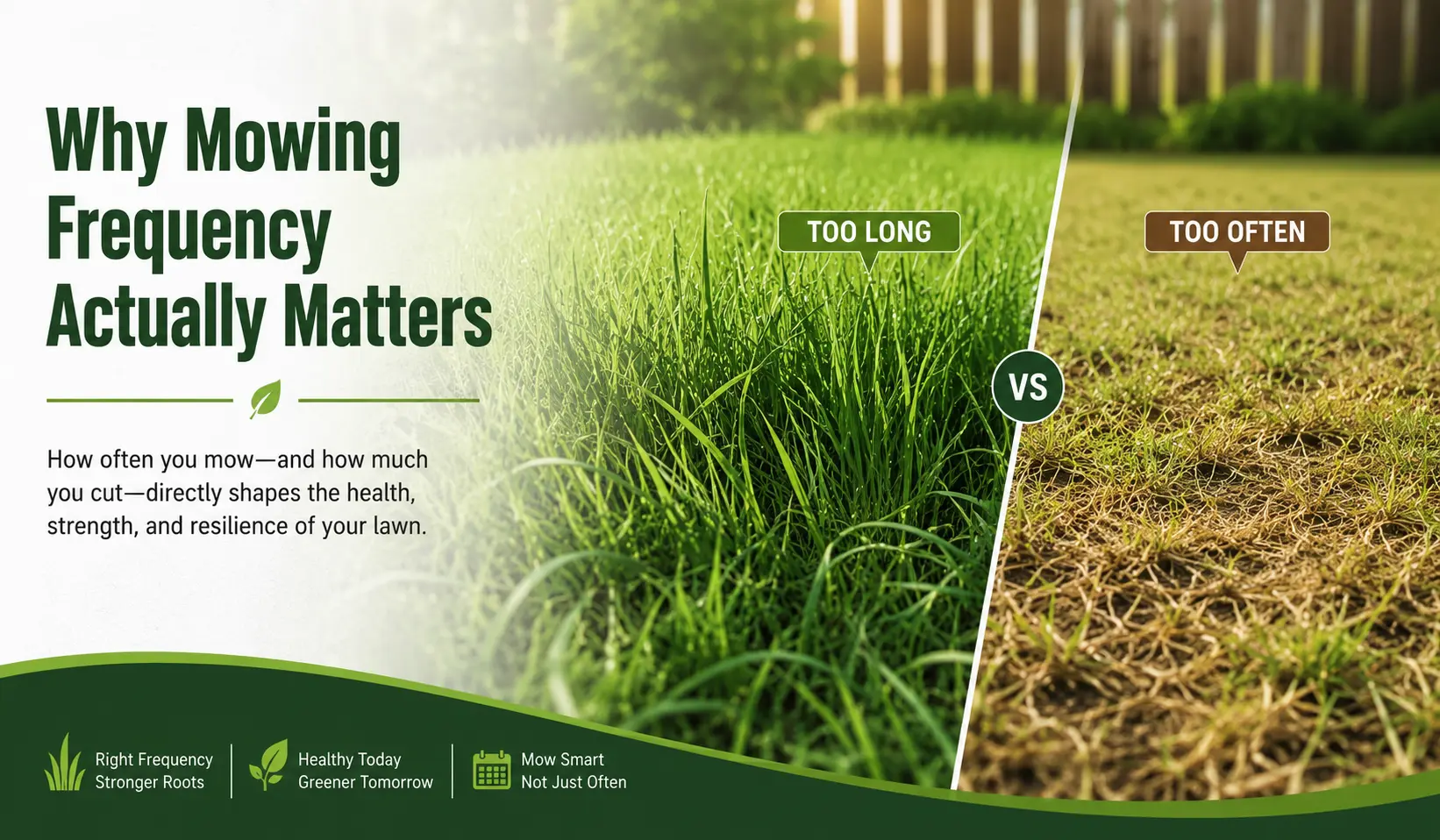
The Real Answer Depends on These Factors
There’s no single right answer. How often you should mow your lawn comes down to five variables, and they interact with each other.
Understanding them is more useful than memorizing a schedule.
Grass Type and Growth Rate
Warm-season grasses – Bermuda, Zoysia, St. Augustine, Centipede – grow fast in heat and humidity. During peak summer, Bermuda can put on an inch of growth in five to six days. That means mowing every five to seven days is often necessary.
Cool-season grasses – Kentucky Bluegrass, Tall Fescue, Fine Fescue, Perennial Ryegrass – grow hardest in spring and fall when temperatures stay between 60°F and 75°F. In summer heat, they slow down or go semi-dormant. Every seven to ten days is usually enough during those stretches.
Mixing up these two categories – or not knowing which one you have – is one of the most common reasons mowing schedules fail.
Season and Climate Zone
A Tampa lawn in July grows at a completely different pace than a Minneapolis lawn in July. Heat and humidity push warm-season grasses hard. Cool, wet springs drive cool-season grasses into their fastest period of the year.
Climate zone matters more than any calendar. In Phoenix, my Bermuda lawn barely needed attention from November through February. The same grass in June needed cutting every six days.
How Much You Fertilize and Water
More nitrogen means more growth. If you’re on an aggressive fertilization plan – three to four applications per year with high nitrogen counts – expect to mow more often. The grass will grow faster because you’re feeding it to grow faster.
The same logic applies to watering. A lawn on a daily irrigation schedule grows more than one that gets water twice a week. This is worth thinking about when you’re frustrated by how often you’re mowing. The fertilizer and irrigation schedule you’ve set is partly driving that frequency.
Your Lawn Goals (Lush vs. Low-Maintenance)
A dense, dark show lawn takes more work. You’re mowing at a lower height, more often, fertilizing on a tight schedule, and keeping blades sharp. It looks great. It takes real time.
A low-maintenance lawn – kept at a taller height, mowed less often, fertilized twice a year – is more forgiving. It handles drought and skipped mowing weeks better. It won’t win any neighborhood competitions, but it won’t turn brown every August either.
Neither goal is wrong. But commit to one before setting your schedule.
Mowing Frequency by Grass Type and Season
| Grass Type | Spring | Summer | Fall | Winter |
|---|---|---|---|---|
| Bermuda | Every 7 days | Every 5-6 days | Every 7-10 days | Minimal/none |
| Zoysia | Every 7-10 days | Every 7 days | Every 10-14 days | None |
| St. Augustine | Every 7 days | Every 5-7 days | Every 10-14 days | Minimal |
| Tall Fescue | Every 5-7 days | Every 10-14 days | Every 7 days | Minimal |
| Kentucky Bluegrass | Every 5-7 days | Every 10-14 days | Every 7-10 days | None |
| Perennial Ryegrass | Every 5-7 days | Every 10 days | Every 7 days | Minimal |
How Often I Mow in Different Climates (From Personal Experience)
I’ve maintained lawns in Florida, Arizona, and the Midwest. The schedules are completely different – and what worked in one place failed completely in another.
Mowing in Florida and the Southeast (Warm, Fast-Growing Grass)
Florida is relentless from April through October. St. Augustine and Bermuda lawns grow fast enough that a week without mowing is noticeable. Two weeks and you’re in trouble.
In my Tampa backyard, I was out every six days in summer. After a run of heavy afternoon rains, I’d move it to every five. The heat and humidity just don’t let up.
The tricky part: Florida’s summer afternoon rain pattern means the grass is often wet in the morning. I learned the hard way that mowing wet grass leaves clumps, tears blades, and creates an uneven cut. I started mowing mid-morning after the dew dried, before the afternoon storms. That one change made every cut cleaner.
The emotional reality of Florida mowing is that it’s never quite done. You finish on a Saturday, and by Thursday you can already see it needs another pass. That’s the deal you make with warm-season grass in a humid climate.
Mowing in the Southwest and Arizona (Dry Heat, Dormant Periods)
Phoenix is the opposite experience. Bermuda grass there grows well in spring and early summer. Then the extreme heat of August and September slows it down. It goes brown and dormant in winter.
When I lived in the Scottsdale area, I mowed every seven days from March through June. By July and August, with temperatures regularly above 110°F, growth slowed enough that every ten days was fine – and mowing itself felt like a punishment. I started going out at 6 a.m. to beat the heat.
From November through February, the Bermuda was fully dormant and brown. No mowing needed at all. That’s a real psychological break from the Florida pace.
Some Phoenix homeowners overseed with Perennial Ryegrass in fall to keep a green lawn through winter. If you do that, you’re mowing the Ryegrass every seven to ten days from October through March while the Bermuda sleeps underneath.
Mowing in the Midwest and North (Cool-Season Grasses, Short Windows)
Minnesota spring doesn’t arrive gradually. It arrives fast, and so does the grass growth. My Kentucky Bluegrass in the Twin Cities area would jump in April and May. I was mowing every five to six days in May just to keep up without violating the one-third rule.
Then summer heat hit and the pace dropped completely. Dry July stretches meant I could go ten to fourteen days without the lawn looking neglected. The grass wasn’t growing much because the heat wasn’t its ideal range.
Fall brought a second push. September and October in the Midwest are excellent growing months for cool-season grass. I’d be back to mowing every six to seven days as temperatures cooled down.
The Midwest mowing season is roughly April through October – but the pace is highly uneven. Spring and fall demand more attention than the summer calendar might lead you to expect.
Climate vs. Recommended Mowing Schedule
| Region | Peak Mowing Season | Peak Frequency | Slow Season | Slow Frequency |
|---|---|---|---|---|
| Southeast (FL, GA) | April-October | Every 5-7 days | November-March | Every 10-14 days |
| Southwest (AZ, NM) | March-June | Every 7 days | July-Aug, Nov-Feb | Every 10-14 days / none |
| Midwest (MN, OH, IL) | April-May, Sept-Oct | Every 5-7 days | June-August | Every 10-14 days |
| Mid-Atlantic / Northeast | April-June, Sept-Oct | Every 6-7 days | July-August | Every 10-14 days |
| Pacific Northwest | March-June | Every 7 days | July-September | Every 10-14 days |
The One-Third Rule – And Why I Ignored It (Until I Ruined My Lawn)
The one-third rule is the most useful single guideline in lawn care. I dismissed it as overly cautious for about two years. That decision cost me a full season of ugly brown patches.
What the One-Third Rule Actually Means
Never remove more than one-third of the grass blade in a single mowing session.
If your grass is 3 inches tall, don’t cut it below 2 inches. If it’s at 4.5 inches, stay above 3 inches. Simple math, significant consequences if you ignore it.
The reason: grass blades are where photosynthesis happens. Remove too much at once, and the plant can’t produce enough energy to recover. It shifts resources away from root growth, weakens, and becomes more vulnerable to heat, drought, and disease.
Most grass types perform best at these heights: St. Augustine at 3 to 4 inches, Bermuda at 1.5 to 2 inches, Tall Fescue at 3 to 3.5 inches, Kentucky Bluegrass at 2.5 to 3.5 inches. If your mower is set lower than these ranges, that’s the first thing to change.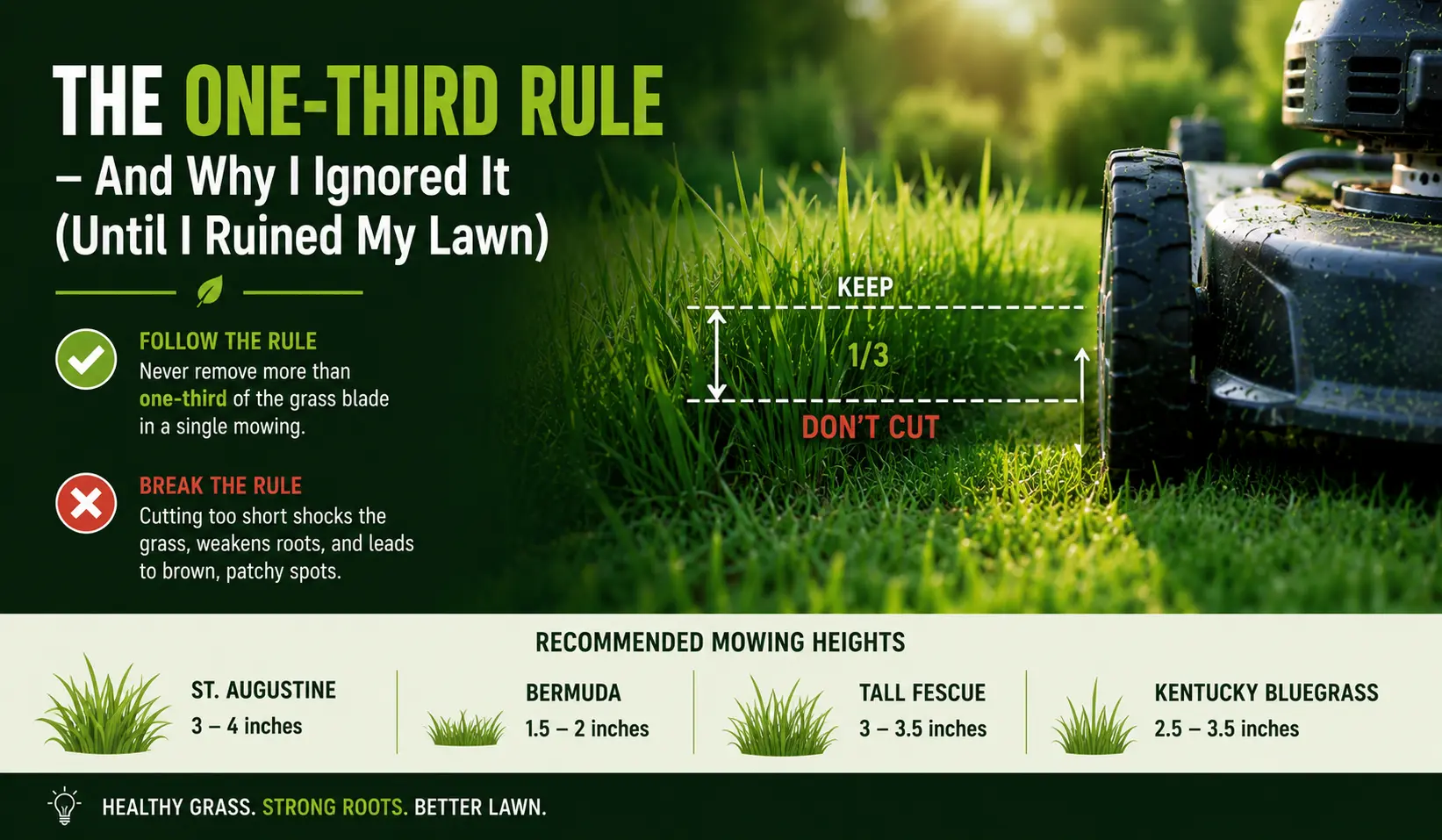
When It’s Okay to Break It
Sometimes the grass gets away from you. You’ve been away, it rained all week, the mower was in the shop. The grass is tall and you have to deal with it.
In that situation, don’t try to cut it all the way down in one pass. Set the mower at its highest setting and make one pass. Wait two to three days, then cut again. Bring it down gradually over two or three sessions, not in one aggressive cut.
This is exactly what I should have done after returning from that Tampa trip. Instead, I made one pass at normal height and scalped large sections. The gradual approach takes more time but keeps the lawn alive.
Signs You’ve Already Cut Too Much
Brown or yellowish patches that appear within a day or two of mowing – that’s scalping. You’ve cut through the green tissue and exposed the pale stem.
The lawn will likely recover, but it takes three to four weeks in most cases. Don’t fertilize a scalped lawn right away; it adds stress to already-damaged grass. Water it well, raise your mowing height, and give it time.
Seasonal Mowing Schedules That Actually Work
The right mowing schedule shifts through the year. A routine that makes sense in May won’t serve you well in August.
Spring – When to Start and How Often
Start mowing when the grass reaches one-third above your target height – not based on a date.
For most of the US, cool-season grasses wake up in mid-to-late April. Warm-season grasses in the South start growing in late April or May, depending on how far south you are. The first mow of the year should be at a slightly higher setting than your normal summer height. Let the roots re-establish before you push the grass.
Spring is when growth is fastest for cool-season grasses. You may need to mow every five to six days to stay within the one-third rule. That feels like a lot. It is a lot. It’s also just what cool-season grass demands in its peak season.
Summer – Adjusting for Heat and Drought
Raise your mowing height by half an inch in summer. Taller grass shades the soil, reduces water evaporation, and handles heat stress better. A Fescue lawn that you keep at 3 inches in spring can go to 3.5 inches from June through August.
If the lawn hits a drought stretch – no meaningful rain for two weeks or more – stop mowing until it rains. The grass has gone semi-dormant to protect itself. Forcing it to recover from a haircut on top of drought stress slows the whole recovery process.
One summer in Minnesota, I kept to my every-seven-day schedule out of habit through a dry July. The grass wasn’t growing much, so I wasn’t cutting much anyway – but the mower traffic and blade stress still set the lawn back. Looking at the actual grass instead of the calendar would have saved me three mowing sessions that month.
Fall – Slowing Down Without Stopping
Cool-season grasses come back strong in fall. Resume more frequent mowing in September – every six to seven days for Fescue, Bluegrass, or Ryegrass.
Warm-season grasses slow down as temperatures drop. Push the schedule to every ten to fourteen days for Bermuda, Zoysia, or St. Augustine as fall arrives.
Keep mowing until the first hard frost. Stopping too early lets the grass go into winter tall. Tall grass mats down under frost and snow and can develop fungal issues like snow mold.
The last mow of the year should bring cool-season grass to about 2 to 2.5 inches. That height goes into winter cleanly and comes back faster in spring.
Winter – Should You Mow at All?
For dormant warm-season grasses in the South and Southwest: no. The grass is brown and at rest. Leave it alone.
For cool-season grasses that stay green in mild winters – Pacific Northwest, mild mid-Atlantic areas – mow if the grass is actively growing above your target height. In parts of Oregon and Washington, that can mean cutting in December or January.
For overseeded warm-season lawns: treat the Ryegrass like a cool-season lawn. Mow when growth warrants it, typically every seven to ten days through winter.
Month-by-Month Mowing Guide by Region
| Month | Southeast | Southwest | Midwest/North |
|---|---|---|---|
| January | Every 14+ days | None | None |
| February | Every 14 days | None | None |
| March | Every 10-14 days | Every 7-10 days | None |
| April | Every 7 days | Every 7 days | Every 7-10 days (start) |
| May | Every 5-7 days | Every 7 days | Every 5-7 days (peak) |
| June | Every 5-7 days | Every 7 days | Every 7-10 days |
| July | Every 5-7 days | Every 10 days | Every 10-14 days |
| August | Every 6-7 days | Every 10-14 days | Every 10-14 days |
| September | Every 7-10 days | Every 7-10 days | Every 6-7 days |
| October | Every 10-14 days | Every 10-14 days | Every 7-10 days |
| November | Every 14 days | None | Finishing cuts only |
| December | Every 14+ days | None | None |
Common Mowing Mistakes and How to Fix Them
Most lawn problems can be traced back to one of three mowing habits. These are the ones I’ve seen most often – and made myself.
Mowing on a Fixed Schedule Instead of Watching the Grass
A set schedule feels organized. Mow every Saturday and move on with the weekend. The problem is that grass doesn’t grow on a human schedule.
In a wet May, waiting until Saturday may mean you’re cutting 40 to 50% of the blade in one pass – too much. In a dry July, you’re stressing grass that barely grew at all. Both situations work against the lawn.
The fix is simple but requires a small mental shift: before you get the mower out, look at the grass. Is it at or above one-third over your target height? Mow. If it’s not there yet, put the mower back and wait.
That one habit change eliminates most over-mowing and under-mowing problems without any other adjustment.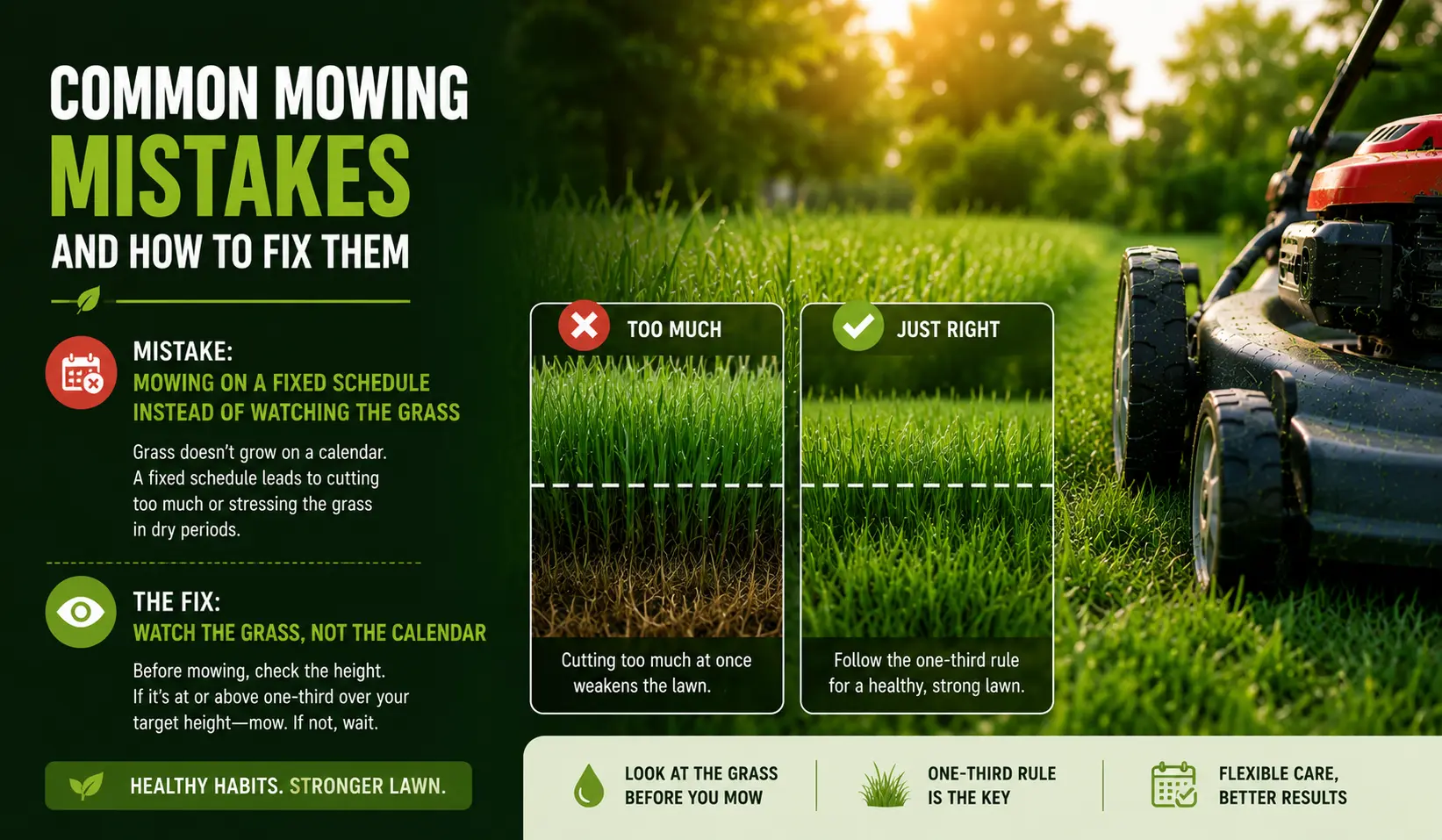
Cutting Wet Grass Because You’re Behind
Wet grass bends under the mower deck. Some blades get cut; others lie flat and avoid the blade entirely. You get an uneven cut, and the clippings come off in dense, wet clumps that sit on the lawn and block sunlight.
Those clumps can also promote fungal growth, especially in humid climates. In Florida, I had a small patch of brown circular spots appear after mowing wet grass three weeks in a row. It was dollar spot fungus, and it cost me two applications of fungicide to clear.
The fix: mow in the morning after dew has dried, or wait until afternoon after a morning rain. If you absolutely have to cut wet grass, raise the mowing height to reduce clumping, and go slower to give the deck more time to discharge clippings.
Mowing at the Wrong Height for Your Grass Type
Cutting Bermuda at 3.5 inches because it looks thicker is wrong. Cutting St. Augustine at 1.5 inches because you don’t want to mow as often is also wrong. Both choices weaken the lawn over a season.
Each grass type has an ideal height range for a reason. St. Augustine at 3 to 4 inches has enough leaf surface to handle Florida heat and shade. Bermuda at 1.5 to 2 inches stays dense and chokes out weeds. Fescue at 3 to 3.5 inches shades its own roots and reduces summer stress.
One more thing on this: keep your mower blades sharp. Dull blades tear grass instead of cutting it. Torn tips turn brown within a day or two and are more vulnerable to disease. You can see the difference – a lawn cut with a sharp blade looks clean; one cut with dull blades looks slightly hazy or tan at the tips. Sharpen at least once per season, twice if you mow frequently.
My Final Recommendation
After maintaining lawns in climates that couldn’t be more different – humid Florida summers, Phoenix heat, Minnesota cold snaps – the one piece of advice I’d give a friend is this: stop treating mowing as a chore on a fixed rotation. Start treating it as reading the yard.
Go outside. Look at the grass. Is it at one-third above your target height? Cut it. Not there yet? Leave it alone. That shift in thinking – watching the grass instead of the calendar – solves most mowing problems without any other change. It’s free. It takes thirty seconds. And it’s more accurate than any schedule.
The second thing I’d say: raise your mowing height by half an inch from wherever you have it now. Most homeowners in the US cut too short. Taller grass builds deeper roots, handles drought better, and gives crabgrass less of an opening. A 3-inch St. Augustine lawn looks full and healthy. A 1.5-inch St. Augustine lawn looks stressed by August.
And if you’ve already made a mistake – scalped a section, let it go too long, ignored wet grass for a month – give it time. Grass recovers. Water it, back off fertilizer for a few weeks, and raise the mowing height. A stressed lawn usually comes back within three to four weeks. The worst thing you can do is try to fix it too fast with more aggressive cuts. Patience does more for a lawn than almost any intervention I’ve tried.
Frequent vs. Less Frequent Mowing: Trade-Offs at a Glance
| Factor | Mowing More Often | Mowing Less Often |
|---|---|---|
| Lawn appearance | Neater, more uniform | Slightly rougher between cuts |
| Time investment | Higher | Lower |
| Grass health (if done correctly) | Good | Good |
| Risk of scalping | Lower | Higher if schedule slips |
| Drought resistance | Lower (shallower roots) | Higher (roots grow deeper) |
| Clipping size | Small, mulch easily | Larger, may need bagging |
| Schedule flexibility | Less | More |
| Best suited for | Show lawns, Bermuda, warm climates | Low-maintenance, cool-season grass |
Frequently Asked Questions About Lawn Mowing Frequency
How often should you mow your lawn in summer?
For warm-season grasses (Bermuda, Zoysia, St. Augustine), mow every five to seven days in peak summer. For cool-season grasses (Fescue, Kentucky Bluegrass), mow every ten to fourteen days in summer since heat slows their growth. Always use the one-third rule to decide – if the grass hasn’t grown enough to warrant cutting, skip the session.
What happens if I mow my lawn too short?
Cutting below the ideal height for your grass type removes too much leaf surface. The plant can’t photosynthesize enough to recover well, roots stay shallow, and the lawn becomes more vulnerable to drought and disease. This is called scalping. Brown patches appear within a day or two. Recovery typically takes three to four weeks.
Is it better to mow in the morning or evening?
Mowing in the mid-to-late morning is best for most situations – after dew has dried but before afternoon heat peaks. Evening mowing leaves cut surfaces exposed overnight in moist conditions, which can encourage fungal growth, especially in humid climates.
Should I leave grass clippings on the lawn?
Yes, in most cases. Grass clippings are about 80% water and break down quickly when mowed at the right frequency. They return nitrogen to the soil – roughly equivalent to one fertilizer application per year, according to the University of Minnesota Extension (2023). Only bag clippings if they’re too long and clumping on the surface.
How do I know when to start mowing in spring?
Start when the grass reaches one-third above your target mowing height – not on a calendar date. For most of the US, that’s mid-April for cool-season grasses and late April through May for warm-season grasses. The soil temperature should also be consistently above 55°F for cool-season grasses and above 65°F for warm-season varieties.
What is the best mowing height for Bermuda grass?
Bermuda grass performs best at 1.5 to 2 inches. At this height, it stays dense, chokes out most weeds, and maintains its characteristic tight appearance. Cutting Bermuda higher than 2.5 inches allows it to develop a thick thatch layer that weakens the turf over time.