

Quick Overview
- Mowing wet grass usually causes more damage than waiting a few hours – torn blades, compacted soil, and clumping are the most common problems.
- The risks depend on your grass type, mower, soil conditions, and how wet the ground actually is.
- Morning dew is not the same as post-storm saturation – they call for very different decisions.
- If you absolutely have to mow wet grass, raise your cutting height and slow down.
- Most lawns recover fine after one bad-timing mow. Repeated wet mowing is where the real damage happens.
The Short Answer (And Why It’s More Complicated Than You Think)
Technically, you can mow wet grass. You probably shouldn’t – but whether it’s a bad idea or a really bad idea depends on a few things you need to check first.
I’ve made this call hundreds of times across different climates. My Seattle backyard gets rained on for six months straight. My Louisiana clients were dealing with summer humidity so thick the grass was damp by 9 AM even without rain. And Ohio – Ohio will throw three days of thunderstorms at you right before your lawn hits five inches and needs cutting.
The short answer is: wait if you can. If you can’t, know what you’re risking.
What Actually Happens When You Mow Wet Grass
Wet grass blades bend instead of standing upright. Your mower blade hits them sideways, tears rather than cuts cleanly, and leaves jagged edges on every blade. Those torn edges turn yellow or brown within 24 hours – you’ll see it.
At the same time, your mower wheels are compressing wet soil with every pass. Wet soil compacts two to three times more easily than dry soil (University of Minnesota Extension, 2022). Compact soil blocks water and air from reaching roots. That’s a slow-burn problem you won’t see for weeks.
When It’s Okay – and When It’s Really Not
It’s generally fine if: there was only light dew or a brief drizzle, you have sandy or well-draining soil, and you’re using a sharp blade at a higher cut height.
It’s a real problem if: the ground is soft and your feet sink in when you walk across it, the grass is actively dripping, or you have clay-heavy soil. Clay holds water long after the surface looks dry – and clay compacts badly.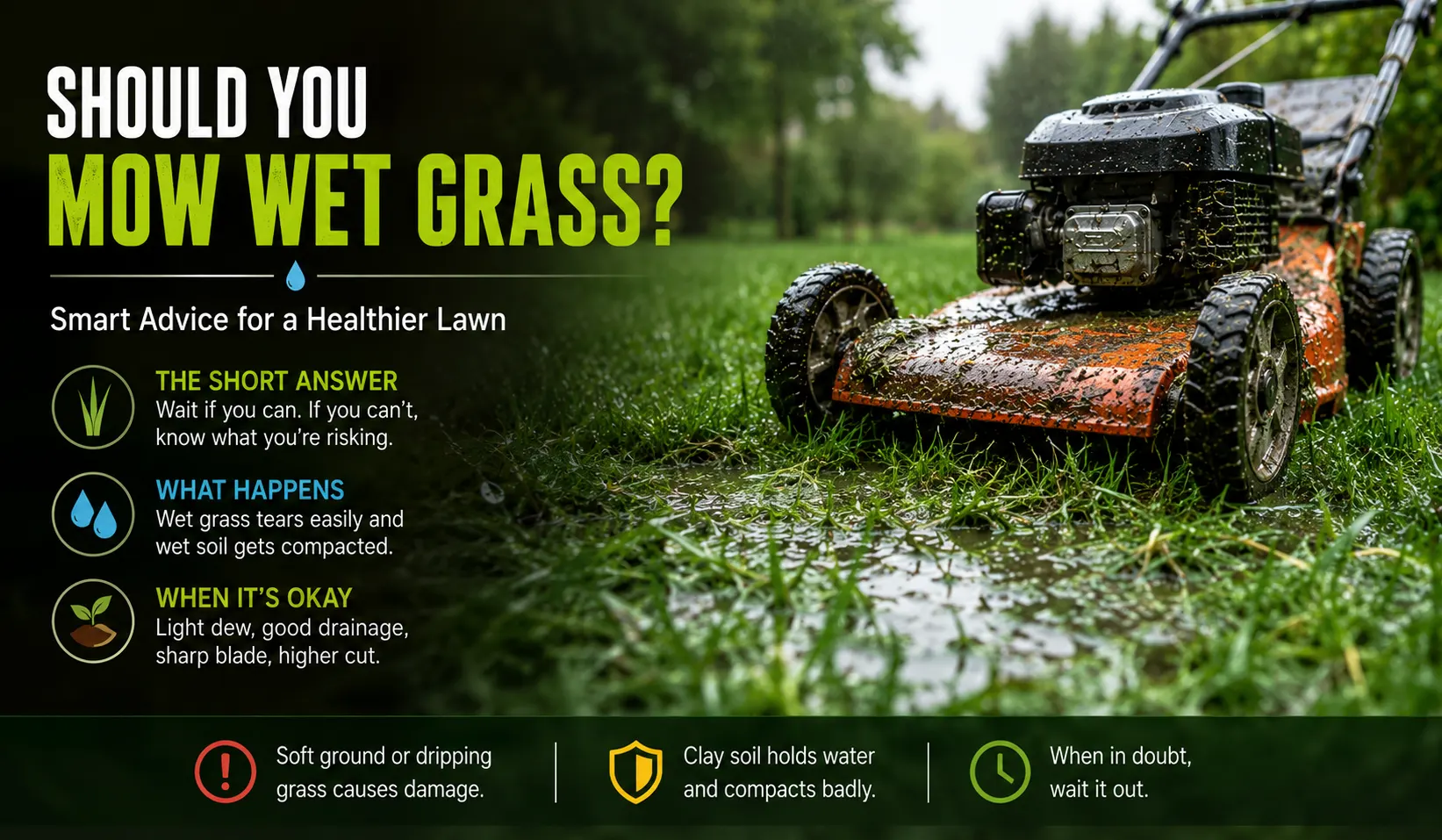
The Real Risks I’ve Seen Firsthand
I’ve seen all of these play out on actual lawns. Some were mine. Some were clients’. All of them were preventable.
Damage to Your Lawn (Clumping, Tearing, Ruts)
Wet clippings clump together immediately. Instead of dispersing evenly, they pile up in thick mats across the lawn. Those mats block sunlight and trap moisture underneath. Leave them more than a day and you’re looking at dead patches.
The ruts are worse. A riding mower on wet soil will leave visible wheel tracks in your lawn that take weeks to fill back in. I made that mistake on an Ohio property after a late-May storm – the client noticed before I finished the second pass.
Push mowers cause less rut damage, but they still tear and clump.
Danger to You and Your Mower
Wet grass is slippery. On any kind of slope, that matters. I always stop before slopes that look manageable when dry – they’re not manageable when wet. The mower can slide; you can slide following it.
Inside the mower, wet clippings pack tightly around the blade and under the deck. That strains the engine and can cause overheating. If you mow wet regularly, you’ll shorten your blade life and push your engine harder than it needs to work.
Fungal Disease and What It Looks Like Later
This is the one people miss until it’s too late. Mowing wet grass spreads fungal spores across your lawn. The mower picks up spores from one area and deposits them everywhere it travels.
Two to three weeks later, you start seeing brown circular patches, powdery residue on blades, or an orange-red discoloration in the morning light. That’s dollar spot, brown patch, or rust – all preventable fungal diseases (Turfgrass Science, Purdue University, 2021).
Warm, humid climates are highest risk. Louisiana and Florida lawns are essentially incubators for fungal disease in summer.
Risk Level by Grass Type and Moisture Level
| Grass Type | Light Dew | Post-Rain (1-2 hrs) | Saturated Ground |
|---|---|---|---|
| Bermuda (South) | Low | Moderate | High |
| Fescue (Midwest) | Low | Moderate-High | High |
| Ryegrass (Northwest) | Low-Moderate | High | Very High |
| Zoysia (South/Southeast) | Low | Low-Moderate | High |
| Kentucky Bluegrass (Midwest) | Low | Moderate | High |
Does It Matter What Kind of Mower You Use?
Yes – significantly. The same lawn in the same conditions will respond differently depending on what’s rolling across it.
The biggest factors are weight and wheel size. Heavier mowers compact soil more. Larger wheels distribute that weight better, but only to a point.
Gas Mowers vs. Battery-Powered in Wet Conditions
Gas mowers are generally heavier and more powerful – they’ll push through wet clippings without bogging down as easily. The downside is that more power means more torque on wet soil, which makes rutting worse.
Battery-powered mowers are lighter. That’s an advantage on wet lawns. They compact soil less, and many modern battery models have enough torque to handle wet grass without stalling. They’re not waterproof, though – never mow in active rain with an electric mower.
Riding Mowers and Soil Compaction
Riding mowers are the worst choice for wet conditions. A typical riding mower weighs 400 to 700 pounds (lbs), sometimes more with a full fuel tank. That weight on wet soil creates ruts and compaction that can damage root systems down six inches or more.
If you own a riding mower and your ground is soft, wait. Full stop.
Push Mowers on Slopes After Rain
A push mower on a slope after rain is the scenario I worry about most from a safety standpoint. The machine can slide downhill on wet grass. You can lose your footing on the wet slope.
Mow slopes only when the surface is dry enough to grip. If your shoe slides when you test-step the incline, put the mower away.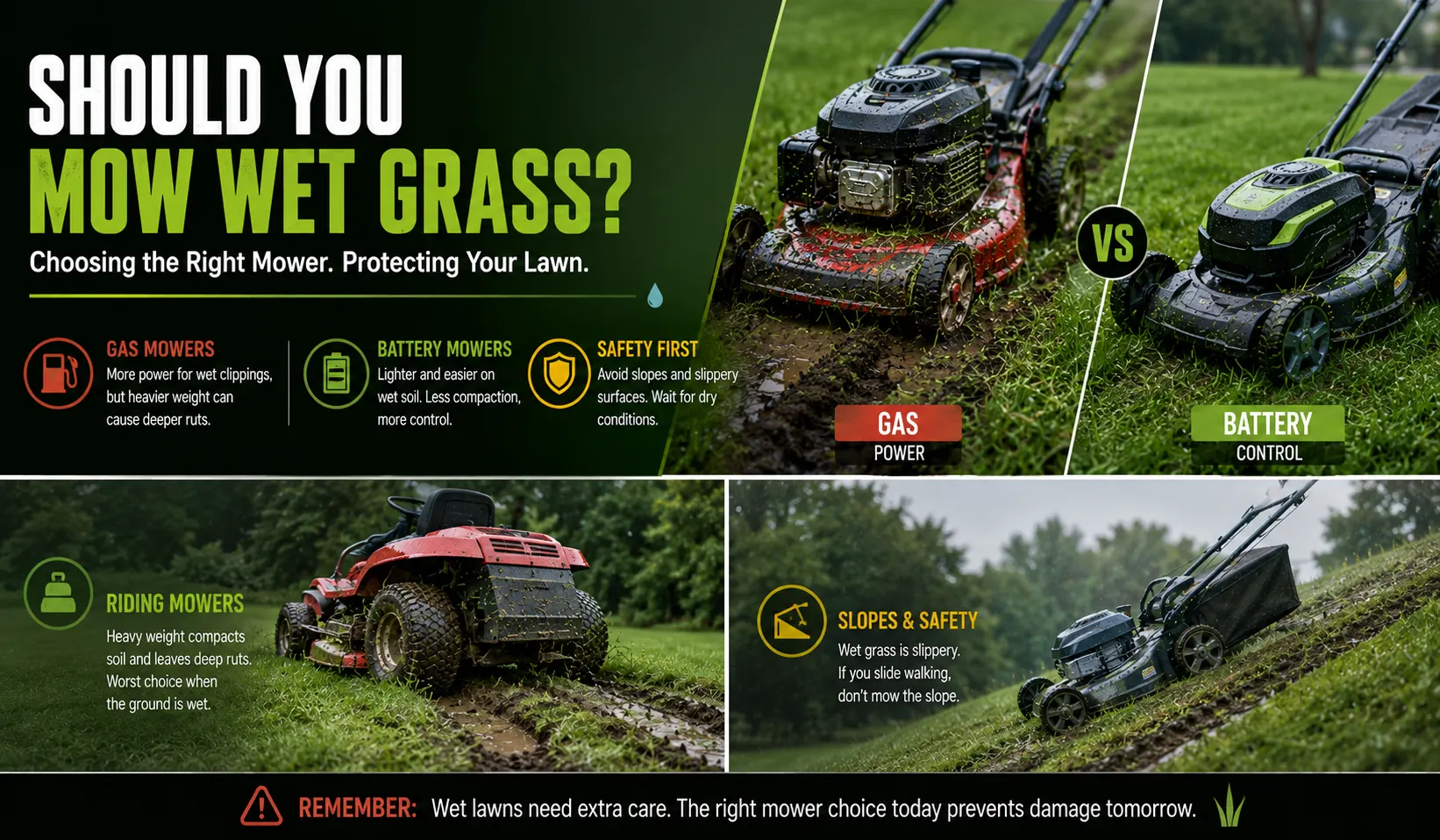
Mower Type vs. Wet Grass Performance
| Mower Type | Compaction Risk | Clumping | Rut Risk | Wet Safety |
|---|---|---|---|---|
| Lightweight push (battery) | Low | Moderate | Low | Moderate |
| Gas push mower | Low-Moderate | Moderate | Low-Moderate | Moderate |
| Self-propelled gas | Moderate | Moderate | Moderate | Moderate |
| Riding mower | High | High | Very High | Poor |
| Zero-turn riding | Very High | High | Very High | Poor |
How to Tell If Your Grass Is Too Wet to Mow
There’s no moisture meter you need for this. The signs are obvious once you know what to look for.
Most of the time, the answer is right under your feet.
The Simple Foot Test (and What It Tells You)
Walk across your lawn in a normal pace. Pay attention to two things: whether your shoes get soaked through, and whether you can feel the ground giving way slightly under each step.
If your shoes are soaking wet after a walk across – wait. If you feel the ground compressing underfoot, especially in softer areas – wait.
Dry enough to mow means: your shoes pick up some moisture but don’t get soaked, and the ground feels firm underfoot with no visible footprint impression left behind.
How Long to Wait After Rain
A general rule: wait at least two hours after light rain, and four to eight hours after heavy rain. After a full-day storm, wait until the next morning at minimum.
That said, soil drainage matters as much as elapsed time. Sandy soil drains fast – sometimes two hours is enough after moderate rain. Clay soil holds water for 12 to 24 hours after the same storm.
Morning Dew vs. Heavy Rain – Not the Same Thing
Morning dew is a thin film of moisture on the grass surface. It usually burns off within 30 to 60 minutes after sunrise. Mowing in heavy dew is less ideal than waiting an hour, but it’s not in the same category as mowing after an inch of rain.
The key difference is whether the soil itself is wet. Dew sits on the grass blades; it doesn’t saturate the ground. Rain does both. A lawn that looks wet from dew in the early morning may be totally fine to mow by 9 AM.
Wait Times by Rainfall Amount and Grass Type
| Rainfall | Sandy/Well-Drained Soil | Mixed Soil | Clay-Heavy Soil |
|---|---|---|---|
| Light dew | 30-60 min | 30-60 min | 60-90 min |
| Light rain (under 0.5″) | 1-2 hours | 2-3 hours | 4-6 hours |
| Moderate rain (0.5-1″) | 2-4 hours | 4-6 hours | 8-12 hours |
| Heavy rain (1″+) | 4-6 hours | 8-12 hours | 24 hours+ |
| Storm/sustained rain | Next morning | 24 hours | 24-48 hours |
If You Have to Mow Wet Grass, Do This
Sometimes waiting isn’t an option. The lawn is already nine days past its last mowing, your schedule has no openings, and there’s more rain in the forecast all week. That’s a real situation, not an excuse.
Here’s how to minimize the damage when you have to push through.
Raise Your Cutting Height
Go one to two settings higher than your normal cut. Wet grass bends instead of standing up straight, so your blade is already cutting lower than the height setting suggests. Raising the deck compensates for that and reduces stress on both the grass and the mower.
Never cut more than one-third of the blade height at once – this applies any time, but especially in wet conditions.
Slow Down and Make Narrower Passes
Cut your mower speed by half. Slower passes let the blade make cleaner contact with each blade of grass instead of tearing through wet clumps.
Overlap each pass by 25 to 30 percent instead of your normal overlap. That way any clumps from the previous pass get a second chance at dispersal.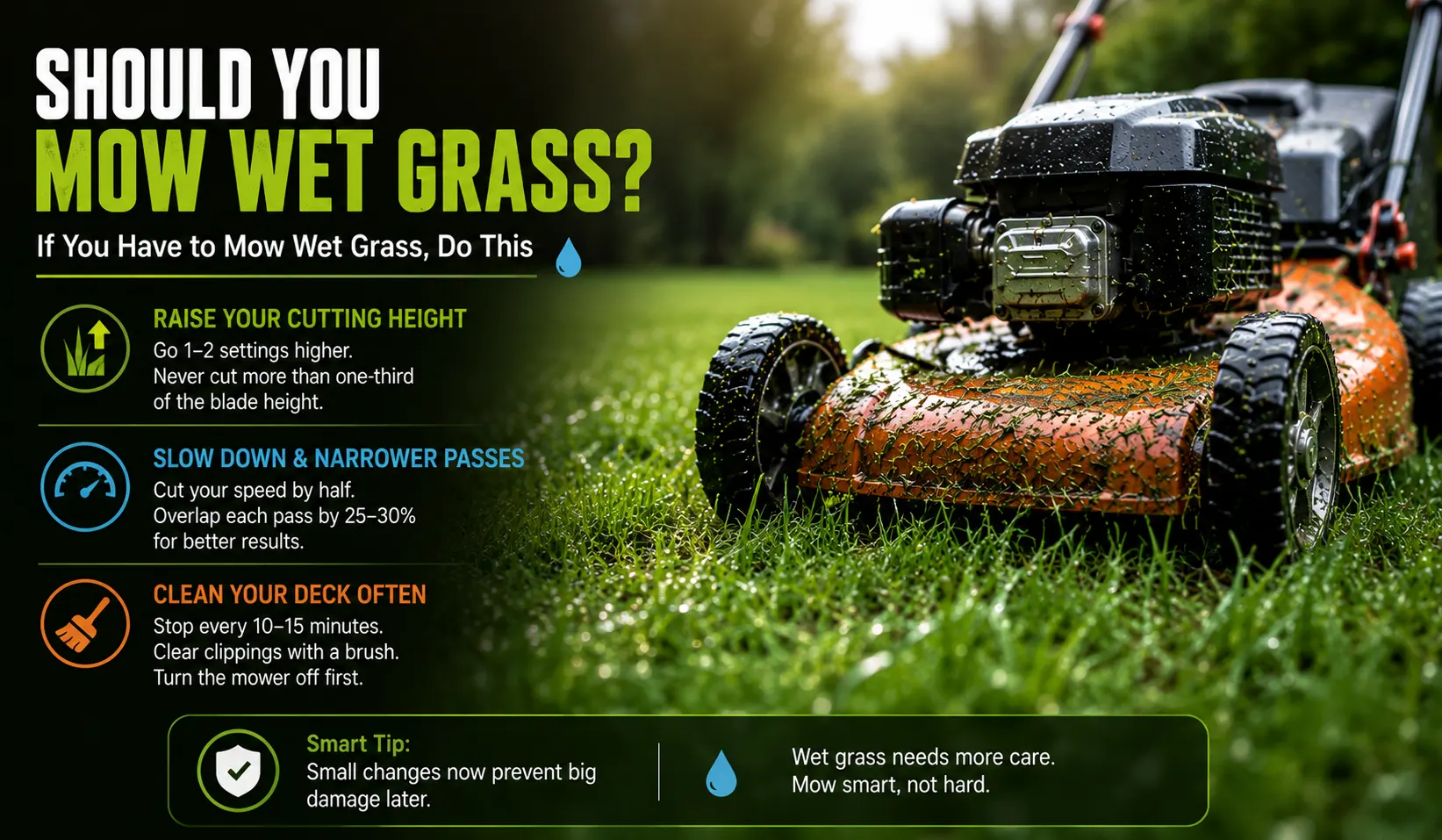
Clean Your Deck Often During the Job
Stop every 10 to 15 minutes and clear the clippings from under your deck with a stick or deck brush. Wet clippings build up fast and restrict blade movement. A clogged deck also reduces suction, which means more clippings dumped in piles on your lawn.
Turn the mower off completely before clearing the deck. Every time.
What to Do With Wet Clippings
Don’t mulch wet clippings back into the lawn – they’ll mat down and smother the grass underneath. Use your bag attachment if you have one and collect them as you go.
If you don’t have a bag, rake the clumps off the lawn immediately after mowing. Left overnight, a dense mat of wet clippings will kill the grass underneath it.
Common Mistakes People Make
Most wet-mowing regrets come from the same two decisions.
Mowing Too Soon After a Storm
The lawn looks dry on the surface within an hour of the rain stopping. The surface dries first – the soil underneath stays saturated for much longer.
A dry-looking surface after a summer storm is the most common reason people mow too soon. Do the foot test before you trust your eyes.
Forgetting About Soil Compaction
Compaction is the quiet problem. You mow wet, it looks fine, the grass bounces back, you think you got away with it. But underground, the soil structure took a hit. Repeated wet mowing over a season creates hard, dense soil that starts showing up as thin, patchy grass the following spring.
Aerate once a year if you mow wet with any regularity. It’s easy to do and it reverses compaction before it becomes permanent.
My Honest Take
I’ve mowed wet grass more times than I’d like to admit – sometimes out of necessity, sometimes out of impatience. The Minnesota lawns in early May don’t wait for perfect conditions. Neither does a client’s lawn in Florida after a hurricane week.
One wet mow on an otherwise well-maintained lawn? It’ll recover. The grass is resilient. What causes real, lasting problems is the habit of mowing wet every time because the schedule says it’s mowing day regardless of what the sky did the night before.
The trade-off is honest: waiting is better for the lawn, full stop. But a missed mow when the grass is at seven inches is also a problem. If you’re stuck choosing between mowing wet and letting the lawn get out of control, mow wet – just use the techniques above, bag the clippings, and give the lawn a few days to recover.
What I’d tell my neighbors: build a two-day buffer into your mowing schedule in rainy seasons. That flexibility alone prevents 90 percent of the wet-mowing decisions you’d otherwise have to make.
Pros and Cons of Mowing Wet Grass
| Factor | Pros | Cons |
|---|---|---|
| Schedule flexibility | Lets you mow regardless of weather | Risk of damage to lawn and mower |
| Grass height control | Prevents overgrowth in rainy seasons | Torn blades, uneven cut, yellowing |
| Convenience | No waiting required | Clumping, clogging, more cleanup needed |
| Soil impact | None | Compaction, especially with heavy mowers |
| Disease risk | None | Spread of fungal spores across the lawn |
| Safety | Get the job done | Slip risk on slopes, electrical risk with battery mowers in heavy rain |
Frequently Asked Questions About Mowing Wet Grass
Should you mow wet grass if you’re already behind on mowing?
If your lawn is significantly overgrown and more rain is coming, mowing wet is a better option than letting the grass get to an unmanageable height. Raise your cutting height, bag the clippings, and avoid mowing if the ground feels soft underfoot.
How long after rain can you mow?
For light rain or dew, wait 30 minutes to two hours. After heavy rain or a full storm, wait at least eight hours – and 24 hours is better for clay soils. The foot test (does the ground feel firm when you walk across it?) is the most reliable indicator.
Does mowing wet grass spread lawn disease?
Yes. Mower blades pick up fungal spores from affected areas and spread them across the entire lawn in a single pass. This is one of the main reasons wet mowing in humid climates can cause dollar spot, brown patch, and rust – diseases that are expensive to treat once established (Turfgrass Science, Purdue University, 2021).
Is morning dew bad for mowing?
Light dew is not the same as post-rain saturation. Dew sits on the surface and typically burns off within an hour of sunrise. If your only concern is surface moisture from overnight dew, waiting until mid-morning is usually sufficient.
What type of mower handles wet grass best?
A lightweight battery-powered push mower causes the least soil compaction on wet ground. Gas push mowers are a reasonable middle ground. Riding mowers and zero-turns are the worst option on wet soil – their weight causes significant rutting and compaction that can take weeks to correct.
Can wet grass damage my mower?
Yes. Wet clippings pack under the deck and strain the engine, especially in gas mowers. They also accelerate blade dulling and can cause rust on the underside of the deck over time. Always clean the deck thoroughly after mowing wet grass.