
Quick Overview
- Lawn mower tracks and ruts happen when mower tires compress wet or soft soil, breaking down the root zone and creating visible depressions.
- Shallow tracks (under 1 inch deep) can be fixed with topdressing and a lawn roller in a single afternoon.
- Deep ruts (1-3+ inches) need the cut-and-fold sod method or topsoil fill plus overseeding – and take 4-8 weeks to fully recover.
- The repair method that works depends on your rut depth, soil type, and time of year – not one approach fits every yard.
- Preventing new ruts is mostly about timing: never mow on wet ground and change your mowing pattern every week.
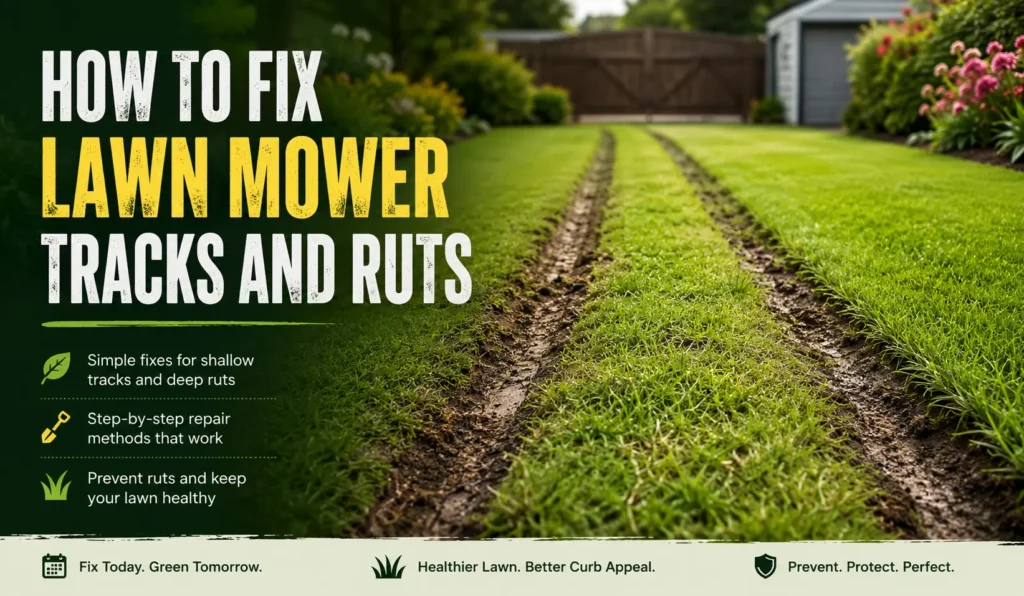
You finish mowing on a Saturday morning, step back to admire the clean stripes – and your stomach drops. Deep tire grooves cut across your front lawn like a dirt road. Two parallel tracks, dragging all the way from the gate to the garage. Knowing how to fix lawn mower tracks and ruts in your yard before they harden into permanent channels is the difference between a quick Saturday fix and months of patchy recovery.
I’ve dealt with this in three very different yards: heavy red clay in Georgia, fast-draining sandy soil near Austin, and thick cool-season fescue up in Minnesota where the spring thaw turns everything to mush. This guide covers what actually works – and what I’ve wasted time on.
Why Lawn Mower Tracks and Ruts Happen in the First Place
Most ruts aren’t caused by the mower being too heavy. They happen because the timing was wrong – usually wet soil, repetitive patterns, or a combination of both.
Wet Soil and Poor Timing
This is the most common cause, and the easiest to prevent after the fact. When soil is saturated, the water between soil particles acts like a lubricant. A mower tire rolling over wet ground doesn’t just compress – it shears the soil sideways, shoving it out from under the wheel and leaving a channel behind.
I learned this the hard way after a wet spring in Minnesota. Mowed two days after heavy rain because the grass was getting long. The whole yard looked like a tank rolled through it by the time I finished.
The squelch test is your friend: step on your lawn before mowing. If your boot sinks or you hear water, wait. Even 24-48 more hours of drying can make a big difference.
Heavy Mowers on Soft Ground
Zero-turn mowers and riding mowers with wide rear tires distribute weight differently than push mowers. A typical 54-inch zero-turn with a full fuel tank and catcher bag can weigh 900-1,100 lbs. On firm soil, that’s fine. On soft ground, that’s enough to compress the top 2-3 inches of soil and crush the root zone.
Ground pressure – the pounds per square inch at the contact patch – is what actually causes damage, not total weight alone. Wider tires spread that load. Turf tires with a lower PSI spread it further. But neither solves the problem if the ground is too wet to support any significant load.
Repetitive Mowing Patterns
Running your mower in the exact same path every single week is a slow-motion rut factory. Even on dry ground, the same strip of turf gets compressed every 7 days. Over a full season, that repeated pressure collapses the soil structure, and shallow tracks become permanent impressions.
Alternating your direction by 90 degrees every week – or even switching from straight lines to a diagonal pattern – distributes the load across a wider area. Most well-maintained golf courses change mowing direction daily for exactly this reason.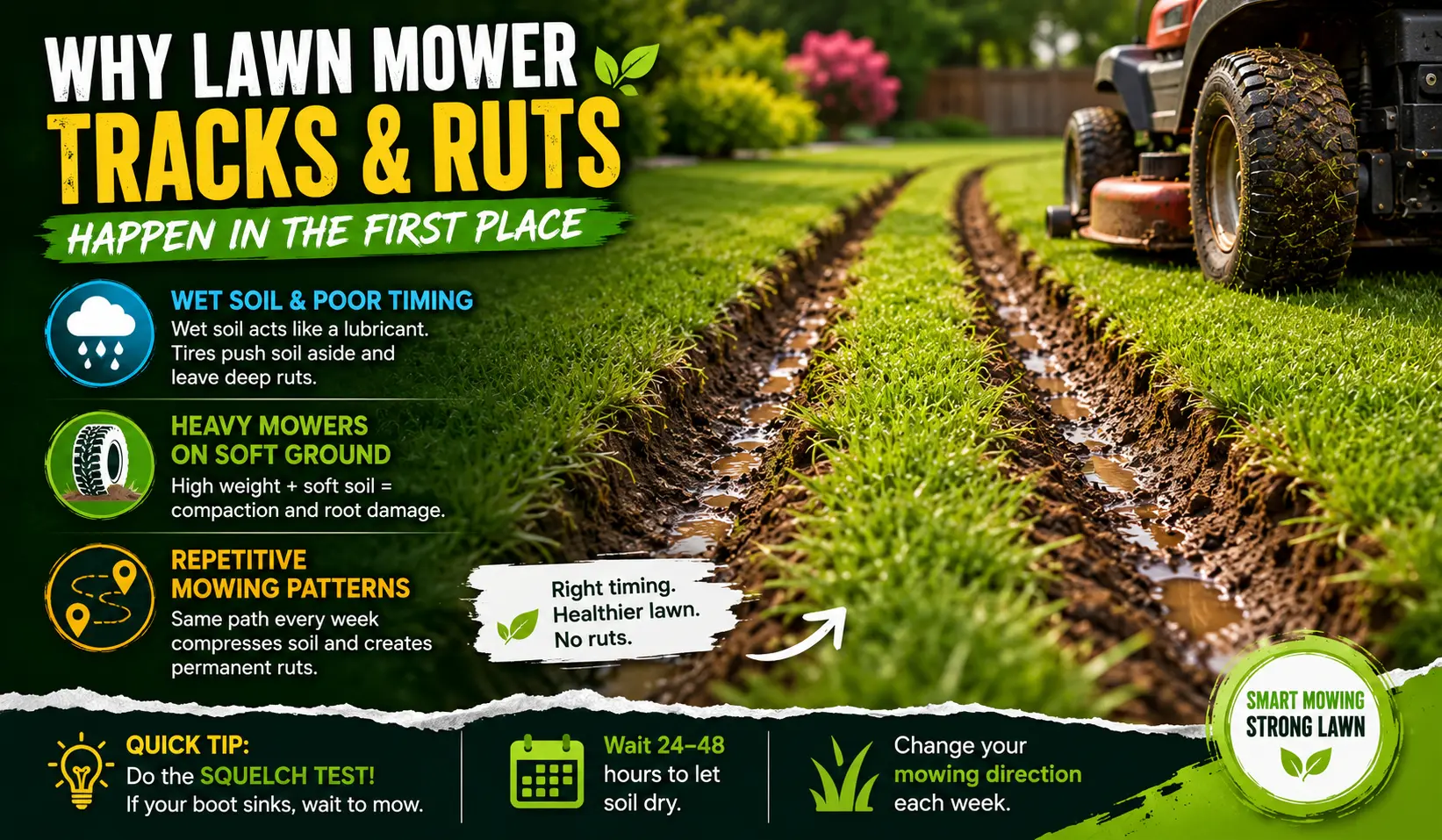
How Bad Is the Damage? (And Does It Matter?)
Not every tire track is an emergency. Some shallow impressions dry out and spring back within a few days. Others cut deep enough to strand water, kill grass roots, and create drainage problems that feed themselves. Knowing which you’re dealing with changes your repair approach completely.
Shallow Tracks vs. Deep Ruts – What’s the Difference?
A shallow track is a cosmetic depression – the soil is compacted but the grass is still alive. The blades may be flattened or bruised, but the root zone is largely intact. These are typically under 1 inch deep and often disappear with a good rain and a few days of growth.
A deep rut is structural damage. The soil has been displaced, not just compressed. Grass roots in the rut have been severed or buried. Water pools in the channel instead of draining. These are 1 inch or deeper and won’t recover on their own – you have to physically intervene.
When Ruts Actually Hurt Your Grass
Ruts become a real problem when they change how water moves across your lawn. A 2-inch rut running down a slope becomes a drainage channel. During heavy rain, it concentrates flow, erodes the edges, and widens itself over time. Standing water in a rut also suffocates grass roots – they need oxygen in the soil, and a waterlogged channel starves them of it within days.
The other issue is mowing: a riding mower wheel dropping into an existing rut creates uneven deck height, scalps the high edges, and deepens the rut again on the next pass.
Compression Table: Rut Depth vs. Repair Method
| Rut Depth | Damage Level | Recommended Repair |
|---|---|---|
| Under 0.5 inch | Cosmetic | Wait and monitor; may self-correct |
| 0.5 – 1 inch | Shallow | Topdressing + lawn roller |
| 1 – 2 inches | Moderate | Topsoil fill + overseeding |
| 2 – 3 inches | Deep | Cut-and-fold sod method |
| Over 3 inches | Severe | Professional grading may be needed |
How to Fix Shallow Lawn Mower Tracks
Shallow tracks – anything under 1 inch – are a weekend repair. You do not need to dig anything up. The goal is to fill the depression, break up surface compaction, and give the existing grass room to grow back into the repaired area.
Topdressing with Sand or Compost
Topdressing means spreading a thin layer of material over the depressed area to bring it level with the surrounding lawn. For clay soils, a 50/50 mix of coarse sand and compost works well – the sand opens up the clay structure while the compost feeds the grass. For sandy soil, straight compost is usually enough.
Work the material into the depression with the back of a rake. You want to fill the low spots flush with the surrounding grade without burying the existing grass more than about a half inch. Buried more than that, most grass varieties will struggle to push through.
I use a hand cultivator to scratch the surface of the compacted area before topdressing. Breaking that crust up – even just half an inch down – helps the new material bond instead of sitting on top like a layer of kitty litter.
Scotts Premium Topsoil and Jonathan Green Black Beauty Topdressing mix are both widely available at Lowe’s and Home Depot and work well for this.
Using a Lawn Roller the Right Way
A lawn roller – a water-fillable drum you push or pull behind a mower – is useful after topdressing, but only if you use it right. The goal is light compaction to seat the new material, not heavy compression that recreates the problem.
Fill the roller a quarter to halfway with water. You want it heavy enough to firm the topdressed area, not so heavy it sinks into the surrounding turf. Roll across the repaired area once in each direction.
Do not use a lawn roller on wet ground. That just shifts you from fixing ruts to creating them.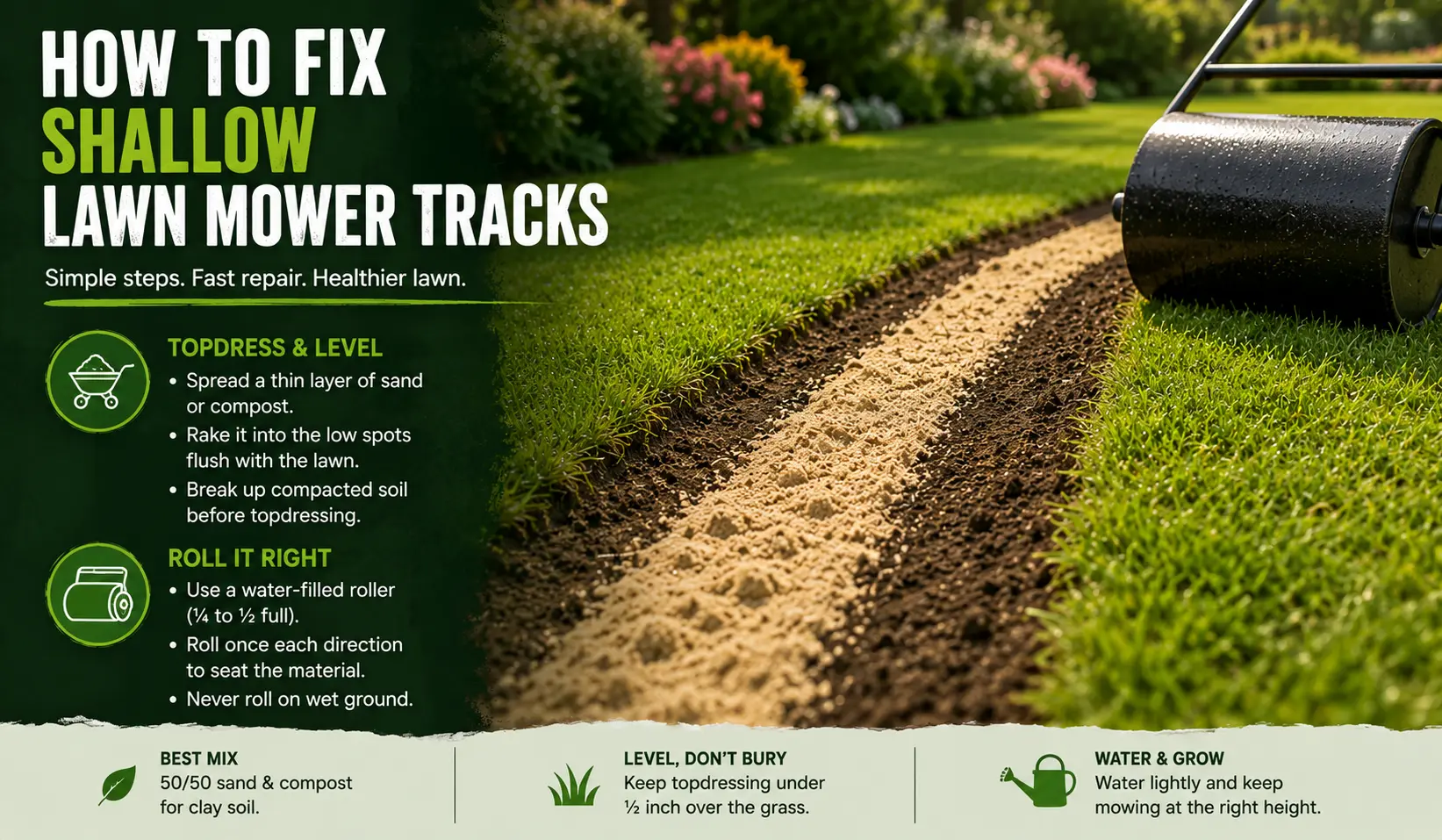
Overseeding After Leveling
Once the area is level and lightly firmed, overseed the repaired spots. Even if the existing grass looks okay, ruts usually damage or thin out the turf. Getting new seed down while the soil is freshly worked gives it the best chance to germinate.
Match the seed variety to what’s already growing. For the Southeast and transition zone, tall fescue or Bermuda blends are standard. In the Midwest and upper South, Kentucky bluegrass or a fescue-rye mix holds up well to mower traffic.
Scotts Turf Builder Starter Food for New Grass applied at seeding helps establishment. Keep the area consistently moist for 10-14 days while seed germinates.
Compression Table: Products and Tools for Shallow Repairs
| Product / Tool | Purpose | Where to Buy |
|---|---|---|
| Coarse sand or topdressing mix | Fill and level depressions | Garden centers, Lowe’s, Home Depot |
| Compost (bagged) | Improve soil structure | Nurseries, home improvement stores |
| Lawn roller (rental) | Firm topdressed areas | Equipment rental shops |
| Overseeding mix | Restore grass coverage | Scotts, Jonathan Green – most garden centers |
| Hand cultivator | Break up surface crust before topdressing | Hardware stores |
How to Fix Deep Ruts in Your Lawn
Deep ruts – anything over 1 inch – need more than topdressing. You have to address the displaced soil underneath, not just fill in from the top. There are two main approaches, and which one you use depends on whether the surrounding grass sod is still in decent shape.
The Cut-and-Fold Sod Method
This is my go-to for ruts in the 1.5 to 3-inch range where the surrounding grass is still healthy. The idea is to cut the sod back like a flap, fix the subsoil level underneath, then fold the original sod back into place. Done right, you get nearly invisible results within 2-3 weeks.
Here’s how to do it:
- Use a flat spade or sod cutter to cut along both sides of the rut, about 6 inches outside the depression. Cut in a U or rectangular shape, keeping the cuts clean and straight.
- Gently peel back the sod flap without tearing it. Fold it to the side and keep the roots moist – don’t let them dry out.
- Loosen the compacted subsoil at the bottom of the rut with a garden fork. Go 3-4 inches deep. This step matters – if you skip it, the rut just comes back.
- Add topsoil or a topsoil-compost blend to bring the grade level with the surrounding lawn. Firm it with your hands or a small hand tamper.
- Fold the sod back into place. Press it firmly into the new soil base.
- Water immediately and keep the area consistently moist for 2 weeks while the roots re-establish.
One honest note about this method: it works poorly if the sod is already thin or if the rut is very old. Brittle, dead sod tears apart when you try to fold it back. In that case, the topsoil-and-seed method is more reliable.
Filling Ruts with Topsoil and Seed
When the sod over the rut is too damaged to save, the simpler approach is to fill and seed. Loosen the compacted base with a fork or mattock, fill with topsoil to within a half inch of the surrounding grade, firm it lightly, and overseed. Cover with a thin layer of straw to hold moisture.
This method works, but takes longer – 6-8 weeks to get grass coverage that blends with the rest of the lawn. In Texas or Florida, warm-season grasses like Bermuda or Zoysia fill in fast during summer. In Minnesota or the Midwest, you’re waiting on cool-season grass germination, which is slower.
For large ruts, I use a mix of Quikrete All Purpose Sand and a bagged topsoil blend as the base, then finish the top inch with a straight compost-topsoil mix for good seed contact.
When to Call a Pro vs. DIY
Most homeowners can handle ruts up to 3 inches with the methods above. Beyond that – especially if the ruts run along a slope, are wider than 12 inches, or are causing drainage problems that redirect water toward a foundation – it’s worth calling a landscaper or grading contractor.
The cost of professional rut repair ranges from $200-$800 for most residential lawns depending on the extent of the damage and region (HomeAdvisor, 2024). That’s not cheap, but it’s less expensive than dealing with erosion damage or water intrusion problems that can develop from unmanaged drainage channels.
Compression Table: Deep Rut Repair at a Glance
| Method | Best For | Skill Level | Time to Visible Recovery |
|---|---|---|---|
| Cut-and-fold sod | Healthy surrounding turf, 1.5-3 inch ruts | Intermediate | 2-3 weeks |
| Topsoil fill + overseeding | Damaged or dead turf over the rut | Beginner | 6-8 weeks |
| Professional grading | Ruts over 3 inches or drainage issues | N/A | Varies |
How to Fix Ruts Based on Your Soil and Grass Type
The repair process is the same whether you’re in Georgia or Minnesota – but the materials you use, the timing, and how fast you’ll see results depend heavily on what’s under your feet.
Clay Soil (Southeast, Midwest, Pacific Northwest)
Clay soil holds water like a sponge, which is exactly why it ruts so easily and why repairs can be frustrating. Filling a clay-soil rut with straight clay topsoil from your local garden center usually just recreates the problem.
Mix coarse sand into the fill material at roughly 30-40% by volume. This opens up the soil structure and improves drainage in the repaired area. For Georgia red clay specifically, adding gypite or a gypsum soil amendment to the surrounding area after repair helps break up compaction in the broader zone around the rut.
Cool and wet spring conditions in the Pacific Northwest and upper Midwest mean you’ll often be waiting longer for repair windows. Aim for repairs in late spring or early fall when the soil is workable but not saturated.
Sandy Soil (Texas, Florida, Coastal Regions)
Sandy soil drains fast – sometimes too fast. The good news: it ruts less often because water doesn’t linger. The bad news: when it does rut (usually after heavy irrigation or tropical rain), the fill material needs organic content to hold together.
Use a topdressing mix with higher compost content – 50-60% – to give the repaired area some water-holding capacity. Straight sand fill in a sandy soil lawn just drains away from the seed before it can germinate.
Florida Bahia and Centipede grass lawns are forgiving about rut repair timing – warm temperatures year-round mean you can usually reseed anytime and expect reasonable germination. Texas Bermuda grass is even more aggressive: in summer, it’ll fill shallow rut repairs from rhizome spread alone within 3-4 weeks without overseeding.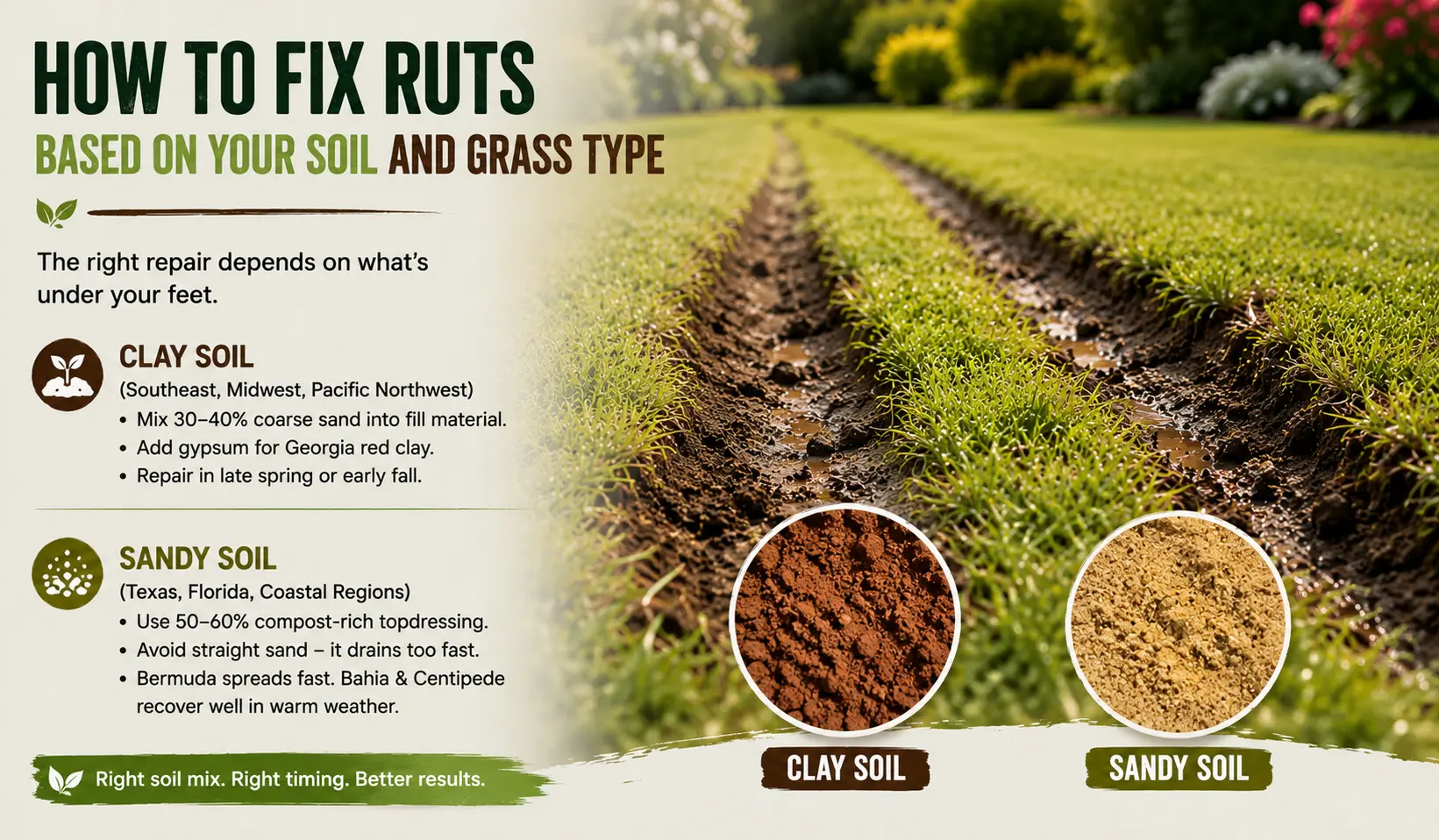
Cool-Season vs. Warm-Season Grass Recovery
Timing your repair to match your grass type’s growth cycle makes a real difference in how fast the area recovers.
Cool-season grasses (Kentucky bluegrass, tall fescue, ryegrass) recover best when repaired and seeded in late summer to early fall – roughly August through October in most of the US. Soil temperatures are still warm enough for germination, but air temperatures are dropping, which reduces heat stress on new seedlings. Spring repairs work too, but summer heat often kills newly established seedlings before they mature.
Warm-season grasses (Bermuda, Zoysia, St. Augustine, Centipede) recover fastest when repaired during their active growth window – May through August. Overseeding is less commonly needed with these varieties because stolons and rhizomes spread laterally to fill gaps, as long as the soil level is corrected.
How to Prevent Lawn Mower Tracks from Coming Back
Fixing the current ruts is step one. Keeping them from coming back takes a few consistent habits that most people skip because they feel minor – until the tracks show up again.
Change Your Mowing Pattern Regularly
Alternating your mowing direction is the single highest-return habit for rut prevention. Rotate 90 degrees every mow, or switch between parallel stripes and diagonal cuts. The point is to avoid running the same tires over the exact same strip of soil week after week.
If you have a riding mower with fixed paths around obstacles – trees, garden beds, slopes – pay extra attention to those areas. Those are the spots where you have no choice but to make the same turn in the same place. Consider hand-mowing those tight zones or using a string trimmer instead of driving the riding mower through repeatedly.
Avoid Mowing on Wet Ground
This bears repeating because it’s the most ignored piece of lawn advice that actually matters. Wait until the soil is firm enough that you don’t leave footprints when you walk across it. In Georgia after a spring thunderstorm, that might mean waiting 48-72 hours. In Texas with sandy soil, it might only take 12-24 hours.
If the grass is getting long and you have no choice but to mow in marginal conditions, reduce your mowing deck by only one setting rather than cutting everything to final height. Less weight on the tires for a longer time does more damage than a single efficient pass.
Tire Pressure, Mower Weight, and Ground Pressure
Lower tire pressure spreads the contact patch and reduces ground pressure – the actual force per square inch being applied to the soil. Most riding mower manufacturers recommend 8-14 PSI for turf tires. Running at the lower end of that range when the ground is soft is a practical way to reduce rut risk.
That said, don’t drop below the manufacturer’s minimum. Underinflated tires on a zero-turn can cause handling problems and uneven wear.
If you’re consistently dealing with ruts and you own a heavy zero-turn mower, turf-friendly foam-filled tires or turf saver tires with a different tread pattern can help distribute the load more effectively than standard turf tires.
Using Mowing Mats or Turf Protectors
Mowing mats – interlocking plastic or composite mesh panels – are used in commercial lawn care to prevent ruts in high-traffic areas. For most homeowners, they’re overkill.
Where they do make sense: a regular path your mower takes between two fixed obstacles, like a narrow gate passage or the strip between a fence and a garden bed. Laying mowing mats in those specific zones prevents compaction in the spots where you simply cannot vary your line.
Ground protection mats designed for landscaping equipment are available at most equipment rental suppliers and some big-box stores. They’re temporary solutions – you lay them before mowing and pick them up after – not something you leave in place.
Common Mistakes People Make When Fixing Ruts
Most rut repair failures come down to two things: skipping a step that seems unnecessary, or using the wrong material because it was what was on hand.
Filling Ruts Without Fixing Compaction First
The most common mistake I see is filling a rut with topsoil and stopping there. The rut didn’t just remove soil – it compacted the soil beneath it. If you fill the depression without loosening that compacted base, you’re essentially building a new surface on a concrete-hard substrate. Grass roots won’t penetrate it, drainage will remain poor, and the filled area will sink again within a season.
Always fork or aerate the base of the rut before filling. Even two or three passes with a garden fork loosens the layer enough to make a difference.
Using the Wrong Soil Mix
Filling a sandy soil rut with heavy clay topsoil creates a drainage barrier in the soil profile – water hits the clay layer and can’t pass through, drowning roots. Filling a clay soil rut with pure sand can create the opposite problem: a fast-draining pocket that dries out faster than the surrounding lawn and stresses the new grass.
Match your fill material to the native soil texture, then modify it slightly to improve drainage (for clay) or water retention (for sand). A local soil supplier or nursery can usually tell you what blend is most compatible with your area’s native soil.
My Final Recommendation
After fixing ruts across three very different yard types, the honest answer is that the cut-and-fold method is the most satisfying repair when the surrounding turf is still alive and you can pull it off cleanly. The results are nearly invisible in 2-3 weeks, and you’re not waiting on seed germination. I used it on a 40-foot run of mower tracks in a Minnesota fescue lawn after a spring thaw disaster, and by midsummer you couldn’t tell where the repair was.
For most people, though, topsoil fill with overseeding is the more practical option – it requires less precision, works even when the sod over the rut is too damaged to save, and the materials are available at any garden center. The trade-off is patience. Six to eight weeks before it fully blends in.
Whatever method you use, fix the compaction first, match your fill material to your native soil, and time the repair to your grass type’s growth cycle. Those three things matter more than which specific product you use or how many passes you make with the lawn roller.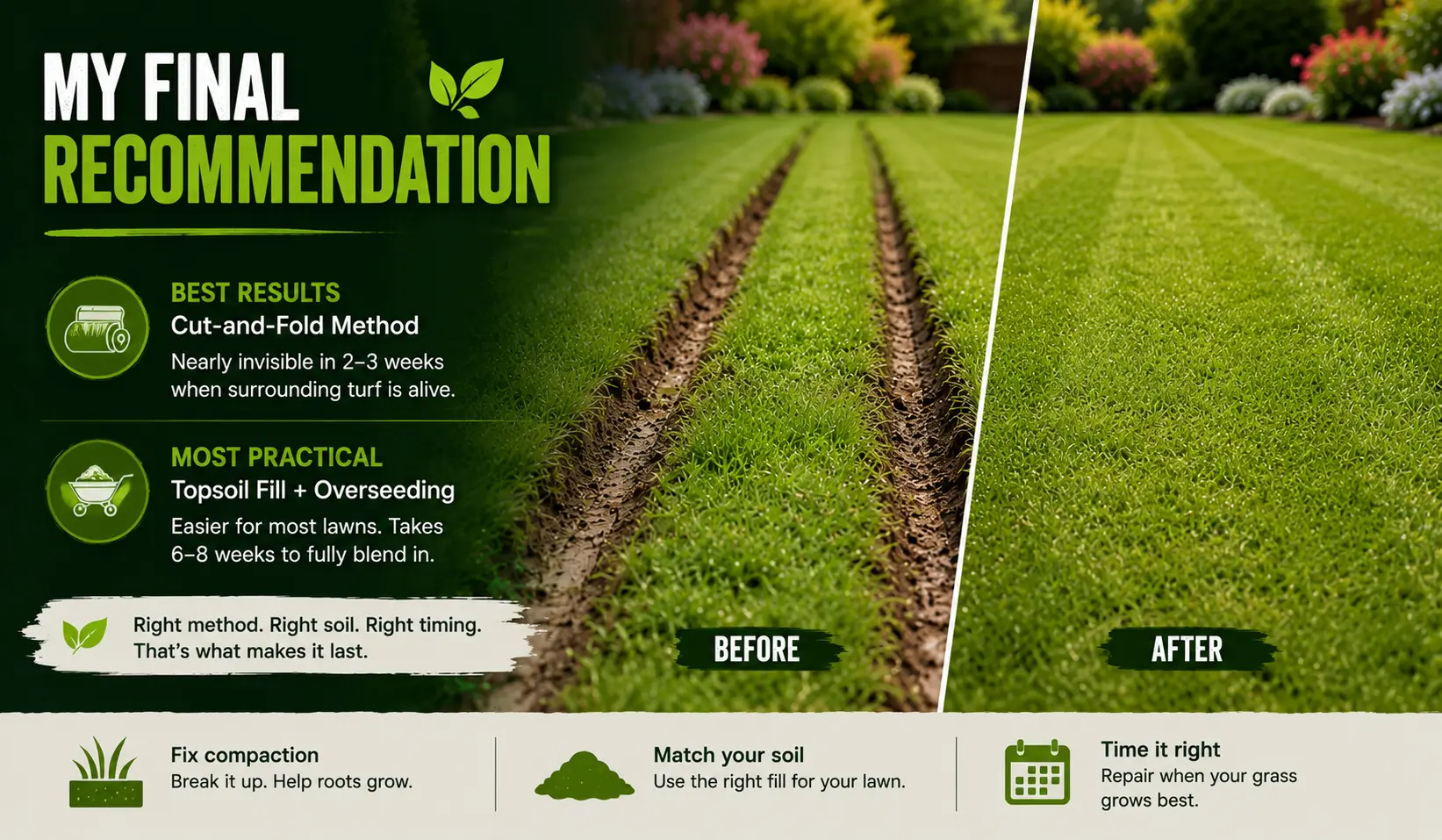
Pros and Cons of Each Rut Repair Method
| Method | Pros | Cons |
|---|---|---|
| Topdressing + lawn roller | Fast, no digging, easy for beginners, works same day | Only effective for depressions under 1 inch |
| Cut-and-fold sod | Fastest visible recovery (2-3 weeks), nearly invisible results, preserves existing turf | Requires intact surrounding sod; difficult on old/brittle turf |
| Topsoil fill + overseeding | Works even when sod is dead, low skill required, inexpensive | Slowest recovery (6-8 weeks), requires consistent watering |
| Professional grading | Best for severe or drainage-affecting ruts, correct equipment | Most expensive; $200-$800+ (HomeAdvisor, 2024) |
| Mowing mats (prevention) | Prevents ruts in fixed-path zones, reusable | Doesn’t fix existing ruts; adds setup/cleanup time each mow |
Frequently Asked Questions About Fixing Lawn Mower Tracks and Ruts
How long does it take for lawn mower ruts to go away on their own?
Ruts under half an inch deep in healthy turf sometimes self-correct within 2-4 weeks as the grass grows back and natural soil movement fills the low spots. Anything deeper than that will not go away on its own – you need to actively fill and reseed the area.
What is the best time of year to repair lawn ruts?
For cool-season grasses (fescue, bluegrass, ryegrass), repair in late August through October for the fastest recovery. For warm-season grasses (Bermuda, Zoysia, St. Augustine), repair during active growth from May through August. Avoid repairing during drought stress or the hottest weeks of summer regardless of grass type.
Can I use a lawn roller alone to fix deep ruts?
No. A lawn roller flattens and firms existing soil but does not add material to fill depressions. Using a heavy roller on a deep rut compresses the edges without addressing the channel itself. Use topdressing or topsoil fill first, then use the roller to firm the new material.
Why do my ruts keep coming back after I fix them?
Recurring ruts usually mean the subsoil compaction under the rut was not addressed before filling. If you fill the depression without loosening the compacted base, the area sinks again within a season. Always fork the base before filling. Recurring ruts can also mean you’re still mowing in wet conditions or using the same mowing path every week.
Does lawn aeration help with rut recovery?
Yes, especially in clay soils. Core aeration before repairing ruts loosens the soil profile, improves drainage, and helps new roots establish faster in the repaired area. Aerate the full lawn if possible, not just the rut zone – it improves overall soil health and reduces future rut risk.
Is it better to repair ruts in spring or fall in the Midwest?
Fall is generally better for Midwest lawns with cool-season grass. Soil temperatures in August and September are warm enough for fast germination, air temperatures are cooler so seedlings don’t stress, and fall rains provide natural irrigation. Spring repairs work but carry the risk of young grass hitting summer heat before it’s fully established.