
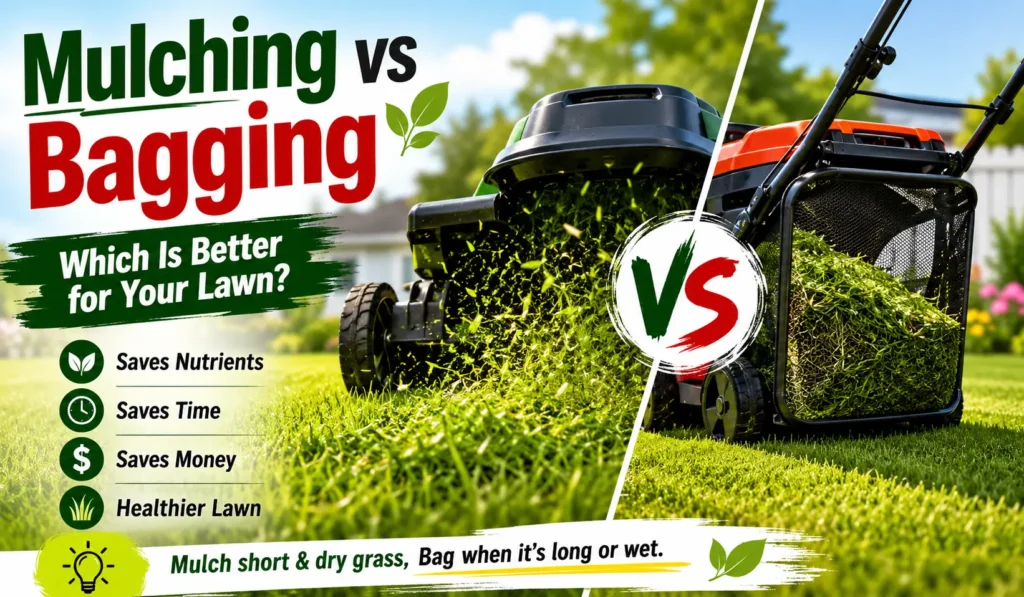
Quick Overview
- Mulching returns roughly 25% of your lawn’s nitrogen needs back to the soil for free, making it the better default for most homeowners. (University of Minnesota Extension, 2023)
- Bagging is the right call when clippings are wet and matting, when your lawn is diseased, or when you’ve let the grass grow too long.
- Grass type and season matter more than most people realize – warm-season grasses like Bermuda handle mulching year-round; cool-season grasses need bagging in peak spring growth.
- Mulching does not cause thatch buildup – that’s one of the most persistent myths in lawn care.
- Neither method is universally better. The right answer depends on your grass, your mowing habits, and what’s happening in your yard right now.
What’s the Real Difference Between Mulching and Bagging?
Both methods cut the grass. What they do with the clippings afterward is where they split – and that difference has real consequences for your soil, your schedule, and your lawn’s health over time.
How Mulching Actually Works
A mulching mower uses a specially shaped deck and blade to recirculate clippings inside the cutting chamber. The clippings get chopped into smaller and smaller pieces – sometimes four or five passes before they drop. What lands back on the lawn isn’t a clump of grass. It’s fine organic material that sifts down through the grass blades to the soil surface, where it breaks down within days.
The biology here matters. Grass clippings are about 80% water and decompose fast. As they break down, they release nitrogen, potassium, and phosphorus back into the soil. That’s not a small thing. Research from the University of Minnesota Extension (2023) estimates that returning clippings can supply the equivalent of one full fertilizer application per season.
I mulched a thick tall fescue lawn in Ohio for three consecutive seasons without adding a single bag of fertilizer. The color stayed dark green from April through October. That was not what I expected when I started.
How Bagging Works (and Why People Default to It)
Bagging collects clippings in an attached bag or box. The mower cuts, and everything goes into the bag instead of back onto the lawn. You get a clean finish immediately. No clippings visible on the surface.
Most homeowners default to bagging because of how it looks. The lawn looks finished the second you stop mowing. There’s nothing to explain to a neighbor, nothing to step over on the way to the car.
The tradeoff: every bag you haul to the curb is nitrogen leaving your property. Over a full season, that adds up to fertilizer cost you never recover.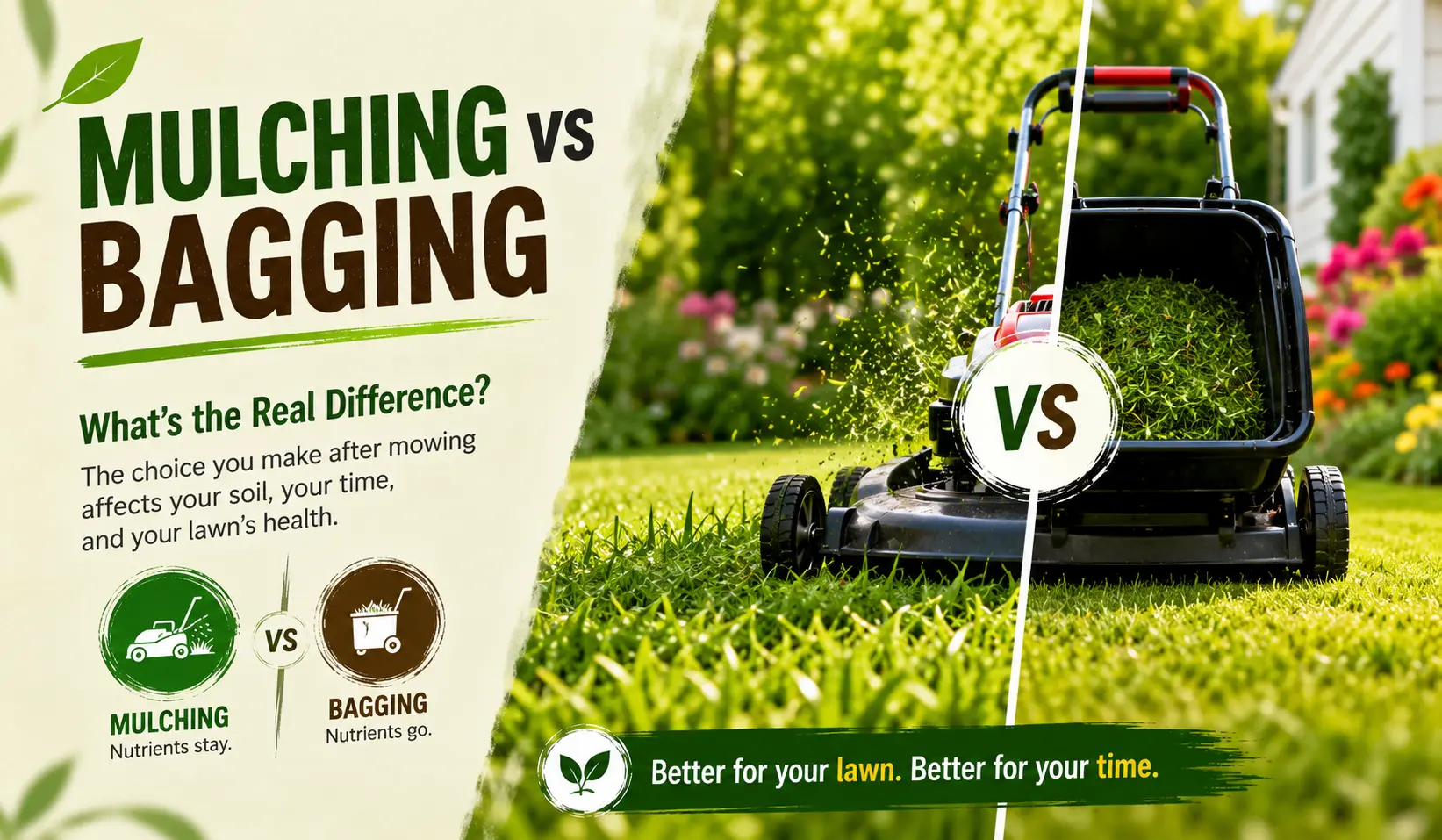
The Case for Mulching Your Grass
Mulching is the better default for most lawns most of the time. Here’s why – and where it can go wrong.
Mulch Clippings Return Nutrients to the Soil
Grass clippings are not waste. They’re free fertilizer in disguise. A healthy lawn clipping is mostly water, with the rest being nitrogen, potassium, and phosphorus in forms that soil microbes can process quickly.
Over a full mowing season, those nutrients add up. Studies from Purdue University’s turfgrass program (2022) found that lawns receiving returned clippings showed equivalent nitrogen availability to lawns receiving one to two additional fertilizer applications per year – without any extra product applied.
That savings is real money. A 50-pound bag of slow-release fertilizer covering 5,000 square feet runs $35-55 at most home improvement stores. Mulching gives you similar results for nothing.
It Saves Time and Cuts Down on Yard Waste
The math on time is straightforward. No bag to empty means fewer stops. No bag means no hauling clippings to the curb or the compost pile.
In Georgia, where summer growth can push cool-season grasses to six inches in a week, that time savings compounds fast. I’ve cut mowing time by 20-25% just by switching from bagging to mulching on a half-acre property.
There’s also the waste angle. In many municipalities, yard waste pickup is seasonal or fee-based. In California and several other western states, some water districts have ordinances encouraging clipping retention as part of broader conservation programs. Mulching removes the problem entirely.
When Mulching Can Hurt Your Lawn
Mulching is not the right call every time. The two situations where it genuinely causes problems:
- Clippings are too long. The mulching chamber needs short clippings to re-chop effectively. If grass is more than four inches tall when you mow, the clippings come out as full-length blades, not fine particles. Those clumps mat on the surface, block light and air, and can kill turf underneath.
- The lawn has active disease. Returning clippings from a lawn with brown patch, dollar spot, or rust spreads fungal spores across the entire lawn. In humid climates – coastal Georgia, central Florida, the mid-Atlantic in August – that one mowing can turn a small patch into a lawn-wide problem.
Beyond those two scenarios, mulching is almost always the better choice.
The Case for Bagging Your Grass Clippings
Bagging gets more criticism than it deserves. There are situations where it’s clearly the right call, and one underappreciated cost that nobody talks about.
Bagging Keeps Your Lawn Looking Cleaner
The visual argument for bagging is real. Immediately after mowing, a bagged lawn looks manicured. No clippings sitting on blades, no green film on the driveway, no questions from the homeowners association.
For high-visibility properties – a front yard on a busy street, a lawn you’re prepping for sale, a yard going in front of guests on a holiday weekend – that clean finish has value.
When Bagging Is the Smarter Choice
Four specific situations call for bagging over mulching:
- After a missed mow or a long rain that pushed grass height above four inches
- When your lawn shows active fungal disease (brown patch, dollar spot, red thread)
- During fall, when clippings are mixing with leaf debris and creating dense mats
- When you’re mowing a weed-heavy lawn and don’t want to spread seed
That last point surprises people. A lawn thick with dandelions or crabgrass going to seed is not a lawn you want to mulch. Every pass with a mulching mower is a pass that chops seeds into smaller pieces and spreads them further. Bag it, haul it, come back to the weed problem separately.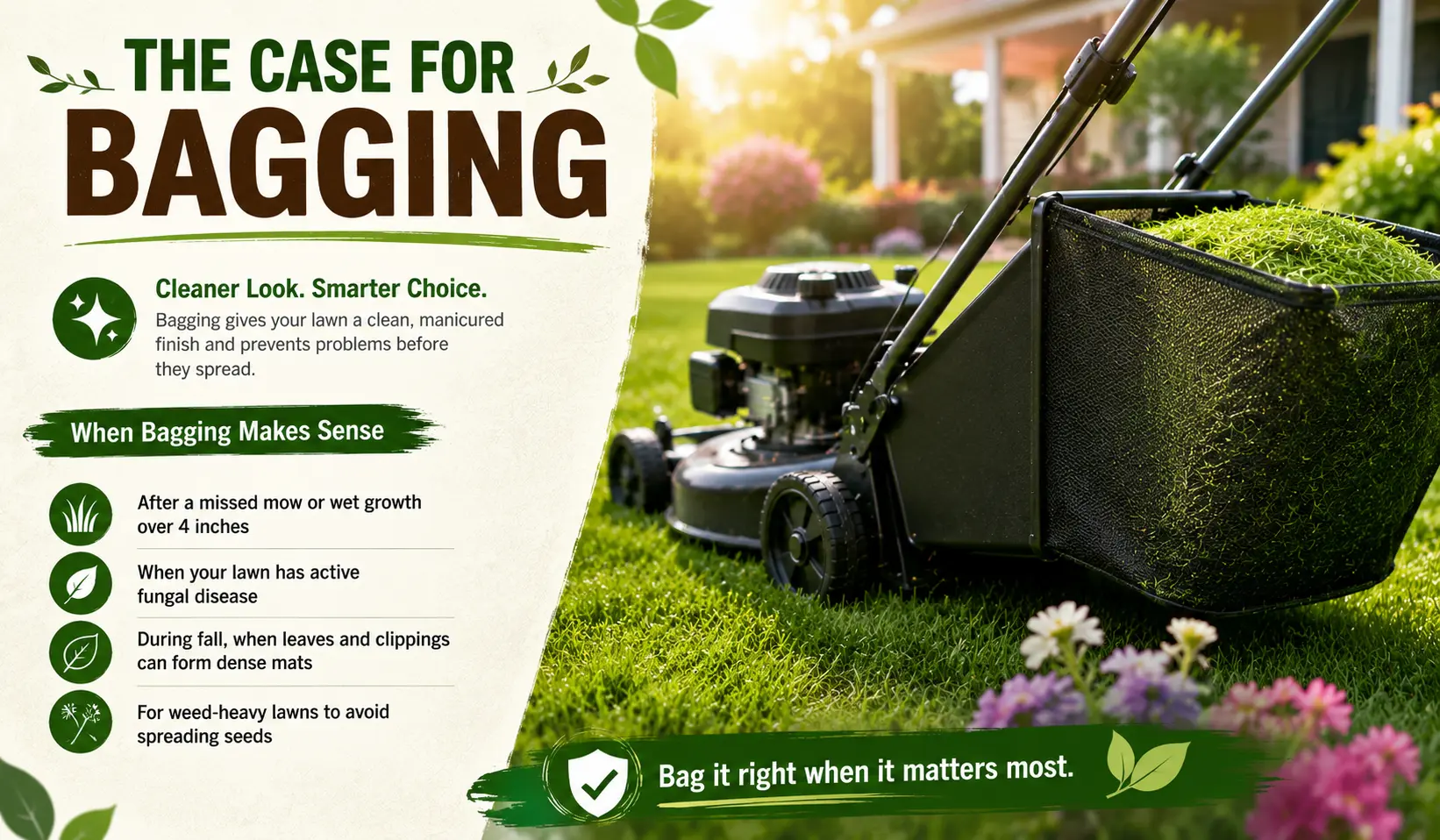
The Downside Nobody Talks About
Bagging removes organic matter from the lawn system continuously. Most homeowners offset this by fertilizing, but fertilizer replaces nutrients without replacing structure. Soil that never receives organic matter back becomes compacted and dense over time.
In Arizona and New Mexico, where water conservation matters and soils are naturally low in organic content, bagging can quietly degrade your lawn’s water retention over multiple seasons. I watched a Bermuda lawn in the Phoenix area go from needing two waterings a week to three over about four years of consistent bagging. The connection between organic matter and water retention is real.
Mulching vs Bagging – A Side-by-Side Comparison
The right method depends on your specific situation. Here’s how the two approaches stack up across the factors that matter most.
Lawn Health and Soil Benefits
Mulching wins on soil health in almost every category. Returned clippings feed soil microbes, improve organic matter levels, and reduce the nitrogen cost of maintaining green turf.
Bagging is neutral to slightly negative for soil health when done consistently over multiple years. Occasional bagging causes no lasting harm. Making it the default removes a meaningful source of organic matter from the system.
Time, Effort, and Cleanup
Mulching saves time per session – no bag stops, no clipping disposal. But it requires more frequent mowing. If you let the lawn go too long between mowings, you lose the advantage.
Bagging takes longer per session but gives you more flexibility on timing. You can let the grass grow a bit longer between mowings without wrecking the result.
Grass Type and Climate Considerations
Warm-season grasses – Bermuda, St. Augustine, Zoysia – produce fine-bladed clippings that mulch well almost year-round. Cool-season grasses like Kentucky bluegrass, fescue, and ryegrass grow faster in spring and fall and produce bulkier clippings that can clump if not cut frequently.
Climate amplifies this. High humidity slows decomposition, which means mulched clippings sit longer on the surface before breaking down. In dry climates, decomposition is fast and mulching works cleanly even with slightly longer clippings.
Comparison: Mulching vs Bagging Across Key Factors
| Factor | Mulching | Bagging |
|---|---|---|
| Lawn health | Returns nitrogen and organic matter | Removes nutrients from lawn |
| Appearance | Minor clipping residue visible | Clean, manicured finish immediately |
| Effort per session | Lower – no bag stops | Higher – regular bag emptying |
| Best season | All seasons with short clippings | Spring peak growth, fall, diseased turf |
| Best grass types | Bermuda, Zoysia, fine fescues | All types when grass is long or wet |
| Cost over time | Reduces fertilizer needs | Neutral to higher fertilizer need |
| Biggest risk | Clumping if grass is too long | Soil organic matter depletion over time |
What Actually Works by Grass Type and Climate
Grass type is the most underweighted variable in this debate. What works in a Florida backyard fails in an Ohio spring, and vice versa.
Warm-Season Grasses (Bermuda, St. Augustine, Zoysia – Florida, Texas, Southeast)
Warm-season grasses are built for mulching. They grow in summer, when temperatures and decomposition rates are both high. Clippings break down fast.
Bermuda in particular produces short, thin clippings that disappear into the turf quickly. I’ve mowed Bermuda in central Florida from May through September without a single visible clipping on the surface by the following morning. Mulching is the default call here.
St. Augustine is bulkier. Its clippings are wider and take longer to break down. Mulching still works, but mowing frequency matters more – once a week minimum in peak summer, and at a consistent height.
Zoysia falls between the two. Dense, slow-growing, it handles both methods well but benefits from mulching in fall to add organic matter before dormancy.
Cool-Season Grasses (Kentucky Bluegrass, Fescue, Ryegrass – Midwest, Northeast, Pacific Northwest)
Cool-season grasses are the harder case. Their two growth peaks – spring and fall – produce fast, lush growth that is thick and wet. That combination is mulching’s worst condition.
Kentucky bluegrass in an Ohio spring can grow four inches in five days after a warm rain. If you miss one mowing, you’re bagging. There’s no choice. The clippings are too long and too wet to mulch effectively.
During summer, when cool-season grass slows down, mulching works fine. Fall is mixed – mulching works if you stay on schedule, but leaf drop complicates things.
My general rule for cool-season lawns: mulch from June through August, bag in the first six weeks of spring and during any stretch where you’ve missed more than one mowing.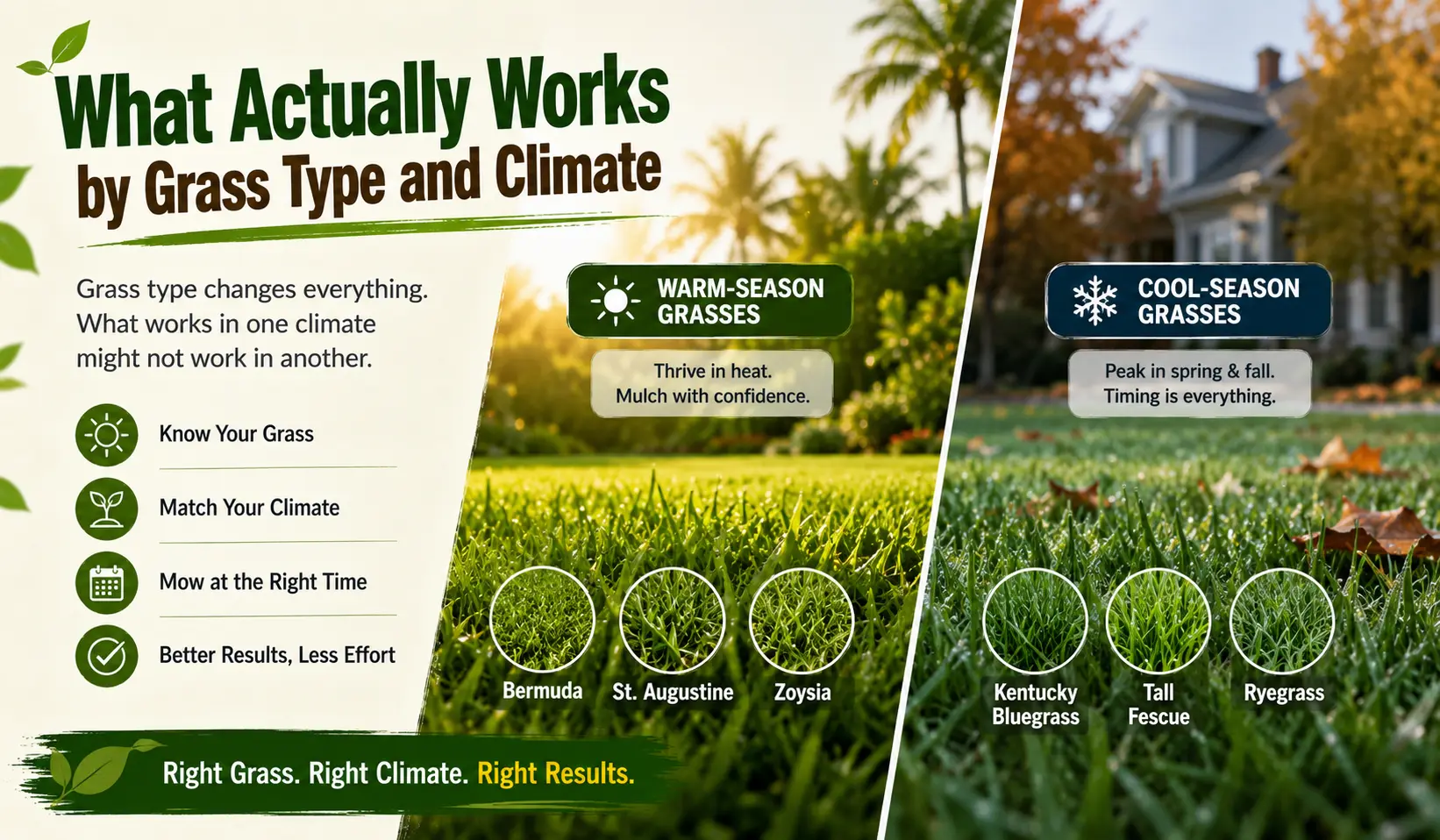
Mixed or Transitional Zones
The transition zone – running roughly from Virginia through North Carolina, Tennessee, and into Kansas and Missouri – is home to lawns that won’t cooperate cleanly with either method year-round. You may have Bermuda patches that handle summer heat and tall fescue that takes over in cooler months.
In these zones, flexibility beats commitment. Keep the mower set up to do both. Bag in spring, mulch in summer, bag again in fall if leaf drop is heavy. No single method is right all season.
Grass Type vs Recommended Method by Season
| Grass Type | Spring | Summer | Fall | Winter |
|---|---|---|---|---|
| Bermuda | Mulch | Mulch | Mulch | Dormant |
| St. Augustine | Mulch (with frequent mowing) | Mulch | Mulch | Slow growth – mulch |
| Zoysia | Mulch | Mulch | Mulch | Dormant |
| Kentucky Bluegrass | Bag (peak growth) | Mulch | Bag or mulch | Dormant |
| Tall Fescue | Bag (peak growth) | Mulch | Mulch if on schedule | Slow growth – mulch |
| Ryegrass | Bag (peak growth) | Mulch | Mulch | Mulch if active |
When to Mulch, When to Bag – A Practical Decision Guide
Forget the theory for a second. These are the situations that actually come up.
After a Long Rain or Missed Mow
Bag it. Full stop.
Wet clippings clump. Long clippings don’t get chopped fine enough to break down before they mat. If you missed two weeks of mowing or got three inches of rain before your scheduled mow, the mulching chamber is not going to save you. Take the bag, accept the extra time, and get the lawn back to a manageable height.
The fix for the next mowing: if it’s still too tall, lower the deck one step and bag again. Once you’re back to the right height, return to mulching.
During Heavy Growth Season
This one requires honest self-assessment. Mulching during peak growth works if you’re mowing every five to six days. If your schedule is every ten to fourteen days, switch to bagging during the fast-growth months and return to mulching when growth slows.
The clipping pile on a neglected lawn is not a fertilizer return. It’s a mat.
Fall Leaf Season Overlap
This is where mulching gets interesting in a good way. A mulching mower does something a bagger can’t: it chops leaves and grass together and deposits the mix as fine organic matter. Shredded leaves add carbon to the soil; grass clippings add nitrogen. Together, they break down faster than either would alone.
If your leaf coverage is light to moderate – maybe 30% leaf coverage on the lawn at any point – mulching through fall is better for the soil than bagging and hauling everything away. Run the mower over leaves and grass together and let the mix work into the turf.
Heavy leaf coverage (you can’t see the grass) means the mulching mower can’t keep up. Rake or blow first, then mow and mulch what’s left.
If Your Lawn Has Weeds or Disease
Disease: bag immediately and clean the underside of your mower deck before the next use. Brown patch and dollar spot spread through infected plant material. Every mulch pass on a diseased lawn is a disease application.
Weeds going to seed: bag. Weed seeds survive a mulching mower and get redistributed across the lawn. If you’re managing crabgrass, dandelion, or nutsedge and you can see seed heads forming, remove the clippings.
Common Mistakes People Make Choosing a Method
Most mulching and bagging mistakes come down to two things.
Mulching Too-Long Clippings
This is the most common lawn care mistake I see. The “one-third rule” exists for a reason: never cut more than one-third of the grass blade in a single mowing. At the right height, mulching works. At the wrong height, it creates visible clumps that sit on the lawn for days.
The solution is boring but effective: mow more often during fast-growth seasons. That means every five days, not every ten, during peak spring and summer growth. If that’s not realistic for your schedule, bag during those stretches.
Bagging When the Lawn Is Already Stressed
A drought-stressed lawn is pulling energy from everywhere it can. Removing clippings from a lawn that’s already running low on nitrogen and organic matter removes the one free input the lawn was about to receive.
In a Texas August, when Bermuda is slow and dry and you’re running the sprinklers twice a week, mulching is exactly what the lawn needs. The clippings decompose and return nitrogen right when grass is under the most pressure. Bagging during drought stress is removing a resource from a lawn that can’t afford to lose it.
My Honest Take After Years of Both
After mowing lawns across the Midwest, the Southeast, and the Southwest, I’ve landed in the same place every time: mulch by default, bag by exception.
Mulching is better for the soil, better for your schedule, better for your water bill in dry climates, and better for the environment. The nitrogen return is real and measurable. The thatch myth – the idea that mulching builds up thatch – has been disproven consistently by university extension programs going back to the 1990s. Clippings are not thatch. Thatch is made up of stems, roots, and stolons, not leaf blades.
But mulching only works when you stay on schedule. A mulching setup that gets used every five to six days during peak growth is dramatically better than one used every two weeks. If your mowing schedule is irregular, bagging protects you from the clumping problem.
The method I’d actually recommend: set your mower to mulch, keep to a weekly schedule during active growth, switch to bagging when you’ve missed mowing or the grass is wet, and never bag a drought-stressed lawn. That’s not a complicated system. It just requires paying attention to what your lawn is actually doing, not what a general rule says to do.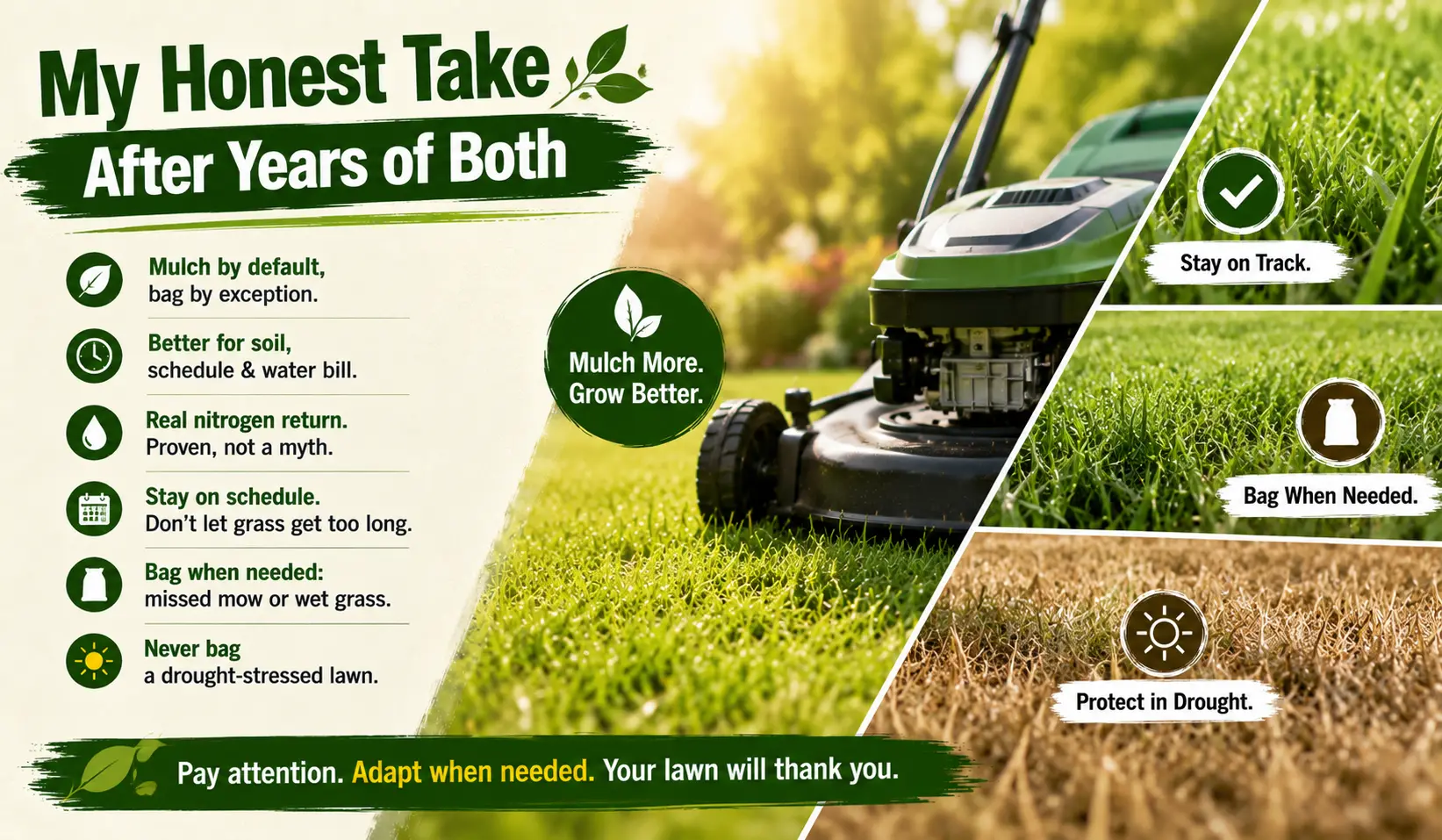
Pros and Cons: Mulching vs Bagging at a Glance
| Mulching | Bagging | |
|---|---|---|
| Lawn health | Returns nitrogen and organic matter; improves soil over time | Removes nutrients; can deplete organic matter long-term |
| Aesthetics | Light clipping residue; mostly invisible if cut at correct height | Clean, finished look immediately after mowing |
| Effort | Lower per session; requires more frequent mowing | Higher per session due to bag stops; more flexible on timing |
| Cost | Reduces fertilizer needs over season | May increase fertilizer need; bag disposal costs possible |
| Best use case | Healthy lawn on a regular mowing schedule; warm-season grasses; dry climates | Long or wet grass; diseased turf; weeds going to seed; fall leaf season |
| Biggest drawback | Clumping and matting if grass is too tall or wet | Removing free nitrogen; soil organic matter loss over multiple seasons |
Frequently Asked Questions About Mulching vs Bagging Grass
Does mulching grass cause thatch buildup?
No. Thatch is made of slow-decomposing materials like grass stems, roots, and stolons. Grass clippings are mostly water and break down within days. Returning clippings does not cause or accelerate thatch. This is one of the most common and persistent myths in residential lawn care.
How often do I need to mow if I mulch?
Every five to seven days during active growth periods. Mulching works best when clippings are short – roughly one inch or less in cut length. If you’re letting grass grow two inches before mowing, the clippings will be too long to mulch cleanly. Frequent, light mowing is the key to mulching well.
Can I mulch wet grass?
Technically yes, but the results are usually bad. Wet clippings clump together and don’t get chopped finely by the mulching blade. Those clumps land on the lawn surface and mat, blocking light and air. If the grass is wet, bag it that session and return to mulching once conditions dry out.
What is the difference between a mulching blade and a regular blade?
A mulching blade (sometimes called a 3-in-1 blade) has a curved surface and additional cutting edges that recirculate clippings through the deck multiple times before dropping them. A standard blade cuts once and discharges. Using a standard blade in mulching mode is less effective – the clippings won’t be as finely cut. Most mulching kits include a plug to close the discharge chute and the appropriate blade.
Should I bag in the fall or mulch through leaf season?
Mulch if leaf coverage is moderate – roughly 30% or less of the surface covered at any time. A mulching mower chops leaves and grass into fine organic matter that feeds the soil over winter. If leaf coverage is heavy, rake or blow first, then mow and mulch what remains. Sending bags of leaves to the curb is disposing of free carbon and organic matter your soil could use.
Is mulching better for the environment than bagging?
Yes, in most cases. Mulching keeps organic matter in the lawn system, reduces the need for synthetic fertilizer, and eliminates yard waste going to landfill or municipal composting. Bagging generates yard waste bags, fuel for collection trucks, and often leads to greater fertilizer use to compensate for removed nutrients.