
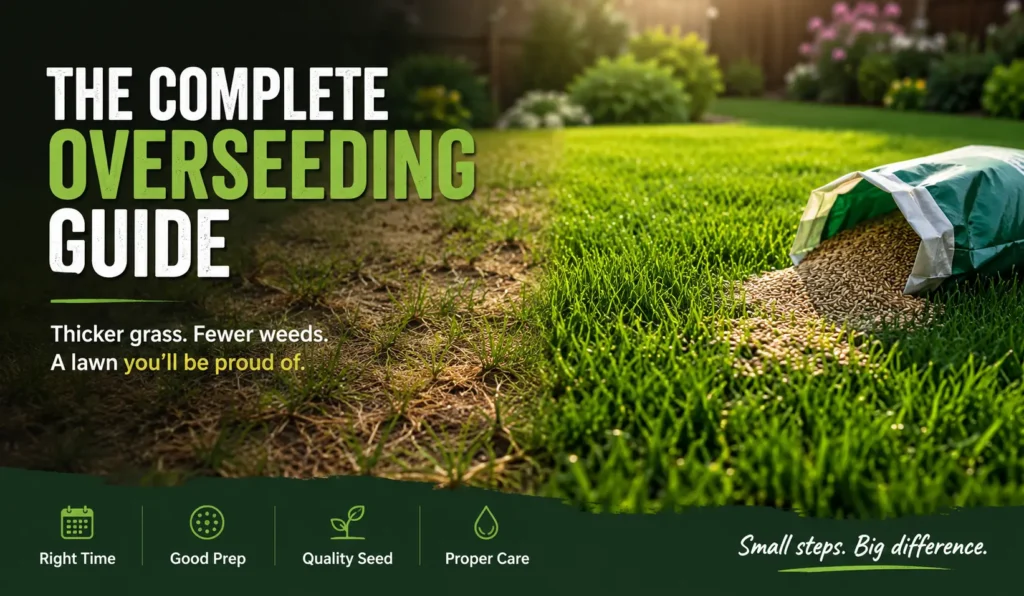
Quick Overview
- Overseeding means spreading new grass seed over existing turf to thicken thin or bare spots – without tearing out what’s already there.
- Timing is the single biggest factor: cool-season grasses (fescue, bluegrass, ryegrass) need late summer to early fall; warm-season grasses (Bermuda, Zoysia) need late spring.
- Soil-to-seed contact is non-negotiable – aerate or dethatch before you seed, or most of your seed will die sitting on thatch.
- A soil test costs about $15 and can save you from wasting $80 worth of seed on pH-hostile soil.
- Most first-timers fail because they seed at the wrong time, skip aeration, or overwater in week one.
The summer I’m most embarrassed about involved a backyard in Ohio that I let go completely patchy by July. Crabgrass had taken over three distinct sections near the fence line, and a dry spring had thinned out a whole strip along the south-facing slope. My neighbor’s fescue was thick enough to lose a shoe in. Mine looked like I’d given up.
I’d tried throwing seed at it the previous fall – just grabbed a bag of “sun and shade” mix from the hardware store, scattered it by hand, and watered for two weeks. Almost nothing germinated. I blamed the seed. The seed was not the problem.
If you’ve ever tried to overseed a lawn and watched it fail, this guide is for you. If this is your first attempt, even better – you get to skip the mistakes I made over two seasons of figuring this out.
This isn’t a textbook walkthrough. It’s what actually worked – and what embarrassingly didn’t – across lawns in Georgia, Ohio, and Colorado.
What Overseeding Actually Is (And Why Most People Skip It)
Overseeding is the process of spreading grass seed directly into existing turf to fill in thin patches, restore density, and improve overall lawn health – without tearing out what’s already growing. It’s not starting over. It’s adding to what’s there.
Most homeowners skip it because it looks like it should be unnecessary. If grass is growing, it’s growing. But grass thins out every year due to heat stress, drought, foot traffic, and natural aging. The average lawn loses noticeable density every 3-5 years without intervention (Penn State Extension, 2022). Overseeding is how you stay ahead of that.
Overseeding vs. Reseeding – What’s the Difference?
Overseeding goes into existing turf. Reseeding (sometimes called lawn renovation) means removing the old grass entirely – by solarization, herbicide, or physical removal – and starting from bare soil.
Overseeding is cheaper, faster, and less disruptive. Reseeding makes more sense when the existing lawn is beyond saving: more than 50% weeds, severely compacted soil, or a grass type that’s completely wrong for your climate. If you’re dealing with patchy fescue in Ohio, overseed. If you’re dealing with a lawn that’s 70% dandelion, renovate.
Why Your Lawn Goes Thin in the First Place
Grass thins for several reasons, and knowing yours changes what you do about it.
Heat and drought stress kill off individual grass plants, especially in exposed or sloped areas where soil dries faster. Foot traffic compacts soil over time, reducing the oxygen and water the root zone needs. Thatch buildup – the layer of dead organic matter between the soil surface and the green growth – can get thick enough to prevent new seedlings from ever reaching soil.
Shade is another factor. A tree that grew out over five years can turn a formerly sunny patch into a semi-shaded zone that existing grass can’t handle. That’s when you need a shade-tolerant seed blend, not just more of the same seed. 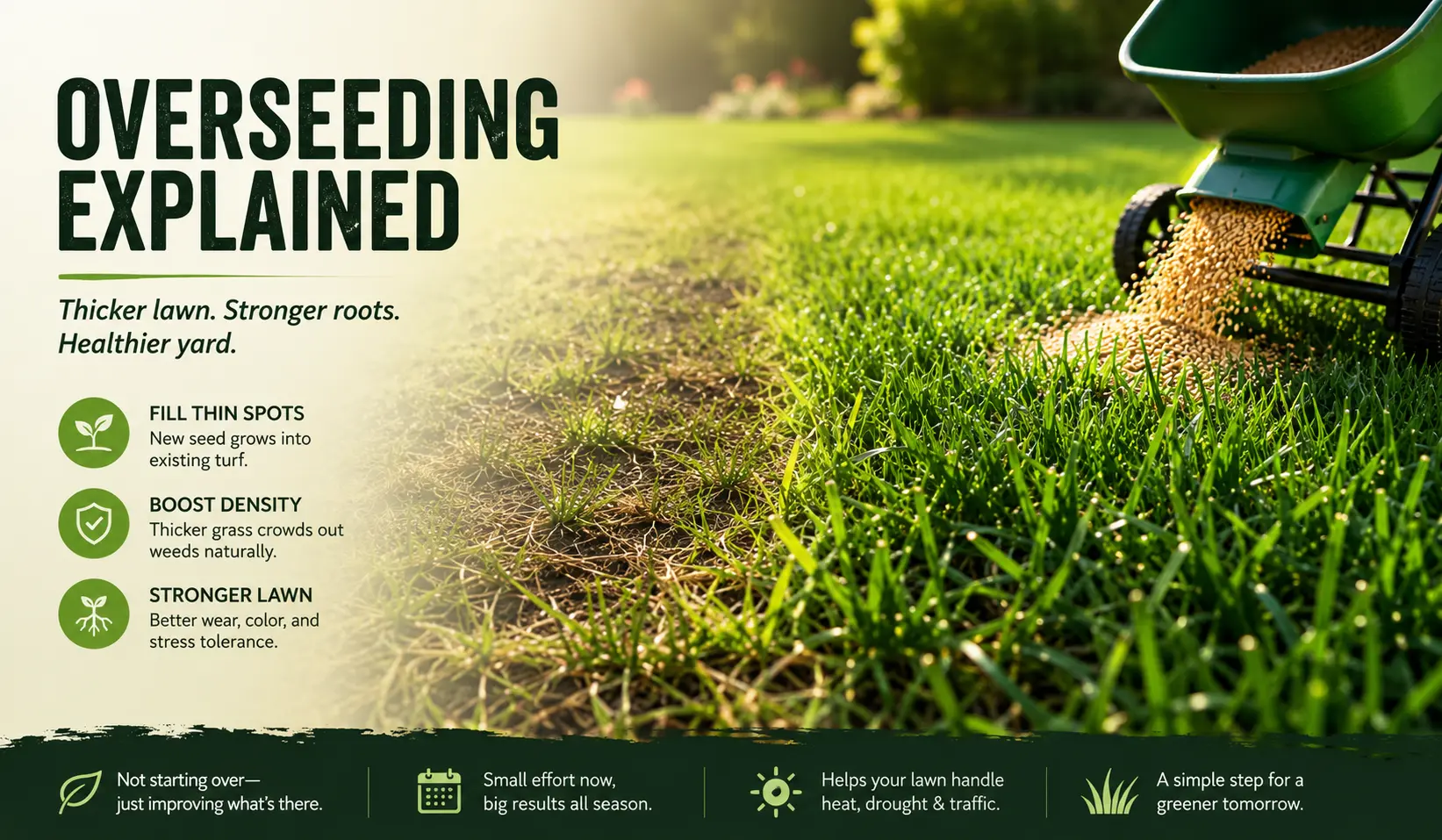
When Is the Best Time to Overseed?
Timing your overseeding correctly is more important than the seed you choose or the equipment you use. Seed the wrong window and you’re betting against the plant’s biology.
The two variables that matter most are soil temperature and the amount of growing time before the next season’s stress. Germination happens within a specific soil temperature range for each grass type. After germination, new seedlings need weeks to establish roots before they face summer heat or winter cold.
Cool-Season Grasses (Fescue, Bluegrass, Ryegrass)
The best window for cool-season grasses is late summer to early fall – typically late August through mid-October, depending on your region. Soil temperatures drop into the 50-65°F range that these grasses prefer, and new seedlings get 6-8 weeks of mild weather before the first frost.
Spring is a distant second option for cool-season grass. You’ll get germination, but the seedlings spend their entire juvenile phase fighting summer heat. Most of them don’t make it.
In Ohio and Minnesota, I aim for the last week of August through mid-September. That window consistently produces the thickest germination I’ve seen.
Warm-Season Grasses (Bermuda, Zoysia, St. Augustine)
Warm-season grasses need soil temperatures above 65-70°F to germinate reliably. That puts the ideal overseed window in late spring – late April through June in most of the Southeast and Southwest.
One caveat: St. Augustine doesn’t grow well from seed at all. It spreads better through sod plugs or sprigs. If your lawn is St. Augustine, talk to a local extension office before buying a bag of seed.
In Georgia, I’ve had good results with Bermuda overseeding in early May when the soil is reliably warm but the brutal summer heat hasn’t set in yet.
What Happens If You Overseed at the Wrong Time
I seeded fescue in mid-July once in Ohio. The soil temperature was around 80°F. I got about 15% germination, and most of those seedlings wilted out by August because they had no root depth going into peak heat.
Seeding too early in spring means seedlings face soil competition from fast-growing spring weeds. Seeding too late in fall means seedlings don’t establish before frost and either die or sit dormant until spring – if they survive at all.
Timing Comparison Table by Grass Type and Region
| Grass Type | Best Overseed Window | Soil Temp Target | Regions |
|---|---|---|---|
| Tall Fescue | Late Aug – mid Oct | 50-65°F | Ohio, Midwest, Mid-Atlantic |
| Kentucky Bluegrass | Late Aug – mid Sep | 50-65°F | Colorado, Upper Midwest |
| Perennial Ryegrass | Late Aug – Oct | 55-65°F | Pacific Northwest, Northeast |
| Bermuda | Late Apr – Jun | 68-75°F | Georgia, Southeast, Texas |
| Zoysia | May – Jun | 68-75°F | Southeast, Mid-South |
| St. Augustine | Plugs only (spring) | 70°F+ | Florida, Gulf Coast |
What You Need Before You Start
Before you open a seed bag, three things will determine whether your overseed works: the right seed for your climate, the right tools for your lawn size, and soil that’s actually ready to accept seed.
Choosing the Right Grass Seed for Your Climate
Match the seed to your USDA hardiness zone and sun exposure, not the bag that looks most appealing at the store.
For cool-season lawns in the Midwest, I’ve had the best results with Jonathan Green’s Black Beauty tall fescue blend. It establishes quickly and handles Ohio’s clay soil better than thinner-bladed varieties. In Colorado, I used Pennington’s Kentucky Bluegrass blend on a higher-altitude lawn and got decent germination, though bluegrass is slower than fescue – expect 2-3 weeks before you see anything.
For warm-season lawns in the Southeast, Scotts Turf Builder Bermuda grass seed with a coating works well on Georgia’s red clay once you’ve corrected soil pH. Uncoated Bermuda seed is cheaper, but the coated version retains moisture longer and improves germination rate noticeably.
One thing I learned the hard way: don’t buy a “sun and shade” blend if your lawn is mostly sun. Those blends are compromises. For a consistently sunny lawn, get a full-sun variety. For genuinely shaded areas (50%+ shade), get a shade-specific mix – usually a fine fescue blend. 
Tools and Equipment You’ll Actually Need
You don’t need a lot of equipment for a basic overseed on a small or medium lawn. Here’s what you actually need versus what’s optional:
Required:
- Mower (set low for prep cut)
- Broadcast spreader or drop spreader for seeding
- Leaf rake or thatch rake for clearing debris
- Garden hose with a sprinkler head – or a sprinkler system
- Starter fertilizer
Helpful but optional for smaller lawns:
- Core aerator (rent one – typically $70-90/day from Home Depot or Lowe’s)
- Lawn roller (helps press seed into soil after spreading)
Worth renting for large lawns over 5,000 sq ft:
- Slit seeder (also called a slice seeder or overseeder machine)
Soil Test – Why I Wish I’d Done This First
I skipped soil tests for the first two overseed attempts. I wasted seed both times because the soil pH in one section of my Ohio lawn was sitting around 5.2 – too acidic for fescue to absorb nutrients properly, even with fertilizer.
A basic soil test costs around $15-20 through your state’s cooperative extension service. It tells you pH, nitrogen levels, phosphorus, and potassium. Most fescue and bluegrass prefer a pH of 6.0-7.0. Bermuda and Zoysia prefer 5.8-7.0.
If your pH is off, apply lime (to raise pH) or sulfur (to lower it) at least 2-4 weeks before overseeding. Lime takes time to activate.
Equipment Comparison Table (Broadcast Spreader vs. Slit Seeder vs. Hand Seeding)
| Method | Best For | Coverage | Seed-to-Soil Contact | Cost |
|---|---|---|---|---|
| Broadcast spreader | Lawns under 5,000 sq ft | Fast, wide | Moderate (needs aeration) | $30-80 purchase |
| Slit seeder | Lawns over 5,000 sq ft or heavy thatch | Slower, thorough | Excellent | $70-100/day rental |
| Hand seeding | Small patches only | Very slow | Poor without raking | Free |
| Drop spreader | Precise placement, small lawns | Slow | Moderate | $40-60 purchase |
The slit seeder is worth renting if you’re doing more than half an acre. It cuts small grooves in the soil and drops seed directly into them, which dramatically improves germination rate compared to broadcasting over an unprepped surface.
How to Overseed a Lawn – Step by Step
This is the process I follow now, after two seasons of getting parts of it wrong. Each step matters. You can skip aeration if your soil is genuinely loose and thatch-free – but in most established lawns, that’s not the case.
Before anything else, do the timing and soil test checks above. If you’re within the right window and your pH is acceptable, here’s the full sequence.
Step 1 – Mow Low and Remove Clippings
Set your mower to its lowest setting – or close to it. For fescue, I go down to about 1.5 inches. For Bermuda, I’ll take it to 1 inch. Mowing short does two things: it reduces competition for the new seedlings, and it lets sunlight and air reach the soil surface.
Bag your clippings this time. Leaving them creates a layer that blocks seed-to-soil contact.
After mowing, use a leaf blower or rake to clear any remaining debris, dead leaves, or loose thatch from the surface.
Step 2 – Dethatch or Aerate the Soil
This is the step I skipped the first time. It’s the most important one.
Thatch is the spongy, brownish layer of dead stems and roots that builds up between the soil and the green grass canopy. If it’s thicker than about half an inch, seed sitting on top of it rarely makes good contact with actual soil.
Dethatching – Use a thatch rake or rent a power dethatcher. Pull it through the lawn in two directions. It looks brutal. The lawn looks worse before it looks better. That’s normal.
Core aeration – A core aerator pulls small plugs of soil out of the ground and leaves them on the surface. This relieves compaction and creates small pockets where seed can fall and make direct soil contact. Leave the plugs on the surface – they break down on their own in a week or two.
On compacted clay soil (very common in Georgia, Ohio, and many parts of the Midwest), aeration makes a bigger difference than almost anything else you’ll do. The crunch of pulling plugs out of dry clay is oddly satisfying.
Step 3 – Spread the Seed at the Right Rate
Check the bag for the overseeding rate – it’s different from the new lawn rate. Using the new lawn rate for overseeding means you’re applying too much seed, which causes competition between seedlings and poor germination across the board.
Typical overseeding rates:
- Tall fescue: 4-6 lbs per 1,000 sq ft
- Kentucky bluegrass: 1-2 lbs per 1,000 sq ft
- Bermuda (hulled): 1-2 lbs per 1,000 sq ft
- Perennial ryegrass: 4-6 lbs per 1,000 sq ft
Load your broadcast spreader and make two passes at half the rate each time – one going north-south, one going east-west. This gives you even coverage and fills in any gaps from the first pass.
After spreading, use the back of a rake to lightly work the seed into the aeration holes and any loose thatch. This improves seed-to-soil contact without burying the seed too deep. Grass seed germinates best in the top 1/8 to 1/4 inch of soil – no deeper.
Step 4 – Apply Starter Fertilizer
Apply starter fertilizer immediately after seeding, before the first watering. Starter fertilizer is high in phosphorus, which supports root development in new seedlings. A standard 10-18-10 or similar ratio works well (Scotts Starter Fertilizer and Andersons PGF are the ones I’ve used most).
Do not use a weed-and-feed product here. Most weed preventers are also pre-emergents – they’ll prevent your grass seed from germinating along with the weeds.
Don’t over-apply. Follow the bag rates. More fertilizer doesn’t mean faster growth; it means burned seedlings.
Step 5 – Water Without Washing the Seed Away
Watering correctly in the first two weeks is where most people either save or kill their overseed.
The goal is to keep the top 1/2 inch of soil consistently moist – not soaked, not dry. For the first 2 weeks, water lightly 2-3 times per day if you can. Morning and early afternoon are better than evening (evening watering increases disease risk).
Use a sprinkler head that gives you a fine mist or gentle spray – not a strong jet that moves seed around. I’ve watched people blast perfectly seeded areas with a hose nozzle on “jet” setting and wash the seed into piles at the edge of the lawn. Sound travels, and the sound of seed hitting dry soil and not moving is what you’re after.
Once the seedlings are about 1 inch tall (usually 2-3 weeks in), shift to deeper, less frequent watering: 2-3 times per week, soaking down about 4-6 inches.
Don’t mow until the new grass reaches 3-4 inches. First mow should take off no more than one-third of the blade height.
Step-by-Step Checklist Table
| Step | Task | Common Error |
|---|---|---|
| 1 | Mow low, bag clippings | Leaving clippings on surface |
| 2 | Dethatch and/or aerate | Skipping entirely on compacted soil |
| 3 | Spread seed at overseeding rate (not new lawn rate) | Using too much seed |
| 4 | Apply starter fertilizer | Using weed-and-feed instead |
| 5 | Water lightly 2-3x daily for 2 weeks | Overwatering or using strong spray |
| 6 | Wait until 3-4 inches to mow | Mowing too early |
How Results Differ Across US Climates
Germination timelines and success rates vary significantly by region. What works in September in Ohio needs adjustment for Georgia in May or Colorado in August.
The basic process stays the same. What changes is seed choice, watering frequency, and realistic germination expectations.
Hot and Humid Lawns (Georgia, Florida, Southeast)
Bermuda and Zoysia are the right grasses here. Cool-season grasses planted in the South summer out – they go dormant or die when temperatures stay above 90°F for weeks at a time.
In Georgia clay, aeration is critical. The red clay compacts easily and drains poorly. I’ve found double aeration – two passes in perpendicular directions – makes a noticeable difference in Georgia clay compared to a single pass.
Watering needs are higher in heat. You may need to water 3-4 times daily during the first two weeks if daytime temperatures are above 85°F. Early morning watering is essential; midday evaporation kills soil moisture fast.
Germination for Bermuda in warm soil typically runs 7-14 days. Don’t judge your results until you’re past day 14. 
Dry and Rocky Soil (Southwest, Colorado, Arizona)
Colorado presents a specific challenge: low humidity means the soil surface dries out quickly, even if it rained the day before. Kentucky bluegrass is the standard choice for Colorado’s Front Range, but it germinates slowly and needs careful moisture management.
Phoenix and Tucson lawns often use Bermuda with winter overseeding of perennial ryegrass to keep the lawn green when Bermuda goes dormant. This is a two-grass system: Bermuda handles summer, ryegrass handles winter.
Rocky or sandy soil needs a pre-overseed compost layer in some cases – roughly 1/4 inch of compost worked into the surface helps with water retention.
Altitude matters too. At 5,000+ feet, UV intensity is higher and evaporation is faster. You may need to shade newly seeded areas with burlap or straw for the first week.
Cool and Dense Turf (Midwest, Ohio, Minnesota)
Ohio and Minnesota lawns typically run tall fescue or Kentucky bluegrass. The good news is that the climate is well-suited for cool-season grass: warm days and cool nights in September are nearly ideal.
The challenge in the Midwest is thatch. Established fescue lawns often accumulate significant thatch over 3-4 years. Skipping dethatching means seed sits in a spongy layer and never reaches soil.
In Minnesota, the window tightens. By mid-September you’re looking at frost risk in some years. If you’re in Minnesota, overseed no later than the first week of September to ensure 6 weeks of establishment before hard frost.
Climate vs. Expected Germination Time Table
| Grass Type | Climate | Soil Temp | Germination Timeline |
|---|---|---|---|
| Tall Fescue | Ohio (fall) | 55-65°F | 7-14 days |
| Kentucky Bluegrass | Colorado (fall) | 50-60°F | 14-21 days |
| Perennial Ryegrass | Minnesota (early fall) | 55-65°F | 5-10 days |
| Bermuda (hulled) | Georgia (spring) | 68-75°F | 7-14 days |
| Zoysia | Southeast (spring) | 68-75°F | 14-21 days |
| Ryegrass (winter) | Arizona (fall) | 55-65°F | 5-10 days |
Common Overseeding Mistakes I’ve Made (So You Don’t Have To)
I’ve made most of these at least once. Some of them twice.
Seeding Too Late in the Season
My first Ohio overseed was in early October. I thought I still had time. Germination happened, slowly, over about 18 days – and then we had a cold snap in mid-October that dropped nighttime temperatures below 28°F for four consecutive nights. The seedlings that had just emerged were gone.
Fescue seedlings can handle light frost once they’re established. Brand-new seedlings with almost no root depth cannot.
The cutoff is roughly 6 weeks before the average first hard frost date for your area. NOAA’s frost date maps give you this by zip code. Use it as your deadline, not a guideline.
Skipping Aeration on Compacted Soil
My second mistake, and the one that explained my first failed overseed. I scattered seed on thatch in a compacted clay lawn in Ohio, watered it faithfully for two weeks, and got about 12% germination.
When I finally tested the soil that fall, I found out the soil was so compacted that water was pooling on the surface and running off rather than soaking in. The seed never had a chance.
A $70 aerator rental would have saved me a $55 bag of seed and two weeks of daily watering.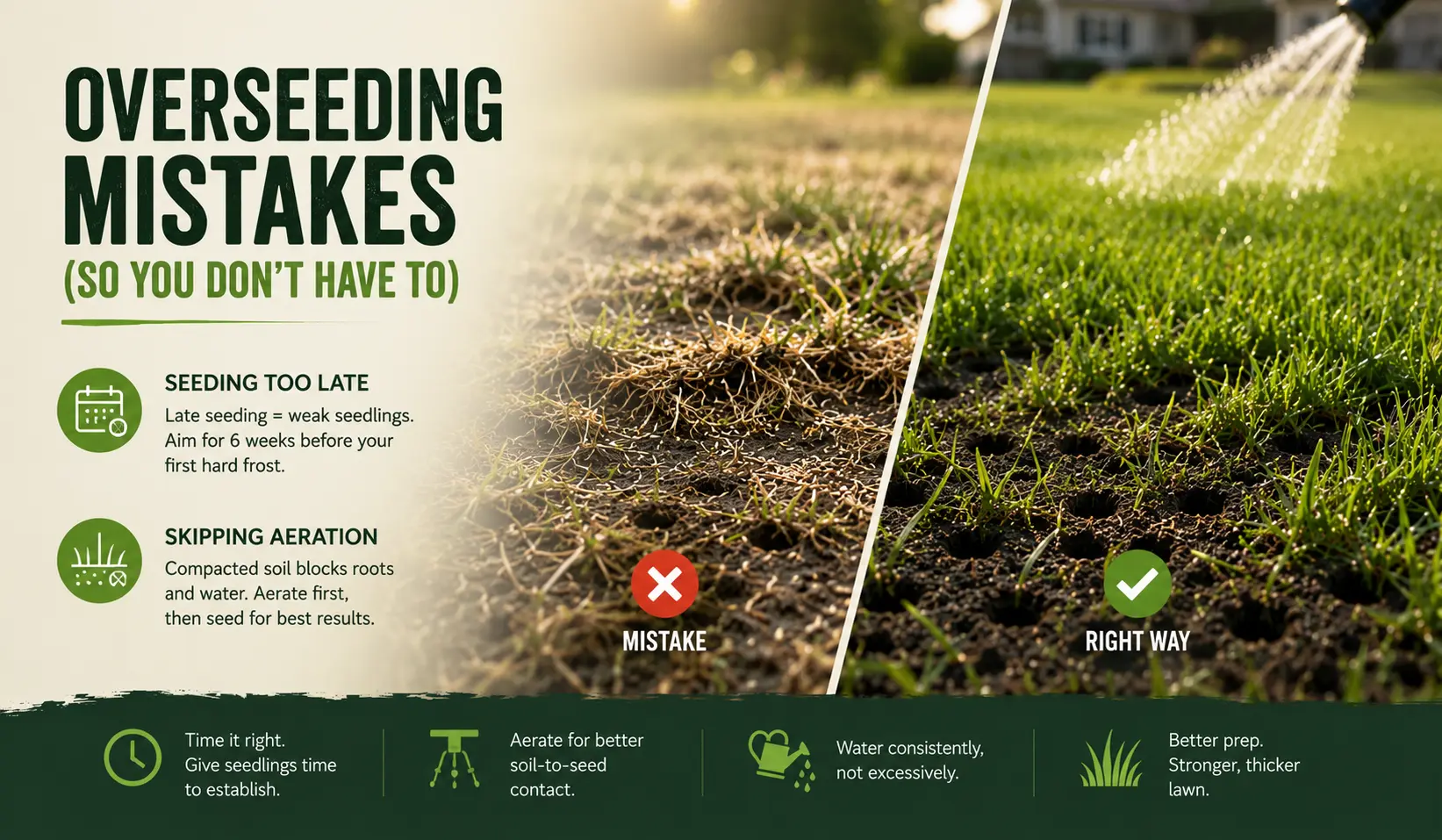
Overwatering in the First Week
This one surprised me in my Georgia lawn. I watered heavily, twice a day, in the first week after seeding in early May. Temperatures were warm and I assumed more water meant faster germination.
What actually happened was fungal disease in two patches – a gray, matted growth that killed seedlings in a roughly circular pattern. The soil surface stayed too wet for too long, and Pythium blight moved in. It’s a common warm-weather disease that thrives in consistently wet, warm surface conditions.
Light and frequent is the rule – not heavy and frequent. The top half-inch should be moist, not saturated.
My Final Recommendation
If I were overseeding a lawn today, starting from scratch with what I know now, I’d do three things differently than my first attempt.
First, I’d do the soil test before anything else. It’s the cheapest insurance you can buy. A bag of seed on pH 5.2 soil is money in a compost pile. An $18 test tells you whether you need to correct pH before you spend anything else.
Second, I’d rent a slit seeder for anything over 3,000 square feet. Hand broadcasting into an established lawn, even after aeration, gives you uneven seed-to-soil contact. The slit seeder puts seed directly into the ground. Germination rates go up noticeably – in my experience, from roughly 40-50% with broadcast spreading to 70-80% with a slit seeder on the same lawn.
Third, I’d trust the timing tables and ignore the temptation to start early in spring. I’ve done spring fescue overseed twice. Both times the germination was decent and the results were mediocre by July. Fall is when cool-season grass wants to grow. Work with the grass, not around it.
The one thing that surprised me: lawn care in general rewards patience more than effort. You can do everything right and still wait 21 days for Kentucky bluegrass to show. That’s not failure – that’s biology.
Pros and Cons of Overseeding vs. Full Lawn Renovation
| Factor | Overseeding | Full Lawn Renovation |
|---|---|---|
| Cost | Low ($50-200 DIY) | High ($500-3,000+ depending on lawn size) |
| Time to results | 3-8 weeks | 8-16 weeks (from bare soil) |
| Disruption | Minimal | Complete removal of existing grass |
| Best for | Thin lawns with less than 50% weeds | Weed-dominated, heavily compacted, or wrong-grass lawns |
| Weed risk | Existing weeds remain | Can start fresh with clean soil |
| Effort | Moderate | High |
| DIY-friendly | Yes | Partially (depends on renovation method) |
Frequently Asked Questions About Overseeding
What is overseeding a lawn?
Overseeding means spreading new grass seed over existing turf to fill in thin patches and restore lawn density, without removing the existing grass. It’s used to thicken a lawn that has thinned due to heat, drought, traffic, or aging – and is far less disruptive and expensive than a full lawn renovation.
How long does overseeded grass take to germinate?
Germination time depends on grass type and soil temperature. Perennial ryegrass is fastest at 5-10 days. Tall fescue germinates in 7-14 days. Kentucky bluegrass is the slowest at 14-21 days. Cool soil or inconsistent moisture extends these timelines.
Do I need to aerate before overseeding?
In most established lawns, yes. Aeration creates pockets in the soil for seed to reach mineral soil rather than sitting on thatch. On genuinely loose, well-draining soil with minimal thatch, you may be able to skip it – but for compacted clay soils common in the Midwest and Southeast, aeration consistently improves germination rates.
Can I overseed in spring instead of fall?
You can overseed cool-season grasses in spring, but results are usually weaker than fall overseeding. Seedlings established in spring face summer heat before their roots are deep enough to handle it. Fall gives cool-season grasses ideal germination conditions and 8+ months before the next summer stress period.
What fertilizer should I use after overseeding?
Use a starter fertilizer, which is high in phosphorus (the middle number in the N-P-K ratio). A 10-18-10 or similar blend supports root development in new seedlings. Do not use a weed-and-feed product – pre-emergent herbicides in those formulas prevent grass seed germination along with weeds.
How often should I water after overseeding?
For the first 2 weeks, water lightly 2-3 times daily to keep the top half-inch of soil consistently moist. After seedlings reach 1 inch tall, shift to deeper watering 2-3 times per week. Avoid heavy single waterings early on – they can wash seed, cause fungal disease, or create poor surface conditions for germination.
When can I mow after overseeding?
Wait until new grass reaches 3-4 inches before mowing. Set the mower high and remove no more than one-third of the blade height in the first mow. Mowing too early stresses shallow-rooted seedlings and can pull them out of the soil entirely.