
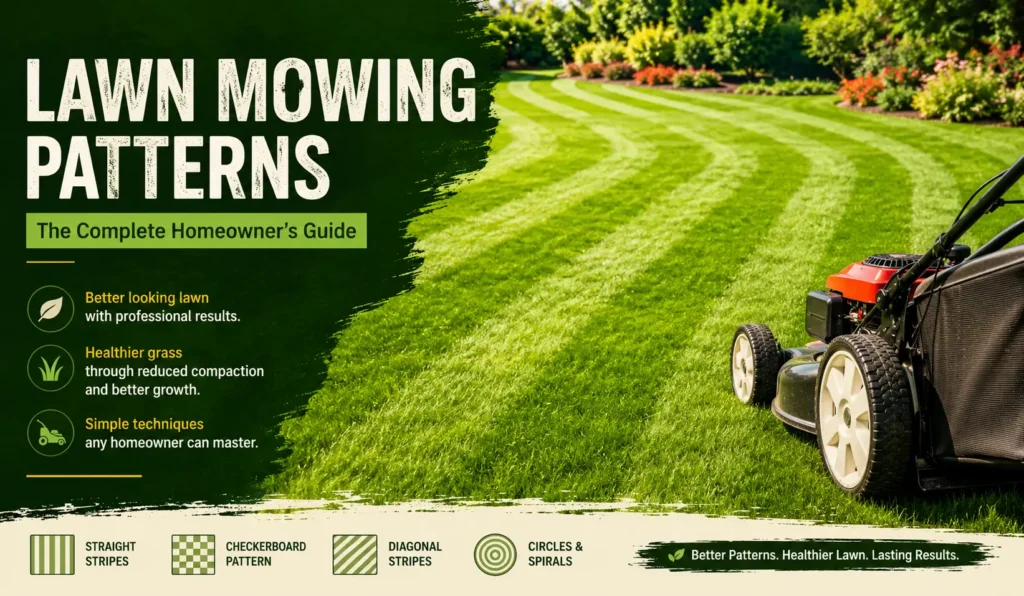
Quick Overview
- Lawn mowing patterns do more than look good – they affect grass blade direction, soil compaction, and long-term turf health.
- Straight stripes are the easiest starting point for beginners and work on almost any yard type.
- Checkerboard and diagonal patterns require more planning but deliver noticeably better visual impact.
- Warm-season grasses like Bermuda don’t stripe as dramatically as cool-season grasses like Kentucky Bluegrass.
- Rotating your pattern every 1-2 mows prevents ruts, compaction, and grass that leans permanently in one direction.
I used to live next door to a guy in suburban Ohio who had the most ridiculous-looking yard on the block. Not in a bad way. His lawn looked like it belonged outside a baseball stadium. Clean diagonal stripes, alternating shades of green, perfectly edged. Meanwhile mine looked like I’d chased a dog across it with a mower.
The difference wasn’t his grass. It wasn’t even his mower. It was his lawn mowing patterns.
This guide is for homeowners who want that same result without hiring a lawn crew. I’ve mowed dozens of different yard types – small Ohio subdivisions, wide-open Minnesota properties, thick Bermuda-grass lots in Georgia – and I’ll walk you through what actually works, what looks impressive with the least effort, and what’s honestly not worth your time.
Why Lawn Mowing Patterns Actually Matter
Most homeowners think patterns are purely cosmetic. They’re not.
It’s Not Just About Looks
The striping effect you see in a well-mowed lawn comes from grass blades bending in opposite directions. When blades bend toward you, they reflect more light and appear lighter. When they bend away, they look darker. That contrast creates the stripe.
But here’s what most guides skip: the direction you push your mower also determines where wheel and foot traffic is repeatedly concentrated. Mow the same path every week, and you’re compressing that exact strip of soil over and over. Compacted soil restricts root growth, drains poorly, and weakens the grass.
Varying your pattern breaks that compaction cycle. It’s a real, practical benefit – not just aesthetics.
How Patterns Affect Grass Health Over Time
When grass is always cut in the same direction, the blades start to lean. That lean is called “grain,” and it affects how your lawn plays (if you’re a golfer, you already know this) and how evenly it grows.
Heavy grain also makes your lawn harder to cut cleanly. You’re always going against or with the lean rather than through it. Rotating your mowing direction every couple of sessions keeps the blades upright, improves cut quality, and reduces the chance of scalping along ridges caused by compacted ruts.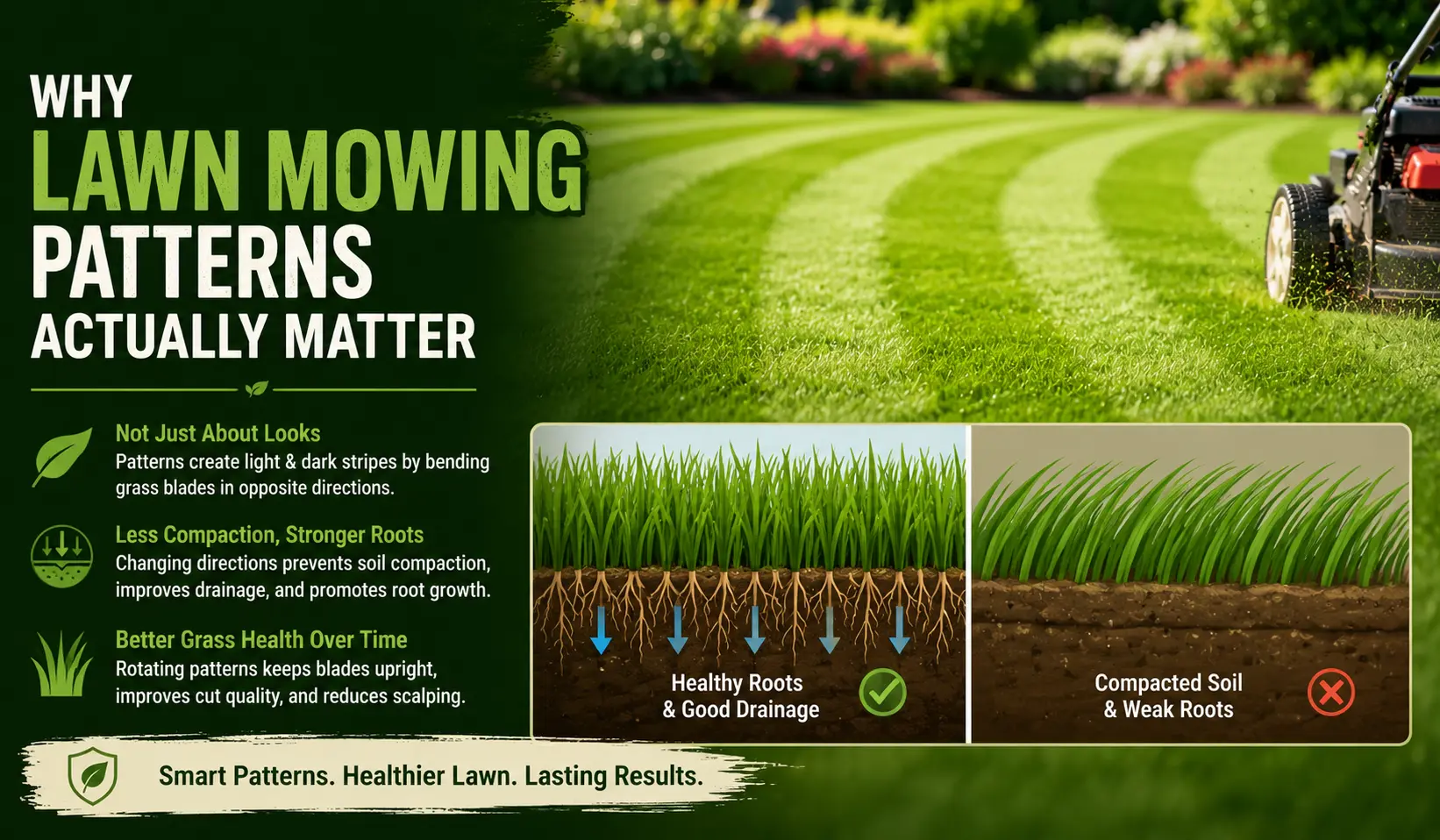
The Most Common Lawn Mowing Patterns Explained
There are four patterns most homeowners will ever need. Everything else is a variation or a combination.
Straight Stripes
This is the baseline. You mow in a straight line to one end of the yard, lift or turn, and come back parallel to your first pass with about a 1-2 inch overlap.
The visual result depends entirely on how straight your lines are. Start by picking a fixed reference point at one end – a fence post, the edge of the driveway, a tree. Lock onto it and walk toward it. Don’t look down at the mower. Looking ahead is the single biggest technique improvement most beginners make.
Straight stripes work on nearly every yard type and any standard mower. No special equipment required.
Checkerboard (Double Stripe)
The checkerboard is just two rounds of straight stripes – one set running north-south, one running east-west. You mow the full yard in one direction first, then mow it again perpendicular.
In morning light, a good checkerboard on Kentucky Bluegrass looks genuinely stunning. I’ve had neighbors stop their cars to ask how I did it.
The trade-off: you’re mowing the lawn twice. That’s double the time and double the wear on the grass. For most people, this is a once-a-month pattern, not a weekly one.
Diagonal Stripes
Diagonal stripes run at 45 degrees to your property lines instead of parallel to them. Setup is the same as straight stripes – you need a reference line to walk toward – but you’re working from a corner.
The visual effect is sharper than straight stripes because the diagonal creates a stronger contrast at the edges where light changes. This is the pattern my old neighbor in Ohio was running.
One honest note: diagonal stripes on irregular lots look messy. If your yard has odd angles, curves, or protruding garden beds, diagonals are more trouble than they’re worth.
Circles and Spirals
Circles start from the outside edge and spiral inward, or from the center and spiral outward. Professional groundskeepers use them on athletic fields where they want a radial design.
For a typical home lot? I’d skip it. The turns are tight, controlling the overlap is hard, and if you drift even slightly, the whole pattern falls apart. The grass health benefits are real – you’re rarely repeating the same direction twice – but the difficulty level is high for results most homeowners won’t appreciate at street level.
Pattern Comparison by Difficulty, Best Yard Type, and Visual Impact
| Pattern | Difficulty | Best Yard Type | Visual Impact | Extra Equipment |
|---|---|---|---|---|
| Straight Stripes | Low | Any | Moderate | None |
| Checkerboard | Medium | Square/rectangular lots | High | None |
| Diagonal Stripes | Medium | Large, open yards | High | None |
| Circles/Spirals | High | Round or perfectly symmetrical yards | Very High | Striping kit helps |
Which Pattern Works Best for Your Yard
The right pattern depends on your lot’s shape more than anything else. Pick the wrong one and you’ll spend more time making correction passes than actually mowing.
Small and Narrow Yards
Straight stripes running the long dimension of the yard. That’s it. Trying to run a checkerboard on a 30-by-60-foot suburban yard eats up more time in turns than in actual mowing passes.
If your yard is genuinely narrow – say, under 20 feet wide – diagonal stripes actually help. They let you run a slightly longer line before turning, which means fewer awkward pivots.
Large Open Lawns
Large open properties in the Midwest are where checkerboards and diagonals really shine. You have room to build momentum, get your lines straight, and see the full pattern develop before you have to turn.
On wide Minnesota or Iowa properties I’ve mowed, straight stripes at 45 degrees across the full width of the lot create a professional look with a single mowing pass. No second round needed.
Oddly Shaped or Irregular Lots
Irregular lots – the kind with a jutting garden bed, an angled property line, or a curve where the yard meets the street – need a different approach.
The best strategy: identify the largest rectangular or square-ish section of the yard and run your pattern there. Then treat the irregular edges as a separate “cleanup” pass. You spiral or trim those areas last. This keeps your main pattern clean without fighting the odd geometry. 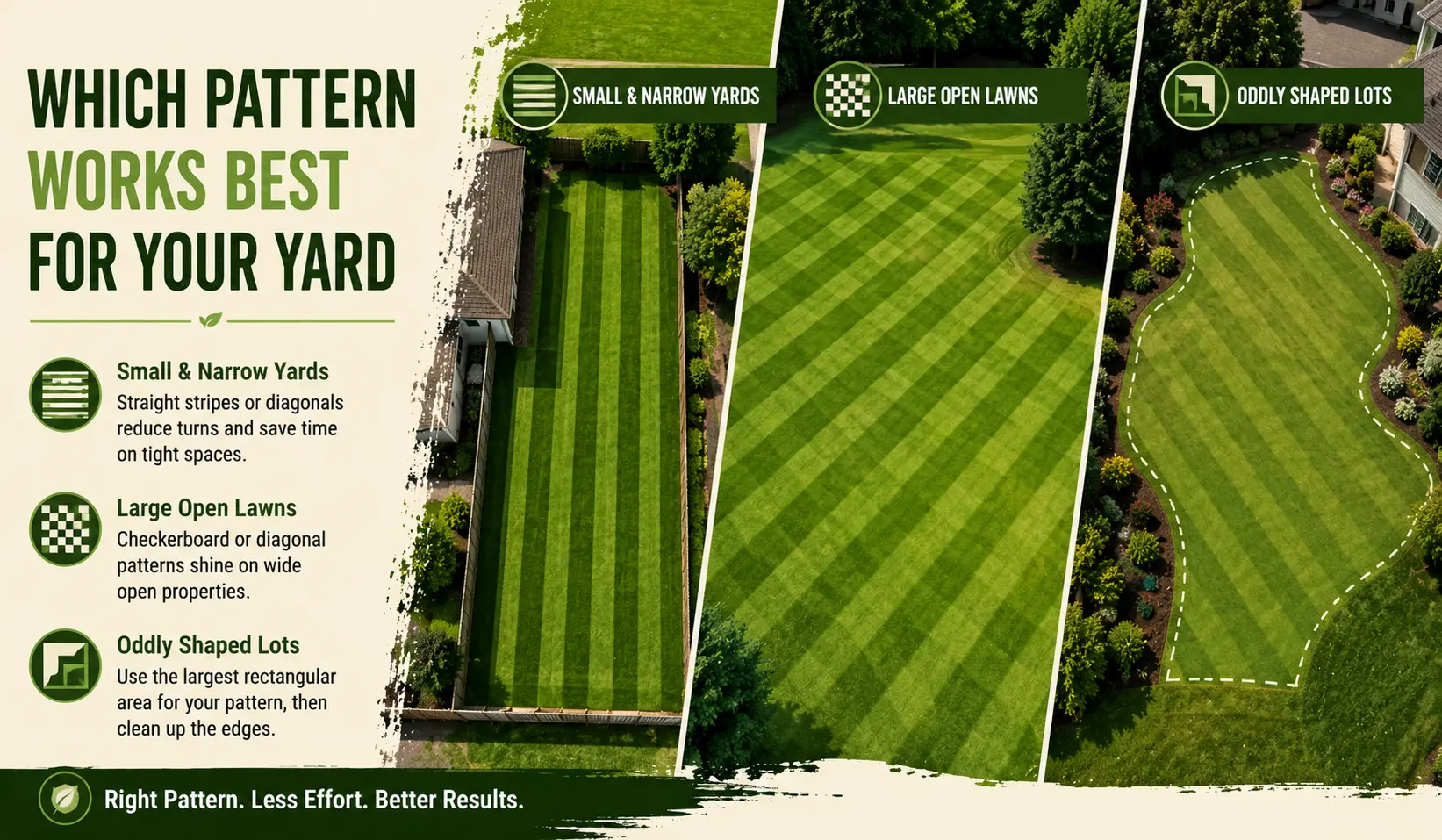
Slopes and Uneven Terrain
Mow across slopes, not up and down them. This is a safety rule first, but it’s also a pattern rule. Running your stripes horizontally across a slope looks better from the road and keeps your footing stable.
On steep or uneven terrain like some Georgia backyards with thick Bermuda, I switch to a simple back-and-forth pattern with a slight angle. You’re not going for visual drama here – you’re going for even coverage and not sliding downhill with a running mower.
Yard Type vs. Recommended Pattern
| Yard Type | Recommended Pattern | Why |
|---|---|---|
| Small/narrow lot | Straight stripes (long axis) | Fewest turns, clean look |
| Large open lawn | Checkerboard or diagonal | Room to develop full pattern |
| Irregular/oddly shaped | Straight stripes in main area + cleanup passes on edges | Keeps pattern readable |
| Slopes | Horizontal straight stripes | Safety + even cut |
| Round or circular yard | Circles/spirals | Natural alignment with yard shape |
How to Actually Mow Stripes Like a Pro
The technique matters as much as the pattern choice. Good equipment helps, but most beginners’ stripe problems come from execution, not gear.
The Right Equipment (Rollers, Striping Kits, Regular Mowers)
You do not need special equipment to mow stripes. Any rear-wheel-drive push mower or riding mower will produce some degree of striping just from its rear roller or the pressure of the deck.
That said, a striping kit – a rubber flap or roller that attaches behind your mower deck – bends the grass blades more aggressively. The result is a crisper, higher-contrast stripe. On cool-season grasses especially, the difference is visible.
A dedicated lawn roller (a weighted drum you pull behind the mower or separately) gives you even more blade bending. These are worth it if you’re maintaining a large property or you want professional-grade results. For a typical suburban lot, the built-in roller on most push mowers is enough.
Mowing Direction and Overlap Rules
Always overlap each pass by 1-3 inches. This prevents the thin strip of uncut grass that shows up between passes – sometimes called “mohawk” lines.
At the end of each row, mow a border strip around the entire perimeter of the yard first. This gives you a turning lane at each end so you’re not grinding your wheels into the lawn on every reverse.
Walk straight. This sounds obvious, but most people naturally drift without a fixed target point. Pick something 20-30 feet ahead and walk toward it. Don’t look down.
How Often to Switch Patterns
Switch your pattern every 1-2 mows. This is not a hard rule, but as a general guide:
- Cool-season grasses: Switch every mow if possible. These grasses stripe easily and also develop grain quickly.
- Warm-season grasses: Every 2-3 mows. They’re harder to stripe, and the visual difference between passes is subtler.
At a minimum, never mow the same direction more than two weeks in a row.
Equipment Options by Budget and Result
| Option | Approximate Cost | Best For | Stripe Quality |
|---|---|---|---|
| Standard push mower (no kit) | Equipment you already own | Casual homeowner | Moderate |
| Striping kit attachment | $30-$80 | Homeowners who want sharper stripes | Good |
| Rear roller mower | $300-$600+ | Large lawns, serious results | Excellent |
| Dedicated lawn roller | $50-$200 | Adding to existing setup | Excellent |
Grass Type Changes Everything
The same technique that creates dramatic stripes on Kentucky Bluegrass does almost nothing on Bermuda. Understanding why changes how you approach the whole process.
Cool-Season Grasses (Kentucky Bluegrass, Fescue, Ryegrass)
Cool-season grasses have finer blades that bend easily and hold their direction well. This is why stadium turf – usually Bluegrass or a blend – looks so vivid on television.
In northern yards (Minnesota, Ohio, the upper Midwest), these grasses respond beautifully to striping. Even a standard push mower with no striping kit will produce visible stripes on a healthy Bluegrass lawn mowed at the right height (2.5 to 3.5 inches).
Don’t cut cool-season grasses below 2.5 inches if you want stripes. Short grass bends less.
Warm-Season Grasses (Bermuda, St. Augustine, Zoysia)
Warm-season grasses have coarser, denser blades. They don’t bend as easily, so the light-reflection contrast that creates visible stripes is much weaker.
I spent a summer trying to get baseball-field stripes on a Georgia Bermuda lawn. The result was visible but underwhelming compared to what I’d get on Bluegrass. The pattern was there – you could see it – but it didn’t pop the way it did up north.
The practical advice: don’t chase dramatic stripes on warm-season grasses. Focus on clean, consistent mowing at the right height instead. Bermuda looks best mowed short (0.5 to 1.5 inches with a reel mower, 1.5 to 2 inches with a rotary). St. Augustine does better at 3 to 4 inches.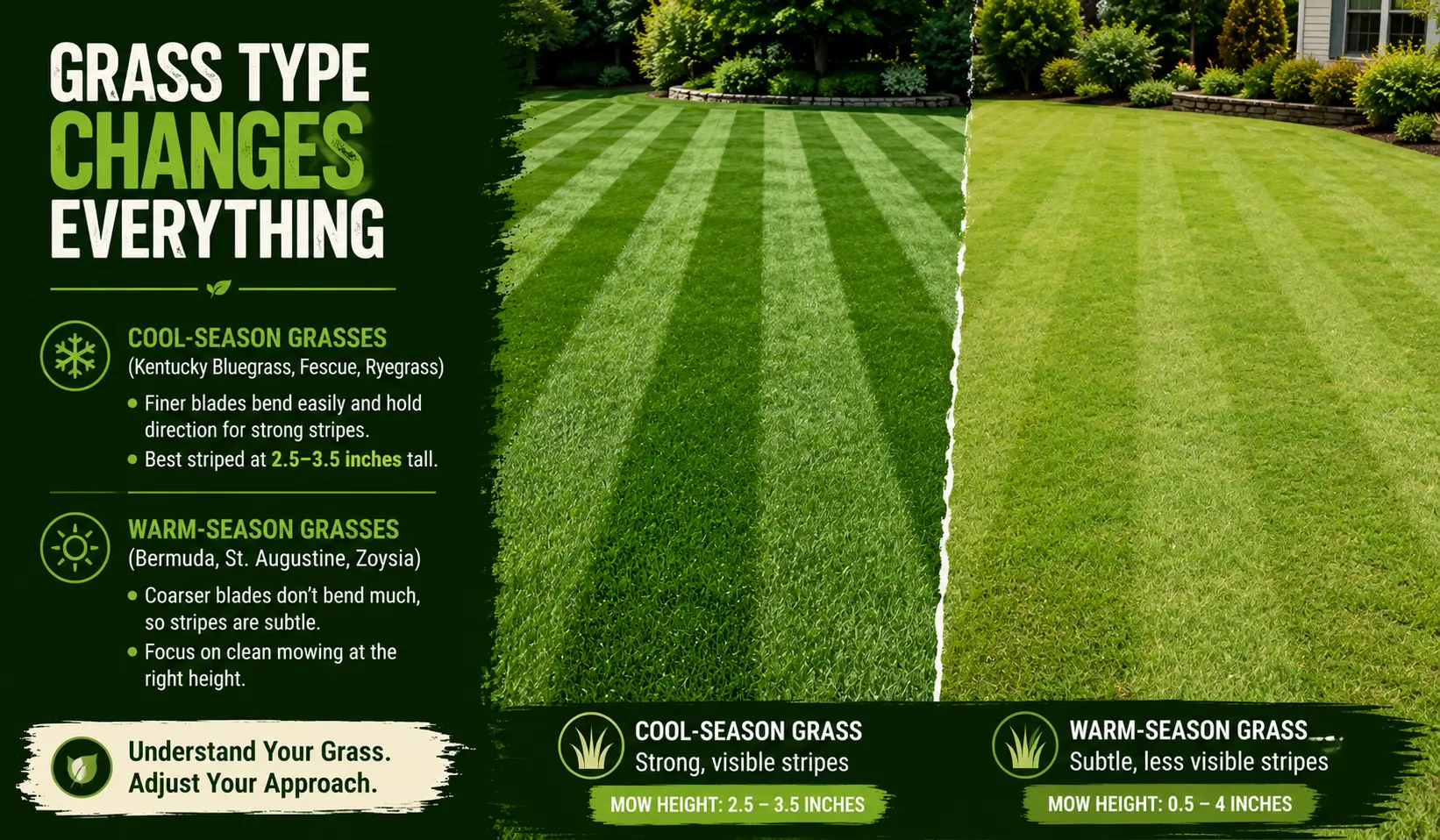
Grass Type vs. Best Pattern and Mowing Height
| Grass Type | Best Pattern | Mowing Height | Stripe Potential |
|---|---|---|---|
| Kentucky Bluegrass | Checkerboard or diagonal | 2.5-3.5 in | High |
| Tall Fescue | Straight stripes | 3-4 in | Moderate-High |
| Perennial Ryegrass | Any | 2-3 in | High |
| Bermuda | Straight stripes | 0.5-2 in | Low |
| St. Augustine | Straight stripes | 3-4 in | Low-Moderate |
| Zoysia | Straight stripes | 1-2.5 in | Moderate |
Mistakes That Ruin Your Mowing Pattern
Most pattern failures come from the same handful of errors. They’re all fixable once you know what to look for.
Always Mowing the Same Direction
This is the most common mistake, and it compounds over time. Mow the same direction every week and within a few months you’ll have:
- Visible ruts where the wheels always run
- Grass that leans in one direction and is hard to cut cleanly
- Compacted soil strips that show up as dry, thin grass in summer
The fix is simple. Write a note on your phone or garage whiteboard: “switched to diagonal” or “east-west today.” Alternate every week.
Cutting Too Low or Too High
Scalping – cutting too short in a single pass – stresses the grass severely. You’re removing more than the top third of the blade, which forces the plant to pull energy from its roots to recover. Repeated scalping leads to thin, patchy turf.
On the other hand, cutting too high leaves the lawn looking shaggy and makes stripes almost invisible. The blade needs to be long enough to bend and create contrast, but short enough that the cut is actually clean.
Never remove more than one-third of the blade height in a single mow. If the grass got ahead of you, lower gradually over 2-3 sessions.
Starting in the Wrong Spot
Most people start at the edge of the yard and work inward. That’s fine, but where exactly on the edge matters.
If you start at an angle to your house or fence, every stripe that follows inherits that angle. By the time you’re halfway across the yard, your lines are noticeably crooked.
Always start parallel to the longest straight edge of your property – typically your house, a fence, or the street. Use that edge as your anchor for the first two passes. Every subsequent pass follows naturally.
My Go-To Pattern for Each Season
In spring, I start with straight stripes running north-south. The lawn is recovering, growth is uneven, and I want simple, clean coverage rather than complexity. Once the grass thickens up after a couple of mows, I switch to diagonal stripes in late May. The diagonal shows off the green at its peak and the overlapping passes help even out any winter damage.
Summer is when I stay consistent and boring on purpose. Heat-stressed grass doesn’t need the extra mowing pass a checkerboard requires. Straight stripes, rotate direction every week, and keep the blade height up. The lawn looks fine and the grass stays healthier.
Fall is the best time to get ambitious with your pattern. Cooler temperatures, lower stress, and the last weeks before dormancy – that’s when I’ll run a checkerboard on a cool-season lawn. The visual payoff is at its highest when the grass is green, healthy, and growing fast.
For anyone just starting out: run straight stripes parallel to your longest property edge. Get those lines clean and consistent before worrying about anything else. A sharp, straight stripe on a healthy lawn looks better than a sloppy checkerboard every time.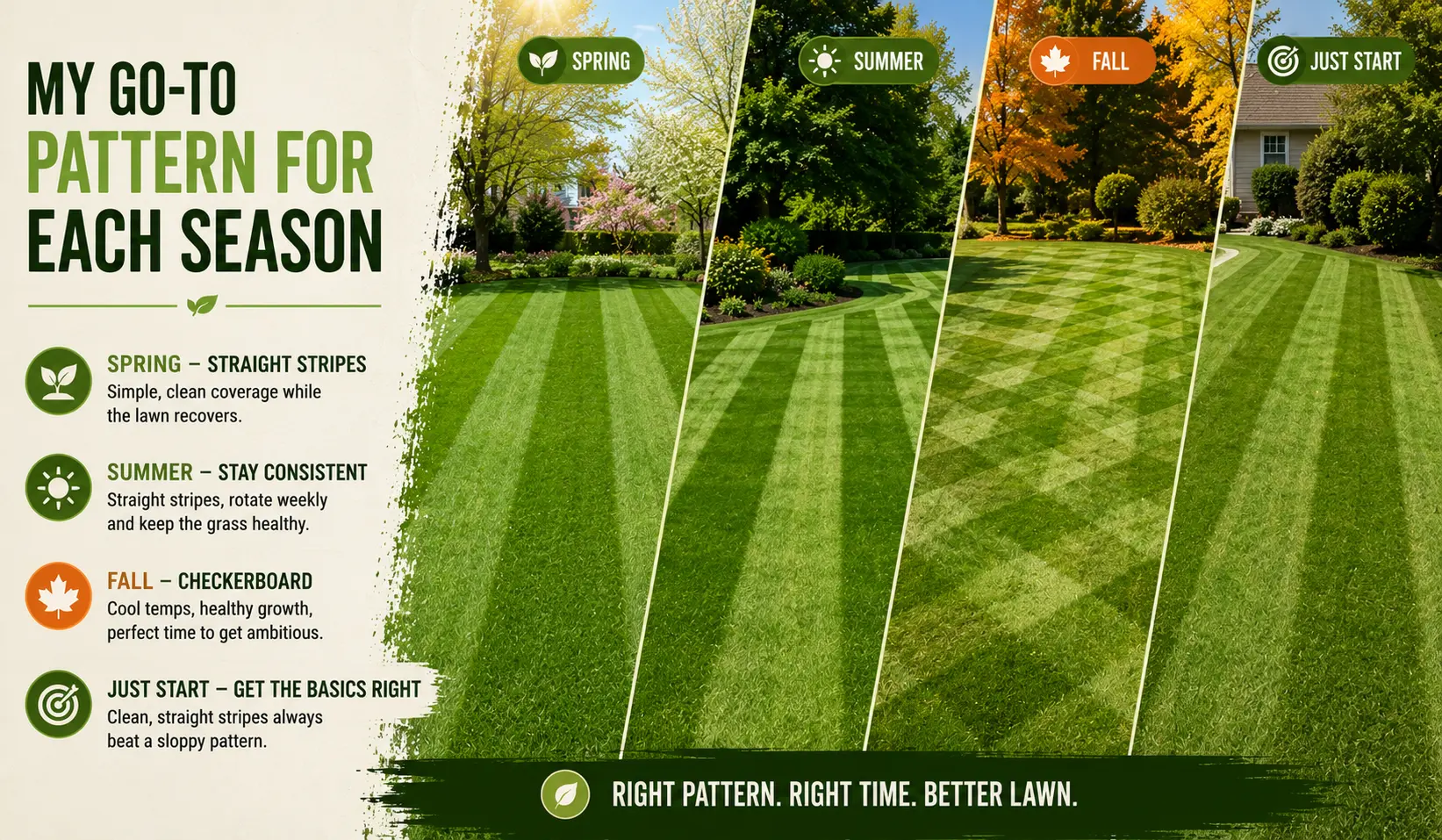
Pros and Cons: All Major Patterns at a Glance
| Pattern | Difficulty | Visual Impact | Grass Health Benefit | Best For |
|---|---|---|---|---|
| Straight Stripes | Low | Moderate | Good (if direction is rotated) | All yards, all skill levels |
| Checkerboard | Medium | High | Very Good (two passes, two directions) | Square/rectangular lots, cool-season grasses |
| Diagonal Stripes | Medium | High | Good | Large open lawns, corner lots |
| Circles/Spirals | High | Very High | Excellent (constant direction change) | Round yards, athletic-field aesthetics |
Frequently Asked Questions About Lawn Mowing Patterns
What are lawn mowing patterns and why do they matter?
Lawn mowing patterns are the paths you follow when cutting grass – straight lines, diagonals, checkerboards, or spirals. They matter because they affect both how your lawn looks (blade direction creates light-reflecting stripes) and how your turf stays healthy (rotating patterns prevents soil compaction and grass grain).
How do I get straight stripes when mowing?
Pick a fixed point 20-30 feet ahead of you – a fence post, the edge of a driveway, or a tree – and walk toward it without looking down at the mower. Start your first two passes parallel to your longest straight edge. Overlap each pass by 1-3 inches to avoid uncut strips between rows.
Do I need a special mower to create lawn stripes?
No. Any standard push mower or riding mower will create some degree of striping. A striping kit (costs $30-$80) or a mower with a rear roller improves contrast, especially on warm-season grasses. Cool-season grasses like Kentucky Bluegrass stripe well even without accessories.
How often should I switch my mowing pattern?
Switch every 1-2 mows. At a minimum, never mow the same direction more than two weeks in a row. Repeating the same pattern builds compacted ruts, causes grass to lean permanently in one direction, and degrades turf health over time.
Why don’t my lawn stripes show up on my Bermuda grass?
Bermuda and other warm-season grasses have coarser, denser blades that don’t bend as easily as cool-season grasses like Kentucky Bluegrass or Fescue. The light-contrast effect that creates visible stripes depends on blade flexibility. Bermuda stripes are possible but subtle – don’t expect the same pop you’d get on a northern lawn.
What is scalping and how does it ruin a mowing pattern?
Scalping means cutting the grass too short in a single pass – typically removing more than one-third of the blade height. It stresses the turf, forces the plant to draw energy from its roots, and leads to thin or patchy grass over time. Scalped areas also show up as uneven discoloration that makes any mowing pattern look worse. Always lower your mowing height gradually if the grass has grown long between sessions.
Which lawn mowing pattern is best for beginners?
Straight stripes. They require no special equipment, work on every yard shape, and teach you the fundamental skill that every other pattern builds on: walking in a straight line with consistent overlap. Once your straight stripes are clean and even, checkerboards and diagonals are easy to learn.