

Quick Overview
- Summer is the hardest season for grass because heat stress triggers dormancy and watering mistakes accelerate damage – not drought alone.
- Grass type determines everything: warm-season grasses like Bermuda thrive in summer heat while cool-season grasses like Kentucky Bluegrass struggle above 85°F (USDA, 2024).
- Raise your mower deck in summer – cutting grass shorter than 3 inches during a heat wave is one of the fastest ways to kill a lawn.
- Water deeply and infrequently (1 inch per week, applied in the early morning) rather than lightly and often.
- A structured summer routine – adjusted for your climate zone – is the difference between a lawn that survives and one that needs expensive renovation in fall.
It was a Tuesday morning in late July. My Florida backyard looked fine. By Friday afternoon, a 6-foot patch near the fence had turned the color of straw and crunched under my boots like cornflakes. No warning. No gradual fade. Just gone.
That summer taught me more about summer lawn care than any textbook ever did. The heat index hit 108°F that week in central Florida. The grass – a St. Augustine variety I’d babied all spring – went into heat stress faster than I could adjust my irrigation schedule.
This guide is for homeowners who want a green, healthy lawn through June, July, and August without wasting money on fertilizer that burns, water that evaporates, or lawn services that follow a one-size-fits-all calendar. Whether you’re in Tampa, Tulsa, or Toledo, I’ll tell you exactly what works – and what cost me a patch of lawn on that Thursday morning.
Why Summer Is the Hardest Season for Your Lawn
Summer does not kill lawns in a single dramatic event. It kills them through a slow accumulation of bad conditions – and most homeowners don’t notice until the damage is done.
Heat Stress and What It Actually Does to Grass
Heat stress kicks in when soil temperatures exceed 85-90°F, which happens regularly in most of the US from June through August (Penn State Extension, 2023). At that point, grass slows photosynthesis and begins conserving energy by reducing top growth.
You’ll see it as wilting, a blue-gray tint to the blades, and footprints that don’t spring back when you walk across the lawn. That footprint test is one of the most reliable early signs – if your footprints stay pressed into the turf for more than 30 seconds, the grass is already under stress.
For cool-season grasses like fescue and Kentucky Bluegrass, prolonged heat stress can trigger full dormancy. The grass turns brown, growth stops, and it goes into a kind of suspended animation. That’s not death – but if you ignore it long enough, or make the wrong moves during dormancy, it becomes death.
The Watering Trap Most Homeowners Fall Into
The most common summer lawn mistake I see has nothing to do with heat. It’s overwatering – specifically, light, frequent watering that conditions roots to stay near the surface where temperatures are most extreme.
A homeowner in Phoenix sets their irrigation system to run 10 minutes every day. The top inch of soil stays moist. Roots never need to go deep. Then a week of triple-digit heat arrives, the surface dries out in hours, and the shallow root system has nothing to hold onto.
The fix sounds simple: water less often, but longer. A 30-45 minute deep soak two or three times a week pushes moisture down 6-8 inches, where soil temperatures are cooler and roots can find refuge. That one change – switching from daily light watering to deep, infrequent irrigation – saves more lawns every summer than any fertilizer product ever could.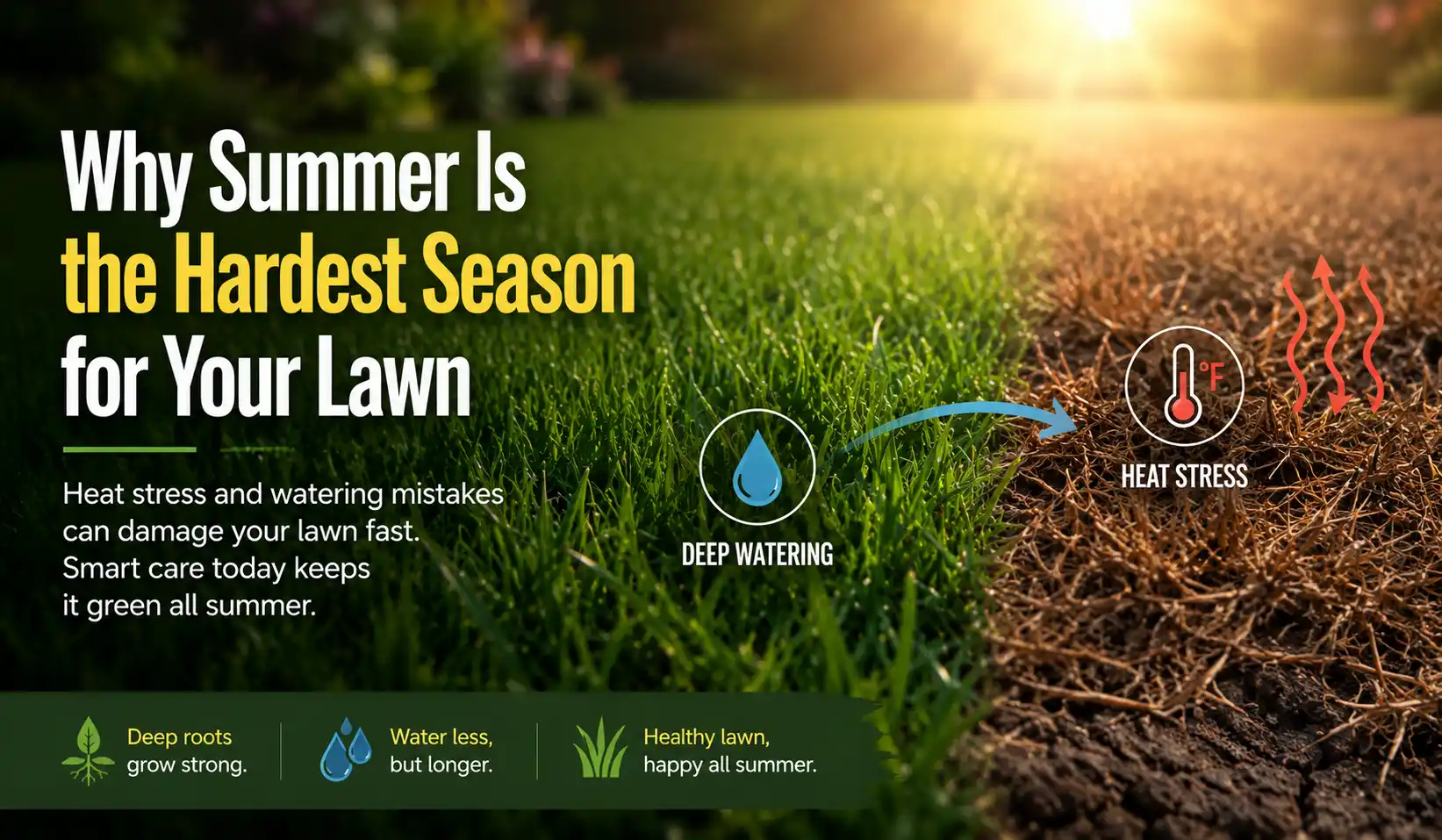
What to Know Before You Start a Summer Lawn Routine
Before you change a single thing about how you mow or water, you need to know what type of grass you have. Not a vague category – the actual variety, if possible. That one fact changes almost every decision you’ll make.
Grass Type Matters More Than You Think
There are two major grass families: warm-season and cool-season. Warm-season grasses (Bermuda, Zoysia, St. Augustine, Centipede) grow most actively in summer heat and go dormant in cold winters. Cool-season grasses (Kentucky Bluegrass, Tall Fescue, Perennial Ryegrass) do their best growing in spring and fall, and they genuinely struggle when temperatures stay above 85-90°F for weeks at a time.
Getting this wrong means you’ll be fertilizing at the wrong time, watering on the wrong schedule, and mowing at the wrong height. In Minnesota, where cool-season fescue dominates, July lawn care looks completely different than it does in Georgia, where Bermuda thrives in that same heat.
Mowing Height in Summer (This One Change Saves Lawns)
Raise your mower deck. I can’t say this clearly enough. Cutting grass short – a habit left over from spring when growth is vigorous – is one of the single most damaging things you can do to a summer lawn.
Taller grass blades shade the soil. That shading keeps soil temperatures 10-15°F cooler than bare or closely mowed ground (University of Georgia Extension, 2022). Cooler soil means less evaporation, deeper root health, and fewer weeds. For most warm-season grasses, 2.5-3 inches is the summer target. For tall fescue, 3.5-4 inches.
Never remove more than one-third of the blade in a single mow. That rule – called the one-third rule – exists precisely because summer grass can’t recover fast enough from an aggressive cut the way spring grass can.
Fertilizing – When to Do It and When to Skip It
Summer fertilizing depends entirely on your grass type.
Warm-season grasses actively grow in summer and can handle a moderate nitrogen application in June. But hold off on heavy fertilization in July and August – pushing growth during peak heat exhausts the plant’s energy reserves and makes it more vulnerable to disease.
For cool-season grasses, skip summer fertilizing almost entirely. Feeding fescue or bluegrass during a heat wave forces growth the plant can’t sustain. You’ll see a brief green flush followed by rapid decline. Wait until September.
One product worth mentioning: Scotts Turf Builder for Summer is formulated with slow-release nitrogen for exactly this reason. It’s not a magic fix, but it’s better than a standard nitrogen-heavy spring fertilizer applied at the wrong time of year.
Weed and Pest Pressure in Hot Months
Summer is prime time for crabgrass, nutsedge, and grubs. Crabgrass germinates aggressively in warm soils and will fill any thin or bare spot your lawn provides. The best defense is a dense, healthy lawn that leaves no room for opportunists.
Grubs – the larvae of Japanese beetles, June bugs, and others – feed on grassroots underground. By the time you see the damage (spongy turf that lifts like a carpet), the feeding is already done. In the Midwest especially, mid-to-late July is when grub populations peak. A targeted grub treatment applied in June or early July, before they go deep, is far more effective than a rescue treatment in August.
Grass Type Care Comparison: Summer Needs
| Grass Type | Heat Tolerance | Mowing Height (Summer) | Watering Frequency | Fertilize in Summer? | Drought Response |
|---|---|---|---|---|---|
| Bermuda | Very high | 1.5-2.5 in | 2-3x/week | Yes (June only) | Tolerant |
| Zoysia | High | 2-2.5 in | 2x/week | Light June application | Very tolerant |
| St. Augustine | High | 3-4 in | 2-3x/week | Light June only | Moderate |
| Tall Fescue | Low-moderate | 3.5-4 in | 3x/week | No | Goes dormant |
| Kentucky Bluegrass | Low | 3-3.5 in | 3-4x/week | No | Goes dormant |
My Summer Lawn Care Routine, Week by Week
No single schedule works for every lawn. But the framework below – adjusted for your climate zone – has held up for me across Florida, Arizona, and the Midwest. Think of it as a starting point, not a rigid prescription.
Early Summer (June) – Setting the Foundation
June is your best window to get ahead of summer stress. Temperatures are rising but haven’t peaked. Cool-season grasses still have some resilience. Warm-season grasses are entering their active growth phase.
In June, I raise the mowing deck to summer height and stay there until September. I apply a slow-release fertilizer to warm-season lawns (not cool-season), check for any thin spots that crabgrass will colonize, and calibrate the irrigation system to deep, infrequent cycles.
This is also when I apply pre-emergent if I haven’t already. For grub control in high-pressure areas like Ohio and Michigan, a preventative grub treatment goes down in June – not August when it’s too late.
Peak Summer (July-August) – Survival Mode
This is where most lawn care goes wrong. The instinct is to do more – more water, more fertilizer, more treatments. The reality: less intervention is usually better during peak heat.
In July and August, I mow less frequently (warm-season grass slows its growth rate in extreme heat), avoid fertilizing, and water only in the early morning – ideally between 4:00 and 9:00 AM before evaporation rates spike. I let cool-season lawns go dormant if drought conditions hit rather than trying to force them to stay green through aggressive irrigation.
One real moment: In Phoenix, I watched a neighbor spend $200 in August trying to green up his dormant fescue with fertilizer and extra watering. Three weeks later he had a fungal outbreak – pythium blight loves the combination of heat, moisture, and forced growth. His lawn needed $800 in renovation that fall.
Dormancy is not failure. It’s the grass protecting itself. Let it.
Late Summer (Late August-September) – Recovery and Prep
As temperatures drop below 90°F consistently, cool-season grasses begin recovering from dormancy. This is actually a critical window – the right moves now set up a strong fall.
Late August and September are the time to overseed thin cool-season lawns (the soil is warm, which aids germination, and fall rains are coming). For warm-season lawns, a final light fertilization in late August helps them build carbohydrate reserves before the first cool nights. Aeration – either core or spike – done in September dramatically improves water penetration heading into fall.
Weekly Task Checklist by Climate Zone
| Task | Cool-Season Zone (Midwest/NE) | Warm-Season Zone (South/SW) | Transition Zone (Midwest, Carolinas) |
|---|---|---|---|
| Mow | Every 10-14 days | Every 5-7 days | Every 7-10 days |
| Water | 3-4x/week (early AM) | 2-3x/week (early AM) | 2-3x/week |
| Fertilize | No | June only | Varies by grass type |
| Check for grubs | June-July | April-June | June-July |
| Overseed thin areas | September only | Not summer | September only |
| Weed control | Light, spot-treat | Active management | Spot-treat |
How Summer Conditions Change Everything
The same lawn care advice that works in Atlanta will actively harm a lawn in Minneapolis. Regional conditions – humidity, overnight temperatures, soil type, precipitation patterns – change what “good lawn care” actually means.
Hot and Humid Climates (Florida, Gulf Coast, Southeast)
In humid climates, the challenge is less about drought and more about fungal disease. High overnight humidity combined with moist turf creates ideal conditions for brown patch, gray leaf spot, and dollar spot. I learned this the hard way in a backyard in Gainesville, Florida – watering too late in the evening left the grass blades wet overnight, and within two weeks I had a brown patch outbreak that took up a quarter of the lawn.
Rules in humid climates: water early in the morning so grass dries before nightfall, avoid watering at all if rainfall already hit that day, and give St. Augustine and Zoysia room to breathe by not overwatering. Fungal treatment may be necessary if you see irregular brown patches or a white cottony growth at dawn.
Dry and Arid Regions (Arizona, Nevada, Southwest)
In Phoenix, the problem is pure evaporation. Water applied during the hottest part of the day – 10 AM to 6 PM – loses 30-50% to evaporation before it reaches the root zone (Arizona Cooperative Extension, 2023). The soil surface can reach 150°F during an August afternoon.
Bermuda grass is the default choice for a reason – it has genuine drought tolerance and can handle temperatures other grasses can’t. Watering twice weekly at depth, combined with a 3-inch layer of organic mulch around landscape beds (not grass areas), makes a meaningful difference in soil temperature and moisture retention.
One thing I never skip in desert climates: I check the moisture level 6 inches below the surface before adding more water. The surface can feel bone dry while the lower root zone still has adequate moisture. A cheap soil probe – under $20 at any hardware store – takes the guesswork out entirely. 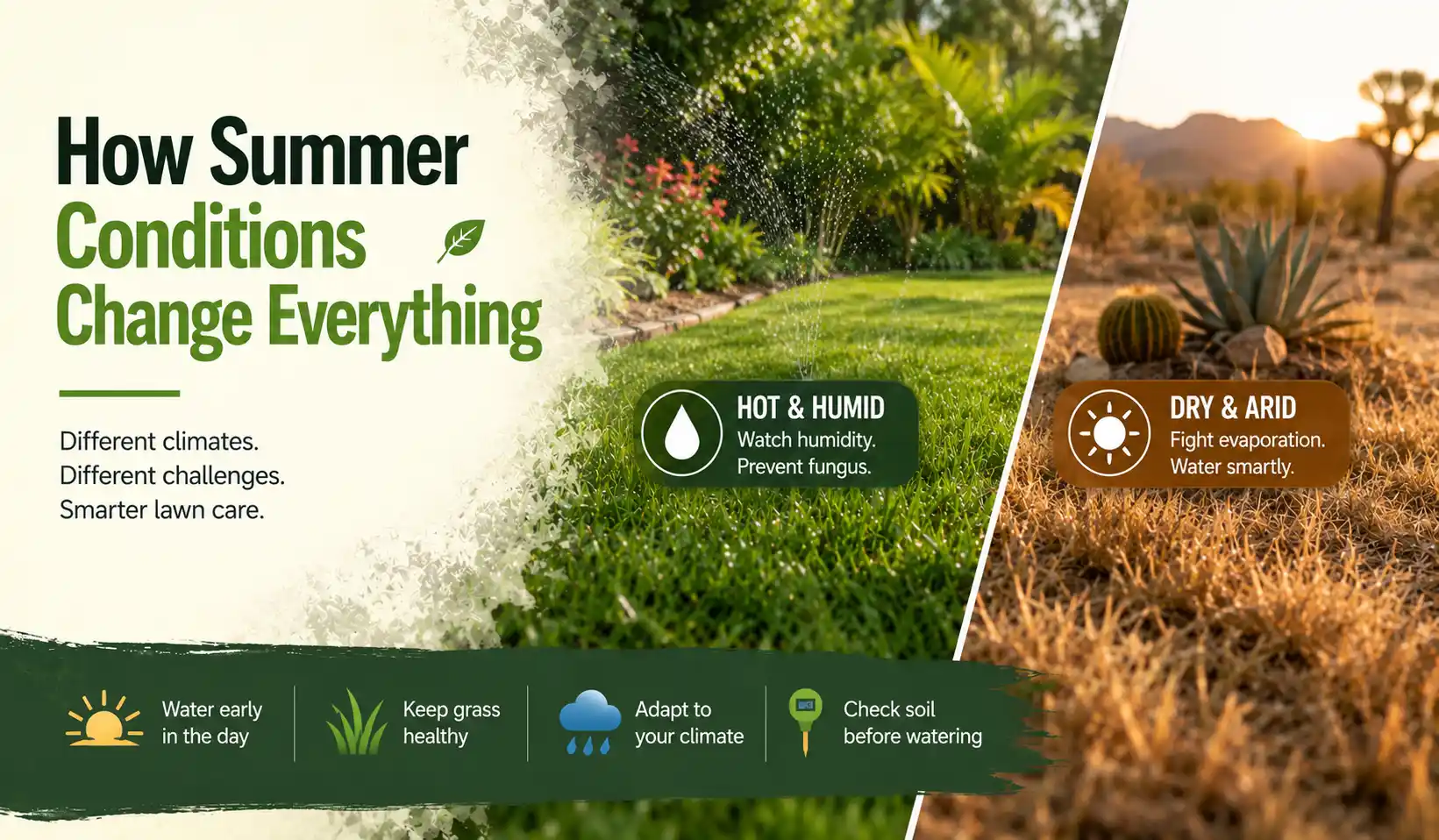
Humid Continental Zones (Midwest, Great Lakes, Ohio Valley)
Midwest summers present a different challenge: variable heat. A Minnesota July can run 65°F one week and 95°F the next. Cool-season fescue and Kentucky Bluegrass hate that variability. Roots that were recovering from a mild stretch get hit again before they’ve rebuilt.
In Chicago and Columbus, I manage expectations: a cool-season lawn will not look its best in August. That’s not lawn failure – that’s biology. What you can control is keeping it alive and positioned for a strong September recovery. That means resisting the urge to fertilize, accepting some brown in peak heat, and staying consistent with morning watering even when the lawn looks temporarily beyond help.
Climate vs. Watering and Mowing Frequency
| Climate Zone | Example Cities | Watering Frequency | Mow Frequency | Key Summer Risk |
|---|---|---|---|---|
| Hot and humid | Tampa, Atlanta, Houston | 2-3x/week | Every 5-7 days | Fungal disease |
| Dry and arid | Phoenix, Las Vegas, Tucson | 2x/week (deep) | Every 7-10 days | Evaporation, heat death |
| Humid continental | Chicago, Cleveland, Minneapolis | 3x/week | Every 10-14 days | Dormancy, heat stress |
| Coastal moderate | San Diego, Portland | 1-2x/week | Every 10-14 days | Minimal – mild summers |
Common Summer Lawn Mistakes I See Every Year
After years of managing lawns across different US climates, the mistakes that cause the most damage are rarely dramatic. They’re small, repeated choices that compound quietly until the lawn shows up one morning looking like something went very wrong.
Cutting Grass Too Short in a Heat Wave
Scalping a lawn in July is the most common way homeowners unknowingly stress their turf. Short blades mean exposed soil. Exposed soil heats up fast, accelerates water loss, and creates gaps for weed seeds to land and germinate.
I’ve seen homeowners set their mowers to the lowest setting in summer because they think short grass means less mowing. The opposite is true. Taller, healthier grass grows more slowly during heat stress. A scalped lawn goes into damage mode and tries to push new growth constantly – exhausting itself trying to recover.
Set your mowing height at the start of June, raise it by half an inch from your spring setting, and don’t touch that dial until September.
Watering at the Wrong Time of Day
Watering between noon and 6:00 PM in summer is close to pointless in most climates. Evaporation rates are highest during peak sun hours, and the water that does reach the soil can’t penetrate effectively because surface temperatures are too high.
Evening watering is worse. The grass stays wet overnight, fungal pressure builds, and by morning you’ve created exactly the conditions that trigger brown patch and dollar spot – especially in humid zones like Florida and the Gulf Coast.
The window that actually works: 4:00-9:00 AM. The water has hours to soak into the root zone before the heat of the day begins. The grass dries naturally as the sun rises. And in climates where municipal water restrictions apply (Arizona, much of California), early morning timing often aligns with the permitted watering windows too.
My Final Recommendation
After working through lawns from Phoenix to central Florida to the humid stretch of Ohio farm country, I’ve come to one honest conclusion: most summer lawn problems are caused by well-intentioned overwork, not neglect. People water too often, mow too short, fertilize too late, and treat dormancy like a crisis.
The single change that makes the biggest difference – in every climate I’ve worked in – is raising the mower deck. It costs nothing. It takes thirty seconds. And it does more for soil moisture, root health, and weed suppression than any product in the Scotts or Pennington lineup.
Everything else follows from that: deep watering early in the morning, no summer fertilizer on cool-season grass, and accepting that some brown is normal in August. A lawn that goes slightly dormant in peak heat and recovers strong in September is a healthy lawn. One that looks unnaturally green in a July heat wave – because someone is pushing it with water and nitrogen – is a lawn headed for trouble.
Give the grass room to respond to its own season. Summer is its hardest test. Your job is to reduce the pressure, not fight the biology.
Structured Routine vs. Casual Approach: Pros and Cons
| Factor | Structured Summer Routine | Casual Approach |
|---|---|---|
| Time required | 2-4 hours/month of active management | Low until problems appear |
| Cost | Moderate (targeted products, proper timing) | Often higher (reactive treatments, renovation) |
| Lawn health | Consistent – lawn enters fall in strong shape | Variable – higher risk of summer damage |
| Stress on homeowner | Low – decisions are made in advance | High – reactive decision-making in peak heat |
| Learning curve | Moderate – need to know your grass type and climate | Low until something goes wrong |
| Flexibility | Less – routines need to stay consistent | High – no schedule to maintain |
| Recovery from mistakes | Fast – structured approach catches problems early | Slow – mistakes often caught too late |
| Long-term cost | Lower – healthy lawns need less intervention over time | Potentially higher if summer damage leads to fall overseeding or sod replacement |
Frequently Asked Questions About Summer Lawn Care
What is the best time to water grass in summer?
Water between 4:00 and 9:00 AM. This window allows moisture to reach the root zone before peak evaporation during midday heat. Evening watering leaves grass wet overnight, which increases the risk of fungal disease – particularly in humid climates like Florida and the Gulf Coast.
How often should I mow in summer?
Mowing frequency depends on your grass type and growth rate. Warm-season grasses like Bermuda may need mowing every 5-7 days in early summer, slowing to every 7-10 days in peak heat. Cool-season grasses in semi-dormancy may only need mowing every 10-14 days in July and August. Never mow more than one-third of the blade length in a single session.
Should I fertilize my lawn in summer?
Warm-season grasses can receive a light, slow-release nitrogen application in June. Avoid fertilizing any lawn in July and August – high temperatures prevent proper nutrient uptake and forced growth during heat stress makes grass more susceptible to disease and burnout. Cool-season grasses should not be fertilized in summer at all; wait until September.
What does lawn dormancy mean and is it a problem?
Dormancy is a natural survival mechanism. When temperatures stay above 90°F for extended periods, cool-season grasses stop active growth and turn brown to conserve water and energy. This is not damage – it’s biology. A dormant lawn will recover when temperatures drop in late August or September. The problem is trying to force a dormant lawn back to green with heavy irrigation and fertilizer, which stresses the plant rather than helping it.
How do I know if my lawn has heat stress or a disease?
Heat stress shows as uniform wilting, a blue-gray tint, and slow footprint recovery across the whole lawn. Disease damage tends to appear in irregular patches, circles, or streaks – not uniform browning. Brown patch disease creates circular tan patches with a darker border. Dollar spot creates small, silver-dollar-sized dead spots scattered across the turf. If the damage pattern is irregular and appears overnight or after humid conditions, suspect disease over heat stress.
What grass type is best for hot summers in the US?
Bermuda grass is the most heat-tolerant option widely available in the US. It thrives in USDA Hardiness Zones 7-10, handles drought well, and recovers quickly from heat stress (University of Florida IFAS, 2023). Zoysia is a close second – slightly slower to recover but more shade-tolerant. For the transition zone (Carolinas, Oklahoma, southern Midwest), Zoysia or a heat-tolerant tall fescue blend is often the most practical choice.
Can I overseed my lawn in summer?
Overseeding in summer is generally not recommended. Soil temperatures above 85°F reduce germination rates for cool-season grass seed, and newly germinated seedlings can’t tolerate peak summer heat. The right window for overseeding cool-season lawns is mid-August to mid-October, when soil is still warm (which aids germination) but air temperatures have moderated. For warm-season grasses, overseeding with ryegrass for winter color is a fall activity, not summer.