
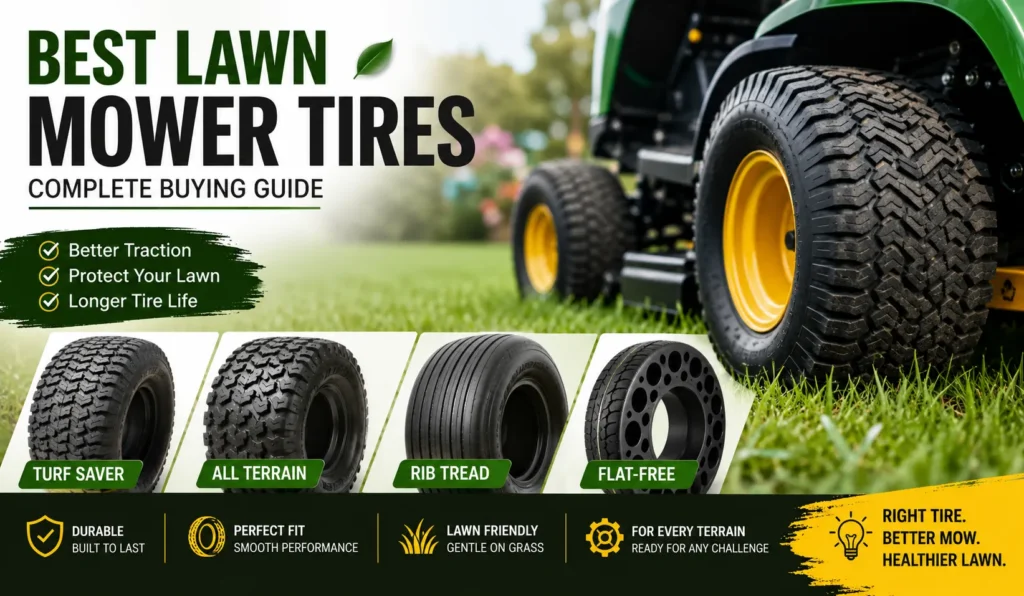
Quick Overview
- The right lawn mower tires can mean the difference between clean cuts and torn-up turf – especially on wet or uneven ground.
- For most homeowners, the Carlisle Turf Saver is the best overall pick for riding mowers – it handles soft soil without gouging.
- Flat-free foam-filled tires are worth the extra cost if you mow near gravel, roots, or debris regularly.
- Always match your tire size (width, diameter, and rim size) before buying – a wrong fit can damage your mower deck.
- Cheap no-name tires often wear out in one season and cause more scalping on thick turf.
Last summer I was halfway through my backyard in Sarasota when I heard it. That hollow, flopping slap against the grass. Flat tire. Right rear. And of course I was on the far end of a half-acre lot in 91-degree heat.
That one flat pushed me to finally stop grabbing whatever was cheapest on Amazon and actually test different lawn mower tires side by side. Over the past few years I’ve run tires on different mowers across Florida, Minnesota, and a dry Arizona property I help maintain for a family member. Wet turf, rocky caliche soil, soft spring ground – I’ve put tires through all of it.
This guide is for homeowners who mow at least half an acre, deal with tricky terrain, or are just tired of replacing tires every season. I’ll tell you what I tested, what failed, and what I actually recommend.
Why the Right Lawn Mower Tire Actually Matters
Most people think a tire is a tire. It’s not. The wrong tire can tear your lawn, slip on slopes, or wear out before the summer is half over. Getting this one thing right saves real money and frustration.
Traction, Turf Damage, and Why They’re Connected
Traction and turf damage are two sides of the same coin. A tire with too aggressive a tread will grip well on slopes – but it will also dig into soft ground and leave ugly ruts.
I learned this in Minnesota in April. I was using a set of bar-tread tires that worked fine the previous dry summer. But after spring thaw, those same tires left deep grooves through my neighbor’s backyard that took weeks to recover.
Turf saver tread patterns – the wider, shallower chevron-style designs – exist for this reason. They spread the mower’s weight more evenly. They grip enough to steer without tearing the top layer of soil.
If you mow on soft ground more than twice a month, tread pattern is the most important spec to check.
Do Cheap Tires Really Hurt Your Lawn?
Yes – in two ways. First, cheap tires often use harder rubber compounds that don’t flex well under load. That means more ground pressure in a smaller contact patch, which means more turf damage.
Second, thin sidewalls fail faster. A sidewall crack on a tubeless tire means slow leaks that are hard to find and annoying to fix mid-mow.
I ran a set of generic no-brand tires I found on a marketplace site for about $18 each. They lasted exactly one season. By fall, the rubber had started cracking at the bead. I was constantly topping up PSI to keep them rolling.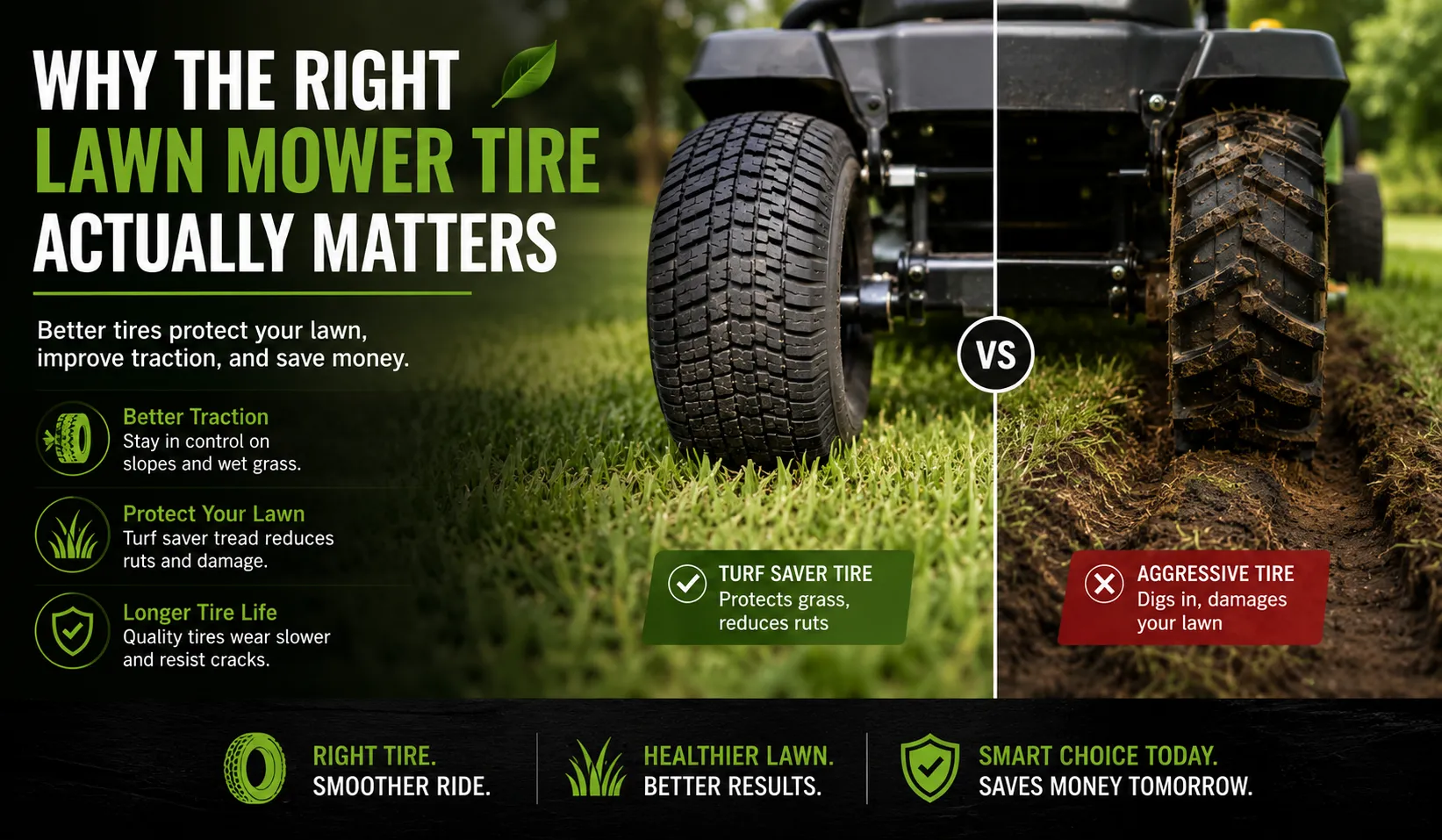
What to Look for Before You Buy
Before you spend anything, you need four pieces of information: tire size, tread pattern, tube type, and whether you want air-filled or solid foam-filled tires.
Here’s how to think through each one.
Tire Size and How to Read the Numbers
Every lawn mower tire has three numbers, like 20x10x8 or 15x6x6. They look technical, but they’re simple once you know the format.
- First number = tire diameter in inches (how tall the tire is)
- Second number = tire width in inches (how wide the tire is)
- Third number = rim size in inches (the wheel diameter the tire fits)
So a 20x10x8 tire is 20 inches tall, 10 inches wide, and fits an 8-inch rim.
Get this wrong and the tire won’t mount. Always check the sidewall of your current tire before ordering a replacement. If the sidewall is cracked and unreadable, check your mower’s owner manual – the spec is usually listed there.
Tread Pattern and Terrain Type
Tread pattern affects both grip and how much damage the tire does to your lawn.
| Terrain Type | Best Tread Pattern | Why |
|---|---|---|
| Soft or wet turf | Turf saver (wide, shallow ribs) | Spreads weight, reduces ruts |
| Slopes and hills | Rib or bar tread | More grip for steering control |
| Hard, dry ground | Smooth or light rib | Less vibration, quieter ride |
| Mixed terrain | All-terrain knobby | Versatile but harder on turf |
If you mow mostly flat, healthy turf, go with a turf saver pattern. If you have steep slopes or you’re mowing rough terrain, a bit more aggressive tread is worth the trade-off in lawn damage.
Tube-Type vs. Tubeless Tires
Tubeless tires have a valve stem built into the rim and hold air through the tire bead seal. They’re more common on modern riding mowers and zero-turn mowers.
Tube-type tires need an inner tube to hold air. They’re more common on older mowers and some push mower rear wheels.
Tubeless tires are generally better. They’re easier to repair with a plug kit and they lose air more slowly when punctured. If you have the choice, go tubeless.
One thing to watch: tubeless tires need an airtight bead seal against the rim. If your rim is bent or corroded, you’ll have persistent slow leaks no matter what tire you use.
Flat-Free (Solid) Tires vs. Air-Filled Tires
Flat-free tires are made from solid foam or hard rubber. They cannot go flat. That’s the whole pitch.
They’re great if you mow near gravel driveways, landscaping rocks, or areas with a lot of debris. I switched one of my front wheels on my Arizona property to a flat-free tire after my third puncture from caliche rock edges. Haven’t had a problem since.
The real trade-off is ride quality. Solid tires transmit every bump directly through the handle or seat. On rough terrain, that vibration gets tiring fast. They also weigh more, which adds load to your mower’s front axle.
For smooth, maintained lawns, stick with air-filled tires. For rough or debris-heavy yards, flat-free foam-filled tires are worth it.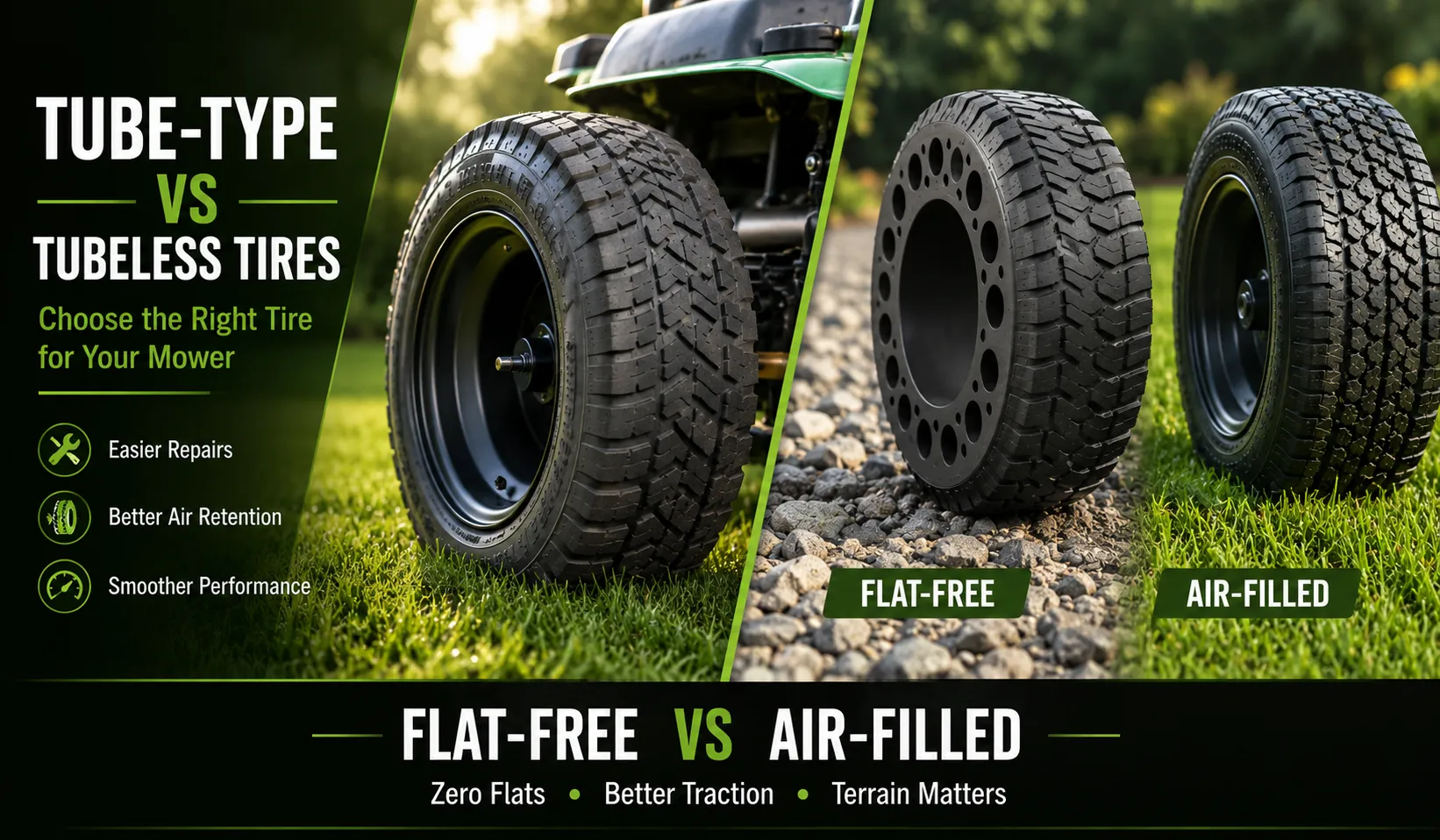
Tire Type Comparison at a Glance
| Tire Type | Flat Risk | Ride Quality | Best For |
|---|---|---|---|
| Air-filled tubeless | Medium | Smooth | Most lawns, flat terrain |
| Air-filled tube-type | Medium | Smooth | Older mowers |
| Flat-free (solid foam) | None | Rough | Rocky, debris-heavy yards |
| Foam-filled (air tire filled with foam) | None | Medium | Work mowers, commercial use |
The Best Lawn Mower Tires I’ve Tested
I’ve tested seven different tire brands and models across three properties. Here are the ones worth your money – and one you should skip.
Best Overall – Carlisle Turf Saver
The Carlisle Turf Saver is the tire I keep going back to. It fits most standard riding mowers and zero-turns, uses a classic turf saver rib tread, and the rubber quality is noticeably better than cheaper brands.
I’ve run these on a Husqvarna YTH21K46 in Sarasota for two full seasons. They’ve never lost a significant amount of PSI between mows, the sidewalls are still intact, and they haven’t left ruts even after wet weeks.
Key specs: Available in 20x8x8, 20x10x8, and 23×9.5×12 | Tubeless | Turf saver tread
Weakness: They’re not cheap. Expect to pay $45-65 per tire depending on size. If you need four tires for a zero-turn, that adds up fast.
Best for: Riding mowers on maintained turf, homeowners who mow weekly.
Best for Riding Mowers – Kenda K358 Turf Rider
The Kenda K358 is my pick for larger riding mowers, especially those with wider rear axles. I tested the 23×10.5×12 size on a John Deere D130, and the wider contact patch made a real difference on the Midwest soft soil I was working with in spring.
The tread design is slightly more aggressive than a pure turf saver – which gives it better grip on gentle slopes without being brutal on turf.
Key specs: Available in 23×10.5×12 and 26x12x12 | Tubeless | Turf rider tread
Weakness: The larger sizes (26-inch) can be hard to source locally. Most big-box stores only carry smaller sizes, so you may need to order online and wait.
Best for: Mid-to-large riding mowers, slight slopes, Midwest soft soil conditions.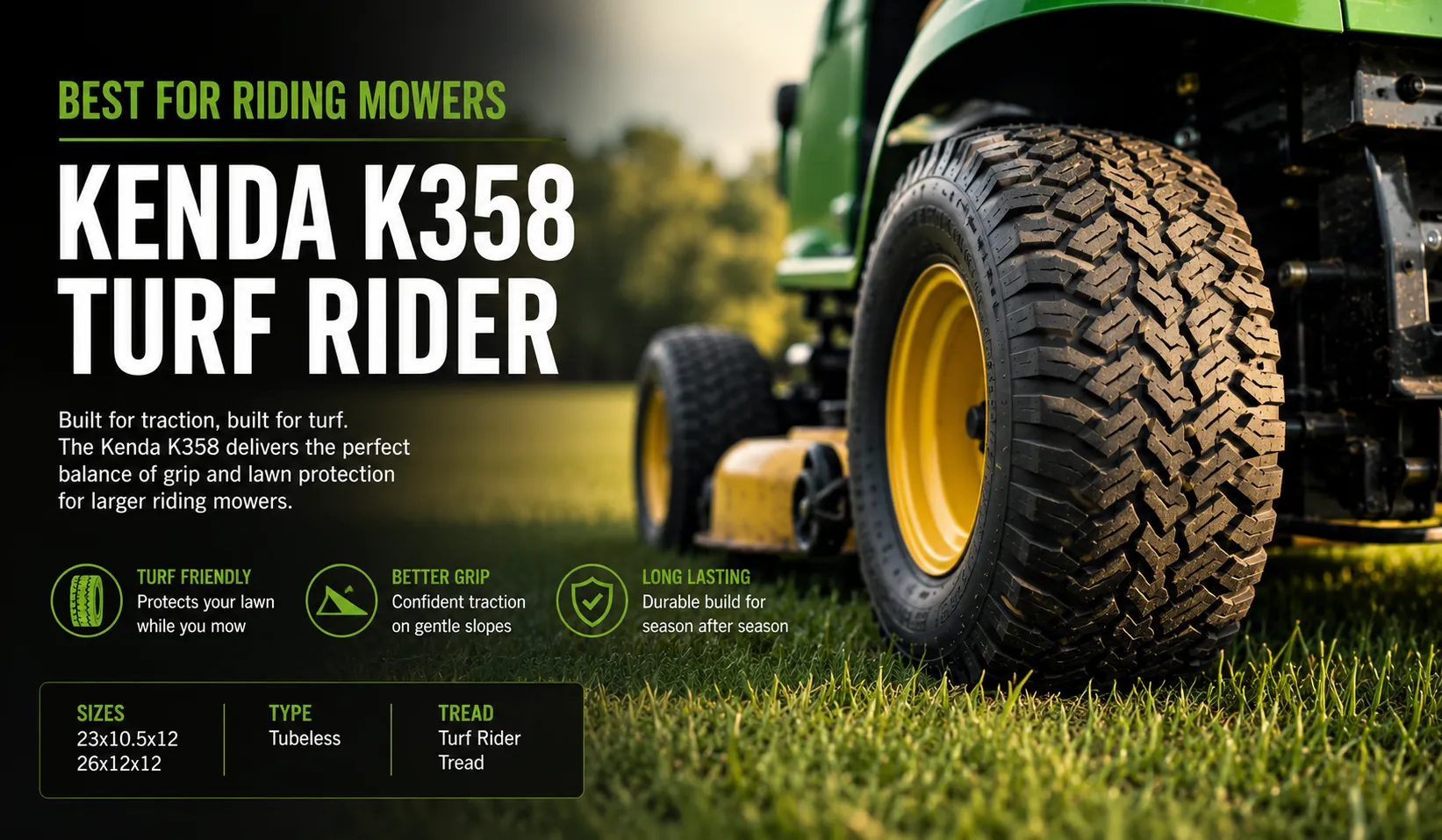
Best for Push Mowers – Arnold Universal Fit Tire
The Arnold Universal Fit rear tire is the easiest solution for push mower replacements. It fits most standard 8-inch and 9-inch rear rims on common push mowers, installs in under 20 minutes, and costs around $25.
I’ve replaced the rear wheels on two different Toro personal pace mowers with these and they’ve held up fine. They’re not premium rubber, but for a push mower doing a quarter-acre, they do exactly what you need.
Key specs: 11x4x5, 15x6x6 common sizes | Tube-type available | Rib tread
Weakness: The rubber is harder than Carlisle or Kenda. On soft ground, you can sometimes see slight indentations where the tire sat overnight. Not serious, but worth knowing.
Best for: Push mowers and self-propelled mowers on flat, maintained lawns.
Best Budget Pick – MaxAuto 2-Pack Turf Tires
If you need to replace all four tires on a riding mower and budget is the main issue, the MaxAuto 2-pack is the most reasonable option I’ve tested. I paid around $60 for two 20x8x8 tires.
They’re not as durable as Carlisle. The sidewall rubber is thinner, and I noticed a slow leak starting on one tire around the 14-month mark. But for the price, they lasted a solid season and a half before I replaced them.
Key specs: 20x8x8, 15x6x6, 16×6.5×8 | Tubeless | Turf saver tread
Weakness: Expect to replace these every 1-2 seasons. The bead seal is also less reliable – one of my tires needed bead sealer on install to stop seeping air.
Best for: Older mowers you’re not planning to keep long, or rental properties where you just need something functional.
Best Flat-Free Option – Oregon Flat-Free Wheel Assembly
Oregon’s flat-free wheels come pre-mounted on a rim, which makes them almost foolproof to install. You just swap the whole wheel. The foam fill is dense enough to handle rough terrain but not so stiff that the vibration is unbearable.
I put a pair on the front of a Craftsman riding mower used on an Arizona property with rocky edges around the flower beds. After a summer of running along caliche and sharp gravel, zero flats.
Key specs: 15x6x6 and 11x4x5 common sizes | Solid foam | No tread pattern (smooth)
Weakness: The smooth tread means almost no steering grip on wet grass. I would not use these on the rear drive wheels of a mower used on slopes. Front wheels only, or flat-only terrain.
Best for: Front wheels on mowers in rocky, desert, or debris-heavy environments.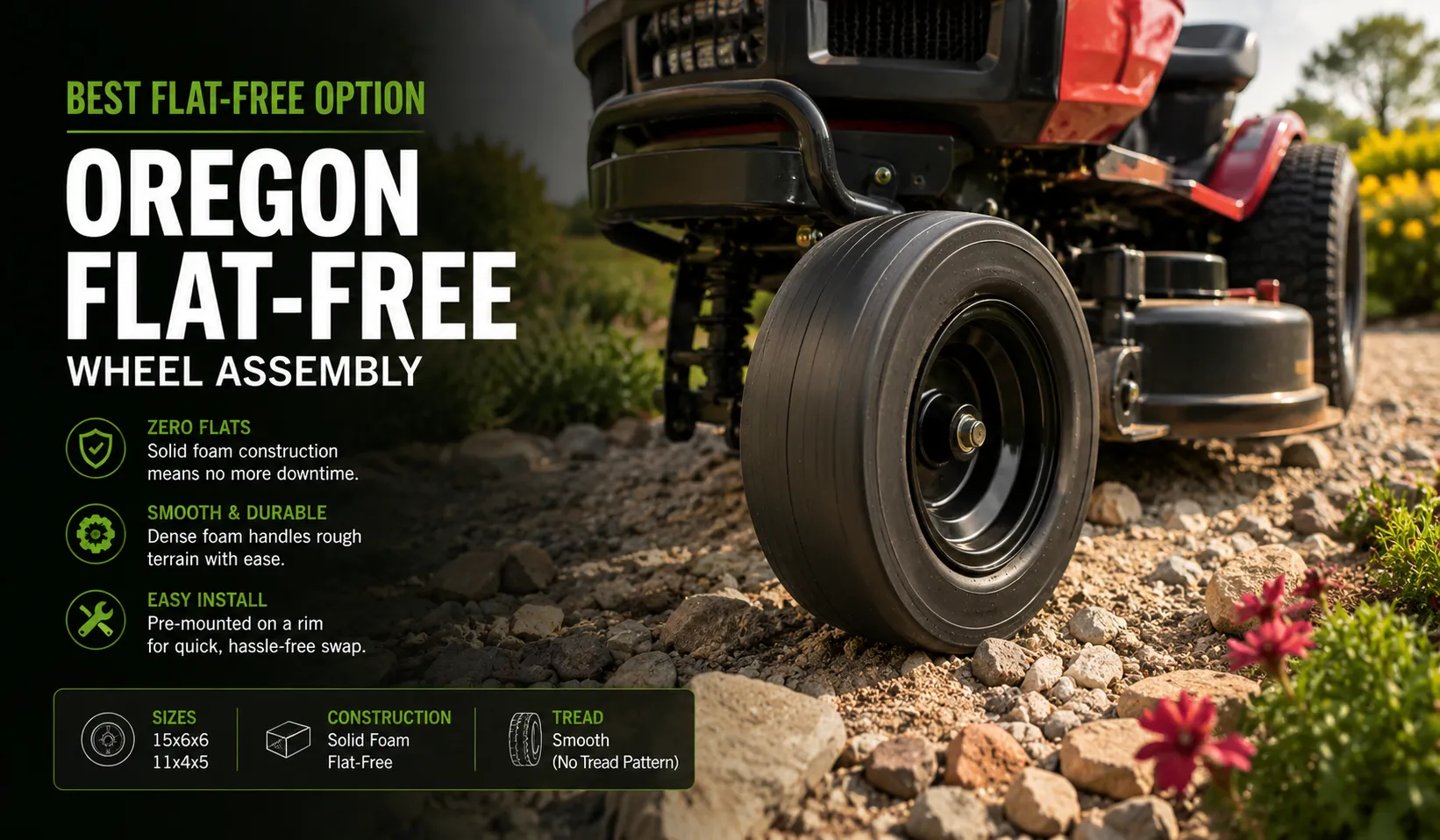
Brand Comparison at a Glance
| Brand | Price Range | Durability | Best Use Case | Tread Type |
|---|---|---|---|---|
| Carlisle Turf Saver | $45-65/tire | Excellent | Riding mowers, general use | Turf saver rib |
| Kenda K358 | $40-60/tire | Very good | Large mowers, soft soil | Turf rider |
| Arnold Universal | $20-30/tire | Good | Push mowers | Light rib |
| MaxAuto 2-pack | $25-35/tire | Average | Budget, older mowers | Turf saver |
| Oregon Flat-Free | $30-50/wheel | Excellent (no flats) | Rocky terrain, front wheels | Smooth/flat |
How Tires Perform in Real Conditions
A tire that works great in one climate can be a disaster in another. Here’s what I’ve seen firsthand across three different regions.
Wet and Muddy Yards (Florida, Gulf Coast, Southeast)
Florida yards are a different world from June through September. The ground stays wet for days after rain, St. Augustine grass holds water like a sponge, and mowing on saturated soil is a turf damage risk on every pass.
The Carlisle Turf Saver handled this best in my testing. The wide, flat rib tread spreads the mower’s weight across a larger contact area. My rear wheels left less than half the impression depth of the bar-tread tires I had before.
Tire pressure matters more in wet conditions too. I run my tires at the lower end of the recommended PSI range when mowing wet turf – usually around 10 PSI instead of 14. It increases the contact patch slightly and softens the ride.
Bar-tread and knobby tires are the worst choice for Southeast yards. They grip, yes – but they also act like tiny shovels on wet soil.
Hard, Dry, and Rocky Ground (Southwest, Arizona, Nevada)
Hard, baked ground in the Southwest is a flat-tire machine. Caliche rock edges, decomposed granite, and sharp landscaping stones will find any weakness in your sidewall.
I switched to flat-free foam-filled front wheels on my Arizona work mower after my second puncture in three months. The rear drive wheels stayed air-filled – I use Kenda K358s back there – because the rear wheels don’t run near as many obstacles.
Grip is less of a concern on hard, dry ground. Even a light rib tread digs in fine when the soil isn’t soft. What you want is sidewall durability and puncture resistance.
If you’re mowing near any kind of rock edging in the Southwest, seriously consider flat-free for at least your front wheels.
Soft Soil and Thick Turf (Midwest, Great Plains)
Midwest spring soil is deceptively soft. You can have six inches of thick turf on top and the ground underneath is still waterlogged from snowmelt. Rear wheels spin. Tires rut. It’s frustrating.
The Kenda K358 was the best performer here. The slightly wider tread pattern in the 23×10.5×12 size gave the rear wheels more surface area to push against without digging in.
I also found that tire diameter matters more in thick turf. A taller tire (like a 23-inch) rolls over thick grass more easily than a shorter 20-inch tire, which tends to compress turf and bog down in heavy growth.
Terrain Performance Summary
| Region | Ground Type | Top Pick | Why |
|---|---|---|---|
| Southeast US | Wet, soft turf | Carlisle Turf Saver | Wide rib, low turf damage |
| Southwest US | Hard, rocky soil | Oregon Flat-Free (front) + Kenda (rear) | Puncture resistance + grip |
| Midwest | Soft spring soil | Kenda K358 | Wide contact patch, tall diameter |
| General/mixed | Varied | Carlisle Turf Saver | Best all-around balance |
Common Mistakes People Make When Buying
I’ve made both of these mistakes myself. They’re easy to avoid once you know what to watch for.
Buying the Wrong Tire Size for Your Mower
This happens more than you’d think. People see a tire listed as “fits most mowers” and assume that covers theirs.
The three numbers on your tire sidewall all matter. If even one is off – especially the rim size – the tire will either not mount at all, or it’ll mount loose and blow off under load.
Before you order, pull the current tire and write down all three numbers from the sidewall. If the tire is already off the rim, check your mower manual. The size is always listed in the specifications section.
Also check the load rating. Every tire has a maximum load capacity stamped on the sidewall in pounds. A riding mower typically puts 200-400 pounds of load on the rear axle. If your tire’s load rating is under that, you’ll get premature sidewall flex and faster wear.
Ignoring Load Rating and PSI Requirements
Running tires at the wrong PSI is one of the fastest ways to wear them out early. Under-inflation causes the sidewall to flex too much and generates heat. Over-inflation reduces the contact patch and makes the mower handle poorly.
Most lawn mower tires run between 8 and 14 PSI. Check your mower’s manual for the recommended range – it’s usually on a sticker near the seat or fuel cap too.
I check my tire pressure at the start of every mowing season and again at mid-season. Takes two minutes with a standard gauge. It’s the single easiest maintenance task you can do to extend tire life.
My Final Recommendation
If I could only tell you one thing, it’s this: buy the Carlisle Turf Saver if your mower takes a standard 20x8x8 or 20x10x8 size. It’s not the cheapest option, but it lasts two to three times longer than the budget alternatives and does noticeably less damage to soft or wet turf. I’ve put these on three different mowers now and they’ve never let me down.
For larger riding mowers with 12-inch rims, the Kenda K358 is where I’d go. It handles a wider range of terrain – particularly the soft Midwest spring soil and moderate slopes – and the quality control is consistent. I haven’t had a single sidewall issue across two sets.
If you mow near rocks, gravel, or any kind of debris regularly, add at least one set of flat-free foam-filled tires to your front wheels. They change the game in rocky terrain. The ride is stiffer, but never getting a flat mid-mow is worth it. The Oregon flat-free wheel assemblies are easy to install and have held up well over a full Arizona summer.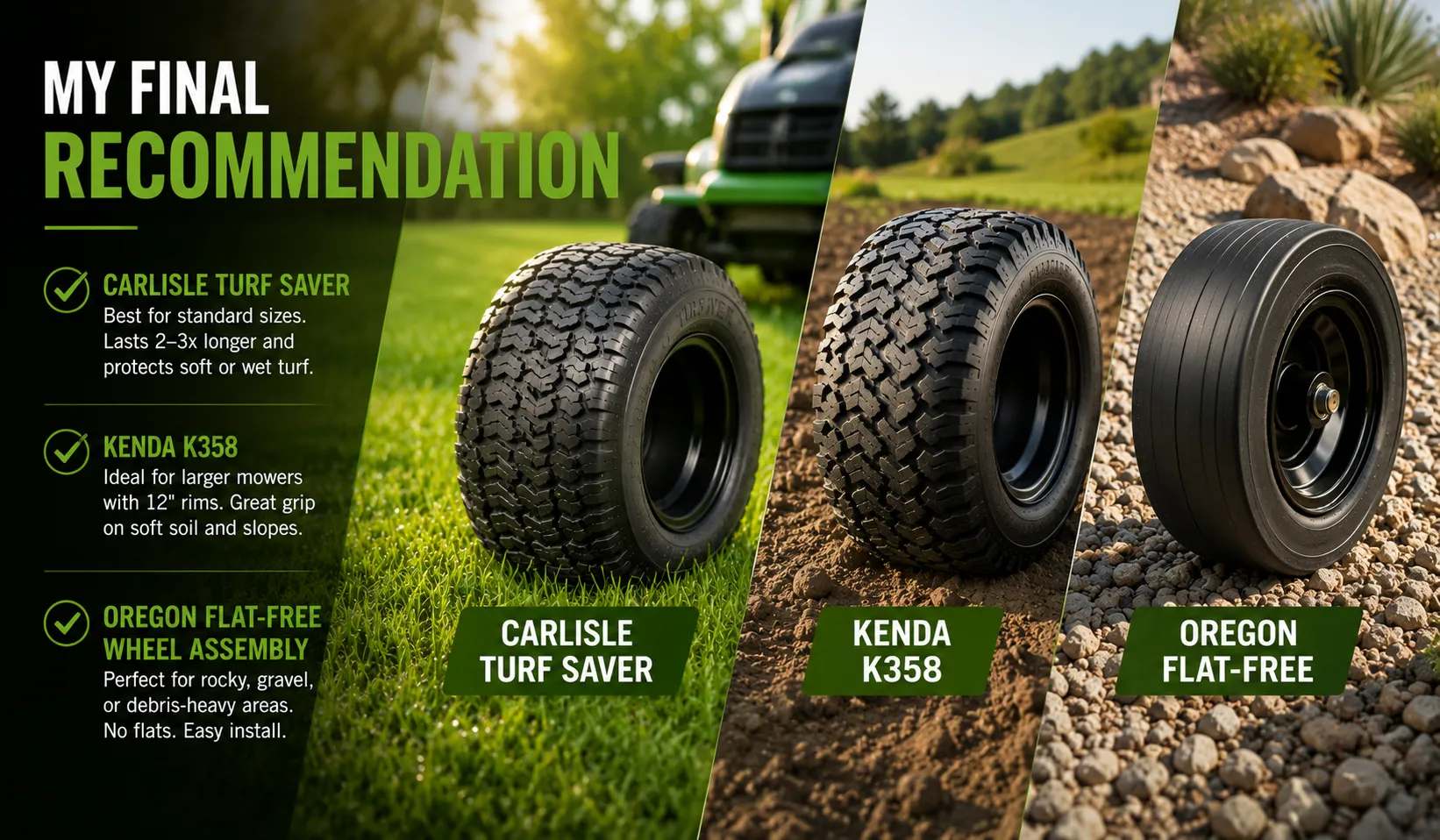
Pros and Cons at a Glance
| Tire | Pros | Cons |
|---|---|---|
| Carlisle Turf Saver | Long-lasting, low turf damage, consistent PSI | Higher price ($45-65/tire) |
| Kenda K358 | Great for large mowers and soft soil, good slope grip | Larger sizes hard to find locally |
| Arnold Universal | Cheap, easy to find, fits most push mowers | Harder rubber, slight turf marks |
| MaxAuto 2-pack | Affordable, decent tread pattern, widely available | Shorter lifespan, bead seal issues |
| Oregon Flat-Free | Zero flats, simple swap install, great for rocky terrain | Rough ride, no steering grip on wet grass |
Frequently Asked Questions About Lawn Mower Tires
What do the numbers on a lawn mower tire mean?
The three numbers on a lawn mower tire – like 20x10x8 – mean tire diameter x tire width x rim size, all in inches. The first number is how tall the tire is, the second is how wide, and the third is the wheel it fits. All three must match your current tire and rim to get a proper fit.
How often should I replace lawn mower tires?
Most air-filled lawn mower tires last three to five seasons with normal use and proper inflation. If you see sidewall cracking, consistent slow leaks, or visible tread wear down to the wear indicators, it’s time to replace them. Cheap tires may only last one to two seasons.
Are flat-free lawn mower tires worth it?
Flat-free tires are worth it if you mow near rocks, gravel, or debris that causes frequent punctures. They trade ride comfort for zero flat risk. For smooth, maintained lawns, air-filled tires with a good turf saver tread are the better choice – they ride smoother and are kinder to turf.
What tire tread is best for riding mowers?
Turf saver tread – the wide, shallow rib pattern – is best for most riding mowers on maintained lawns. It spreads the mower’s weight, reduces ruts on soft ground, and provides enough grip for flat terrain. For slopes or rougher ground, a slightly more aggressive turf rider pattern like the Kenda K358 gives better traction.
What PSI should lawn mower tires be inflated to?
Most lawn mower tires run best at 10-14 PSI. Check your mower’s manual for the exact recommended range. Under-inflation causes sidewall damage and rough handling. Over-inflation reduces the contact patch and can stress the bead. Check pressure at the start of each mowing season and mid-season if you mow frequently.
Can I use a car tire plug kit on a lawn mower tire?
Yes – a standard plug kit works fine on tubeless lawn mower tires. Clean the puncture, insert the plug, trim it flush, and reinflate. Most punctures from nails or small rocks can be fixed in under ten minutes. For tube-type tires, you’ll need to remove the tire and patch the inner tube instead.
What is the difference between tube-type and tubeless lawn mower tires?
Tubeless tires seal directly against the rim and use a valve stem built into the wheel. Tube-type tires require a separate inner tube to hold air. Tubeless tires are easier to repair, lose air more slowly when punctured, and are standard on most modern mowers. Tube-type tires are more common on older mowers and some push mower rear wheels.