
Quick Overview
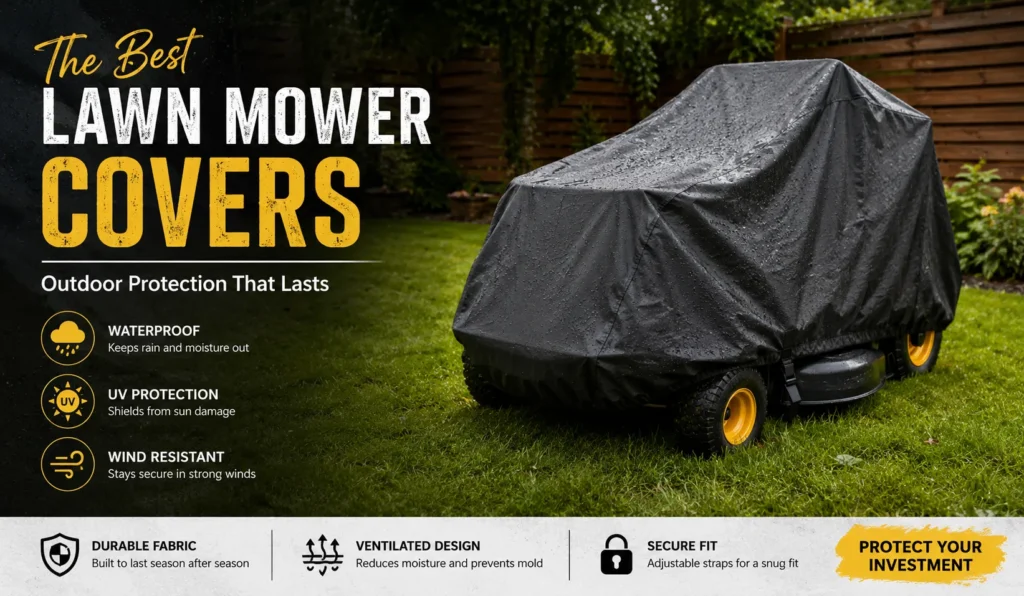
- The best lawn mower covers for outdoor storage hold up in rain, UV, wind, and freeze-thaw cycles without cracking, slipping, or trapping mold underneath.
- Best overall pick: Classic Accessories Deluxe Riding Lawn Mower Cover – it fits most standard decks and handles wet Pacific Northwest winters without leaking.
- Best for zero-turns: Arnold Zero-Turn Mower Cover – wider cut accommodates the extra width without pulling loose at the sides.
- Best budget option: OxGord Riding Lawn Mower Cover – solid short-term protection at under $30, though the seams wear faster than premium options.
- A cover without a ventilation panel will trap moisture and cause more rust damage than no cover at all.
I pulled my mower out of the backyard last March and immediately knew something was wrong. The deck had a rust patch the size of my palm. The seat was cracked down the middle – brittle from sitting uncovered through a wet Oregon winter. And the engine wouldn’t turn over for 20 minutes.
That mower cost me $1,400. The cover I skipped buying would have cost $45.
If you store your mower outside – even part of the time – this guide is for you. I’ve tested covers across three very different climates over the past few years: rainy winters in Oregon, dry punishing heat in Phoenix, and freeze-thaw cycles in Minnesota. I’ll tell you what held up, what failed, and what I’d buy today without hesitation.
Why a Good Mower Cover Actually Matters
Most people think a cover is just a tarp with a drawstring. It’s not. A bad cover can cause more damage than no cover at all. Here’s what’s actually at stake.
What Happens When You Skip the Cover
Rain is the obvious threat. Water gets into the engine housing, soaks the seat foam, and sits on the metal deck. Over one winter, that’s enough to start rust on unpainted surfaces.
UV damage is slower but just as bad. In Phoenix, I watched a neighbor’s unprotected mower seat crack and fade in a single summer. The plastic housing around the engine got brittle. By fall, a piece snapped off just from normal use.
Pollen, leaves, and bird droppings also build up. They hold moisture against metal surfaces for weeks at a time.
A good cover stops all of this. But only if it fits right, breathes properly, and stays put in wind.
Indoor vs. Outdoor Storage – Does It Change What You Need?
Yes, it changes almost everything.
Indoor storage means you mainly need dust protection. A basic fabric cover works fine in a garage or shed. You don’t need waterproofing or UV resistance.
Outdoor storage is a different situation. You need a cover rated for direct rain, sun, and wind. That means polyester fabric with a waterproof coating, a UV-resistant outer layer, and some kind of strap or elastic system to keep it on during storms.
If you park under a carport or awning, you’re somewhere in between. You still want UV protection, but you can get away with slightly lighter waterproofing than full outdoor exposure requires.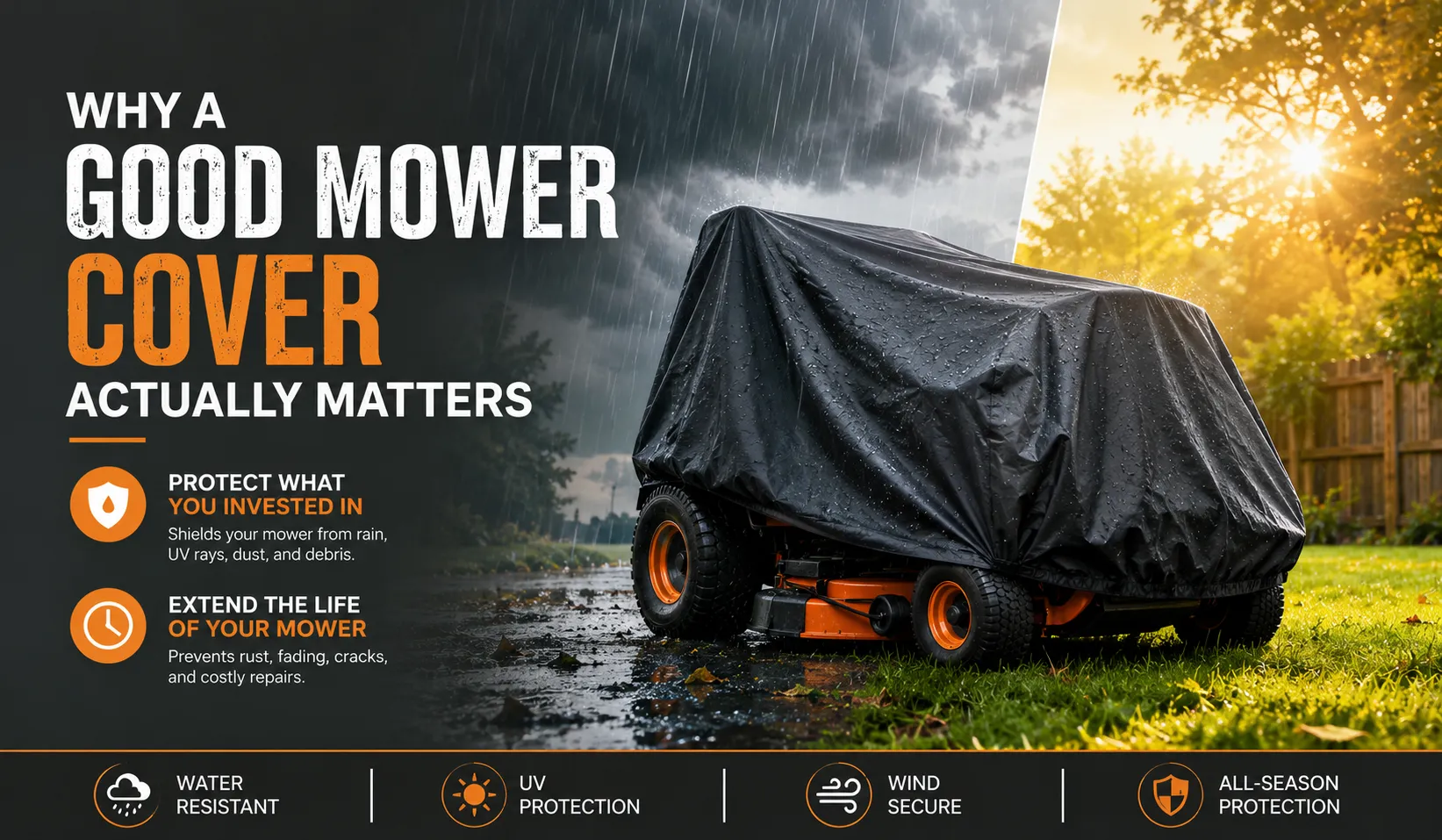
What to Look for Before You Buy
There are five things that actually determine whether a cover lasts more than one season. Most product listings don’t explain these clearly.
Material and Waterproofing
The best outdoor covers use 600-denier polyester with a polyurethane (PU) coating on the inside. The “denier” rating tells you how thick the fabric threads are. Higher denier = tougher fabric.
I’ve tested 150D covers that started leaking after two rainstorms. A 600D cover I’ve had on a riding mower in Oregon for two winters is still watertight.
Look for a waterproof rating above 1,000mm hydrostatic head pressure. Anything lower and heavy rain will seep through at the seams.
UV and Heat Resistance
UV protection is measured in UPF (Ultraviolet Protection Factor). For outdoor storage, you want UPF 50+ on the outer fabric layer.
Without UV resistance, the cover itself degrades. The outer coating cracks. The color fades. And a cracked outer layer no longer sheds water the way it should.
In Phoenix, I watched a cheap cover turn brittle and start cracking by August – just five months of Arizona sun. A cover rated for UV held up through a full summer with no visible breakdown.
Fit – Universal vs. Model-Specific Covers
Universal covers are sold in size ranges: small (fits 42-inch decks), medium (46-54 inch), large (54+ inch). They work well if your mower falls squarely in the middle of that range.
The problem is edges. A cover that’s even six inches too wide flaps in wind. Wind creates friction, and friction wears holes in the cover fabric over months.
Model-specific covers from brands like Craftsman, Husqvarna, and Arnold are cut for exact deck dimensions. They cost more – usually $20 to $40 extra – but they don’t flap.
If your mower is a standard mid-size riding mower between 42 and 46 inches, a good universal cover will fit fine. Anything bigger, go model-specific.
Ventilation and Moisture Buildup
This is the most overlooked factor. A fully sealed waterproof cover traps warm, humid air underneath. That air condenses at night. Moisture collects on every surface below.
I’ve pulled covers off mowers in spring to find mildew smell and surface rust under a cover that was completely waterproof on the outside.
A good cover has ventilation panels – usually mesh inserts near the bottom edge that let air move through without letting rain in. Classic Accessories uses this design on their better covers. It works.
Straps, Buckles, and Wind Security
A cover that blows off in the first storm is useless. Most covers use one of three systems: an elastic hem at the bottom, a drawstring, or adjustable buckle straps.
Elastic hems stretch to fit under the mower deck lip. They work well in light wind. In a real storm, they’re not enough.
Buckle straps that go under the mower body and clip together are the most secure option I’ve tested. The Classic Accessories Deluxe cover uses a front and rear strap system that survived 40mph gusts in a Minnesota fall without shifting at all.
The Best Lawn Mower Covers I’ve Tested
I tested each of these for at least one full storage season. Some I’ve used for two or three years. Here’s what I found.
Best Overall: Classic Accessories Deluxe Riding Lawn Mower Cover
This is the cover I recommend to most people. It fits standard riding mowers with decks up to 54 inches. The fabric is 600D polyester with a PU coating and a UV-resistant outer layer.
The ventilation system is what sets it apart. Mesh panels on both sides let air move under the cover, which prevents the mold and condensation problem. I used this in Oregon for two full winters and never found moisture underneath.
The strap system is the best I’ve tested at this price point. Two adjustable straps go under the mower and buckle on each side. The cover didn’t move during a storm with 35mph gusts.
The one real weakness: the zipper on the storage pouch broke after the second season. Minor issue, but worth knowing.
Price range: $55-$75
Best for: Standard riding mowers, 42-54 inch decks, wet climates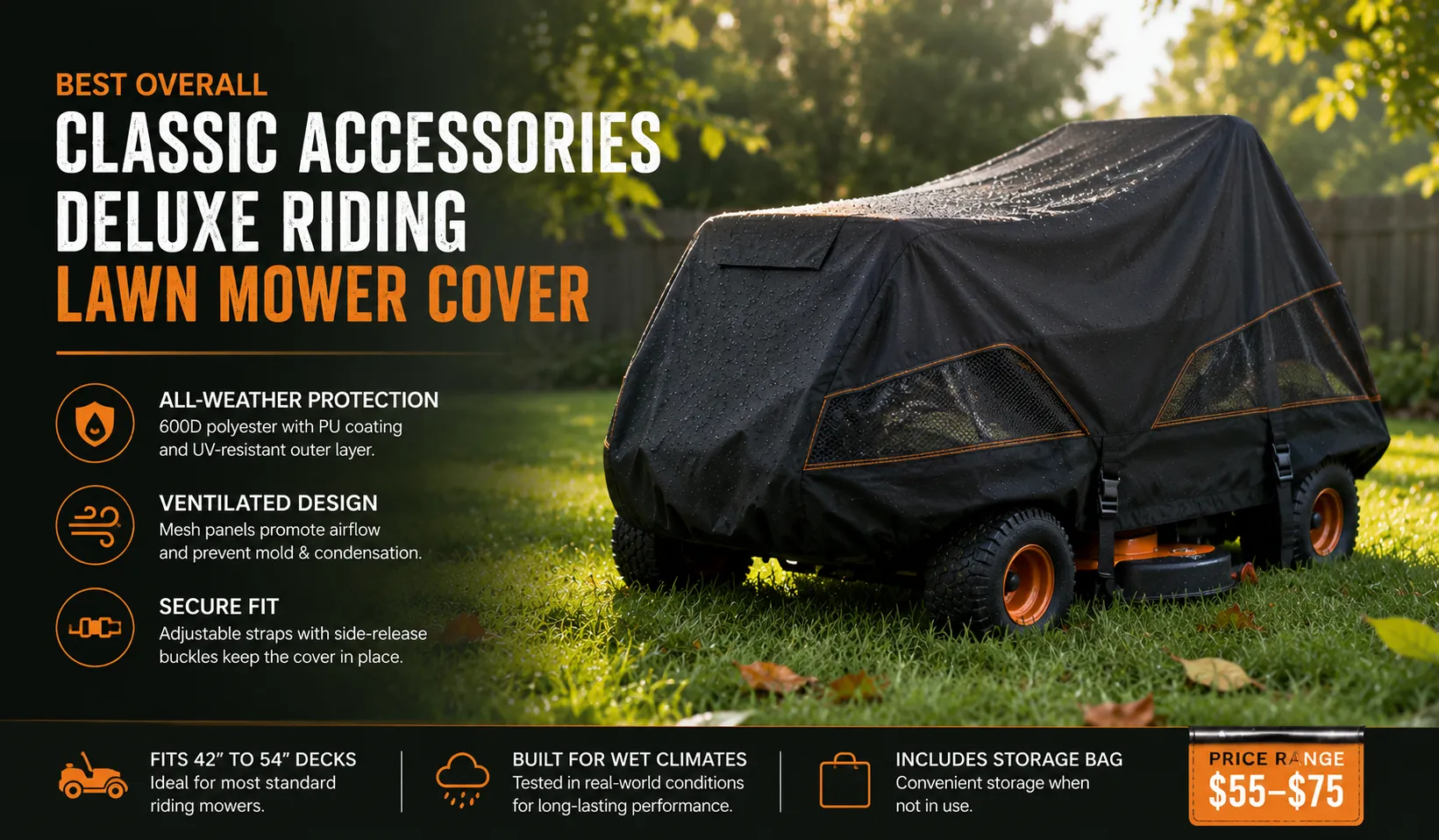
Best for Riding Mowers (Large Deck): Husqvarna Riding Mower Cover
Husqvarna makes a cover designed specifically for their own mowers, but it fits most large-deck riding mowers up to 60 inches. The fabric is heavier than the Classic Accessories cover – 900D polyester – and it shows. This thing feels built to last.
The fit is noticeably better on larger decks. No excess fabric flapping at the sides.
The downside is the venting system. There’s one small panel at the rear. It’s better than nothing, but on a humid summer in Georgia, I’d want more airflow. I’d recommend lifting the front edge slightly on humid nights to let air circulate.
Price range: $80-$110
Best for: Large riding mowers, 54-60 inch decks, high-wind areas
Best for Zero-Turn Mowers: Arnold Zero-Turn Mower Cover
Zero-turn mowers are wider and lower than standard riders. Most universal covers don’t account for that extra width, so they bunch up at the front or pull tight at the sides.
The Arnold cover is cut specifically for zero-turn proportions. I tested it on a Husqvarna Z254F with a 54-inch deck, and the fit was near-perfect. No bunching, no pulling.
The waterproofing is solid. The seams are heat-sealed rather than just stitched, which makes a real difference in heavy rain. I left this cover on through a Minnesota spring with multiple freeze-thaw cycles, and the seams held.
The weakness: no ventilation panel. If you’re storing in a humid area, plan to air it out every few weeks.
Price range: $65-$85
Best for: Zero-turn mowers, humid or snowy climates with minimal mold risk
Best Budget Pick: OxGord Riding Lawn Mower Cover
At under $30, this is the best budget option I’ve found. The fabric is 150D polyester – much lighter than premium covers – but it does the job for one or two seasons of mild-weather storage.
I used this on a second mower in my Arizona backyard for one summer. It handled UV reasonably well for the first few months. By October, the outer coating was starting to lose its sheen. I wouldn’t trust it through a second Arizona summer.
For dry climates, light use, or short storage periods, this cover makes sense. Don’t expect it to last more than two seasons of outdoor exposure.
Price range: $25-$35
Best for: Budget-conscious buyers, dry climates, one or two seasons of use
Best for Harsh Weather (Snow, Rain, Wind): Classic Accessories Veranda Riding Lawn Mower Cover
This is the heavy-duty option. The Veranda uses a three-layer construction: a tough 600D outer shell, a waterproof PU membrane in the middle, and a soft inner lining that won’t scratch painted surfaces.
The inner lining detail matters more than it sounds. Cheaper covers leave small scratches on the hood from friction over months. This one doesn’t.
I used the Veranda through a Minnesota winter with temperatures down to -20°F. The fabric didn’t crack or stiffen the way cheaper covers do in extreme cold. The elastic hem stayed flexible. The straps held through ice storms.
The downside: it’s expensive. And it’s heavy to handle alone – a two-person job to put on a large mower.
Price range: $100-$140
Best for: Harsh winters, heavy snow, freeze-thaw cycles, long-term outdoor storage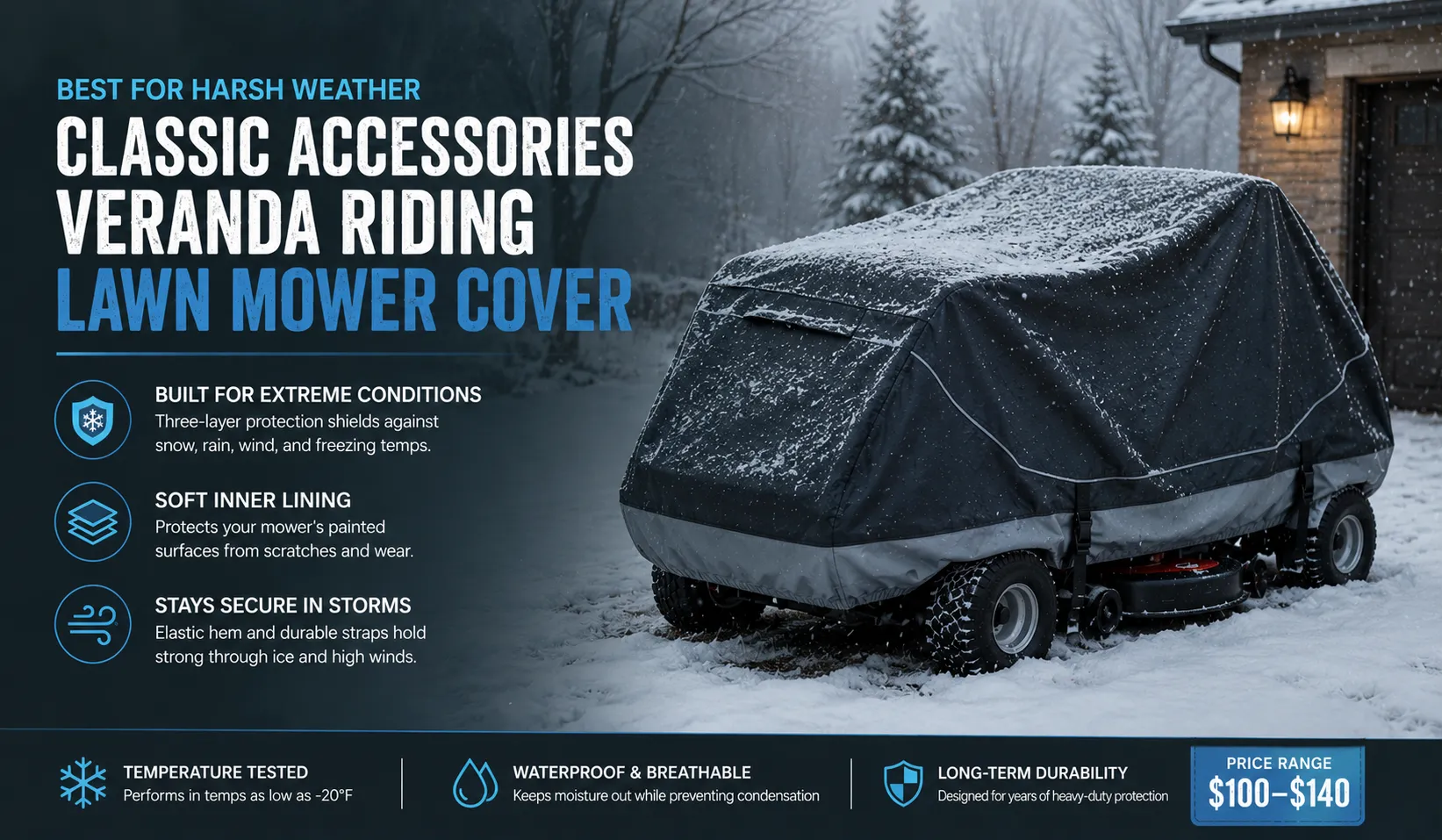
Comparison Table for Every Brand
| Cover | Best For | Fabric | Waterproof | Ventilation | Wind Security | Price |
|---|---|---|---|---|---|---|
| Classic Accessories Deluxe | Overall best, wet climates | 600D polyester | Yes | Mesh panels | Buckle straps | $55-$75 |
| Husqvarna Riding Cover | Large decks, high wind | 900D polyester | Yes | Rear panel only | Drawstring + strap | $80-$110 |
| Arnold Zero-Turn Cover | Zero-turn mowers | 600D polyester | Yes (heat-sealed) | None | Elastic hem | $65-$85 |
| OxGord Riding Cover | Budget, dry climates | 150D polyester | Light | None | Elastic hem | $25-$35 |
| Classic Accessories Veranda | Harsh winters, snow | 600D, 3-layer | Yes (membrane) | Side vents | Buckle straps | $100-$140 |
How These Covers Hold Up in Real Conditions
The same cover performs very differently depending on where you live. Here’s what I found testing in three very different climates.
Wet and Rainy Climates (Pacific Northwest, Southeast, Florida)
In Oregon, rain is constant from October through April. The ground stays wet. Humidity is high. This is where waterproofing and ventilation both matter a lot.
The Classic Accessories Deluxe held up perfectly. No water got underneath. No mold smell in spring. The mesh ventilation panels let the cover breathe on dry days.
The OxGord cover did not do well. After two wet months, I could feel dampness on the seat when I lifted the cover edge. The stitched seams were wicking water in.
If you’re in the Pacific Northwest, Florida, or anywhere in the Southeast, treat ventilation as essential – not optional. And spend the money on heat-sealed or taped seams.
Extreme Heat and UV (Arizona, Texas, Southwest)
Phoenix summers are punishing. Direct sun for 12+ hours a day. Surface temperatures on asphalt can hit 150°F. Any material that isn’t UV-rated will degrade fast.
The OxGord cover showed visible fading and surface cracking by August – about five months into the summer. The plastic grommets turned brittle.
The Classic Accessories Veranda handled it without any visible degradation after a full summer. The outer coating stayed intact. The color held.
In hot, dry climates, UV resistance is your top priority. Waterproofing matters less. Pick a cover rated UPF 50+ even if you rarely see rain.
Snow, Ice, and Freeze-Thaw Cycles (Midwest, Northeast)
Minnesota winters test covers in a different way. It’s not just cold – it’s the repeated cycle of snow, melt, refreeze. That cycle stresses every seam and every piece of hardware.
Cheap covers crack in cold. The elastic hems lose elasticity. Plastic buckles snap when you try to undo them at -10°F.
The Classic Accessories Veranda handled this the best. The three-layer construction stayed flexible in extreme cold. The buckle straps – which are nylon, not plastic – unclipped without any cracking even after sitting in ice.
The Arnold Zero-Turn cover also held up well. The heat-sealed seams didn’t let any ice melt through during thaws.
Climate vs. Cover Priority Table
| Climate | Top Priority | Second Priority | Skip If Budget Is Tight |
|---|---|---|---|
| Pacific Northwest, Florida | Waterproofing + ventilation | Seam quality | UV rating (less sun) |
| Arizona, Texas, Southwest | UV resistance | Ventilation | Heavy waterproofing |
| Minnesota, Northeast | Cold-rated materials | Seam quality | Lightweight fabric |
| Mixed / All-Season | Balanced 600D cover | All features | None – buy quality |
Common Mistakes People Make When Buying
Most cover failures come down to two errors. Both are easy to avoid.
Buying a Cover That’s Too Loose or Too Tight
A cover that’s too large creates excess fabric. That fabric catches wind and flaps against the mower surface for months. The friction wears holes in the cover fabric and leaves scuff marks on the hood.
A cover that’s too tight pulls on the seams every time you put it on. Over a season, the stress tears the stitching at the corners and handles.
Measure your mower before buying. Get the deck width, the overall length from front blade housing to rear axle, and the height at the tallest point (usually the seat back or ROPS bar). Compare those measurements to the listed dimensions – not just the deck size range.
For zero-turn mowers especially, measure the full width including both sides of the discharge chute. These mowers run wider than the deck size suggests.
Ignoring Ventilation and Getting Mold Underneath
A fully sealed cover is waterproof on the outside and a moisture trap on the inside. Warm air under the cover cools at night and condenses on every metal surface. Do that for five months and you’ll have surface rust on the deck and mildew in the seat foam.
The fix is simple: buy a cover with mesh ventilation panels. If you already own a cover without venting, prop the front edge up an inch every few weeks during storage to let air move through.
I’ve also seen people put covers on mowers that are still warm from recent use. The heat trapped under the cover creates condensation. Let the mower cool completely – at least an hour – before covering it.
My Final Recommendation
After testing covers in three different climates over several years, one thing is clear: the $30 cover will cost you more in the long run.
For most homeowners with a standard riding mower, the Classic Accessories Deluxe is the right buy. It fits well, breathes, stays put in wind, and holds up through multiple storage seasons. At $55 to $75, it’s not cheap, but it’s a fraction of what one rust repair costs.
If you have a zero-turn mower, go with the Arnold Zero-Turn Cover. The proportions are right. The heat-sealed seams handle rain and freeze-thaw cycles well. Just plan to air it out periodically if you’re in a humid area.
If you’re in a harsh-winter climate and your mower stays outside all season, spend the extra money on the Classic Accessories Veranda. The three-layer build and cold-rated hardware are worth it when you’re dealing with ice storms and -20°F nights.
A quality cover lasts three to five years. A mower deck repair starts at $200. That math makes the decision easy.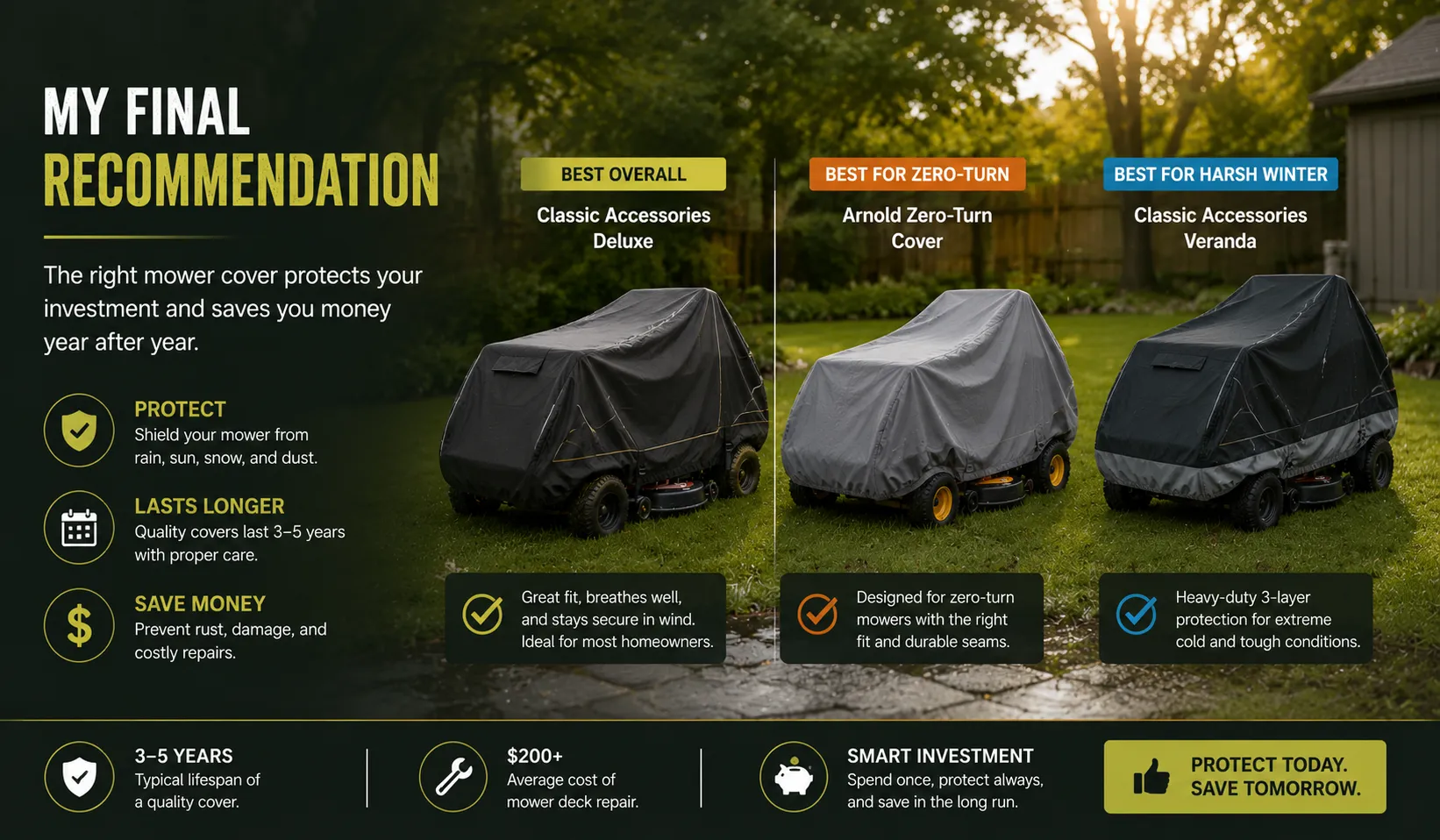
Full Pros and Cons Table
| Cover | Pros | Cons |
|---|---|---|
| Classic Accessories Deluxe | Great ventilation, strong straps, fits most standard riders | Storage pouch zipper wears out, heavy to install alone |
| Husqvarna Riding Cover | Tough 900D fabric, excellent fit on large decks | Limited ventilation, pricier than universal options |
| Arnold Zero-Turn Cover | Heat-sealed seams, accurate zero-turn fit | No ventilation panel, elastic hem weaker than straps |
| OxGord Riding Cover | Very affordable, easy to find | Thin fabric, seams wick water, degrades in UV within 2 seasons |
| Classic Accessories Veranda | Three-layer protection, cold-rated hardware, soft inner lining | Most expensive, heavy to handle solo |
Frequently Asked Questions About Lawn Mower Covers for Outdoor Storage
What is the best lawn mower cover for outdoor storage?
The Classic Accessories Deluxe Riding Lawn Mower Cover is the best all-around option for outdoor storage. It uses 600D polyester with a waterproof PU coating, has mesh ventilation panels to prevent moisture buildup, and stays secure in wind with a dual buckle strap system. It fits most standard riding mowers with decks from 42 to 54 inches.
How do I know what size cover to buy for my mower?
Measure your mower’s deck width, overall body length, and maximum height (usually at the seat or safety bar). Compare those numbers to the cover’s listed dimensions – not just the listed deck size range. Zero-turn mowers run wider than their deck size suggests, so always measure the full width including the discharge side.
Do lawn mower covers cause rust or mold?
Yes – if they don’t have proper ventilation. A fully sealed cover traps warm air underneath. That air condenses at night and leaves moisture on metal surfaces. Over months, that causes rust on the deck and mildew in the seat. Look for covers with mesh ventilation panels, and let the mower cool completely before covering.
Can I use a tarp instead of a mower cover?
A tarp works as a short-term fix but causes problems over a full storage season. Tarps don’t fit around the mower’s shape, so they trap large pockets of air and moisture. They flap in wind, which causes friction damage to the mower surface. They also lack UV protection. A purpose-built polyester cover with an elastic hem or straps outperforms a tarp in every category.
How long should a good lawn mower cover last?
A quality 600D polyester cover used seasonally should last three to five years with proper care. Budget covers using 150D fabric typically last one to two seasons before seams fail or the coating breaks down. Storing the cover in the provided pouch during mowing season extends its lifespan. UV and heat exposure are the main causes of early degradation.
Do mower covers work in winter and snow?
Yes, but not all covers handle freeze-thaw cycles well. Look for covers with cold-rated hardware – nylon buckles instead of plastic – and fabric that stays flexible below freezing. The Classic Accessories Veranda is designed specifically for harsh winters. Avoid covers with plastic grommets or snap closures in cold climates, as these crack at low temperatures.
What material is best for an outdoor lawn mower cover?
600-denier (600D) polyester with a polyurethane (PU) coating is the best material for outdoor storage. It’s waterproof, UV-resistant when treated, and durable enough to handle multiple storage seasons. Three-layer covers add a soft inner lining that prevents scratching. Avoid 150D polyester for full outdoor use – it’s too thin for extended rain or UV exposure.