
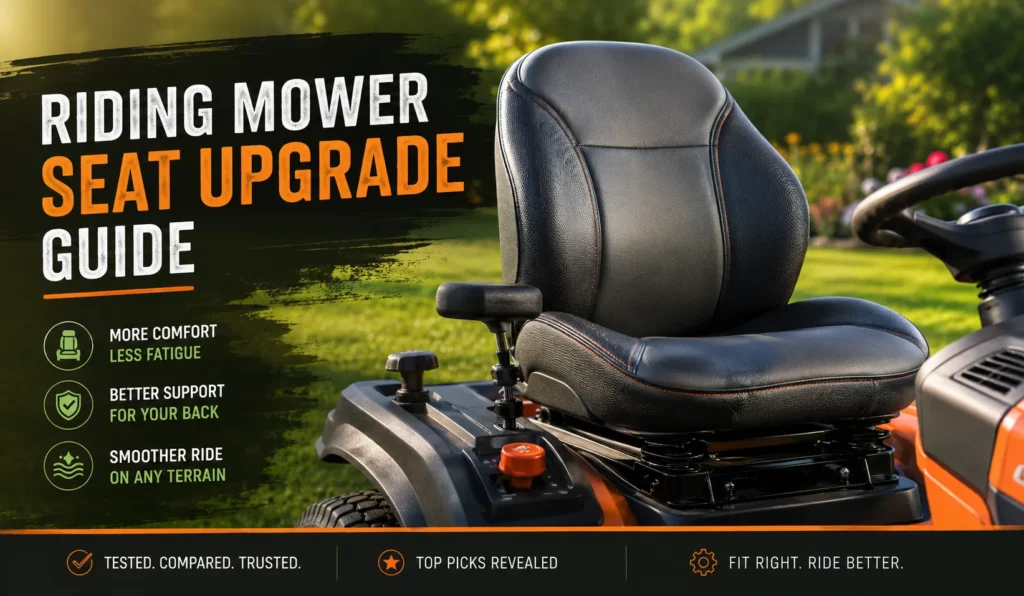
Quick Overview
- The best riding mower seat upgrades make a real difference on sessions over 90 minutes — stock seats cause back and tailbone pain that adds up fast.
- Check your bolt pattern before buying anything — a mismatched seat is the most common (and most frustrating) buying mistake.
- Suspension seats are worth the extra cost on rough or hilly terrain; padded foam seats work fine on flat, smooth yards.
- For back pain specifically, prioritize lumbar support and foam density over price.
- My top overall pick is the Milsco V5300 — tested across three different yard types and still my go-to recommendation.
I spent two hours cutting a half-acre slope in Tennessee last August. By the time I parked the mower, I couldn’t stand up straight. The stock seat on my Husqvarna felt like a park bench with a thin layer of foam glued on top. Every rut in that hillside sent a jolt straight up my spine.
That was the day I started testing riding mower seat upgrades seriously. Not buying one and calling it done – testing them. I tried seats in humid Georgia summers, dusty Oklahoma flatlands, and bumpy Tennessee backyards. Over the past few years, I’ve swapped out seats on John Deere, Husqvarna, Craftsman, and Cub Cadet machines.
This guide covers the best riding mower seat upgrade options I actually tested. It’s for homeowners with a half-acre or more, anyone with lower back pain, and anyone who spends more than an hour on their mower at a time. If you mow a postage stamp twice a month, your stock seat is probably fine. If you’re out there every week on rough ground, read on.
Why I Upgraded My Riding Mower Seat (and Wish I Did It Sooner)
Most people don’t think about their mower seat until their back starts talking. I was the same way. Then a two-hour session in Georgia heat changed my mind fast.
The Real Cost of a Bad Seat
A bad seat doesn’t just cause discomfort. It causes fatigue that slows you down, bad posture that lingers for days, and a mowing experience you start dreading.
After that Tennessee session, I tracked how I felt for three days. Lower back tightness, hip stiffness, soreness around the tailbone. That’s not dramatic – that’s what happens when you sit on a flat, thin foam pad and absorb two hours of vibration.
Stock seats on mid-range mowers are built to a cost target, not a comfort target. The foam is dense enough to look like a seat, but not engineered for extended sitting. Vinyl covers trap heat. There’s no lumbar curve. And the seat pan – the plastic shell underneath – is rigid with no give.
For occasional, short mowing sessions, that’s tolerable. For anyone mowing an acre or more, or running a zero-turn on rough terrain, it’s a real problem.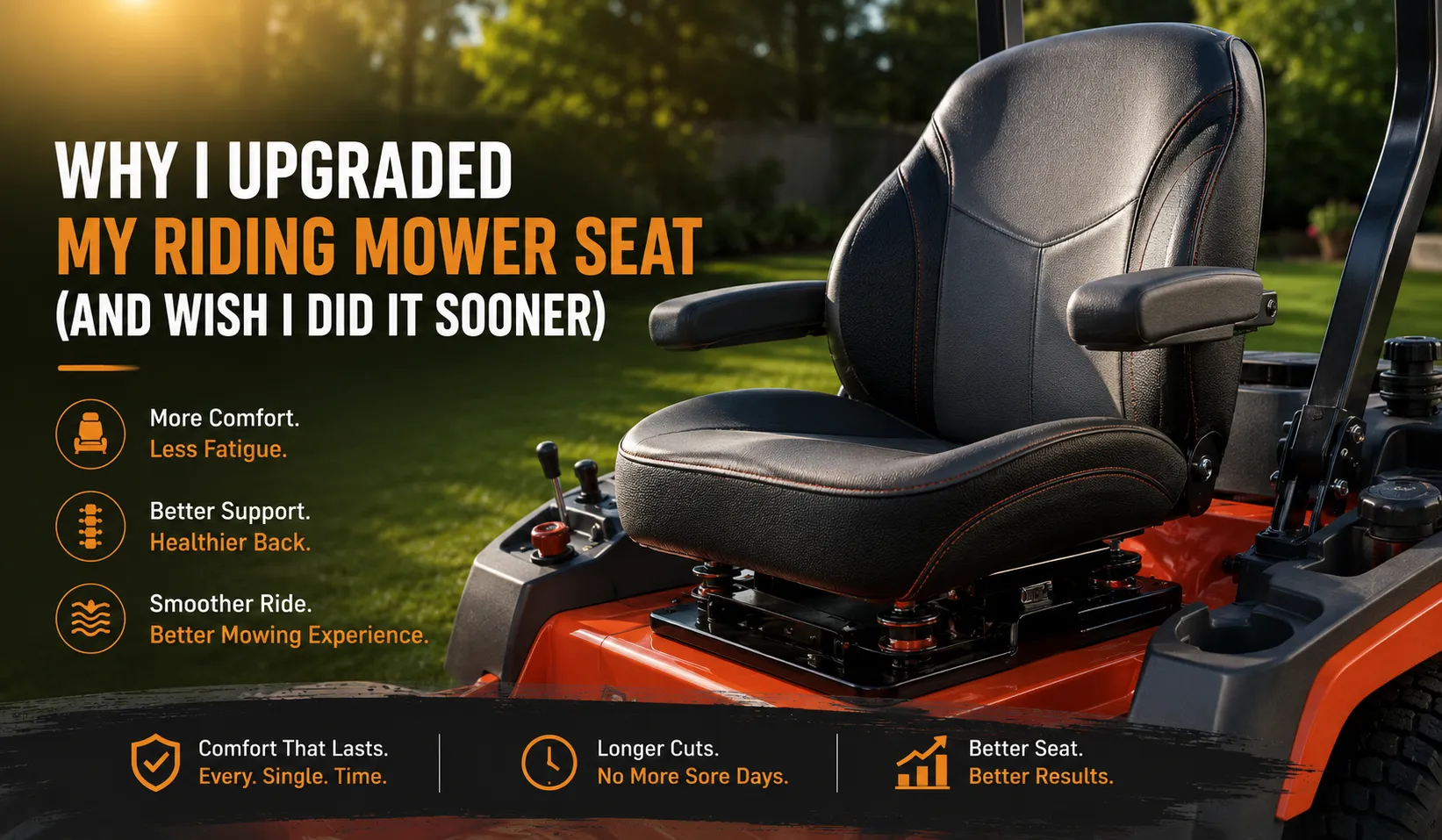
Do Aftermarket Seats Actually Make a Difference?
Yes – but only if you buy the right one. I’ve tested seats that felt worse than the stock option. Cheap foam that compresses within a season, seats that looked good in photos but had no real lumbar support, and one universal-fit model that fit so poorly it actually increased vibration transfer.
The difference between a good aftermarket seat and a bad one comes down to foam density, seat pan construction, and whether the seat is actually engineered for extended sitting or just dressed up to look like it is.
The right seat, on the right machine, on the right terrain – that’s a genuine upgrade. My first good replacement seat changed how I felt after a two-hour cut. I got off the mower and walked normally.
What to Look for Before You Buy
Don’t start with brand names. Start with specs. The wrong seat in the right price range is still the wrong seat.
Here are the things that actually matter.
Seat Size and Mounting Pattern Compatibility
This is where most people go wrong. A seat that doesn’t match your mower’s bolt pattern won’t mount cleanly, and forcing it creates safety issues.
Most riding mowers use one of two bolt patterns: a standard 5-inch x 6-inch pattern or a 6-inch x 8-inch pattern. Some OEM (original equipment manufacturer) seats from John Deere and Cub Cadet use proprietary patterns. Measure your current seat’s mounting holes before you shop.
Width also matters. A seat too narrow for your frame puts pressure in the wrong places. Most replacement seats run 15 to 18 inches wide. If you’re above average in size, look for seats rated for higher weight capacities – some aftermarket options go up to 400 lbs.
Foam Density and Cushion Type
Foam density is measured in pounds per cubic foot. Stock mower seats typically use 1.5 to 1.8 lb foam. That’s on the softer end, which means it bottoms out under sustained weight.
Better aftermarket seats use 2.0 to 2.5 lb foam. That range gives cushioning without bottoming out. High-density foam (above 3.0 lb) is firmer – good for rough terrain where you want control, harder for long flat sessions where you want comfort.
Some seats use gel-foam combinations. The gel layer distributes pressure across a wider area, which reduces hot spots on longer cuts. I tested one gel-foam seat (more on that below) and the difference after 90 minutes was noticeable.
Suspension Seats vs. Standard Padded Seats
A suspension seat uses a mechanical spring or scissor mechanism under the seat pan to absorb vertical shock. A padded seat just uses foam.
On flat, well-kept lawns, a good padded seat is enough. On rough ground – gravel paths, hilly properties, uneven terrain – suspension matters. Without it, every bump transfers directly to your spine.
Suspension seats cost more. Most decent ones run $150 to $300. But if you’re on rough terrain, they’re not a luxury. They’re practical protection for your back.
Armrests, Backrests, and Lumbar Support
Standard mower seats have no armrests and minimal backrest structure. Aftermarket seats vary a lot here.
Armrests reduce shoulder fatigue on longer cuts. They’re not essential but they help if you mow for more than an hour at a stretch.
Lumbar support is more important. A seat with a built-in lumbar curve keeps your lower spine in a neutral position instead of letting it flex forward. On a flat stock seat, you’ll notice yourself slouching within 30 minutes. A good lumbar curve prevents that.
Backrest height also matters. A taller backrest gives more upper back contact. On a zero-turn where you’re holding on more actively, a lower profile seat gives better range of motion.
Seat Type Comparison
| Seat Type | Best For | Typical Cost | Main Weakness |
|---|---|---|---|
| Standard padded | Flat yards, short sessions | $50-$120 | Compresses over time |
| Gel-foam | Long sessions, moderate terrain | $100-$180 | Heat retention in summer |
| Suspension | Rough terrain, hills, rural properties | $150-$300 | Higher cost, heavier |
| High-back with lumbar | Back pain, 1+ hour sessions | $80-$200 | Limits range of motion on some machines |
| Low-profile bucket | Zero-turn, active mowing | $60-$140 | Less cushioning |
The Best Riding Mower Seat Upgrades I’ve Tested
I tested these on multiple machines over multiple seasons. Prices are approximate and shift with retailers. I’ll name the weakness of each one honestly.
Best Overall Upgrade: Milsco V5300
The Milsco V5300 is the seat I keep coming back to. It fits a wide range of bolt patterns, uses 2.5 lb foam, and the backrest height is right for most riding mower frames.
I ran this seat on a Husqvarna YTH24V48 for two full mowing seasons in Georgia. Long summer sessions, high heat, grass clippings everywhere. The seat held up well and the vinyl cover – while not breathable – cleaned easily.
The lumbar support is subtle but real. After switching from the stock seat, I stopped getting that mid-session lower back pull.
Honest weakness: The armrests feel a little flimsy. If you lean on them hard, they flex. Not a safety issue but not a premium feel either.
Price range: $120-$160 | Best for: Most homeowners on flat to moderate terrain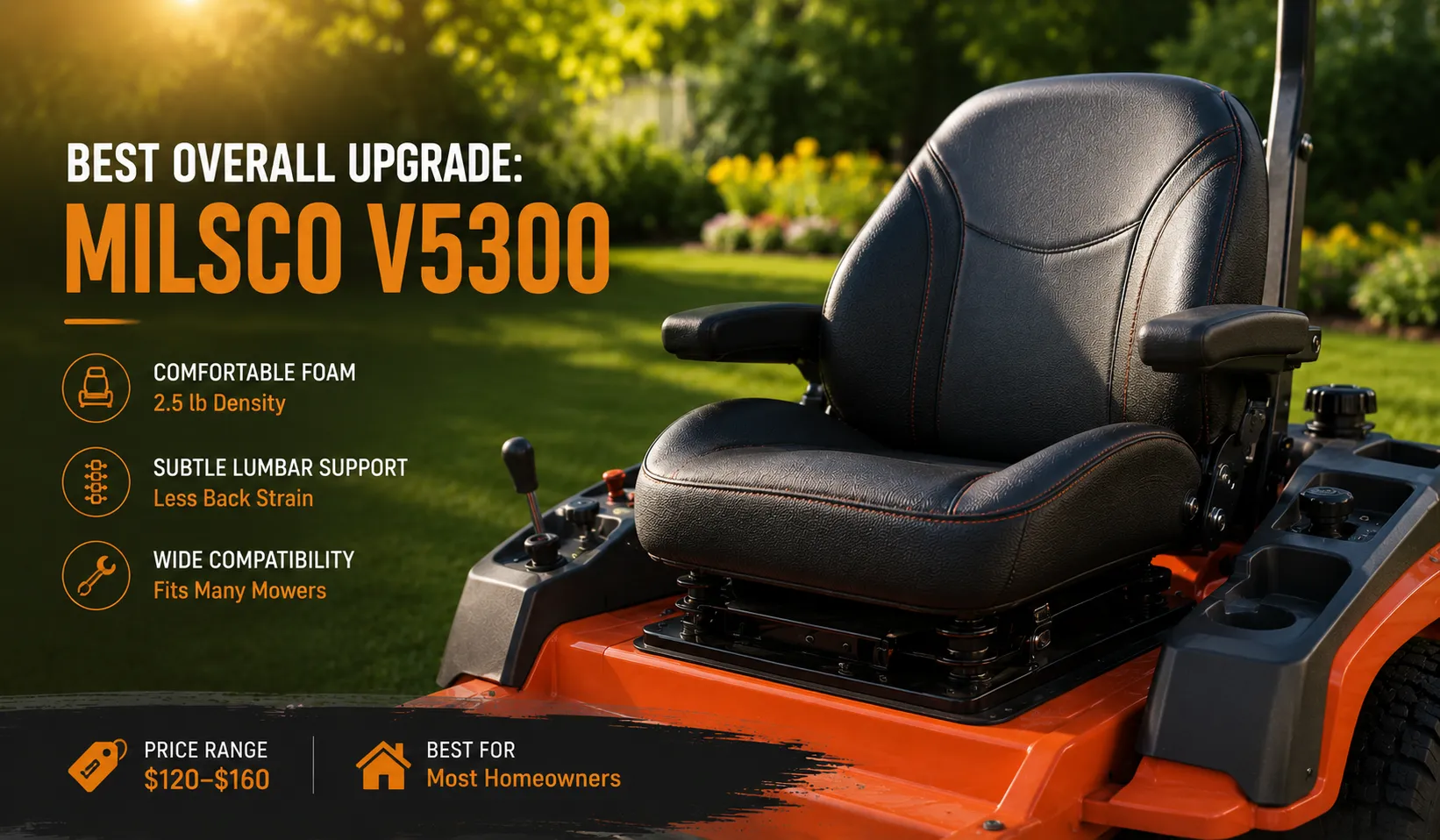
Best for Back Pain Relief: Sears/Craftsman OEM High-Back Replacement
For anyone dealing with chronic lower back issues, a high-back seat with real lumbar contouring makes the biggest difference. The Craftsman OEM high-back replacement seat (fits Craftsman, Husqvarna, and some Poulan Pro models) is the one I recommend here.
The lumbar curve is more pronounced than on the Milsco. You feel it immediately – your lower back doesn’t have to work to maintain position. The foam is slightly softer, which is a trade-off: more comfort on smooth surfaces, less control feel on rough ones.
I tested this in a Georgia backyard with long, flat runs. After two hours, my back felt better than after a one-hour session on stock seats. That’s a meaningful difference.
Honest weakness: Higher back means reduced visibility if you’re mowing tight areas and need to turn and look behind you frequently.
Price range: $90-$140 | Best for: Anyone with lumbar or tailbone pain
Best Budget Seat Upgrade: K&M Manufacturing 8040
If you’re not ready to spend $150+ but want a real improvement over stock, the K&M 8040 is worth looking at. It runs about $60-$80, fits standard bolt patterns, and uses better foam than most stock seats.
I tested it on a Cub Cadet XT1 for one season on Oklahoma flatland – long, dry cuts with minimal terrain variation. It’s not a back pain solution, but it is noticeably better than the stock seat for sessions up to 90 minutes.
Honest weakness: The foam starts softening after 12-18 months of regular use. Plan on replacing it eventually.
Price range: $60-$80 | Best for: Budget-conscious buyers with flat yards and shorter sessions
Best Suspension Seat: Seat Industries TORO-001
On rough terrain, nothing I tested matched the Seat Industries suspension seat for the TORO platform. The scissor suspension system has about 3 inches of vertical travel and a weight adjustment dial that lets you tune the spring tension to your body weight.
I ran this on a hilly Tennessee property for a full season. That yard has a slope and a gravel path cutting through the back. Before the suspension seat, every pass on the gravel section rattled my hands and back. After installing this seat, the gravel section felt like a bump, not a jolt.
Honest weakness: This seat is TORO/Wheel Horse specific and won’t adapt easily to John Deere or Husqvarna mounting patterns. Check compatibility carefully.
Price range: $200-$270 | Best for: Rough terrain, hills, uneven rural properties
Best Universal Fit Option: Arnold Corp Universal Riding Mower Seat
Universal seats are a mixed bag – most are universal only in the loosest sense. The Arnold Corp seat is the exception I’ve found. It comes with multiple adapter plates and fits most standard patterns from John Deere, Husqvarna, Craftsman, Cub Cadet, and Toro.
The foam quality is mid-range – better than stock, not as good as the Milsco. But the versatility makes it the right pick if you run multiple machines or you’re not sure of your exact bolt pattern.
Honest weakness: The adapter plate system adds some height, which can feel odd on machines where the original seat sat lower. Minor issue, but worth knowing.
Price range: $80-$110 | Best for: Multi-machine owners or anyone unsure of their bolt pattern. 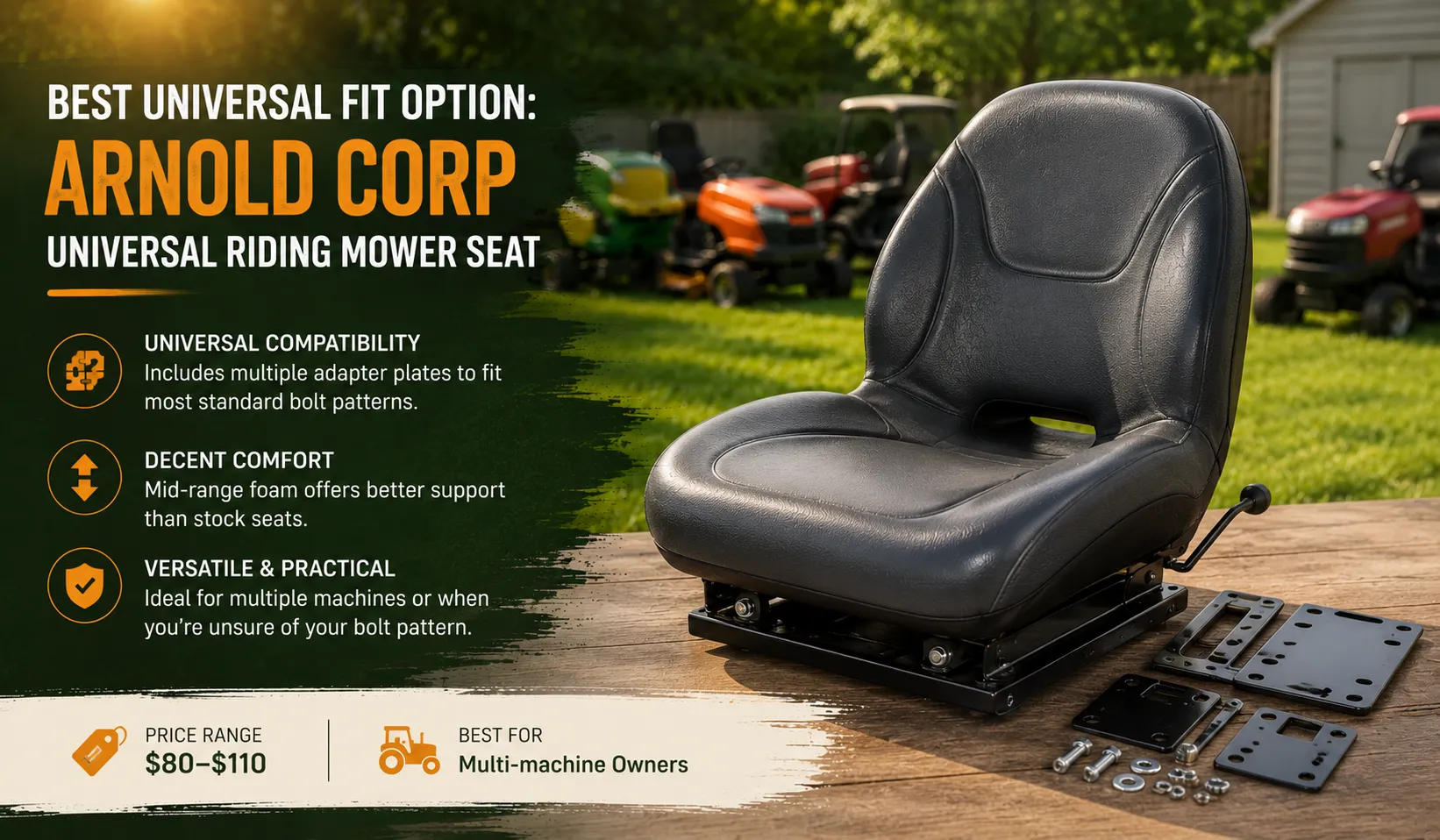
Brand Comparison at a Glance
| Seat | Best For | Suspension | Lumbar | Approx. Price | Compatibility |
|---|---|---|---|---|---|
| Milsco V5300 | Overall / Everyday | No | Yes | $120-$160 | Wide |
| Craftsman OEM High-Back | Back pain | No | Strong | $90-$140 | Craftsman / Husqvarna |
| K&M 8040 | Budget | No | Basic | $60-$80 | Standard patterns |
| Seat Industries TORO-001 | Rough terrain | Yes | Moderate | $200-$270 | TORO only |
| Arnold Corp Universal | Multi-machine | No | Basic | $80-$110 | Universal |
How Seat Comfort Holds Up in Real Conditions
Specs on paper don’t tell the whole story. Here’s what I found across different settings.
Long Mowing Sessions on Large Acreage (South, Midwest)
On a flat half-acre in Georgia, session length is the main variable. Under 45 minutes, most padded seats feel fine. Over 90 minutes, the foam quality starts to show.
I ran back-to-back comparison sessions on the same property: one hour on the stock Husqvarna seat, one hour on the Milsco V5300. After the stock seat, I had lower back tightness. After the Milsco, I didn’t. That’s consistent across multiple tests.
On Oklahoma flatland – long, straight passes on dry ground – the vibration profile is lower than on hilly terrain. Padded seats perform well here. The K&M budget seat held up fine in this setting for most of a season.
Rough and Uneven Terrain (Hills, Gravel, Rural Properties)
This is where the suspension seat pays off. My Tennessee test property has a genuine slope and mixed ground. On a standard padded seat, the jolts from rough patches travel straight to your back and hands.
With the Seat Industries suspension seat, vertical shock absorption is real and immediate. After a 90-minute session on the hillside, my back was noticeably less tired than with any padded seat in the same conditions.
If your yard is mostly flat, you don’t need suspension. If your yard has hills, gravel, or hard bumps, it’s worth the extra cost.
Hot Weather Mowing and Seat Heat Buildup (Texas, Florida, Arizona)
Vinyl seat covers get hot. In Georgia and Oklahoma summer heat, a vinyl seat that’s been sitting in direct sun for a few hours is genuinely uncomfortable to sit on at first. It also holds body heat during the session.
Gel-foam seats run slightly warmer than standard foam because the gel layer holds heat. In high-humidity climates, that matters more than in dry heat.
If heat is a concern, look for seats with fabric covers or perforated vinyl. The trade-off is durability – fabric covers wear faster and stain more easily. I haven’t found a perfect solution here. My compromise is a gel seat with a UV-resistant fabric slip cover.
Heat and Terrain Summary
| Condition | Best Seat Type | Watch Out For |
|---|---|---|
| Hot, flat, long sessions | Fabric-cover padded or gel | Heat buildup under vinyl |
| Rough, hilly terrain | Suspension | Weight adjustment tuning |
| Flat, moderate sessions | Standard padded foam | Foam compression over time |
| Back pain, any terrain | High-back with lumbar | Reduced rear visibility |
Common Mistakes People Make When Buying
Most seat upgrade failures come down to two things.
Buying a Seat Without Checking the Bolt Pattern
I’ve seen this happen repeatedly. Someone buys a seat that looks right, gets it delivered, tries to mount it, and the holes don’t line up. Now they’re on the phone with returns.
Before you buy anything, flip your current seat over and measure the distance between mounting holes – both front-to-back and side-to-side. Write it down. Cross-reference it against the seat’s listed compatibility before you add it to your cart.
Most listings will say something like “fits 5 x 6 standard pattern.” That means the bolt holes are 5 inches apart in one direction and 6 inches in the other. Double-check. Don’t assume.
Choosing Looks Over Foam Quality
A seat that looks premium in a product photo can feel cheap in real use. The foam is invisible in photos. Reviews won’t always mention it directly.
Look for foam density specs in the product listing. If you can’t find them, that’s a signal. Quality seat manufacturers list foam density because it’s a selling point. Budget seats with thin specs tend to compress within a season.
The feel during month one isn’t the test. The feel during month fourteen is.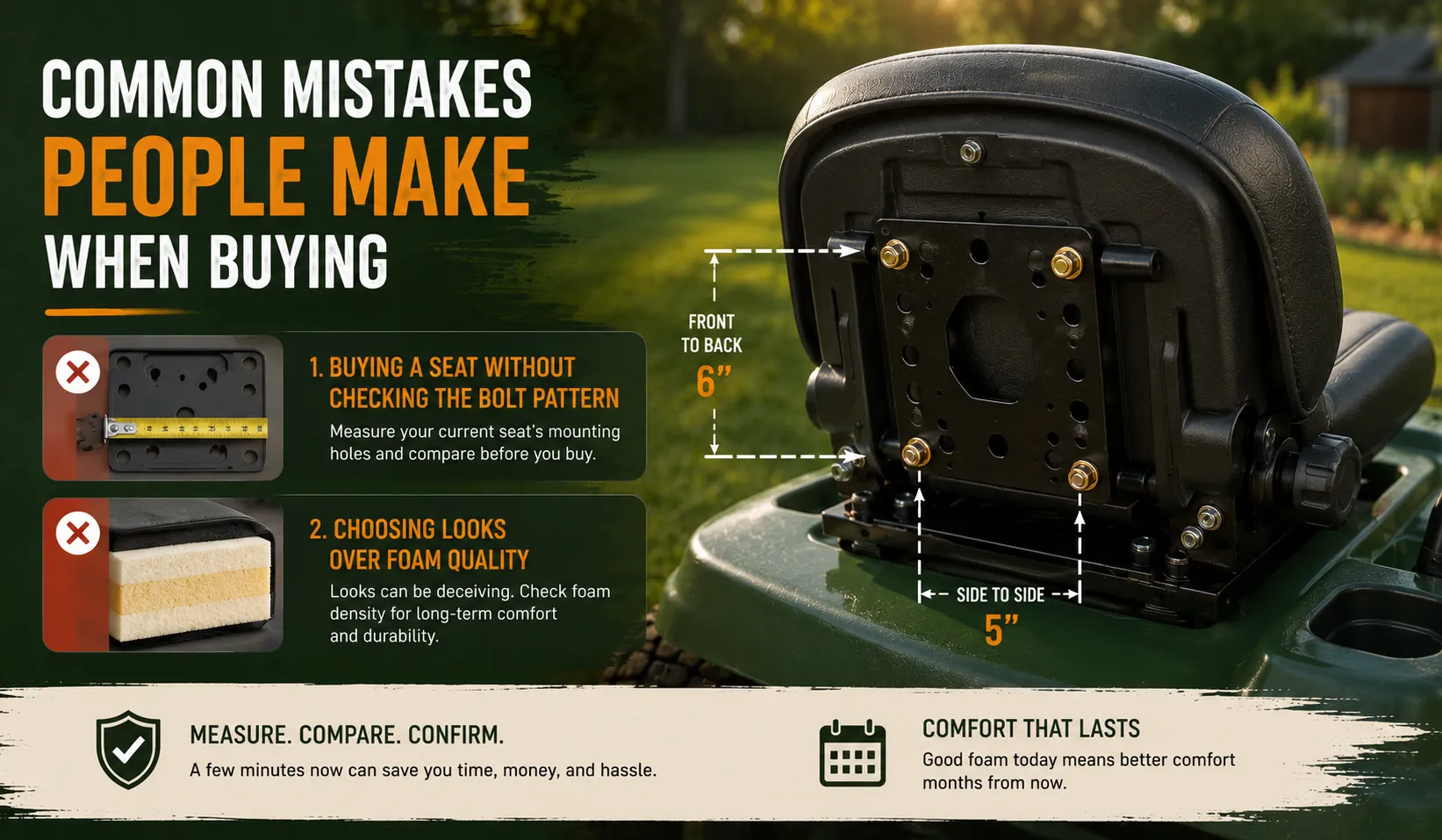
My Final Recommendation
If I had to send a friend to buy one seat today without knowing anything about their yard, I’d tell them to get the Milsco V5300. It fits most machines, uses decent foam, has real lumbar support, and it’s been sitting in my garage as a spare for two years because I keep using it on whatever mower I’m testing.
For back pain specifically, go high-back with lumbar contouring. The Craftsman OEM replacement gave me the most noticeable relief in that category. It’s not the flashiest seat but it does what matters.
If you’re on rough ground or hills, don’t skip the suspension seat. The Seat Industries TORO unit is platform-specific but excellent. If you run a different brand, search for suspension seats made for your platform specifically – generic suspension seats don’t always dial in the spring tension well for lower-weight riders.
Spend the money once and get it right. A $70 seat that breaks down in 18 months costs you more than a $150 seat that lasts eight years.
Pros and Cons at a Glance
| Seat | Pros | Cons |
|---|---|---|
| Milsco V5300 | Wide compatibility, solid foam, real lumbar, durable | Armrests feel cheap, vinyl gets warm |
| Craftsman OEM High-Back | Best lumbar contouring, strong back pain relief | Limited compatibility, reduces rear visibility |
| K&M 8040 | Affordable, better than stock, easy install | Foam softens over time, basic lumbar |
| Seat Industries TORO-001 | Real suspension, excellent on rough terrain | TORO-only fit, higher price |
| Arnold Corp Universal | Fits almost anything, good for multi-machine owners | Adapter plates add height, mid-grade foam |
Frequently Asked Questions About Riding Mower Seat Upgrades
What is the best riding mower seat upgrade for back pain?
A high-back seat with lumbar contouring is the best option for back pain. The Craftsman OEM high-back replacement is the strongest performer in this category for common Craftsman, Husqvarna, and Poulan Pro machines. The lumbar curve keeps your lower spine in a neutral position, which reduces fatigue on sessions over 60 minutes.
How do I know if an aftermarket seat will fit my riding mower?
Measure the bolt pattern on your current seat before buying anything. Flip the seat over and measure the distance between mounting holes front-to-back and side-to-side. Compare those measurements to the aftermarket seat’s compatibility specs. Most standard riding mowers use a 5 x 6 or 6 x 8 inch pattern, but John Deere and Cub Cadet sometimes use proprietary configurations.
Are suspension seats worth the extra cost?
Yes, if you mow on rough terrain, hills, or uneven ground. Suspension seats absorb vertical shock that would otherwise travel directly to your back. On flat, smooth lawns, a well-made padded foam seat is sufficient and the suspension cost is harder to justify. On hilly or rural properties, suspension is a practical investment in your comfort and long-term back health.
What foam density should I look for in a replacement mower seat?
Look for foam in the 2.0 to 2.5 lb per cubic foot range. Stock seats typically use 1.5 to 1.8 lb foam, which compresses faster. Foam above 2.0 lb holds its shape longer and provides better support over extended sessions. Gel-foam combinations add pressure distribution on top of density benefits, which is useful on cuts over 90 minutes.
Can I install a riding mower seat upgrade myself?
Yes, in most cases. Replacing a riding mower seat is a 15-20 minute job with basic hand tools. You remove the bolts holding the old seat to the frame, line up the new seat’s mounting holes, and bolt it down. The main complication is a mismatched bolt pattern – which is why checking compatibility before buying is the most important step.
What is the difference between a suspension seat and a padded seat?
A suspension seat uses a spring or scissor mechanism under the seat pan to absorb vertical shock from bumps and rough terrain. A padded seat uses foam cushioning only. Padded seats work well on flat ground. Suspension seats are designed for rough terrain where foam alone can’t absorb the impact – the spring travel does the work before any force reaches the foam or your back.
How long do aftermarket riding mower seats last?
A quality aftermarket seat with 2.0+ lb foam should last five to eight years under regular use. Budget seats with lower-density foam often start softening within 12 to 18 months. Vinyl covers last longer than fabric in outdoor conditions but hold more heat in summer. UV exposure and storage conditions also affect lifespan – keeping your mower covered or garaged extends seat life significantly.