
Key Takeaways
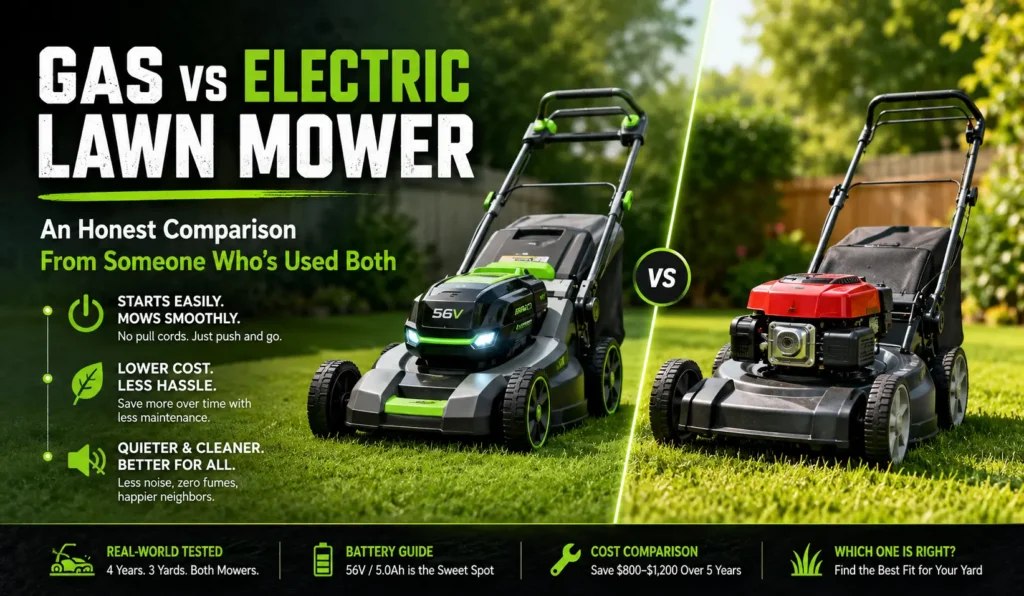
- Electric lawn mowers are the better choice for most homeowners with yards under half an acre – they start instantly, cost less to run, and need almost zero maintenance.
- Gas mowers still win on raw power and runtime for large lawns (half an acre and above), thick grass, and uneven terrain.
- Over a 5-year ownership period, a gas mower costs an estimated $800-$1,200 more than a comparable battery-electric model when you factor in fuel, oil, and tune-ups (Consumer Reports, 2024).
- Battery voltage and amp-hours (Ah) are the two numbers that determine how long an electric mower runs – a 56V / 5.0Ah battery handles most medium yards in one charge.
- If you have a small or medium yard and your mower sits unused for months at a time, switch to electric. You will not miss the gas.
How I Came to Test Both Gas and Electric Lawn Mowers Side by Side
I spent four years running a gas mower and an electric mower in back-to-back seasons across three different yards – a quarter-acre lot in Tampa, a third-acre patch in Columbus, Ohio, and a dry half-acre property outside Tucson. That wasn’t planned research. It happened because I kept second-guessing my choices.
The short version: I started on gas, got frustrated, switched to electric, got frustrated again for different reasons, then bought a second electric machine and landed somewhere I’m genuinely happy with. This article is what I learned doing that.
My History With Gas Mowers
My first mower was a Honda HRX217 – a solid machine by any measure. I used it for three seasons and it cut well. What it didn’t do well was cooperate on hot mornings. If I hadn’t run it in two weeks, starting it was a ritual: prime, choke, pull, pull again, adjust, pull three more times. On a humid July morning in Florida, that gets old fast.
I also paid around $90 a year in fuel and $60-$80 per season for oil changes and blade sharpening done at a shop. Not budget-breaking, but it added up. And the exhaust smell when mowing in a smaller yard with neighbors close by was something I never stopped noticing.
When I Started Taking Electric Mowers Seriously
A neighbor in Columbus switched to an EGO Power+ LM2135SP and couldn’t stop talking about it. I borrowed it for one mow. One press of a button, no fumes, no choke. It finished my third-acre yard on a single charge with battery life to spare.
I bought my own the following month. That was the turning point – not because electric was perfect, but because it fixed the specific problems that bothered me most.
The Real Differences That Matter Day to Day Between Gas and Electric
The meaningful gap between a gas lawn mower and an electric lawn mower isn’t on the spec sheet. It’s in the weekly routine – what you do before you mow, during, and after.
Startup, Convenience, and the Weekly Routine
Electric mowers start with a button press, every time, without exception. Gas mowers require a pull-cord start, and if the machine has sat for two or more weeks, expect to prime the carburetor and adjust the choke before it fires. On a 90-degree day, that’s a real friction point.
With electric, the routine is: charge the battery after each mow (30-60 minutes on a fast charger for most 56V packs), store it, press the button next week. That’s it. With gas, the routine adds: check the oil level, check the fuel level, make sure the fuel hasn’t gone stale (ethanol-blended gasoline degrades in about 30 days), and pull-start the engine.
For people who mow every 7-10 days, this is a small difference. For anyone who mows every 2-3 weeks – which is common in slower-growth seasons – stale fuel and cold-start issues become a recurring annoyance with gas.
Power and Performance on Real Grass
Gas mowers produce more torque at the blade than most battery-electric models in the same price range. On thick Bermuda grass, overgrown St. Augustine, or wet Zoysia, that torque matters. A gas engine doesn’t bog down the same way a brushless motor does when the load spikes suddenly.
That said, the best electric mowers – EGO, Greenworks Commercial, Ryobi 40V+ – have closed that gap significantly. A brushless motor on a 56V platform delivers enough blade speed for clean cuts on most residential grass types. The difference shows up on thick, dense, or wet grass, not on a well-maintained lawn mowed on schedule.
Cutting height adjustment works the same way on both types. Most models offer a single-lever or per-wheel adjustment with 5-7 height settings. No edge to either side there.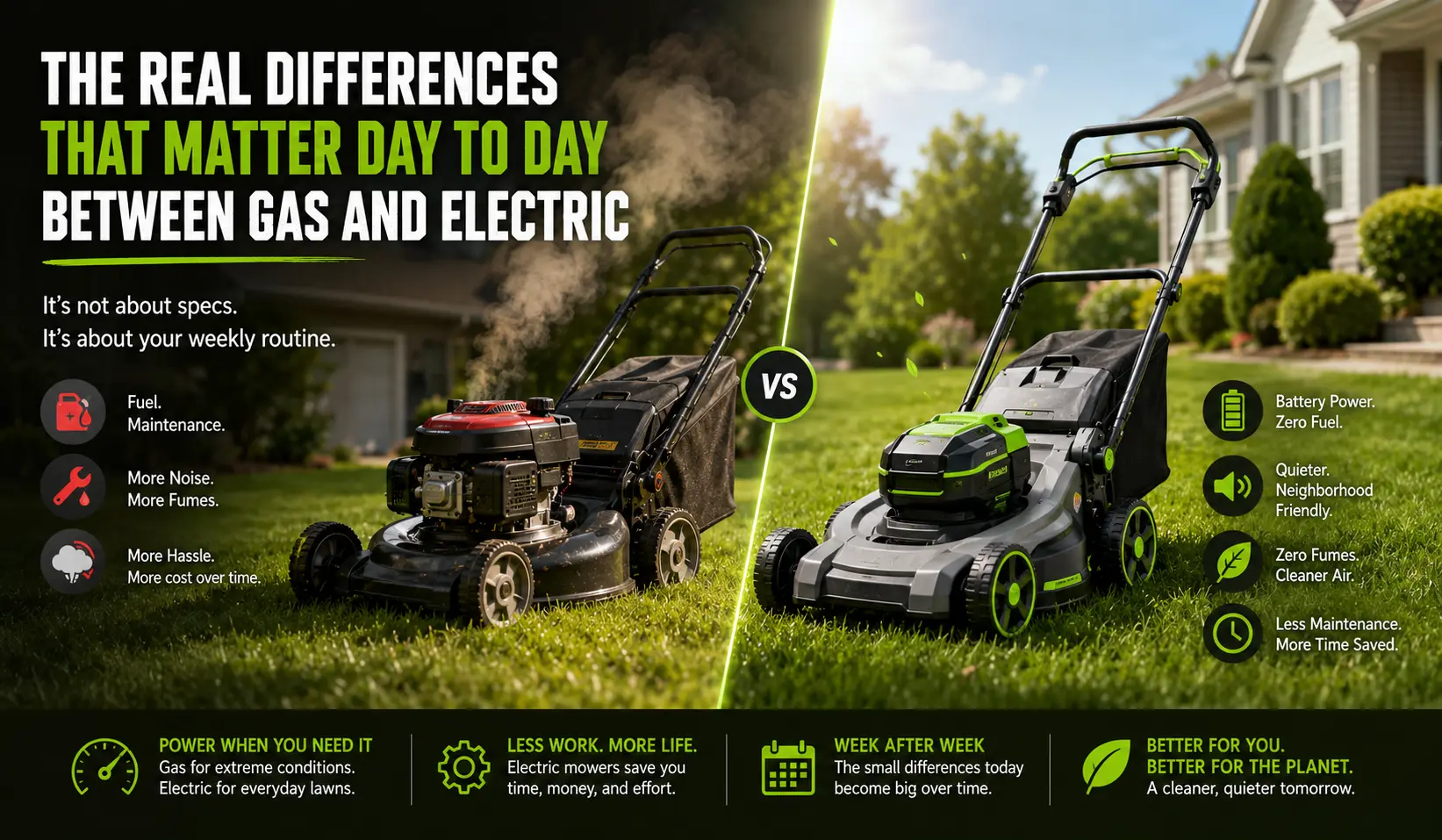
Noise, Fumes, and Neighborhood Etiquette
A gas mower runs at roughly 85-95 decibels (dB) at the operator’s ear (Consumer Product Safety Commission, 2023). The EPA recommends hearing protection above 85 dB for sustained exposure. Most electric mowers run at 75-80 dB – quieter, but not silent.
The practical difference: with a gas mower, neighbors three houses away hear you. With an electric mower, they might not notice until you’re in front of their yard. If you mow early on weekend mornings, or live in a neighborhood with close lot lines, that gap matters to people around you as much as it does to you.
Fumes are a non-issue with electric. Gas mowers emit carbon monoxide and unburned hydrocarbons throughout the mow. In an open yard that’s not a health hazard, but near a fence line, a garage, or any enclosed space, the smell and exhaust are real. Carbon emissions from a gas lawn mower equal roughly 11 cars driving for one hour per year of typical use (EPA, 2023).
Maintenance Over Time
Gas mowers need: oil changes every 25-50 hours of use, air filter replacement annually, spark plug replacement every 1-2 seasons, carburetor cleaning if the machine sits unused, and blade sharpening once or twice a year. That’s 3-4 hours of annual maintenance minimum, or $60-$120 if you take it to a shop.
Electric mowers need: blade sharpening once a year and battery care (avoid storing at 0% charge, keep out of extreme heat). That’s roughly 30 minutes of annual maintenance.
The one real maintenance concern with electric is battery replacement. A quality lithium-ion battery pack – like EGO’s 56V 5.0Ah – lasts 500-1,000 charge cycles (EGO Power+, 2024). At one mow per week, that’s 10-20 years of battery life before you’d need a replacement. Battery degradation in practice shows up as shorter runtime per charge, not sudden failure.
Cost Breakdown – What Gas vs Electric Actually Costs Over 5 Years
Electric mowers cost more at the register and less to run. Gas mowers cost less upfront and more each year. Over a 5-year window, electric comes out ahead for most homeowners.
What You Pay at the Register
A mid-range gas push mower – Honda HRN216, Toro Recycler 22 – runs $350-$500. A comparable self-propelled model from Husqvarna or Toro runs $450-$650.
A mid-range battery-electric push mower – EGO LM2102SP, Greenworks 40V, Ryobi 40V – runs $400-$550 with battery and charger included. Self-propelled electric models land at $500-$700.
At purchase, the price difference is $50-$150, usually in favor of gas. Not a significant gap.
The Hidden Costs Most People Miss
This is where the 5-year math shifts. Here’s a realistic cost comparison for a quarter-acre yard:
| Cost Category | Gas (5 Years) | Electric (5 Years) |
|---|---|---|
| Fuel (0.5 gal/mow, 30 mows/year) | $360-$480 | $0 |
| Oil changes (annually, DIY) | $50-$75 | $0 |
| Spark plugs / air filter | $40-$60 | $0 |
| Blade sharpening | $75-$100 | $75-$100 |
| Electricity (charging) | $0 | $15-$25 |
| Battery replacement (if needed) | $0 | $0-$150 |
| Total extra operating cost | $525-$715 | $90-$275 |
Over five years, gas ownership costs an estimated $400-$600 more in operating expenses than electric (Consumer Reports, 2024). Add the initial purchase price and electric breaks even or comes out ahead by year 3 for most users.
The only scenario where gas wins financially is if you already own a gas mower and the battery replacement cost on an electric platform pushes total cost back up. For a first-time buyer, electric is the better value over time.
Which Mower Type Wins for Your Yard Size and Grass Type
For yards under half an acre with maintained grass, electric wins. For larger properties or demanding grass types, gas is the more reliable choice.
Small to Medium Yards – Under Half an Acre
A 56V battery-electric mower with a 5.0Ah or 7.5Ah battery handles yards up to half an acre on a single charge with room to spare. Runtime on a 56V / 5.0Ah pack is typically 45-60 minutes of continuous mowing (EGO Power+, 2024) – enough for a third-acre yard in one session.
Common grass types in smaller residential yards – Fescue in the Midwest, St. Augustine in Florida, Bermuda in the South – are all manageable for a quality electric mower when maintained on a regular schedule. If you mow every 7-10 days and keep the grass at a normal height, electric handles it without issue.
Large Lawns and Acreage – Half an Acre and Above
Above half an acre, gas mowers are the more practical choice for most homeowners. Runtime becomes the limiting factor on electric – finishing a three-quarter acre yard may require swapping to a second battery mid-mow, which adds cost and inconvenience.
Self-propelled gas mowers – Husqvarna HU800AWDH, Honda HRX217 – handle large properties well. They don’t stop mid-yard because the tank ran dry as long as you refuel. For acreage above one acre, a riding mower – gas or electric – is worth considering over any push model.
Thick, Overgrown, or Wet Grass
This is where gas still has a clear edge. When grass is overgrown (more than 5-6 inches), wet from recent rain, or dense like Zoysia, a gas engine maintains blade speed more consistently under load. A brushless motor on a battery platform can slow down or trigger the overload protection cutoff when conditions are tough.
If you know your lawn gets away from you for 2-3 weeks at a stretch, or if your grass type is naturally thick, a gas mower is more forgiving. If you mow on a regular schedule and keep grass at 3-4 inches, electric handles it fine.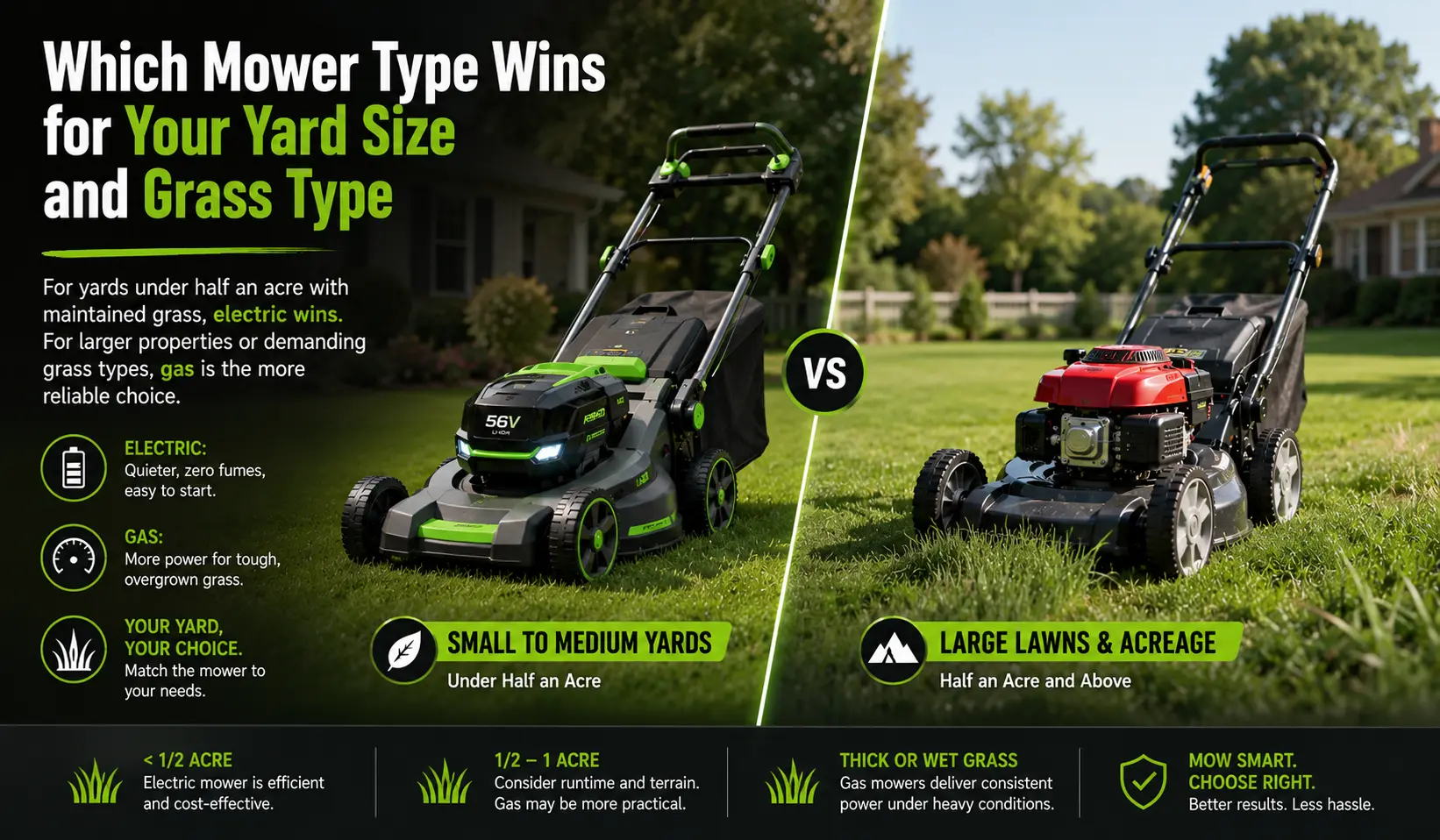
How Each Type Holds Up in Different US Climates
Climate affects both types, but in different ways. Gas mowers struggle in cold starts and with stale fuel after storage. Electric mowers underperform in extreme heat when battery capacity drops.
Heat, Humidity, and Southern Summers
In Florida, Texas, and the Gulf Coast, heat is the main factor. Gas mowers handle heat well mechanically – engines are built for it. The problem is the operator. Mowing in 95-degree heat with exhaust blowing near your legs is genuinely unpleasant.
Battery-electric mowers perform well in heat, but lithium-ion batteries lose some capacity above 95-100 degrees Fahrenheit (Battery University, 2023). On an extremely hot day, you may get 10-15% less runtime than the rated spec. That’s rarely a deal-breaker, but it’s worth knowing.
Humidity affects gas mowers more than electric. High humidity accelerates carburetor gum buildup when fuel sits in the system unused. If you’re in a humid climate and store your gas mower for 30+ days between uses, fuel stabilizer is not optional – it’s necessary.
Cold Starts, Spring Moisture, and the Midwest
In Ohio, Michigan, Minnesota, and similar states, cold weather is the main stress on gas mowers. Below 50 degrees Fahrenheit, a gas engine takes longer to warm up and is harder to pull-start. Fuel that sat all winter – even with stabilizer – can gum the carburetor and require professional cleaning ($50-$80 at a small engine shop).
Electric mowers in cold weather face one issue: lithium-ion batteries charge more slowly and deliver less capacity below 40 degrees. The fix is simple – store the battery indoors and bring it out at room temperature before you mow. In practice, this adds 10 minutes to the startup routine. It’s not a major problem.
Spring moisture – wet grass from snowmelt or April rain – is tougher on electric than gas for the same torque reasons mentioned above. If your first spring mow is always in wet, matted grass, a gas mower handles it more easily.
Dry Heat and Hard Terrain Out West
In Arizona, Nevada, and Southern California, dry heat is the main variable. Lithium-ion batteries hold up better in dry heat than humid heat, so electric mowers perform closer to rated spec in these conditions.
The terrain challenge out West is more relevant: rocky soil, hard-packed clay, and uneven ground. Both mower types are equally affected by terrain – this is a deck and wheel quality issue, not engine type. Self-propelled drive systems – both gas and electric – matter more on slopes. For hills above 20 degrees of grade, a self-propelled model with rear-wheel drive is the better choice regardless of fuel type.
Honest Pros and Cons – No Sugarcoating
Both types have genuine strengths and real limitations. Here’s where each one actually wins.
Where Gas Mowers Still Have the Edge
Gas wins on runtime, power under load, and availability of service. You can buy a gallon of gas anywhere and keep mowing. If the engine has a problem, any small engine shop in any town can fix it. For large properties, demanding grass, or homeowners who need maximum flexibility, gas is still the more capable tool.
Specific advantages of gas mowers:
- Unlimited runtime – refuel and keep going, no waiting for a battery to charge.
- Higher torque at the blade for thick, wet, or overgrown grass.
- Repairability – parts are widely available, any mechanic can service them.
- No battery degradation – performance stays consistent for years without replacing a $150 battery pack.
Where Electric Mowers Have Quietly Won
Electric wins on convenience, cost per mow, noise, and simplicity of ownership. For a homeowner with a maintained yard under half an acre, there’s no longer a practical argument for gas.
Specific advantages of electric mowers:
- Instant button-start, every time, even after months of storage.
- No fuel cost – charging a 56V battery costs roughly $0.10-$0.15 per mow (U.S. Energy Information Administration, 2024).
- Near-zero maintenance – sharpen the blade once a year, keep the battery charged above 20%.
- Quieter operation at 75-80 dB vs. 85-95 dB for gas (Consumer Product Safety Commission, 2023).
- No exhaust, no fuel smell, no carbon monoxide near enclosed spaces.
- Battery platforms are cross-compatible – an EGO 56V battery works in EGO blowers, trimmers, and chainsaws.
My Final Take: Which Mower Would I Buy Today
If I were buying today for a yard under half an acre with maintained grass – which describes most US homeowners – I’d buy an electric mower without hesitating. Specifically, something on the EGO 56V platform or the Greenworks 60V platform, self-propelled, with at least a 5.0Ah battery.
The button-start alone is worth the switch from gas. Not having to think about fuel, oil, or carburetors is worth even more. The cost math works out in electric’s favor by year 3. And for anyone who stores their mower for winter, the spring startup experience on electric is dramatically less frustrating.
If I had a yard above half an acre, or if I regularly let the grass get long between mows, I’d still choose gas. A Toro TimeMaster or Honda HRX217 for a larger property, or a self-propelled Husqvarna for anything with real hills. The power and runtime advantages are real at that scale.
The honest answer is: the gas vs electric lawn mower debate was settled for most homeowners a few years ago. Electric technology caught up. The only people for whom gas is clearly the better answer are those with large properties, demanding grass conditions, or a legitimate need for maximum power and unlimited runtime. Everyone else – switch to electric. The daily experience is better in almost every way that actually matters.
Frequently Asked Questions About Gas vs Electric Lawn Mowers
What is the main difference between a gas and electric lawn mower?
A gas lawn mower uses a combustion engine fueled by gasoline, while an electric lawn mower uses a rechargeable lithium-ion battery and a brushless motor. Gas mowers produce more torque and offer unlimited runtime via refueling. Electric mowers start instantly, require minimal maintenance, and cost less per mow – roughly $0.10-$0.15 in electricity vs. $0.50-$0.80 in fuel per session (U.S. Energy Information Administration, 2024).
How long does an electric lawn mower battery last on a single charge?
A 56V / 5.0Ah battery on a quality electric mower like the EGO LM2135SP lasts approximately 45-60 minutes of continuous mowing (EGO Power+, 2024). That’s enough to mow a quarter-acre yard once and a third-acre yard with some battery remaining. Runtime drops by 10-15% in very high heat or when cutting thick, wet grass.
Is a gas or electric lawn mower better for a large yard?
A gas mower is better for yards above half an acre. The main reason is runtime – a battery-electric mower may require a battery swap mid-mow on larger properties, while a gas mower refuels in 60 seconds and keeps going. For yards above one acre, a riding mower is worth considering over any push model, regardless of fuel type.
How much does it cost to run a gas mower vs an electric mower per year?
For a typical quarter-acre yard mowed 30 times per year, gas costs roughly $90-$120 per year in fuel plus $60-$80 in annual maintenance (oil, filter, spark plug, blade sharpening). Electric costs $5-$10 per year in electricity and $15-$25 for blade sharpening. The annual operating cost gap is $125-$175 in favor of electric (Consumer Reports, 2024).
Are electric lawn mowers as powerful as gas mowers?
For most residential grass types and maintained lawns, a quality electric mower on a 56V or 60V platform delivers enough blade speed and torque for clean cuts. The power gap shows up in demanding conditions – thick grass above 5 inches, wet or matted grass, or dense varieties like Zoysia. In those conditions, a gas engine maintains blade speed more consistently than most battery-electric motors.
How long do electric lawn mower batteries last before needing replacement?
A quality lithium-ion battery pack rated for 500-1,000 charge cycles – the standard on EGO, Greenworks, and Ryobi platforms – will last 10-20 years at one mow per week before needing replacement (EGO Power+, 2024). Degradation shows up as shorter runtime per charge, not sudden failure. Proper storage – never fully discharged, kept at room temperature – extends battery life significantly.
Which is quieter: a gas or electric lawn mower?
Electric lawn mowers are quieter. Most gas mowers operate at 85-95 decibels (dB) at the operator’s ear. Most electric mowers operate at 75-80 dB (Consumer Product Safety Commission, 2023). That 10-15 dB difference is not subtle – it’s roughly the difference between needing hearing protection and not needing it. For early-morning mowing in a dense neighborhood, electric is noticeably less disruptive to neighbors.