
Quick Overview
- The right mower depends on yard size first, power source second, and features third – in that order.
- For yards under 1/4 acre, a battery-powered push mower in the $300-$400 range handles almost everything.
- For 1/4 to 1/2 acre, a self-propelled mower (battery or gas) saves real time and energy.
- Over 1/2 acre, seriously consider a riding mower – the time savings alone justify the cost.
- EGO and Honda lead for quality; Ryobi wins on value; robot mowers are worth it only if your yard is flat and simple.
I’ve watched a lot of people freeze up in the mower aisle. They’re standing in front of thirty machines, all with slightly different specs and confusing model numbers, and they have absolutely no idea what any of it means for their specific backyard.
If that’s you right now – or if you’re just tired of fighting your old mower every Saturday morning – this guide is for you. I’ll walk you through the actual decision, step by step, the same way I’d explain it to a friend.
The First Question You Need to Answer: How Big Is Your Yard?
Yard size drives everything else. Get this wrong and you’ll either buy a mower that’s too small to do the job efficiently or spend twice what you needed to on a machine better suited for a farm.
Under 1/4 Acre – Keep It Simple
A quarter acre is about 10,000 square feet. If you’re renting a house with a postage-stamp backyard, or you own a typical suburban lot in a newer development, you’re probably in this category.
For small yards, a basic push mower does the job. You don’t need self-propel. You don’t need a huge deck. What matters is that it starts reliably, cuts cleanly, and doesn’t take up half your shed.
Battery-powered is the obvious choice here. You’ll mow for maybe 20-30 minutes at a time – well within what most 40V or 56V batteries handle on a single charge. No gas to store, no oil to change, no pull cord to fight.
Budget: $200-$350 covers this category well.
1/4 to 1/2 Acre – You Have Options
This is the most common yard size in suburban America – roughly a quarter to half acre, with maybe some slope, some obstacles, and grass that takes 40-60 minutes to cut.
Here, self-propelled starts to matter. If you have any slope at all, pushing a heavy mower uphill in July stops being exercise and starts being miserable. A self-propelled mower with rear-wheel drive handles hills much better than front-wheel drive.
You can go either battery or gas at this size. A good 7.5Ah or 10Ah battery system (EGO’s 56V platform, for example) gets through a half acre with runtime to spare. Gas still works fine too – just adds maintenance.
Budget: $350-$600 is the sweet spot.
Over 1/2 Acre – Power and Comfort Matter
At half an acre and above, a walk-behind mower becomes a workout. If you’re mowing 3/4 of an acre or more every week, you’re looking at 60-90 minutes of walking behind a machine.
At this point, I always ask: do you genuinely want that exercise, or would you rather get it done in 25 minutes on a riding mower? There’s no wrong answer, but be honest with yourself before you spend $600 on a walk-behind you’ll resent by August.
Riding mowers and zero-turn mowers are worth serious consideration above half an acre. They cost more upfront but they’re a completely different experience.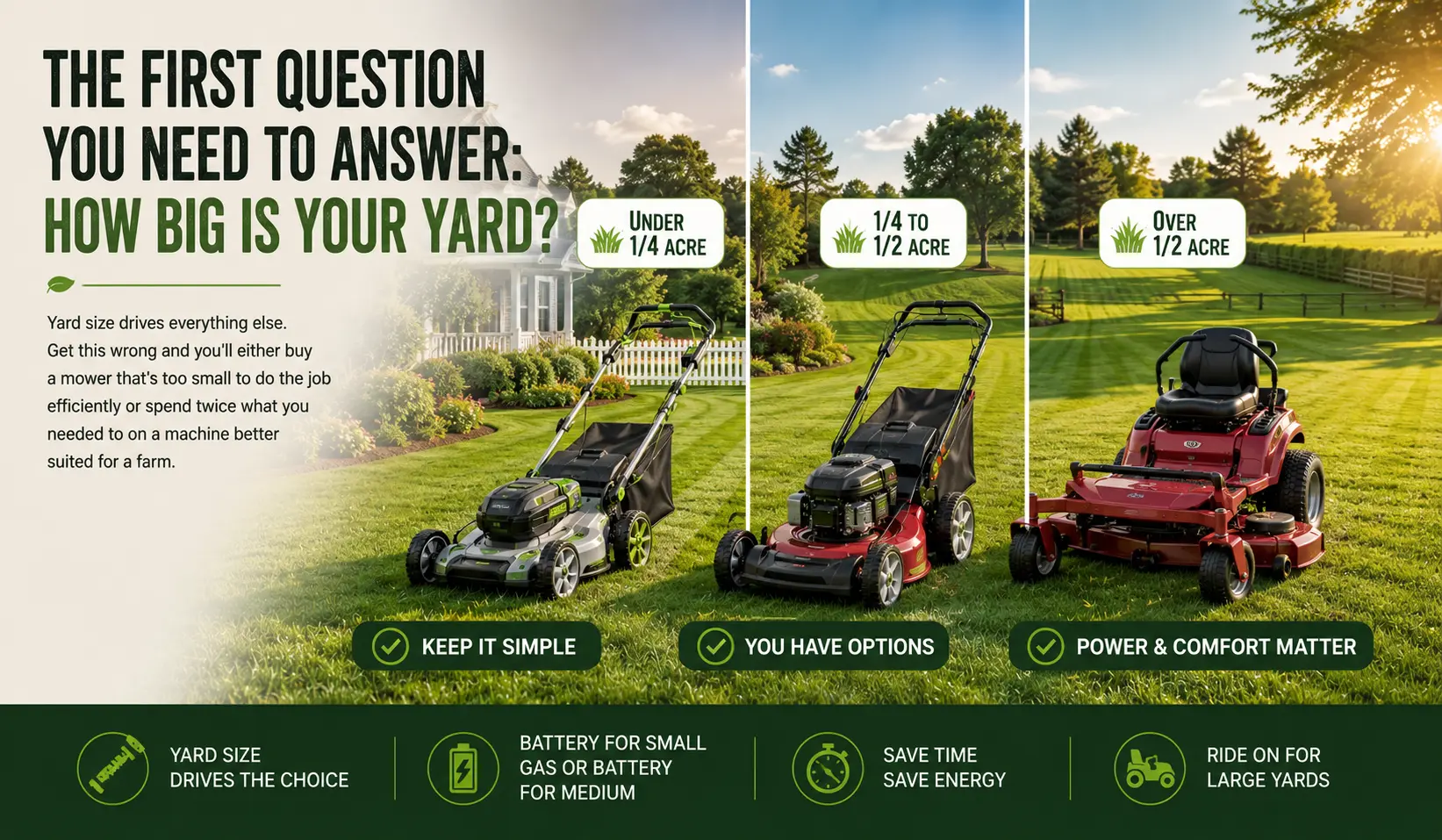
The Four Main Types of Lawn Mowers (And Who Each Is For)
There are four categories. Everything else is just a variation within them.
Push Mowers
A push mower is exactly what it sounds like – you supply all the forward momentum. They’re lighter (usually 60-70 lbs), simpler, cheaper, and easier to store.
Perfect for flat, small yards. The moment you add slope or size, you’ll want self-propel.
Self-Propelled Mowers
Self-propelled mowers have a drive system that moves the mower forward on its own – you guide it, it pulls itself. Most run between 2.5 and 4.5 mph.
Front-wheel drive is better for flat ground and makes it easier to turn. Rear-wheel drive grips better on slopes and is worth the extra cost if your yard has any hills.
Variable-speed self-propel (where you control the pace with a bar on the handle) is a feature I’d pay for. Fixed-speed is fine, but variable matches your walking pace better and feels less like you’re being dragged.
Riding Mowers and Zero-Turn Mowers
Riding mowers look like small tractors. Zero-turn mowers steer by controlling each rear wheel independently, which lets them pivot in place and cut tight around obstacles.
Zero-turns are faster and more maneuverable, but they’re not for beginners, and they’re hard to control on steep slopes. A traditional riding mower is slower but more stable and easier to learn.
For most homeowners with 1/2 to 2 acres and relatively flat terrain, a mid-range riding mower ($1,200-$2,000) is the right call. Zero-turns make more sense at $2,500+ when speed and precision genuinely matter.
Robot Mowers
Robot mowers are real and they actually work – with conditions.
They’re best for flat, unobstructed yards with simple shapes. They run on a schedule, cut a small amount of grass daily, and keep your lawn looking consistently trimmed.
They struggle with steep slopes (anything over 20 degrees is iffy), complex layouts, and very tall grass. Setup involves installing a boundary wire, which takes a couple hours.
The price has dropped a lot. Husqvarna’s Automower 115H runs around $700-$900 (Husqvarna, 2024). If your yard qualifies, it’s worth considering – especially if you travel or just genuinely hate mowing.
Gas vs. Battery vs. Electric – Which Power Source Fits Your Life?
The power debate is real, but most people overcomplicate it. Here’s the honest breakdown.
Gas Mowers: Raw Power With a Few Trade-Offs
Gas mowers have more raw torque than battery mowers at equivalent price points. They’ll chew through thick, wet, or overgrown grass without slowing down.
But you’re also signing up for maintenance: oil changes every 25-50 hours, annual spark plug checks, carburetor issues if you store them with gas in the tank, and a pull cord that always seems hardest to start when it’s 90 degrees out.
Gas makes the most sense if you’re mowing a large yard regularly, dealing with consistently thick or damp grass, or you already own gas equipment and want interchangeable fuel.
For most homeowners in 2024-2025, battery has closed the gap enough that gas is no longer the obvious default.
Battery-Powered Mowers: The Modern Choice
The quiet hum of a battery mower is genuinely pleasant compared to the vibration and exhaust of a gas engine. You start it with a key or button, it runs until the battery dies, and you charge it like anything else.
The key specs are voltage (higher = more power and consistent performance) and amp-hours (higher = longer runtime). EGO’s 56V 7.5Ah battery is a reliable benchmark – that combination handles most yards under 1/2 acre on a single charge.
Battery mowers have gotten strong enough that Consumer Reports ranked EGO mowers above several Honda gas models in cut quality tests (Consumer Reports, 2024).
The limitation is runtime – if your yard is large or your grass is very heavy, you may need a second battery or a short recharge break.
Corded Electric Mowers: The Forgotten Option
Corded electric mowers are genuinely overlooked. They’re cheap ($150-$250), lightweight, require zero maintenance, and never run out of power.
The obvious catch is the cord. For small, simple, flat yards with an outdoor outlet close by, they’re completely practical. A 100-foot extension cord covers most small suburban backyards.
If your yard has lots of obstacles, slopes, or is far from an outlet, the cord becomes a real annoyance fast.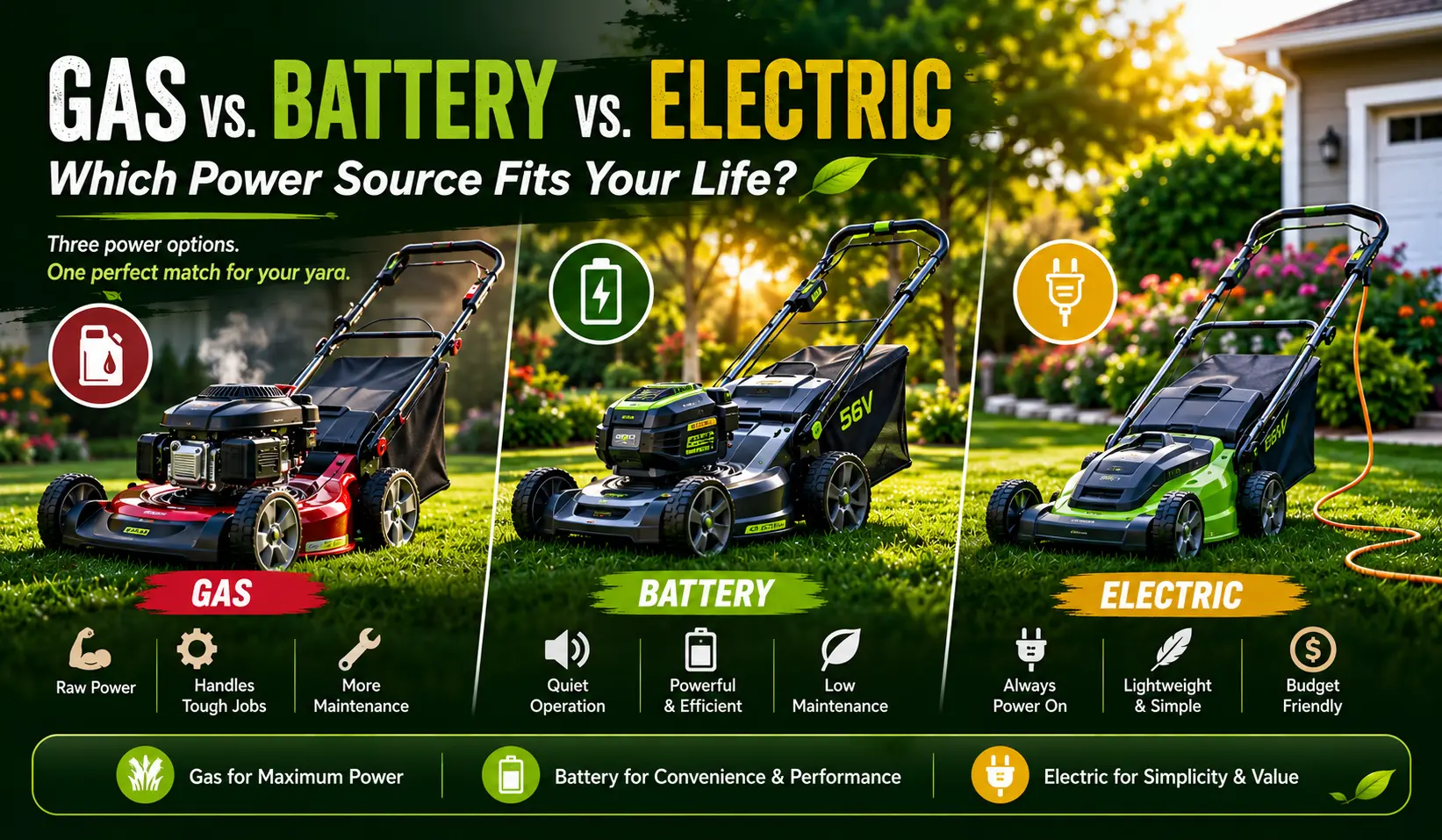
Features That Actually Matter (And Ones You Can Ignore)
Not every spec sheet item is worth your attention. Here’s what actually changes the mowing experience.
Cutting Width and Deck Size
Deck size is the width the mower cuts in one pass. More width = fewer passes = faster mowing.
- 19-20 inch: fine for tiny yards, annoying for anything larger
- 21 inch: the most common size, works well for most suburban lots
- 22-24 inch: noticeably faster on medium-large yards
A wider deck also adds weight, so there’s a trade-off on hills and maneuverability.
Cutting Height Adjustment
Single-lever height adjustment (one lever changes all four wheels at once) sounds obvious but it’s absent on the cheapest mowers, which require adjusting each wheel separately. Get single-lever. The difference in convenience is significant.
Most mowers offer cutting heights between 1 and 4 inches. That covers everything you’d realistically need for cool-season grasses (Kentucky bluegrass, fescue) and warm-season grasses (Bermuda, St. Augustine) across US climate zones.
Mulching, Bagging, and Side Discharge
Most mowers offer all three in one machine – you either put the bag on, the mulch plug in, or leave the discharge chute open.
Mulching is the default for healthy lawns. Fine clippings decompose quickly and return nitrogen to the soil. Side discharge works well for overgrown grass where mulching would leave clumps. Bagging is useful in fall for leaf cleanup or when you just want a clean finish.
Look for a mower that does all three. Most mid-range and above models do.
Self-Propel Speed and Drive Type
As I mentioned, rear-wheel drive is worth it for slopes. Variable-speed is worth it for comfort. If you’re spending $350 or more, you should be able to get both.
Features That Sound Good But Rarely Matter
- Blade brake clutch (stops the blade without turning off the engine): useful if you’re constantly clearing debris, unnecessary for most people
- Electric start on walk-behind gas mowers: nice convenience, adds $50-$100 to cost and a battery to maintain
- Smart connectivity on robot mowers: genuinely useful for scheduling and alerts
My Honest Take on Popular Brands
EGO – Premium Battery Performance
EGO makes the best battery mowers available right now. Their 56V platform is genuinely powerful, the build quality is solid, and the battery ecosystem works across their full line of tools.
The Select Cut models with multi-blade systems produce a noticeably cleaner cut than standard single-blade mowers. Worth the premium if cut quality matters to you.
Downside: they’re not cheap, and if the battery platform changes, your investment in batteries doesn’t transfer.
Honda – Gas Done Right
Honda’s HRX and HRN series are the gold standard for gas mowers. The engines are reliable, the cut quality is excellent, and they hold their value.
The HRX217 in particular has a devoted following among homeowners who want a gas mower they won’t have to replace for 15 years. It costs around $600-$700, which is more than most alternatives, but the reliability record justifies it.
If you need gas and you want to buy once, Honda is where I’d point you.
Ryobi – Best Bang for Budget Buyers
Ryobi isn’t premium, but it’s consistently solid for the price. Their 40V lineup hits the $200-$350 range and performs well on small to medium yards.
A lot of homeowners already have Ryobi tools, which means they might already have compatible batteries. That matters. A mower body that works with batteries you already own drops the effective cost significantly.
Don’t expect EGO-level performance, but for light to moderate use on a typical suburban yard, Ryobi delivers.
Husqvarna – Built for Bigger Jobs
Husqvarna’s reputation is strongest on the large-yard end: riding mowers, zero-turns, and robotic mowers. Their walk-behinds are fine but not exceptional.
If you’re shopping for a riding mower or a robot mower, Husqvarna deserves serious consideration. Their dealer network is also strong – easier to get service and parts than some brands.
Greenworks – Solid Mid-Range Choice
Greenworks sits between Ryobi and EGO in price and performance. Their 60V and 80V platforms offer more power than the Ryobi 40V without the EGO price tag.
They’re a sensible choice if you want good battery performance at $250-$400 and don’t need top-tier features.
What to Expect at Every Price Point
Under $200 – Entry Level, Real Limitations
At this price, you’re looking at a basic corded electric or a very basic push mower. They do the job on small, flat yards but they typically lack height adjustment, durable decks, or any self-propel.
If you’re mowing a small rental yard and you need something functional for low cost, fine. If you’re buying a home you’ll own for years, spend more.
$200-$400 – The Sweet Spot for Most Homeowners
This is where most people should shop. You’ll find solid self-propelled battery mowers, decent single-speed gas mowers, and basic corded options.
EGO’s entry-level 56V mowers start here. Ryobi’s best walk-behinds live in this range. For 1/4 to 1/2 acre yards, this tier handles it well.
$400-$700 – Where Performance Gets Serious
At $400-$700, you get better battery capacity (longer runtime), larger decks, variable-speed self-propel, and better build quality.
EGO’s 56V 7.5Ah and 10Ah models are in this range, as are Honda’s mid-tier gas options. If you have a larger yard or deal with thick grass regularly, this is worth the step up.
$700 and Up – Worth It Only If You Need It
Above $700, you’re buying robotic mowers, high-end gas mowers like the Honda HRX, or large-deck self-propelled machines built for 1+ acre yards.
Don’t spend here unless you have a specific reason. A $350 EGO handles a half-acre yard just fine. Paying $800 for a slightly nicer walk-behind on the same yard is real money for marginal gains.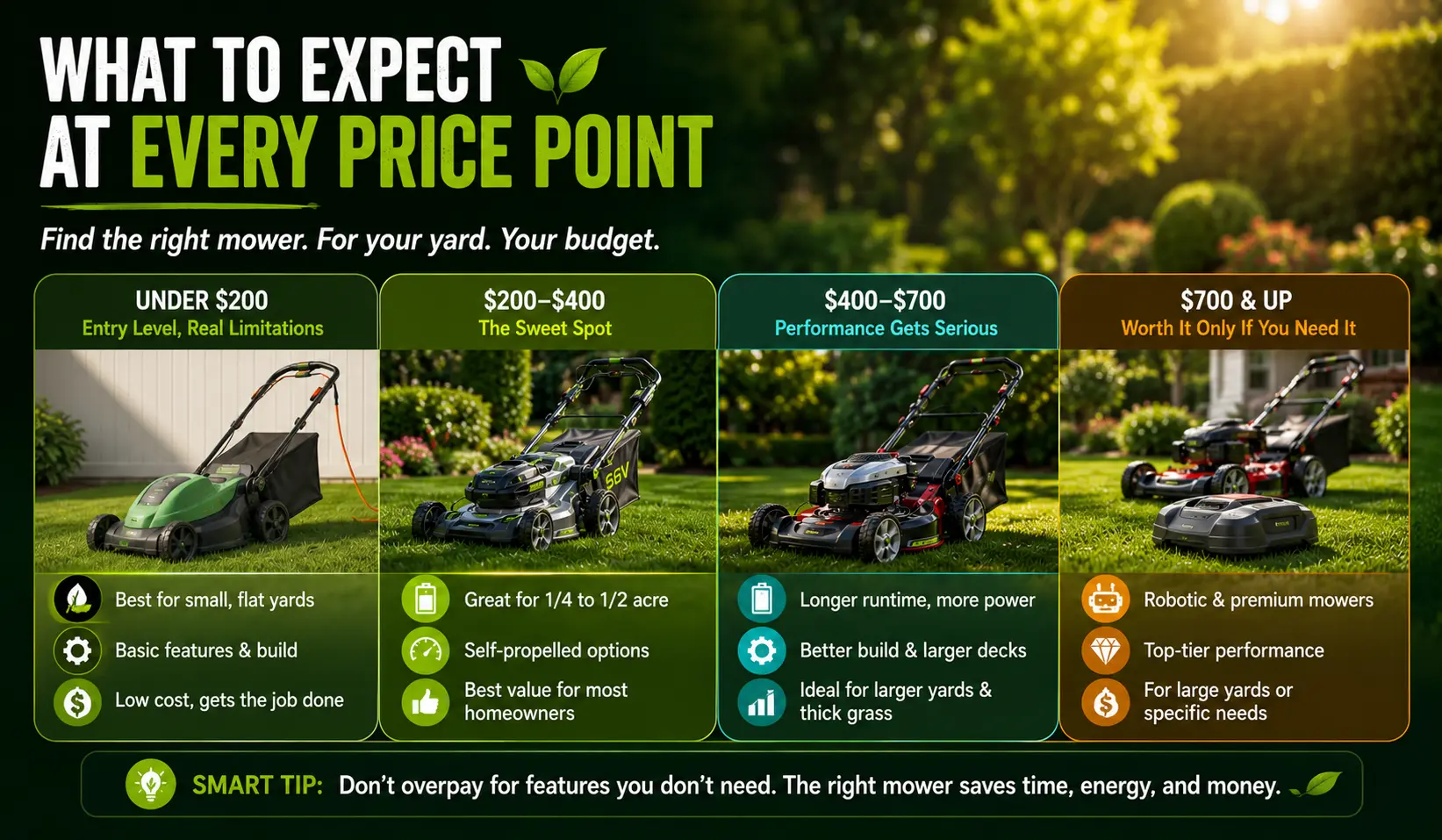
Common Buying Mistakes I See All the Time
Buying Too Much Mower for a Small Yard
A retiree with a 6,000-square-foot flat yard does not need a self-propelled 21-inch gas mower with a bagging system. That’s the person I see buying it, though, because it feels safer to have “too much” than too little.
The oversized machine ends up being awkward to store, annoying to maneuver around tight spots, and more maintenance than the yard justifies. Right-size your purchase to your actual yard.
Ignoring Terrain and Slope
Most people know their yard size. Far fewer accurately remember their slopes.
Walk your yard before you buy. If any part of it is steep enough that you’d hesitate to jog across it, you need rear-wheel drive self-propel at minimum. Significant slopes (15 degrees and above) may push you toward a riding mower with good traction – or toward leaving the slopes to a string trimmer.
A suburban dad I know in North Carolina bought a push mower for what he described as a “gentle slope.” He was back at Home Depot three weeks later buying a self-propelled. Don’t skip this step.
Forgetting About Long-Term Costs
Gas mowers need oil, spark plugs, air filter replacements, and potentially carburetor cleaning. Budget $30-$60 per year for basic maintenance, and more if something breaks.
Battery mowers need… the batteries replaced eventually. A quality battery lasts 5-7 years with normal use; replacements run $100-$200 depending on capacity.
Both have real ongoing costs. Factor them in when comparing a $300 battery mower to a $250 gas model.
My Final Recommendation
If I had to give one answer for the widest range of homeowners, it’s this: if your yard is a quarter to half acre, buy an EGO 56V self-propelled mower in the $400-$500 range with at least a 7.5Ah battery. It’ll handle almost anything a typical suburban yard throws at it, it’s quiet enough to use early on a Saturday morning without waking the street, and the platform is worth investing in.
If you have a larger yard – half an acre and above with open terrain – spend time looking at a mid-range riding mower before you buy another walk-behind. The time math changes quickly above half an acre, and the comfort difference is significant.
If you’re budget-constrained and the yard is small, a Ryobi 40V push mower at $200-$250 gets the job done without drama. It’s not exciting, but it works.
The perfect mower is the one that matches what you’re actually mowing. Get that part right first, and the rest of the decision falls into place.
Frequently Asked Questions About Buying a Lawn Mower
What lawn mower should I buy for a small yard?
For yards under 1/4 acre, a battery-powered push mower in the $200-$350 range is the right choice for most people. Brands like EGO (56V) and Ryobi (40V) both offer reliable options at this price. You don’t need self-propel for flat small yards, and battery eliminates the maintenance hassle of gas.
How do I know if I need a self-propelled mower?
Get a self-propelled mower if your yard is larger than 1/4 acre, has any noticeable slope, or you simply don’t want to push a 70-80 lb machine for 45+ minutes. Rear-wheel drive is better for slopes; front-wheel drive is slightly easier to turn on flat ground.
Is battery or gas better for lawn mowers in 2025?
For most homeowners with yards under 1/2 acre, battery-powered mowers now match or exceed gas in practical performance. They’re quieter, require less maintenance, and don’t need fuel storage. Gas still has an edge on very large yards or extremely heavy grass conditions, but the gap has narrowed significantly.
What is the difference between a zero-turn mower and a riding mower?
A traditional riding mower steers like a car with a steering wheel. A zero-turn mower uses independent rear-wheel speed control to steer, which lets it pivot in place and navigate around obstacles faster. Zero-turns are quicker and more precise but harder to handle on steep slopes. Traditional riding mowers are more stable and easier to learn.
How much should I spend on a lawn mower?
For most homeowners with yards under 1/2 acre, $300-$500 buys a solid battery-powered self-propelled mower that handles the job well. Under that, you’re making real compromises on battery size or build quality. Above $600 for a walk-behind is only justified for large yards, very demanding conditions, or specific brand preferences like Honda’s HRX gas line.
Are robot lawn mowers worth it?
Robot mowers are worth considering if your yard is flat, relatively simple in shape, and under about 1/4 to 1/3 acre. They’re not great on steep slopes or in yards with lots of obstacles. Entry-level options like the Husqvarna Automower 115H run $700-$900 (Husqvarna, 2024) and do a genuine job of keeping grass consistently trimmed on qualifying yards.
What mower brands are most reliable?
Honda leads for gas reliability, with engines routinely lasting 15+ years with basic maintenance. EGO leads for battery reliability and performance. Husqvarna has strong dealer support and is the top pick for riding and robotic mowers. Ryobi and Greenworks offer solid mid-range value with acceptable reliability for normal home use.