
Quick Overview
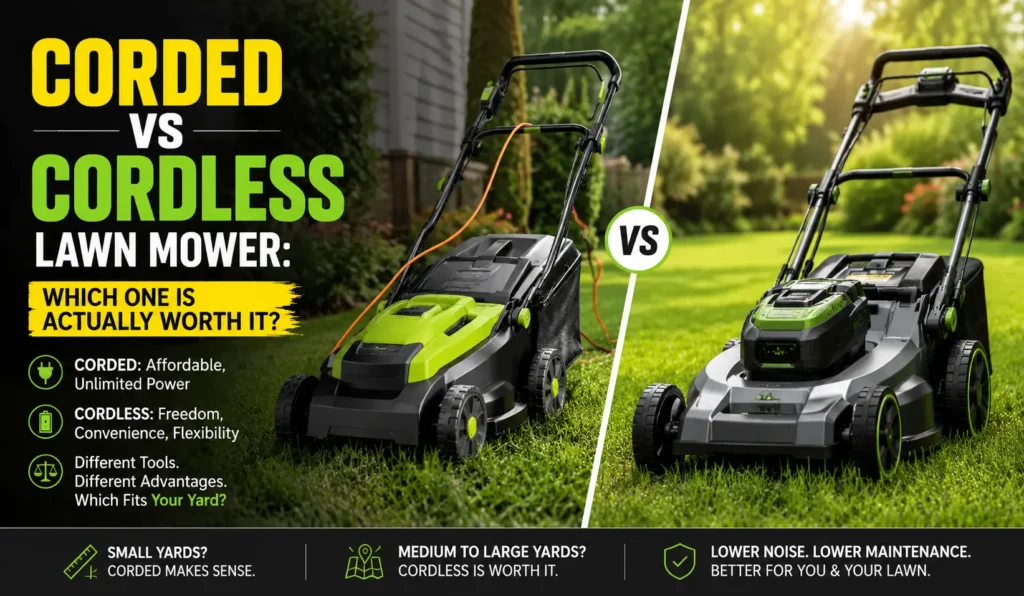
- Corded mowers cost less upfront ($90-$160) and never lose power mid-mow, but the cord limits you to roughly a 100-foot working radius.
- Cordless mowers handle yards up to 1/2 acre on a single charge and move freely, but a quality 56V/6Ah battery system runs $300 or more.
- For small yards under 1/4 acre with a nearby outlet: a corded mower gets the job done cheaper.
- For medium to large or irregular yards: a cordless with a 56V brushless motor is worth the investment.
- Both are quieter, cheaper to run, and lower maintenance than gas – the question is which trade-off fits your yard.
I’m standing in my backyard in Columbus, Ohio, holding 100 feet of orange extension cord that’s somehow managed to tangle itself around the hose reel, a garden stake, and one very confused azalea bush. This is the third time in a single mow. That moment is what finally made me take the corded vs cordless lawn mower question seriously.
I’ve owned both. I’ve used a Sun Joe MJ401E on a tight urban yard in Chicago and an EGO Power+ LM2135SP on a half-acre corner lot in Atlanta. Each one made sense for that yard. Neither one would have made sense for the other.
This comparison is for homeowners who are about to spend real money and want to know which type actually fits their life, not just a spec sheet rundown.
The Real Difference Between Corded Vs Cordless Mowers
Both run on electricity. Beyond that, they’re different tools designed for different situations. The core difference isn’t power – it’s freedom of movement and how long you can mow without stopping.
How a Corded Mower Actually Works
A corded mower plugs into a standard 120V household outlet and draws 12 to 13 amps of continuous power. That’s it. As long as the outlet works and the cord reaches, the mower runs at full strength.
The motor gets consistent amperage throughout the entire mow. There’s no drop-off, no performance fade, nothing to recharge. Sun Joe’s MJ401E, for example, pulls 13 amps and maintains that draw whether you’re cutting the first strip or the last one.
The catch is the cord. A standard 16-gauge, 100-foot outdoor extension cord is the practical limit for most 13-amp mowers. Go longer or use a lighter gauge cord and you get voltage drop – the motor strains, performance suffers, and the cord heats up. At 100 feet of reach from the outlet, you can cover about 1/8 to 1/4 acre before you start fighting the cord.
How a Cordless Mower Works (And Why the Battery Matters)
A cordless mower runs off a rechargeable lithium-ion battery pack. The two numbers that matter are voltage and amp-hours.
Voltage (typically 40V, 56V, or 80V) determines how much power the motor can handle. Amp-hours (Ah) determine how long it runs. A 56V/6Ah battery gives you roughly 45-60 minutes of runtime on a medium lawn. A 40V/4Ah battery might give you 30-40 minutes before it needs a recharge.
The other term worth knowing: brushless motor. Most quality cordless mowers today use a brushless motor, which runs cooler, lasts longer, and manages battery draw more efficiently than older brushed designs. The EGO LM2135SP uses a brushless motor and self-propels at variable speeds – it genuinely changes how you move through a large yard.
Charging time is real. Most batteries take 30 to 90 minutes to charge, depending on voltage and amp-hour capacity. If your yard takes longer to mow than your battery lasts, you’re pausing mid-mow. That either forces you to buy a second battery (common) or accept the break.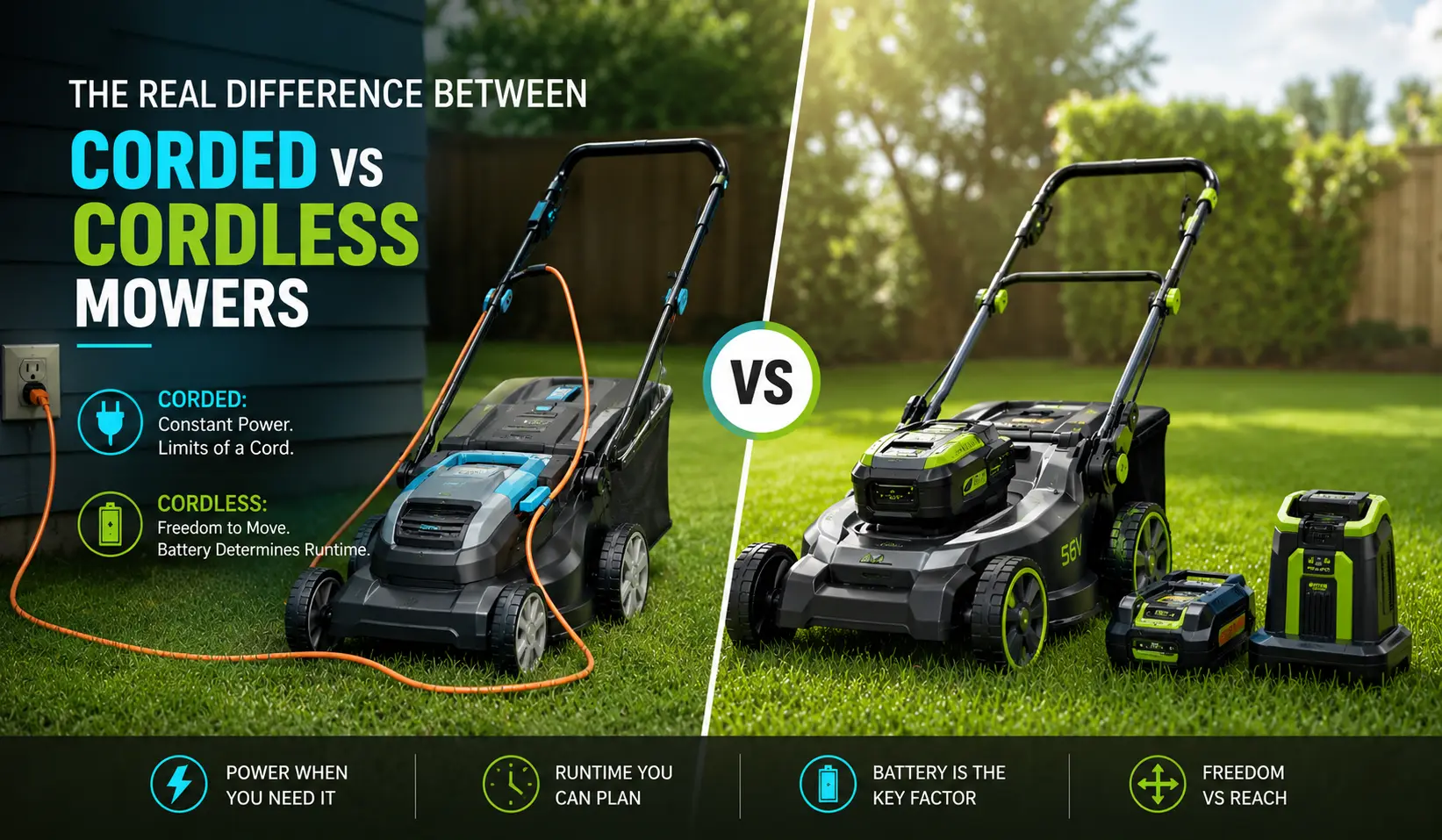
Where Corded Mowers Win
Corded mowers lose the freedom argument before it even starts. What they win is everything that makes ownership simple.
Unlimited Runtime – No Interruptions
You plug in, you mow until it’s done. There’s no battery meter to watch, no mid-lawn pause, no second battery needed. For a small yard that takes 15-25 minutes to mow, this is actually the better experience. You start, you finish, you put it away.
I used a corded mower on a narrow city backyard in Chicago for two years. The cord was occasionally annoying, but the mow itself was always uninterrupted. I never once stopped because the power ran out.
Lower Upfront Cost
A quality corded electric mower runs $90 to $160. The Sun Joe MJ401E is around $100. Greenworks’ 13-amp corded mower is similarly priced.
Compare that to a cordless setup. The EGO Power+ LM2135SP body alone lists for around $280 without a battery. Add a 56V/6Ah battery at $180 and a charger at $40 and you’re over $500 for the full kit. Even budget cordless options like the Ryobi RY40104VNM with a 40V battery come in around $250-$299.
For a small yard, the performance difference doesn’t justify a $300 price gap.
Consistent Power Output
This matters more in thick or wet grass than in ideal conditions. A corded mower draws its full 13 amps throughout the job – it doesn’t slow down as the battery depletes.
Some cordless mowers handle this well with load-sensing technology. But cheaper 40V models can bog down noticeably in dense grass when the battery drops below 20%. A corded mower at 13 amps handles overgrown wet grass the same way it handles a clean dry lawn.
Where Cordless Mowers Win
Once you step outside the small-yard category, the cord stops being a minor inconvenience and becomes a genuine obstacle.
Freedom to Move Without a Cord
An L-shaped yard in Atlanta taught me this. My backyard had a detached garage, a raised bed, and a dogleg that put part of the grass 90 feet from the nearest outlet. With a cord, I was constantly backtracking, re-routing, and catching the extension cord on the corner of the raised bed. With an EGO, I just mowed.
No cord also means no risk of accidentally running it over – something I’ve done once, which was enough. A cord draped across a lawn is a real hazard when you’re focused on the mowing line.
Better for Medium to Large Yards
For yards between 1/4 and 1/2 acre, a 56V/6Ah cordless mower is the right tool. The EGO LM2135SP covers up to 3/4 acre on a single charge according to EGO’s own runtime data (EGO Power+, 2024), though actual coverage depends on grass height and terrain.
At those sizes, managing an extension cord isn’t just inconvenient – it slows you down enough to make the mow noticeably harder work. Cordless removes that friction entirely.
Quieter and More Convenient Overall
Both corded and cordless electric mowers are far quieter than gas. But cordless has a slight edge in practice: no cord to trip over, easier storage, and you can mow without hunting for an outdoor outlet.
Most cordless mowers also have a fold-down handle for compact storage. The EGO and HART models fold flat enough to hang on a garage wall. That matters if you’re tight on storage space.
The Honest Downsides of Each
Both types have genuine weaknesses. Anyone who glosses over these is selling something.
Corded: The Cord Is a Real Problem
I’ve said this already, but it deserves its own section because it’s more limiting than it sounds.
At 100 feet of working radius, you can cover roughly 7,850 square feet – about 1/5 of an acre – from one outlet position. That’s fine for a square urban lot. It’s not fine for an irregular suburban yard where the nearest outdoor GFCI outlet is on one side of the house.
Older American homes are the worst case. A 1960s ranch house in Ohio often has one exterior outlet, maybe two, and they may not be on opposite ends of the house. If your yard wraps around the building, you’re replanting the cord mid-mow.
The cord also catches things. Tree roots, garden borders, the lip of a patio. Every snag breaks your rhythm. I once jerked hard enough on a tangle that I yanked the mower sideways into a flower bed. It was completely avoidable with a cordless mower.
Cordless: Battery Life and Charging Time
A single battery on a mid-range cordless mower covers 30-50 minutes of actual mowing. That’s fine for most 1/4-acre yards. It gets tight at 1/3 to 1/2 acre, especially in thick grass.
The real-world workaround is buying a second battery and swapping it mid-mow. That adds $150-$200 to your cost and requires remembering to keep both charged. The EGO system does offer fast-charging (a 56V/7.5Ah battery charges in about 40 minutes with the EGO Turbo charger), but you need to buy the turbo charger separately.
Battery degradation over time is also real. Lithium-ion packs lose capacity with charge cycles. A quality 56V pack from EGO or Ryobi should hold capacity well for 3-5 years with normal use, but by year six or seven, runtime shortens noticeably. Replacement batteries for a 56V EGO system run $120-$180. That’s an eventual cost that doesn’t apply to corded mowers at all. 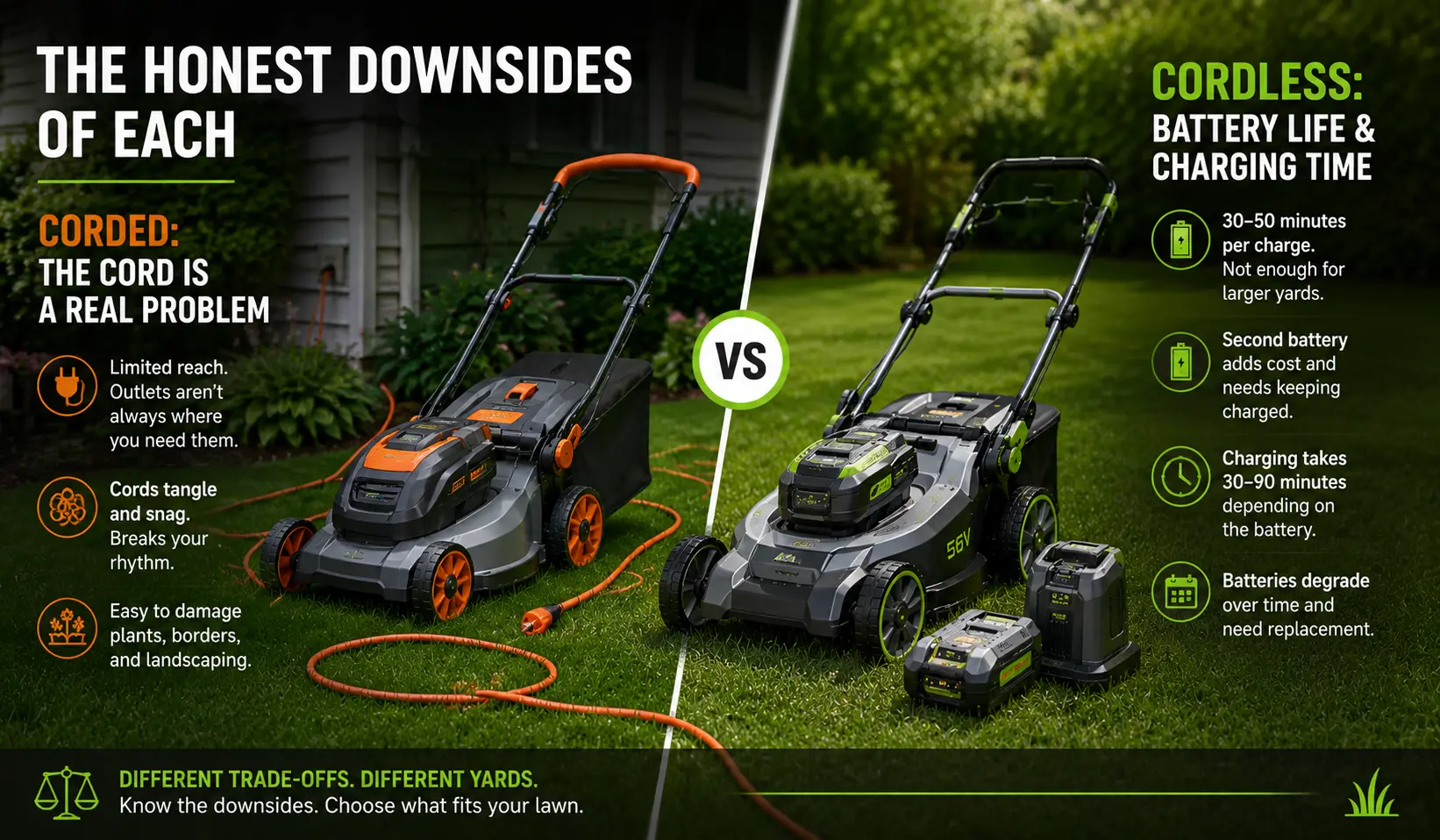
Which One Is Right for Your Yard?
The answer depends almost entirely on yard size, shape, and your nearest outdoor outlet – not on which brand has better marketing.
Small Yards Under 1/4 Acre
A corded mower is the better buy here. You’ll spend under $150, get consistent power, and mow a small lot in 20-25 minutes without ever thinking about battery life.
The cord is manageable at this scale. A single extension cord looped on a hook handles the storage. The mow takes long enough to matter but short enough that cord management is mildly annoying, not seriously inconvenient.
Exception: if your yard is irregular or the outdoor outlet is positioned poorly, even a small yard can become a cord headache. Measure the distance from your outlet to the farthest corner of your lawn before buying.
Medium Yards Between 1/4 and 1/2 Acre
This is where the cordless mower earns its higher price. A 56V/6Ah setup covers most mid-size suburban lots on a single charge, and the freedom to move around a larger yard without routing a cord saves real time.
A 56V brushless motor also handles the variable grass thickness that comes with more ground to cover – some areas thicker near the fence line, some dry and light near the street. The motor adjusts, the cut stays consistent.
At this size, go with EGO or Ryobi 40V as the entry point. HART’s 40V system (sold at Walmart) runs about $100 less than EGO for comparable specs – a reasonable choice if budget matters.
Large or Irregular-Shaped Lawns
Over 1/2 acre, you need either a self-propelled cordless with a high-capacity battery (EGO’s 56V/10Ah pushes 90+ minutes of runtime) or a walk-behind that’s genuinely enjoyable to push.
Irregular yards with trees, detached structures, and obstacles are where cordless mowers make the most dramatic difference. I mowed an L-shaped yard in Atlanta with a gas mower, then with a corded electric, then finally with an EGO cordless. The EGO was the first time it felt like a reasonable task rather than an athletic event.
For very large lots – above 3/4 acre – a cordless walk-behind starts to feel underpowered. At that size, a riding mower or a self-propelled cordless with two batteries is worth considering.
Top Brands Worth Knowing
The electric mower market has consolidated around a few brands that actually deliver. Here’s a fair summary without the manufacturer talking points.
Best Corded Options (Sun Joe, Greenworks)
Sun Joe MJ401E is the most popular corded mower on Amazon and consistently holds a 4.4+ star rating across thousands of reviews. It’s 13 amps, 14-inch cutting width, and handles most small yards without complaint. Cutting height adjusts from 1.2 to 3.5 inches across six positions. It folds for storage and weighs 29 pounds. For $95-$110, there’s nothing better in its class.
Greenworks 16-inch 13-amp steps up to a 16-inch cutting width, which reduces mowing passes on slightly larger lots. It sells for $120-$140 and adds a grass collection bag. The extra two inches of cutting width cuts mow time on a 1/4-acre lot by about 15%.
Both brands use standard motors without brushless technology – that’s acceptable at this price point because corded motors don’t need the efficiency management that battery-powered motors do.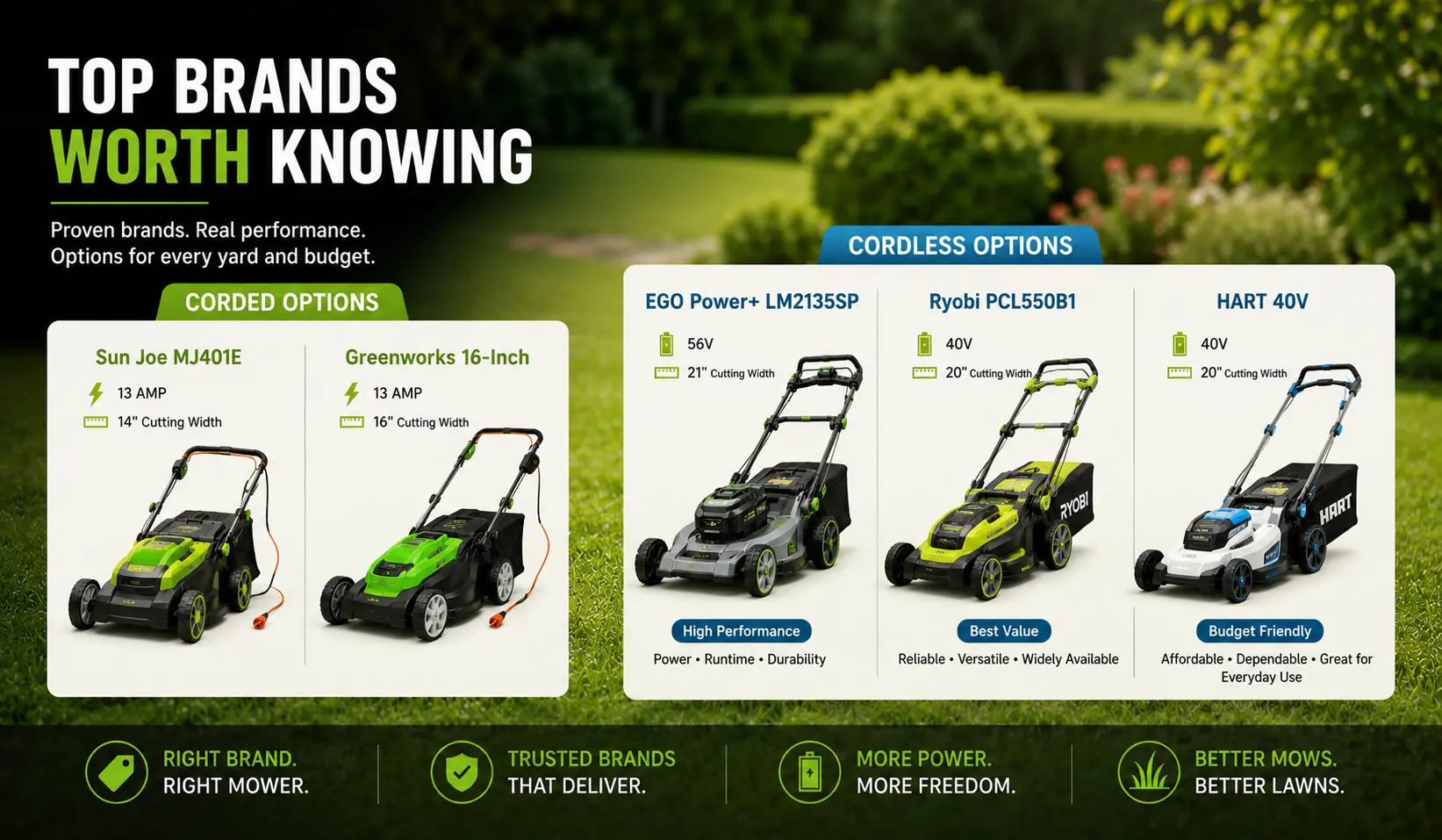
Best Cordless Options (EGO, Ryobi, HART)
EGO Power+ LM2135SP is the standard that other brands benchmark against. 21-inch cutting deck, brushless motor, self-propelled at variable speeds, compatible with EGO’s full 56V battery ecosystem. It’s not cheap – $300 for the body alone – but it handles thick grass, handles slopes, and the battery system is interchangeable with EGO’s blowers, trimmers, and chainsaws. If you’re building out a cordless yard tool collection, EGO’s battery compatibility makes each tool more cost-efficient.
Ryobi PCL550B1 uses a 40V battery and runs around $249 with one battery included. It’s a reliable mid-tier option that covers most 1/3-acre yards on a charge. Ryobi’s 40V ONE+ battery system is the most widely used cordless system in North America (Ryobi Tools, 2023), which means batteries are available at every Home Depot at every price point.
HART 40V is Walmart’s house brand for cordless outdoor tools. It costs $30-$60 less than equivalent Ryobi or EGO models for comparable voltage and cutting width specs. Build quality is slightly below EGO, but for a casual homeowner mowing a 1/4-acre yard once a week, it does the job without the premium price.
My Final Take
If your yard is under 1/4 acre and you have a decent outdoor outlet on the right side of the house: buy the Sun Joe corded mower, spend the $100, and move on. The cord will annoy you twice a season. The savings over a cordless setup are real and the performance is the same. I used one for two years on a narrow Chicago backyard and never once wished I’d spent more money.
If your yard is bigger than that, or if it has trees, a detached garage, a corner lot layout, or any obstacle that turns cord management into a project – spend the money on cordless. The EGO 56V system is the right pick if you want to build out a tool ecosystem. Ryobi 40V is the right pick if you want reliable and want to save $100-$150. Either way, the one-time battery investment pays off in convenience every single mow.
The honest truth about the corded vs cordless lawn mower debate is that neither type is objectively better. One is cheaper and simpler. The other is freer and more flexible. The answer comes down to 200 square feet and one question: can you reach every corner of your lawn without fighting an extension cord?
Frequently Asked Questions About Corded vs Cordless Lawn Mowers
What is the difference between a corded and cordless lawn mower?
A corded mower draws power from a household outlet through an extension cord and runs continuously as long as it’s plugged in. A cordless mower runs on a rechargeable lithium-ion battery pack and operates untethered but for a limited runtime per charge, typically 30-60 minutes depending on voltage and amp-hour capacity.
How big of a yard can a corded electric mower handle?
A 13-amp corded mower with a 100-foot extension cord can handle approximately 1/4 acre, or about 10,000 square feet, before cord management becomes too restrictive. Yards with obstacles, irregular shapes, or distant outlets become difficult sooner.
How long does a cordless lawn mower battery last?
Runtime depends on voltage and amp-hours. A 56V/6Ah battery covers most 1/3 to 1/2 acre yards on a single charge – roughly 45-60 minutes of mowing. A 40V/4Ah battery delivers 30-40 minutes. Charging takes 30-90 minutes depending on the charger and battery size.
Is a 40V or 56V cordless mower better?
For yards under 1/3 acre, a 40V mower is sufficient and costs less. For yards between 1/3 and 3/4 acre, or for thick grass and slopes, a 56V brushless motor delivers noticeably better performance and longer runtime. The voltage difference is most noticeable when cutting overgrown or wet grass.
Are corded electric mowers worth buying anymore?
For small yards under 1/4 acre, yes – they’re the most cost-efficient choice and require zero battery management. For anything larger, the cord limitation outweighs the cost savings and a cordless system is the better long-term buy.
What extension cord do I need for a corded mower?
Use a 12-gauge or 14-gauge outdoor extension cord rated for at least 15 amps. At 100 feet, a 12-gauge cord handles a 13-amp mower with minimal voltage drop. A 16-gauge cord at 100 feet causes enough resistance to strain the motor and shorten its lifespan.
How much does it cost to replace a cordless lawn mower battery?
Replacement batteries for 56V EGO systems run $120-$180. Ryobi 40V replacement batteries cost $80-$130. HART 40V batteries cost $60-$100. Battery costs are one ongoing expense that doesn’t apply to corded mowers.