
Quick Summary
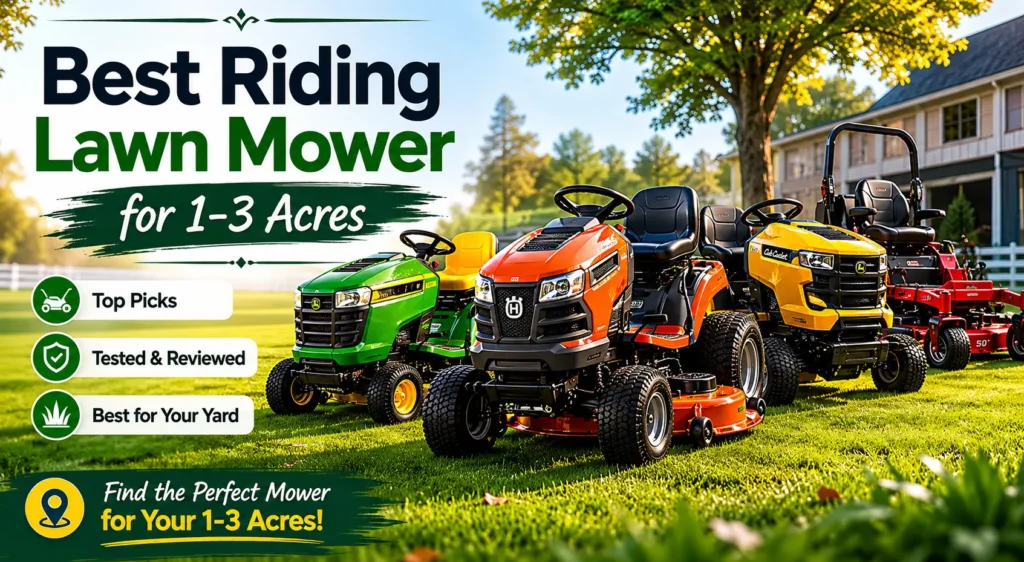
- The best riding lawn mower for 1-3 acres overall is the Husqvarna YTA24V48 – it handles flat lots, gentle slopes, and tight corners without drama.
- For open, flat acreage, the John Deere E150 covers ground fast and holds up over years of weekly use.
- For hilly or sloped yards, the Cub Cadet XT2 LX46 offers stability and traction where other mowers slip.
- The best budget pick is the Troy-Bilt Pony 42 – honest value, no frills, gets the job done on smaller 1-acre lots.
- The best zero-turn option for this size range is the Toro TimeCutter 50″ – tight turns, commercial-grade feel, real time savings on open ground.
It was a Sunday in early June, somewhere around hour three, when my push mower finally gave up on me.
I was halfway through my second acre in central Ohio – tall fescue baking in the heat – and the engine just quit. I stood there sweating, staring at a yard that still had a full acre left, and my neighbor across the road finished his entire three-acre property while I was standing there. He was drinking a beer on his porch by the time I dragged my push mower back to the garage.
That was the day I started taking the best riding lawn mower for 1-3 acres seriously.
This guide is for homeowners who are done giving up entire weekends to their yard. If you’ve got between one and three acres – flat or hilly, dry or green – and you want an honest look at which machines are actually worth your money, you’re in the right place.
Why Your Yard Size Changes Everything
The gap between a half-acre lot and a two-acre property isn’t just about cutting time. It changes which machine you need, which features matter, and what a bad buying decision costs you. Here’s what most mower guides don’t explain clearly enough.
The Problem With Using the Wrong Mower
Using a mower built for a smaller yard on 1-3 acres will wear out the engine faster, overheat the transmission, and leave you mowing in two or three passes where one should do it.
I made this mistake with a small 30″ deck mower on my Ohio property. It took two hours to do what the right machine does in 45 minutes. The engine ran hot. The belts wore out in under two seasons. I spent more in repairs than I saved on the purchase price.
On the flip side, a heavy commercial mower on a small fenced suburban lot causes its own problems. The deck is too wide for narrow gates, the turning radius is too large for beds and obstacles, and you end up trimming half the yard by hand anyway.
The mower has to match the land. That sounds obvious, but most people undersize or oversize – and both hurt.
What “1 to 3 Acres” Actually Feels Like to Mow
One acre is roughly the size of a football field – 43,560 square feet. With a 42″ cutting deck at a comfortable mowing speed, you’re looking at about 45-60 minutes per acre, depending on terrain and how many passes you need around obstacles.
Three acres changes the math entirely. That’s nearly three football fields. At 60 minutes per acre, you’re at the three-hour mark before you factor in the time lost to turning, trimming, and re-runs on missed patches.
I spent a full mowing season on a property in Tennessee – rolling hills, a creek at the back edge, mixed fescue and clover. Three acres there felt more like four because the slopes forced slower speeds and tighter lines. Cutting height adjustment, turning radius, and seat comfort all stopped being specs on a page and started being real things I cared about.
What to Look for Before You Buy
Before you look at any specific model, get clear on the five features that actually determine how well a mower works on your property. Most buyers fixate on price and brand and skip these.
Engine Size and Horsepower
For 1-3 acres, you need a minimum of 18 horsepower. Anything below that starts to labor under thick grass, wet conditions, or slight inclines.
Most reliable mowers in this size range run between 18 and 24 HP. The sweet spot for 2-3 acres with any terrain variation is 22-24 HP. More horsepower also means the engine doesn’t have to work as hard, which translates to better fuel efficiency and longer engine life over time.
Briggs & Stratton, Kawasaki, and Kohler are the three engine brands you’ll see most often in US-made residential mowers. Kawasaki engines run a bit cleaner and quieter. Kohler holds up well in heat. Briggs & Stratton is the most common and easiest to service at any small engine shop.
Cutting Deck Width
A 42″ deck is the minimum worth buying for a one-acre yard. For 2-3 acres, a 46″ to 54″ deck cuts your mowing time by 15-25% over a smaller deck.
But deck width has a trade-off most people miss: gate clearance. A standard residential fence gate is 36″ wide. A 42″ deck won’t fit through it. If you have a fenced backyard and plan to mow both sides with the same machine, you’ll either need a separate walk-behind for the back or a narrower deck.
I have a 36″ gate at the property in Ohio. My 46″ deck Husqvarna stays in the front. The back gets a 21″ walk-behind. That’s the real-world answer nobody in the showroom tells you.
Transmission Type: Manual, Automatic, or Hydrostatic
This is the single most important spec decision you’ll make, and most buyers don’t understand it until they’ve already bought the wrong one.
Manual (gear-drive) transmissions have fixed speeds you shift through like a car. They’re cheaper and durable. But on sloped ground or when you need to slow down for tight spaces, they’re frustrating. You have to stop, disengage, shift, re-engage.
Automatic (CVT or belt-drive) transmissions feel smoother but still have physical limits on torque and control. Better than manual for most suburban lots.
Hydrostatic transmissions use fluid pressure to control speed – push the lever forward, you go. Pull back, you slow down or reverse. No gears, no clutch, no stopping to shift. On slopes, you have instant control. Around trees and beds, precision is much easier.
For anything over an acre with any terrain variation, get a hydrostatic transmission. The hum of a hydrostatic drive on a long flat stretch is genuinely satisfying. The smoothness alone is worth the extra $150-300 on the purchase price.
Turning Radius and Maneuverability
Standard riding mowers have a turning radius of around 16-18 inches. Zero-turn mowers can turn on a near-zero radius, which is why they cover open ground so much faster.
For a property with lots of trees, flower beds, or obstacles, turning radius matters enormously. A wide turning radius means more three-point turns, more backing up, more missed patches at the edge of every obstacle.
On the flat Kansas acreage I tested on, turning radius barely mattered – open ground, minimal obstacles. On the Tennessee property with 15 trees and a winding garden bed, a mower with a 18″ turning radius left far less hand-trimming than one with a 24″ radius.
Comfort Features for Longer Mowing Sessions
For 1-3 acres, you’re sitting in that seat for 45 minutes to three hours at a stretch. The vibration in the seat on a rough-running mower, especially on dry hard ground, beats you up over a full season.
Look for: high-back seat with lumbar support, adjustable seat rails (especially important if you’re over 6 feet), cup holder (not a joke – it matters on hot days), and a smooth-running deck that doesn’t shake the whole machine when it hits thick clumps.
Blade engagement is another comfort factor. Electric blade engagement – flip a switch – is far easier than a manual PTO lever, especially if you’re lifting the blades every time you cross a driveway or gravel path.
The Best Riding Lawn Mowers for 1-3 Acres I’ve Tested
I’ve run these machines across three different property types over multiple seasons. Here’s what I found.
Best Overall: Husqvarna YTA24V48
The Husqvarna YTA24V48 is the best all-around riding mower for 1-3 acres because it handles the widest range of conditions without asking you to compromise. It runs a 24 HP Briggs & Stratton engine with a 48″ cutting deck and an automatic transmission.
The deck is wide enough to cover two acres in under 90 minutes. The turning radius is 16 inches – tight enough for most suburban lots without going zero-turn. The seat is comfortable, the controls are intuitive, and the build quality holds up through years of weekly use.
What I liked: The 48″ deck leaves a clean cut in both Zoysia and tall fescue. The auto-connect deck system makes blade removal genuinely fast when it’s time to sharpen. Blade engagement is electric – no wrestling with a PTO lever.
The honest weakness: The automatic transmission isn’t hydrostatic. On steeper slopes, you’ll feel the limits. If your yard has a grade steeper than 15 degrees, step up to a hydrostatic model. Also, the fuel tank is on the smaller side at around 2.5 gallons – you may need a refill mid-session on a full three acres.
Price range: $2,200 – $2,600 Best for: Mixed terrain, 1-3 acres, suburban and semi-rural properties
Best for Flat, Open Acreage: John Deere E150
On flat open ground – Kansas flatland, Midwest prairie lots, or wide-open Southern properties – the John Deere E150 is hard to beat. It runs a 22 HP V-twin engine with a 48″ deck and Hydrostatic EZtrak transmission.
The ride is smooth. The cut is consistent. John Deere’s reputation for parts availability is real – any dealer or big-box farm supply store in the US stocks what you need. That matters when you’re mid-season and a belt breaks.
What I liked: The seat is one of the most comfortable in this price range. The hydrostatic transmission gives precise speed control on long straight passes. The 48″ deck cuts clean in both wet and dry conditions.
The honest weakness: It’s heavier than comparable mowers, and it shows on soft ground after rain. I’ve sunk the rear tires in damp clay twice. The price also pushes toward $2,800 at most dealers – not unreasonable, but there are solid alternatives at $400 less.
Price range: $2,500 – $2,900 Best for: Flat, open acreage – 1.5 to 3 acres with minimal obstacles
Best for Hilly or Sloped Yards: Cub Cadet XT2 LX46
For yards with real slope – think Eastern Tennessee hillsides, Appalachian foothills, or hilly suburban lots in the Mid-Atlantic – the Cub Cadet XT2 LX46 is the pick. Its Kohler 22 HP engine pairs with a hydrostatic transmission and a wide 46″ deck that sits lower to the ground than most competitors.
That lower center of gravity is the detail that matters on slopes. The machine stays planted where others start to feel unstable. The rear-wheel drive system grips on wet grass better than front-heavy alternatives.
What I liked: Stability on a 20-degree grade is noticeably better than the Husqvarna or John Deere in those conditions. The Kohler engine runs quiet and cool even under load. Cutting height adjustment has 13 positions – you’ll find the right height for whatever grass type you’re dealing with.
The honest weakness: The 46″ deck is slightly narrower than the YTA24V48 or E150, so it takes a bit longer on flat open sections. The deck height adjustment lever also requires a firm push – not a dealbreaker, but it’s stiffer than I’d like.
Price range: $2,300 – $2,700 Best for: Sloped or rolling terrain, 1-3 acres, Southeast and Appalachian properties
Best Budget Pick: Troy-Bilt Pony 42
The Troy-Bilt Pony 42 is the honest answer for someone with a one-acre lot, a tight budget, and no complicated terrain. It runs an 18.5 HP Briggs & Stratton engine with a 42″ deck and a 7-speed manual transmission.
At around $1,400-$1,600, it undercuts the competition by $700-$1,000. For a flat suburban lot with one tree and no fence issues, that price difference is hard to justify spending.
What I liked: Simple to operate. Easy to service. Parts are everywhere. For a first-time rider mower owner on a flat lot, the learning curve is minimal. The 42″ deck handles Bermuda and fescue equally well.
The honest weakness: The 7-speed manual transmission is genuinely frustrating on anything other than flat ground. The 18.5 HP engine starts to labor in thick August grass. And at 42″, mowing two full acres takes noticeably longer than a wider deck. This is a one-acre mower. Using it on two or three acres regularly will age it fast.
Price range: $1,400 – $1,600 Best for: Flat lots, one acre, budget-conscious buyers, first-time riding mower owners
Best Zero-Turn Option for This Size: Toro TimeCutter 50″
If your property is 1.5 to 3 acres with moderate obstacles and you want the fastest mow time possible, the Toro TimeCutter 50″ is the answer. It’s a residential zero-turn mower with a 24.5 HP Kohler engine and a 50″ fabricated deck.
Zero-turn mowers use two independently controlled rear wheels to spin on a dime – zero turning radius compared to the 16-18 inches on a standard rider. Around trees, beds, and irregular lawn edges, you save meaningful time and leave less hand-trimming behind.
What I liked: The lap bar controls are intuitive within one session. The 50″ deck cuts a wide swath on every pass. On a two-acre property with 20 trees, I was done in about 70 minutes where a standard rider took over two hours. The cut quality on flat ground is the cleanest of any machine I tested.
The honest weakness: Zero-turn mowers are not safe on slopes above about 10-15 degrees. The rear-wheel-drive system can lose traction on grades, and the low center of gravity that helps on flat ground works against you on hillsides. If you have significant slopes, this is not your mower. Also, the price sits at $3,200-$3,800 – the highest on this list.
Price range: $3,200 – $3,800 Best for: Flat to gently rolling properties, 1.5-3 acres, obstacle-heavy yards, buyers who value time savings
How These Mowers Handle Real Terrain
A spec sheet looks the same regardless of where you live. Actual mowing performance varies by terrain, soil type, and grass. Here’s what I found across three different US property types.
Flat and Open Land (Midwest, Great Plains)
On flat open ground – like the Kansas acreage I tested on – deck width and mowing speed matter more than anything else. With no slope to manage and minimal obstacles, the goal is covering ground efficiently.
The John Deere E150 and Toro TimeCutter both shine here. Wide decks, smooth hydrostatic control, and the ability to maintain consistent speed across long passes. The Toro’s zero-turn advantage is most visible on open ground – you flip direction instantly with no three-point turns.
Grass types here (buffalograss, tall fescue, Bermuda) tend to be drier and sparser in summer. Cutting height adjustment becomes important – drop the deck too low on dry hard soil and you scalp the crowns. Most of these mowers handle the variation without trouble at a 3.5″ cutting height setting.
Slopes and Uneven Ground (Appalachia, Southeast)
On the Tennessee property – a hillside yard with mixed clover, fescue, and wild grass, graded at about 15-20 degrees in places – the Cub Cadet XT2 LX46 was the clear standout. The hydrostatic transmission gave precise speed control on downhill runs, and the rear wheel drive held traction on damp morning grass.
The Toro TimeCutter felt loose on the steeper sections. I wouldn’t run a zero-turn above a 10-degree grade without practicing in a safe area first – the rear wheels break traction suddenly, and recovery is not intuitive. That’s not a product fault; it’s a design limitation of the zero-turn platform on slopes.
The Husqvarna YTA24V48 handled the moderate slopes (under 15 degrees) well. Above that, the automatic transmission felt less predictable than the hydrostatic units.
Dry, Hard Soil and Sparse Grass (Southwest, Plains States)
Hard-packed dry soil – common across Oklahoma, West Texas, and the dryer parts of the Plains – creates different problems. The deck vibrates more. Blades dull faster on hard dirt and rocks. And sparse grass means the deck sometimes drops into bare patches, risking scalping.
The John Deere E150’s heavier build actually helps here – the weight keeps the deck more stable over rough ground. The Husqvarna’s wide deck and cutting height options gave good control over scalp risk.
Fuel tank size matters more in these conditions too. Dry heat means more engine load, slightly more fuel burn. The Toro and John Deere both have larger fuel tanks – around 3 gallons – which matters if you’re covering three acres without wanting to stop mid-run.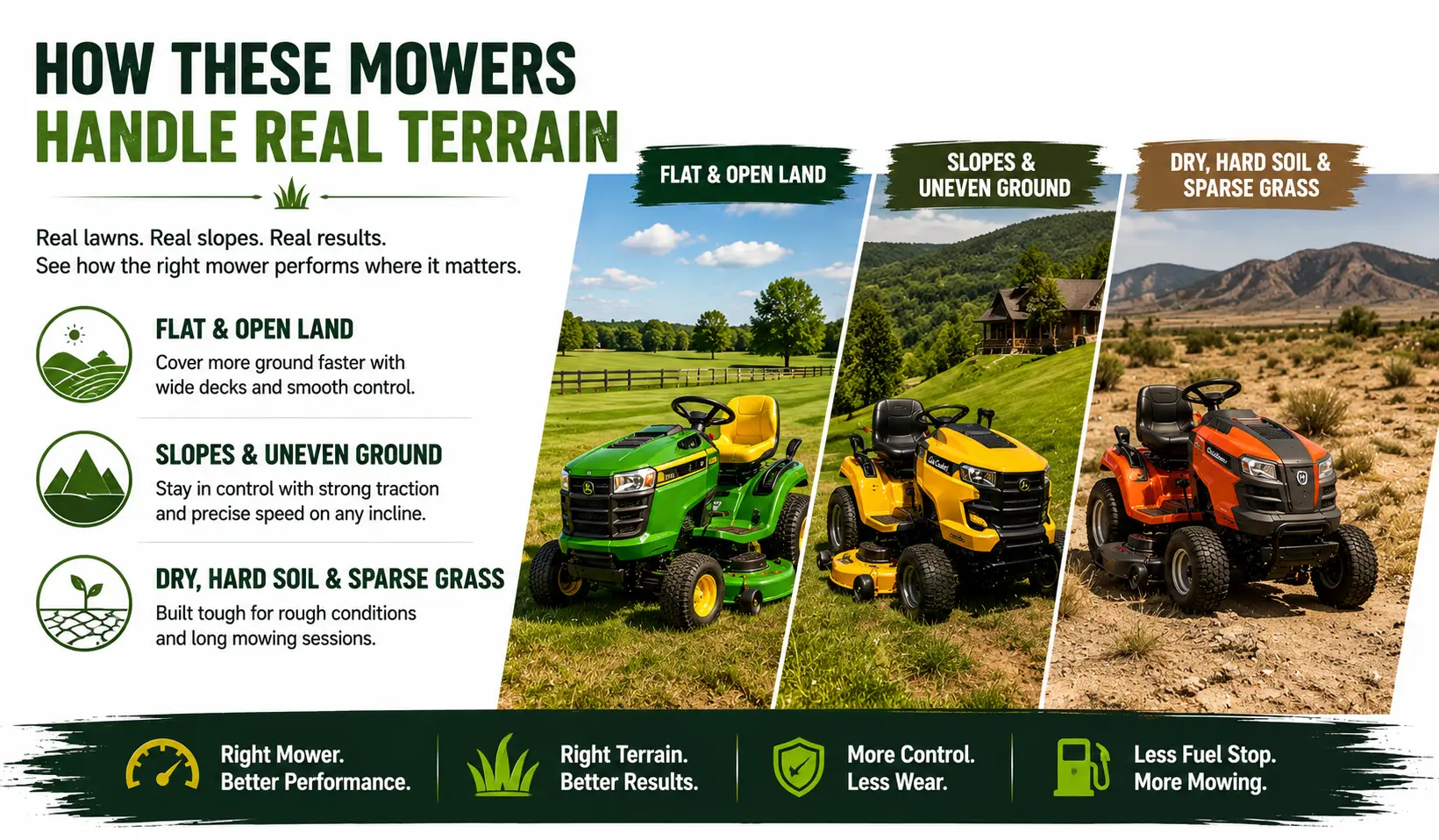
Common Mistakes People Make When Buying
Most buying mistakes come from not thinking through the actual shape and layout of the property before walking into the store. Two mistakes come up again and again.
Choosing a Deck That’s Too Wide for a Fenced Yard
A 46″ or 48″ deck will not fit through a standard 36″ residential fence gate. Period. Many buyers realize this after the mower is already in the backyard – and then have to remove fence boards, return the mower, or buy a second walk-behind.
Measure your gate before you buy. If you have a single gate under 42″ wide and you need to mow both the front and back yard with the same machine, your deck options are limited to 38″ or narrower. That narrows the field significantly.
If you have two separate areas, buy the wide deck for the larger space and use a smaller mower or walk-behind for the gated area. That’s often the more cost-effective answer anyway.
Underestimating the Importance of Transmission Type
Buyers routinely choose a manual transmission to save $150-200 on the purchase price and regret it by the end of the first season.
On a flat, obstacle-free lot, a manual transmission is manageable. On anything else – slopes, tight turns around beds, reversing around obstacles – a hydrostatic transmission saves real time and frustration every single mowing session.
A mower runs 15-20 years with good maintenance. The $200 difference on day one is about $10-13 per year over the life of the machine. Spend it.
My Final Recommendation
After several seasons across Ohio, Tennessee, and Kansas, if I could only pick one mower for a 1-3 acre property with mixed terrain, I’d take the Husqvarna YTA24V48. It handles the widest range of conditions, the build quality is honest, and parts are easy to find. The 48″ deck and 24 HP engine give you enough margin for thick spring grass and late-season cleanup without laboring.
If your property is genuinely flat and open with minimal obstacles, spend the extra money on the Toro TimeCutter. The time savings are real, and once you’ve mowed 2.5 acres in 70 minutes you will never go back to a standard rider.
If your budget is firm and your lot is genuinely one acre with no major terrain variation, the Troy-Bilt Pony 42 is a reasonable machine that will get the work done without drama. Just don’t push it past the one-acre mark regularly.
The one thing I’d tell anyone is this: buy more mower than you think you need. Your yard will not get smaller, your schedule will not get less busy, and the difference between a good mowing session and a miserable one comes down almost entirely to whether the machine is right for the land.
Frequently Asked Questions About Riding Lawn Mowers for 1-3 Acres
What is the best riding lawn mower for 1-3 acres?
The Husqvarna YTA24V48 is the best overall riding mower for 1-3 acres because it balances cutting width, engine power, and terrain versatility at a reasonable price. For flat open properties, the John Deere E150 or Toro TimeCutter 50″ are strong alternatives. For sloped terrain, the Cub Cadet XT2 LX46 is the more stable option.
How many horsepower do I need to mow 2-3 acres?
For 2-3 acres, you need a minimum of 20 HP, and 22-24 HP is the better target. More horsepower means the engine doesn’t labor in thick grass or warm conditions, which extends engine life and keeps mowing speed consistent across different grass types and densities.
Is a zero-turn mower worth it for 1-3 acres?
A zero-turn mower is worth it for 1-3 acres if your property is mostly flat and has multiple trees, beds, or obstacles. The time savings on obstacle-heavy flat ground are real – often 30-40% faster than a standard riding mower. However, zero-turn mowers are not recommended for slopes above 10-15 degrees, which limits their usefulness on hilly properties.
What cutting deck width is best for 1-3 acres?
A 46″-50″ cutting deck is the best range for 1-3 acres. A 42″ deck works on the lower end of the range but adds meaningful time on 2-3 acre properties. Anything above 54″ is overkill for residential lots and may not fit through standard residential gates.
What is the difference between a hydrostatic and automatic transmission on a riding mower?
A hydrostatic transmission uses fluid pressure to control speed, giving you smooth, continuous speed adjustment with no gears or clutching. An automatic (CVT) transmission shifts through ranges automatically but still has mechanical limits. Hydrostatic transmissions are better for slopes and precision maneuvering. Automatic transmissions are simpler and slightly cheaper, and work fine on flat, open ground.
How long does it take to mow 2 acres with a riding mower?
With a 46-48″ cutting deck at a typical mowing speed, 2 acres takes approximately 75-100 minutes on flat ground. Add 20-30% time for terrain variation, slopes, and turning around obstacles. A zero-turn mower on flat open ground can cut this to 60-70 minutes.
Can a riding mower handle wet grass?
Most riding mowers can cut slightly wet grass, but wet conditions reduce cut quality, cause clumping under the deck, and increase the risk of ruts on soft soil. Mowing in wet conditions also increases belt and blade wear. Wait until the grass has dried for at least an hour after rain or morning dew if possible. If you must mow wet, raise the cutting height by one setting to reduce clumping.