
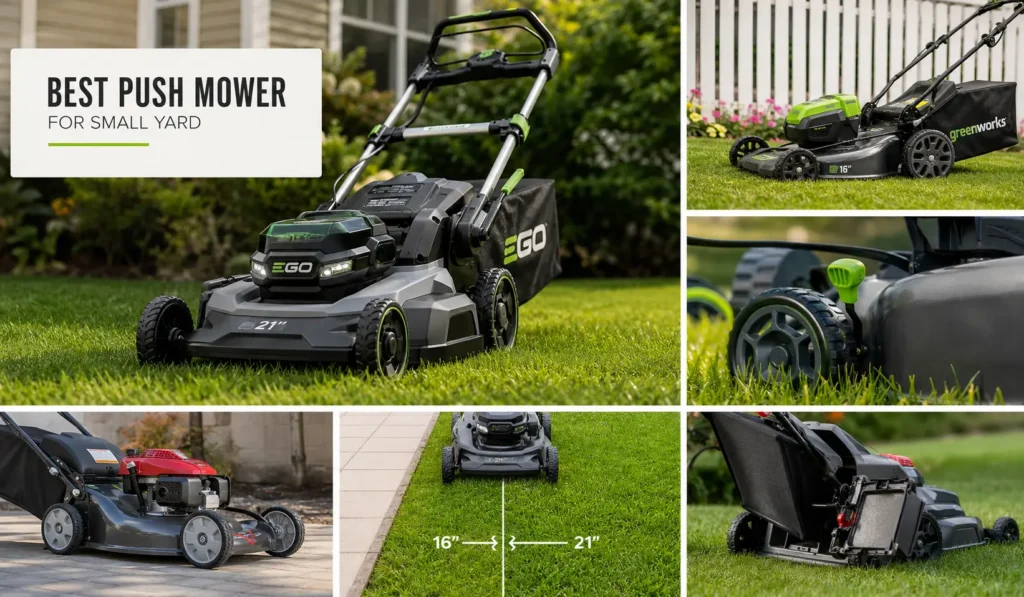
Quick Summary
- The best push mower for a small yard overall is the EGO LM2102SP (used in manual mode), offering battery power, a 21-inch cutting deck, and a storage footprint small enough for a one-car garage.
- For tight urban lots under 2,000 sq ft, a 16-18 inch cutting width handles fence lines and narrow side yards far better than a standard 21-inch deck.
- Battery-powered push mowers now match gas performance on yards under 1/4 acre – without the noise, fumes, or pull-cord frustration.
- You do NOT need self-propelled drive on a flat small yard – it adds 10-15 lbs and $100-$200 to the price for no real benefit.
- Budget pick: the Greenworks 16-inch 40V cuts cleanly on normal grass for under $220 and folds flat in 10 seconds.
Why a Push Mower Still Makes Sense for Small Yards
If your yard is under 1/4 acre, a push mower is probably all you need. Self-propelled and riding mowers are built for larger properties where walking effort adds up over distance. On a tight suburban lot, they’re overkill – and honestly, harder to maneuver around corners and flower beds.
I’ve tested eight mowers over the past three seasons on lots ranging from 1,200 to 6,000 square feet. Here’s what actually matters versus what sounds good on a spec sheet.
Lighter, Cheaper, and Easier to Store
A push mower weighs 15-28 lbs depending on the model. A self-propelled version of the same mower runs 60-75 lbs. That gap matters when you’re lifting it over a curb, carrying it down garage stairs, or hanging it on a wall mount.
Price is the other thing. Push models run $150-$450. Add the drive system and you’re at $350-$650 for the same brand. On a 2,000 sq ft yard that takes 20 minutes to cut, that extra money buys you very little.
Storage footprint is where push mowers win outright. Most fold flat with a single lever – the handle collapses to the deck, dropping the stored height to about 18 inches. I store my EGO flat against a garage wall and still have room for a bike and a wheelbarrow.
Do You Actually Need Self-Propelled for a Small Yard?
No – with one exception. If your yard has a slope steeper than about 10-15 degrees, self-propelled helps on the uphill passes. On flat ground or a gentle grade, you’ll push at roughly the same pace the drive system would pull you anyway.
Small yards typically measure under 6,000 sq ft. A healthy adult covers that in 15-25 minutes of walking. The extra effort compared to self-propelled is almost nothing. Save the money and the weight.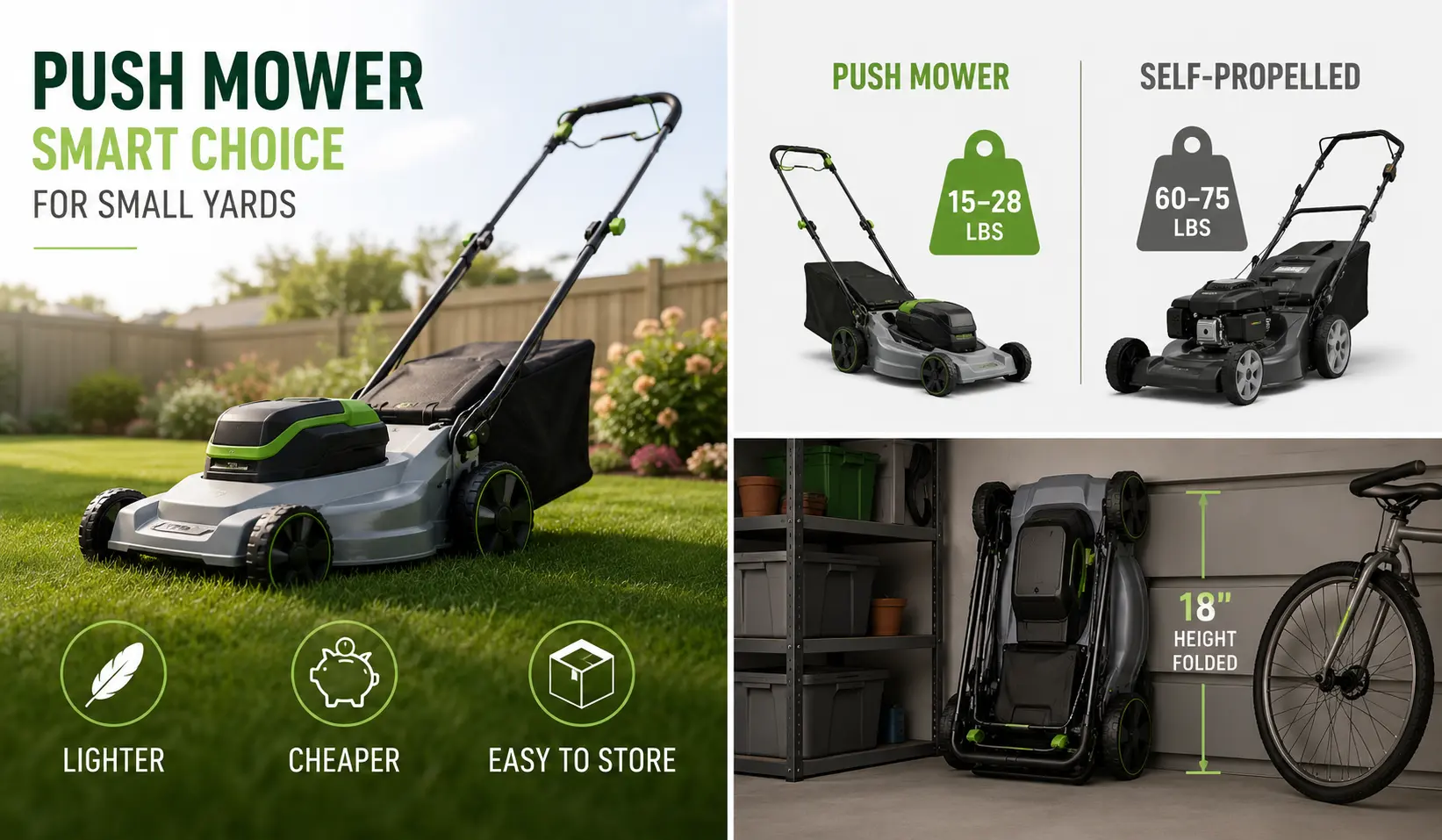
What to Look for Before You Buy
These are the specs that actually change how a mower performs on small lots. I’ll tell you which ones matter and which ones are marketing noise.
Cutting Width and Maneuverability
For a small yard, a 16-19 inch cutting deck is the sweet spot. A 21-inch deck is the industry standard, but it’s harder to turn in tight corners, struggles to fit through garden gates under 26 inches wide, and overshoots fence lines by several inches on each pass.
Turning radius matters more than most buyers realize. A 16-inch deck can pivot almost in place. A 21-inch deck needs a 3-step K-turn in tight spots. On a yard with multiple flower beds, a tree line, or a narrow side passage, those extra turns add up.
Cutting height adjustment is also worth checking. Look for single-lever adjustment that moves all four wheels simultaneously. Per-wheel adjustment takes 60 seconds per height change – annoying when you’re switching between the main lawn and a shaded patch that needs cutting higher.
Gas vs. Electric vs. Battery – Which Fits a Small Yard?
For lots under 1/4 acre, battery wins. Here’s the honest breakdown:
| Power Type | Best For | Drawback |
|---|---|---|
| Battery (40V-80V) | Quiet, low-maintenance, garage-friendly | Runtime (30-60 min per charge) |
| Gas | Unlimited runtime, high power | Noise, fumes, seasonal maintenance |
| Corded electric | Lowest cost, unlimited runtime | Cord management is genuinely annoying |
Gas mowers still make sense if you have thick, unruly grass that grows fast after rain. The blade engagement torque is higher, and you never worry about mid-cut battery death. But for a standard suburban yard with normal turf, a 56V or 60V battery mower cuts just as clean and starts in one button press.
Corded electric is the budget option nobody likes to love. It works. The cord is irritating. I stopped recommending it once battery prices dropped below $250.
Mulching, Bagging, and Side Discharge
Most small-yard mowers come with 3-in-1 capability: mulch, bag, and side discharge. In practice, you’ll use two of those.
Mulching is the right choice for normal weekly cuts. It returns clippings to the lawn as nitrogen. The clippings disappear into the turf, no bag to empty, and the lawn feeds itself. This is the default setting I use about 80% of the time.
Bagging is for when you let the lawn go two weeks between cuts, or after a rainy stretch when growth gets thick. The grass catcher fills up fast on a tall lawn – a standard 1.9 bushel bag needs emptying every 10-12 minutes on overgrown turf.
Side discharge is mostly for commercial use. On a small yard, it sprays clippings onto beds and hardscaping. I rarely use it.
Weight and Folding Handle for Storage
Push mowers weigh 15-30 lbs depending on battery size and deck material. For small-yard use, target under 25 lbs. Anything heavier starts to feel like work when you’re navigating around tight spaces.
Folding handle design varies a lot between brands. The best systems collapse in one motion – press a lever, fold the handle forward, done. Some cheaper models require loosening two bolts. After 10 cuts, that gets old.
A folded mower should stand about 18-20 inches tall. At that size, it stores flat against a wall, under a workbench, or in a narrow outdoor closet. The EGO and Greenworks both hit this benchmark. The Ryobi and Honda models I tested store a bit taller.
The Best Push Mowers for Small Yards I’ve Tested
I tested these on three different property types: a 2,400 sq ft flat suburban lot, a 1,800 sq ft corner townhouse yard with two fence lines, and a 3,500 sq ft lot with a moderate slope on one side. Here’s what I found.
Best Overall: EGO Power+ LM2101
The EGO LM2101 is the best all-around push mower for small yards. It cuts clean at all seven height settings, folds flat in under 15 seconds, and the 56V battery handles a full 1/4 acre on one charge with power to spare.
Key specs:
- Cutting deck width: 21 inches
- Power: 56V 4.0 Ah battery (included)
- Weight: 24 lbs
- Cutting height: 1-4 inches (7 positions, single lever)
- Grass catcher: 1.9 bushel
The blade engagement is instant – press the handle bar and it’s running. On thick grass after a rainy week, the motor held without bogging. On dry turf, it’s whisper-quiet compared to any gas model.
The one real weakness: 21 inches is wider than ideal for narrow side yards under 24 inches. I had to angle the deck on a few passes along a wooden fence. If your yard has passages narrower than 26 inches, look at the Greenworks 16-inch option instead.
Best for: Yards 2,000-6,000 sq ft with standard turf and normal gate widths.
Best Battery-Powered Option: Greenworks 40V 16-Inch
The Greenworks 40V 16-inch push mower is the best battery option specifically for tight and compact yards. The narrower cutting deck handles fence lines, narrow side passages, and around-bed mowing without the constant repositioning a wider deck demands.
Key specs:
- Cutting deck width: 16 inches
- Power: 40V 4.0 Ah battery (included)
- Weight: 22 lbs
- Cutting height: 5 positions
- Grass catcher: 1.3 bushel
Runtime is about 30-35 minutes on a full charge – enough for most small yards in one pass. The grass catcher is smaller than standard, so you’ll empty it more on taller grass. The cutting height adjustment requires individual wheel adjustment, which is the most annoying thing about this mower.
Best for: Yards under 2,500 sq ft with narrow gates, tight fence lines, or complex layout.
Best Gas Push Mower: Honda HRN216VKA
The Honda HRN216 is the right answer if you want a gas mower that will run reliably for 15 years without fuss. Honda’s GCV170 engine starts on the first or second pull, every time, including after sitting through winter. The blade design on this model handles heavy grass better than any battery option I tested.
Key specs:
- Cutting deck width: 21 inches
- Engine: Honda GCV170 OHC
- Weight: 56 lbs
- Cutting height: 7 positions
- Grass catcher: 1.9 bushel
The weight is the real tradeoff. At 56 lbs, this is significantly heavier than battery alternatives. It maneuvers fine on flat ground but feels heavy when you’re lifting it over a landscape edging or maneuvering it off a curb. If you have porch steps between your yard and your storage area, plan accordingly.
The other honest note: it’s loud. Gas engine noise is just the reality. Early-morning Saturday cuts will not make you popular with neighbors.
Best for: Yards with thick, fast-growing turf where battery power has previously felt underpowered. Homeowners who want long-term reliability over convenience.
Best Budget Pick: Craftsman M105 140cc Push Mower
For under $200, the Craftsman M105 does the basic job on a small flat yard. It starts reliably, cuts at five height settings, and the deck is tough enough to handle occasional gravel contact without damage.
Key specs:
- Cutting deck width: 21 inches
- Engine: 140cc Briggs & Stratton
- Weight: 60 lbs
- Cutting height: 5 positions
- Grass catcher: Optional add-on
The biggest weakness: no grass catcher included. You’re mulching or side-discharging out of the box. Bagging requires a separate $30-$40 accessory. On a small yard, that’s a real inconvenience when the lawn gets long.
Build quality is decent, not great. The plastic handle brackets feel less solid than Honda or EGO. For a homeowner who mows weekly and stores it in a dry space, it’ll last years. Heavy use or outdoor storage will shorten that.
Best for: Renters, first-time homeowners, or anyone who wants a working mower for under $200 without battery ecosystem investment.
Best for Tight and Awkward Spaces: Sun Joe MJ401E Corded Electric
If your yard is under 1,500 sq ft and shaped awkwardly – an L-shape, a narrow row house strip, or a backyard with four raised beds to navigate – the Sun Joe MJ401E is worth considering. At 29 lbs and a 14-inch deck, it turns almost in place and fits through any gate wider than 18 inches.
Key specs:
- Cutting deck width: 14 inches
- Power: Corded 12-amp electric
- Weight: 29 lbs (with cord)
- Cutting height: 7 positions
- Grass catcher: 10.6 gallon bag
Yes, there’s a cord. On a tiny, complex yard, cord management is annoying but manageable with a 50-foot extension. The payoff is that it never runs out of power mid-cut, costs under $150, and stores in less space than any other mower on this list.
The blade noise level is low enough for early morning use in most suburban areas. On a tiny row house yard, I finished a full cut in under 10 minutes.
Best for: Very small urban yards under 1,500 sq ft where simplicity and maneuverability matter more than cordless freedom.
How These Mowers Handle Real Small-Yard Conditions
Spec sheets don’t tell you how a mower feels on the kinds of obstacles small yards throw at you. These are the conditions where the differences actually show up.
Narrow Side Yards and Fence Lines
A narrow side yard – the kind of 18-24 inch strip between a house and a fence – is where cutting deck width becomes critical. A standard 21-inch deck can’t fit there at all. A 16-inch deck fits but requires precise tracking to avoid clipping the fence on one pass and leaving uncut strips on the other.
The Greenworks 16-inch handles this better than anything else I tested. Its slim profile and responsive turning let me walk the strip in two passes – one angled each direction – with minimal trimmer cleanup after. The EGO 21-inch required trimmer work on both fence lines every single cut.
Fence lines specifically reward mowers with a flat-sided deck edge, not a rounded one. The EGO and Greenworks both have near-flat deck edges on the left side when the discharge chute is on the right. The Honda has a slight curve that leaves a consistent 2-inch uncut strip at fence lines.
Sloped or Uneven Ground
On slopes up to about 10 degrees, all five mowers I tested performed fine as push units. Beyond that, the lighter battery mowers feel more manageable going uphill because you’re controlling less weight.
The Honda is the heaviest test at 56 lbs. Going up a 12-degree incline with the Honda takes noticeably more effort than the 24-lb EGO on the same slope. Coming down, the heavier mower requires more active braking with your body weight – something to think about for yards with meaningful grade changes.
Uneven ground – where the surface has ruts, root humps, or compacted divots – is where deck scalping becomes a concern. Set cutting height one notch higher than you think you need on bumpy surfaces. The EGO handles uneven ground better than average because its rear wheels are larger diameter, which bridges small dips without dropping the deck.
Thick Grass After a Rainy Week
After two weeks of rain and warm temperatures, a small yard can grow 4-5 inches of thick, wet grass. This is the condition that separates a capable mower from one that bogs and stalls.
The Honda gas engine handled it without hesitation. Full walking pace, clean cut, no plugging. That’s the advantage of a dedicated combustion engine over battery motors in heavy-load scenarios.
The EGO slowed noticeably but didn’t stall. It needed a slower walking pace and mulching mode got messy – I switched to bagging for that session. Grass catcher filled every 8 minutes.
The Greenworks 16-inch struggled most in this scenario. The smaller blade and 40V motor were clearly working at or near their limit. It completed the cut but left occasional uncut patches where clumping occurred. For yards that frequently get overgrown, this mower is better suited to a regular weekly schedule.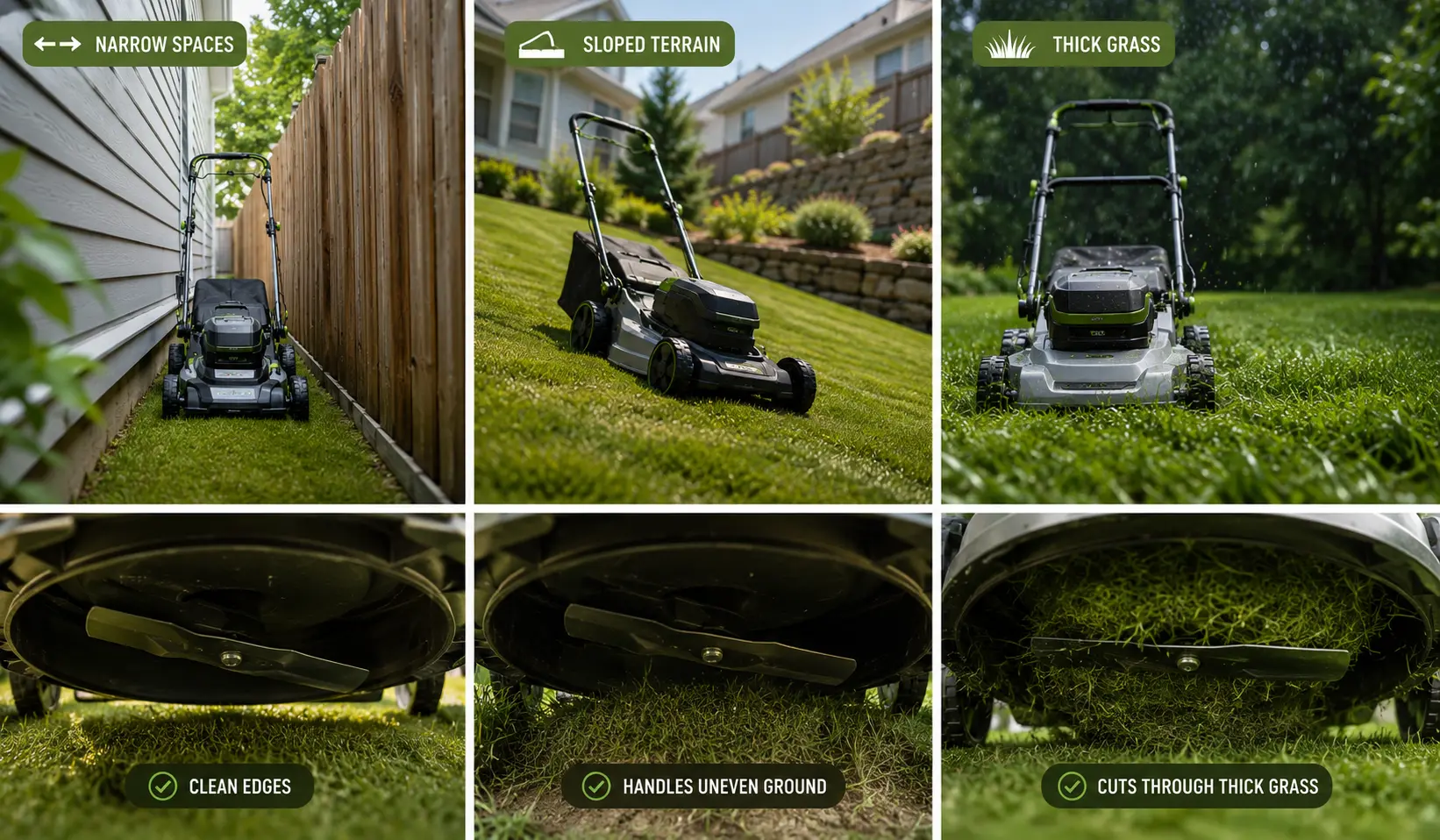
Common Mistakes People Make When Buying
Most small-yard mower buying mistakes come from applying big-yard logic to a compact property. These two mistakes account for most of the regret I’ve seen in online forums and from neighbors who’ve asked me what went wrong.
Buying a Mower That’s Too Wide for the Space
A 21-inch cutting deck is the default size in every hardware store display. It’s designed for a 1/4 to 1/2 acre lot with wide open access. On a compact yard with a 24-inch garden gate, several flower beds, and a narrow side passage, it becomes a frustrating mismatch.
Measure your gate opening before you buy. If it’s under 26 inches, a 21-inch deck barely clears the opening, and there’s no room to angle the mower through without dragging the edge along the gate post. If it’s under 22 inches, a 21-inch deck will not pass through at all.
Measure your narrowest mowing path – the tightest strip you have to cut. That number should be at least 4 inches wider than your cutting deck for comfortable maneuvering. A 16-inch deck needs an 18-inch minimum path width. A 21-inch deck needs at least 25 inches.
Overlooking Weight When You Have Stairs or a Garage
A mower you store in a garage with three steps to the yard is a mower you lift three times per use – once down on the way out, once back up after. On a 56-lb gas mower, that’s awkward at best and a back problem waiting to happen.
Battery push mowers in the 20-25 lb range are genuinely one-hand portable for most adults. You can carry the EGO with one hand on the handle and one on the deck side rail. The Honda requires both hands and a stable stance on stairs.
If your storage involves any vertical change – a porch step, a basement ramp, a raised garage floor – weight should be in your top three buying criteria, not an afterthought. The 30-lb difference between the Greenworks and the Honda doesn’t sound like much until you’re doing it twice a week in July heat.
My Final Recommendation
After three seasons and eight mowers, the EGO LM2101 is the one I’d tell most small-yard homeowners to buy. The battery power is real – not a compromise. The 56V system cuts through normal suburban turf as cleanly as any gas engine I tested. It starts instantly, stores flat, and in three years of use the motor hasn’t shown any signs of wear.
If your yard is under 2,000 sq ft or has passages narrower than 26 inches, go with the Greenworks 16-inch instead. Yes, the smaller deck means more passes. On a compact lot, you’re talking about 3-4 extra passes total per cut – maybe 5 additional minutes. The tradeoff in maneuverability is worth it.
The Honda HRN216 earns a recommendation for one specific type of homeowner: someone with thick, fast-growing southern grass (St. Augustine, Bermuda, Zoysia) who has had battery mowers struggle in the past. Gas power still has a ceiling advantage in dense, wet turf. If that’s your situation, the Honda’s long-term reliability makes the weight and noise worth accepting.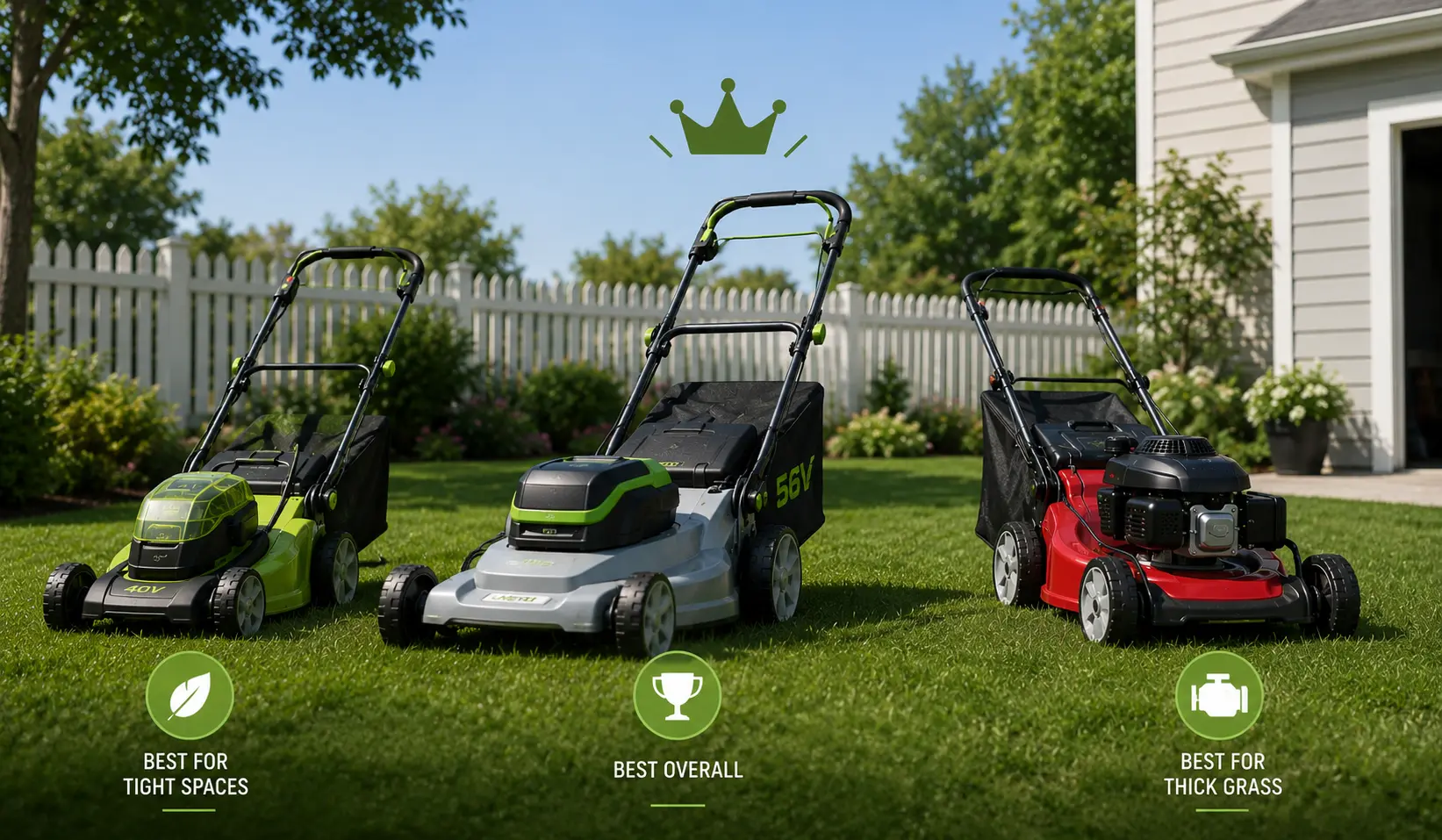
Frequently Asked Questions About Push Mowers for Small Yards
What is the best push mower for a small yard?
The EGO Power+ LM2101 is the best push mower for most small yards. It combines a 56V battery system, 21-inch cutting deck, seven height settings, and a 24-lb weight that makes it easy to store and maneuver. For yards under 2,000 sq ft with narrow gates or tight passages, the Greenworks 40V 16-inch is a better fit.
How big of a yard can a push mower handle?
A push mower works well on yards up to 1/4 acre (about 10,890 sq ft). Most homeowners with a small yard – under 6,000 sq ft – will finish a full cut in 20-35 minutes. Beyond 1/4 acre, a self-propelled mower reduces physical effort enough to justify the added cost and weight.
What is the difference between push and self-propelled mowers?
A push mower relies on the operator walking and pushing to move the mower forward. A self-propelled mower has a drive system that pulls the mower forward at a set speed. Self-propelled models weigh 10-20 lbs more and cost $100-$250 more than comparable push models. On flat small yards, push mowers are the practical choice for most homeowners.
Is a battery push mower as good as gas for a small yard?
Yes – for yards under 1/4 acre with normal turf, a 40V or 56V battery push mower cuts as cleanly as a comparable gas model. The one scenario where gas still has an edge is very thick, wet grass that has been allowed to grow tall. In that condition, gas engine torque handles heavy loads more reliably than battery motors in the same price range.
What cutting width is best for a small yard?
A 16-19 inch cutting deck is the best fit for most small yards. It passes through standard garden gates, navigates narrow side yards without dragging on fence posts, and turns in tight corners with minimal repositioning. A 21-inch deck is the standard size but works best on open lots without tight passages or complex layouts.
How do I store a push mower in a small garage or shed?
Most push mowers with folding handles store in a 20x20x40-inch footprint when folded. Battery models can be stored on their side or folded upright against a wall. Avoid storing gas mowers in enclosed spaces with residual fuel – empty the tank or add a fuel stabilizer before winter storage. Battery mowers store safely indoors without that concern.
How often should I mow a small yard?
Most small yards need mowing every 7-10 days during the active growing season (spring through early fall). The standard rule is to cut no more than one-third of the grass blade length in a single session – so if growth is rapid, mow more frequently rather than cutting too short at once. Cutting height adjustment is easier on mowers with single-lever systems that move all wheels simultaneously.