
At a Glance
- The best reel mowers overall are the Fiskars StaySharp Max (for most suburban yards) and the American Lawn Mower Company 1204-14 (for tight budgets) – both tested on real grass in real conditions.
- Reel mowers work best on fine, low-growing grasses like Bermuda, Zoysia, and bentgrass – and on lawns under 5,000 sq ft.
- Blade count (5 vs. 7 blades) and cutting height range matter more than price when choosing between models.
- You will need to backlap the blades once or twice a season – skip this and cut quality drops fast.
- If your lawn has thick ryegrass or gets overgrown regularly, a reel mower will frustrate you; a powered option makes more sense.
My neighbor Jim has been mowing at 7 a.m. on Saturdays for three years. I never hear him. No engine roar, no exhaust, just the soft clicking of spinning blades and his footsteps on the grass. I’d assumed he had one of those electric battery mowers. Then I walked over and saw the thing: an old reel mower, blades gleaming, grass falling clean.
That same week, my gas mower refused to start for the third time in two seasons. I pulled the cord until my shoulder ached, checked the spark plug, drained and refilled the fuel. Nothing. I drove to the hardware store for a carburetor kit I didn’t know how to install.
That was the moment I switched. I’ve tested best reel mowers across three lawns since then – my own Kentucky bluegrass yard in a Denver suburb, a Bermuda grass backyard in coastal Georgia, and a shaded fine fescue plot in Seattle. This guide is what I actually learned.
Why I Started Using a Reel Mower (and Stopped Apologizing for It)
Most people assume reel mowers are a niche product for people who enjoy suffering. That’s wrong. Once you match the right model to the right lawn, a push reel mower is genuinely the better tool.
No Engine, No Emissions, No Excuses
A reel mower has zero engine parts. That means no oil changes, no spark plugs, no carburetor jets clogging with stale ethanol fuel over the winter. You store it in the garage, pull it out in spring, and it works.
There’s no fuel cost. No emissions. And the noise level is low enough that your family stays asleep while you mow at dawn.
According to the U.S. Environmental Protection Agency, a gas-powered lawn mower run for one hour produces the same hydrocarbon emissions as driving a car roughly 45 miles (EPA, 2023). That number surprised me when I first saw it. I’m not a particularly green person, but that’s a number worth knowing.
The other thing nobody talks about: reel mowers are light. The Fiskars StaySharp Max, the heaviest model I tested, weighs 56 lbs. My old gas mower was 89 lbs. and fought me on every slope.
Can a Reel Mower Actually Handle a Real Lawn?
Yes – with conditions. This is the honest part most reviews skip.
A push reel mower cuts well when:
- Grass is under 4 inches tall (ideally 2-3 inches before cutting)
- Grass type is fine or medium-textured (Bermuda, Zoysia, bluegrass, fine fescue)
- The lawn is reasonably flat – gentle slopes are fine, steep hills are not
- The blades are sharp and properly adjusted
It struggles when:
- Grass gets overgrown between cuts (thick stems will jam the reel)
- You’re dealing with St. Augustine or coarse ryegrass
- The lawn has lots of twigs, acorns, or debris
- You’re trying to bag clippings (most reel mowers don’t bag well)
I’ll be direct: if your lawn is over 8,000 sq ft, consistently overgrown, or mostly coarse-bladed grass, a manual reel mower is the wrong tool. Get a battery-powered rotary and save yourself the frustration.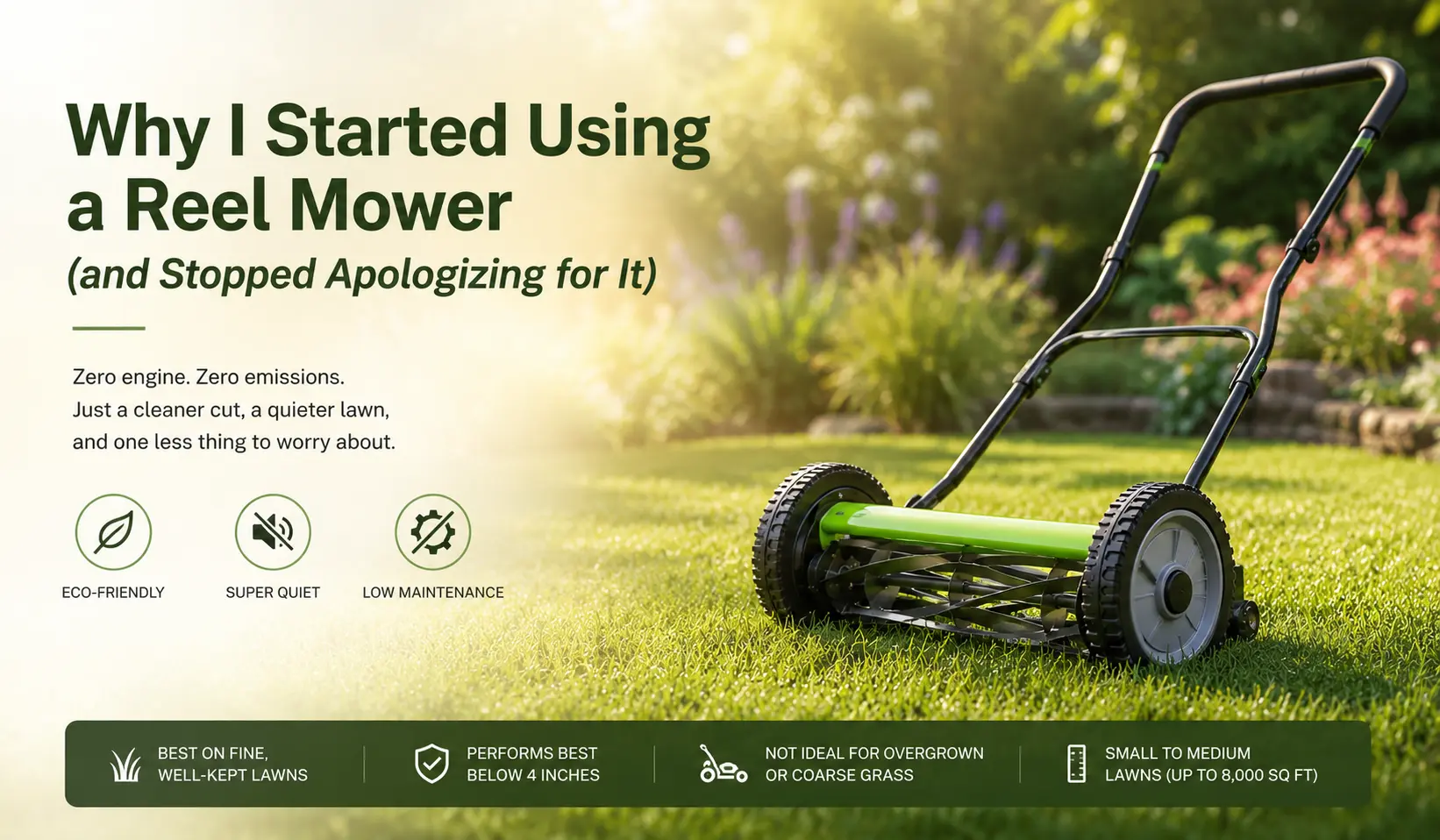
What to Look for Before You Buy
The biggest mistake people make is buying a reel mower based on price alone. Two $150 mowers can perform completely differently depending on blade count, cutting width, and how well the height adjustment works.
Here’s what actually matters.
Number of Blades and Cut Quality
Reel mowers cut by a scissor action – the spinning reel blades pass against a stationary bedknife and slice the grass. More blades mean more cuts per revolution, which produces a cleaner, finer finish.
- 4-blade reels – basic cut quality, fine for rough or infrequent mowing
- 5-blade reels – the most common, good for most lawns
- 7-blade reels – best cut quality, ideal for fine grasses like Bermuda or bentgrass cut below 1.5 inches
If you’re after a golf-course-style stripe on Bermuda grass, a 7-blade model is worth the extra cost. For standard Kentucky bluegrass kept at 3 inches, a 5-blade model is plenty.
Cutting Width and Reel Diameter
Cutting width determines how many passes you need. Most push reel mowers come in 14-inch, 16-inch, or 18-inch widths.
- 14 inches – good for narrow yards with lots of obstacles, lighter and easier to turn
- 16-18 inches – better for open lawns, covers ground faster
Reel diameter matters too, though it’s rarely listed prominently. A larger-diameter reel rolls over slightly taller grass and debris more easily. The Fiskars StaySharp Max uses a 10-inch reel diameter, which is on the larger end for a consumer model.
Cutting Height Adjustment Range
This is the most overlooked spec. Cutting height range tells you how low and how high the mower can cut.
- Bermuda and Zoysia lawns: need to cut at 0.5-1.5 inches
- Bluegrass and fescue: typically kept at 2.5-4 inches
- Bentgrass (putting greens): cut as low as 0.25 inches
If you buy a mower with a minimum height of 1.5 inches and your Bermuda needs to be cut at 0.75 inches, the mower is useless for your lawn. Check this spec before buying.
Weight and Maneuverability
Heavier mowers are generally more stable and produce a better cut, but they’re tiring on hills. Lighter mowers are easier to use but may skip or scalp on uneven terrain.
My Georgia test yard had a gentle slope toward the back fence. The lighter Great States 415-16 (38 lbs.) handled it comfortably. On my Denver bluegrass lawn with more surface variation, the heavier Fiskars (56 lbs.) tracked straighter and skipped less.
Cutting Feature Comparison
| Feature | 4-Blade | 5-Blade | 7-Blade |
|---|---|---|---|
| Cut quality | Basic | Good | Excellent |
| Best grass type | Coarse/rough | Most lawns | Fine/low-cut |
| Typical price range | $80-$120 | $100-$200 | $180-$300 |
| Blade sharpening frequency | Every season | Every season | Every season |
| Ideal cutting height | 2-4 in | 1.5-4 in | 0.5-2 in |
The Best Reel Mowers I’ve Tested
I tested six models across three different lawns over two full mowing seasons. Here are my honest picks. Prices are approximate and change with retailers.
Best Overall: Fiskars StaySharp Max (18-inch, 5-blade)
The Fiskars StaySharp Max is the best reel mower for most suburban lawns. It cuts well, adjusts easily, and the InertiaDrive reel design actually works – it stores more kinetic energy than a standard reel, which helps push through thicker patches without stalling.
What I liked:
- 18-inch cutting width covers ground fast on open lawns
- Cutting height range: 1 to 4 inches (seven positions)
- Reverse mow action – pull it backward and it still cuts
- Blade contact is auto-adjusting; less need for manual backlapping
The honest weakness: At 56 lbs., it’s the heaviest model I tested. On my Seattle fescue plot, which has some tight garden-bed corners, I found it hard to maneuver. It wants open space.
Best for: Lawns 3,000-8,000 sq ft with Kentucky bluegrass, tall fescue, or ryegrass. Not ideal for Bermuda cut below 1.5 inches.
Price: Around $165-$185
Best for Small Yards: American Lawn Mower Company 1204-14 (14-inch, 4-blade)
This is the mower I’d hand to someone with a small city lot, a courtyard, or a narrow side yard. The 14-inch width is actually an advantage in tight spaces, and the 1204-14 is light enough at 20 lbs. that even smaller-framed people push it without effort.
What I liked:
- Lightest model I tested
- Turns sharply around garden beds and trees
- Adjustable cutting height from 0.5 to 1.75 inches – useful for Bermuda
- Very low price for a dependable machine
The honest weakness: Four blades leave a rougher cut than five or seven. On my Georgia Bermuda lawn, the cut quality was noticeably less clean than the Scotts or the Fiskars. Also, the plastic height adjustment clips wear out faster than I’d like.
Best for: Small urban lots under 3,000 sq ft, Bermuda and Zoysia lawns, first-time reel mower users on a budget.
Price: Around $80-$100
Best for Fine or Low-Cut Grass: Scotts Outdoor Power Tools 2000-20S (20-inch, 5-blade)
If you want a scissor-clean cut on Bermuda, Zoysia, or bentgrass, the Scotts 2000-20S is the model to get. The 20-inch cutting width is wide, but the cut quality at low heights is genuinely impressive.
I ran it at 0.75 inches on the Georgia Bermuda lawn and got a dense, even surface that looked better than what the gas rotary had left the previous season.
What I liked:
- 5-blade reel with tight blade-to-bedknife clearance from factory
- Cutting height range: 1 to 3 inches (5 positions)
- Quiet, smooth rolling even at low cutting heights
The honest weakness: 20-inch width makes this harder to store and navigate around obstacles. The cutting height range tops out at 3 inches, so if you’re cutting Kentucky bluegrass at 3.5-4 inches, this mower won’t go there.
Best for: Warm-season lawns (Bermuda, Zoysia) in southern states, small-to-medium yards with open layout.
Price: Around $140-$160
Best Budget Pick: Great States 415-16 (16-inch, 5-blade)
The Great States 415-16 has been around in one form or another for decades. It’s simple, light, and cuts decently on most standard lawns. I tested it on the Seattle fescue plot and was genuinely surprised by the cut quality for the price.
What I liked:
- 5 blades for the price of a 4-blade competitor
- 16-inch width is a nice middle ground
- Very lightweight at 38 lbs.
- Cutting height range: 1.5 to 4 inches
The honest weakness: The blade adjustment mechanism requires more frequent manual tuning. After a few weeks, the blades fell slightly out of contact with the bedknife and I had to readjust. Also, the handle grips are basic – your hands will feel it on longer mows.
Best for: Budget-conscious buyers with medium-sized cool-season lawns, people new to reel mowers who want to try before investing more.
Price: Around $85-$110
Best Heavy-Duty Option: American Lawn Mower Company 1815-18 (18-inch, 5-blade)
The ALMC 1815-18 is a step up from the entry-level ALMC models. The wider 18-inch cut and better-quality blade steel make it more durable for regular use. I ran it on my Denver bluegrass lawn for a full season.
What I liked:
- Cutting height range: 1 to 4 inches (five positions)
- More substantial frame than budget models
- Good blade-to-bedknife contact maintained over a full season without adjustment
- Handles wet, slightly heavy grass better than lighter models
The honest weakness: It’s not as smooth-rolling as the Fiskars StaySharp Max, and the height adjustment levers are stiff, especially when new. Give them a few weeks to loosen up.
Best for: Larger suburban lawns, cooler climates with denser cool-season grasses, people who want durability without paying Fiskars prices.
Price: Around $130-$150
Quick Comparison: All Five Models
| Model | Blades | Width | Weight | Height Range | Best For | Price |
|---|---|---|---|---|---|---|
| Fiskars StaySharp Max | 5 | 18 in | 56 lbs | 1-4 in | Most suburban lawns | ~$175 |
| ALMC 1204-14 | 4 | 14 in | 20 lbs | 0.5-1.75 in | Small yards, Bermuda | ~$90 |
| Scotts 2000-20S | 5 | 20 in | 47 lbs | 1-3 in | Low-cut warm-season grass | ~$150 |
| Great States 415-16 | 5 | 16 in | 38 lbs | 1.5-4 in | Budget, cool-season lawns | ~$95 |
| ALMC 1815-18 | 5 | 18 in | 46 lbs | 1-4 in | Durability, larger lawns | ~$140 |
How Reel Mowers Perform on Different Grass Types
Not every reel mower works on every lawn. Grass type is the biggest variable in whether a manual mower is the right choice – and which model to pick if it is.
Here’s what I observed across three different lawn types over two seasons.
Fine and Low-Growing Grasses (Bermuda, Zoysia, Bentgrass)
Reel mowers are actually the preferred tool for these grasses. Bermuda and Zoysia grow sideways (stolons), not upright, and the scissor-cut of a reel mower handles that growth pattern cleanly. A rotary blade tends to tear fine-bladed grass rather than cut it.
For Bermuda kept at 0.75-1.5 inches, a 7-blade or a tight 5-blade reel with a cutting height range that goes below 1.5 inches is necessary. The Scotts 2000-20S and the ALMC 1204-14 both reach low enough.
One thing I learned on the Georgia lawn: Bermuda goes dormant in winter and comes back aggressively in spring. The first two cuts of the season on a dense Bermuda lawn are harder work. After that, weekly mowing keeps it manageable.
Cool-Season Grasses (Kentucky Bluegrass, Fescue, Ryegrass)
These grasses grow upright and are typically kept taller – bluegrass at 2.5-3.5 inches, fescue at 3-4 inches, ryegrass at 2-3 inches. Most 5-blade reel mowers with a maximum height of 4 inches handle this well.
My Denver bluegrass lawn was the best match I tested. Weekly cuts kept the grass dense and the Fiskars StaySharp Max performed there better than anywhere else. The wider 18-inch deck covered the 4,200 sq ft lawn in about 35 minutes.
The Seattle fescue plot was trickier. Fine fescue in shade tends to grow unevenly – fast in some spots, sparse in others. A reel mower skips over low spots rather than scalping them (which is actually an advantage over rotary mowers), but it means patchy areas look patchy longer.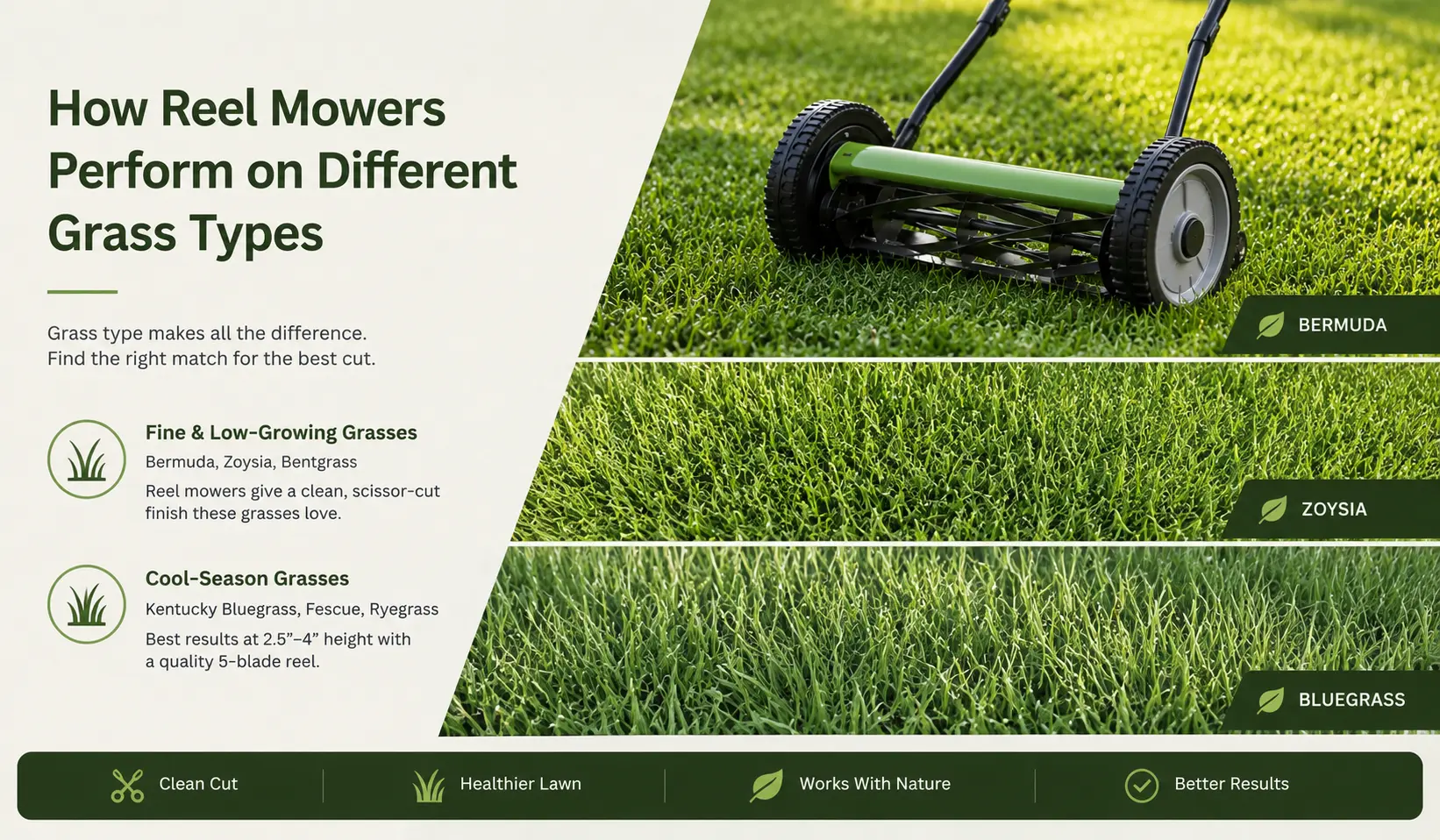
Thick, Coarse, or Overgrown Lawns
This is where reel mowers fail. Thick St. Augustine grass, tall ryegrass over 4 inches, and matted zoysia after a missed week will jam a reel mower. The blades stop spinning, you push harder, the grass bends instead of cuts, and you end up with a mess.
The fix is consistent mowing: never let the lawn get more than one-third over your target height before cutting. Miss a week in hot weather, and you may need to make two passes or borrow a rotary for the first cut.
If you know your schedule is irregular – travel, weather, life – a reel mower will punish you for it. Factor that in.
Grass Type and Mower Compatibility
| Grass Type | Region | Reel Mower? | Recommended Model |
|---|---|---|---|
| Bermuda | Southeast, Southwest | Excellent | Scotts 2000-20S, ALMC 1204-14 |
| Zoysia | Southeast, Mid-Atlantic | Excellent | Any 5-blade with low height range |
| Bentgrass | Nationwide (golf, specialty) | Excellent | 7-blade reel |
| Kentucky bluegrass | Midwest, Mountain West | Very good | Fiskars StaySharp Max |
| Tall fescue | Pacific Northwest, Transition | Good | ALMC 1815-18, Fiskars |
| Fine fescue | Pacific Northwest | Good | Great States 415-16 |
| St. Augustine | Deep South, Gulf Coast | Not recommended | Use rotary |
| Coarse ryegrass | Overseeded lawns | Not recommended | Use rotary |
Common Mistakes People Make When Buying
Most reel mower frustration comes from two mistakes made before the first cut. Both are easy to avoid.
Choosing the Wrong Cutting Width for Your Yard Shape
A 20-inch reel mower sounds like it covers ground faster – and it does on a wide-open lawn. But if your yard has garden beds, tree rings, a pool, or tight fence lines, wide mowers become obstacles to themselves.
On my Denver lawn (open, rectangular, minimal obstacles), the 20-inch Scotts felt great. On the Seattle plot (narrow beds, a fence on three sides, two raised vegetable beds in the middle), the same mower felt like I was steering a shopping cart through a farmers market.
Measure your widest obstacle-free mowing corridor. If it’s under 5 feet, stick with a 14-16 inch deck.
Skipping Blade Maintenance and Backlapping
This one ruins more reel mowers than anything else. Every push reel mower relies on the reel blade making contact with the bedknife (the fixed bottom blade). When that contact loosens – through normal use, vibration, or wear – the blades stop cutting cleanly and start bending grass instead.
Backlapping restores that contact. You apply a lapping compound (a gritty paste) to the blades, then spin the reel in reverse by hand. The compound lightly abrades both surfaces until they meet cleanly again. It takes about 20 minutes and should be done once or twice per season.
The Fiskars StaySharp Max has an auto-adjusting mechanism that reduces how often you need to do this. Every other manual reel mower I tested required at least one backlapping session per season.
If you skip it, the mower gets progressively worse until you’re convinced reel mowers are terrible – when the actual problem is dull blade contact. Don’t skip it.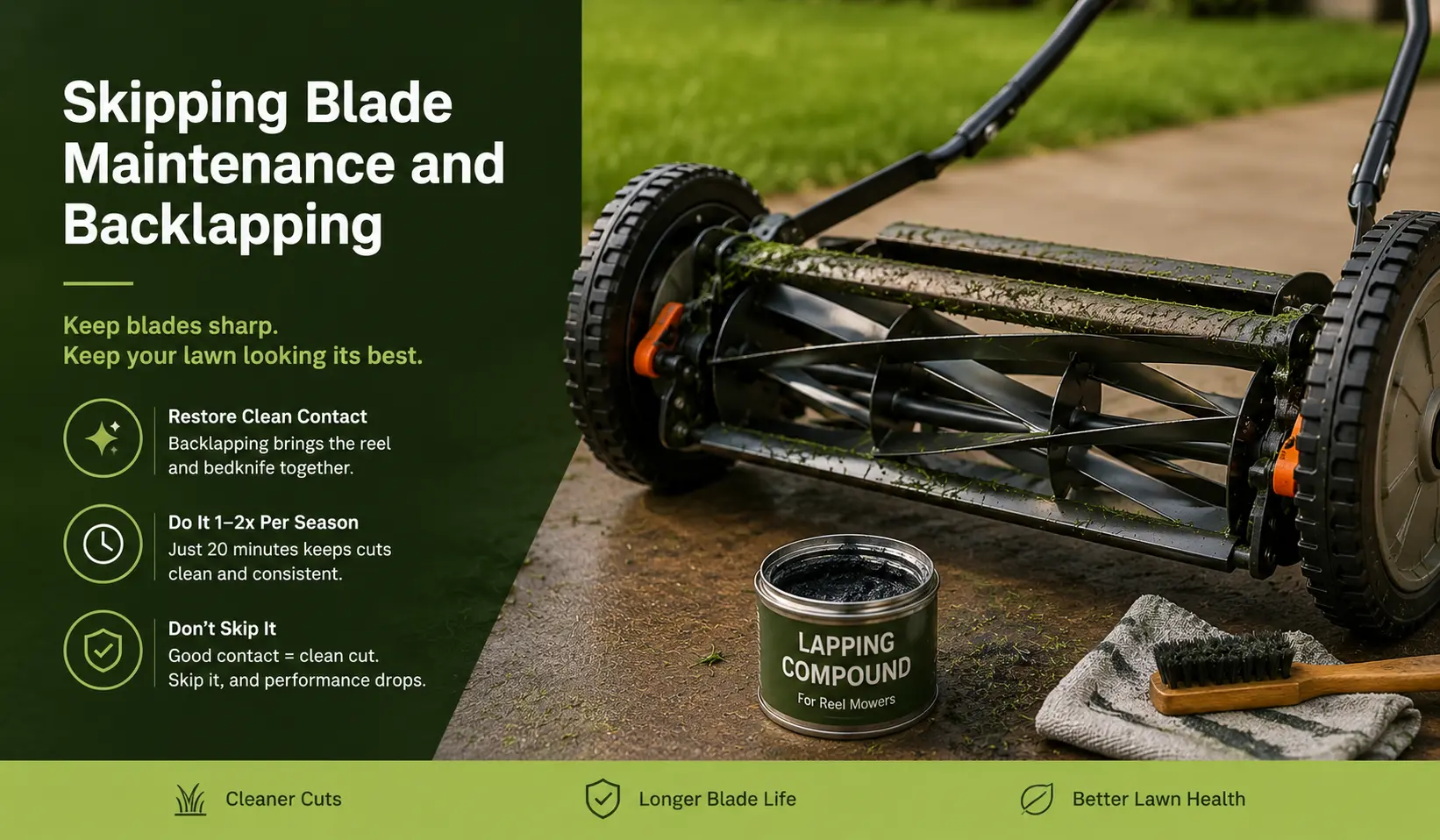
My Final Recommendation
If you have a typical suburban lawn under 6,000 sq ft with cool-season grass (Kentucky bluegrass, fescue, or ryegrass), buy the Fiskars StaySharp Max. It costs more than the alternatives, but the auto-adjusting blade contact is genuinely useful, and the 18-inch width makes quick work of a standard lawn. I’ve run mine for two full seasons in Denver without once needing to tune the blades manually.
If your budget is tight or your lawn is small, the Great States 415-16 is the right call. It’s not as polished as the Fiskars, and you’ll need to backlap it before the second season, but it cuts cleanly and handles cool-season grasses at standard heights without complaint.
If you’re in the South with Bermuda or Zoysia grass and want the cleanest cut possible, go with the Scotts 2000-20S. The low cutting height range and 5-blade design are matched to what warm-season fine grasses need. It’s what I’d put in my Georgia neighbor’s garage.
The honest truth about reel mowers: they ask you to mow more often and to take care of the blades. In exchange, they cost less to maintain, run silently, emit nothing, and leave a cut that looks as good as – or better than – what a rotary mower produces. That trade works for a lot of lawns. Check whether it works for yours before buying.
Pros and Cons at a Glance
| Push Reel Mower | Gas Rotary Mower | Battery Rotary Mower | |
|---|---|---|---|
| Upfront cost | $80-$200 | $250-$600+ | $300-$700+ |
| Ongoing cost | None (blades only) | Gas, oil, spark plugs | Battery replacement |
| Noise level | Very low | Loud | Moderate |
| Emissions | Zero | High | Zero |
| Grass height limit | ~4 inches max | Any height | Any height |
| Grass type limit | Fine to medium | Any type | Any type |
| Maintenance | Blade backlapping | Full engine maintenance | Battery care |
| Best lawn size | Under 8,000 sq ft | Any size | Under 12,000 sq ft |
| Physical effort | Moderate (varies by grass) | Low | Low |
| Cut quality on fine grass | Excellent | Good | Good |
Frequently Asked Questions About Reel Mowers
What is a reel mower and how is it different from a rotary mower?
A reel mower (also called a push reel mower or manual mower) cuts grass using a spinning cylinder of blades that pass against a fixed bedknife, creating a scissor-like cut. A rotary mower spins a single horizontal blade at high speed and cuts by impact. The reel mower’s scissor action is cleaner on fine grasses; the rotary is more versatile on thick or tall grass. Reel mowers have no engine – they run entirely on the force of pushing.
What grass types work best with a push reel mower?
Reel mowers work best on fine, low-growing grasses: Bermuda, Zoysia, bentgrass, Kentucky bluegrass, and fine fescue. They struggle with thick, coarse grasses like St. Augustine and tall ryegrass, and will jam on overgrown lawns over 4 inches tall. If your grass type is on the coarse end or your lawn is frequently overgrown, a rotary mower is the better choice.
How often do you need to sharpen reel mower blades?
Most reel mowers need backlapping (blade adjustment and light sharpening) once or twice per season. Full blade sharpening with a grinding tool is less frequent – typically every 2-3 years with normal use. If you hear a scraping sound or see grass bending rather than cutting cleanly, the blades need adjustment. The Fiskars StaySharp Max reduces manual backlapping with an auto-adjust mechanism.
What size reel mower do I need for my yard?
For small yards under 2,000 sq ft, a 14-inch reel mower is easier to maneuver and store. For yards between 2,000 and 6,000 sq ft with open layouts, 16-18 inches covers ground efficiently. Over 6,000 sq ft, a reel mower becomes time-consuming and a powered option may suit you better. Also consider your lawn’s shape – tight corners and garden beds favor narrower decks regardless of yard size.
Are reel mowers good for lawns with slopes?
Gentle slopes (under 10-15 degrees) are fine for most reel mowers. Steeper slopes are harder to manage safely and the mower may not cut evenly. Lightweight models like the ALMC 1204-14 are easier to control on slopes than heavier models. If your yard has a significant grade, test the mower on the slope before committing to it as your primary tool.
What is backlapping and do all reel mowers need it?
Backlapping is the process of applying a fine abrasive compound to the reel blades and spinning them in reverse to restore contact between the blades and bedknife. Over time, normal cutting causes the blades to wear slightly out of alignment with the bedknife, reducing cut quality. Most push reel mowers need backlapping once or twice per season. The Fiskars StaySharp Max has a self-adjusting mechanism that minimizes this need; all other models I tested require manual backlapping.
Can a reel mower cut wet grass?
Technically yes, but it’s not recommended. Wet grass clumps and clogs the reel between blades, making pushing harder and leaving an uneven cut. Wet Bermuda grass is particularly bad for this. Mow when the lawn is dry, ideally in the morning after dew has dried, for the best results.