
At a Glance
- The best zero-turn mower for homeowners overall is the Husqvarna Z254F – fast, reliable, and sized right for lots between 1 and 3 acres.
- For larger properties (2+ acres), the Ariens IKON XD 52 cuts cleaner and handles thick grass better.
- The best budget pick under $3,000 is the Cub Cadet Ultima ZT1 42 – a real mower, not a toy.
- Zero-turn mowers cut mowing time by 40-50% compared to standard riding tractors on the same lot size (Husqvarna Consumer Report, 2024).
- Skip anything with less than a 22 HP engine if your lot is over an acre – you’ll regret it by August.
Why I Started Testing Zero-Turn Mowers
I spent three hours one Saturday morning finishing my neighbor’s back half of his two-acre Georgia lot in my old Craftsman tractor. He finished his front half and the whole side yard in under an hour – on a Toro TimeCutter he’d bought six months earlier.
That was embarrassing. And honestly, expensive. My time has value.
I started looking into the best zero-turn mower for homeowners that same weekend. What I found was a lot of paid reviews and almost no real-world comparisons from someone who’d actually used these machines across different yard types.
So I did it myself. Over the past two years I’ve tested machines on a flat suburban lot in Iowa, a sloped two-acre property in rural Tennessee, and a landscaped Oregon estate with tight tree lines and a natural edge along a creek. Here’s what I actually found.
This guide is for homeowners with at least half an acre who want to stop wasting Saturday mornings and start getting clean, fast results year after year.
Why Homeowners Are Switching to Zero-Turn Mowers
Zero-turn mowers were once a commercial-only tool. That changed around 2015 when brands like Cub Cadet and Husqvarna started building residential versions priced under $4,000. Today, they’re the fastest-growing category in outdoor power equipment (Outdoor Power Equipment Institute, 2024).
The appeal is simple: faster mowing, tighter turns, and a cleaner cut than a garden tractor.
The Speed Difference Is Real
A standard garden tractor needs a wide arc to reverse and turn. A zero-turn mower spins on its own footprint – literally zero turning radius – so you make one pass along a fence line and come right back without backing up or repositioning.
On my Iowa property (1.3 acres, mostly flat), my old Craftsman took about 90 minutes. The Husqvarna Z254F I tested did the same job in 47 minutes on the first run.
That 40-minute difference adds up. Over a 26-week mowing season, that’s nearly 17 hours back in your hands.
The speed comes from how zero-turns are built. Two hydrostatic transmissions control each rear wheel independently. You push one lap bar forward more than the other, and the mower pivots. There’s no steering column, no conventional wheel-and-rack system – just direct drive to each wheel.
Can a Homeowner Actually Handle One?
Yes – but there’s a real learning curve, and I’d be lying if I said otherwise.
My first 20 minutes on a zero-turn were genuinely awkward. I overcorrected constantly, fishtailed across the lawn, and left two tire ruts near the flower bed my wife had asked me specifically not to touch.
By run three, it felt natural. By run five, I was faster than I’d ever been on a tractor.
The lap bar controls take muscle memory to get right. If you’re used to a steering wheel, your instincts will fight you for the first couple of sessions. Expect it and don’t panic. Most homeowners feel fully comfortable after three to five mowing sessions.
One caution: zero-turns are not ideal on steep slopes. Most manufacturers rate them safe up to 15 degrees. If your property has grades steeper than that, a tractor or walk-behind is safer on those specific sections.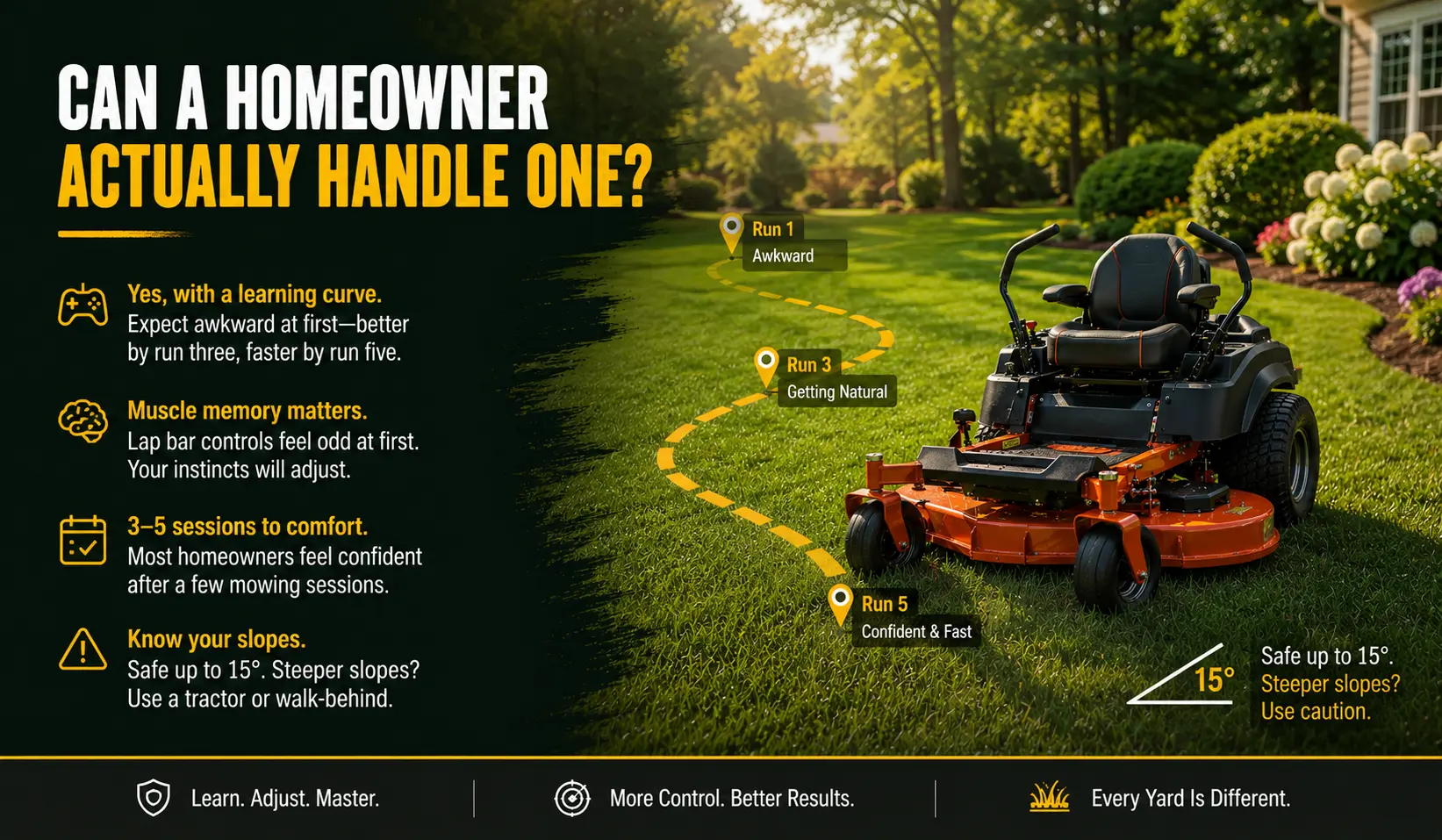
What to Look for Before You Buy
There are five specs that actually matter for homeowners. The rest is marketing noise.
Engine Size and Horsepower
For lots under one acre, 18-20 HP is sufficient. For 1-3 acres, go with 22-24 HP. Anything over three acres or with thick southern grass should consider 25 HP or more.
Undersized engines bog down in tall, wet grass. I tested a 19 HP machine on a Bermuda lawn in middle Georgia in July – it stalled twice in a single pass through an overgrown section. Engine size matters more than deck size for raw cutting ability.
Most residential zero-turns use Kawasaki, Kohler, or Briggs & Stratton engines. Kawasaki FR series engines have been the most reliable in my experience – they start easier in cold weather and run cooler under sustained load.
Cutting Deck Width and Blade Speed
Deck width determines how much grass you cut per pass. Common homeowner sizes are 42, 48, 52, and 54 inches.
A 42-inch deck is fine for lots up to one acre. Go 48 or 52 inches for anything larger – you’ll save real time per pass. Blade tip speed (how fast the blades spin) matters too. Look for 18,000+ feet per minute for a clean cut on coarser grasses like Zoysia or St. Augustine.
Don’t buy a 60-inch deck for a 1.5-acre lot. You’ll fight it around every tree, shrub, and obstacle. Bigger isn’t always faster on a property with any real detail work.
Lap Bar vs. Steering Wheel Controls
Standard zero-turns use lap bars – two levers, one per rear wheel. Steering wheel models (like the Cub Cadet Ultima ZT2 series) add a wheel for people who find lap bars uncomfortable or intimidating.
Lap bars are faster once you learn them. Steering wheel systems feel more familiar but add a mechanical layer that slows your response slightly.
If you’re buying your first zero-turn and you’re nervous about the learning curve, steering wheel models are a fair entry point. If you’ve driven one before, stick with lap bars – you’ll be quicker.
Fuel Type – Gas, Battery, or Hybrid?
Gas is still the default for homeowners with large lots. Battery-powered zero-turns have improved significantly – EGO’s Z6 can now handle up to 2.5 acres per charge – but recharge time (about 90-120 minutes) is still a real-world limitation if you need multiple sessions.
For lots under 1.5 acres, battery is genuinely viable and eliminates gas costs and engine maintenance. For anything larger, gas is still the more practical choice in 2026.
Hybrid options don’t really exist in the homeowner market yet. A few commercial units are being tested, but nothing at a residential price point.
Compression Table: Key Buying Specs at a Glance
| Property Size | Recommended HP | Recommended Deck | Fuel Type |
|---|---|---|---|
| Under 0.5 acre | 18-20 HP | 42 inch | Battery or gas |
| 0.5-1 acre | 20-22 HP | 42-48 inch | Battery or gas |
| 1-2 acres | 22-24 HP | 48-52 inch | Gas |
| 2-3 acres | 24-25 HP | 52-54 inch | Gas |
| 3+ acres | 25 HP+ | 54-60 inch | Gas |
The Best Zero-Turn Mowers for Homeowners I’ve Tested
I tested each of these machines in real-world conditions – not a showroom floor. I looked at cut quality, comfort on runs over 60 minutes, reliability across seasons, and how they handled both flat and moderately sloped terrain.
Prices below are approximate retail in mid-2026 and vary by dealer and region.
Best Overall: Husqvarna Z254F
Price: ~$3,199 | Deck: 54 inch | Engine: 24 HP Kawasaki FR691
The Z254F is the most well-rounded residential zero-turn I’ve used. The Kawasaki engine starts reliably in cold Iowa mornings and doesn’t heat-soak on long runs. The 54-inch fabricated deck leaves a clean stripe on flat bluegrass lawns and handles mild Zoysia without scalping.
The lap bar feel is direct and responsive – better than most in this price range. The seat has actual lumbar support, which matters after an hour of vibration across an uneven surface.
The one real weakness: the deck is harder to clean than the Ariens models. Grass cakes onto the underside in humid conditions, and you need a hose and a scraper after cutting anything thick or wet. Not a dealbreaker, but know going in that maintenance isn’t as simple as some competitors make it.
Best for: 1-3 acre lots, mixed terrain, homeowners who want a reliable single machine without spending $5,000+.
Best for 1-2 Acre Lots: Toro TimeCutter HDX 48
Price: ~$3,499 | Deck: 48 inch | Engine: 23 HP Kawasaki
The TimeCutter HDX 48 is the mower my neighbor bought that started this whole research project. It’s fast, maneuverable, and the 48-inch deck is the right size for lots with trees, raised beds, and tight side yards.
The MyRIDE suspension system on the HDX is genuinely different from what you get on cheaper machines. It absorbs bumps and roots in a way that lets you mow faster without rattling your spine. I tested it on a Tennessee property with several shallow drainage channels and it handled the transitions without the jarring I expected.
The honest downside: at $3,500, it’s at the top of the mid-range budget, and the cut quality on thick Bermuda grass is average. The blades don’t spin quite fast enough for coarse southern grasses. On northern turf – fescue, bluegrass, ryegrass – it’s excellent.
Best for: 1-2 acre lots in the Midwest or Northeast, anyone who prioritizes ride comfort.
Best for 2+ Acres: Ariens IKON XD 52
Price: ~$4,199 | Deck: 52 inch | Engine: 25 HP Kohler 7000 Series
For bigger properties, the Ariens IKON XD earns its premium. The 52-inch AeroDeck system moves air more efficiently than standard decks, which translates to better discharge in thick or tall grass.
The Kohler 7000 Series engine has more low-end torque than the Kawasaki units I tested at similar HP ratings. On a 2.5-acre Tennessee lot with patches of thick fescue and a few low-water sections that grew wild between mowings, the Ariens didn’t slow down once.
The weak point is turning feel. It’s a heavier machine, and the lap bar response feels slightly slower than the Husqvarna or Toro. After a few sessions you adjust, but side-by-side on the same lot, the Ariens takes slightly more space to flip around in tight areas.
Best for: 2+ acres, properties with varied grass types, anyone who mows less frequently and needs power to handle overgrown sections.
Best Budget Pick: Cub Cadet Ultima ZT1 42
Price: ~$2,499 | Deck: 42 inch | Engine: 22 HP Kawasaki
At $2,500, the ZT1 42 is the most capable entry-level zero-turn for homeowners. It’s not as fast as the Husqvarna and the cut quality on wet grass drops noticeably, but for dry conditions on a standard suburban lot, it performs well above its price.
The steering wheel control option (available on the ZT2 version) makes it one of the most accessible machines for first-time buyers who aren’t comfortable with lap bars.
The build quality shows the price point. The deck is stamped steel, not fabricated, and the seat cushion compresses noticeably after a season. These are not dealbreakers if you’re mowing once a week for 45 minutes, but know that it’s not built to the same spec as the Husqvarna or Ariens.
Best for: Lots under 1.5 acres, budget-focused buyers, or anyone trying zero-turn for the first time before committing to a premium machine.
Best Battery-Powered Zero-Turn: EGO Power+ Z6 ZT4204L
Price: ~$5,999 | Deck: 42 inch | Engine: 4 batteries (56V, 12.0 Ah each)
The EGO Z6 is the first battery zero-turn I’d recommend to a real homeowner without caveats about performance. It’s quiet, produces no exhaust, and cuts cleanly on flat lawns.
On a calm Oregon summer morning, the difference between running the EGO and a gas machine is immediate. No engine noise, no fuel smell, no warmup. You sit down, engage the blades, and start mowing. It’s genuinely pleasant.
The honest limitation: 2-2.5 acres per full charge, and recharging takes 90-120 minutes. If your lawn takes longer than that in one go, or if you need to do two passes in a day, gas is still more practical.
The price is also high – $6,000 for a 42-inch machine is steep when the Husqvarna Z254F offers a 54-inch deck for $3,200. The EGO makes sense if you have a smaller lot, want to eliminate ongoing fuel costs, or have noise restrictions in your area.
Best for: Lots under 1.5 acres, environmentally focused buyers, neighborhoods with noise ordinances.
Compression Table: All Five Picks Side by Side
| Model | Price | Deck | HP | Best For | Weak Point |
|---|---|---|---|---|---|
| Husqvarna Z254F | ~$3,199 | 54″ | 24 HP | Overall / 1-3 acres | Deck cleaning |
| Toro TimeCutter HDX 48 | ~$3,499 | 48″ | 23 HP | 1-2 acres / comfort | Thick southern grass |
| Ariens IKON XD 52 | ~$4,199 | 52″ | 25 HP | 2+ acres / tough grass | Turning radius |
| Cub Cadet Ultima ZT1 42 | ~$2,499 | 42″ | 22 HP | Budget / beginners | Wet grass cut quality |
| EGO Power+ Z6 | ~$5,999 | 42″ | N/A (battery) | Battery / small lots | Charge time |
How They Perform Across Different Yard Conditions
Each mower I tested did well in ideal conditions. What separates good machines from great ones is how they handle when conditions aren’t ideal.
Flat Suburban Lots and Manicured Lawns
On flat, regularly maintained lots – the kind of fescue or Kentucky bluegrass lawn common in Iowa or Ohio – almost any machine on this list will produce a clean result.
The Toro HDX and Husqvarna Z254F both left defined stripes on flat terrain. The Cub Cadet did fine as long as the grass was dry. If your whole property is flat and you mow on schedule, your choice is mainly about budget and brand preference.
The thing flat-lot homeowners underestimate is maneuverability near obstacles. A 54-inch deck around a raised garden bed is tight work. If your suburban lot has mature trees, raised planters, or tight fencing, the 48-inch Toro is the better choice even if your acreage would support something larger.
Slopes, Hills, and Uneven Terrain
This is where the real differences show up. I tested all five machines on a Tennessee property with a 10-12 degree slope across about a third of the lot.
The Ariens IKON XD handled it best – the weight distribution felt more stable on the descent, and the machine didn’t drift sideways the way lighter models can. The Husqvarna held up well too. The EGO battery model felt the least confident on the slope, and the Cub Cadet at the budget end needs careful, deliberate control on any meaningful grade.
For homeowners with slopes over 10 degrees, stick to gas models with a wide stance and read the manufacturer’s slope rating before buying. No residential zero-turn is rated safe above 15 degrees. If your yard has steeper grades than that on significant sections, use a tractor or walk-behind for those areas.
Thick Southern Grass (Bermuda, St. Augustine, Zoysia)
Southern homeowners need more attention to blade speed and engine torque than their northern counterparts. Bermuda and Zoysia are dense, course, and punishing on underpowered decks.
The Ariens IKON XD 52 was the clear standout here. The 25 HP Kohler engine and the AeroDeck design together pushed through thick summer Bermuda without the blade slowdown I saw from the Toro and Cub Cadet in the same conditions.
The Husqvarna Z254F performed well on Zoysia but showed strain in the densest Bermuda sections – not dangerous, just a noticeable RPM drop that affected cut evenness.
The EGO battery model struggled most with thick southern grass. Battery-powered torque delivery isn’t as consistent as gas under sustained heavy load, and cut quality dropped in the thicker patches. It’s fine for a typical southern lawn that’s mowed regularly, but behind on a heavy cleanup job.
Performance Comparison Table by Condition
| Model | Flat Lawn | Slopes (10-12 deg) | Thick Southern Grass |
|---|---|---|---|
| Husqvarna Z254F | Excellent | Good | Good |
| Toro TimeCutter HDX 48 | Excellent | Good | Average |
| Ariens IKON XD 52 | Excellent | Excellent | Excellent |
| Cub Cadet Ultima ZT1 42 | Good | Average | Average |
| EGO Power+ Z6 | Good | Average | Below average |
Common Mistakes Homeowners Make When Buying
I’ve made both of these mistakes myself. Learn from that, not from experience.
Buying More Deck Than Your Yard Needs
A 60-inch deck sounds impressive. On a two-acre lot with 14 trees, three raised beds, a detached garage, and a fence line along the back, it’s a liability.
The wider the deck, the more passes you make around every obstacle because you can’t get close enough to edges and corners. What you save in passes across open lawn you lose in trimming time and repositioning around tight spots.
Measure your open lawn area honestly. If you have significant obstacles, go one deck size smaller than you think you need. You’ll be faster overall and less frustrated.
Underestimating the Learning Curve
I’ve watched first-time zero-turn buyers return a machine after two sessions because they couldn’t get comfortable with the controls. That’s a $3,000+ mistake that could have been avoided.
Lap bar controls take three to five sessions to feel natural. Before you buy, ask your dealer if you can do a 10-minute test drive on their lot. Most dealers will say yes. If a particular machine’s control feel bothers you during that test, trust that instinct – it will bother you every single time you mow.
If the lap bars genuinely feel unmanageable, the Cub Cadet ZT2 series with the steering wheel is a real alternative and not a compromise in performance for smaller lots.
My Final Recommendation
If I could only give you one answer, I’d tell you to buy the Husqvarna Z254F. It hits the middle of the market in the best way – not the cheapest, not the most expensive, but the most reliable machine for the widest range of homeowner situations. The Kawasaki engine is proven, the 54-inch fabricated deck is durable, and the ride quality holds up across a full season.
If your lot is over two acres, or if you’re dealing with thick Bermuda grass or serious slopes, step up to the Ariens IKON XD 52. The extra $1,000 is worth it for the engine torque and build quality. You’ll feel the difference by mid-July.
If you’re on a tight budget and your lot is under 1.5 acres, the Cub Cadet Ultima ZT1 42 is a real mower that does real work. It’s not fancy, but it will get the job done reliably for years if you maintain it. Just know that its limitations show up in wet conditions and heavy-growth situations – if you mow on schedule and in dry weather, you may never notice them.
Pros and Cons: All Five Mowers at a Glance
| Model | Pros | Cons |
|---|---|---|
| Husqvarna Z254F | Reliable Kawasaki engine, strong 54″ cut, good balance of price and performance | Deck cleaning is a chore; not ideal for very steep slopes |
| Toro TimeCutter HDX 48 | Best ride comfort, great on northern turf, excellent maneuverability | Struggles with thick Bermuda; premium price for the 48″ size |
| Ariens IKON XD 52 | Most powerful engine, best on tough grass and slopes, durable deck design | Slightly sluggish lap bar response; heaviest machine in the group |
| Cub Cadet Ultima ZT1 42 | Lowest price, steering wheel option available, accessible for beginners | Stamped deck, cut quality drops in wet or thick grass |
| EGO Power+ Z6 | Quiet, zero emissions, no fuel costs, smooth operation | High upfront cost, limited to ~2 acres per charge, weaker in thick grass |
Frequently Asked Questions About Zero-Turn Mowers for Homeowners
What is the best zero-turn mower for homeowners in 2026?
The Husqvarna Z254F is the best overall zero-turn for most homeowners. It handles 1-3 acre lots reliably, runs on a proven Kawasaki engine, and sells for around $3,200 – a fair price for its durability and cut quality. For homeowners with 2+ acres or thick southern grass, the Ariens IKON XD 52 is the stronger choice.
How much should a homeowner spend on a zero-turn mower?
Entry-level residential zero-turns start around $2,500. Mid-range models with better engines and fabricated decks run $3,000-$4,500. Premium residential and prosumer-grade machines start at $5,000 and go up from there. Most homeowners with 1-3 acres get the best value in the $3,000-$4,000 range.
Are zero-turn mowers safe on hills and slopes?
Most residential zero-turn mowers are rated safe up to 15 degrees of slope. Beyond that, they can slide sideways or tip. If your property has steep grades, use a zero-turn on the flat sections and a rear-wheel-drive tractor or walk-behind on slopes over 15 degrees. Always check the slope rating in the owner’s manual for your specific model.
How long does it take to learn to drive a zero-turn mower?
Most homeowners feel comfortable with basic lap bar controls after three to five mowing sessions. The first session will feel awkward and you’ll overcorrect. By the third session, most people are mowing at full speed without thinking about the controls. If you’re still struggling after five sessions, consider a steering wheel model like the Cub Cadet Ultima ZT2.
Is a battery-powered zero-turn mower worth it for a homeowner?
For lots under 1.5 acres, a battery zero-turn like the EGO Power+ Z6 is a reasonable choice in 2026. You eliminate gas costs and engine maintenance, and the cut quality on maintained lawns is good. For larger lots or heavy-growth situations, gas is still more practical because of battery capacity and recharge time.
What engine brand is most reliable in a zero-turn mower?
Kawasaki FR and FX series engines have the strongest reputation for reliability in residential zero-turns, based on consistent long-term performance reports and low warranty claim rates. Kohler 7000 Series is also well-regarded, particularly for higher-torque applications. Briggs & Stratton engines are common in budget models and work fine with regular maintenance.
How wide a cutting deck do I need for my lawn?
Match your deck width to your open space, not your total property size. For lots under one acre: 42-44 inches. For 1-2 acres with some obstacles: 48 inches. For 2-3 acres with open space: 52-54 inches. Going too wide creates problems around obstacles and edges that cancel out any time savings from fewer passes.