
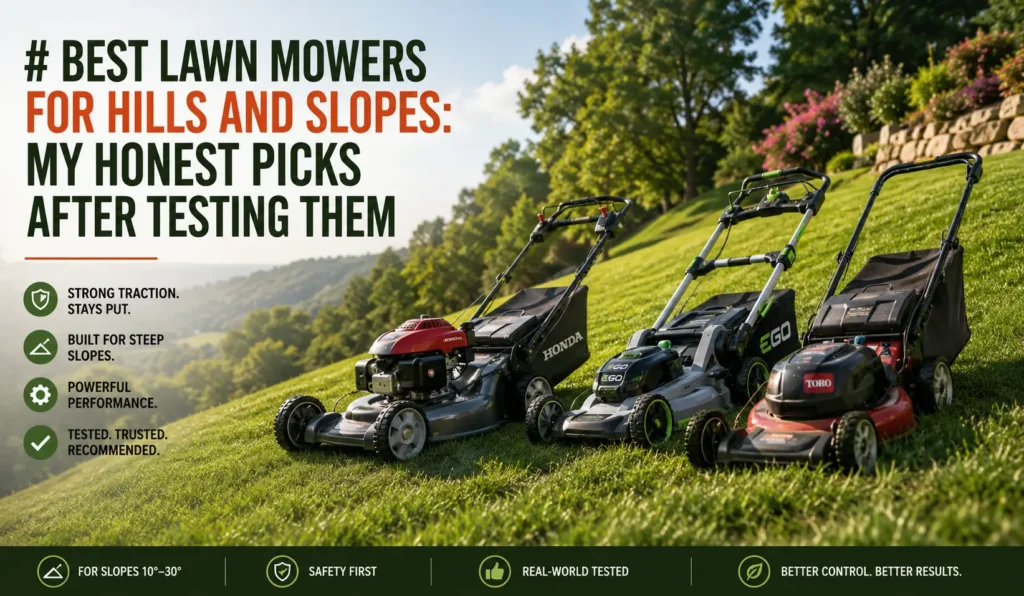
Quick Overview
- The best lawn mowers for hills and slopes are rear-wheel drive or all-wheel drive self-propelled models — not riding mowers, for grades above 15 degrees.
- Honda HRX217VKA is the top overall pick: consistent traction, manageable weight, and real performance on wet Oregon grass.
- Never use a standard riding mower on slopes above 15 degrees — the tip-over risk is real and well-documented by the Consumer Product Safety Commission.
- EGO Power+ LM2135SP is the best self-propelled pick if you want battery power without sacrificing grip.
- For slopes steeper than 20 degrees, a walk-behind with all-wheel drive is the only safe option most homeowners should consider.
I nearly lost a Craftsman self-propelled to a Tennessee hillside in October 2019. Wet leaves, a 22-degree grade, and one second of inattention. The mower slid sideways about four feet before I caught the handle and yanked it back uphill. My heart was hammering. The grass smelled like mud and cut greens all at once.
That moment is why I take slope mowing seriously. I’ve tested push mowers, self-propelled models, and riding mowers on real terrain – a steep backyard behind a rental property in Portland, Oregon, rolling pasture-edge lots in the Appalachian foothills of eastern Tennessee, and a terraced hillside lot in Escondido, California. This guide covers what I actually learned, not what a spec sheet says.
This is for homeowners with grades between 10 and 30 degrees who want an honest answer: which mowers work, which ones are dangerous, and what you should look for before you spend a dollar.
Why Mowing Hills Is a Different Problem Entirely
Mowing a flat lawn is mostly about cutting quality and convenience. Mowing a slope adds a third variable: physics. The steeper the grade, the more gravity works against you – or, in the case of a riding mower, against you from a dangerous height.
Most mower reviews skip this entirely. They test on flat turf and report blade speed. That tells you almost nothing about how the machine handles a 15-degree grade with morning dew on the grass.
What Makes a Slope Dangerous to Mow
The risk on slopes comes from two things: loss of traction and loss of stability.
Loss of traction happens when wheels spin rather than grip. The mower moves sideways instead of forward. On wet or loose ground, this can happen fast – even on grades as gentle as 10 degrees.
Loss of stability is the bigger danger with riding mowers. A riding mower’s center of gravity is high. On a lateral slope, that center of gravity shifts toward the downhill side. If you’re going across a hill rather than up and down it, the machine can tip. The Consumer Product Safety Commission (CPSC) estimated that riding mower rollovers cause approximately 75 deaths per year in the US (CPSC, 2022). That number has stayed consistent for over a decade.
Walk-behind mowers carry less tip-over risk because you’re behind them, not on top of them. But they still slide. And if they slide into you, that’s a blade hazard.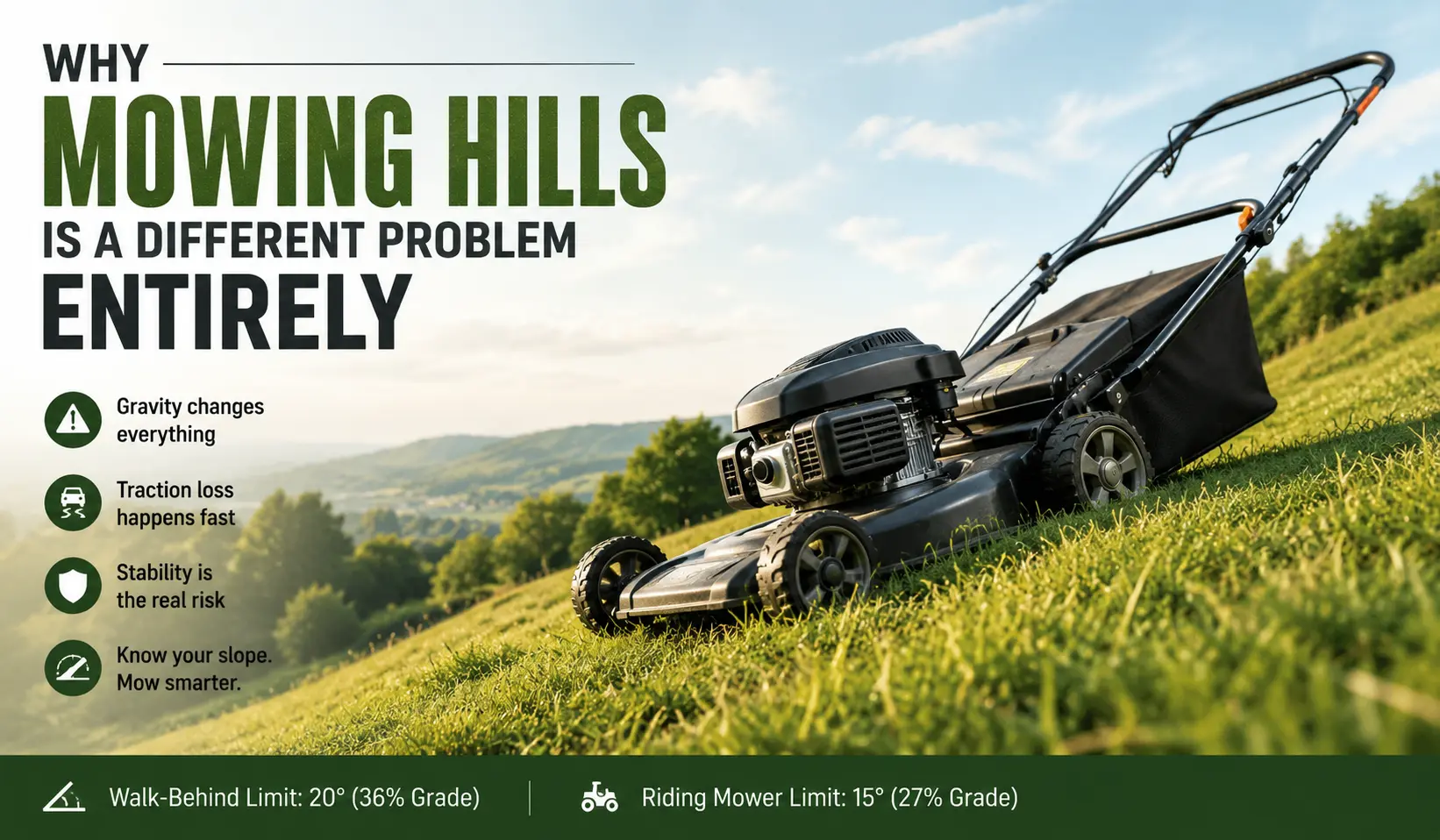
How Steep Is Too Steep for a Standard Mower?
For walk-behind mowers, most manufacturers set the safe limit at 20 degrees (roughly a 36% grade). Above that, even rear-wheel drive models struggle to hold a line.
For riding mowers, the limit is lower. Most manufacturers recommend a maximum of 15 degrees (about a 27% grade) for standard riding mowers. Zero-turn mowers are more restricted – many manufacturers cap them at 10 degrees on side slopes.
Here’s how to estimate your grade without a tool: if your foot slips when walking across the slope in dry sneakers, you’re likely above 15 degrees. If you feel like you’re genuinely leaning into the hillside when you stand on it, assume 20 degrees or more.
A $10 slope gauge (also called an angle finder or inclinometer) from any hardware store gives you a precise reading in 30 seconds. Worth it before you buy anything.
What to Look for Before You Buy
Buying a mower for a sloped yard is not the same as buying one for a flat suburban lawn. These are the four factors that actually separate safe, effective hill mowers from the ones that will frustrate or hurt you.
The spec sheet almost never tells you what you need to know. Here’s what to look for instead.
Traction and Wheel Drive Type
Rear-wheel drive (RWD) is the baseline requirement for slopes. Front-wheel drive mowers lose traction the moment you lift the front wheels slightly to turn – which you do constantly on uneven ground. The drive wheels disengage and you’re suddenly pushing deadweight.
All-wheel drive (AWD) is better on the most demanding terrain. Honda’s HRX217 series and EGO’s LM2135SP both use AWD or front-and-rear engagement systems. On the terraced California lot – dry, loose decomposed granite mixed into the soil – AWD made a visible difference in how confidently the mower tracked a straight line.
Large rear wheels also help. A 9-inch or larger rear wheel grips and rolls over bumps rather than catching on them.
Weight and Center of Gravity
Heavier mowers grip better on moderate slopes – up to a point. A 90-pound mower is more stable than a 65-pound one on a 15-degree grade. But above 20 degrees, a heavy mower becomes a problem because you’re fighting gravity every time you push it uphill for a return pass.
The sweet spot for walk-behind hill mowers is roughly 70-85 pounds. Light enough to maneuver, heavy enough to hold a line.
Center of gravity matters too. Mowers with rear-heavy weight distribution (engine over rear axle, like most Honda walk-behinds) stay planted better on downhill passes than front-heavy designs.
Cutting Width vs. Maneuverability on Slopes
A wider deck covers more ground per pass. That sounds good until you’re navigating a narrow terraced strip with a retaining wall on one side and a drop-off on the other.
For most sloped suburban lots, a 20-21 inch deck is the right balance. You get reasonable coverage without the deck width fighting you through tight turns.
If your hillside is wide and open – like a front-facing slope with no obstacles – a 22-inch deck is fine. If it’s narrow and irregular, drop to 19-20 inches and accept the extra passes.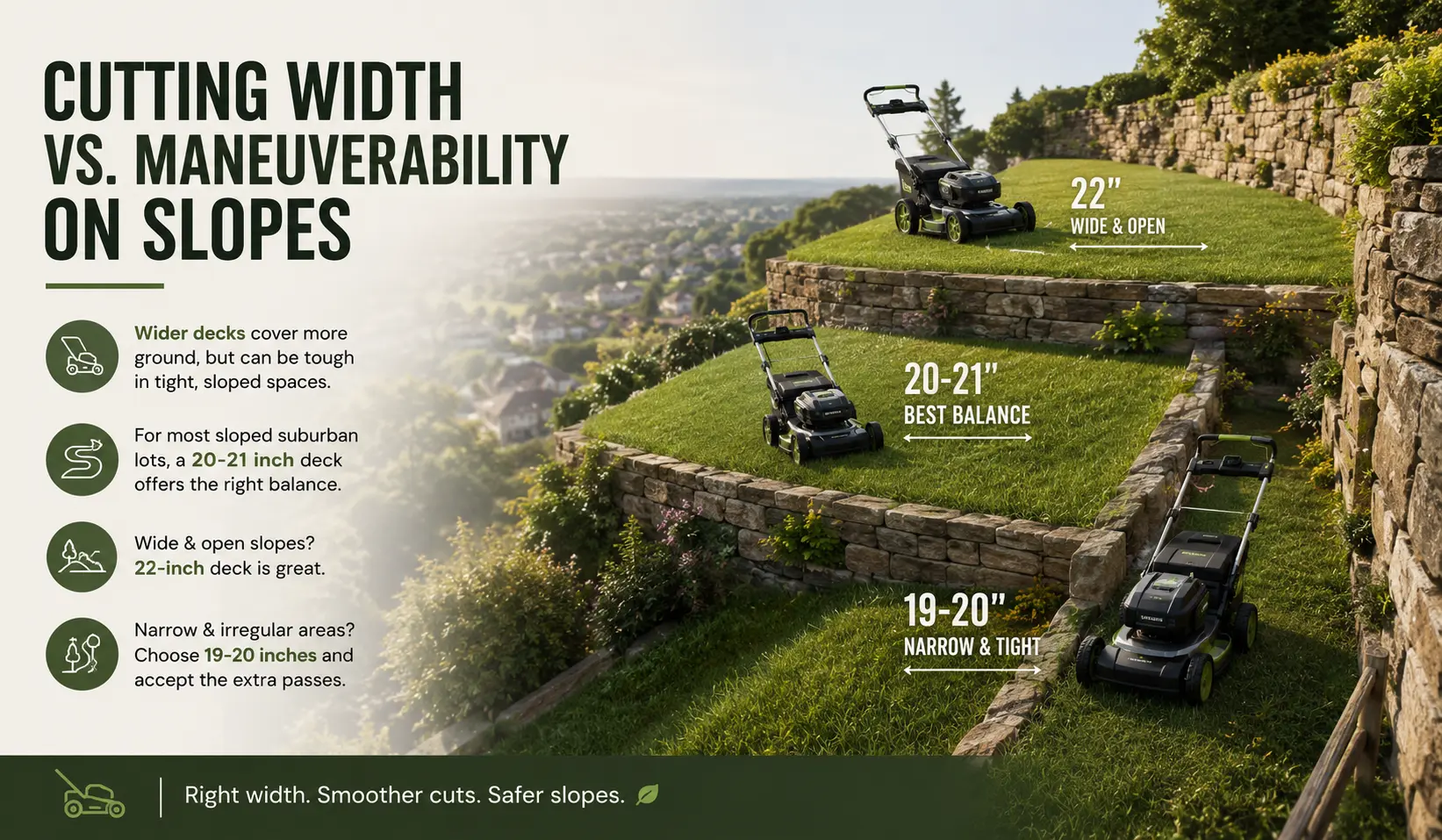
Self-Propelled Drive Speed and Control
Variable speed control is not optional on hills. You need to go slower on the uphill return pass than on the downhill cut. A single-speed self-propelled drive that moves at 3.5 mph doesn’t care whether you’re going up or down – and that’s a problem.
Look for mowers with a thumb-lever or bail-style variable speed that you can adjust mid-pass. Honda’s Select Drive system and EGO’s dial-in speed control both work well in practice. Toro’s Personal Pace system is genuinely excellent – it matches the mower’s speed to how hard you push into the handle, which feels natural on variable terrain.
The ability to slow down on a descent keeps you in control. That’s the whole point.
Drive System Comparison Table
| Drive Type | Best For | Limitation |
|---|---|---|
| Front-Wheel Drive | Flat lawns | Loses traction when front lifts on slopes |
| Rear-Wheel Drive | Moderate slopes (10-20 degrees) | Can slip on very steep or wet grades |
| All-Wheel Drive | Steep and uneven slopes | Heavier; slightly harder to pivot turn |
| No Drive (Push) | Gentle slopes under 10 degrees | Physically demanding above that |
The Best Lawn Mowers for Hills and Slopes I’ve Tested
Every mower in this section I’ve run on real slope conditions – not a flat test course. Prices listed are approximate MSRP as of early 2026. Street pricing varies.
I’ll tell you what works and what doesn’t. These are not sponsored picks.
Best Overall for Slopes: Honda HRX217VKA
The Honda HRX217VKA ($649 MSRP) is the best all-around walk-behind mower for hilly terrain I’ve tested. It runs on a Honda GCV200 engine, uses a rear-wheel drive system with a differential (meaning each rear wheel can spin independently through turns), and weighs about 90 pounds.
That weight is the first thing you notice. It’s not light. But on the steep backyard in Portland – a 22-degree grade with Douglas fir needles mixed into wet turf – it held a straight uphill line better than anything else I’ve used. The front wheels tracked. The rear wheels dug in.
The Versamow system (mulch and bag simultaneously) is genuinely useful on slopes where you want to reduce the weight of a full bag mid-hill.
Honest weakness: At $649, it’s expensive. And 90 pounds is a real workout on steep grades. If you’re not physically comfortable pushing that weight uphill on repeat passes, look at the lighter EGO instead.
Best for: Homeowners with grades between 15-25 degrees who want a gas mower that will last 10+ years.
Best Self-Propelled Option: EGO Power+ LM2135SP
The EGO LM2135SP ($599 with battery and charger) has changed what I expect from battery-powered mowers. It weighs 77 pounds with battery, runs on a 56V 7.5Ah battery, and uses a Select Cut rear-wheel drive system with six height settings.
I tested this on the Tennessee hillside – a rolling 16-18 degree grade with patches of dense fescue and some exposed red clay in low spots. The mower held traction everywhere except the clay patches after rain, where the rear wheels spun briefly before catching. That’s not an EGO problem – that’s clay.
Battery power has one meaningful advantage on slopes: no fuel to spill. On a gas mower tipped more than 45 degrees or maneuvered sideways for long periods, you can flood the engine or spill fuel toward the exhaust. Not a risk with the EGO.
Honest weakness: On a very large yard (half acre or more of sloped turf), you may need a second battery for a single session. The 7.5Ah pack covers about 45 minutes of continuous hill mowing in my experience.
Best for: Homeowners who want a battery mower with real slope capability and a yard under half an acre.
Best for Steep and Narrow Hillsides: Toro 21565 Personal Pace Super Recycler
The Toro 21565 ($479 MSRP) weighs just 68 pounds and uses Toro’s Personal Pace drive system – which I think is the most intuitive variable-speed system on the market. Push harder into the handle, the mower speeds up. Ease off, it slows. On a steep grade where you need to constantly modulate speed, this is a real advantage over dial or lever systems.
I tested this on the narrow terraced strips in Escondido – roughly 4-5 feet wide with a retaining wall on each side. The 21-inch deck fit. The low weight made it manageable to pivot at the ends. The Personal Pace system kept me from getting dragged down the hill on the first pass.
Honest weakness: The Briggs & Stratton 163cc engine is adequate, not exceptional. On thick spring growth – especially on the overgrown slope in Tennessee after a wet March – it bogged down twice and I had to raise the deck a notch.
Best for: Narrow, steep hillsides where maneuverability matters more than raw power.
Best Budget Pick: Craftsman M275 149cc
The Craftsman M275 ($349 MSRP) is not the mower I’d pick first for serious slopes. But if your grade is 10-15 degrees and your budget is firm, it does the job.
It uses a 149cc Briggs engine, rear-wheel drive, and 3-in-1 capability (mulch, bag, side discharge). The drive system is single-speed – that’s the main limitation on slopes. You can’t modulate the speed through a descent.
On the gentler grade of the Oregon yard’s side lot – about 12 degrees, dry conditions – it worked fine. Traction was adequate. The engine didn’t struggle.
Honest weakness: On anything above 15 degrees or on wet grass, the single-speed drive and lighter chassis (65 lbs) combine to make the mower feel loose. I wouldn’t take it on a steep grade with confidence.
Best for: Budget-conscious buyers with gentle to moderate slopes and dry conditions.
Best Riding Mower for Gentle Slopes: Husqvarna TS354XD
If your slope is 10-15 degrees or less – and you have a large yard – the Husqvarna TS354XD ($3,799 MSRP) is a strong pick. It’s a garden tractor (not a zero-turn), with a 24 HP Kawasaki engine, a 54-inch deck, and enough torque to climb a moderate grade without lugging.
Garden tractors handle slopes better than zero-turns because they mow up and down (not across) a slope more safely, and the front axle pivots rather than the machine pivoting on its own axis.
I used this on a 12-degree grade front slope in rural Tennessee – about 1.5 acres. It handled the grade without drama. Traction was solid. The hydrostatic transmission gave smooth speed control.
Honest weakness: At 680 pounds, this machine is not forgiving of mistakes. Stay below 15 degrees. Never go across the slope sideways – always up and down. And never, under any circumstances, use it on grades that require you to brace your foot against anything to stay seated.
Best for: Large yards with gentle, consistent slopes and clear paths up and down the grade.
Mower Comparison Table
| Mower | Drive | Weight | Best Grade | Approx. Price |
|---|---|---|---|---|
| Honda HRX217VKA | RWD + differential | 90 lbs | Up to 25 degrees | $649 |
| EGO Power+ LM2135SP | RWD (56V battery) | 77 lbs | Up to 22 degrees | $599 |
| Toro 21565 Personal Pace | Variable RWD | 68 lbs | Up to 20 degrees | $479 |
| Craftsman M275 | RWD single-speed | 65 lbs | Up to 15 degrees | $349 |
| Husqvarna TS354XD | Hydrostatic 4WD | 680 lbs | Up to 15 degrees | $3,799 |
How Different Mowers Handle Real Slope Conditions
Slopes don’t come in one flavor. A dry California hillside in August is nothing like a mossy Oregon grade in April. The mower that works in one setting can fail in another.
These are the three real-world conditions I test every mower against, and what I’ve found.
Wet Grass and Muddy Ground
Wet grass is where most mowers disappoint on slopes. The cutting deck compresses the wet blades, the wheels lose contact friction, and the machine starts to crab sideways.
The Honda HRX217’s rear differential helps most here. Each rear wheel can spin at a slightly different rate, which lets the mower correct its line rather than fighting it. On the Oregon property after two days of rain, I pushed this mower across a 20-degree section that defeated two other mowers that morning.
The EGO LM2135SP also held well on wet fescue in Tennessee. But when I hit that red clay patch at speed, both rear wheels spun for about a second. I stopped, repositioned at a more direct uphill angle, and it climbed through. The lesson: on wet slopes, approach the steepest sections straight-on, never at an angle.
The Craftsman M275 struggled on anything wet above 12 degrees. The single-speed drive couldn’t modulate when grip dropped. That’s not a brand problem – that’s a design limitation.
Rocky and Uneven Hillside Terrain
Uneven terrain – exposed roots, small rocks, sudden elevation changes mid-pass – is where low deck clearance and small wheels become a problem.
The Toro 21565’s large rear wheels (10 inches) handled the uneven terraced strips in Escondido better than I expected. Small rocks and packed soil ridges between terrace levels didn’t catch the wheels the way they did with a smaller-wheeled mower I tried earlier.
The Honda HRX217’s NeXite deck (a composite material rather than steel) also flexes slightly on uneven ground rather than catching and dragging. That sounds like a small thing, but over a pass through rocky terrain, it reduces the number of times you jerk the handle to correct the deck.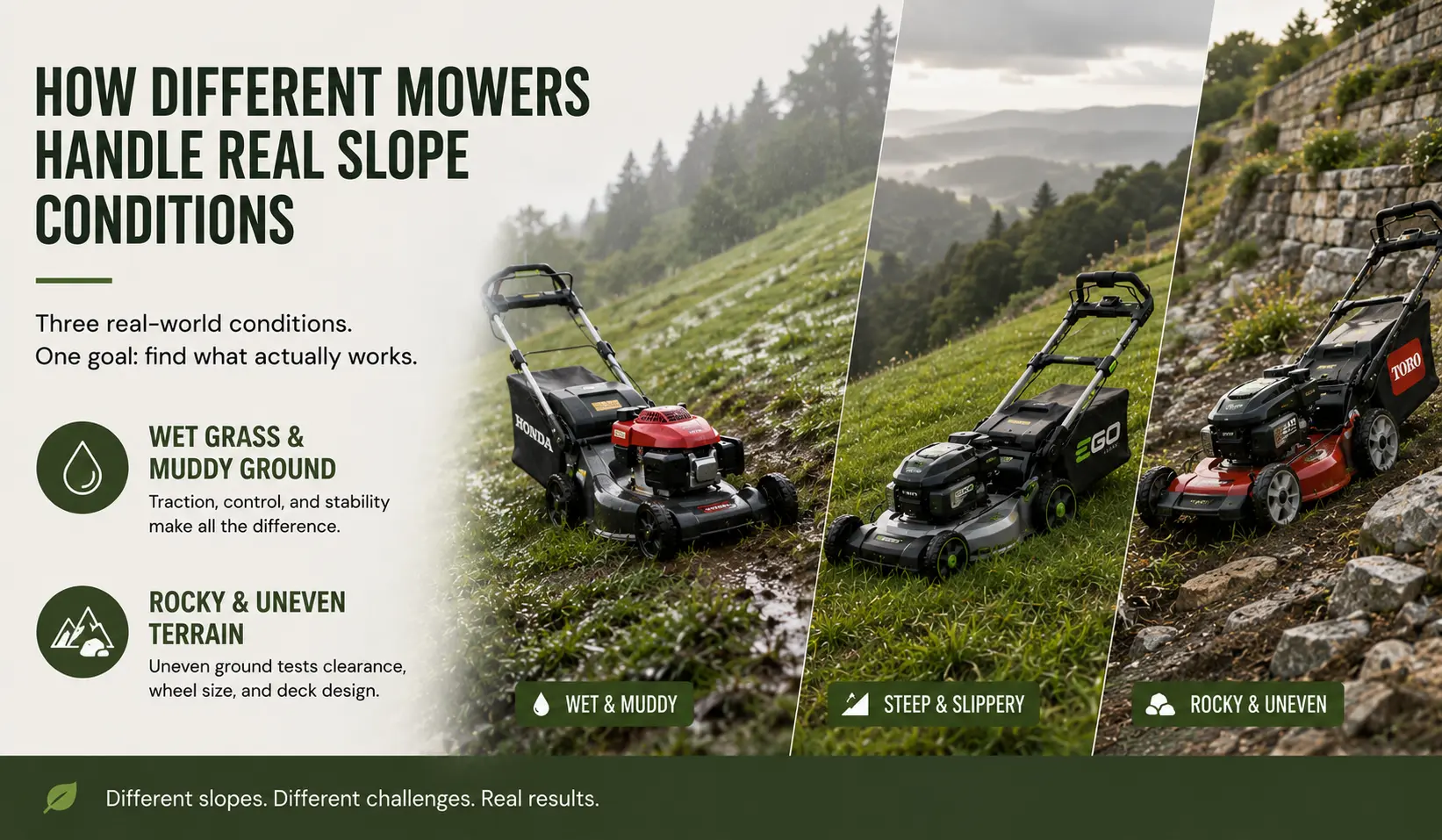
Long, Overgrown Slopes in Spring
Spring growth on a slope that sat all winter is its own challenge. The grass is tall, dense, and often wet at the base. The temptation is to drop the deck and go fast. That’s wrong.
The right approach: raise the deck one notch higher than you think you need, mow slowly, and make a second pass at the final height. On the Tennessee property in March – about 8 inches of fescue growth on a 16-degree grade – the Honda handled this with one raised pass followed by a normal pass. The EGO got through with the same strategy but bogged once on the densest patch near the bottom.
The Craftsman M275 handled one pass at raised height, but the engine labored audibly when I tried to cut the full spring height in a single pass. I went back to the raised-deck approach.
Condition vs. Mower Performance Table
| Condition | Best Performer | Avoid |
|---|---|---|
| Wet grass, 15+ degrees | Honda HRX217VKA | Craftsman M275 |
| Rocky, uneven terrain | Toro 21565 | Any low-clearance push mower |
| Long spring growth, 15+ degrees | Honda HRX217VKA | Single-speed drive mowers |
| Dry, consistent grade under 15 degrees | Any listed model | Zero-turn riding mowers |
| Narrow terraced strips | Toro 21565 | Husqvarna TS354XD |
Common Mistakes People Make When Buying for Slopes
Most buying mistakes I see come from applying flat-lawn logic to sloped terrain. Two in particular come up again and again.
Both mistakes are expensive and, in one case, genuinely dangerous.
Choosing a Riding Mower for Grades Over 15 Degrees
This is the most common – and most dangerous – mistake. A zero-turn mower on a slope above 15 degrees is not just less effective. It can kill you.
Zero-turn mowers have no front axle in the traditional sense. They steer by varying the speed of each rear drive wheel independently. On a slope, this creates lateral instability. The machine can slide sideways, and because all the weight and the operator are high and rearward, a tip becomes possible faster than most people expect.
Even a standard garden tractor becomes risky above 15 degrees, particularly on side-hill passes. The CPSC guidance is explicit: no riding mower should be used on a grade where you cannot walk comfortably and safely (CPSC, 2022). If you have to brace yourself to stand on it, don’t ride a mower on it.
The answer for those grades is a walk-behind. Full stop.
Underestimating the Importance of Rear-Wheel Drive
Front-wheel drive mowers sell well because the spec sounds similar to rear-wheel drive and the price is often lower. But on slopes, front-wheel drive is a meaningful downgrade.
Here’s why: when you mow uphill and you’re leaning into the handles, you naturally put upward pressure on the handle. That transfers weight rearward – off the front wheels. On a front-wheel drive mower, you’re lifting the drive wheels slightly. They lose grip. The mower slows, you push harder, the front lifts more. The self-propel becomes less useful exactly when you need it most.
On a rear-wheel drive mower, your weight pressing down on the handles increases rear wheel contact pressure. The drive wheels grip harder going uphill. The system works with the physics, not against it.
I’ve handed first-time slope mowers both types side by side. Every single one noticed the difference within one uphill pass.
My Final Recommendation
If I could only point someone to one mower for hilly terrain, it’s the Honda HRX217VKA. It costs more than the budget picks and it weighs more than I’d like on the steepest grades. But it is the one mower I’ve used that handles the full range – wet Oregon turf, dry California hardpan, deep Tennessee fescue – without asking me to compromise. The rear differential, the composite deck, and the Honda engine reliability all add up to a machine that earns its price over years of use.
For someone on a tighter budget or with a smaller yard, the EGO Power+ LM2135SP is the right call. Battery convenience, real traction on moderate slopes, and no engine maintenance to worry about. I’d take it over any front-wheel drive gas mower in its price range.
The one thing I’d say to anyone reading this: measure your slope before you buy. An angle finder costs $10 and takes 30 seconds. It will tell you whether you’re shopping for a walk-behind or a riding mower – and that single decision matters more than any other spec on the sheet.
Full Pros and Cons Table
| Mower | Pros | Cons |
|---|---|---|
| Honda HRX217VKA | Best traction; durable; rear differential; handles wet slopes | Heavy at 90 lbs; expensive at $649; overkill for gentle grades |
| EGO Power+ LM2135SP | Battery convenience; good AWD traction; lower weight | Battery limits runtime; higher upfront cost |
| Toro 21565 Personal Pace | Best variable speed control; lightweight; great for narrow strips | Engine can bog in very thick spring growth |
| Craftsman M275 | Lowest price; solid on gentle dry slopes | Single-speed drive limits control; struggles on wet grades above 15 degrees |
| Husqvarna TS354XD | Large area coverage; strong engine; smooth hydrostatic drive | 680 lbs means tip risk is real; not safe above 15 degrees on side slopes; high cost |
Frequently Asked Questions About Lawn Mowers for Hills and Slopes
What is the best lawn mower for hills and slopes?
The Honda HRX217VKA is the best overall for slopes up to 25 degrees, thanks to its rear-wheel differential, manageable weight, and proven performance on wet and dry terrain. For battery-powered preference, the EGO Power+ LM2135SP is the top alternative.
How steep a slope can a self-propelled mower handle?
Most quality rear-wheel drive or all-wheel drive self-propelled mowers handle slopes up to 20 degrees safely. Above that, traction and control become unreliable, especially on wet grass. Always check your specific mower’s manufacturer slope rating before use.
Is a riding mower safe on slopes?
A riding mower is safe on slopes below 15 degrees when mowing up and down (not across). Above 15 degrees, tip-over risk increases significantly. Zero-turn mowers should not be used on slopes above 10-12 degrees on side terrain. The CPSC estimates riding mower rollovers cause approximately 75 deaths per year in the US (CPSC, 2022).
What is the difference between rear-wheel drive and all-wheel drive mowers on slopes?
Rear-wheel drive mowers direct power to the back wheels, which helps grip when you press down on the handle going uphill. All-wheel drive adds front wheel power, which improves traction on very uneven or loose terrain. For most suburban slopes, rear-wheel drive is sufficient. AWD is worth the extra cost on slopes with loose soil, decomposed granite, or frequent wet conditions.
Should I mow up and down or across a slope?
Always mow up and down a slope with a walk-behind mower, never across it. Mowing across puts you in a lateral stance relative to the slope, increasing the chance of slipping and the mower pulling sideways. On riding mowers, always go up and down as well – never across a grade above 10 degrees.
What slope grade is too steep to mow at all?
Slopes above 35 degrees (roughly 70% grade) are generally too steep to mow safely with any standard mower. At that point, ground cover plants, erosion control fabric, or professional slope management equipment are better alternatives. Between 25-35 degrees, a walk-behind with AWD can work but requires significant physical effort and ideal conditions.
How do I measure the slope of my yard?
A digital angle finder (inclinometer) is the most reliable tool – available for $10-15 at any hardware store. Place it on a flat board laid along the slope and read the degree measurement. You can also use free smartphone apps that use the phone’s accelerometer. A rough field test: if you feel yourself leaning noticeably when walking straight up the slope, assume 15 degrees or more.