
Quick Overview
- Most startup smoke is white or gray and comes from overfilled oil or condensation burning off – not an emergency.
- Blue smoke means the engine is burning oil. Black smoke means it’s burning too much fuel.
- Check your oil level and air filter first. Those two things cause most smoking mowers I’ve seen.
- Worn piston rings cause ongoing blue smoke and usually mean a repair shop visit, not a DIY fix.
- Climate matters. Humid mornings in Florida, dusty summers in Arizona, and cold Midwest spring starts each smoke a little differently.
It was a Saturday morning in my own backyard, coffee still in hand, when I gave the pull cord one good yank and jumped back like I’d stepped on a snake. A cloud of gray smoke rolled out from under the deck. My neighbor, mowing his own lawn two yards over, just laughed and yelled, “Overfilled it again, didn’t you?” He was right.
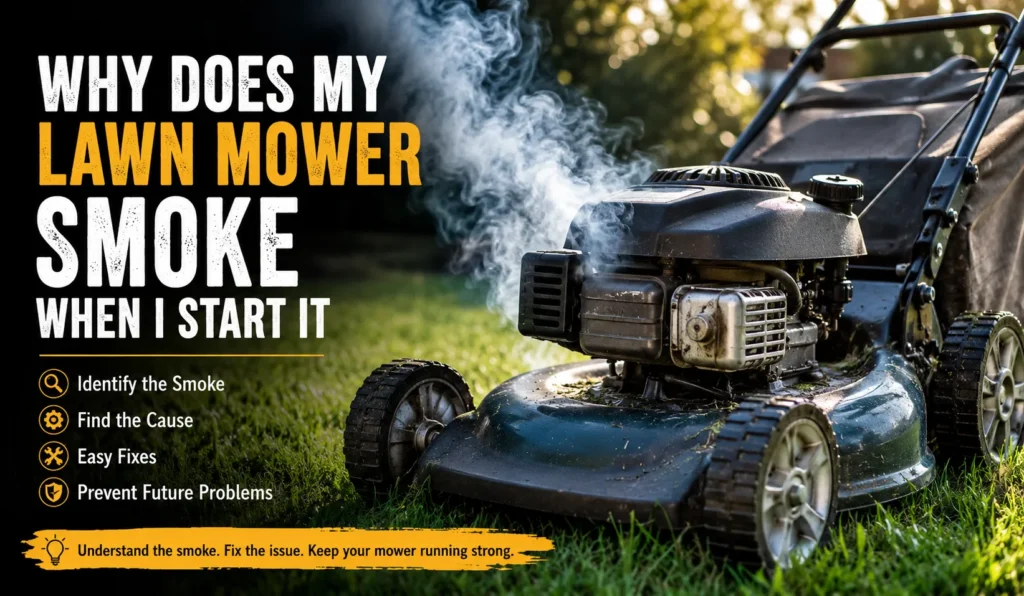
If you’re asking why does my lawn mower smoke when I start it, you’re probably standing in your own yard right now, staring at your machine, wondering if you just broke it. Take a breath. In most cases, you didn’t.
I’ve spent years pulling apart small engines – Toro, Craftsman, Honda, Briggs & Stratton, you name it – in humid Florida garages, dusty Arizona sheds, and cold Minnesota driveways. This guide is for anyone who owns a mower and just wants a straight answer, not a sales pitch.
Why Mower Smoke Isn’t Always a Bad Sign
Smoke on startup usually means something simple is off, not that your engine is dying. Color tells you almost everything. Learn to read it before you panic.
Most small engine smoke falls into three categories: white, blue, or black. Each one points to a different cause, and only one of them is genuinely serious.
White Smoke vs. Blue Smoke vs. Black Smoke
White smoke is often just water vapor. It happens on cool mornings when condensation sits inside the engine or muffler overnight. It usually clears up in under a minute.
Blue smoke means oil is burning inside the combustion chamber. That’s the one to take seriously, especially if it doesn’t stop after the first minute of running.
Black smoke means the engine is running rich – too much fuel, not enough air. A clogged air filter or a stuck choke are the usual suspects.
| Smoke Color | Likely Cause | Should You Worry? |
|---|---|---|
| White/gray | Condensation or light oil residue burning off | Usually not |
| Blue | Oil entering the combustion chamber | Yes, if it continues past startup |
| Black | Fuel-to-air ratio is off | Sometimes – check air filter and choke |
Is It Actually Smoke, or Just Dust and Steam?
Sometimes what looks like smoke is dust kicked up from dry grass clippings sitting on a hot muffler. I saw this constantly in Phoenix, where dust from bone-dry lawns settles on every surface of the mower.
Steam is another common mix-up. If you mowed wet grass the day before, moisture trapped near the engine can look exactly like smoke when it heats up again.
A quick way to check: smell it. Burning oil has a sharp, acrid smell. Steam and dust don’t smell like much of anything.
Common Reasons Your Mower Smokes on Startup
Five causes account for almost every smoking mower I’ve diagnosed. Overfilled oil tops the list, followed by bad fuel, a dirty air filter, a tilted mower, and worn internal parts.
Let’s go through each one, plain and simple.
Overfilled Oil
This is the most common cause I’ve seen, hands down. Too much oil in the crankcase gets churned up by the crankshaft and pushed into the combustion chamber, where it burns and smokes.
The fix is easy. Pull the dipstick, check the level, and drain any excess with a turkey baster or oil extractor pump. Most small engines hold somewhere between 15 and 20 ounces of oil, depending on the model.
One real limitation here: if you’ve been overfilling for months, oil may have already fouled your spark plug. You might need to replace that too.
Old or Wrong Fuel
Gas that’s sat in the tank all winter breaks down and gums up the carburetor. I’ve pulled apart carburetors in Minnesota that looked like they were coated in varnish after just one season of old fuel sitting inside.
Wrong fuel type causes problems too. Using fuel with more than 10% ethanol in an older small engine can lead to rough starts and extra smoke.
Fresh fuel, stored no longer than 30 days, solves this in most cases. A fuel stabilizer helps if you’re storing the mower over winter.
Dirty Air Filter
A clogged air filter starves the engine of air, forcing it to run rich on fuel. That extra fuel burns dirty and produces black smoke.
Foam filters need a wash in soapy water every season. Paper filters just need swapping out – they’re cheap, usually under ten dollars.
I’ve seen this exact problem on Craftsman mowers left in dusty Arizona sheds. The filter was so packed with dust it looked solid.
Tilted Mower or Carburetor Flooding
Tipping a mower the wrong way to change the oil or blade lets oil leak into the air filter or cylinder. When you start it back up, that oil burns off as smoke.
Always tip a mower so the air filter and carburetor stay on top, spark plug side up. Check your owner’s manual – Honda and Toro often specify the exact tilt direction.
Flooding can also happen from pumping the primer bulb too many times before a cold start. Extra fuel pools in the carburetor and smokes on ignition.
Worn Piston Rings or Seals
This is the one that worries people, and honestly, it should get your attention. Worn piston rings let oil slip past into the combustion chamber constantly, not just on startup.
I diagnosed this on a 12-year-old Briggs & Stratton engine that smoked blue every single time it ran, not just at startup. The owner had been topping off oil every week without asking why it kept disappearing.
Real limitation: piston ring replacement often costs more than a new mower for lower-end models. It’s usually only worth fixing on higher-end engines or ones with sentimental value.
Comparison Table for Every Smoke Cause
| Cause | Smoke Color | DIY Fix? | Cost to Fix |
|---|---|---|---|
| Overfilled oil | White/blue | Yes | Free (just drain excess) |
| Old/wrong fuel | Black/white | Yes | $10-15 for fresh fuel |
| Dirty air filter | Black | Yes | $5-15 for new filter |
| Tilted mower/flooding | White/blue | Yes | Free (wait and dry out) |
| Worn piston rings | Blue (constant) | No | $150+ or replace mower |
How to Diagnose the Problem Yourself
Start with the simplest explanation first: oil level, then fuel, then air filter. Work your way up to the more serious causes only if the easy fixes don’t stop the smoke.
Here’s how I’d walk a friend through it, step by step.
Best for First-Time Owners
If this is your first mower, start with the dipstick. Pull it, wipe it, reinsert, and check the level against the “full” line. This alone fixes a surprising number of smoking mowers.
Next, look at the air filter. If it’s dark gray or caked in debris, that’s your answer.
Best for Older Mowers
For mowers over eight years old, pay attention to whether the smoke happens only at startup or continues the whole time you’re mowing. Continuous blue smoke on an older engine usually points to worn rings or valve seals.
Run the mower for five minutes on a flat surface and watch the exhaust the entire time. Don’t just glance at it once and walk away.
Best Quick Fixes You Can Try Today
- Drain excess oil if the dipstick reads above the fill line.
- Replace the air filter if it looks dark, cracked, or clogged.
- Drain old fuel and refill with fresh gas if the mower sat all winter.
- Let a flooded carburetor sit for 10 minutes before trying to restart.
Best Time to Call a Repair Shop
Call a shop if smoke continues past the first two minutes of running, if it smells sharply of burning oil the entire time, or if you’ve already checked oil, fuel, and the air filter with no change.
I’ll be honest: most small engine shops charge a flat diagnostic fee, often $40 to $60, just to look at it. That’s worth it if you’re not comfortable pulling the engine apart yourself.
Best Preventive Habits
Change your oil once a season, or every 25 hours of use. Store the mower with fresh fuel or a stabilizer added. Clean the air filter every few mows if you’re in a dusty area.
Comparison Table for Every Diagnosis Method
| Method | Best For | Time Needed | Tools Required |
|---|---|---|---|
| Dipstick check | First-time owners | 2 minutes | None |
| Air filter inspection | All owners | 5 minutes | None |
| Fresh fuel test | Mowers stored over winter | 10 minutes | Fuel can |
| 5-minute run test | Older mowers | 5 minutes | None |
| Professional diagnostic | Persistent or unclear smoke | 1-2 days | Repair shop visit |
How Smoke Issues Show Up in Real Conditions
Climate changes how and why your mower smokes. Humidity, dust, and cold mornings each create a slightly different pattern, and knowing your local quirks saves guesswork.
Hot and Humid Climates (Florida, Texas, Southeast)
In Florida, I saw white steam-like smoke almost every humid morning, especially after overnight rain. Grass clippings hold moisture, and that moisture works its way into the mower deck and muffler area.
Humidity also speeds up fuel degradation. Gas left in a Florida garage over summer breaks down faster than gas stored in a dry Arizona shed.
Dry and Dusty Terrain (Southwest, Arizona)
Phoenix summers bring a different problem: dust. Dry, brittle grass kicks up fine particles that clog air filters fast, sometimes within a few mowing sessions.
Black smoke from a starved air filter was the most common complaint I heard in Arizona. The fix was almost always the same – swap or clean the filter.
Cool, Damp Mornings (Midwest, Northeast)
A cool Minnesota spring morning brings condensation-driven white smoke almost every time. Cold engines take longer to warm up, and moisture sitting in the muffler burns off slower in lower temperatures.
Cold starts in the Midwest also mean more choke use, which can flood the carburetor if you’re not careful with the primer bulb.
Comparison Table
| Climate | Common Smoke Type | Main Cause | Local Fix Priority |
|---|---|---|---|
| Humid Southeast (FL, TX) | White/steam | Moisture in clippings and muffler | Check fuel freshness |
| Dry Southwest (AZ, NV) | Black | Dust-clogged air filter | Clean/replace filter often |
| Cool Midwest/Northeast | White | Condensation, cold starts | Go easy on the primer bulb |
Common Mistakes People Make When Troubleshooting
Two mistakes come up again and again, no matter what state I’m working in. Both are easy to avoid once you know what to watch for.
Overfilling the Oil “Just to Be Safe”
I get it. More oil feels like more protection. But overfilling pushes oil past the rings and into the cylinder, where it burns and smokes.
Use the dipstick every time, not a guess. It takes ten seconds and saves you a smoky startup.
Ignoring Smoke Because “It Always Does That”
I’ve heard this line more times than I can count. Just because a mower has smoked for years doesn’t mean it’s fine. Constant blue smoke usually means the rings are wearing down further every season.
Ignoring it doesn’t stop the problem. It just delays the repair and often makes it more expensive.
Quick Fixes vs. When to See a Professional
| Situation | Quick Fix | See a Professional |
|---|---|---|
| Smoke clears in under 2 minutes | Yes – likely condensation | No |
| Smoke only after tilting the mower | Yes – let it sit and dry | No |
| Black smoke, dirty filter visible | Yes – replace filter | No |
| Blue smoke, continues past 2 minutes | No | Yes |
| Smoke plus oil disappearing weekly | No | Yes |
| Engine runs rough alongside smoke | Maybe – check fuel first | Yes, if fuel change doesn’t help |
My Final Take
After years of chasing down smoking mowers in three very different climates, here’s what I’ve learned: most smoke is nothing to panic about. Check the oil level first. It solves more problems than any other single step.
If the smoke sticks around past a couple of minutes, or if it’s blue and keeps coming back mow after mow, don’t keep topping off oil and hoping it goes away. That’s usually your engine telling you the rings are wearing out, and no amount of ignoring it fixes that.
I’ve replaced plenty of $30 air filters that solved a smoking mower in five minutes. I’ve also told a few owners their 15-year-old mower wasn’t worth a $200 ring replacement. Both are honest answers. Your mower will usually tell you which one applies, if you just watch the smoke and listen to the engine for a minute before you decide what to do.
Frequently Asked Questions About Mower Smoke on Startup
Why does my lawn mower smoke when I start it but then stop?
This is usually condensation or slightly overfilled oil burning off. If it clears within the first minute or two of running, it’s rarely a serious issue.
Is blue smoke from a lawn mower dangerous?
Blue smoke itself isn’t dangerous to be around briefly, but it signals oil is burning inside the engine. Left unaddressed, it usually means increasing engine wear over time.
Can a dirty air filter really cause a mower to smoke?
Yes. A clogged air filter forces the engine to run on too much fuel relative to air, which produces black smoke. Cleaning or replacing the filter often fixes it immediately.
How much oil should a lawn mower engine hold?
Most residential mower engines hold between 15 and 20 ounces of oil, but check your owner’s manual for the exact amount, since it varies by engine size and brand.
Should I keep running my mower if it’s smoking?
For light white smoke that clears quickly, running it is usually fine. For continuous blue or black smoke, stop the engine and check oil level, fuel, and air filter before continuing.
Why does my mower only smoke in cold weather?
Cold mornings cause more condensation buildup inside the muffler and engine, which burns off as white smoke during the first minute or two of running. It usually isn’t a mechanical problem.