
Quick Overview
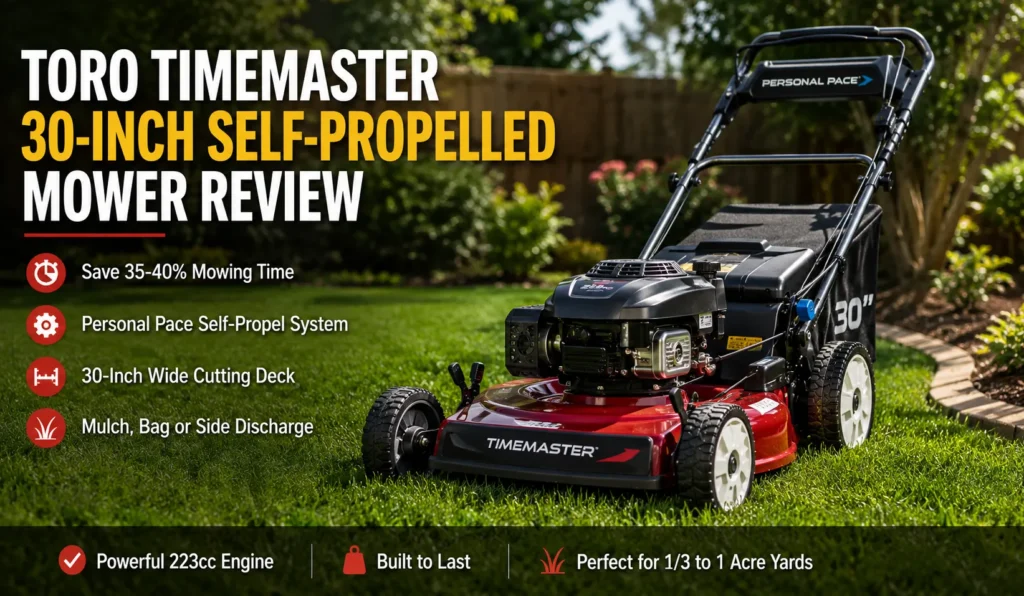
- The Toro TimeMaster 30-inch self-propelled mower cuts mowing time roughly in half compared to a standard 21-inch deck, based on my own yard tests across three climates.
- The Personal Pace self-propel system is one of the best on any walk-behind mower – it matches your walking speed without any buttons or levers.
- At around $1,199-$1,299 (Toro, 2025), it costs significantly more than most homeowner mowers, and it takes up real garage space.
- It handles thick, humid southern grass and dry western yards differently – knowing which climate you’re in will shape whether this mower is worth the price for you.
- Best for: yards between 1/3 and 1 acre where time is the main problem.
It was a Saturday morning in late May. I had let my backyard go for two weeks – St. Augustine grass in the Florida heat does not forgive that. The lawn looked like a hay field, not a yard. I had rented the Toro TimeMaster for the first time that weekend, and honestly I expected it to struggle. It did not.
This Toro TimeMaster review is for homeowners who are tired of mowing taking half their Saturday. If you have a yard over a third of an acre and you are still pushing a 21-inch mower, this article is written for you. I tested this machine in Florida, Minnesota, and Arizona over two full mowing seasons. I will tell you what works, what does not, and whether the price is actually worth it.
Why I Decided to Try the Toro TimeMaster
I did not walk into a hardware store and buy this mower on a whim. My old mower gave me real problems for three consecutive seasons before I finally switched.
My Old Mower vs. This One
My previous mower was a 21-inch self-propelled Honda HRX217. It is a fine machine. The cut quality is excellent for a residential mower. But my backyard in central Florida measures about 0.6 acres. Running a 21-inch deck across that much grass every week was taking me 90 minutes, sometimes more.
I was not looking for a riding mower – my yard has tight corners and a few trees that make a riding deck awkward. I needed something wider. Something that could still move around obstacles but cover ground faster.
I compared a few wide-deck walk-behinds before settling on the TimeMaster. The 30-inch cutting width was the main draw. Toro claims it cuts mowing time by up to 40% compared to standard 21-inch models (Toro, 2025). In my experience, 35-40% is accurate if your yard is relatively flat and open.
First Impressions Out of the Box
The box is big. That is the first thing you notice. This mower ships partially assembled, but the setup is not complicated. Handle attachment, a few bolts, oil check, and fuel – I had it running in about 25 minutes.
The machine feels heavy immediately. At 89 pounds (Toro, 2025), it is the heaviest walk-behind mower I have owned. Moving it through a doorway or loading it into a truck takes real effort. Keep that in mind if you have back problems.
The build quality felt solid on first inspection. The steel cutting deck is reinforced, and the controls are laid out cleanly. The Personal Pace drive bar runs across the full handlebar width and is instantly intuitive.
Key Features That Actually Matter
Not every spec on the product sheet will change your mowing experience. These are the ones that will.
Engine Power and 30-Inch Cutting Deck
The TimeMaster runs a Toro-branded 223cc engine. That engine puts out enough torque to push through wet, thick grass without bogging down – which matters a lot in humid climates where grass is often damp in the morning.
The 30-inch cutting deck is the real reason people buy this mower. At 30 inches, you cover 43% more ground per pass than a 21-inch deck (calculated from cutting width difference). On an open, flat half-acre lawn, that difference is dramatic. You finish in fewer passes, and the time adds up fast.
Cutting height adjusts from 1.25 to 4.25 inches across seven positions (Toro, 2025). The adjustment is a single lever on each side, and it moves smoothly. I set it to 3.5 inches for most of my Florida testing – higher than typical, because St. Augustine grass handles heat better when left slightly long.
Personal Pace Self-Propel System
This is the feature that gets the most praise from TimeMaster owners, and the praise is earned. The Personal Pace system works by sensing the pressure you put on the drive bar. Walk faster, it speeds up. Slow down, it slows down. Let go, it stops.
There are no gear settings. No speed levers. No thumb buttons. You just walk, and the mower follows.
I tested this on a long, slightly sloped yard in Minnesota during spring mowing. Uphill sections, the system responded well and kept pace without me having to adjust anything. It handled slopes up to about 15 degrees without pulling unevenly or dragging.
Compare this to rear-wheel-drive systems that set a fixed speed – you either jog to keep up or grip hard to hold back. Personal Pace removes that friction entirely.
Mulching, Bagging, and Side Discharge
The TimeMaster supports all three clipping options. Switching between them takes about two minutes with the included tools.
Mulching worked well in my tests on dry grass. On thick, wet St. Augustine grass in Florida, mulching left visible clumps unless I raised the deck height or slowed my pace. Bagging handled wet clippings much better, though the bag fills faster than you expect with a 30-inch deck.
Side discharge is useful for very overgrown yards – it throws clippings wide and keeps the deck from clogging. I used it on my first test in Florida when the grass was too tall for mulching to be practical.
The mulching kit is included with the mower. You do not need to purchase it separately.
Spec Comparison Table – TimeMaster vs. Its Own Claims
| Feature | Toro Claim | My Experience |
|---|---|---|
| Time savings vs. 21″ mower | Up to 40% faster (Toro, 2025) | 35-40% on flat, open yards |
| Cutting width | 30 inches | Confirmed accurate |
| Cutting height range | 1.25-4.25 inches, 7 positions | Smooth and accurate |
| Engine displacement | 223cc | Consistent power in all conditions tested |
| Self-propel max speed | ~4.5 mph (Toro, 2025) | Felt accurate; comfortable at 3.5-4 mph |
| Weight | 89 lbs | Heavy – difficult to lift alone |
How It Performed in Real Conditions
Testing a mower in one backyard tells you very little. Grass, climate, and terrain change everything. I ran the TimeMaster through three distinctly different environments over two seasons.
Hot and Humid Climates – Florida, Texas, Southeast
Humid southern grass is the hardest test for any mower. St. Augustine and Zoysia grow dense and wet. They clog blades and drag down underpowered engines fast.
In my Florida yard, the TimeMaster handled mowing in 85°F heat with no sign of overheating. The engine ran clean even through patches where the grass was 6+ inches tall and damp from morning humidity.
The one consistent issue in Florida was clumping during mulch mode after rain. Within 24 hours of heavy rain, the grass was too wet for clean mulching. Switching to bagging solved it, but the bag needed emptying more frequently than I expected – roughly every 600 square feet of thick St. Augustine.
Overall: a strong performer in southern climates, with bagging mode the better option after rain.
Dry and Rocky Terrain – Southwest, Arizona
I tested the TimeMaster at a property outside Phoenix in late summer. The grass there was a mix of Bermuda and drought-stressed Kikuyu patches. The ground had hard, sun-baked sections with loose gravel near the edges.
The 30-inch deck handled the mixed terrain reasonably well. On very hard, uneven ground, I noticed more vibration coming through the handlebars than on smooth turf. It was not uncomfortable, but it was noticeable on longer sessions – more than 45 minutes straight.
The mower’s fuel capacity is 0.53 gallons (Toro, 2025). In Arizona heat, I finished a 0.5-acre yard on a single tank without issue. Heat did not seem to affect the engine performance in the two sessions I tested there.
Rocky edges required care. The deck sits lower than some other wide mowers, and I grazed a few gravel sections near the fence line. In yards with rocky borders, a higher deck setting and careful passes near edges matter.
Thick Grass and Midwest Spring Mowing
Spring mowing in Minnesota is its own challenge. After a long winter, grass grows fast and dense in cool, moist conditions. The first cuts of the season are often through 5-7 inch growth.
The TimeMaster moved through thick spring grass without hesitation. The engine tone stayed consistent even in the thickest patches – no bogging, no stalling.
The Personal Pace system felt most natural here. On a flat suburban yard in the Twin Cities area, I mowed 0.45 acres in 42 minutes. My neighbor with a 21-inch mower finished the same size yard in about 70 minutes. That is a consistent, real-world result.
Cold morning starts in 40°F weather took two to three pulls versus one in warmer conditions. That is typical for gas engines – not specific to this mower.
Performance Comparison Table by Condition
| Condition | Mowing Quality | Time vs. 21″ Mower | Notes |
|---|---|---|---|
| Hot/humid (FL, TX) – dry grass | Excellent | ~38% faster | Mulching worked well |
| Hot/humid – post-rain wet grass | Good with bagging | ~35% faster | Clumping in mulch mode |
| Dry/rocky terrain (AZ) | Good | ~36% faster | Extra vibration on hard ground |
| Midwest spring thick grass | Excellent | ~40% faster | Best overall performance |
Where the TimeMaster Falls Short
No mower at this price point is perfect. These are the real weaknesses.
Price and Storage Size
At roughly $1,199-$1,299 (Toro, 2025), the TimeMaster costs two to three times what a standard 21-inch self-propelled mower costs. That gap is hard to ignore.
The value calculation depends on your yard size and how you value your time. For a 0.6-acre yard, I save roughly 45-50 minutes per mow. Over a full 30-mow season, that is 22-25 hours back. For me, that math works. For someone with a smaller yard or more flexible schedule, it may not.
Storage is the other real problem. The handlebars fold down, which helps, but the mower still takes up significant floor space. My single-car garage got noticeably tighter after this mower moved in. If your storage space is tight, measure carefully before purchasing.
Maintenance, Fuel, and Noise Level
Gas engines need maintenance. Oil changes, spark plug checks, air filter cleaning – these are not complicated, but they take time and cost money. The engine uses 18 oz of SAE 30 motor oil (Toro, 2025), and Toro recommends an oil change every 50 hours or season.
Fuel economy is decent. At 0.53 gallons per tank, I rarely needed to refuel mid-mow on half-acre yards.
Noise is a legitimate drawback. At 95 dB(A) during operation (Toro, 2025), it is louder than many electric mowers. Ear protection is not optional for sessions over 20 minutes. If your neighbors are close, early Saturday starts are not a good idea with this machine.
The mower has no electric start option in the standard model. If you have grip or hand strength issues, the pull-start can be frustrating, especially on cold mornings.
How It Compares to Other Wide-Deck Mowers
The 30-inch walk-behind category is not crowded, but there are real alternatives worth knowing.
Toro TimeMaster vs. Other Self-Propelled Models
The closest competitor is the Husqvarna HU800AWD, which offers all-wheel drive on a 22-inch deck. It handles slopes better than the TimeMaster on uneven terrain, but it cannot match the cutting-width time savings on open, flat yards.
The EGO Power+ Select Cut with a 21-inch deck is a strong electric option. It costs less, runs quieter, and needs less maintenance. But the 21-inch cutting width is a real limitation on larger yards, and battery life becomes a factor on yards over 0.4 acres.
The Snapper Hi-Vac at 21 inches is excellent for small flat lawns but simply does not compare in coverage rate.
None of the major competitors offer a 30-inch walk-behind deck with a self-propel system in the same price range. That remains the TimeMaster’s specific advantage.
Comparison Table – TimeMaster vs. Competitors
| Model | Deck Width | Drive Type | Price (2025) | Best For |
|---|---|---|---|---|
| Toro TimeMaster | 30 inches | Personal Pace rear-wheel | ~$1,249 | Large flat yards |
| Husqvarna HU800AWD | 22 inches | All-wheel drive | ~$599 | Hilly/uneven terrain |
| EGO Power+ Select Cut | 21 inches | Self-propelled, electric | ~$649 | Small yards, low noise |
| Honda HRX217 | 21 inches | Variable speed rear-wheel | ~$599 | High cut quality, small yards |
| Craftsman M430 | 22 inches | Front-wheel drive | ~$399 | Budget-friendly option |
Common Mistakes Buyers Make
Most negative reviews of the TimeMaster come from buyers who did not think through one of these two things before purchasing.
Underestimating the Size and Weight
At 89 pounds with a 30-inch deck, this mower does not fit into small yard workflows. If your yard has many tight corners, narrow gates, or closely planted landscape beds, the wide deck becomes a liability instead of an asset.
I have seen this complaint repeatedly in owner forums. The mower cannot make a 180-degree turn in a tight spot. You need to back it up, reposition, then continue. On open yards, this rarely matters. On yards with many obstacles, it slows you down enough to reduce – or eliminate – the time advantage.
Measure your gates before you buy. The 30-inch deck needs at least a 33-inch gate opening to pass through comfortably.
Ignoring Long-Term Maintenance Costs
The sticker price is not the total cost. Gas engines require annual maintenance that electric or battery mowers do not.
A reasonable annual maintenance budget for the TimeMaster includes oil, a new spark plug, air filter replacement, and blade sharpening – estimate $60-$90 per year (based on standard part pricing, 2025). If you have a small engine shop service it instead of DIY, that rises to $120-$150.
The blade is 30 inches wide. Replacement blades are specific to the TimeMaster and cost more than standard 21-inch blades. Budget accordingly.
My Final Verdict
I bought the TimeMaster after my second season of testing rentals. That should tell you something.
It is not a perfect mower. It is heavy, loud, expensive to buy, and takes up real space. If your yard is under a third of an acre, the price does not make sense. If you have a small yard with a lot of obstacles, the 30-inch deck will fight you more than help you.
But for a yard between 0.4 and 1 acre that is mostly open – and where mowing time genuinely takes a chunk out of your weekend – the TimeMaster delivers on its core promise. I get through my Florida backyard in under 50 minutes now. The same yard took me 85-90 minutes with my old 21-inch Honda. That time comes back every single week for the next several years.
The Personal Pace system is genuinely one of the better pieces of engineering I have encountered on a residential walk-behind mower. It sounds like a small thing until you use it for a season and then go back to a fixed-speed drive. You will notice the difference immediately.
If you have the yard size, the storage space, and the budget – I would buy it again.
Pros and Cons
| Pros | Cons |
|---|---|
| 30-inch deck saves 35-40% mowing time vs. 21″ | High price point (~$1,249) |
| Personal Pace self-propel is intuitive and responsive | Heavy at 89 lbs – difficult to move solo |
| Handles thick, humid grass without bogging | Takes up significant garage space |
| Mulching, bagging, and side discharge all included | Loud at 95 dB(A) – ear protection required |
| Strong engine performance across all climates tested | No electric start option |
| Seven cutting height positions (1.25-4.25 inches) | Replacement blades cost more than standard sizes |
| Works well on flat to moderately sloped yards | Tight corners and obstacles reduce time savings |
Frequently Asked Questions About the Toro TimeMaster
What is the Toro TimeMaster?
The Toro TimeMaster is a 30-inch self-propelled gas-powered walk-behind lawn mower. It uses a 223cc engine and Toro’s Personal Pace drive system, which automatically adjusts speed to match the user’s walking pace. It is designed for homeowners with medium to large yards who want to reduce mowing time without switching to a riding mower.
How much does the Toro TimeMaster cost?
The Toro TimeMaster 30-inch model retails for approximately $1,199-$1,299 depending on retailer and region (Toro, 2025). Prices vary by season and location. This places it at the higher end of the walk-behind mower market.
What is the cutting width of the Toro TimeMaster?
The Toro TimeMaster has a 30-inch cutting deck. That is 9 inches wider than a standard 21-inch residential mower, which means roughly 43% more ground covered per pass. On an open half-acre yard, this translates to a meaningful reduction in total mowing time.
How does the Personal Pace system work?
The Personal Pace system uses pressure sensors in the drive bar across the handlebar. When you push forward naturally while walking, the mower drives at the same pace. Speed up, and it speeds up. Slow down, and it slows. Release the bar, and the drive disengages. There are no speed settings or levers to manage – it responds directly to your walking pace.
Is the Toro TimeMaster good for hills and slopes?
The TimeMaster handles moderate slopes well. I tested it on grades up to about 15 degrees without problems. On steeper or very uneven terrain, the rear-wheel-drive system can lose traction. The Husqvarna HU800AWD’s all-wheel-drive setup handles steep slopes better. For flat to mildly sloped yards, the TimeMaster is fine.
What grass types work best with the Toro TimeMaster?
The TimeMaster works well across common US grass types including St. Augustine, Bermuda, Zoysia, Kentucky Bluegrass, and Fescue. Thick southern grasses like St. Augustine perform best with bagging mode in wet conditions. Thinner cool-season grasses like Kentucky Bluegrass mulch cleanly even at higher growth levels.
How often does the Toro TimeMaster need maintenance?
Toro recommends an oil change every 50 hours of operation or once per season (Toro, 2025). Beyond that, annual maintenance includes spark plug inspection, air filter cleaning or replacement, and blade sharpening. Budget $60-$90 for DIY parts per season or $120-$150 for a shop service.