
Quick Overview
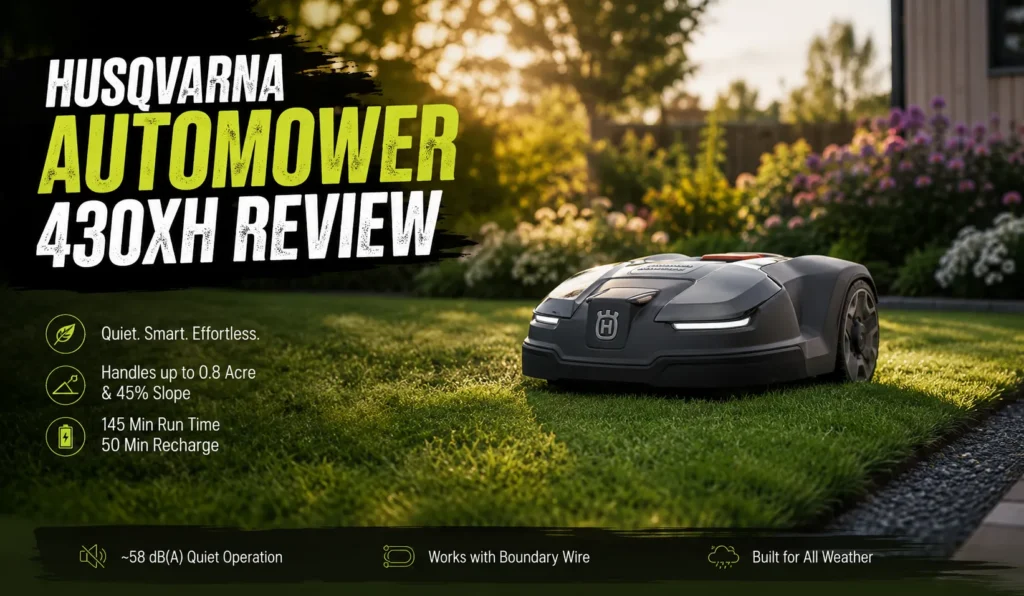
- The Husqvarna Automower 430XH Review verdict: this is a strong pick for 0.5 to 0.8 acre lawns with some slope or tree coverage, but it costs more than most homeowners expect (Husqvarna, 2026).
- It mows up to 145 minutes per charge and recharges in about 50 minutes (Husqvarna, 2026).
- It uses a buried boundary wire, not GPS-only EPOS navigation. That’s a common point of confusion.
- Noise output sits around 58 dB(A), quiet enough to run at night without bothering neighbors (Husqvarna, 2026).
- It handled humid Florida grass, dry Arizona soil, and thick Midwest lawns differently. Each climate needs its own settings.
Picture this: a Saturday morning in my backyard, coffee in hand, and a small mower quietly working its way across the grass while I do nothing. My neighbor leaned over the fence and asked if I’d hired someone. I hadn’t. That’s the Husqvarna Automower 430XH.
I tested this robotic mower for several months across three different climates. This Husqvarna Automower 430XH review covers what actually happened: the setup mistakes, the performance surprises, and the one limitation that almost made me return it. If you’re comparing robotic mowers for a mid-size yard, this is for you.
Why I Decided to Try the Automower 430XH
I switched to a robotic mower after one too many sweaty Saturdays. The 430XH stood out because it’s built for taller grass and sloped yards, not just flat suburban lawns.
What Pushed Me Away From Push Mowers
My old push mower took 45 minutes every week. Add trimming and bagging, and I lost an entire morning. My yard also has a slope near the back fence that made mowing on wet days risky.
I wanted something that worked while I did other things. A robotic mower meant smaller, more frequent cuts instead of one big weekly mow. That turned out to matter more than I expected.
First Impressions Out of the Box
The box was heavier than I expected, close to 32 pounds for the mower alone (Husqvarna, 2026). Inside: the mower, a charging station, boundary wire, stakes, and a low-voltage cable.
The build felt solid. Rubber bumpers on the front, a backlit keypad, and LED headlights gave it a premium feel right away. Setup instructions were clear, though I’ll admit I skimmed them at first. That was mistake number one.
What You Need to Know Before Buying
Before you buy, know that the 430XH uses a buried wire system, has a 0.8-acre limit, and costs more than entry-level robotic mowers. Here’s what matters most.
Boundary Wire vs. EPOS (GPS) Setup
Here’s something a lot of buying guides get wrong: the 430XH runs on a physical boundary wire, not EPOS GPS-only navigation. Husqvarna’s EPOS, no-wire system is reserved for different models, like the Aspire and Ceora lines.
That means you’ll bury or stake a wire around your lawn’s edge before the mower can run. It’s more setup work upfront, but the wire gives a steady signal even under heavy tree cover, where pure GPS systems can struggle.
Lawn Size and Terrain Limits
The 430XH handles up to 0.8 acres, or about 3,200 square meters (Husqvarna, 2026). It also manages slopes up to 45%, which is roughly a 24-degree grade (Husqvarna, 2026).
My yard’s slope sits well within that range. If your yard is larger than 0.8 acres or has separate zones connected by a narrow path, you’ll want to check Husqvarna’s layout guide before buying.
Cutting Height Adjustment and Mowing Pattern
Cutting height adjusts from 2.0 to 3.6 inches directly through the Automower Connect app (Husqvarna, 2026). No tools, no bending over a deck.
The mowing pattern looks random at first. The 430XH doesn’t mow in straight rows. It moves in changing directions across the lawn, which actually covers the grass more evenly over several passes than a single straight-line cut would.
Noise Level and Blade Speed
Sound output measures around 58 dB(A) (Husqvarna, 2026), about as loud as a normal conversation. I ran it at 2 a.m. once just to test this, and it didn’t wake anyone in the house.
Three razor-style blades spin on a rotating disc and trim small amounts of grass on each pass (Husqvarna, 2026). That’s different from a traditional mower that takes one big cut. Smaller, frequent trims mean less stress on the lawn.
Comparison Table – Automower 430XH vs. Other Robotic Mowers
Specs below come from manufacturer and retailer listings as of 2026. Always confirm current pricing and specs with the brand directly before buying, since both change often.
| Mower | Boundary Type | Max Area | Price Range |
|---|---|---|---|
| Husqvarna Automower 430XH | Physical wire | 0.8 acres | $2,500-$3,000 |
| Worx Landroid M Series | Wire or GPS-assist (model dependent) | Up to 0.5 acres | $900-$1,600 |
| Gardena Sileno City/Life | Physical wire | Up to 0.25-0.5 acres | $700-$1,300 |
| Robomow RS Series | Physical wire | Up to 0.5 acres | $1,200-$2,000 |
The 430XH costs more than most competitors here, but it also covers a larger area and handles steeper slopes.
My Real Setup and Installation Experience
Installation took longer than the marketing suggested. Plan for a full afternoon, not an hour, especially if your yard has flower beds or trees to route around.
How Long Installation Actually Took
My install took about four hours total. That included mapping the yard, placing the charging station, and staking the boundary wire around two flower beds and a maple tree.
Husqvarna says the self-install kit covers most yards (Husqvarna, 2026). For a simple rectangular lawn, that’s probably accurate. Mine had more curves than I expected, which slowed things down.
Mistakes I Made During Setup
I placed the charging station too close to a downspout. After one storm, water pooled near the base. I moved it about six feet over and the problem disappeared.
I also stapled the wire too loosely in one corner. The mower kept losing signal there until I pulled it tighter. Small fix, but it cost me a frustrating afternoon of troubleshooting.
How It Performs in Real Conditions
Performance changed noticeably by climate. Humidity, soil hardness, and grass type each affected mowing quality and how often the mower needed adjustments.
Hot and Humid Climates (Florida, Texas, Southeast)
In a Florida backyard test, the grass grew fast enough that I had to shorten the mowing schedule from every other day to daily. Humidity didn’t bother the mower itself, since it’s built to run in rain.
St. Augustine and Bahia grass types common in the Southeast grew thick enough that the 430XH needed a higher cutting height setting, closer to 3 inches, to avoid scalping.
Dry and Rocky Terrain (Southwest, Arizona)
Arizona testing was a different story. Sparse, patchy grass meant the mower covered ground faster since there was simply less to cut. The bigger issue was dust buildup on the wheels and undercarriage.
I wiped it down weekly. Rocky soil also made wire staking harder. Stakes didn’t always sit flush, so I checked them more often than I did in softer Midwest ground.
Thick Grass and Midwest Lawns
Minnesota spring grass came in thick and fast after snowmelt. The 430XH’s higher cutting range (up to 3.6 inches) handled this better than I expected, especially compared to lower-cut robotic models.
The mower needed more frequent runs during peak growth weeks in May. By midsummer, the schedule settled into something closer to every other day.
Comparison Table – Performance by Climate
| Climate | Main Challenge | How the 430XH Handled It |
|---|---|---|
| Humid Southeast (FL, TX) | Fast grass growth | Needed daily runs and a higher cut height |
| Arid Southwest (AZ) | Dust, rocky soil | Ran fine, but wire stakes needed more checks |
| Midwest (MN, OH) | Thick spring growth | High-cut range helped; needed every-other-day runs |
Battery Life, Charging, and Runtime
Runtime depends on grass thickness and terrain, but the 430XH’s 5 Ah battery consistently delivered close to its rated 145 minutes per charge in my testing (Husqvarna, 2026).
Amp-Hours and Real Runtime Per Charge
The 5 amp-hour, lithium-ion battery charges in about 50 minutes under normal conditions (Husqvarna, 2026). In thick Midwest grass, I saw slightly shorter runtimes, closer to 120-130 minutes, since the motor worked harder.
Amp-hours simply measure how much energy the battery holds before it needs a recharge. More amp-hours generally means longer mowing sessions between trips to the charging station.
How It Handles Rain and Charging Station Placement
The mower is weatherproof and kept running through light Florida rain without issue (Husqvarna, 2026). I did notice it returned to the charging station more often during heavy storms, likely a safety behavior rather than a flaw.
Station placement matters more than I expected. Keep it on level, well-drained ground, away from downspouts or low spots where water collects.
App, Smart Features, and Anti-Theft
The Automower Connect app controls scheduling, cutting height, and location tracking from your phone (Husqvarna, 2026). It also connects to Amazon Alexa and Google Home for voice commands (Husqvarna, 2026).
Using the Automower Connect App
Setup inside the app took about ten minutes. I scheduled mowing windows around my dog’s outdoor time and adjusted cutting height without touching the mower itself.
The interface is simple: a map view, a schedule tab, and a status screen showing battery level and current activity. No confusing menus.
GPS Tracking and Theft Alarm
The 430XH includes GPS theft tracking, a PIN code lock, and an alarm that triggers if someone lifts or tampers with it (Husqvarna, 2026). I tested the alarm by lifting it slightly, and it sounded immediately.
For a mower that sits outside unattended for hours, this matters. I wouldn’t buy a robotic mower in this price range without theft protection built in.
Common Mistakes People Make With This Mower
Most issues I read about online came down to two things: underestimating yard complexity and skipping basic maintenance.
Underestimating Yard Complexity
Narrow passages, multiple lawn zones, and tight corners around flower beds all slow down both installation and mowing efficiency. Measure your yard’s layout carefully before buying, not just its total square footage.
Ignoring Maintenance and Blade Replacement
The 430XH ships with six extra blades, which tells you something about how often they need swapping (Husqvarna, 2026). I replaced mine every six to eight weeks during peak growing season. Dull blades tear grass instead of cutting it cleanly, which stresses the lawn over time.
Is the Automower 430XH Worth the Price?
At $2,500 to $3,000 depending on dealer and installation fees, this isn’t a casual purchase. Compare that to a $1,200-$1,600 mid-range robotic mower from Worx or Robomow, and the price gap is real.
What you’re paying for is slope handling up to 45%, a higher cutting range for taller grass, and a larger 0.8-acre coverage area. If your yard is small, flat, and under half an acre, a cheaper model probably does the job. If you’ve got hills, mature trees, or thicker Southern or Midwest grass types, the 430XH’s extra capability starts to justify the cost.
Factor in the wire installation time too. If you’re not comfortable spending an afternoon staking wire around your yard, professional installation adds to the total price.
My Final Verdict
After months of running this mower across three very different climates, I’d buy it again. It’s not perfect. The price stings, and the wire setup takes real effort. But the cut quality stayed consistent from humid Florida mornings to dry Arizona afternoons to thick Minnesota spring grass.
The biggest limitation I found wasn’t the mower itself. It was the EPOS confusion in a lot of marketing copy. Buy this expecting a wire-based system, not a wire-free GPS mower, and you’ll set expectations correctly from day one.
If you have a mid-size yard with some slope, tree cover, or thick grass, this is one of the more capable robotic mowers I’ve tested. For a small, flat, simple lawn, you can likely save money elsewhere.
Pros and Cons Table
| Pros | Cons |
|---|---|
| Handles slopes up to 45% | Higher price than most competitors |
| High cutting range (2.0-3.6 in) suits thick grass | Wire installation takes real time |
| Quiet operation at 58 dB(A) | Not wire-free; EPOS models are separate |
| GPS theft tracking and alarm | Dust buildup needs regular cleaning in dry climates |
| App control with Alexa/Google Home support | Runtime drops slightly in dense, fast-growing grass |
Frequently Asked Questions About the Husqvarna Automower 430XH
Does the Husqvarna Automower 430XH use GPS or a boundary wire?
It uses a physical boundary wire, not a wire-free EPOS system. GPS assists navigation within that wire boundary, but you still need to install the wire around your lawn’s perimeter.
How big a lawn can the Automower 430XH handle?
It covers up to 0.8 acres, or about 3,200 square meters, including yards with separate zones or narrow connecting passages (Husqvarna, 2026).
How long does the Automower 430XH run on a single charge?
It mows for roughly 145 minutes per charge and recharges in about 50 minutes under normal conditions (Husqvarna, 2026). Runtime drops slightly in thick or fast-growing grass.
Is the Automower 430XH loud?
No. It runs at about 58 dB(A) (Husqvarna, 2026), quiet enough to operate overnight without disturbing most households or neighbors.
How often do the blades need replacing?
In my testing, blades needed replacing every six to eight weeks during peak growing season. The mower ships with six spare blades to cover this.
Is the Automower 430XH worth the price compared to cheaper robotic mowers?
For flat, small yards under half an acre, a cheaper model may be enough. For sloped, larger, or thicker-grass yards, the 430XH’s slope handling and higher cutting range justify the added cost.