
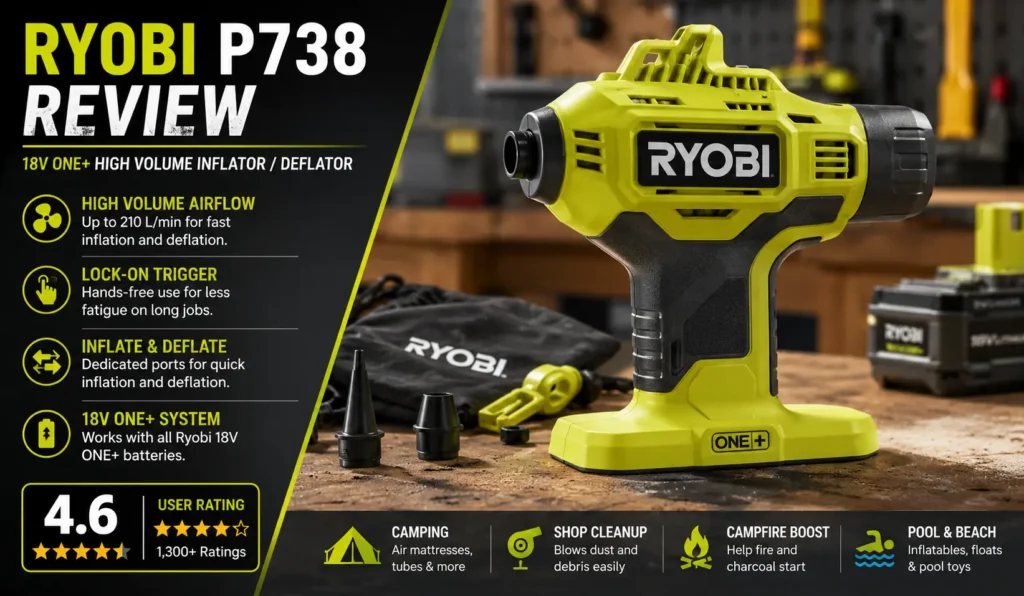
If you’ve spent even five minutes searching for a good cordless inflator, you’ve probably come across the Ryobi P738. This little green tool shows up everywhere — camping gear lists, garage workshop videos, and backyard BBQ tips alike. After using mine for well over a year, I finally sat down to write the Ryobi P738 review I wish I’d found before buying it. Spoiler: it’s one of the most surprisingly useful tools I’ve added to my garage. Let me walk you through everything.
Table of Contents
- What Is the Ryobi P738?
- What I Like
- What Could Be Better
- My Personal Experience with the Ryobi P738
- Comparing With Other Brands
- Recommendation
- FAQs
What Is the Ryobi P738?
The Ryobi P738 is an 18-Volt ONE+ cordless high-volume power inflator and deflator. It runs on any Ryobi 18V battery and pushes about 210 liters of air per minute. That puts it squarely in the high-volume, low-pressure category. Think air mattresses, pool toys, river tubes, inflatable kayaks — not car tires.
It weighs just over one pound bare. It fits in a backpack. It has a locking trigger so you don’t have to hold it down. And it costs about $35 as a bare tool. That is the basic pitch.
But here’s the thing most reviews don’t tell you: the P738 is used daily by people who never even inflate anything with it. They bought it to fill up a camping mattress and ended up using it as a shop blower, a campfire starter, an electronics duster, a car dryer, and a charcoal accelerator. That versatility is what makes this tool worth your time.
Let me break it down piece by piece.
Key Specifications at a Glance
| Spec | Detail |
|---|---|
| Voltage | 18V (Ryobi ONE+ system) |
| Airflow | 210 LPM (~18–19 CFM) |
| Max Pressure | 0.5 PSI |
| Noise Level | 76–80 dB |
| Weight (bare) | 1.05 lbs |
| Dimensions | 7.5″ L x 4.25″ W x 6″ H |
| Material | Durable plastic body |
| Battery | Not included (bare tool) |
| Price | ~$35 (bare tool) |
| Customer Rating | 4.6/5 (1,363+ reviews) |
| Inflate Queen Mattress | ~60–90 seconds |
| Inflate Twin Mattress | ~45 seconds |
What I Like
Let me tell you what genuinely impressed me after extended, real-world use. These aren’t talking points from a product page — these are things I actually noticed.
- It inflates a queen mattress in about 90 seconds. I timed it the first time just to see. My family camps a lot. We have three air mattresses. What used to be a 15-minute cord-hunting, pump-wrestling ordeal is now about four minutes of total work. The P738 just handles it, fast and without complaint.
- The locking trigger is a feature I didn’t know I needed. Click it on, it stays on. You walk away. You come back. The mattress is inflated. That lock-on mechanism is something I wish every inflator had. My old pump required a constant squeeze, and after the second mattress my hand was cramping. Now I click and go do something else.
- It doubles as a daily-use workshop blower. This is the use case that genuinely surprised me. I do a lot of woodworking — custom furniture, small shop projects. Sawdust gets everywhere. The P738 clears my workbench in under 10 seconds. It handles drill presses, table saw tops, router tables. No brush, no mess. Just a quick blast and the surface is clean. I reach for it multiple times a week for this alone.
- It’s shockingly quiet compared to an air compressor. The P738 runs at around 76–80 decibels. That’s about the volume of a loud restaurant conversation. My shop compressor screams at nearly 100 decibels. The difference is huge. I’ve used the P738 early in the morning at campsites without waking my neighbors. That kind of courtesy is easy to underestimate until you actually need it.
- The Ryobi ONE+ compatibility is a massive plus. The Ryobi 18V ONE+ platform is one of the most widely used battery ecosystems in the US. If you already own a Ryobi drill, saw, or any other 18V tool, you already have everything you need. No new charger, no new battery to buy. The tool is just $35 and you’re done.
- It weighs barely over a pound. I have carried this in a daypack on camping trips and barely noticed it. It’s smaller than most water bottles and lighter than a thick paperback book. Portability matters when you’re packing gear for four people.
- The dedicated deflation port is a real feature, not an afterthought. There’s a separate port on top specifically for deflation. It pulls air out fast. No more sitting on your air mattress rolling your whole body across it trying to squeeze the last bit of air out so the case zipper will close. This alone makes pack-up at camp so much less miserable.
- The onboard nozzle storage means you don’t lose pieces. The attachments clip directly onto the tool body. Standard pinch-valve tip, narrow pinch-valve tip, and crevice tool all store right there. I’ve had cheaper inflators where I lost every accessory within a week. With the P738, they’re always where I left them.
- It works brilliantly for tasks nobody advertises. Blowing water out of car door seams after washing. Getting coals burning faster at a cookout. Clearing dust from keyboards and electronics. Aerating a fish tank in a power outage. Lighting kindling at a campsite. I’ve seen people use it for all of these — and I’ve done most of them myself.
- At $35, the price-to-utility ratio is genuinely hard to beat. Even if you only use it to inflate camping mattresses twice a year, it earns its place. But once you realize how many other things it’s good for, $35 feels like a steal.
What Could Be Better
I want to be straight with you. The Ryobi P738 has real limitations, and I’ve felt all of them at some point.
- No variable speed control — at all. The trigger is strictly on or off. Full blast or nothing. There’s no way to dial it down for delicate items. If you’re inflating something with a small valve or something that overinflates easily, you need to be quick on the trigger. The workaround is using different nozzle tips, which changes the spread and feel of the airflow. It helps. But it’s not the same as true variable speed.
- It absolutely cannot inflate tires. This point is critical and I want to be loud about it. The P738 maxes out at 0.5 PSI. A standard car tire needs 32–36 PSI. A road bike tire needs 80–130 PSI. This tool will not do any of that. If you search for “cordless inflator” hoping to top off your tires, you need a different product entirely — like the Ryobi PCL536B or the Milwaukee M18 Inflator. I’ve seen real frustration from buyers who expected this and got something else. Save yourself the disappointment.
- 76–80 decibels is still noticeable. Ryobi calls the newer model a “Whisper Series” and claims it’s 40% quieter than the original. That’s true — and the improvement is real. But it’s still louder than a normal conversation. For short sessions, no problem. For extended use, ear protection is smart. It’s not a dealbreaker, but I want to be honest.
- The battery isn’t included. The $35 price is for the bare tool only. Ryobi is transparent about this, and it’s standard across the power tool industry. But if you’re new to the Ryobi ecosystem, add $30–$60 for a battery and charger to your budget. The starter kit brings the total closer to $80–$100. Still fair, but worth knowing before you buy.
- The plastic nozzle caps can pop off. The accessory clips are molded plastic and mostly work well. But I’ve had them pop off during use if the angle is awkward. It’s a minor complaint, but it’s happened enough times that I want to mention it.
- It can’t replace a compressor for high-pressure tasks. If you need to drive a nail gun, run an impact wrench, or do any pneumatic tool work, this isn’t your tool. It’s purpose-built for high volume at low pressure. Know what you’re buying and you won’t be disappointed.
My Personal Experience with the Ryobi P738
Let me tell you how I actually got this tool. I didn’t plan it. I was on a camping trip with my family in the Blue Ridge Mountains. We showed up at the site at dusk, tired from the drive. Our corded pump was buried in the trunk, and the nearest outlet was a 200-foot extension cord away from our site. I spent 40 minutes setting that up and still had to kneel on the ground to inflate three mattresses. It was miserable.
I ordered the Ryobi P738 before we even got home.
The next camping trip, I had all three mattresses inflated and deflated without ever looking for an outlet. My kids were playing in the tent before I’d even finished setting up the rest of camp. My wife noticed. That’s the kind of win that turns a skeptic into a convert.
Here’s a fuller picture of how I’ve used it across different situations:
- Family camping trips: Three air mattresses, inflated and deflated every trip. Zero outlet hunting. Total inflation time under five minutes.
- Summer pool season: We have a 10-foot above-ground pool with ring floats and pool noodle toys. I inflate everything in one session before the kids come outside. Used to take 20+ minutes of blowing by mouth or wrestling with a corded pump. Now it’s about three minutes.
- Workshop cleanup: Multiple times per week, I blast sawdust off my workbench, drill press, and router table. I also use the crevice tip to blow dust out of gaps in my table saw fence and miter saw fence slots. It’s faster and more thorough than brushing.
- Vehicle detailing: After washing my truck, I blow water out of door handle cavities, side mirror housings, and trim gaps. It leaves a much cleaner result than toweling alone and helps prevent water spotting.
- Electronics cleaning: I use the crevice tip to blow dust from keyboards, computer fans, and audio gear. No more buying canned air for this. It does the same job and costs nothing per use once you own the tool.
- Emergency use: During a summer power outage that lasted about 18 hours, I used the P738 to blow bursts of air into my saltwater aquarium every hour or so to keep oxygen levels up until power returned. My fish survived. I genuinely did not expect this to work as well as it did.
- Campfire and grill: Pointing this at newly-lit charcoal cuts the time to cooking temp dramatically. At a backyard cookout last Fourth of July, I had coals ready in about half the normal time. People were impressed.
Here’s what real users say across the reviews I’ve collected:
“Bought this by mistake — I actually needed the tire inflator. But now I love both tools. I use the P738 as much as my Ryobi drill.”
“This is amazing for festival camping. Get the biggest battery and you’ll be the hero of your group. It deflates too, which is clutch when packing up.”
“I use it weekly in our shop — blowing off dust, drying dirt bikes after washing, inflating river tubes. It’s one of our most-used Ryobi tools and we weren’t even expecting that.”
“Lost power during a storm. Kept my saltwater tank alive by blasting air into it every hour. Never would have thought to use it for that.”
“Perfect for the serious camper. Works better than the battery-operated inflators with D-cell batteries, no contest.”
The pattern I keep seeing: people buy this for one thing and end up using it for five. That kind of real-world utility is hard to manufacture. It either happens or it doesn’t. With the P738, it really does happen.
Comparing With Other Brands
I’ve also used the Milwaukee M18 Inflator, the BLACK+DECKER BDA1160 Air Station, and the Intex Quick-Fill pump over the years. Each has its strengths. The best choice really depends on your setup, your budget, and what you plan to inflate. Let me give you the honest side-by-side.
Ryobi P738 vs Milwaukee M18 Inflator: Quick Comparison
The Milwaukee M18 Inflator (2840-20) is the tool you choose when you need actual tire pressure. It goes up to 150 PSI with a digital gauge. It’s a precision inflator. The Ryobi P738 is a volume inflator. These two tools are not really competitors — they serve different jobs. But people often compare them, so here’s the honest breakdown.
| Feature | Ryobi P738 | Milwaukee M18 Inflator (2840-20) |
|---|---|---|
| Voltage | 18V | 18V |
| Battery System | Ryobi ONE+ | Milwaukee M18 |
| Max Pressure | 0.5 PSI | 150 PSI |
| Airflow | 210 LPM | Lower (precision-focused) |
| Can Inflate Car Tires? | No | Yes |
| Can Inflate Air Mattresses? | Yes (fast) | Yes (slow) |
| Variable Speed / Pressure Control | No | Yes (digital gauge) |
| Primary Use | High-volume inflation + blowing | High-pressure tire/ball inflation |
| Weight (bare) | ~1.05 lbs | ~2.2 lbs |
| Price (bare tool) | ~$35 | ~$80–$100 |
| Locking Trigger | Yes | Yes |
| Best For | Camping, pool, shop blowing | Tires, sports balls, precision fills |
Bottom line: If you need to inflate tires or want a precise PSI reading, go Milwaukee. If you want fast volume inflation and a multi-use blower tool, Ryobi wins and saves you $50 in the process.
Ryobi P738 vs BLACK+DECKER BDA1160: Quick Comparison
The BLACK+DECKER BDA1160 is a corded AC-powered inflator. It’s slightly faster on mattresses because it draws constant wall power instead of a battery. It’s also a few dollars cheaper as a standalone unit. But it needs an outlet — and that changes everything when you’re camping or working away from a power source.
| Feature | Ryobi P738 | BLACK+DECKER BDA1160 |
|---|---|---|
| Power Source | 18V Battery (cordless) | Corded (120V AC) |
| Portability | Fully portable | Outlet required |
| Airflow | 210 LPM | ~350 LPM |
| Max Pressure | 0.5 PSI | 0.5 PSI |
| Can Inflate Tires? | No | No |
| Inflation Speed (Queen Mattress) | ~90 seconds | ~60 seconds |
| Deflation Port | Yes (dedicated) | Yes |
| Weight | ~1.05 lbs | ~1.5 lbs |
| Price | ~$35 (bare tool) | ~$25–$30 |
| Battery System Required | Yes | No |
| Noise Level | 76–80 dB | ~75 dB |
| Best For | Off-grid flexibility, multi-use | Home use near an outlet |
Bottom line: If you’re always at home with easy outlet access and just need to inflate pool toys fast, the BLACK+DECKER is slightly faster and cheaper as a standalone. But if you camp, travel, work in a garage, or want the cordless freedom, the Ryobi P738 is the better long-term investment — especially if you’re already in the ONE+ system.
Ryobi P738 vs Intex Quick-Fill Electric Pump: Quick Comparison
The Intex Quick-Fill is a popular budget-friendly corded pump that’s widely sold in the US at big-box stores. It’s fast, cheap, and purpose-built for pool and air mattress inflation. But it has a very narrow job description compared to the P738.
| Feature | Ryobi P738 | Intex Quick-Fill AC Pump |
|---|---|---|
| Power Source | 18V Battery (cordless) | Corded (AC) |
| Portability | Fully cordless | Outlet required |
| Airflow | 210 LPM | 400–700 LPM (model-dependent) |
| Inflation Speed | Fast (~90 sec queen) | Very fast (~40–60 sec) |
| Deflation Feature | Yes (dedicated port) | No (most models inflate only) |
| Secondary Uses | Blower, dryer, fire starter | Inflation only |
| Price | ~$35 (bare tool) | ~$15–$25 |
| Durability | Tool-grade plastic | Consumer-grade plastic |
| Battery Required | Yes | No |
| Requires Ecosystem Buy-In | Yes | No |
| Best For | Versatility, off-grid, multi-use | Fast home inflation only |
Bottom line: If you just want to inflate pool floats at home as fast as possible and spend the least money today, the Intex wins on speed and cost. But it deflates nothing, blows nothing, travels nowhere without an outlet, and is built to a consumer grade. The Ryobi P738 does more, lasts longer, and goes everywhere. For anyone who camps, has a workshop, or already uses Ryobi tools, the P738 is the smarter choice.
Recommendation
Here’s my honest take after everything I’ve put the Ryobi P738 through.
Buy it without hesitation if you:
- Already own any Ryobi 18V ONE+ battery. The $35 bare tool is a no-brainer. You’re unlocking a huge amount of utility for almost nothing.
- Go camping or spend time outdoors with inflatables. Not having to chase an extension cord or a power source is a freedom you’ll appreciate immediately.
- Have a workshop, garage, or any space where dust cleanup matters. The P738 as a benchtop blower is worth owning on its own merits.
- Deal with pool inflatables, air mattresses, or river gear through the summer. This tool makes seasonal inflation a two-minute task instead of a twenty-minute ordeal.
- Are in the US and love grilling — using this to fire up charcoal faster is a genuinely great hack for cookout season.
Take a step back and think first if you:
- Primarily need to inflate car, truck, or bicycle tires. The 0.5 PSI max will not do the job. Look at the Ryobi PCL536B or the Milwaukee M18 Inflator.
- Are completely new to Ryobi and don’t plan to add more Ryobi tools. You’ll need to buy a battery and charger, which pushes your total to $80–$100. For just occasional home use, a corded option like the BLACK+DECKER might make more sense financially.
- Need precise pressure control with a digital gauge. The P738 has no pressure readout and no variable speed. It goes full blast or off.
My personal bottom line: the Ryobi P738 is one of the best surprise tools I’ve ever bought. I expected a basic mattress inflator and got a multi-use utility tool I reach for several times a week. If you’re on the fence, I’d say trust the 4.6-star rating from over 1,300 real buyers. These people bought it, used it, and loved it enough to leave a review. That’s a strong signal.
FAQs for Ryobi P738 Review
What is the Ryobi P738 best used for?
The Ryobi P738 is best for high-volume, low-pressure inflation tasks. Air mattresses, pool floats, river tubes, inflatable kayaks, and sports balls are ideal. It also works great as a lightweight shop blower to clear sawdust or dust from surfaces.
Can the Ryobi P738 inflate car or bicycle tires?
No. The P738 has a maximum pressure of 0.5 PSI. Car tires need 32–36 PSI and bike tires need even more. For tire inflation, you need the Ryobi PCL536B or a similar high-pressure inflator.
How long does the Ryobi P738 take to inflate a queen mattress?
It takes roughly 60–90 seconds for a standard queen-size air mattress. A twin mattress inflates in about 45 seconds. Times may vary slightly depending on the battery charge level and mattress volume.
What battery does the Ryobi P738 use?
It uses any Ryobi 18V ONE+ battery. It does not come with a battery — it’s sold as a bare tool. Compatible batteries range from compact 1.5Ah packs to high-capacity 6Ah or 9Ah batteries for extended run time.
How long does the battery last on the Ryobi P738?
A compact 2Ah battery gives about 20 minutes of continuous use. A high-capacity 4Ah or 5Ah battery extends that to over an hour. For most inflation tasks, a compact battery is more than enough per session.
Is the Ryobi P738 loud?
It runs at about 76–80 decibels — roughly as loud as a busy restaurant. The newer Whisper Series version is marketed as 40% quieter than the original P738. It’s noticeably quieter than an air compressor, but still audible.
Does the Ryobi P738 deflate as well as inflate?
Yes. It has a dedicated deflation port on the top of the unit. It pulls air out of mattresses and inflatables quickly. This is one of its most appreciated features — pack-up at camp becomes fast and effortless.
What attachments come with the Ryobi P738?
It comes with a standard pinch-valve tip, a narrow pinch-valve tip, and a crevice tool for tight spaces. All three store directly on the tool body so you don’t lose them.
Is the Ryobi P738 worth it if I don’t already own Ryobi batteries?
It depends on how much you’ll use it. The bare tool is $35, but you’ll need to add a battery and charger — roughly $30–$60 extra. If you plan to add more Ryobi tools, it’s a great investment. If you only need a basic home inflator, a corded option might be cheaper upfront.
How does the Ryobi P738 compare to other cordless inflators?
Against high-pressure inflators like the Milwaukee M18, the P738 is faster at volume tasks but can’t inflate tires. Against corded pumps like the BLACK+DECKER BDA1160, it’s slightly slower but fully portable. For most everyday users, especially campers and Ryobi ecosystem owners, the P738 offers the best combination of value and versatility..
Deep Dive: How the Ryobi P738 Works
Understanding how this tool works helps you use it better. The P738 uses a high-speed brushless-style fan motor to move a large volume of air at low pressure. Think of it like a powerful leaf blower scaled down to handheld size — not like an air compressor that builds up pressure in a tank.
This design choice is intentional. High-volume, low-pressure airflow is exactly what air mattresses and pool toys need. These items have large bladders with soft, flexible walls. They don’t need high PSI — they need a lot of air moved fast. A standard air compressor would either overpressurize them instantly or take much longer due to the small port sizes involved.
The P738 fits this task perfectly. Its 210 LPM airflow means it’s moving 210 liters of air every single minute through the inflation port. That’s why a queen mattress fills in 90 seconds instead of five minutes.
The Fan Design and Why It Matters
The fan design also explains why you can use it as a blower. The airflow exits in a smooth, even stream that spreads out from the tip. When you put the crevice tool on, it concentrates that stream into a narrow jet. When you use the wide standard tip, it spreads the air for broad surface coverage.
This adaptability is why so many owners end up using the P738 for tasks they never planned on. The tool isn’t locked into one mode. It’s just moving air, and air is useful for a surprising number of things.
Understanding the 0.5 PSI Limit
The 0.5 PSI maximum pressure is a hard limit. It’s not a setting you can increase. It’s built into the physics of the fan motor design. This is the most important spec to understand before you buy. If your intended use requires more than half a pound per square inch of air pressure, this is the wrong tool. No amount of skill or technique will change that.
For context:
- Car tire: 32–36 PSI
- Road bicycle tire: 80–130 PSI
- Mountain bike tire: 20–35 PSI
- Basketball: 8 PSI
- Air mattress: 0.3–0.5 PSI ✓
- Pool float: 0.1–0.3 PSI ✓
- Inflatable kayak: 0.2–0.5 PSI ✓
The P738 is a perfect match for the bottom of that list. For anything above it, look elsewhere.
Who Uses the Ryobi P738 Most?
Based on user reviews, social content, and my own observation, the Ryobi P738 has a clear user base. It breaks down into a few core groups:
The Outdoor and Camping Crowd
This is the largest group. People who camp regularly — whether car camping, festival camping, or backpacking-adjacent — deal with inflatable sleeping gear constantly. The freedom to inflate and deflate without a power source is the main draw. Many campers say it’s the single tool that makes group camping trips significantly less stressful to set up and pack down.
In the US, where camping participation has grown sharply in recent years, this is a significant and growing audience. National parks and campgrounds often don’t have electrical hookups at individual sites. Cordless tools fill a real gap.
The Ryobi ONE+ Ecosystem Owner
This group buys the P738 because they already have Ryobi batteries and the $35 bare tool price is almost risk-free. They may not even have a strong inflation use case. Many end up discovering the blower capabilities and become regular users for workshop or yard tasks.
Ryobi’s ONE+ system has over 280 tools that share the same battery. The P738 is one of the cheaper ones to add. For an ecosystem owner, the cost-benefit math is easy to justify.
The Workshop DIYer
This user may never inflate anything. They bought the P738 to blow sawdust off surfaces, dust electronics, or clear fine debris from project areas. It’s significantly quieter and more portable than a shop air compressor for light-duty blowing tasks. Several professional woodworkers mention it in their setup videos as a daily utility tool.
Families with Pools and Seasonal Inflatables
Every summer, families with backyard pools, kiddie pools, and inflatable water toys deal with a mountain of inflation tasks. The P738 handles all of them cleanly. Many parents report buying it in May and wondering how they survived summer without it.
Real Use Cases You Might Not Have Considered
Let me give you a fuller picture of what people do with this tool beyond the obvious:
Drying Wet Gear After Camping After a rainy camping trip, gear gets wet. Tent poles, stakes, and straps all hold moisture. The P738 blasts water out of crevices and speeds up drying time significantly. Some users blow out tent body fabric folds before packing up.
Clearing Dust from HVAC Vents A quick blast from the crevice tip clears dust bunnies from HVAC vent covers and registers. Not a replacement for professional cleaning, but a fast way to reduce dust buildup between cleanings.
Pre-Cooking Charcoal Acceleration This is huge for US grill culture. Getting charcoal up to temperature fast matters when you have guests waiting. The P738 blows concentrated air directly onto hot coals and cuts the wait time dramatically. It works like a forge bellows. Several BBQ enthusiasts swear by it.
Blowing Out Irrigation Lines In colder US states, homeowners with underground irrigation systems need to blow out water from lines before winter to prevent freeze damage. The P738 isn’t powerful enough for deep-set professional systems, but it works for small shallow lines and drip irrigation tubing.
Cleaning Out Vehicles Between the crevice tool and wide tip, the P738 is surprisingly useful for clearing crumbs and debris from car seats, cupholders, and dash vents. It won’t replace a vacuum, but as a first-pass tool it moves loose debris fast.
Cooling Down Hot Surfaces After running power tools, surfaces like drill press tables and router tables can hold heat. A quick blast of air speeds cooling. Not essential, but useful when you’re moving fast through a project.
Is the Ryobi P738 Good for People New to the Ryobi Ecosystem?
This is a question I see a lot. The honest answer: it depends on your plan.
If you intend to buy other Ryobi 18V tools — a drill, circular saw, LED work light, fan — then the battery investment makes a lot of sense. Ryobi’s ONE+ starter kits often bundle a 1.5Ah or 2Ah battery with a charger for around $40–$60. You get the battery once and use it across every tool you add. The P738 as an entry point is reasonable.
If you just need a one-off inflator and nothing else, a corded inflator in the $20–$30 range might be a smarter short-term purchase. The Ryobi bare tool price is great, but add $50 for a battery kit and you’re at $85 for a tool that costs $25 at Target.
Think about where you’re headed, not just where you are today. A lot of people buy the P738, then start adding Ryobi batteries for other tools, and eventually wonder why they didn’t switch to the ecosystem sooner.
How to Get the Most Out of Your Ryobi P738
A few tips from extended use:
Use the right tip for the task. The wide pinch-valve tip gives you broad, fast airflow for large mattresses. The narrow tip gives more concentrated flow for smaller inflatables with tighter valves. The crevice tool gives you a directed jet for targeted blowing. Switching tips takes seconds and changes the character of the tool.
Lock the trigger for anything over 60 seconds. Any inflation task that takes more than a minute benefits from the lock-on trigger. Click it on and step back. No reason to stand there holding it.
Charge a battery the night before a camping trip. This sounds obvious, but it’s easy to forget. A fully charged 2Ah battery gives you more than enough run time for a typical inflation session. A 4Ah or 5Ah battery gives you almost unlimited capacity for a weekend trip.
Keep attachments on the tool body when not in use. Clip them back on after every use. The onboard storage slots exist for exactly this reason. Don’t leave them loose in a bag where they’ll disappear.
Let it double as your shop blower from day one. Even if you bought it for camping, keep it in your workshop or garage between trips. It earns its keep every week if you let it.
Final Thoughts on the Ryobi P738
The Ryobi P738 is one of those tools that redefines your expectations of what a single product can do. You buy it thinking it inflates mattresses. Then you realize it clears sawdust. Then you use it to fan charcoal. Then you blast water off your truck. Then you dust your keyboard. Before long, you’ve found six different uses for a $35 tool, and you can’t remember how you managed without it.
It’s not perfect. The lack of variable speed is a real gap. The inability to inflate tires is a genuine limitation that the marketing doesn’t shout loudly enough. And the battery not being included means the real cost of entry is higher than the advertised bare tool price.
But across real-world use, the Ryobi P738 review consensus is clear: people love this tool, they use it constantly, they find new uses for it they never anticipated, and they’d buy it again without hesitation. That’s about as strong an endorsement as a tool can earn.
If you’re in the Ryobi ONE+ ecosystem, buy it now. If you’re not, consider whether you want to be — because once you start, you’ll find a dozen more reasons to add tools.