
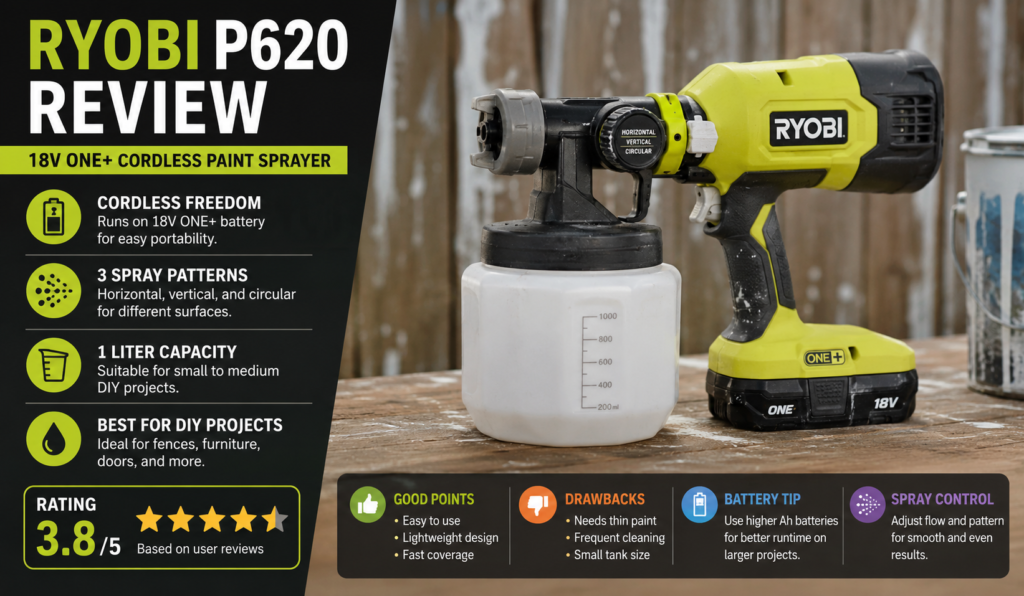
If you’re tired of dealing with tangled cords and slow brush work, the Ryobi P620 review you’ve been looking for is right here. I’ve used this cordless paint sprayer on fences, walls, and outdoor furniture — and I’m ready to give you the honest truth. It’s not perfect, but for the price, it punches well above its weight. Stick around and I’ll walk you through everything — the good, the frustrating, and who this tool is actually built for.
Table of Contents
- What I Like
- What Could Be Better
- My Personal Experience with the Ryobi P620
- Ryobi P620 Full Specifications Table
- Comparing With Other Brands
- Ryobi P620 vs Wagner Flexio 3500: Quick Comparison
- Ryobi P620 vs Graco Magnum X5: Quick Comparison
- Ryobi P620 vs Worx WX020L: Quick Comparison
- Recommendation
- FAQs
What I Like
Let me start with the good stuff. After putting the Ryobi P620 through its paces across several home projects, there’s a lot to appreciate here.
- No cords, no drama. The biggest win with this sprayer is the cordless freedom. It runs on the Ryobi 18V ONE+ battery system, which I already had from my drill and circular saw. That means no new batteries to buy, no charging dock to set up separately. I grabbed the sprayer, snapped in a charged battery, and I was painting within minutes. For outdoor work — especially fences and garden furniture — this is a game-changer. You’re not hunting for an extension cord or tripping over cables on the driveway.
- Three spray patterns that actually make a difference. Most budget sprayers give you one pattern and call it a day. The P620 gives you horizontal, vertical, and circular spray options. I found this genuinely useful — not just a marketing bullet point. When painting the long horizontal panels of my fence, I switched to the horizontal fan. When doing a narrow door frame, I flipped to vertical. The circular pattern worked great for furniture legs and round posts. You just twist the nozzle cap and you’re set. It takes two seconds.
- Multiple nozzle sizes included. The kit comes with three nozzle tips — 1.0mm, 2.5mm, and 3.0mm. The 1.0mm is best for thin, water-based paints and stains. The 3.0mm handles slightly thicker materials. I appreciate that Ryobi didn’t force you to buy accessories separately. Right out of the box, you have real flexibility. It also came with a cleaning brush, a funnel, filters for pouring paint, and gloves. That’s a thoughtful kit for a budget tool.
- Speed that will genuinely surprise you. I tested it side by side with a brush on the same section of fence. With a brush, it took me 12 minutes to cover one panel. With the P620, I did the same panel in under 90 seconds. That’s not an exaggeration. If you have a big project — a full fence, a shed exterior, a garage door — you will finish it in a fraction of the time. For anyone doing a weekend project, that time saving is massive.
- Comfortable to hold and use. At about 1.93 kg (bare tool), it’s light. After 45 minutes of continuous spraying, my wrist wasn’t aching. The GripZone overmold on the handle helps a lot. It gives you a confident grip even when your hands get a bit paint-splattered. The trigger is easy to squeeze and doesn’t require much pressure. This matters on longer jobs.
- The flexible intake tube is a smart design choice. This is a detail most people miss. The intake tube inside the paint container is flexible. That means you can tilt and angle the sprayer while painting and the tube still pulls from the bottom of the container. You waste less paint. When you’re dealing with the last bit of paint in the tank, a rigid tube would just slurp air. The flexible tube keeps going. That’s practical engineering.
- Works with any brand of paint. You’re not locked into a Ryobi-branded paint or any proprietary fluid. I’ve used it with Behr, Rust-Oleum, and a cheap store-brand fence stain. As long as you thin the paint to the right consistency, it sprays it. This is important for US buyers especially — you can pick up paint from any hardware store and it’ll work.
- Budget-friendly entry into spray painting. In the US market, this sprayer typically retails for under $100, often less with sales. For that price, you’re getting a legitimate spray tool — not a toy. Professional airless sprayers start at $300–$500. The P620 fills the gap for homeowners who don’t need professional output but want something better than a brush.
What Could Be Better
No tool is perfect. Here’s where the Ryobi P620 showed its limits during my testing.
- Clogging is a real issue if you skip the prep. This is the number one complaint you’ll find — and it’s justified. If your paint is even slightly too thick, the nozzle will clog mid-project. I learned this the hard way on my first use. I poured latex wall paint straight from the can, and within 5 minutes it was sputtering and spitting. Once I thinned it properly — about 10% water added — it ran smoothly. But the prep requirement is a barrier for beginners who don’t know about thinning ratios. Ryobi should make this clearer on the packaging.
- Cleanup is time-consuming. After every single use, you have to disassemble the nozzle, remove the container, flush everything with water, and clean the filter. It takes 10–15 minutes minimum. If you skip it even once, dried paint will ruin the nozzle or gum up the intake filter. I know people who bought this sprayer, skipped cleanup twice, and had to order replacement nozzles. It’s not a knock-and-go tool. You have to commit to the maintenance ritual.
- Battery life limits big jobs. On a 1.5Ah Ryobi battery, I got about 20–25 minutes of continuous spraying. For a small garden gate, that’s fine. For a full fence surrounding a large yard, you’ll need 2–3 fully charged batteries. If you only own one battery, you’ll be stopping and waiting for it to recharge. I’d strongly recommend picking up a second battery if you’re planning anything bigger than a small shed.
- The 1-liter tank runs out fast. It sounds like enough. It’s not. On larger surfaces, you’ll refill it every 5–8 minutes depending on your spray flow setting. Each refill means stopping, unscrewing the container, pouring carefully (use the funnel), and reattaching. It interrupts your flow and extends the project time. A 1.5 or 2-liter container option would make this a significantly better tool.
- Overspray needs masking. Like any paint sprayer, the P620 throws a fine mist. If you’re painting near windows, trim, or plants, you need to mask carefully. I ruined a section of my patio paving stones with light paint mist the first time I used it. Cover anything you don’t want painted. This is user error more than a product fault — but beginners should be warned.
- Not suited for thick coatings. If you’re thinking about spraying thick exterior masonry paint, elastomeric coatings, or heavy-bodied primers — look elsewhere. The P620 simply doesn’t have the power. It’s built for thinned paints, stains, sealers, and light coatings. Push it beyond that and you’ll fight it all day.
My Personal Experience with the Ryobi P620
I picked up the Ryobi P620 for a summer project — repainting the fence around my backyard and refreshing a set of old wooden garden chairs. Here’s how it went.
First impression: The box is well packed. Everything arrived in good shape and the kit felt complete. Nozzles, filters, funnel, gloves, and the manual — all included.
Setup: I had a Ryobi 18V battery from my drill. Snapped it in. Ready to go. The container attaches and detaches without any twisting — just a quick-release mechanism. I actually love that detail. It makes refilling way faster than older sprayer designs.
The fence project: I used a mid-sheen fence paint thinned with about 10% water. I set the nozzle to the horizontal fan pattern at medium flow. The first few passes looked amazing — even coverage, no drips, fast. I painted the entire back fence (roughly 15 meters long, 1.5m high) in about 40 minutes. With a brush and roller, that job would have been most of my Saturday. I was done before lunch.
The garden chairs: I switched to the circular spray pattern for the chair legs and rungs. This worked well for the awkward angles. The flexible intake tube helped when I tilted the sprayer sideways to hit the underside of the seat.
A few things I noticed:
- The spray output is really strong. Keep a consistent distance — around 25–30 cm from the surface — for the best finish. Get too close and you get runs. Too far and you lose coverage.
- The motor makes a loud whirring sound. It’s not painfully loud but wear ear protection if you’re doing long sessions.
- After my first full fence session, I flushed the sprayer with clean water immediately. Cleanup took about 12 minutes. Worth it.
- On a second session, I forgot to thin the paint quite enough and got a clog after 10 minutes. I cleared it with the cleaning brush and ran water through the nozzle. Back up and running in 5 minutes.
- I tested it on an unprimed wood surface (old fence board) and on a primed exterior wall. Both came out with good coverage after two light coats.
What other users are saying:
- “Used it on my garage door and outbuildings. Finished in an afternoon. Would have taken me all weekend with a brush.”
- “Battery life is the weak point. I needed three batteries charged to finish my fence.”
- “Cleanup is annoying but necessary. If you clean it every time, it keeps working perfectly.”
- “Thinning the paint is critical. Once I got that right, no more clogs.”
- “Great value. Not a professional tool but performs well beyond its price.”
- “The three nozzle sizes are a nice touch. I used the 1.0mm for a stain and it was flawless.”
- “Had it for two seasons. Still works great as long as you maintain it.”
- “In the US, it’s available on Amazon for a very fair price. Worth buying a spare battery at the same time.”
Ryobi P620 Full Specifications Table
| Specification | Detail |
|---|---|
| Brand | Ryobi |
| Model | P620 |
| Voltage | 18V ONE+ |
| Tank Capacity | 1 Liter (1000cc) |
| Weight (bare tool) | 1.93 kg (~4.25 lbs) |
| Spray Patterns | Horizontal, Vertical, Circular |
| Nozzle Sizes Included | 1.0mm, 2.5mm, 3.0mm |
| Coverage Rate | 4 m²/min |
| Paint Coverage | 10 m²/L |
| Power Source | Battery (Ryobi 18V ONE+) |
| Included Accessories | Nozzles, funnel, filters, gloves, cleaning brush |
| Recommended Use | Indoor/outdoor painting, fences, furniture, walls |
| Customer Rating | 3.5/5 (248 reviews) |
| Compatible Paint Types | Thinned latex, stains, sealers, light coatings |
Comparing With Other Brands
I’ve also used the Wagner Flexio 3500 (a corded HVLP sprayer), the Graco Magnum X5 (a professional-grade airless sprayer), and the Worx WX020L (another cordless option in the same price bracket). Each has its own strengths. But after testing all of them, I have a clear sense of where the Ryobi P620 sits — and who it’s really built for.
Ryobi P620 vs Wagner Flexio 3500: Quick Comparison (H3)
| Feature | Ryobi P620 | Wagner Flexio 3500 |
|---|---|---|
| Power Source | Battery (18V cordless) | Corded (electric) |
| Tank Capacity | 1 Liter | 1.5 Liters |
| Spray Patterns | 3 (H/V/Circular) | 2 (wide/detail) |
| Paint Thinning Required | Yes (10–15%) | Less (handles thicker paints) |
| Portability | Excellent (fully cordless) | Limited by cord length |
| Cleanup | Moderate (10–15 min) | Similar |
| Price Range (US) | ~$80–$100 | ~$100–$130 |
| Best For | Outdoor portable projects | Indoor walls, large areas |
| Clogging Risk | Moderate | Low |
| Noise Level | Moderate | Moderate–High |
Verdict: The Wagner Flexio 3500 handles thicker paints better and has a larger tank. But the Ryobi P620 wins on portability. If you work outdoors away from power outlets, the P620 is the clear choice. If you’re doing indoor walls and have easy access to power, the Wagner might give you fewer headaches with thick paint.
Ryobi P620 vs Graco Magnum X5: Quick Comparison (H3)
| Feature | Ryobi P620 | Graco Magnum X5 |
|---|---|---|
| Power Source | Battery (18V cordless) | Corded (electric) |
| Type | HVLP-style | Airless |
| Tank/Container | 1 Liter container | Direct bucket feed |
| Paint Thinning Required | Yes | Minimal to none |
| Pressure Control | Manual knob | Adjustable PSI dial |
| Portability | Excellent | Moderate (cart-mounted) |
| Coverage Speed | Good | Excellent |
| Price Range (US) | ~$80–$100 | ~$300–$350 |
| Best For | Small–medium DIY | Large projects, whole-house |
| Learning Curve | Low | Moderate |
Verdict: The Graco Magnum X5 is a professional-grade tool in a different category. It can spray undiluted paint and cover an entire house exterior in a day. But it costs 3–4x more. If you’re a homeowner doing occasional projects — not a contractor — the Ryobi P620 gets the job done at a fraction of the cost. Save the Graco for the pros.
Ryobi P620 vs Worx WX020L: Quick Comparison (H3)
| Feature | Ryobi P620 | Worx WX020L |
|---|---|---|
| Power Source | Ryobi 18V ONE+ | Worx 20V PowerShare |
| Tank Capacity | 1 Liter | 800ml |
| Spray Patterns | 3 | 3 |
| Nozzle Sizes | 3 included | 2 included |
| Battery Ecosystem | Ryobi ONE+ (huge range) | Worx PowerShare |
| Weight | 1.93 kg | ~1.8 kg |
| Price Range (US) | ~$80–$100 | ~$70–$90 |
| Customer Rating | 3.5/5 | 3.3/5 |
| Best For | Ryobi ecosystem users | Worx ecosystem users |
| Cleanup Difficulty | Moderate | Similar |
Verdict: These two are very close competitors. The Ryobi P620 edges ahead thanks to its larger tank, better nozzle variety, and the enormous Ryobi ONE+ battery ecosystem. If you already own Ryobi tools, the P620 is the easy pick. If you’re a Worx user, the WX020L makes sense. For a first-time buyer with no existing tool ecosystem, I’d go with Ryobi — the brand support and accessory availability in the US is simply better.
Recommendation
So who should actually buy the Ryobi P620? Let me be direct with you.
Buy this if:
- You already own Ryobi 18V ONE+ batteries and tools. The battery compatibility alone makes this a smart buy.
- You have small-to-medium outdoor projects — fences, sheds, garden furniture, garage doors. This is where it shines.
- You’re a homeowner on a budget who wants a major step up from brushes and rollers without spending $300+ on a professional sprayer.
- You’re patient enough to thin your paint properly and clean the sprayer after every use. If you respect the tool, it’ll serve you for seasons.
- You need portability — a backyard without power outlets, a remote shed, or areas where running a cord is a hassle.
Think twice if:
- You have a very large project — an entire house exterior, for example. You’ll fight the battery life and tank capacity all day. Consider renting an airless sprayer for jobs that size.
- You want to spray thick, undiluted paints. This tool needs properly thinned materials to work well.
- You’re a contractor or professional. The P620 is a DIY tool, not a production tool.
- You know you won’t clean it after every use. A poorly maintained P620 clogs and degrades quickly.
A note for US buyers: The Ryobi P620 is widely available at Home Depot, Amazon, and Lowe’s across the US. Ryobi has strong customer support and a broad replacement parts network. Nozzle tips, filters, and containers are easy to find. If you’re already in the Ryobi ONE+ ecosystem — which is one of the most popular tool battery platforms in America — this is a natural, low-cost addition to your garage.
From my personal experience, I’d give the Ryobi P620 a solid 4 out of 5 for what it’s designed to do. It’s not flawless. The clogging risk and cleanup requirements are real. But as a cordless paint sprayer for DIY outdoor projects under $100? It genuinely delivers. I’ve used mine on two fences, a shed, three sets of garden furniture, and a garden gate — and it’s still going strong. Just thin your paint, clean it every time, and keep a spare battery charged. Do those three things and this little sprayer will make you wonder why you ever used a brush.
FAQs for Ryobi P620 Review
Does the Ryobi P620 need its own battery?
No. The Ryobi P620 uses the standard Ryobi 18V ONE+ battery. If you already own any Ryobi 18V tool, your existing batteries will work. You don’t need to buy a new one unless you want extra runtime.
What kind of paint can I use in the Ryobi P620?
The P620 works best with thinned water-based paints, fence stains, sealers, and light coatings. Thin your paint by about 10–15% with water before use. It is not designed for thick, heavy-bodied paints or undiluted latex.
How long does the battery last on the Ryobi P620?
On a standard 1.5Ah Ryobi 18V battery, expect roughly 20–25 minutes of continuous spraying. Larger 4Ah or 5Ah batteries will last significantly longer. For big projects, have two or more charged batteries ready.
Is the Ryobi P620 easy to clean?
It takes about 10–15 minutes to clean properly. You need to disassemble the nozzle and container, flush with clean water, and brush out the filter. It must be cleaned after every single use to prevent clogged nozzles and paint buildup.
Can I use the Ryobi P620 indoors?
Yes, but with precautions. Make sure the space is very well ventilated. The sprayer produces fine paint mist that hangs in the air. Cover floors, furniture, and trim carefully. It works better outdoors where airflow naturally disperses overspray.
Is the Ryobi P620 worth the price?
For most DIY homeowners — yes. It retails for roughly $80–$100 in the US and delivers speed and coverage that a brush or roller simply can’t match. It’s not a professional tool, but for weekend home projects, the value is very strong.
What is the Ryobi P620’s spray coverage rate?
The P620 covers approximately 4 square meters per minute and achieves about 10 square meters per liter of paint. That’s significantly faster than hand painting and makes it efficient for fences, gates, and outdoor furniture.
Why does my Ryobi P620 keep clogging?
Clogging almost always comes down to paint that is too thick. Thin your paint by 10–15% with water before loading the container. Also make sure the nozzle and filter are fully clean before each use. A partially clogged filter from a previous session is a common cause.
Can I use the Ryobi P620 for a car?
No. The P620 is not suitable for automotive refinishing. It doesn’t produce the fine atomization or consistent pressure needed for car paint. Use a dedicated automotive HVLP spray gun for vehicle work.
How does the Ryobi P620 compare to professional airless sprayers?
Professional airless sprayers like the Graco Magnum series operate at much higher pressure, handle undiluted paints, and cover larger areas faster. The P620 is a consumer-grade, low-pressure sprayer. It costs far less but has more limitations. For the occasional DIY homeowner, the P620 is more than enough. For contractors or large-scale projects, go professional.