
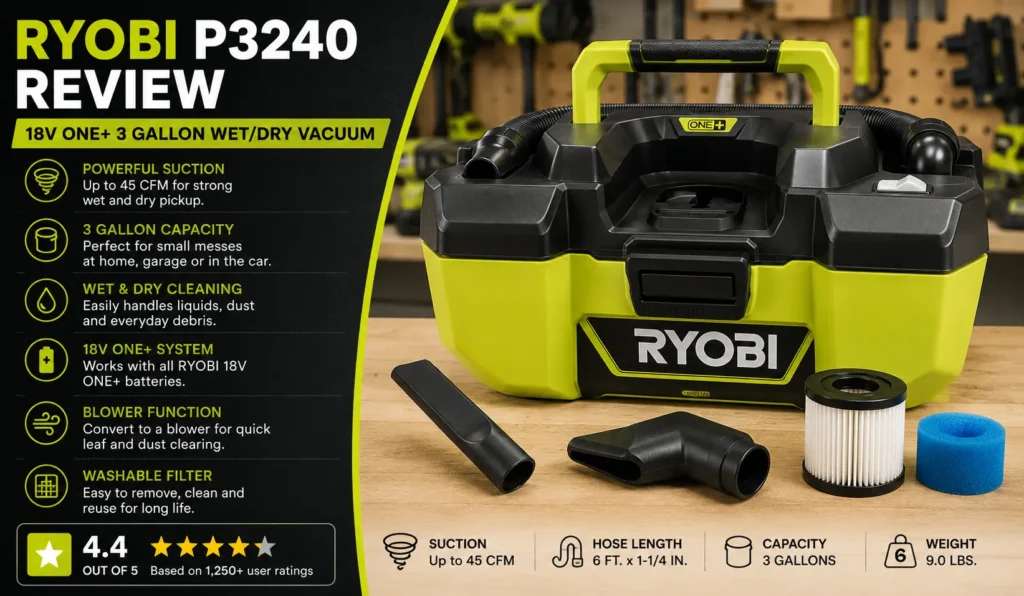
I picked up the RYOBI P3240 after getting tired of dragging a heavy corded shop vac across my garage every time I needed to clean up a small mess. If you’re searching for an honest ryobi p3240 review, you’re in the right place. I’ve been using this little vacuum for over a year now, and I have some strong opinions about it. Stick around — I’ll tell you exactly what works, what doesn’t, and whether it belongs in your workshop.
Table of Contents
- What I Like
- What Could Be Better
- My Personal Experience with the RYOBI P3240
- Comparing With Other Brands
- Recommendation
- FAQs
Quick Specs at a Glance
| Feature | Details |
|---|---|
| Model | RYOBI P3240 |
| Voltage | 18V ONE+ |
| Capacity | 3 Gallon (Dry) |
| Suction Power | 45 CFM |
| Weight | ~10 lbs (with battery) |
| Hose Length | 6 ft (extendable) |
| Filter | Washable Cartridge |
| Noise Level | ~63–74 dB |
| Runtime (4Ah) | 12–16 minutes |
| Price | ~$89–$99 (Tool Only) |
What I Like
The RYOBI P3240 gets a lot of things right. Here are the standout strengths I noticed after real, everyday use.
- Total Cordless Freedom: This is the biggest win for me. No cord means no hunting for an outlet, no tripping hazard, and no extension cords snaking across the floor. I use it in my garage, in my truck bed, and even out in the yard. In the US, where people tend to have bigger garages and detached workshops, this portability is a real game-changer. I just grab it and go.
- The Hose Is Genuinely Good: I’ve used a lot of shop vacs with stiff, cheap hoses that crack or kink after a few months. This one is different. The hose is flexible, transparent, and extends up to 6 feet. The pivoting inlet keeps it from kinking at the base. I was genuinely impressed the first time I used it — it bends and stretches without complaint.
- Fits Right Into the ONE+ Ecosystem: If you already own Ryobi 18V tools, this vacuum just slots right in. I already had three batteries on my workbench. I just snapped one in and I was running. No extra charger, no new battery investment. That makes the $89–$99 price tag feel much more reasonable.
- Washable Filter = Long-Term Savings: The filter is easy to remove, easy to wash, and easy to reinstall. I tap mine out after dusty jobs and rinse it every few weeks. It still performs like new. Replacement filters cost around $13, but honestly I’ve barely needed one.
- Onboard Storage Done Right: Both the crevice tool and utility nozzle clip onto the sides of the unit. The hose stores neatly on top. When I carry it to my truck or a job site, everything stays together. No separate accessory bag needed.
- Surprisingly Quiet: I expected this thing to sound like a jet engine. It doesn’t. At about 3 feet away, it runs around 63 dB — quieter than most corded shop vacs I’ve owned. My neighbors haven’t once complained when I use it in the driveway.
- Flat Top for Easy Stacking: The flat-top design is a small detail that makes a big difference in a crowded workshop. I can stack bins on top of it when it’s stored. It sits on my workbench without wasting vertical space.
- Tough Build Quality: I’ve bumped this thing off shelves, knocked it off my truck tailgate, and it keeps going. One reviewer literally drove over an attachment and it still worked. The plastic feels solid, not hollow and cheap.
What Could Be Better
No product is perfect. Here’s where the RYOBI P3240 falls short — and I want to be upfront about these.
- Runtime Is Short: With a standard 4Ah battery, you get roughly 12–16 minutes of runtime. That’s fine for a quick car clean or a workbench wipe-down. But if you’re doing a full workshop clean or vacuuming a large vehicle interior, you’ll be swapping batteries. A 6Ah battery gets you closer to 24 minutes, which helps — but it’s still a real limitation worth knowing upfront.
- Wet Capacity Is Misleading: The label says 3 gallons. In reality, wet capacity is closer to 1 to 1.5 gallons. The tank is wide and shallow, so the float shutoff kicks in early. If you need to suck up a big spill, this will fill up fast. Taller, narrower tanks (like on the Ridgid) handle liquids more efficiently.
- Accessory Clips Are Flimsy: The crevice tool and utility nozzle clips hold okay when you’re careful. But I’ve reached for my unit without looking and accidentally pulled the whole clip off the body. After months of use, the spring tension weakens. It’s a minor annoyance, but it adds up.
- Crevice Tool Needs a Redesign: This is my biggest frustration. The crevice tool is too short and too wide. It’s not narrow enough to get into tight car vents or tool slots. It’s not long enough to reach under car seats properly. It tries to do everything and ends up doing nothing particularly well.
- Blower Mode Is Awkward: You have to attach the utility nozzle to the exhaust port to use it as a blower. The connection isn’t airtight, so you lose airflow. The whole process is fiddly. I’ve used this as a blower maybe twice in a year.
- Hose Inlet Doesn’t Fit Most Miter Saws: The inlet is 1¼ inches. Most dust ports on miter saws and table saws are larger. To connect this to a tool’s dust port, you’d need to wrap electrical tape around it or buy an adapter. That’s an inconvenient workaround for what should be a basic feature.
- Can Clog on Larger Debris: The ribbed interior of the hose catches larger, lightweight debris like wood shavings and paper. Once something gets lodged in there, you have to manually clear it. Stick to small debris and you’re fine — push the limits and you’ll be frustrated.
My Personal Experience with the RYOBI P3240
I want to be real with you. I bought this vacuum mostly for one reason: cleaning my truck and car without running a 50-foot extension cord from my garage. After about 14 months of real use, here’s what I can honestly say.
The very first time I used it, I was shocked by how well it cleaned my truck cab. I went over the floor mats twice, hit the cup holders, and got into the back seat. The battery lasted the whole job with time to spare. I was sold immediately.
Over time, I started using it for more things:
- Cleaning sawdust after cutting on my workbench — works perfectly
- Vacuuming my car and truck interior — this is where it truly shines
- Cleaning up drywall dust at a small renovation project — handled it well
- Sucking up a small water spill in my garage — worked fine, filled up around 1.5 gallons
- Connecting it to my miter saw dust port — needed tape, was annoying but workable
- Using it as a blower to clear off my patio — barely worth the effort, honestly
The hose is the unsung hero of this product. I’ve used corded vacuums with hoses that feel like garden hoses in cold weather — stiff and uncooperative. This one bends wherever you need it and snaps back into storage cleanly.
The runtime was my biggest adjustment. I now keep two charged 4Ah batteries nearby when I’m doing a bigger job. It’s not a dealbreaker, but you need to plan around it.
One thing I didn’t expect: how often I’d reach for this over my big corded shop vac. I thought the corded one would stay my primary and this would be secondary. It flipped. I use the cordless P3240 probably 80% of the time. The convenience wins every single time.
Comparing With Other Brands
I’ve also used the Ridgid 18V 3-Gallon Wet/Dry Vacuum and the Milwaukee M18 Compact Vacuum. Both are solid tools that compete directly with the RYOBI P3240. The Ridgid has noticeably more raw suction power, but it’s significantly louder and the hose isn’t as flexible. The Milwaukee is well-built and has excellent runtime, but costs considerably more — especially if you’re not already on the M18 platform.
Here’s how they compare:
RYOBI P3240 vs. Ridgid 18V 3-Gallon: Quick Comparison
| Feature | RYOBI P3240 | Ridgid 18V 3-Gallon |
|---|---|---|
| Suction (CFM) | 45 CFM | Higher (~60+ CFM) |
| Noise Level | ~63–74 dB | ~70–78 dB |
| Hose Flexibility | Excellent | Average |
| Wet Capacity | ~1–1.5 gallons | ~2–2.5 gallons |
| Onboard Storage | Excellent | Good |
| Battery Platform | Ryobi 18V ONE+ | Ridgid 18V |
| Runtime (4Ah) | 12–16 min | Similar |
| Price (Bare Tool) | ~$89–$99 | ~$99–$109 |
| Weight | ~10 lbs | ~11 lbs |
| Filter Type | Washable | Washable |
RYOBI P3240 vs. Milwaukee M18 Compact Vacuum: Quick Comparison
| Feature | RYOBI P3240 | Milwaukee M18 Compact Vac |
|---|---|---|
| Suction Power | 45 CFM | ~50+ CFM |
| Battery Platform | Ryobi 18V ONE+ | Milwaukee M18 |
| Price (Bare Tool) | ~$89–$99 | ~$129–$149 |
| Build Quality | Good | Excellent |
| Hose Quality | Excellent | Good |
| Ideal For | Ryobi users, casual use | Pros, heavy use |
| Accessories Included | Crevice + Utility Nozzle | Varies by kit |
| Noise Level | Quiet (~63 dB) | Moderate |
| Runtime | 12–16 min (4Ah) | 15–20 min (5Ah) |
| Dust Port Compatibility | Needs adapter | Better compatibility |
RYOBI P3240 vs. RYOBI 6-Gallon Brushless Vac: Quick Comparison
This comparison matters because Ryobi’s own 6-gallon brushless model is only about $10 more at $99. If you’re choosing between the two within the Ryobi lineup, this table will help:
| Feature | RYOBI P3240 | RYOBI 6-Gallon Brushless |
|---|---|---|
| Capacity | 3 Gallon | 6 Gallon |
| Motor | Brushed | Brushless |
| Suction Power | 45 CFM | Higher |
| Portability | High (compact) | Moderate |
| Runtime | 12–16 min | Longer |
| Price | ~$89–$99 | ~$99 |
| Best For | Workbench, car cleaning | Shop floor, larger jobs |
| Weight | ~10 lbs | ~14 lbs |
| Form Factor | Compact/flat top | Taller, narrower |
My honest take: if you only buy one, the 6-gallon brushless is the better value. But if you already have a larger vac and want a companion tool for quick cleanups — the P3240 is hard to beat.
Recommendation
So who should buy the RYOBI P3240?
Buy it if:
- You’re already in the Ryobi 18V ONE+ system and have batteries on hand
- You need a compact vacuum for car interiors, workbenches, or quick garage cleanups
- You want a quiet, portable second vacuum to complement a larger shop vac
- You’re a DIYer who does occasional light-duty cleanup — not heavy daily use
- You value portability and convenience over raw suction power
Think twice if:
- You don’t own any Ryobi 18V batteries yet — factor in battery cost before comparing prices
- You need extended runtime for large jobs without battery swaps
- You want to connect it directly to a miter saw or power tool without adapters
- You deal with large debris, wet messes over 1.5 gallons, or heavy-duty shop cleanup regularly
- You’re comparing it purely on price without factoring in platform investment
For US buyers specifically: if you work in a garage, on a truck, or on weekend DIY projects — this vacuum genuinely fits that lifestyle. It’s easy to grab off the shelf, toss in your truck bed, and bring to a job. Retailers like Home Depot carry Ryobi tools extensively across the country, making batteries, chargers, and accessories easy to find.
At around $89–$99 bare tool, it’s a solid purchase within its purpose. Don’t ask it to be more than it is, and it will serve you well for years.
FAQs for RYOBI P3240 Review
Is the RYOBI P3240 worth buying?
Yes — if you’re already a Ryobi 18V user. It’s compact, quiet, and great for small jobs. It’s not a full shop vac replacement, but it’s an excellent companion tool. Most users rate it 4.5 out of 5 stars for convenience.
What battery does the RYOBI P3240 use?
It uses any Ryobi 18V ONE+ battery. A 4Ah battery is the minimum recommended. A 3Ah battery draws too much current and may shut the unit off. A 6Ah battery gives you around 24 minutes of runtime.
How long does the RYOBI P3240 run on a single charge?
With a 4Ah battery, expect 12–16 minutes. With a 6Ah battery, expect around 20–24 minutes. Runtime depends on suction load. Light use lasts longer; heavy debris pickup drains faster.
Can the RYOBI P3240 pick up water and wet messes?
Yes, it handles wet pickup. But the actual wet capacity is about 1 to 1.5 gallons — not the full 3 gallons listed. The wide, shallow tank triggers the float shutoff earlier than a taller design would. It works for small spills, not large floods.
How does the RYOBI P3240 compare to the Ridgid 18V vacuum?
The Ridgid has more suction power and higher wet capacity. But the RYOBI P3240 is quieter, has a better hose, and has cleaner onboard storage. If raw power matters most, go Ridgid. If you want quieter, more portable cleanup and you’re on the Ryobi platform, go P3240.
Is the RYOBI P3240 good for cleaning cars?
Yes — this is honestly one of its best use cases. It’s compact enough to bring inside a car, the hose is flexible enough to reach tight spots, and the suction handles carpet dust and crumbs well. Many users, including myself, say this is where it performs best.
Does the RYOBI P3240 work with miter saw dust ports?
Not directly. The hose inlet is 1¼ inches, which is smaller than most miter saw dust ports. You’ll need to wrap electrical tape around the connection or buy a separate adapter. It works, but it’s not a clean fit out of the box.