
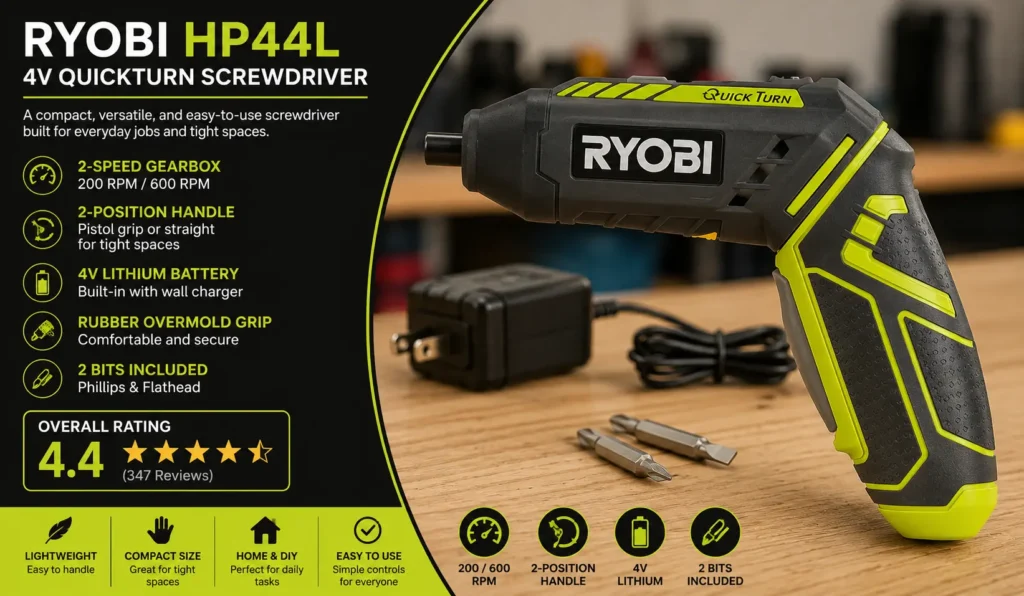
If you’ve been searching for a reliable, compact screwdriver that won’t break the bank, the Ryobi HP44L review might be exactly what you need to read today. I’ve used this little tool extensively — for furniture assembly, RC hobby work, and general home repairs — and I have a lot to say. It punches well above its $30 price tag, but it’s not perfect. Let me walk you through everything so you can decide if it’s the right fit for you.
Table of Contents
- What Is the Ryobi HP44L?
- Key Specifications at a Glance
- What I Like
- What Could Be Better
- My Personal Experience with the Ryobi HP44L
- Ryobi HP44L Performance: Speed, Power, and Battery Life
- Design and Build Quality
- Who Is This Tool Best For?
- Comparing With Other Brands
- Ryobi HP44L vs Black & Decker: Quick Comparison
- Ryobi HP44L vs Milwaukee vs Hitachi: Feature Breakdown
- Value for Money: Is the Ryobi HP44L Worth It?
- Recommendation
- FAQs for Ryobi HP44L Review
What Is the Ryobi HP44L?
The Ryobi HP44L is a 4-volt lithium-ion powered screwdriver. It’s compact, lightweight, and designed for everyday home use. It’s sold at Home Depot and on Amazon across the US for around $30.
This isn’t a heavy-duty drill. It’s a quick-turn screwdriver that handles small jobs — furniture assembly, paneling, RC hobby work, light repairs. Think of it as the upgrade between a manual screwdriver and a full-sized drill.
The name “Quickturn” says it all. The head pivots from a pistol-grip position to a straight inline position. That one feature alone makes it stand out in its price range.
Let’s dig into everything this tool offers.
Key Specifications at a Glance
| Specification | Details |
|---|---|
| Model Number | HP44L |
| Brand | Ryobi |
| Voltage | 4 Volts |
| Battery Type | Lithium-Ion (built-in) |
| Speed Settings | 2 (200 RPM / 600 RPM) |
| Handle Positions | 2 (Pistol grip / Inline straight) |
| Weight | 1.19 lbs |
| Included Accessories | Phillips head bit, Flathead bit, Wall charger |
| Warranty | 2-Year Limited |
| Price (approx.) | ~$30 USD |
| Available At | Home Depot, Amazon |
What I Like
The Ryobi HP44L gets a lot of things right. Here are the standout positives from my personal time using this tool.
- The 2-speed gearbox is genuinely useful. I found myself switching between 200 and 600 RPM constantly. When I was working on delicate RC car parts with tiny hex screws, 200 RPM gave me control. When I had a whole piece of flat-pack furniture to assemble, 600 RPM was a huge time-saver. Most screwdrivers in this price range only give you one fixed speed. This flexibility is a big deal.
- The 2-position handle is a game changer for tight spaces. I’ve had to get into awkward corners — inside cabinet frames, above my head, behind appliances. The ability to snap this from pistol-grip to inline mode is something I didn’t know I needed until I had it. It takes one click of a button to pivot. It’s smooth and snaps into place firmly. I’ve used plenty of tools that claim ergonomic design; this one actually delivers.
- Battery life impressed me more than I expected. I ran this thing through assembling a large shelving unit — around 50 screws total — and the battery still had charge left. Given that it’s a 4V built-in battery, I expected it to die halfway through. It didn’t. The lithium cell holds up well for the kind of light-to-moderate work this tool is built for.
- The rubber overgrip feels solid in your hand. Even when my hands were sweaty from working outdoors, I didn’t feel like I was going to drop it. The rubber overmold wraps the handle well and adds real comfort over long sessions.
- It’s genuinely lightweight at 1.19 lbs. I’ve used heavier tools for hours and paid for it the next day. This one keeps wrist fatigue to a minimum. That matters more than people realize, especially if you’re doing repetitive work.
- It comes with a charger included. No hunting for a compatible charger separately. You plug it into any standard outlet and you’re done. This is an all-in-one package, which makes it especially great as a gift or for anyone who doesn’t want to think about compatibility.
- Bit retention is secure. There were some early concerns from users about bits falling out. In my experience, once you seat a bit properly, it stays. My 2.5mm hex bit and my metric bits all fit without any wobble.
- Ryobi’s green color coding makes it easy to spot in a cluttered toolbox. This sounds minor, but when you’re elbow-deep in a project and need to grab a tool fast, that bright neon green stands out.
What Could Be Better
No tool is perfect. Here are the honest areas where the Ryobi HP44L falls short — and where Ryobi could improve it.
- No clutch mechanism. This is the most common complaint, and it’s legitimate. A clutch lets you set how much torque is applied before the tool stops driving. Without it, you have to manually stop when the screw is tight. For experienced users, this isn’t a big problem — you develop a feel for it. But for beginners who are just learning, it increases the risk of stripping screw heads or over-driving into soft materials.
- The battery is non-removable and non-replaceable. The 4V lithium cell is integrated directly into the driver body. When the battery eventually degrades — and it will, over time — you can’t swap it out. You’d have to replace the entire tool. For a $30 product, that’s understandable, but it’s worth knowing upfront. If you’re a heavy user, this could become an issue faster than you’d like.
- No bit storage compartment. The tool comes with a Phillips and Flathead bit, but there’s nowhere on the tool itself to store them. You’ll need to keep them in a separate pouch or toolbox. A simple magnetic holder on the base of the handle would go a long way.
- No LED light. An earlier version of the HP44L had a built-in LED to illuminate your work area. The current version removed it. For working in dim spaces — inside cabinets, under desks, in crawl spaces — this is a missed opportunity. It’s a small thing, but it matters when you actually need it.
- Low torque for tougher materials. The 4V system is not meant for hardwood or heavy-duty fasteners. If you try to push it beyond its design limits, it’ll struggle. This is expected for a light-duty tool, but new buyers sometimes assume any cordless driver can handle everything. It can’t. Know your use case before you buy.
- The included bits are basic. The Phillips and Flathead bits that come in the box are decent for occasional use, but they’re not premium quality. If you’re doing serious work, you’ll want to invest in a good aftermarket bit set.
My Personal Experience with the Ryobi HP44L
I’ll be honest — I picked this up at Home Depot almost on impulse. My old Black & Decker electric screwdriver ran on four AA batteries and finally gave out on me halfway through a project. I needed a replacement that was fast, affordable, and compact.
The Ryobi HP44L caught my eye on the shelf. I held it in the store for a few minutes, twisted the handle configuration back and forth, and liked how it felt. I paid around $30 and brought it home.
Here’s what I found over weeks of real use:
- I used it to replace Philips hardware with hex screws on an RC desert buggy build. The 600 RPM speed was fast enough to shave seconds off every screw, and that adds up quickly across 40+ fasteners.
- When I was assembling flat-pack furniture, the pistol-grip mode was my default. But when I got to the back panels where space was tight, I flipped it to inline mode and worked comfortably without straining my wrist.
- I ran it until I thought the battery should be dead — it wasn’t. Charged it overnight and went again the next day.
- The bit retention held up without fail. All my hex bits seated firmly and didn’t pop out mid-drive.
- The 2-speed switch is a physical slider. It’s easy to use with one hand. No fumbling.
- The reverse/forward switch is on the back of the tool, which takes a tiny bit of getting used to. Once muscle memory kicks in, it’s fine.
- After a longer session, my hand felt comfortable. The rubber grip does its job well.
- I also lent it to a neighbor who was hanging paneling. She’d never used a power screwdriver before. Within two minutes she was comfortable with it. That says something about the learning curve — there basically isn’t one.
- If I had a complaint from personal experience, it’s the no-clutch issue. I stripped one screw head early on before I calibrated my trigger control. After that, no problems.
- Overall, I’d buy it again. No hesitation.
Ryobi HP44L Performance: Speed, Power, and Battery Life
Let’s talk numbers and real-world performance for the Ryobi HP44L.
Speed: The two-speed gearbox gives you 200 RPM and 600 RPM. The low setting is for precision work — electronics, small fasteners, delicate materials. The high setting covers standard household screwing tasks efficiently. The jump from 200 to 600 is significant and genuinely useful.
Power/Torque: At 4 volts, this is a light-duty tool. It handles most small-to-medium home tasks without issue. Drywall screws, wood screws in soft timber, machine screws, hex fasteners — all fine. Don’t expect it to drive lag bolts into hardwood. That’s not its job.
Battery Life: The integrated 4V lithium battery charges via a standard wall charger (6.5V at 200mA). It’s a slow charge by design, which is actually good for battery longevity. A full charge handles a solid session of light work before needing a top-up. For most users doing intermittent home projects, the battery will outlast the session easily.
Reliability: The most common failure point users report is the pivot wire — the stiff wire inside the handle that enables the swivel function. Some units have had solder joint failures on this wire after extended use. Ryobi could address this by using a thinner, more flexible wire at that junction. If yours ever stops working after the swivel, that’s the likely culprit — and it is solderable if you’re handy.
Design and Build Quality
The Ryobi HP44L has a plastic body with a rubber overmold on the grip. It’s not going to feel like a $200 professional tool — and it shouldn’t at this price.
What it does offer is thoughtful ergonomics. The Quickturn pivot system is the star of the design. One button press releases the head to rotate. Clockwise snaps it to pistol grip. Counter-clockwise snaps it to inline. The pivot clicks firmly into both positions. There’s no slop or wobble in either mode.
The build quality is consistent with Ryobi’s positioning as a value brand. It feels solid enough for regular home use. The plastic isn’t flimsy — it has some heft to it despite the 1.19 lb weight. The bright Ryobi green makes it instantly recognizable.
The charger is a simple wall plug unit. No fancy features. It just works.
The included Phillips and Flathead bits are usable but basic. They’re about 3 inches long, which is better than the short bits that come with cheaper tools. For most users, a small aftermarket bit set is a worthwhile $10–15 add-on.
Who Is This Tool Best For?
The Ryobi HP44L is ideal for:
- Homeowners who do light repairs, furniture assembly, and occasional DIY projects
- RC hobbyists who need a fast, precise small screwdriver for hex bits and machine screws
- Renters setting up a new apartment and looking for an affordable starter tool
- Beginners who want to step up from manual screwdrivers without spending $70+
- Anyone who works in tight spaces and needs the inline configuration option
- Gift buyers looking for a practical, affordable tool gift
It is NOT the right tool for:
- Professional contractors who need clutch control, high torque, or all-day battery life
- Hardwood or heavy fastener work — you need more voltage for that
- Users who want a replaceable battery — the integrated cell is a dealbreaker for some
Comparing With Other Brands
I’ve also used the Black & Decker ScrewDriver (SD2000), the Milwaukee M4 Screwdriver, and the Hitachi DB3DL2 compact screwdriver. Each sits in a different segment of the market, but the comparison is worth making because the Ryobi HP44L competes closely with all three in terms of use case, even if not always in price or features.
The Black & Decker SD2000 is the most direct competitor — it’s similarly priced and also designed for home use. The Milwaukee M4 steps up in build quality and clutch options but costs nearly twice as much. The Hitachi (now Metabo) DB3DL2 is a popular choice among RC hobbyists and precision users; it was once available for $40–50 but now commands closer to $70 on the secondary market.
Ryobi HP44L vs Black & Decker SD2000: Quick Comparison
| Feature | Ryobi HP44L | Black & Decker SD2000 |
|---|---|---|
| Voltage | 4V | 4V |
| Speed Settings | 2 (200 / 600 RPM) | 1 (Fixed) |
| Handle Positions | 2 (Pistol / Inline) | 1 (Pistol only) |
| Battery | Built-in Lithium | Built-in NiMH |
| Charger Included | Yes | Yes |
| Clutch | No | No |
| LED Light | No (current version) | Yes (some models) |
| Weight | 1.19 lbs | 1.1 lbs |
| Approx. Price (USD) | ~$30 | ~$20–25 |
| Bit Storage | No | Yes (some models) |
| Best For | Versatile light work | Basic occasional use |
Verdict: The Ryobi HP44L costs a few dollars more but gives you a significant upgrade: 2-speed gearbox and 2-position handle. If you need flexibility, Ryobi wins this comparison easily.
Ryobi HP44L vs Milwaukee M4 vs Hitachi DB3DL2: Feature Breakdown
| Feature | Ryobi HP44L | Milwaukee M4 Screwdriver | Hitachi DB3DL2 |
|---|---|---|---|
| Voltage | 4V | 4V | 3.6V |
| Max Speed | 600 RPM | 600 RPM | 650 RPM |
| Speed Settings | 2 | 2 | 2 |
| Clutch | No | Yes (6-position) | Yes |
| Handle Positions | 2 (Quickturn) | 2 | 2 |
| Battery Type | Built-in Lithium | Built-in Lithium | Built-in Lithium |
| Battery Removable | No | No | No |
| LED Work Light | No | Yes | Yes |
| Weight | 1.19 lbs | ~1.2 lbs | ~0.9 lbs |
| Bit Storage | No | Yes | Yes |
| Approx. Price (USD) | ~$30 | ~$55–65 | ~$65–75 |
| Best For | Budget DIY / RC | Home + Light Pro | Precision / RC / Pro |
Verdict: If budget is your main concern and you don’t need a clutch, the Ryobi HP44L is hard to beat at $30. If you use your screwdriver frequently and professionally, or need precise torque control, the Hitachi DB3DL2 justifies its higher price. The Milwaukee sits in the middle — a good mid-tier option with a clutch for users who want that control without going full pro.
Ryobi HP44L vs Competing Budget Screwdrivers: Price vs Features
| Feature | Ryobi HP44L | Generic $15–20 Screwdriver | Skil SR2350 |
|---|---|---|---|
| Brand Reliability | High | Low | Medium |
| Speed Settings | 2 | 1 | 2 |
| Handle Flexibility | 2-position | Fixed | Fixed |
| Battery Type | Built-in Lithium | AA Batteries | Built-in Lithium |
| Charger Included | Yes | No | Yes |
| Warranty | 2-Year | None / Short | 1-Year |
| Build Quality | Solid plastic + rubber | Thin plastic | Solid plastic |
| Approx. Price (USD) | ~$30 | ~$15–20 | ~$25–30 |
| Best For | Value home use | Ultra-budget, occasional | Basic home use |
Verdict: Against truly budget tools, the Ryobi HP44L wins on every meaningful specification except price. The $10–15 difference buys you two speeds, two handle positions, a lithium battery, and a genuine brand warranty. That’s excellent value.
Value for Money: Is the Ryobi HP44L Worth It?
Yes. For most home users, the Ryobi HP44L is absolutely worth the $30 price tag.
You get a 2-speed gearbox, a 2-position handle, a lithium battery, a charger, two bits, a rubber grip, and a 2-year warranty. That’s a complete package at a price that most brands would strip down significantly.
In the US market, Home Depot stocks this tool readily. It’s available online and in-store, which makes it easy to pick up without shipping waits. If you’re a Prime member on Amazon, it ships fast too.
The only buyers who might feel let down are those expecting clutch control or a replaceable battery. For those users, spending $55–75 on the Milwaukee or Hitachi makes more sense. But for the vast majority of home DIYers and hobbyists, the HP44L does everything they actually need.
Ryobi has earned its reputation as a dependable value brand in the US home improvement market. This screwdriver fits that reputation well.
Recommendation
Here’s my honest take after extended use of the Ryobi HP44L.
Buy it if you are:
- A homeowner who does light repairs a few times a month
- Someone assembling furniture, hanging shelves, or doing small carpentry
- An RC hobbyist who needs a reliable, fast screwdriver for hex bits
- A first-time power tool buyer looking for a complete, ready-to-use package
- Someone shopping for a practical gift under $35
Do more research before buying if you are:
- A professional or serious DIYer doing heavy or daily work — consider Milwaukee M4 or Hitachi DB3DL2
- Someone who needs clutch control to avoid stripping delicate screws consistently
- A buyer who wants a removable/replaceable battery for long-term use
- Working with hardwood, composite decking, or any material that needs real torque
For US buyers, this tool is widely available at Home Depot and Amazon. I’d recommend checking both — prices sometimes vary and promotional bundles pop up seasonally.
If you’re on the fence, don’t overthink it. At $30 with a 4.4-star rating across 347 reviews, the Ryobi HP44L has earned its reputation. It’s a reliable, versatile, and well-priced tool that most buyers will be happy with.
FAQs for Ryobi HP44L Review
Is the Ryobi HP44L good for beginners?
Yes, it’s one of the best choices for beginners. It’s lightweight, easy to hold, and simple to operate. The two-speed options let new users start slow and build confidence. The only thing beginners should watch is the lack of a clutch — go easy on the trigger when a screw feels tight.
Can I replace the battery in the Ryobi HP44L?
No, the battery is built into the tool body and is not user-replaceable. It’s a 4V lithium cell that charges via the included wall charger. If the battery ever degrades significantly, you would need to replace the entire tool. Given the low $30 price, most users accept this trade-off.
What bits does the Ryobi HP44L accept?
It uses a standard 1/4-inch hex shank, which is the most common bit size for screwdrivers and drills. This means you can use nearly any aftermarket bit set from your local hardware store. The tool comes with a Phillips and a Flathead bit included.
How long does the battery take to charge?
The included wall charger runs at 6.5V and 200mA, which makes it a slow, steady charge. Expect a full charge to take a few hours. The slow charge rate is actually good for long-term battery health. Most users charge overnight and start fresh the next day.
Is the Ryobi HP44L available at Home Depot?
Yes. The HP44L is a staple on Home Depot shelves across the US. It’s also available on Amazon. Home Depot is often the most convenient option since you can pick it up same-day without waiting for shipping. Prices are typically consistent across both retailers at around $30.
Does the Ryobi HP44L have a clutch?
No, it does not have a clutch mechanism. This is one of its main limitations. Without a clutch, the tool drives until you release the trigger. Experienced users adapt quickly. Beginners should practice on scrap material first to avoid stripping screw heads.
What is the difference between the old and new version of the HP44L?
The original version of the Ryobi HP44L had a built-in LED light to illuminate work areas. The current version removed the LED. Otherwise, the core features — 2-speed gearbox, 2-position handle, 4V lithium battery — remain the same. Most users don’t miss the LED, but it was a nice-to-have for dark or confined spaces.
How much does the Ryobi HP44L weigh?
It weighs 1.19 pounds. That makes it light enough for extended use without significant wrist fatigue. It’s one of the lighter options in its class, which is a real advantage for overhead work or long sessions.
Is the Ryobi HP44L good for RC hobby use?
Yes, it’s very well-suited for RC hobby work. The 600 RPM top speed is fast enough to shave meaningful time off repetitive screw tasks. The 1/4-inch hex shank accepts standard metric hex bits (2mm, 2.5mm) that RC builders use most. Many RC enthusiasts choose this over more expensive options because of the dual-speed control and value pricing.
What warranty does the Ryobi HP44L come with?
Ryobi includes a 2-year limited warranty with the HP44L. This covers manufacturing defects. It does not cover damage from misuse or normal wear. For a $30 tool, a 2-year warranty is generous and reflects Ryobi’s confidence in the product.
This review is based on personal use and aggregated real-world user feedback. Prices and availability are subject to change. Always verify current pricing on Amazon or Home Depot before purchasing.
Deep Dive: The Ryobi HP44L Quickturn Mechanism
One of the most talked-about features in any Ryobi HP44L review is the Quickturn pivot system. Let me explain exactly how it works and why it matters.
Most screwdrivers lock you into one orientation. You hold the tool like a gun and drive screws at whatever angle your hand falls. That works fine for most jobs. But it becomes a real problem in tight spaces — inside a cabinet, behind a panel, above your head, or in a low crawl space.
The HP44L solves this with a simple pivot button near the handle junction. Press it, and the front of the tool rotates freely. Swing it 90 degrees and it locks into inline mode — now the tool looks like a traditional straight screwdriver. Press again and swing back for pistol-grip mode.
The pivot snaps firmly into both positions. There’s no slop or looseness. When locked, it feels like one solid piece.
This is the single feature that puts the HP44L above most competitors at its price point. Tools costing double don’t always offer this. For anyone who works in varied environments — home repairs, hobby work, awkward cabinet installations — this alone justifies the $30 price.
One note of caution: this pivot mechanism has an internal wire that enables the electrical connection through the joint. In rare cases, that wire can fail at the solder point after extended heavy use. If your tool stops working and the battery is charged, check the pivot joint area first. The fix is solderable for anyone with basic electronics skills.
Setting Up the Ryobi HP44L: First Use Guide
Out of the box, setup is easy. Here’s what to do when you first get the HP44L:
Step 1: Charge before first use. Plug the included wall charger into any standard outlet. Connect it to the charging port on the tool. A full initial charge sets the lithium cell properly. Aim for at least 3–4 hours before first use.
Step 2: Insert your bit. The quarter-inch hex chuck accepts any standard bit. Push the bit in firmly until it seats with a light click. Give it a gentle tug — if it stays, you’re good. Don’t be surprised if it feels very snug at first. It loosens slightly with use.
Step 3: Set your speed. The speed slider is on top of the tool. Position 1 is 200 RPM (low/precise). Position 2 is 600 RPM (fast/standard). Start on low until you get a feel for the tool.
Step 4: Set forward or reverse. The direction switch is at the back of the handle. Slide it forward for driving screws. Slide it back for removal. It’s a firm switch — you need to push it deliberately.
Step 5: Choose your handle position. For open spaces, use pistol-grip. For tight spots or overhead work, press the pivot button and swing to inline.
Step 6: Squeeze and drive. The trigger is your speed control within the selected gear. A light squeeze gives you slow start-up. Full squeeze gives maximum RPM. Practice on scrap material for the first few screws to calibrate your feel.
Total setup time from unboxing to first screw: under 5 minutes. This is genuinely beginner-friendly.
Ryobi HP44L for US Home Use: Practical Scenarios
In the US, DIY home improvement is a significant part of homeowner life. According to spending data, Americans collectively spend tens of billions on home improvement projects each year. A huge portion of those projects involve nothing more than driving screws.
Here are specific scenarios where the Ryobi HP44L shines for US home users:
IKEA and flat-pack furniture assembly. Almost every IKEA build involves dozens of cam bolts, Phillips screws, and small fasteners. The HP44L handles all of these without breaking a sweat. The 600 RPM speed turns a 90-minute chair build into a 45-minute one. I’ve done this multiple times.
Shelf installation. Whether you’re using a kit from Home Depot or custom brackets, shelf installation means multiple screws into wall studs or anchors. The pistol-grip mode is perfect here, and the rubber grip gives you control on angled drives.
Outlet and switch plate replacement. Small screws, tight quarters, often behind a wall box. The inline mode is ideal for this kind of work. The low-speed setting prevents stripping the tiny machine screws.
Appliance maintenance. Opening up a microwave, dishwasher, or refrigerator for a repair almost always requires a screwdriver. The HP44L handles Phillips and slotted fasteners on appliance panels with no trouble.
Holiday decoration hanging. Picture hooks, light clips, wreath hangers — all the seasonal hardware that goes up and comes down. A quick-turn screwdriver speeds this up significantly compared to manual work.
Deck furniture assembly. Outdoor furniture sets often come in flat-pack form. The HP44L is light and compact enough to carry outside easily, and the rubber grip holds up fine in mild moisture.
For most of these tasks, a $30 screwdriver is all you need. You don’t need 18 volts for a picture hook.
Ryobi as a Brand: What You Need to Know
Ryobi is a well-established power tool brand in the US market. It’s widely available at Home Depot, which has an exclusive retail partnership with Ryobi tools in the US. This means if you buy Ryobi, you know exactly where to go for accessories, batteries (on larger tools), and replacement parts.
Ryobi is positioned as a value brand — not a budget throwaway brand, and not a professional-grade brand. It sits between generic no-name tools and premium brands like Milwaukee and DeWalt. For homeowners and hobbyists, this is the sweet spot.
The HP44L is part of Ryobi’s compact tools line. It doesn’t use the same battery system as the larger 18V or 40V tools, since the 4V cell is fully integrated. But Ryobi’s consistent branding and retail presence makes it trustworthy for consumers who want to buy from a name they recognize.
Ryobi backs the HP44L with a 2-year limited warranty. Given the price, that’s strong coverage. If something goes wrong due to manufacturing defects in the first two years, Ryobi will address it.
One thing retired tradespeople often note about Ryobi: it’s not the tool they’d use on a job site, but for home use, it’s consistently reliable. That’s a meaningful endorsement from people who have used almost every brand at a professional level.
Tips for Getting the Most Out of Your Ryobi HP44L
After extended use, here are the things I’d tell a friend buying this tool:
Use quality bits. The included bits are fine for occasional use. But if you’re doing frequent work, a $12–15 set of premium bits (Irwin, Bosch, or Wiha) will last longer and grip screws more securely, reducing strip risk.
Charge before big jobs. The battery is solid, but don’t start a 60-screw project on a half-charge. Give it a full top-up the night before a big build day.
Don’t force it on hard materials. If the motor is straining, the tool is at its limit. Back off and use a larger driver. Forcing it risks motor wear and heat buildup.
Use low speed for small screws. Anything under M3 or with a fine thread — use 200 RPM. It gives you more control and reduces the risk of cam-out (when the bit slips out of the screw head).
Store it upright or in a case. The pivot mechanism is sturdy, but keeping the tool in a dedicated spot in your toolbox prevents the head from being knocked around unnecessarily.
Check the bit before every use. Make sure it’s properly seated. A loose bit can vibrate free mid-drive, which can strip a screw head in a fraction of a second.
Keep the charger plugged in. Many lithium tools benefit from being stored at a full or near-full charge rather than fully depleted. The HP44L’s charger won’t overcharge it.
Common Questions People Ask Before Buying
Before wrapping up this Ryobi HP44L review, let’s address some of the most common concerns I’ve seen from potential buyers.
“Is this strong enough for drywall screws?” For light drywall work — hanging pictures, installing anchors, attaching outlet covers — yes. For heavy drywall installation with self-tapping screws into metal studs at volume, no. It’ll do it slowly, but it’ll struggle.
“Can kids use this safely?” It’s lightweight and has a safety-oriented trigger. Older teenagers (16+) could use it safely with supervision. It’s not designed as a children’s tool, but it’s not dangerous in sensible hands.
“Will it work on stainless steel machine screws?” Yes, for light-gauge stainless fasteners. Not for heavy stainless bolts. The torque isn’t there for very hard materials.
“Does Ryobi still make this model?” As of this writing, yes. The HP44L is an active product line available at Home Depot and Amazon. It’s been in production long enough to have gone through at least one revision (removing the LED light).
“Is it noisy?” It’s quieter than a full-size drill. At 200 RPM it’s nearly silent. At 600 RPM there’s a mild motor hum. Nothing that would disturb a sleeping household.
Final Verdict on the Ryobi HP44L
The Ryobi HP44L is a well-designed, practical, and excellent-value screwdriver for light home and hobby use. At $30, it offers features — 2-speed gearbox, 2-position Quickturn handle, built-in lithium battery, rubber overgrip, included charger — that most tools at this price point simply don’t match.
Its limitations are real but predictable: no clutch, no removable battery, no LED. For the right buyer, none of these are dealbreakers.
The 4.4-star rating across hundreds of Amazon reviews reflects consistent real-world satisfaction. From flat-pack furniture builders to RC hobbyists to first-time homeowners, the HP44L keeps coming up as a tool people are happy they bought.
If you’re a US buyer, head to Home Depot or Amazon. Pick it up for around $30. Give it a charge and try it on your next project. I’d be surprised if you’re disappointed.
That’s the honest Ryobi HP44L review from someone who has genuinely used it, liked it, and would recommend it to a friend.