
Quick Overview
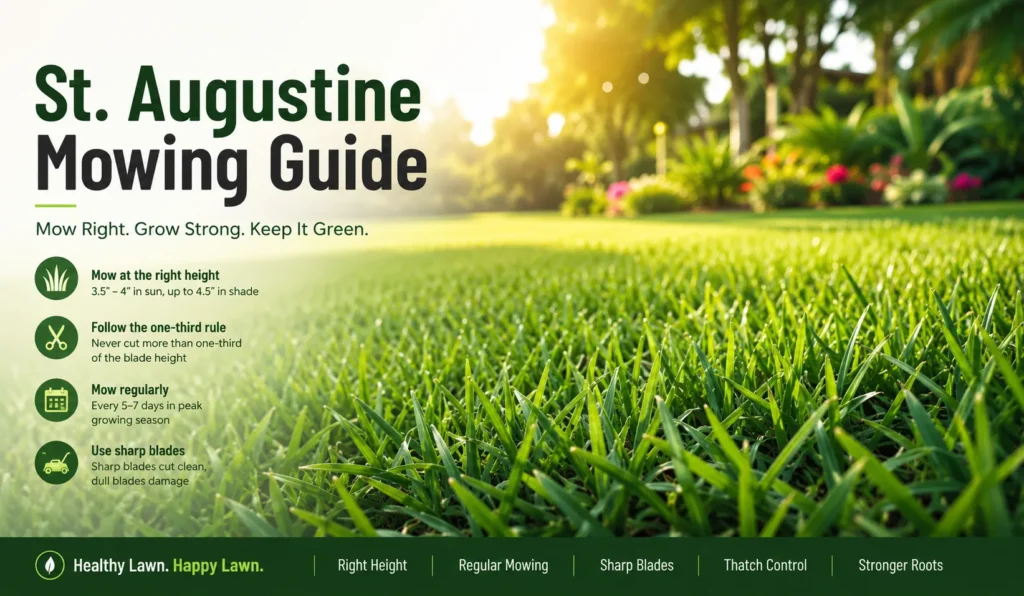
- Mow St. Augustine grass at 3.5 to 4 inches in full sun and up to 4.5 inches in shade – taller than most homeowners think.
- Never cut more than one-third of the blade height in a single mow, or recovery can take weeks.
- During peak growing season in Gulf Coast climates, plan to mow every 5 to 7 days.
- Rotary mowers work fine for St. Augustine as long as the blade is sharp – dull blades shred instead of cut.
- This grass is forgiving once established, but it punishes lazy mowing habits fast.
What Makes Mowing St. Augustine Grass Different
I learned this the hard way during my first Tampa summer. I mowed on a schedule instead of watching the grass. Came back from a weekend trip, saw it had shot up nearly six inches in four days of heat and rain, and I scalped the whole backyard trying to catch up. Brown patches for three weeks. My neighbor’s lawn – same variety, same neighborhood – looked like a golf course. The difference was that he understood how this grass actually grows.
St. Augustine is not like Bermuda. It is not like Zoysia. It has specific needs around height, frequency, and timing, and if you ignore them, the grass tells you immediately.
How It Grows (And Why That Changes Everything)
St. Augustine spreads through stolons – thick, above-ground runners that creep across the soil surface and root at intervals. This is how it fills in bare spots and expands into new areas. But those stolons sit exposed on top of the ground. They are not protected by deep thatch like some other grasses.
When you mow too low, you cut into or near the stolons. The grass loses its energy reserves. Regrowth slows, the lawn thins, and weeds rush into the gaps. When you mow at the right height, the blade canopy shades the stolons and keeps the root zone cooler. That shade is a big deal in a Houston summer.
The Stolons, the Thatch, and the Sensitivity You Need to Know About
St. Augustine also produces thatch faster than most warm-season grasses. Thatch is the layer of dead and living organic matter – mainly old stolons and crown tissue – that builds up between the grass blades and the soil surface. A thin layer is fine. Once it gets past half an inch, it starts blocking water and air from reaching the roots.
Heavy mowing frequency without proper blade height management accelerates thatch buildup. I started seeing it in a Savannah lawn I was maintaining – the grass looked lush from a distance but the surface felt spongy underfoot, like walking on a wet sponge. The fix was a dethatching pass, not more mowing.
What Height Should You Mow St. Augustine Grass?
The right height is higher than you think. Most homeowners coming from Bermuda or Fescue lawns instinctively cut too short. St. Augustine wants to stay tall.
The Right Mowing Height for Sun vs. Shade
For lawns in full sun, keep the cutting height between 3.5 and 4 inches. That height supports deep root growth and helps the grass handle heat stress without extra irrigation.
For shaded areas – under trees, along the north side of fences, near the house – raise the deck to 4 or 4.5 inches. Shaded St. Augustine already gets less sunlight for photosynthesis. Give it more leaf area to work with or it will thin out fast.
I had a section of my backyard in Pensacola that ran under a large live oak. For two years I mowed it at the same height as the rest of the yard. It stayed thin and patchy no matter what I fed it. The day I raised that section by an inch, it thickened up over the next few months. Simple fix I should have made earlier.
The One-Third Rule – And Why Breaking It Wrecks Your Lawn
The one-third rule says you should never remove more than one-third of the grass blade in a single mowing pass. So if your grass is six inches tall, cut it to four inches. Not two.
Cutting more than one-third shocks the plant. The grass redirects energy away from root development and burns through its carbohydrate reserves trying to regenerate leaf area. In summer heat, that recovery window is short. Do it repeatedly and the lawn gets progressively weaker.
The mistake most people make: they wait too long between mows, let the grass shoot up, then try to cut it back to their target height in one pass. That is the exact pattern that causes scalping and the patchy yellow aftermath.
Seasonal Height Adjustments (Summer, Winter, Transition)
In summer, stick to the upper end of your target range. The extra height protects roots from heat and reduces water loss from the soil.
In fall and approaching dormancy – October through November in most Gulf Coast zones – you can drop the height slightly, around a quarter inch. This helps the grass enter dormancy without a thick thatch mat retaining too much moisture over winter, which can invite fungal issues.
Do not scalp the lawn at the end of the season. That advice circulates a lot and it is wrong for St. Augustine. Scalping damages the crowns and stolons going into winter when the grass has no ability to recover quickly.
In spring, as temperatures rise past 65-70°F and new growth begins, return gradually to the full summer height.
Mowing Height by Variety
| Variety | Sun Height | Shade Height | Notes |
|---|---|---|---|
| Floratam | 3.5 – 4 in | 4 – 4.5 in | Most common; tolerates heat, not shade |
| Palmetto | 3 – 3.5 in | 3.5 – 4 in | Better shade tolerance than Floratam |
| Seville | 2.5 – 3 in | 3 – 3.5 in | Finer texture; more shade-tolerant |
| Sapphire | 2.5 – 3 in | 3 – 3.5 in | Dense; handles shade and cold better |
Floratam is what you will find at most Texas and Florida garden centers. It handles Gulf Coast heat but it struggles in dense shade. If you have a heavily treed yard, ask your local supplier about Palmetto or Sapphire before you install.
How Often Should You Mow St. Augustine Grass?
Frequency matters as much as height. The right answer changes by season and by how much rain and heat the lawn is getting.
Mowing Frequency in Peak Growing Season
During summer in warm, humid climates, St. Augustine can grow an inch or more per week. In Tampa or coastal Georgia during July and August, I was mowing every five to seven days just to stay on top of it.
Follow the growth, not the calendar. If the grass hits five and a half inches and your target height is four inches, mow it. If a rainy week pushes it to six inches before day seven, mow earlier.
Skipping a week in peak season almost always means you end up violating the one-third rule when you do mow. Then you spend two weeks watching the lawn recover.
What to Do in Dormancy and Cooler Months
Once nighttime temperatures consistently drop below 55°F, St. Augustine growth slows sharply. In most of Texas and Georgia, that means mowing frequency drops to once every two to three weeks by November.
In South Florida, where temperatures stay warmer through winter, the grass may never fully stop growing. You might still mow once every two weeks through January.
Once the grass goes fully brown and dormant, stop mowing until green growth returns in spring. There is nothing to cut and you will just put wear on your mower without benefit.
Signs You’re Mowing Too Often – Or Not Enough
Too often: blades look ragged and frayed at the tips even after a fresh cut, the lawn is thinning in high-traffic areas faster than normal, and the soil surface feels dry and compacted between mows.
Not enough: you can see the grass leaning over under its own weight, the lawn has a lumpy or uneven surface, and you keep violating the one-third rule every time you mow.
Mowing Schedule by Season and Climate Zone
| Season | Gulf Coast and Florida | Texas and Georgia | Mowing Frequency |
|---|---|---|---|
| Summer (Jun-Aug) | Hot, humid, fast growth | Hot, variable rain | Every 5-7 days |
| Spring (Mar-May) | Warming, active growth | Active growth | Every 7-10 days |
| Fall (Sep-Nov) | Slowing growth | Slowing or dormant | Every 10-14 days |
| Winter (Dec-Feb) | Slow or minimal growth | Mostly dormant | Monthly or none |
The Best Mower Types for St. Augustine Grass
St. Augustine has wide blades and dense horizontal growth. Not every mower handles it well. Here is what actually works.
Rotary vs. Reel Mowers – Which One Actually Works
Rotary mowers work well for St. Augustine and are what most homeowners should use. The wide, coarse blade structure of St. Augustine is a good match for the spinning horizontal blade of a standard rotary mower.
Reel mowers cut cleanly and look great on fine-bladed grasses like Bermuda and Zoysia. On St. Augustine, the thick blades and dense stolons can jam or drag against the cutting cylinder. Some reel mower owners make it work, but it requires more maintenance and adjustment. Unless you are an enthusiast, stick with rotary.
Self-Propelled vs. Push – What Makes Sense for This Grass
For most St. Augustine lawns, a self-propelled mower is worth it. The grass is dense, the stolons add resistance, and pushing through thick summer growth gets tiring fast.
On large lawns – anything over a quarter acre – a riding mower or zero-turn is the sensible choice. St. Augustine does not thin out from riding mower traffic the way fine-bladed grasses sometimes do, as long as you are not turning hard in the same spots repeatedly.
Blade Sharpness and Why Dull Blades Are the Biggest Mistake
This is the single most common mistake I see. A dull mower blade does not cut St. Augustine – it tears and shreds the wide leaves. The tips turn brown and frayed. The lawn looks brown for days after mowing, even with proper height. It also opens the leaf tissue to fungal infection, which is a real concern in humid climates.
Sharpen your blade at least twice per growing season. If you mow a large lawn weekly, sharpen every four to six weeks. A sharp blade makes a visible difference the next day. The cut tips are clean white-green instead of brown and ragged.
Cost to sharpen at a hardware or small engine shop: around $10 to $15 (2024 pricing at most Southern US shops). It is the cheapest lawn care investment you can make.
Mower Type Comparison for St. Augustine
| Mower Type | Works for St. Augustine? | Best For | Drawback |
|---|---|---|---|
| Push rotary | Yes | Small, flat lawns | Tiring on large or dense lawns |
| Self-propelled rotary | Yes, best overall | Most residential lawns | Higher cost than push |
| Riding / zero-turn | Yes | Large lawns | Risk of compaction, rut damage |
| Reel mower | Limited | Enthusiast use only | Clogs on thick stolons |
| Robot mower | Yes, with limits | Low-traffic yards | Struggles with thick summer growth |
Common Mowing Mistakes That Damage St. Augustine Grass
Most lawn problems I have seen come from one of three repeated mistakes, not a single bad mowing session.
Scalping – What It Is and Why It Happens
Scalping is cutting the grass so short that you expose the stolons and crown tissue. The lawn turns yellow or brown almost immediately. In severe cases, it looks like something burned across sections of the yard.
It usually happens for two reasons. First, the homeowner lets the grass get too tall and then tries to cut it back to the right height in one pass. Second, the mower deck is set too low for the terrain – a slight rise or dip in the yard causes the deck to dig into the turf.
If you scalp, stop mowing that area and let it recover. Water consistently. Do not fertilize immediately – that stresses an already stressed plant. Recovery takes two to four weeks in warm weather.
Mowing Wet Grass in Humid Climates
In Florida and along the Gulf Coast, this is a constant temptation because it rains almost every afternoon from June through September. Mowing wet grass causes clumps of clippings to mat down on the lawn surface, blocking light and airflow. In humid conditions, those clippings become an ideal environment for fungal disease.
Wait until the grass surface is dry, even if the soil is still moist underneath. Early mornings after an overnight dry period are usually your best window.
Ignoring Thatch Buildup After Repeated Mows
Thick thatch is a slow-building problem. You will not notice it after one season. But by year two or three of mowing without dethatching, the spongy layer starts showing symptoms – water pools on the surface, fertilizer does not seem to absorb, and the lawn starts to thin in patches.
Plan to dethatch or verticut once a year, in late spring when the grass is actively growing and can recover quickly. A heavy-duty rake does the job on smaller lawns. For larger areas, rent a vertical mower from a local equipment dealer.
How Climate Affects Your Mowing Routine
Where you live changes how you manage this grass. St. Augustine behaves differently in Pensacola than it does in Atlanta.
Gulf Coast and Florida – Heat, Rain, and Fast Growth
From South Texas through Florida, St. Augustine is in its element. The heat, humidity, and consistent rain mean the grass grows fast and stays green a long time. The flip side is that it also grows fast, thatch builds faster, and fungal disease pressure is higher than in drier climates.
Mowing frequency is highest here. Plan for every five to seven days from late April through October. Irrigation is usually not the limiting factor – managing growth rate is.
Texas and Georgia – Managing the Transition Zone
In the Dallas and Atlanta areas, St. Augustine sits at the edge of its comfort zone. Cold snaps can brown it quickly. Dry spells in late summer put it under drought stress before fall.
Here, St. Augustine goes fully dormant most winters and the growing season is shorter – roughly April through October. Mowing frequency drops faster than on the Gulf Coast. The grass also needs a little more care during spring green-up, since it is coming back from a longer dormancy.
If you are in northern Georgia or the Dallas suburbs, check local variety recommendations. Floratam sometimes struggles with late-season cold snaps. Palmetto tends to hold on a bit better in transition zones.
What Happens If You Mow During a Drought
Mowing during a drought period stresses St. Augustine further. The grass is already pulling every available resource toward survival. Removing leaf area cuts off photosynthesis at the worst possible time.
During extended dry periods, raise your mowing height by half an inch. Mow less frequently – only when the grass actually shows growth. If the lawn enters stress dormancy and starts going brown, stop mowing entirely until rain or irrigation restores active growth.
Do not fertilize during drought stress. Do not mow short thinking it will “help.” Both make the problem worse.
My Final Recommendation
After years of maintaining St. Augustine across the Gulf Coast and in transition zone yards, the single most important habit I can give you is this: follow the grass, not the calendar. This grass tells you when it needs to be mowed. A lawn that has grown to five or six inches is asking to be cut. A lawn that is dormant or stressed is asking to be left alone.
The second thing I would tell you is to sharpen your blade more than you think you need to. It feels like a minor detail. It is not. A clean cut on St. Augustine is the difference between a lawn that looks good the day after mowing and one that looks brown and ragged for days.
St. Augustine does demand attention. It grows fast when conditions are right, it punishes low mowing more than other warm-season grasses, and thatch management is ongoing. But if you match your habits to how this specific grass actually grows, it pays back with that dense blue-green carpet that makes a Gulf Coast lawn look like something from a magazine.
St. Augustine Grass as a Lawn Type: Pros and Cons
| Pros | Cons |
|---|---|
| Dense coverage crowds out weeds | High mowing frequency in summer |
| Tolerates heat and humidity well | Sensitive to low cutting heights |
| Good shade tolerance (especially Palmetto, Seville) | Builds thatch faster than most grasses |
| Spreads quickly via stolons | Does not tolerate heavy foot traffic as well as Bermuda |
| Stays green longer into fall in warm climates | Requires annual dethatching |
| Good color and texture for curb appeal | Susceptible to chinch bugs and gray leaf spot |
Frequently Asked Questions About Mowing St. Augustine Grass
What is the best mowing height for St. Augustine grass?
For most varieties, 3.5 to 4 inches in full sun and 4 to 4.5 inches in shade. Floratam, the most common variety sold in the South, does best at the higher end of that range. Cutting shorter than 3 inches stresses the grass and exposes the stolons to heat damage.
How often should I mow St. Augustine grass?
During peak growing season in warm, humid climates, every five to seven days. In cooler months, frequency drops to every two to three weeks or less. Base the schedule on actual grass height – when it reaches one-third above your target mowing height, cut it.
What happens if I mow St. Augustine too short?
You risk scalping the lawn – cutting into or near the stolons that St. Augustine uses to spread and store energy. Scalped areas turn yellow or brown and can take two to four weeks to recover. Repeated scalping thins the lawn and opens it to weed pressure and pest damage.
What type of mower is best for St. Augustine grass?
A self-propelled rotary mower with a sharp blade is the best option for most homeowners. Reel mowers can jam or drag on St. Augustine’s thick blades. Riding mowers and zero-turns work for larger lawns as long as you avoid repeated tight turns in the same spots.
Should I leave grass clippings on the lawn after mowing?
Yes, in most cases. Clippings break down quickly and return nutrients to the soil. The exception is when you have cut off more than one-third of the blade height and have heavy clumps of cuttings lying on the surface – rake or bag those, since they can mat down and block light and air.
Does St. Augustine grass go dormant in winter?
Yes, in most of the South it goes fully dormant once overnight temperatures drop below 55°F consistently. In South Florida, it may only slow down rather than go fully dormant. Stop mowing once the grass stops actively growing and wait for green growth to return in spring before resuming.
How do I know if my St. Augustine lawn has thatch problems?
Press your hand into the lawn surface. If it feels spongy and the compressed layer under the blades is more than half an inch deep, thatch has built up. Other signs include water pooling on the surface after rain and fertilizer not seeming to absorb. Plan a dethatching pass in late spring to fix it.