
Quick Overview
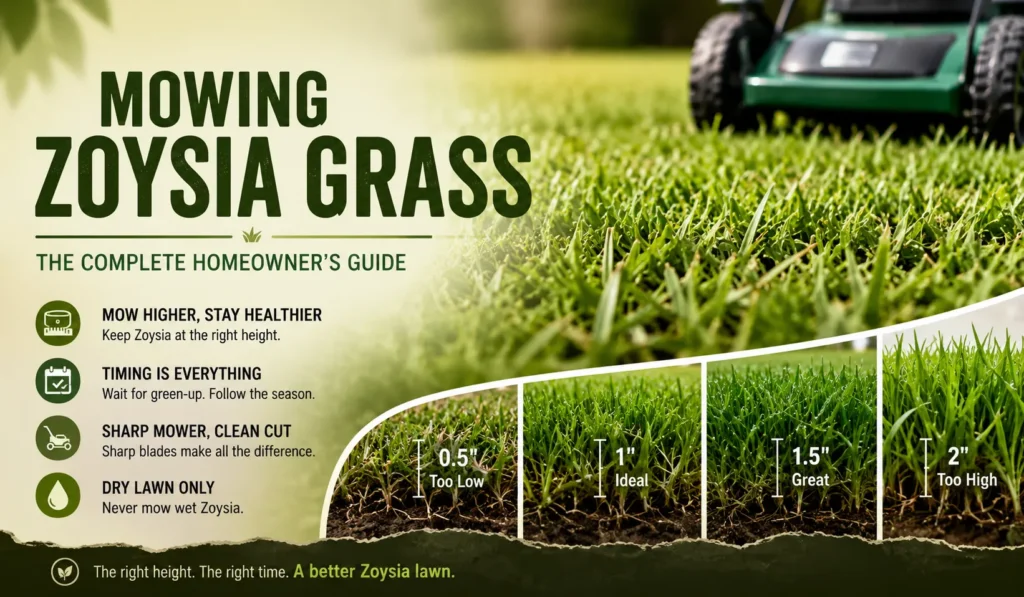
- Zoysia grass needs a mowing height of 1–2 inches for most varieties, but going even slightly too low causes scalping that takes weeks to recover.
- The one-third rule is harder to follow with Zoysia than with any other warm-season grass because it grows in spurts.
- A reel mower gives the best cut quality on Zoysia, but a sharp rotary mower works well for most homeowners.
- Never mow Zoysia too early in spring – wait until at least 50% of the lawn has greened up from dormancy.
- Wet Zoysia tears instead of cuts, leaving a ragged lawn that browns at the tips within 24 hours.
I scalped my first Zoysia lawn on a Saturday in late April. I was proud of myself – fresh mower blades, bright morning, whole weekend ahead. I dropped the deck to the same height I used on my old Bermuda lawn, made one pass, and turned around to find a beige, threadbare mess staring back at me.
My neighbor walked over, looked at it, and just said, “Zoysia.”
That was my introduction to mowing Zoysia grass. It plays by rules that other grasses do not follow, and if you do not respect those rules, the lawn will tell you fast. I have mowed Zoysia in Savannah backyards, Charlotte suburbs, and Houston front yards. This guide is for anyone who just put in a Zoysia lawn – or who has been fighting one for years and wants to stop losing.
Why Zoysia Grass Is Different From Everything Else
Most warm-season grasses are forgiving. Bermuda bounces back fast. St. Augustine is tough to kill with a mower. Zoysia is neither of those things.
It grows slowly, it forms a dense mat of lateral stems, and it holds onto dormancy longer than any grass I have worked with. That combination means that mowing mistakes stay visible for a long time.
Its Growth Pattern Will Fool You
Zoysia spreads through both stolons (above-ground runners) and rhizomes (below-ground runners). That double-spreading system is why Zoysia becomes so dense over time – and why mowing it wrong causes more damage than it would on other grasses.
When you mow too low, you do not just trim leaf blades. You cut into the dense crown layer where new growth originates. Damage there slows recovery from weeks to months.
The grass also grows in bursts tied to soil temperature, not air temperature. A warm week in March might look like the lawn is ready to mow. Soil temps may still be sitting at 52°F, and the grass is barely awake. Cut it then, and you stress it right when it needs energy for spring green-up.
Why It Goes Dormant (and What That Means for Mowing)
Zoysia goes dormant when soil temperatures drop below 55°F. The grass turns straw-colored and stops growing. It is not dead. It is storing energy in its root system until conditions improve.
The mowing mistake I see most often happens right at the edges of dormancy – both entering and leaving it.
Going into fall, people keep mowing at their summer height until frost. That strips off the leaf mass the grass needs to insulate itself. Coming out of dormancy in spring, people mow too early and too low, cutting off the green tissue the grass worked hard to produce.
The rule: do not mow going into dormancy once growth visibly slows, and wait until at least 50% green coverage before your first spring mow.
The Right Mowing Height for Zoysia
The correct height depends on which Zoysia variety you have. Get this wrong and no other tip in this article will save you.
Zoysia varieties range from fine-textured types like Emerald that need very low cuts to coarser types like Meyer that are more forgiving. Mowing all Zoysia at the same height is like using the same cutting pressure on silk and denim.
Warm Season vs. Transitional Zone Differences
In the Gulf Coast and deep Southeast – Florida, Georgia, Louisiana – Zoysia has a longer active growing season. You can generally maintain the lower end of the recommended height range from May through September. The longer active period gives the grass time to recover if you make a minor height mistake.
In the transition zone – Tennessee, the Carolinas, Virginia – the growing window is shorter. I keep Zoysia at the higher end of its range here. A scalping in June in Charlotte gives the grass maybe ten weeks to recover before fall dormancy slows things down again. That is not much time.
What Happens When You Cut Too Low
Scalping means cutting below the green leaf tissue into the brown crown. The lawn turns pale immediately. It does not spring back in a day or two.
In Savannah, I once watched a scalped Zoysia patch take nearly six weeks to return to normal in summer heat. In a Charlotte suburb in late May, similar damage took closer to ten weeks because the growing season had less time left.
Beyond the visual damage, scalping weakens the root system, opens the lawn to weed invasion, and increases the risk of disease during recovery.
Seasonal Height Adjustments
- Spring (green-up period): Mow at the high end of the variety’s range. You want to protect new growth.
- Summer (full growing season): Drop to the middle of the range. The grass is actively growing and can handle more frequent, lower cuts.
- Late summer/early fall: Begin raising the height back up. Give the grass more leaf mass going into dormancy.
- Fall (before dormancy): Stop mowing when growth visibly slows. Do not try to get in a final low cut.
Compression Table – Zoysia Variety vs. Recommended Mowing Height
| Variety | Texture | Recommended Height | Notes |
|---|---|---|---|
| Emerald | Very fine | 0.5–1.5 inches | Needs a reel mower at low settings |
| Zeon | Fine | 0.5–1.5 inches | Dense; scalps easily if set below 0.5 inch |
| Meyer (Z-52) | Medium | 1–2 inches | Most forgiving; good for homeowners |
| Zenith | Medium-coarse | 1.5–2.5 inches | Grows from seed; easier to manage height |
| Empire | Coarse | 1.5–2.5 inches | Handles rotary mowing well |
Best Mowing Practices I Have Learned the Hard Way
Getting the height right is only part of it. How you mow – the timing, the frequency, the direction – matters just as much with Zoysia as with any grass I have worked with.
The practices below are things I learned by doing them wrong first.
Mowing Frequency – How Often Is Too Often?
During peak summer, Zoysia at the right height typically needs mowing every 7–10 days. The exact interval depends on rainfall, fertilization, and temperature.
The trap many people fall into is mowing on a fixed calendar schedule. If it rained three times last week and your lawn is growing fast, waiting 10 days puts you at risk of violating the one-third rule with one cut. Check the grass, not the calendar.
During spring green-up and late-season slowdown, you might go two to three weeks between cuts. That is fine. Mowing when the grass does not need it does nothing useful and adds foot traffic stress.
The One-Third Rule and Why Zoysia Makes It Tricky
The one-third rule says never remove more than one-third of the blade height in a single mow. It applies to every grass, but Zoysia makes it harder to follow.
Because Zoysia grows slowly in cooler periods and then spurts during heat and rain, the time between ideal mowing windows can be very short. You miss one week in July due to travel, and you come home to a lawn two inches taller than your target. Cutting it back to the right height in one pass violates the rule.
The fix: mow once at a compromise height that removes less than a third, wait three to four days, then drop to your target height. It takes an extra step, but it beats the alternative.
Mowing Direction and Pattern Rotation
Mowing in the same direction every time causes two problems with Zoysia specifically. The dense lateral stems start leaning one direction – called grain – which affects how the lawn looks and how evenly it cuts. Second, repeated passes in one direction compact soil in the same wheel tracks.
I rotate my mowing pattern 90 degrees on alternating mows. For a rectangular lawn, that means one week side-to-side, next week front-to-back. For more interesting patterns, diagonal mowing also works.
Rotating directions also helps with lawn striping if that is something you want. The dense texture of Zoysia actually holds stripes well when mowed consistently.
Wet vs. Dry – When to Mow Zoysia
Never mow Zoysia wet. I know this sounds like standard advice, but it matters more with Zoysia than with most grasses.
Zoysia’s dense mat traps moisture. When blades are wet, a rotary mower tears rather than cuts. The torn tips turn brown within 24 hours – the lawn looks like it has been mowed with a lawn tractor driven by someone who has never seen grass before.
Wet mowing also clumps clippings on the surface. Zoysia already has a thatch problem if you are not careful. Leaving clumps of wet clippings speeds that up.
Wait until mid-morning at the earliest after overnight dew. After rain, I wait a full day minimum.
Compression Table – Mowing Scenario vs. Best Practice
| Scenario | What to Do |
|---|---|
| Grass is 30% above target height | Mow to target in one pass |
| Grass is 60%+ above target height | Mow at midpoint height, wait 4 days, mow to target |
| Lawn is wet from rain or dew | Wait minimum 4–8 hours; next day is better |
| First spring mow | Wait for 50% green coverage; mow at high end of range |
| Late fall with slowing growth | Skip the mow; stop for the season |
| Just fertilized (3 days ago) | Mow at normal height but expect faster regrowth in coming days |
The Best Mowers for Zoysia Grass
The right mower for Zoysia depends on your lawn size, your budget, and which variety you have. The short answer: Zoysia rewards sharp blades more than any other grass on this list.
A dull blade tears Zoysia stems. You can see it – the tips look brown and ragged rather than clean and green. Sharpen or replace blades at least once a season, twice if you mow frequently.
Best Overall Mower for Zoysia
Honda HRX217VKA is the mower I recommend most often to Zoysia homeowners with medium-sized lawns. The blade engagement system keeps RPMs consistent through dense Zoysia growth, and the height adjustment range (1 to 4 inches) covers every Zoysia variety. The MicroCut twin-blade system gives a cleaner cut than a single-blade rotary on thick grass.
The drawback: it costs around $600–700 and is heavier than entry-level mowers. Pushing it through dense, mature Empire or Meyer Zoysia in Texas summer heat is real work.
Best Reel Mower Option
McLane 17-inch Gas Reel Mower is the tool Zoysia deserves if you have a fine-textured variety like Emerald or Zeon and want a true golf-course cut. Reel mowers cut with a scissor action rather than a spinning blade. The result on fine Zoysia is noticeably cleaner – less browning at the tips, smoother surface texture.
The honest drawback is real: reel mowers require more frequent sharpening, they struggle with sticks and debris, and they do not handle Zoysia that is even slightly overgrown. If you miss a week in July and the lawn is three inches tall, a reel mower will bog down.
Best Rotary Mower for Thick Zoysia
Husqvarna HU800AWDH is what I recommend for coarser Zoysia varieties – Empire and Zenith especially – and for lawns with any slope. The all-wheel drive handles the resistance that thick Zoysia puts on the drive wheels. The 190cc engine does not bog down in dense growth.
The issue is size. It is a larger mower that requires storage space and is overkill for anything under 5,000 square feet.
Best Budget Pick
Craftsman M220 covers the basics for Zoysia at a price under $350. It does not have self-propulsion, the cutting width is narrow at 21 inches, and the height adjustment is a single lever (not per-wheel). But the engine is reliable, it starts easily, and for a small Meyer Zoysia lawn that gets mowed consistently, it holds up well.
The thing to know: budget mowers often ship with dull blades from the factory. Sharpen it before the first mow.
Best Riding Mower for Large Zoysia Lawns
John Deere S120 works well on large Zoysia properties – a half-acre or more. The cutting height range goes low enough for most Zoysia varieties, and the 42-inch deck cuts mowing time significantly.
The real limitation on any riding mower with Zoysia: deck leveling matters more than most people expect. Zoysia at 1.5 inches is very close to the ground. An unlevel deck shows up immediately as uneven stripes or scalp patches on one side of each pass.
Compression Table – Mower Type vs. Zoysia Performance
| Mower Type | Cut Quality | Best Zoysia Variety | Main Drawback |
|---|---|---|---|
| Reel mower (manual) | Excellent | Emerald, Zeon | Requires sharp blades; cannot handle overgrowth |
| Reel mower (gas-powered) | Excellent | Emerald, Zeon, Meyer | Higher maintenance; less practical for most homeowners |
| Rotary mower (push) | Good | Meyer, Empire, Zenith | Blade sharpness critical; tears wet grass |
| Rotary mower (self-propelled) | Good | All varieties | Cost; engine maintenance |
| Riding mower | Adequate | Empire, Zenith (larger lawns) | Deck leveling critical; risk of scalping on slopes |
How Zoysia Behaves Across US Climates
Zoysia is grown across a wide stretch of the US, from Florida to the transition zone states in the Mid-Atlantic. That range covers a lot of climate variation, and the grass behaves differently enough between regions that mowing strategy changes.
I have worked in three of the major Zoysia climate zones, and the differences matter.
Gulf Coast and Southeast (Florida, Georgia, Louisiana)
In Savannah, Zoysia is fully active from April through October – sometimes longer. Soil temperatures stay warm enough to support steady growth well into fall. That long season is great for recovery from mistakes, but it also means maintaining mowing frequency is demanding.
In this zone, heat stress mowing matters. During July and August in Georgia, I stop mowing during the hottest part of the afternoon. Mowing during heat stress compounds the damage to already-stressed leaf tissue.
Thatch also builds faster in the Gulf Coast heat. Zoysia’s slow decomposition rate means clippings and stem material accumulate. I dethatch every other year in this zone; without it, the lawn starts to feel spongy and develop drought stress spots.
Transition Zone (Tennessee, Carolinas, Virginia)
The Carolinas are where I spent the most time with Zoysia, and the transition zone is genuinely harder to manage than the deep South.
The problem is dormancy timing. Zoysia in Charlotte often goes dormant two to three weeks before fescue neighbors even start thinking about winter. Then it comes out of dormancy later in spring. That gives it a shorter window to do everything – establish, spread, recover from damage.
In this zone, I never push Zoysia past mid-October. Once night temperatures consistently drop below 55°F, I stop mowing and let the grass prepare for dormancy on its own terms.
Drought Conditions and Hot Summers (Texas, Oklahoma)
A Houston front yard I maintained for two summers taught me that drought-stressed Zoysia and mowing are a dangerous combination.
Zoysia has excellent drought tolerance compared to most warm-season grasses. It will go semi-dormant in drought conditions even during summer. The mistake people make is mowing drought-stressed Zoysia at normal height and frequency. The grass cannot recover as fast when it is already water-stressed.
During a Texas drought, I raise the mowing height by half an inch and cut mowing frequency. The extra leaf height provides some shade to the soil and slows moisture loss. Once rainfall resumes and the grass is growing actively again, I gradually drop back to the target height.
Compression Table – Climate Zone vs. Mowing Adjustments
| Climate Zone | Active Season | Key Mowing Adjustment |
|---|---|---|
| Gulf Coast / Deep Southeast | April–October | Watch for thatch; avoid mowing during heat of day in July–August |
| Transition Zone (Carolinas, Tennessee) | May–September | Stop by mid-October; stay at upper height range all season |
| Texas / Oklahoma (hot, dry) | April–September | Raise height during drought; reduce frequency; return gradually after rain |
| Virginia / Maryland edge | May–August | Very short window; prioritize recovery over aesthetics |
Common Mistakes People Make Mowing Zoysia
Most Zoysia problems I have seen come from two mowing mistakes. They are both predictable and both preventable.
Scalping the Lawn Coming Out of Dormancy
This is the most common Zoysia mowing mistake, and I have done it myself.
In early spring, Zoysia still looks brown or patchy. The temptation is to scalp the lawn – cut it very low – to remove the dead matter and let sunlight reach the soil. Some sources recommend this. The problem is that if you do it too early, you remove the green tissue that just started emerging, set the lawn back by weeks, and stress the root system at the worst possible time.
If you want to scalp Zoysia in spring, wait until the lawn is at least 70% green. Use a sharp blade and do one pass only. Do not repeat it.
I stopped scalping Zoysia lawns after the second year. The recovery from dormancy without scalping is nearly as fast, and the lawn looks much better through April and May.
Using the Wrong Blade Type
Zoysia’s density is its strength and its problem. Standard rotary mower blades that work fine on Bermuda or St. Augustine chop through Zoysia’s thick mat without a clean cut – especially when growth is dense.
High-lift blades are the standard recommendation, but for Zoysia I prefer medium-lift blades with frequent sharpening over high-lift blades that are only sharpened once a season. High-lift blades create more airflow and work well in sparse grass. Zoysia’s density means the blade is doing the work, not the airflow. A sharp medium-lift blade cuts cleaner in my experience.
Mulching blades are the other mistake. The recirculating cut they produce works great on thin, light grasses. In dense Zoysia, clippings do not circulate – they pack under the deck. Discharge sideways or bag if your lawn is producing heavy clippings.
My Final Recommendation
If I had to give one piece of advice to someone starting out with Zoysia, it would be this: slow down. Everything with Zoysia rewards patience.
The grass rewards the homeowner who waits for the right soil temperature before the first spring mow. It rewards the person who checks the actual height before cutting rather than mowing on a Thursday because that is what they always do. It rewards sharp blades, proper height, and leaving the lawn alone when conditions are not right.
Zoysia is high-maintenance in the spring and early summer decision-making sense – not in the physical labor sense. The decisions you make in April and May set up the entire season. Get those right and the lawn basically takes care of itself through the heat of summer.
After years of mowing Zoysia in the Gulf Coast heat and Carolina transition zones, I have come to genuinely like the grass. When it is right, there is nothing quite like it – that dense, carpet-like feel underfoot, the uniform color, the way it holds up under foot traffic that would tear other grasses apart. It takes work to get there, but once you stop fighting it, Zoysia is worth every careful pass.
Pros and Cons: Mowing Zoysia vs. Other Warm-Season Grasses
| Factor | Zoysia | Bermuda | St. Augustine | Centipede |
|---|---|---|---|---|
| Mowing frequency (summer) | Every 7–10 days | Every 5–7 days | Every 7–10 days | Every 10–14 days |
| Recovery from scalping | Slow (4–8 weeks) | Fast (1–2 weeks) | Moderate (2–3 weeks) | Moderate (2–4 weeks) |
| Blade type required | Sharp rotary or reel | Standard rotary | Standard rotary | Standard rotary |
| Tolerance for height variation | Low | Moderate | Moderate | Low |
| Dormancy mowing complications | High | Moderate | Low | Moderate |
| Thatch buildup risk | High | High | Low | Low |
| Overall mowing difficulty | High | Moderate | Low | Low |
Frequently Asked Questions About Mowing Zoysia Grass
What is the best mowing height for Zoysia grass?
It depends on the variety. Fine-textured Zoysia types like Emerald and Zeon should be mowed at 0.5–1.5 inches. Medium varieties like Meyer do best at 1–2 inches. Coarser varieties like Empire and Zenith can be maintained at 1.5–2.5 inches. Always stay at the upper end of the range during spring green-up and late fall.
How often should I mow Zoysia grass?
During peak summer growing season, most Zoysia lawns need mowing every 7–10 days. During spring green-up and fall slowdown, the interval can stretch to two to three weeks. Mow based on the actual grass height rather than a fixed schedule – check whether the lawn is approaching one-third above target height.
Can I scalp Zoysia grass in spring?
You can, but timing matters more than almost anything else. Wait until at least 70% of the lawn has greened up from dormancy. Scalping too early removes the new green tissue the grass needs for energy and delays green-up significantly. Many experienced Zoysia growers stop scalping altogether and find the results are nearly the same without the risk.
Why does my Zoysia turn brown after mowing?
Brown tips after mowing are almost always caused by a dull blade or wet grass. A dull blade tears rather than cuts the stem, and the torn tissue browns quickly. Wet Zoysia causes the same tearing effect. Sharpen your blade and only mow dry grass. If tips are browning consistently, the blade is the first thing to check.
What is the difference between mowing Zoysia and Bermuda grass?
Bermuda tolerates more mowing variation and recovers from scalping much faster than Zoysia. Bermuda also has a longer tolerance window for slightly dull blades. Zoysia’s density and slow growth rate mean errors compound – a low cut on Bermuda bounces back in one to two weeks, while the same cut on Zoysia can take four to eight weeks to fully recover.
Should I bag Zoysia grass clippings?
During normal mowing when you are not removing more than one-third of the height, you can leave clippings on the lawn. Zoysia’s growth rate in peak season is slow enough that clippings decompose before they cause problems. However, if clippings are long and heavy, or if you are in a humid environment prone to fungal issues, bagging or side-discharging is the better choice. Zoysia already trends toward thatch buildup – heavy clipping layers make that worse.
When should I stop mowing Zoysia in the fall?
Stop mowing when growth visibly slows – usually when you go two weeks without the lawn reaching one-third above target height. For most transition zone lawns, that happens in October. In the deep South, it may be November. Do not try to get a final low cut before dormancy – let the grass keep leaf mass to insulate itself through winter.