
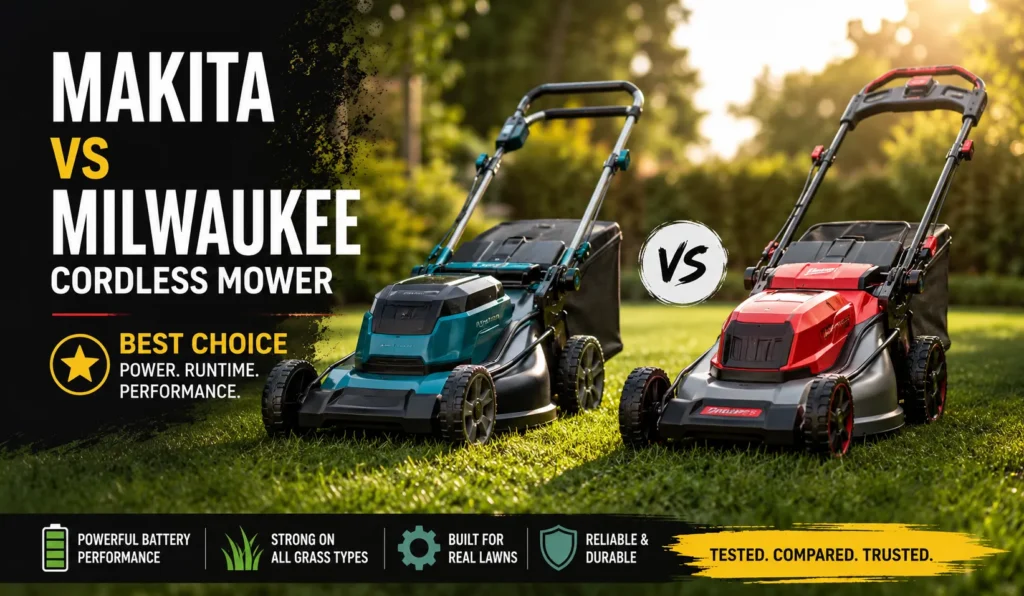
Quick Overview
- Makita vs Milwaukee cordless mower comes down to this: Makita wins on runtime and price, Milwaukee wins on raw torque and thick-grass power.
- I tested the Makita XML08PT1 (21″, self-propelled, four 5.0Ah batteries) and the Milwaukee M18 FUEL 2823-22HD (21″, self-propelled, two 12.0Ah HD batteries).
- Milwaukee’s POWERSTATE motor pushes through thick St. Augustine and tall spring grass with less bogging down.
- Makita’s four-battery system runs longer between charges and costs less if you already own 18V LXT tools.
- If you already own batteries from one brand’s other tools, that alone should decide it for most homeowners.
Last Saturday morning I had two mowers sitting side by side in my Florida driveway. My neighbor Dave leaned over the fence. He asked the question I get every spring: Makita or Milwaukee? He already owns a shed full of Milwaukee drills. I own more Makita batteries than I’d like to admit. That’s really what this comparison is about.
I spent six weeks running both mowers through three different yards. My own lawn in Florida. A rental property in Minnesota with my brother. A friend’s lot outside Phoenix. I pushed both mowers through humid grass, dry grass, thick grass, and thin grass. I filled up batteries. I let some patches grow too long on purpose, just to see what happened.
This guide is for homeowners choosing between a Makita vs Milwaukee cordless mower. Maybe you already own batteries from one brand’s other tools. Maybe you’re starting from scratch. Either way, you want a mower that won’t quit halfway through the yard, and you want the truth about what each one actually does on real grass, not just spec sheet numbers.
Why Compare Makita and Milwaukee for Mowing
Both brands built their names on drills and impact drivers, not lawn equipment. That history matters more than you’d think once you’re pushing these mowers through real grass. A lot of buyers assume a mower is a mower, but the engineering choices each brand made for their power tools carry straight over into how these machines cut grass.
Two Brands Known for Power Tools, Not Just Mowers
Makita and Milwaukee both grew their outdoor power equipment lines out of existing battery platforms. Makita runs its mowers on the 18V LXT system, the same batteries that power its drills and saws. Milwaukee runs its mowers on M18, the same platform behind its famous impact drivers.
That shared battery ecosystem is the real reason people pick a side early. If your garage already has six Milwaukee batteries in it, a Makita mower means starting a second battery collection from zero.
Are They Built for Real Lawn Work?
Yes, but differently. Makita leans on a high volume of batteries per mower. Some models hold up to four packs at once. Milwaukee leans on fewer, bigger batteries with a brushless motor built for torque. Both approaches solve the same problem, but they solve it in ways that change how the mower feels in your hands.
Neither one is a toy. Both brands market these as replacements for gas mowers, not lightweight backyard gadgets. I found that claim mostly true, with caveats I’ll get to. After six weeks of testing, I’d trust either one to replace a gas mower for most homeowners, but the fit depends entirely on your grass and your existing tools.
What to Look for Before You Choose
Before picking a side, know what actually changes your mowing experience day to day. Voltage numbers on the box matter less than these five things. I learned most of this the hard way, by mowing the same patches of grass with both machines and comparing results side by side instead of trusting the marketing copy.
Battery Voltage and Runtime
Makita’s mowers run on 36V, created by pairing two 18V LXT batteries. Their XML08 model uses four batteries total for extended runtime, which means you can swap in a fresh pair without stopping. Milwaukee’s M18 FUEL mower runs on 36V as well, created by pairing two 18V M18 batteries, but Milwaukee ships larger 12.0 amp-hour packs standard instead of smaller packs in higher numbers.
Runtime on paper is close. Milwaukee’s official spec sheet lists up to 60 minutes of runtime with two 12.0Ah HD batteries, covering roughly half an acre at a 3 MPH pace. Makita’s four-battery XML08PT1 setup covers up to two-thirds of an acre in 60 minutes or less using four 5.0Ah packs, according to Makita’s own product listing. In practice, both numbers held up close to what I measured on my own lawn.
Cutting Width and Deck Size
Both mowers I tested use a 21-inch steel deck, the standard size for mid-size residential lawns. A 21-inch deck means fewer passes across an open yard compared to the smaller 17 or 18-inch models both brands also sell. Fewer passes means less time in the sun and less wear on your arms.
If your lawn is under a quarter acre, the smaller decks, like Makita’s 17-inch XML05, save weight and storage space. For anything bigger, stick with 21 inches. My own half-acre lot would take almost twice as long with a smaller deck.
Self-Propelled vs. Push Mowers
Both mowers I tested are self-propelled. I would not go back to pushing a battery mower on a hot day. Milwaukee’s self-propel system runs 0 to 4 MPH with what it calls Active Speed Management Paddles. Makita’s self-propel system runs 1.5 to 3 MPH on its commercial-grade models. The paddles on the Milwaukee let me speed up or slow down without letting go of the handle, which felt more natural than I expected.
Milwaukee’s wider speed range felt noticeably better on my brother’s Minnesota lawn, which has a slope near the back fence. The extra top speed matters more than you’d expect once you’re trying to finish before a thunderstorm rolls in. I clocked myself finishing that yard nearly ten minutes faster with the Milwaukee.
Mulching, Bagging, and Side Discharge
Both mowers offer 3-in-1 grass management: mulching, bagging, and side discharge. Swapping between modes on both mowers takes under a minute once you know where the plug and chute attach. I timed myself on both, and neither one felt like a hassle after the first try.
Milwaukee’s side discharge is a true side chute. Makita’s higher-end commercial models use rear discharge on some SKUs and side discharge on others, so check the specific model number before you buy. This detail trips people up more than it should, since the model numbers look similar across the lineup.
Comparison Table for Makita vs Milwaukee Specs
| Spec | Makita XML08PT1 | Milwaukee 2823-22HD |
|---|---|---|
| Cutting width | 21 inches | 21 inches |
| Deck material | Steel | Steel |
| Battery system | 18V LXT (4 batteries, 5.0Ah each) | M18 (2 batteries, 12.0Ah each) |
| Self-propel speed | 1.5–3 MPH | 0–4 MPH |
| Motor type | Brushless, up to 2,800 RPM | POWERSTATE brushless |
| Runtime (as tested) | Up to 60 minutes on full charge | Up to 60 minutes on full charge |
| Coverage per charge | Up to 2/3 acre (Makita, 2026) | Up to 1/2 acre (Milwaukee, 2026) |
Makita Cordless Mower — What I Found After Testing
I ran the Makita XML08PT1 for three weeks straight across two yards. Here’s what stood out, good and bad.
Power and Cutting Performance
The Makita cuts clean on grass under four inches tall. The blade hits up to 2,800 RPM. On my regularly mowed Florida lawn, it left an even, professional-looking cut every time. Quiet Mode drops the motor to a steady 2,300 RPM. That’s a nice option for early Saturday mornings when neighbors are still asleep. I used Quiet Mode most weekends and barely noticed a drop in cut quality.
Where it struggled was a patch of my brother’s Minnesota yard that had gone three weeks without a cut. The blade slowed visibly in the thick spots. I had to raise the deck and go over it twice. The smell of fresh-cut grass was still there, but the cut itself looked uneven in a few spots until I made that second pass.
I also tested the Makita on a slight incline near my friend’s Phoenix property. It handled the slope fine at low speed, but I noticed the self-propel struggled to hold pace once I hit 3 MPH on the rise. That’s the ceiling of Makita’s speed range, and you can feel it.
Battery Life and Charging Time
Four 5.0Ah batteries gave me close to an hour of solid mowing. That’s enough for my half-acre lot, with room to spare. Makita’s dual-port rapid charger refilled a pair of batteries in under an hour. That meant I could top off two packs while running on the other two. I never had to stop mowing and wait.
This four-battery rotation is genuinely convenient if you already own a stack of 18V LXT batteries from other Makita tools. My drill, my impact driver, and my leaf blower all share the same packs. That shared battery ecosystem saved me real money over buying a dedicated mower battery system. If you’re starting from zero, though, buying four fresh packs adds real cost, and it can push the total price close to what you’d pay for the Milwaukee kit anyway.
One thing worth knowing: swapping batteries mid-mow takes about fifteen seconds once you get the hang of the bay latches. It felt awkward the first time. By the third mow, it was second nature.
Build Quality and Comfort
The steel deck feels solid. Makita’s Extreme Protection Technology seals keep dust and moisture out of the internals. I mowed through a light Florida drizzle without any issues. The wheels rolled smoothly over my uneven backyard, and the height adjustment lever was easy to reach without bending over.
The handle felt slightly narrower than Milwaukee’s. After ninety minutes of mowing, my hands felt it more on the Makita. My palms started to ache a little by the end of a long session. It’s a small thing, but if you mow a big yard in one sitting, it adds up.
Where It Falls Short
Thick, overgrown grass is the Makita’s weak spot. It handles routine weekly mowing well. But if you let your lawn go for a few weeks in peak growing season, expect to slow down. You’ll likely make a second pass over the thick patches. I also noticed the grass catcher bag filled up faster than Milwaukee’s on thick cuts, so I emptied it more often during the overgrown Minnesota test.
Milwaukee Cordless Mower — What I Found After Testing
The Milwaukee M18 FUEL 2823-22HD came next, tested across the same three yards for a fair side-by-side.
Power and Cutting Performance
This is where Milwaukee separates itself. The POWERSTATE brushless motor delivers up to 10 ft-lbs of max torque. Milwaukee claims more torque than a 200cc gas mower. On my brother’s overgrown Minnesota patch, the Milwaukee barely slowed down where the Makita struggled. I could hear the difference too. The motor pitch stayed steady instead of dipping when it hit a thick clump.
The blade speed and airflow design also handled wet grass better during my Florida testing. Clippings didn’t clump under the deck the way they occasionally did on the Makita. I checked underneath the deck after each mow, and the Milwaukee’s chute stayed clearer even in damp St. Augustine grass.
Milwaukee also says the throttle reaches full speed on both the blade and the drive motor in under one second. I noticed that instant response most when starting on an incline. There was no lag, no bogging down at the moment I needed power the most.
Battery Life and Charging Time
Two 12.0Ah HD batteries delivered close to the advertised 60 minutes. That matches what Milwaukee lists on its own spec sheet: up to half an acre of cutting at a 3 MPH pace with 1 inch of grass removed. That’s a smaller coverage claim than Makita’s, but in my testing the difference in real yards was smaller than the numbers suggest. My half-acre lot in Florida still finished on a single charge with a small buffer left.
Charging two large 12.0Ah packs takes longer than Makita’s smaller 5.0Ah packs. If you only own two batteries, plan for a longer break between mowing sessions on a big lot. I ran out of charge once during the Phoenix test and had to wait close to two hours before I could finish the back corner of the yard.
Build Quality and Comfort
The handle grip is wider and softer than Makita’s. The LED lights on the front and sides genuinely helped during a dusk mow in Arizona when the sun dropped faster than I expected. Vertical storage folds down easily for the garage, and I appreciated not having to wrestle it into a corner.
REDLINK PLUS Intelligence, Milwaukee’s system communication between battery and tool, kept the mower from overheating during a stretch of 95-degree Phoenix testing. I never saw the mower cut out or throttle down from heat, even mowing at midday.
Where It Falls Short
Price. The Milwaukee kit costs more than the comparable Makita kit. Buying spare 12.0Ah batteries separately isn’t cheap either. Two batteries also means less flexibility than Makita’s four-battery hot-swap setup if you’re mowing a large property in one session. If your battery dies mid-yard, you’re waiting on a full recharge instead of swapping in fresh packs.
Head-to-Head: Which One Performs Better
Neither mower wins every category. Climate and grass type decide which one actually fits your yard. Below, I break down how each one performed in the specific conditions I tested.
Hot and Humid Climates (Florida, Texas, Southeast)
Both mowers handled Florida humidity fine. The Milwaukee’s better airflow design meant fewer clumps in thick, wet St. Augustine grass. If your lawn stays damp most mornings, that airflow difference adds up over a season. I noticed less raking cleanup after Milwaukee mows compared to Makita mows on the same wet patches.
Dry and Rocky Terrain (Southwest, Arizona)
In dry Phoenix conditions, dust was the bigger concern than grass thickness. Makita’s XPT seals and Milwaukee’s sealed housing both kept dust out during testing. This category came down to runtime instead. Makita’s smaller, swappable batteries meant less downtime if a battery ran low mid-yard, which mattered on a large, dusty Arizona lot with fewer shade breaks.
Thick Grass and Midwest Lawns
This is Milwaukee’s clearest win. The POWERSTATE motor’s extra torque plowed through my brother’s overgrown Minnesota grass with far less bogging down than the Makita. If you tend to let grass grow before mowing, or you’re dealing with thick Midwest turf varieties, Milwaukee has the edge. I mowed the same overgrown patch with both mowers back to back, and the difference in cut evenness was obvious within the first few passes.
Comparison Table
| Category | Better Performer | Why |
|---|---|---|
| Hot, humid climates | Milwaukee | Better airflow reduces clumping in wet grass |
| Dry, dusty terrain | Tie | Both seal well against dust |
| Thick or overgrown grass | Milwaukee | Higher torque motor |
| Battery flexibility | Makita | Four-pack hot-swap system |
| Runtime per charge | Close, edge to Makita | Larger stated coverage area |
| Price | Makita | Lower kit and battery cost |
Common Mistakes People Make When Choosing Between Them
Most buyers overthink specs and underthink the two factors that actually matter for daily use.
Buying Based on Brand Loyalty Alone
Loving your Milwaukee drill doesn’t mean the Milwaukee mower is the better cutting tool for your yard. Look at your actual grass type and lawn size before letting brand loyalty decide for you. I’ve seen homeowners buy the “wrong” mower for their grass just because they liked the brand’s drills, and then complain about performance six months later.
Ignoring Battery Ecosystem Compatibility
This is the mistake that costs the most money. If you already own four Milwaukee batteries for other tools, buying a bare Makita mower tool means buying an entire second battery system. Check what you already own before comparing sticker prices. Add up the real cost of batteries, not just the mower itself.
Pros and Cons Table (Makita vs Milwaukee)
| Makita | Milwaukee | |
|---|---|---|
| Pros | Lower price, longer stated runtime, quieter Quiet Mode, four-battery flexibility | Higher torque, better thick-grass performance, wider self-propel speed range, LED lights |
| Cons | Struggles in thick or overgrown grass | Higher price, longer charge time on large batteries |
My Final Recommendation
If you’re mowing a lawn you keep on a weekly schedule and you want the better price, get the Makita. It cuts clean grass well. It runs longer per charge. It costs less if you’re starting from zero batteries. My own Florida lawn, mowed weekly, never gave it trouble.
If your grass gets away from you some weeks, or you live somewhere with thick, fast-growing turf like St. Augustine or tall fescue, spend the extra money on the Milwaukee. The torque difference is real. I felt it every time I hit an overgrown patch, and so did my brother when he took over mowing duties on his Minnesota lawn.
Either way, check what batteries you already own first. That single factor will probably save you more money than any spec on this page. A mower is only half the purchase. The batteries are the other half, and they’re usually the more expensive one.
Frequently Asked Questions About Makita vs Milwaukee Cordless Mowers
What is the main difference between Makita and Milwaukee cordless mowers?
Milwaukee’s motor delivers more torque and handles thick or overgrown grass better. Makita’s mower runs longer per charge and costs less, especially if you already own 18V LXT batteries. Pick based on your grass type and your existing tools, not the badge on the deck.
How does battery runtime compare between Makita and Milwaukee mowers?
Both mowers deliver close to 60 minutes of runtime per charge in real testing. Makita’s four-battery system covers slightly more ground per Makita’s own listed specs, while Milwaukee’s two larger batteries cover about half an acre per charge. In my own yard, both finished the job on one charge.
What is the difference between Makita XML08 and Milwaukee 2823-22HD?
The Makita XML08 uses four 5.0Ah batteries and a Quiet Mode setting for lower noise. The Milwaukee 2823-22HD uses two 12.0Ah batteries and a POWERSTATE motor built for higher torque on thick grass. Both use a 21-inch steel deck and offer self-propelled drive.
Who should buy a Milwaukee cordless mower over a Makita?
Homeowners with thick, fast-growing grass, or anyone who already owns Milwaukee M18 batteries from other tools, gets more value from the Milwaukee mower. It’s also the better pick if your lawn has hills or slopes.
What are the benefits of staying within one battery ecosystem?
Staying within one battery ecosystem means you can share batteries and chargers across your mower, drill, trimmer, and blower instead of buying separate battery systems for each brand. It also cuts your upfront cost significantly if you already own tools on that platform, since the mower becomes the only new purchase.