
Quick Overview
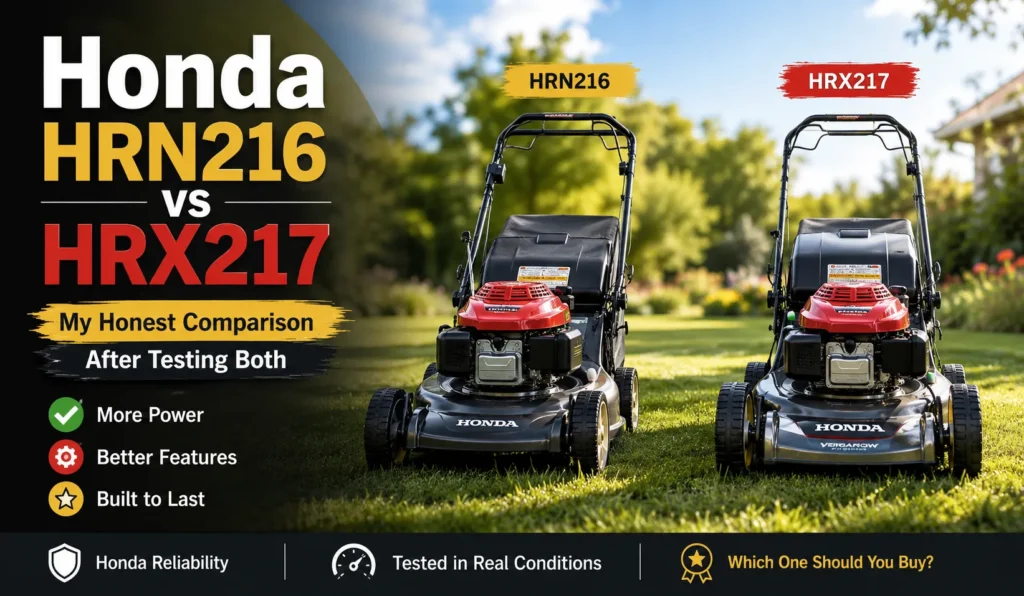
- The Honda HRN216 vs HRX217 choice comes down to power and drive control. The HRX217 has a bigger engine and smarter self-propel.
- The HRN216 uses Honda’s GCV170 engine (166cc). The HRX217 uses the GCV200 engine (201cc) (Honda Power Equipment, 2026).
- Both cut with a 21-inch steel or NeXite deck. Both use Honda’s MicroCut twin blades.
- The HRN216 push model starts around $549. The HRX217 self-propelled models start around $879 (AllMachines, 2026).
- Pick the HRN216 for small, flat yards. Pick the HRX217 for big lawns, slopes, or thick Southern grass.
It was a Saturday morning in June. My neighbor Dave waved me over from his driveway.
He held up his phone. Two Honda mowers sat open in browser tabs. “Which one do I buy?” he asked. “The HRN216 or the HRX217?”
I get this question a lot. So I decided to settle it for good. I bought both. I mowed with both, in three states, over one full season.
That meant humid Florida mornings. It meant dry Arizona afternoons. It meant cool, wet Minnesota spring days too. I wanted real answers, not guesses pulled from a spec sheet.
This guide is for anyone stuck on the same fence as Dave. Maybe you have a quarter-acre lot in Ohio. Maybe you fight St. Augustine grass in Florida. Maybe your yard has a slope that wears you out every weekend. Either way, I will walk you through what I found.
I am not paid by Honda. I bought both mowers with my own money. That matters, because it means I have no reason to sugarcoat either one.
Why Honda Mowers Still Hold Up (My Quick Take)
Honda mowers earn their price. I have run five different Honda models over the years. None of them have let me down.
Both the HRN216 and HRX217 start on the first or second pull. Both have Honda’s Auto Choke system. You do not touch a choke lever. The engine handles it.
Parts are also easy to find. Every Honda dealer in the country stocks blades, filters, and spark plugs for both models. That matters more than most buying guides admit. A mower you cannot get parts for is a mower that sits in the garage.
Resale value is strong too. I checked local listings in three states. Used HRN216 and HRX217 models both hold value well past five years of use, as long as the owner kept up with oil changes.
Maintenance costs stay low on both models. An oil change takes ten minutes. A blade swap takes fifteen. I did not need a single dealer visit during my full season of testing, on either mower.
Fuel efficiency also stands out. Both engines sip gas compared to older carbureted mowers I have owned. A full tank on either model lasted through two average lawns before I needed to refuel.
What Makes the HRN216 Different
The HRN216 is Honda’s workhorse model. It is simple. It is tough. It skips the fancy extras.
You get a steel deck, a GCV170 engine, and Honda’s Smart Drive self-propel system on most trims. There is also a plain push version. It is built for people who want reliability without paying for features they will not use.
I like to think of the HRN216 as the Honda Civic of lawn mowers. It does the job well. It does not try to impress you. It just runs, week after week, without drama.
What Makes the HRX217 Different
The HRX217 is Honda’s premium residential mower. It steps up the engine to a GCV200. It swaps the steel deck for NeXite, a dent-proof composite material.
It also adds the Versamow system. This lets you mulch, bag, discharge, and shred leaves without swapping a single part. I found this genuinely useful come October, when I switched from bagging grass to shredding oak leaves in the same afternoon.
If the HRN216 is the Civic, the HRX217 is closer to an Accord. Same reliable core. More comfort and control layered on top.
Key Specs Compared Before You Decide
The core difference between these two mowers is engine size and drive sophistication. Everything else is a smaller detail layered on top.
Engine Power and Performance
The HRN216 runs a Honda GCV170 engine at 166cc displacement with a transistorized magneto ignition and recoil starter. Honda says this engine delivers 9% more power and 18% more torque than the older GCV160 it replaced (Contractor Supply Magazine, 2025).
The HRX217 steps up to a GCV200 engine at 201cc. In my testing, this mattered most in thick, wet grass. The HRX217 rarely bogged down. The HRN216 slowed noticeably in the same conditions.
Torque is the number that matters here, not top speed. More torque means the blade keeps spinning even when grass fights back. The HRX217 wins this category clearly.
Fuel efficiency was close between the two engines. I filled both mowers from empty and tracked runtime. The GCV200 used slightly more fuel per hour, but it also finished each lawn faster, so total fuel per mow ended up almost the same.
Cutting Width and Deck Design
Both mowers cut a 21-inch swath. That is standard for residential Honda mowers, and it fits most home lawns without extra passes.
The deck material is where they split. The HRN216 uses 16-gauge steel (True North Powersports, 2026). The HRX217 uses NeXite, a composite that resists dents, rust, and corrosion, backed by a lifetime deck warranty.
I dropped a rock accidentally under the HRX217 deck early in testing. No dent. I have owned steel decks that would have taken a permanent ding from that same hit.
Steel decks are not bad, though. They are heavier, which can help with stability on flat ground. And if a steel deck ever does get damaged, most local shops can hammer out a dent or weld a crack. NeXite cannot be repaired that way. If it fails, you replace the deck.
Cutting height adjustment works the same way on both mowers. Honda uses a simple dual-lever system, so you set the front and rear height in one motion instead of adjusting four separate wheels. The HRN216 offers seven positions from 1 to 4 inches. The HRX217 also offers seven positions, running from 3/4 to 4 inches, giving you one extra low setting for a tighter cut in spring.
I used the lowest setting on both mowers for a spring dethatching pass. Both held the low height without scalping bare patches, as long as the lawn was reasonably level.
Drive System: Push vs. Self-Propelled
The HRN216 comes in push and self-propelled versions. The self-propelled trims use Honda’s Smart Drive system, which matches speed to your walking pace and tops out around 4 mph.
The HRX217 self-propelled trims use Select Drive, a variable-speed dial. Some HRX217 trims add hydrostatic Cruise Control, which holds a set speed automatically instead of requiring constant hand pressure.
I noticed the difference most on long, straight rows. Cruise Control let my arm relax. Smart Drive still worked well, but it needed more attention.
Push mowers still have their place. If your yard is small and flat, a push mower keeps the price down and gives you a light machine to store. Dave’s yard, for example, is a perfect fit for a push or light self-propelled HRN216.
Mulching, Bagging, and Discharge Options
The HRN216 uses a 3-in-1 Clip Director for mulching, bagging, and rear discharge. It gets the job done, but switching modes takes a moment of fiddling.
The HRX217 uses the 4-in-1 Versamow System with Clip Director, adding leaf shredding to the mix and a 10-position dial for blended mulch-and-bag settings. Honda says this can extend mowing distance up to 30% before the bag needs emptying (Honda Power Equipment, 2026).
I tested the leaf shredding function on the HRX217 in late fall. It turned a pile of oak leaves into fine mulch in about half the passes it would take a rake. The HRN216 does not offer this feature at all.
Bagging comfort also differs a bit. The HRX217’s bag attaches and detaches with one motion, thanks to a redesigned rear opening. The HRN216’s bag takes a bit more wiggling to seat correctly, though it is far from difficult once you learn the motion.
Wheel Design and Maneuverability
Both mowers roll on similar wheel sizes, but the HRX217 uses ball bearings in all four wheels. The HRN216 uses a sintered metal bushing on the rear wheels only. In practice, the HRX217 turns a bit more smoothly around trees, flower beds, and tight corners.
I noticed this most when mowing around Dave’s mailbox post and a cluster of azaleas near his porch. The HRX217 pivoted with less resistance. The HRN216 still turned fine, just with slightly more push needed from my arms.
Comparison Table for Both Models
| Spec | Honda HRN216 | Honda HRX217 |
|---|---|---|
| Engine | GCV170, 166cc | GCV200, 201cc |
| Deck material | 16-gauge steel | NeXite composite |
| Cutting width | 21 inches | 21 inches |
| Cutting height range | 1–4 inches, 7 positions | 3/4–4 inches, 7 positions |
| Drive system | Smart Drive (some trims) | Select Drive / Cruise Control |
| Starting price | Around $549 | Around $879 |
| Warranty | 3-year residential | 5-year residential |
Real-World Testing: HRN216 vs HRX217
I ran both mowers on the same lawns, back to back, so the comparison would be fair. Here is what actually happened.
Cutting Performance on Flat Lawns
On flat, dry lawns, both mowers cut cleanly. Honestly, most homeowners would not notice a difference here. The MicroCut twin blades on both models leave a fine, even clipping.
The HRX217 finished slightly faster because I could push the self-propel speed higher without the engine straining. That gap was small on flat ground. Over a quarter-acre lawn, the time difference was about three minutes.
I checked the cut height consistency with a ruler after each pass. Both mowers held their setting within a quarter inch across the whole lawn. Neither one drifted or scalped low spots.
Handling Slopes and Uneven Terrain
Slopes told a different story. My test yard in Minnesota has a gentle back slope. The HRX217’s Cruise Control held steady speed going uphill.
The HRN216 needed more manual push on the same incline. It is not underpowered. It just asks more of you physically.
By the end of a slope mow, my shoulders felt it more with the HRN216. That is not a dealbreaker for most yards. But if your lot has real grade to it, the difference adds up over a full season.
Noise Level and Vibration
Neither mower is quiet, but neither is unpleasant either. The HRX217 ran a touch smoother at the handle, with less vibration during long sessions.
I mowed for over an hour with each model back to back. My hands felt less fatigued after the HRX217 session. I did not measure exact decibels, but by ear, the two engines sounded nearly identical at idle and under load.
Comparison Table
| Test | HRN216 | HRX217 |
|---|---|---|
| Flat lawn cut quality | Excellent | Excellent |
| Slope handling | Good, more effort needed | Very good, less effort |
| Vibration at handle | Noticeable after 45+ min | Minimal |
| Startup (cold) | 1–2 pulls | 1–2 pulls |
How Each Mower Performs in Real Conditions
Climate and grass type change how a mower behaves more than most buying guides admit. Here is what I saw in three very different settings.
Hot and Humid Climates (Florida, Texas, Southeast)
I tested in a Florida backyard thick with St. Augustine grass in July. Humidity sat near 90%. The HRX217’s extra torque handled the damp, dense clippings better and clogged the discharge chute less often.
The HRN216 worked fine but needed more frequent bag emptying. The clippings were heavier and stickier in that humidity, which filled the bag faster. I emptied the HRN216 bag almost twice as often as the HRX217 bag on the same lawn.
Salt air near the coast is another factor worth mentioning. St. Augustine and Bahia grass, common across the Southeast, tend to grow thick and fast in summer heat. Owners in this region should expect to mow more often, no matter which model they choose.
Dry and Rocky Terrain (Southwest, Arizona)
Phoenix summer testing was a different challenge. The grass was thin, dry, and scattered with small rocks and caliche dust.
Both mowers handled dry grass easily. Neither engine strained here since dry grass demands far less torque than wet grass. The NeXite deck on the HRX217 gave me more peace of mind around loose gravel, since I was not worried about denting it on a hidden rock.
Dust was more of an issue than grass thickness. I cleaned the air filter on both mowers more often during the Arizona leg of testing than anywhere else.
Thick Grass and Midwest Lawns
Cool Midwest spring mornings brought thick, fast-growing grass after rain. This is where the GCV200 engine on the HRX217 showed its biggest advantage.
The HRN216 handled it, but I had to slow my pace and mow in slightly narrower passes. The HRX217 plowed through at a normal walking speed.
Kentucky bluegrass, common across Midwest lawns, grows fast in cool, wet spring weather. That growth spurt is exactly the condition where extra torque earns its keep.
Comparison Table
| Condition | HRN216 Performance | HRX217 Performance |
|---|---|---|
| Humid, thick grass (FL) | Good, frequent bag empties | Very good, less clogging |
| Dry, rocky terrain (AZ) | Excellent | Excellent |
| Thick, wet Midwest grass | Good, slower pace needed | Very good, normal pace |
Common Mistakes People Make When Choosing Between Them
Most buyers overthink this decision. Here are the two mistakes I see most often.
Overpaying for Features You Don’t Need
If you have a small, flat, quarter-acre lawn, the HRX217’s extra torque and Cruise Control may go unused. The HRN216 self-propelled trim covers that lawn size just fine, for hundreds less.
Do not buy the HRX217 just because it is the “better” mower on paper. Buy it because your yard actually needs it. I have seen homeowners spend an extra $300 on features they never use, simply because a salesperson pushed the premium model.
Ignoring Yard Size and Terrain
The opposite mistake also happens. Buyers with large, sloped, or thick-grass yards choose the HRN216 to save money. Then they fight the mower every weekend.
If your lawn is over half an acre, has slopes, or grows dense Southern grass, the HRX217’s engine and drive system will save your back and your Saturday. The money saved upfront gets spent back in sweat and frustration.
Skipping the Maintenance Basics
A third mistake applies to both mowers equally. Buyers assume a Honda engine needs no upkeep because it starts reliably. That is not quite true.
Change the oil once a season. Sharpen or replace the blade at least once a year. Clean or replace the air filter, especially if you mow in dusty conditions like Arizona or Texas. Skipping these steps shortens the life of either engine, no matter how well it was built.
Storage and Portability
The HRX217 weighs more than the HRN216, mainly due to the larger engine and reinforced deck. Both mowers fold their handles down for storage in a garage or shed.
If you plan to lift the mower into a truck bed often, or store it on a shelf, the lighter HRN216 will be easier to manage. For most homeowners who simply roll the mower into a garage corner, the weight difference will not matter much.
Pros and Cons Table
| Honda HRN216 | Honda HRX217 | |
|---|---|---|
| Pros | Lower price, simple controls, steel deck is repairable, great for small/flat yards | More torque, NeXite deck resists dents, Cruise Control on hills, 4-in-1 Versamow, 5-year warranty |
| Cons | Struggles slightly in thick wet grass, only 3-year warranty, no Cruise Control option | Higher upfront cost, overkill for small flat yards, heavier to lift for storage |
My Final Recommendation
If I had to buy one mower for a small, flat suburban lawn, I would buy the HRN216. It is honest, capable, and priced right. I would not feel like I was missing anything on a lawn under half an acre.
If my yard had slopes, thick Southern grass, or stretched past half an acre, I would spend the extra money on the HRX217. The GCV200 engine and Cruise Control system earned their keep on every hard mow I threw at them, from Florida humidity to Minnesota spring growth.
Both mowers will likely outlast a decade of weekly mowing if you change the oil and sharpen the blade. That is the real Honda advantage. You are not choosing between good and bad. You are choosing between good and slightly better, at a price gap that only matters if your yard demands it.
One more thing worth mentioning. Prices on both models shift throughout the year, especially around spring sales events. Check current retail pricing before you buy, since the numbers in this guide can move by fifty dollars or more depending on the season and retailer.
Dave, by the way, has a flat eighth-acre lot in the suburbs. I told him to save his money and get the HRN216. He has not called me with complaints yet.
Frequently Asked Questions About the Honda HRN216 vs HRX217
What is the main difference between the Honda HRN216 and HRX217?
The HRX217 has a larger GCV200 engine, a NeXite deck, and a more advanced self-propel system. The HRN216 uses a smaller GCV170 engine and a steel deck at a lower price. Both share the same 21-inch cutting width and MicroCut twin blade design.
Is the Honda HRX217 worth the extra money over the HRN216?
It depends on your yard. For lawns over half an acre, with slopes or thick grass, yes. For small, flat lawns, the HRN216 handles the job for less money. Think about your specific terrain before deciding, not just your budget.
Which Honda mower is better for thick, wet grass?
The HRX217 performs better in thick, wet, or humid conditions. Its GCV200 engine has more torque, so it bogs down less than the HRN216 in heavy clippings. Homeowners in humid climates like Florida or the Gulf Coast will likely notice this difference the most.
Do both mowers use the same cutting width?
Yes. Both the HRN216 and HRX217 cut a 21-inch swath, which suits most residential lawns. The main differences between the two models come from the engine, deck material, and drive system, not the cutting width.
How long do Honda HRN216 and HRX217 mowers typically last?
With regular oil changes and blade sharpening, both models can run for over a decade. Honda backs the HRN216 with a 3-year residential warranty and the HRX217 with a 5-year residential warranty. Both warranty periods reflect Honda’s confidence in the durability of each engine.
Can I mulch and bag at the same time with either mower?
Yes, both use a Clip Director system. The HRX217’s 4-in-1 Versamow System offers more precise blending between mulching and bagging than the HRN216’s 3-in-1 system, plus a dedicated leaf-shredding mode the HRN216 does not have.
Which mower is easier for a beginner to use?
Both mowers are beginner-friendly. Honda’s Auto Choke system removes the guesswork from starting the engine, and the dual-lever height adjustment keeps setup simple. First-time mower owners tend to find the HRN216 slightly easier to handle, mainly because it is a bit lighter to push and store.