

Quick Overview
- A lawn mower vibrating too much is almost always caused by an unbalanced or damaged blade, loose hardware, or debris caught under the deck.
- Check the blade first — it causes over 60% of vibration problems (Oregon Tool, 2023).
- Most fixes take under 30 minutes and cost less than $20 in parts.
- If vibration comes with a new metallic clanking sound, stop immediately — that signals a crankshaft or engine mount issue.
- This guide covers gas, electric, and battery-powered mowers.
You’re halfway through the backyard when something changes. The handles start rattling in your palms. The mower sounds different — rougher, louder. You stop and wonder if it’s always done that, or if something just broke.
That feeling is what this guide is for. A lawn mower vibrating too much is one of the most common problems homeowners deal with. And most of the time, you can fix it yourself in under an hour without a repair shop.
I’ve diagnosed vibration problems on everything from a Honda HRX217 in a Georgia backyard to a Husqvarna riding mower on a sloped Minnesota lot. I’ve worked on EGO battery mowers, old Ryobi push mowers, and zero-turns that shook hard enough to rattle your fillings loose. In most cases, the fix was simple.
This guide is for homeowners who want to find the problem themselves before spending money on a repair or replacement.
Why Your Lawn Mower Is Vibrating More Than Normal
Abnormal vibration means something is out of balance, loose, or damaged. The mower is trying to tell you something. The key is knowing how to read the signal.
A little vibration is normal — especially on gas push mowers with single-cylinder engines. What you’re looking for is a change: vibration that’s new, getting worse, or sharp enough to feel in your hands and forearms after just a few minutes.
It’s Usually One of Five Things
After years of diagnosing these issues, the cause almost always comes down to one of these:
- An unbalanced or bent mower blade
- A loose blade bolt or loose hardware on the deck
- A worn or broken drive belt
- Debris packed under the deck
- A damaged engine or motor mount
The blade is the place to start. It spins at up to 3,000 RPM (Outdoor Power Equipment Institute, 2022). Even a small nick or warp throws off the balance — and at that speed, small imbalances become big vibrations fast.
How to Tell If the Vibration Is Serious
Not all vibration is equal. Here’s how to read the signs.
Mild, consistent vibration that was always there – usually normal for your mower type.
New vibration that started suddenly – something changed. Check the blade and hardware right away.
Vibration with a new metallic sound – stop mowing immediately. This can mean a bent crankshaft, a blade that hit something hard, or a loose internal component.
Vibration that gets worse over time during a single session – heat-related or a belt that’s slipping.
If the mower shakes so hard you can’t hold it steady, or if you hear grinding, stop and do not restart it until you’ve found the cause. Running a mower with a bent crankshaft will destroy the engine.
The Most Common Causes (And How to Check Each One)
There’s a right order to diagnose this. Start with the easiest and most common causes before moving to the harder ones.
Each of these checks takes just a few minutes.
Unbalanced or Damaged Blade
This is the #1 cause of excessive mower vibration. It’s also the most overlooked.
Blades get nicked when they hit rocks, roots, or hard debris. A small nick on one side means one end of the blade is heavier than the other. At 3,000 RPM, that imbalance shakes the whole machine.
To check it: disconnect the spark plug (or battery on electric mowers), tip the mower on its side, and look at the blade. Look for:
- Visible bends or warps
- Chunks missing from the cutting edge
- Uneven wear — one end looks more worn than the other
- A blade that isn’t flat — hold a straightedge against it
A bent blade usually can’t be straightened safely. Replace it.
Loose Blade Bolt or Deck Hardware
If the blade bolt works loose, the blade wobbles as it spins. This creates a violent, irregular vibration — different from the steady hum of an unbalanced blade.
Check the blade bolt first with a torque wrench. Most mowers require 35-50 ft-lbs (check your owner’s manual for your specific model). Also check:
- Deck mounting bolts
- Handle bolts
- Any bracket or guard screws
Loose deck bolts are especially common after hitting a hard object or after a season of use.
Worn or Damaged Drive Belt
On self-propelled and riding mowers, the drive belt transfers power from the engine to the wheels or cutting deck. A worn belt develops flat spots, cracks, or fraying. When it spins over the pulleys unevenly, you feel it as vibration.
Signs of a bad belt:
- Vibration that pulses in and out rhythmically
- A squealing or slapping sound alongside the vibration
- Self-propulsion that’s inconsistent or jerky
To inspect it, remove the deck cover (see your manual) and look at the belt. If you see cracking, glazing, or fraying, replace it. Belt replacement is a moderate DIY job — typically 30-45 minutes.
Debris Caught Under the Deck
Wet grass, sticks, and compacted clippings can pack tightly under the deck. When a clump catches on the blade or spindle housing, it throws off rotation and causes sudden vibration.
This is the easiest fix on this list. Disconnect power, tip the mower, and clean the underside with a scraper or putty knife. Do it after every few mowing sessions in thick grass.
In states like Louisiana or Georgia where St. Augustine grass grows thick and wet, I do this every single time I mow.
Engine or Motor Mount Problems
The engine or motor sits on rubber mounts that absorb vibration. When those mounts crack or deteriorate, the engine vibrates directly into the frame — and into your hands.
This one is harder to spot. Look for:
- Cracked or missing rubber where the engine bolts to the frame
- The engine visibly rocking when it’s running (have someone watch from the side)
- Vibration that doesn’t change no matter what the blade condition is
Replacing engine mounts is a medium-difficulty job. On some mowers it’s straightforward. On others, you need to partially disassemble the top of the mower. If you’re not comfortable with that, take it to a shop.
Cause, Symptom, DIY Fix, and Difficulty Level
| Cause | Main Symptom | DIY Fix | Difficulty |
|---|---|---|---|
| Unbalanced blade | Steady, strong vibration | Balance or replace blade | Easy |
| Loose blade bolt | Irregular, violent shake | Torque bolt to spec | Easy |
| Worn drive belt | Pulsing vibration + sound | Replace belt | Moderate |
| Deck debris | Sudden or uneven vibration | Clean under deck | Easy |
| Engine mount worn | Vibration doesn’t change | Replace rubber mounts | Moderate |
| Bent crankshaft | Vibration + grinding sound | Take to a shop | Pro only |
How to Fix a Vibrating Lawn Mower Step by Step
Before you start any repair, disconnect the spark plug wire on gas mowers. On electric or battery mowers, remove the battery pack. These steps are not optional — a blade can spin if the engine fires unexpectedly.
Work on a flat surface with good lighting. A concrete driveway or garage floor is ideal.
Tools You’ll Need Before You Start
- Torque wrench
- Socket set (3/8″ drive is usually enough)
- Work gloves — mower blades are sharp even when dull
- A blade balancer (costs about $5 at any hardware store)
- Flat file or angle grinder (for sharpening)
- Penetrating oil like PB Blaster (for stubborn bolts)
- A stiff brush or putty knife for cleaning the deck
How to Balance a Mower Blade at Home
A blade balancer is a cheap cone-shaped tool that tells you instantly if one side of the blade is heavier. Here’s how to use one:
- Remove the blade (block it with a piece of wood first to stop it from spinning while you loosen the bolt).
- Clean both sides of the blade with a rag.
- Place the blade’s center hole over the cone of the balancer.
- Watch which side drops – that side is heavier.
- File metal from the heavier side’s back edge (not the cutting edge) in small amounts.
- Re-test until the blade sits level on the balancer.
If the blade is bent or has large chunks missing, don’t file it. Replace it. A new blade costs $15-25 for most push mowers.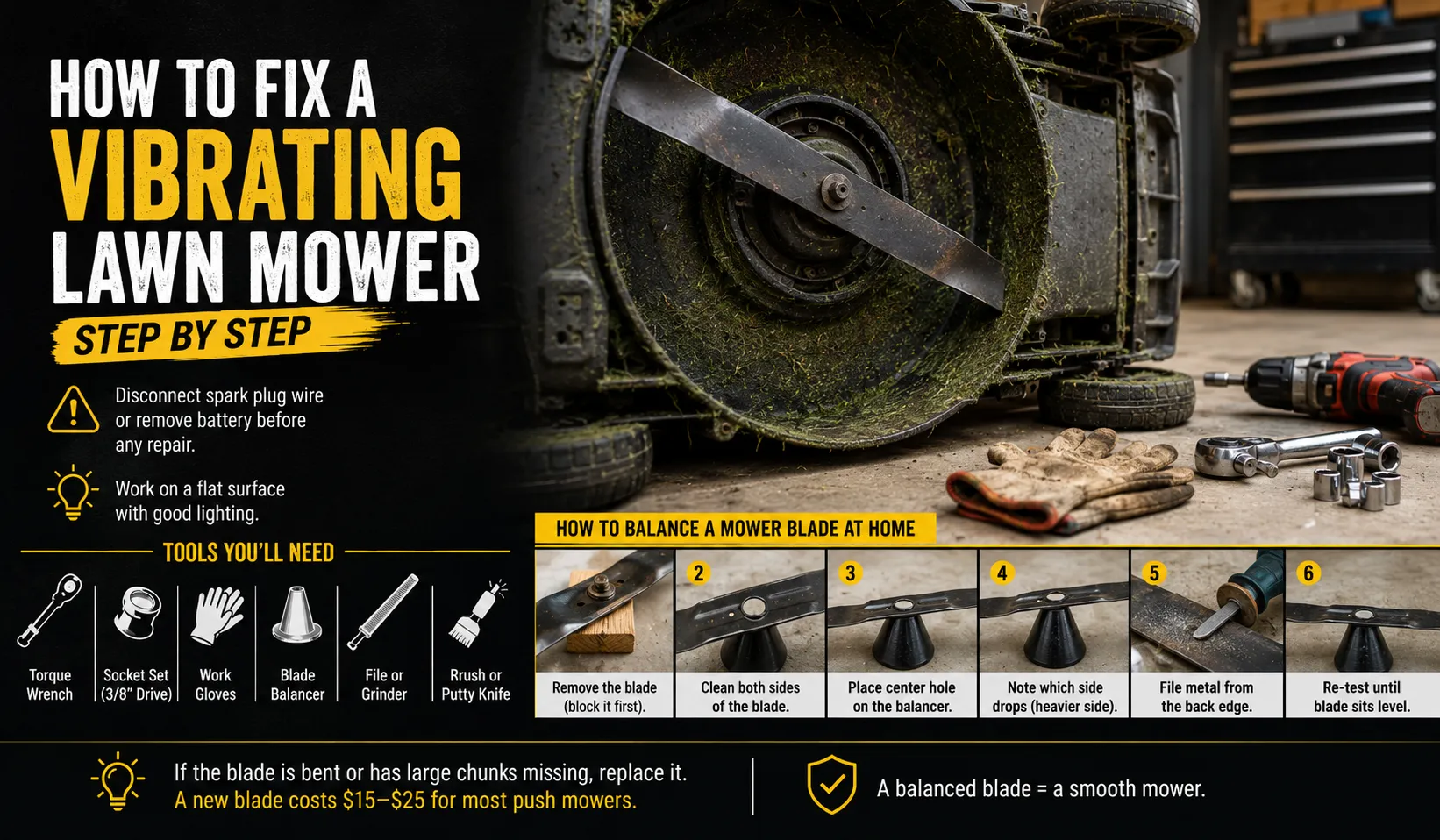
Tightening Loose Parts the Right Way
Torque matters. Over-tightening strips threads. Under-tightening lets things shake loose again.
- Blade bolt: Check your manual. Most are 35-50 ft-lbs. Honda HRX series uses 36 ft-lbs. Toro Recycler models typically call for 38 ft-lbs.
- Deck bolts: Usually 15-20 ft-lbs.
- Handle bolts: Snug, but not with full force — these are often plastic brackets.
Use blue threadlocker (Loctite 243) on bolts that keep coming loose. Do not use red — it’s nearly permanent and hard to remove later.
When to Replace vs. Repair
Here’s the honest answer: blades under $30 should almost always be replaced rather than repaired. The time you spend trying to straighten a bent blade isn’t worth it — and a straightened blade is never as safe as a new one.
For belts, same logic applies. A cracked belt that’s been running hot will fail again soon. Replace it.
For engine mounts — if the rubber is cracked but the mount is still mostly intact, you might get another season. If the rubber is gone and metal is hitting metal, replace it now.
Fix, Time Required, Estimated Cost, and Skill Level
| Fix | Time | Estimated Cost | Skill Level |
|---|---|---|---|
| Balance the blade | 15 min | $0-5 | Beginner |
| Replace the blade | 20 min | $15-30 | Beginner |
| Tighten blade bolt | 10 min | $0 | Beginner |
| Clean under deck | 10 min | $0 | Beginner |
| Replace drive belt | 30-60 min | $20-50 | Intermediate |
| Replace engine mounts | 45-90 min | $15-40 | Intermediate |
| Bent crankshaft repair | N/A | $100-300+ | Professional |
How Vibration Problems Show Up Differently by Mower Type
The cause of vibration depends partly on what kind of mower you’re running. Gas, electric, and battery-powered mowers have different components and different failure points.
Knowing your mower type narrows the diagnosis before you even pick up a wrench.
Gas Push Mowers
Gas push mowers — Toro Recycler, Honda HRX, Craftsman M215 — are the most common source of vibration complaints. The single-cylinder engine already produces more vibration than electric motors, so it can be harder to spot when something’s wrong.
On gas mowers, the blade is the first suspect. These mowers hit rocks and debris constantly, and the blade takes the hit directly. After that, check the engine mounts — rubber mounts on older gas mowers dry out and crack, especially in dry climates like Arizona or New Mexico.
Also check the air filter housing. On some older Briggs & Stratton engines, a loose air filter housing transmits vibration that feels like it’s coming from the engine itself.
Riding and Zero-Turn Mowers
Riding mowers and zero-turns (Husqvarna, Cub Cadet, Bad Boy) have more moving parts — which means more places for vibration to start.
The spindle is often the culprit here. Each blade on a deck has its own spindle — a shaft with a bearing inside. When that bearing wears out, the blade wobbles and the whole deck vibrates. You’ll feel it more when you engage the PTO (the lever that turns the blades on).
A bad spindle bearing makes a distinct high-pitched grinding sound when you put your hand near the deck housing (engine off, blade stopped). Replace the spindle assembly — it’s usually around $25-60 and a moderate DIY job.
Also check the deck belt tension. Zero-turns run long belts over multiple pulleys, and a stretched belt causes uneven power delivery.
Battery-Powered and Electric Mowers
EGO, Greenworks, Ryobi 40V, and similar battery mowers vibrate less than gas by design. The motors are smoother and more balanced. So when a battery mower vibrates noticeably, the cause is almost always mechanical — usually the blade.
One thing unique to electric mowers: the motor itself can vibrate if something gets into the motor housing. This is rare but it happens in dusty conditions or if small debris gets past the deck. If cleaning the blade and deck doesn’t fix it, have the motor inspected.
Battery mowers also don’t have a drive belt in the traditional sense. So if a Ryobi or EGO is vibrating, skip the belt check and go straight to blade balance and deck debris.
Mower Type, Common Cause, and Warning Signs
| Mower Type | Most Common Cause | Key Warning Sign |
|---|---|---|
| Gas push mower | Unbalanced blade or cracked engine mount | Vibration worsens mid-session |
| Riding mower | Worn spindle bearing or deck belt | Vibration starts when PTO engages |
| Zero-turn | Multiple blade spindles — any one can fail | Vibration from one side of the deck |
| Battery / electric | Blade balance or deck debris | Sudden vibration on an otherwise smooth mower |
How Different Conditions Make Vibration Worse
Your yard’s conditions affect how hard your mower works — and how quickly vibration problems develop.
The same mower that runs fine on a flat, sandy Arizona lawn might shake badly on a bumpy Midwest yard full of hidden rocks.
Thick, Overgrown Grass (Midwest, Pacific Northwest)
Tall, dense grass in places like Iowa or western Oregon puts the blade under heavy load. The blade slows slightly as it cuts through the thick grass. That creates a momentary imbalance in each rotation.
If you let grass get too tall before mowing, you strain the blade and belt. In this case, raise the cutting height and mow in two passes. The vibration usually drops immediately.
Grass that’s wet also clumps under the deck faster. After mowing wet grass in the Pacific Northwest, always clean under the deck before the clippings dry and harden.
Sandy or Rocky Terrain (Southwest, Southeast Coastal)
Sandy soil in places like coastal South Carolina or the Arizona desert hides rocks just below the surface. A blade hitting a buried rock at full speed takes a hard impact.
That’s how most blades get bent. One hit to a half-buried rock in a Scottsdale backyard left me with a blade so bent I could see it wobbling without even picking it up.
After mowing in rocky terrain, always check the blade. Even if it doesn’t look bent, run it on the balancer. Small imbalances from rock impacts are common.
Sloped or Uneven Yards
On hills and uneven ground, the mower’s weight shifts constantly. This strains the engine mounts and the drive system on self-propelled models. The wheels drop into dips and the deck flexes in ways it wasn’t built for.
Sloped mowing also lets grass and debris hit the blade at odd angles, which causes uneven wear over time. If you mow a lot of slopes, check blade balance more often — every 10-15 hours of run time rather than the standard 25.
Condition, Effect on Vibration, and Prevention Tip
| Condition | Effect on Vibration | Prevention |
|---|---|---|
| Thick / overgrown grass | Loads blade unevenly | Raise cutting height, mow in two passes |
| Wet grass | Debris packs under deck fast | Clean deck after every session |
| Sandy / rocky terrain | Blade gets nicked or bent often | Inspect blade after every mow |
| Sloped or uneven yard | Extra stress on mounts and drive | Check blade balance every 10-15 hours |
Common Mistakes People Make When Diagnosing Vibration
Most people go straight to the engine when their mower starts shaking. That’s usually the wrong move — and it wastes time.
Here are the two mistakes I see most often.
Blaming the Engine Before Checking the Blade
The blade is the first thing to check. Always. It causes more vibration problems than every other component combined.
I’ve seen people spend $150 at a shop diagnosing an “engine problem” that turned out to be a $20 replacement blade. The mechanic wasn’t wrong to check the engine — but the blade should have been inspected first.
Before you assume anything is wrong with the engine, do this in order:
- Remove and inspect the blade (bent, nicked, or unbalanced?)
- Check the blade bolt torque
- Clean under the deck
- Then look at the belt and spindles
Only after all of those come back clean should you start thinking about the engine.
Over-Tightening After a Fix
When something has been vibrating loose, the instinct is to crank it down hard. Don’t.
Over-tightening the blade bolt can crack the blade adapter — the metal cup the blade sits on. Replace that, and you’re looking at a $30-60 part and a frustrating afternoon.
Over-tightening deck bolts can strip threads in aluminum decks. Once the threads strip, you need a thread repair kit or a new deck.
Use a torque wrench. Every time. It takes 30 extra seconds and saves you from a much bigger problem.
My Final Recommendation
If your mower just started vibrating, start with the blade and deck hardware. These two things account for the vast majority of vibration problems. You can check both in under 20 minutes without special tools — just disconnect the spark plug first and use work gloves. Most of the time, you’ll find your answer there.
If you’ve gone through the full diagnosis — blade, bolt, belt, mounts, deck debris — and the vibration is still there, take it to a shop. A bent crankshaft, a failing ignition component, or internal engine damage aren’t things to guess at. Running a mower with a bent crankshaft will destroy the engine in a single season.
To prevent this from coming back: sharpen and balance the blade every 25 hours of use, clean under the deck after every wet-grass session, and check your bolt torque at the start of each season. That routine takes about 30 minutes a year and it’s the reason my mowers run smooth well past the 5-year mark.
DIY Diagnosis and Repair vs. Taking It to a Shop
| DIY | Shop | |
|---|---|---|
| Cost | $0-50 for most repairs | $60-200+ depending on diagnosis |
| Time | 20 min to 2 hours | 1-7 days wait time |
| Works best for | Blade, bolt, belt, deck debris | Crankshaft, engine internals, spindle replacement on riding mowers |
| Risk | Blade removal carries injury risk if done without precautions | Minimal risk to you |
| Tools needed | Torque wrench, sockets, balancer | None — shop provides |
| Learning value | High — you understand your mower better | Low |
Frequently Asked Questions About Lawn Mower Vibration
What causes a lawn mower to vibrate too much?
The most common causes are an unbalanced or damaged blade, a loose blade bolt, worn drive belt, debris packed under the deck, or a damaged engine mount. The blade alone accounts for the majority of vibration complaints (Oregon Tool, 2023). Start your diagnosis there.
Is it safe to keep mowing if my lawn mower is vibrating badly?
No. If the vibration is new, getting worse, or comes with a metallic clanking sound, stop immediately. Running a mower with a bent blade or failing crankshaft can cause further mechanical damage or a safety hazard. Diagnose the cause before mowing again.
How do I balance a lawn mower blade at home?
Remove the blade and place its center hole over a blade balancer cone — these cost about $5 at any hardware store. Whichever side drops is heavier. File small amounts of metal from the back edge of the heavy side until the blade sits level. If the blade is bent or heavily damaged, replace it instead.
Why does my mower only vibrate when the blades are engaged?
On riding mowers and zero-turns, vibration that only happens when you engage the PTO usually points to a worn spindle bearing, an unbalanced blade, or a deck belt problem. Each blade on a multi-blade deck has its own spindle. A worn bearing in any one of them creates this symptom.
How often should I check my mower blade for balance?
Check and sharpen the blade every 25 hours of use — about once per season for most homeowners. If you mow in rocky or sandy terrain (Southwest, Southeast coastal areas), check after every session. A single rock strike can throw off blade balance enough to cause noticeable vibration.
Can a dirty deck cause mower vibration?
Yes. Compacted grass clippings and debris under the deck can catch on the blade or spindle housing during rotation. This creates sudden, irregular vibration. Clean under the deck with a scraper after mowing wet or thick grass. It takes five minutes and prevents most debris-related vibration issues.
When should I take my vibrating mower to a repair shop?
Take it to a shop if you hear grinding alongside the vibration, if the mower shakes too hard to control, or if you’ve ruled out all DIY causes (blade, belt, mounts, debris) without finding the problem. A bent crankshaft or internal engine failure needs professional repair.