
Key Takeaways
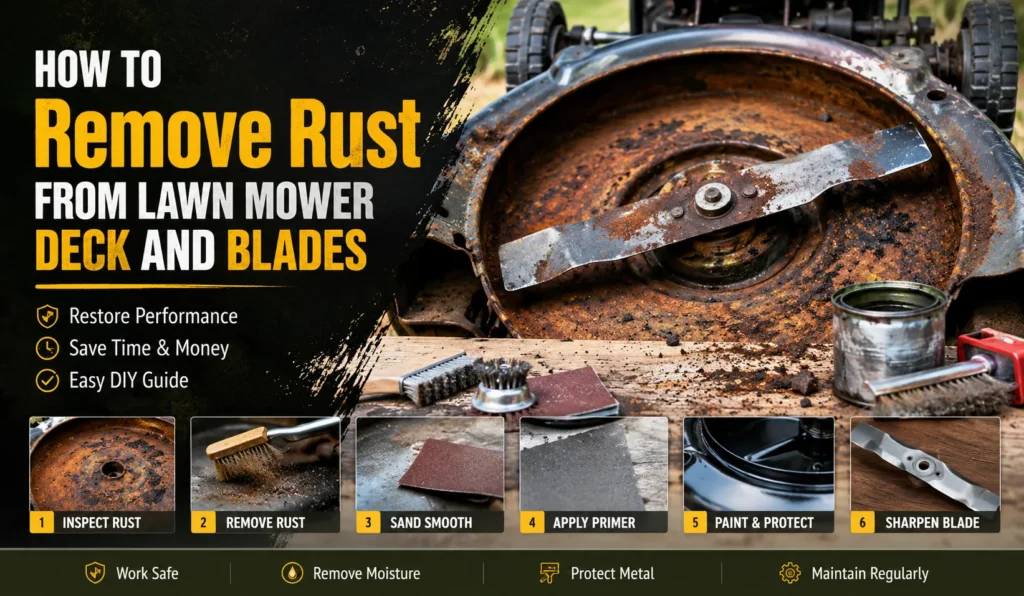
- You can remove rust from a lawn mower deck and blades at home using a wire brush, chemical rust remover, or sandpaper – no mechanic needed.
- Surface rust is fixable in an afternoon; deep rust with holes means it’s time to replace the part.
- Always disconnect the spark plug before touching the deck or blade.
- After rust removal, prime and paint the deck or rust comes back within weeks.
- Naval jelly works fastest on blades; a sanding disc works best on large deck areas.
Pull your mower out of the garage in spring and you might see it: orange crust coating the deck, maybe a blade that looks like it spent winter at the bottom of a lake. I’ve seen this more times than I can count – in a damp shed in Savannah, a leaky garage in Seattle, and yes, even a backyard shed in Phoenix where the monsoon season catches people off guard.
This guide is for homeowners who want to know how to remove rust from lawn mower deck and blades without calling a repair shop or buying a new mower. If the rust hasn’t eaten through the metal, you can fix it yourself in a few hours. I’ll walk you through exactly what I do, what products I use, and the one mistake I made in my first attempt that cost me an extra trip to Home Depot.
Why Lawn Mower Rust Is More Serious Than It Looks
Rust on a mower isn’t just cosmetic. Left alone, it weakens the metal, dulls blades faster, and can eventually eat holes through the deck. Here’s what you need to understand before you decide how to handle it.
Surface Rust vs. Deep Rust – What’s the Difference?
Surface rust is the orange-red layer that forms when moisture sits on bare metal. It hasn’t gone deep yet. You can scratch it with a fingernail and see solid metal underneath. This is what most people are dealing with after a wet winter.
Deep rust has started to pit or flake the metal. Press your thumb on it and it feels soft or crumbly. If you see holes – even small ones – the metal has been eaten through. At that stage, a deck patch or full replacement is the honest answer, not a wire brush.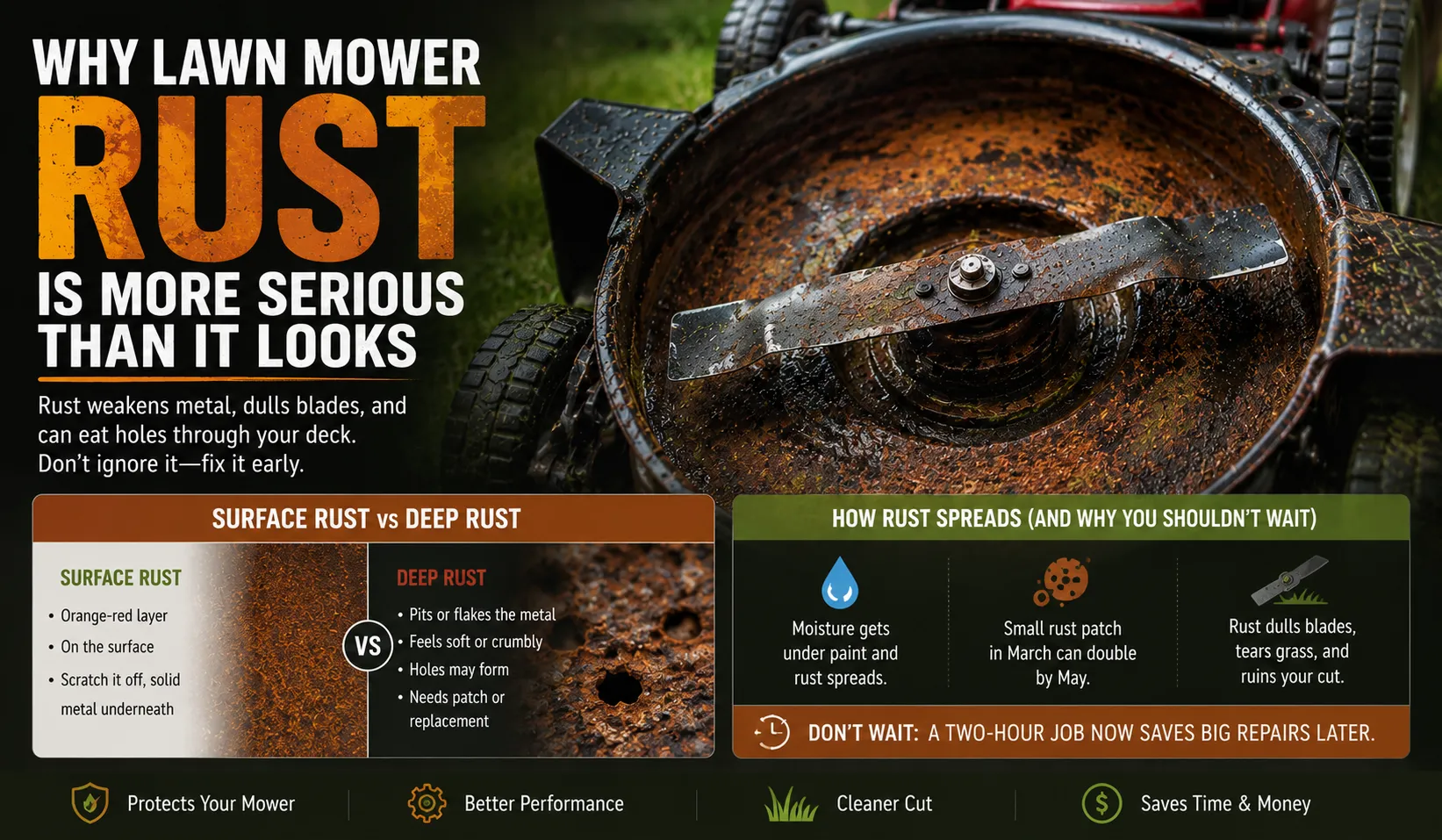
How Rust Spreads (and Why You Shouldn’t Wait)
Rust doesn’t stay in one spot. Once moisture gets under the paint, it travels along the metal surface. A small rust patch in March can double in size by May.
On blades, rust creates tiny rough edges. Those edges catch grass instead of cutting it cleanly. Your lawn ends up looking torn, not mowed. I noticed this on a Craftsman mower I was working on last spring – the cut looked ragged even after I’d sharpened the blade. The rust on the edge was the problem.
Don’t wait. A two-hour job now beats a full deck replacement later.
Tools and Materials You’ll Need Before You Start
Get everything together before you start. Stopping mid-job to run to Lowe’s is frustrating, and leaving bare metal exposed while you wait doubles the rust risk.
Safety Gear You Can’t Skip
- Safety glasses – wire brush bristles and rust flakes fly
- Heavy work gloves – blades are sharp even when rusted
- N95 dust mask – rust dust is not something you want to breathe
- Old clothes – rust remover stains and won’t wash out
Rust Removal Products That Actually Work
Not every product on the shelf does what it claims. Here’s what I’ve used and trusted:
- Wire brush (hand or drill attachment) – good for scrubbing loose rust on the deck
- Naval jelly – a phosphoric acid gel that dissolves rust on blades and tight spots
- Rust converter (like Corroseal or Rust-Oleum Rust Reformer) – chemically bonds with rust and turns it into a paintable surface
- 80-grit sandpaper or sanding disc – for smoothing after chemical treatment
- Rust-inhibiting primer (Rust-Oleum Clean Metal Primer works well)
- High-heat spray paint – standard deck paint holds up better than regular enamel
Tools, Cost, and Where to Buy
| Tool / Product | Approx. Cost | Where to Find It |
|---|---|---|
| Wire brush drill attachment | $8-$15 | Home Depot, Lowe’s |
| Naval jelly (8 oz) | $7-$10 | Home Depot, Amazon |
| Rust converter spray | $10-$15 | Lowe’s, Auto parts stores |
| 80-grit sandpaper pack | $6-$9 | Any hardware store |
| Rust-inhibiting primer | $8-$12 | Home Depot, Lowe’s |
| High-temp deck paint | $10-$14 | Home Depot, Lowe’s |
How to Remove Rust From a Lawn Mower Deck
The deck takes the most abuse. It sits inches above wet grass for hours. Here’s the exact process I follow every time.
Step 1 – Safety First, Disconnect the Spark Plug
Before anything else, pull the spark plug wire off. It’s a black rubber cap on the side of the engine. Pull it loose and tuck it away from the plug. This prevents any accidental starts while your hands are near the blade.
Tip the mower on its side with the air filter facing up. This keeps oil from draining into the filter. On most Husqvarna and Toro push mowers, this means tilting toward the left side.
Step 2 – Scrape Off Loose Rust and Debris
Use a putty knife or stiff scraper to knock off any loose rust, caked grass clippings, and flaking paint. Don’t skip this. Chemical removers and primers don’t bond well to loose material.
The smell when you scrape wet rust off a mower deck is distinctive – damp, metallic, slightly sour. If you get that smell, you’re doing it right.
Step 3 – Apply Your Rust Remover or Wire Brush Method
For light surface rust, a wire brush drill attachment is the fastest tool. Run it across the rusted areas in short, overlapping strokes. You’ll see the rust come off in orange dust. Takes about 10-15 minutes for a standard deck.
For heavier rust, apply naval jelly with an old paintbrush. Coat the rusted areas and let it sit for 10-15 minutes. It turns the rust into a dark, almost black layer that wipes off with a damp rag. This is where I made my mistake the first time – I wiped it off after 5 minutes and had to reapply. Let it sit the full time.
Step 4 – Sand and Smooth the Surface
After the rust is removed, run 80-grit sandpaper over the area to smooth any rough spots. Then switch to 120-grit to give the primer something to grip. Wipe everything down with a damp rag and let it dry completely – 20-30 minutes in normal conditions.
The metal should look dull gray at this point. If you still see orange patches, go back with the wire brush or naval jelly.
Step 5 – Apply Rust-Inhibiting Primer and Paint
This step is the one most people skip. Don’t.
Spray a thin, even coat of rust-inhibiting primer over the bare metal. Let it dry for 30 minutes. Then apply a second coat. Once the primer is fully dry (usually 1-2 hours), apply two thin coats of high-temp deck paint. Hold the can 10-12 inches away and keep moving – pooling paint will peel.
The deck will look almost new. More importantly, the primer seals the metal and slows moisture from getting back in.
Rust Removal Methods Compared
| Method | Best For | Time Required | Cost | Effort Level |
|---|---|---|---|---|
| Wire brush | Light surface rust on flat areas | 15-20 min | Low ($8-$15) | High effort |
| Naval jelly | Moderate rust, tight spots, blades | 20-30 min | Low ($7-$10) | Low effort |
| Chemical rust converter | Heavy rust, skip sanding step | 30-40 min | Medium ($10-$15) | Very low effort |
| Sanding disc | Large deck areas, prep before paint | 20-30 min | Low ($6-$9) | Medium effort |
How to Remove Rust From Lawn Mower Blades
Blades are different from the deck. The metal is thicker, the rust patterns are different, and there’s a real question of whether a rusty blade is worth cleaning or just needs to be replaced.
When to Clean the Blade vs. When to Replace It
Clean the blade if the rust is surface-level and the blade edge is still intact. Run your gloved finger along the edge – it should feel sharp enough to bite.
Replace the blade if:
- You see pitting or deep grooves from rust
- The blade is bent (even slightly)
- There are cracks near the center hole
- The edge has chunks missing
A new blade for most standard push mowers runs $15-$30 at Home Depot. For an EGO or Toro, check the brand’s site for the right part number. It’s a cheap fix if the blade is too far gone.
How to Safely Remove the Blade
With the spark plug disconnected and the mower on its side, hold the blade with a thick rag or work glove. Use a socket wrench (usually 5/8″ or 15/16″ depending on the mower) to loosen the center bolt. Turn counterclockwise.
The bolt is usually tight. Sometimes very tight. I use a breaker bar on older Craftsman decks where the bolt hasn’t moved in years.
Mark which side of the blade faces down before you remove it. Some blades have a slight curve that matters for airflow.
The Best Way to Remove Rust From Blades
Naval jelly is my go-to for blades. It gets into the edges and tight spots that a wire brush can’t reach cleanly.
Lay the blade on cardboard. Brush a thick coat of naval jelly over both sides. Leave it for 15 minutes. Then scrub with a stiff brush and rinse under running water. Dry immediately with a rag – don’t let it air dry or it’ll start rusting again before you’ve even put it back.
For stubborn spots, steel wool (0000 grade) works well. It’s fine enough not to scratch but abrasive enough to take off the rust.
Sharpening After Rust Removal – Does It Need It?
Yes, almost always. The wire brush and sandpaper needed to remove rust will dull the edge slightly. A dull blade tears grass instead of cutting it, which stresses the lawn and makes it prone to disease.
You can sharpen with a flat metal file, a blade sharpening stone, or a drill-mounted sharpening kit from Home Depot. Keep the angle consistent – usually 30 to 45 degrees, following the factory bevel. Sharpen until you see a thin silver edge form.
If you’re not confident sharpening at home, a local small engine shop can do it for $5-$10 and it’s worth it.
Blade Condition Guide
| Condition | What You See | Action |
|---|---|---|
| Light surface rust | Orange film, edge still sharp | Clean with naval jelly, resharpen |
| Moderate rust | Pitting, dulled edge | Clean, sharpen, check balance |
| Heavy rust | Deep grooves, rough texture | Likely replace |
| Bent or cracked | Visible damage | Replace immediately |
How Rust Builds Up in Different US Climates
Rust doesn’t happen the same way everywhere. Where you live changes how fast it develops and what habits matter most.
Humid and Coastal Climates (Florida, Carolinas, Gulf Coast)
Salt air is the most aggressive environment for mower decks. In coastal areas like the Carolinas and Gulf Coast, the combination of humidity and salt accelerates rust faster than almost anywhere else. I’ve seen decks in Savannah rust through in two seasons when left uncovered.
If you’re in this climate, rinse your deck with fresh water after every mow during salt-wind season. And prime every year, not every few years.
Rainy Seasons (Pacific Northwest, Midwest)
In Seattle, a mower stored in a slightly damp garage will rust in one winter. The issue isn’t dramatic rain – it’s constant low-level moisture. A dehumidifier in the storage area or a breathable cover over the mower makes a big difference.
I’ve had the best results in wet climates by coating the clean deck with WD-40 before winter storage, then priming and repainting in spring.
Dry Climates – Yes, It Still Happens (Arizona, Nevada)
People in Phoenix or Las Vegas are often surprised by rust on their mowers. But Arizona’s monsoon season brings weeks of high humidity in July and August. Mowers left outside during those weeks develop rust fast, especially if they’ve been through sandy, abrasive conditions that strip paint from the deck.
The fix is the same – just be aware the window of risk is concentrated in those monsoon months.
Climate vs. Rust Risk Level
| Climate / Region | Rust Risk | Primary Cause | How Often to Inspect |
|---|---|---|---|
| Coastal / Gulf Coast | Very High | Salt air + humidity | Every 3 months |
| Pacific Northwest | High | Constant moisture | Every 6 months |
| Midwest | Medium-High | Humid summers, wet springs | Every 6 months |
| Southeast (inland) | Medium | Summer humidity | Once a year |
| Southwest (dry) | Low-Medium | Monsoon seasons | Once a year |
Common Mistakes People Make When Removing Rust
Most rust removal jobs fail at the same two points. Here’s what to watch for.
Using the Wrong Product on the Wrong Surface
Rust converter and naval jelly are not interchangeable. Rust converter works best when you leave the treated rust in place and paint over it – it bonds with the rust and creates a stable surface. Naval jelly removes the rust entirely, which is what you want on blades where a smooth, clean edge matters.
I used rust converter on a blade once thinking it would save time. The blade looked fine, but the converted layer started chipping off within a few weeks under the stress of mowing. Stick to naval jelly or mechanical removal (wire brush + sandpaper) for blades.
Skipping the Primer After Rust Removal
Bare metal rusts fast. Faster than you’d think. I’ve seen a cleaned deck develop light surface rust within 48 hours of sitting in a humid garage without primer.
Primer isn’t optional. It’s the step that makes everything else last. Rust-inhibiting primer creates a barrier between the metal and moisture. Without it, you’re back to square one by next season.
How to Prevent Rust From Coming Back
Getting rid of rust is the hard part. Keeping it gone is mostly habit.
Storage Habits That Make a Big Difference
Store your mower in a dry place with good airflow. A plastic tarp draped directly over a mower can trap moisture underneath, which is worse than no cover at all. Use a breathable fabric cover or leave a gap at the bottom.
Before winter storage, run the engine until it’s warm, then shut it off and let it cool. Clean the deck thoroughly – wet grass clippings left on the deck all winter are one of the most common causes of rust. Then apply a coat of WD-40 to the underside of the deck and the blade.
Simple Maintenance Routine After Every Mow
Hose off the underside of the deck after every mow. Let it dry before putting it away. Once a month during the mowing season, look at the deck underside for any bare metal spots or small rust patches. Catch them early and a quick sand and touch-up coat handles it in 20 minutes.
Once a year – I do it every spring before the first mow – inspect the blade condition, check the deck for paint chips, and reapply primer and paint anywhere the coating is wearing thin.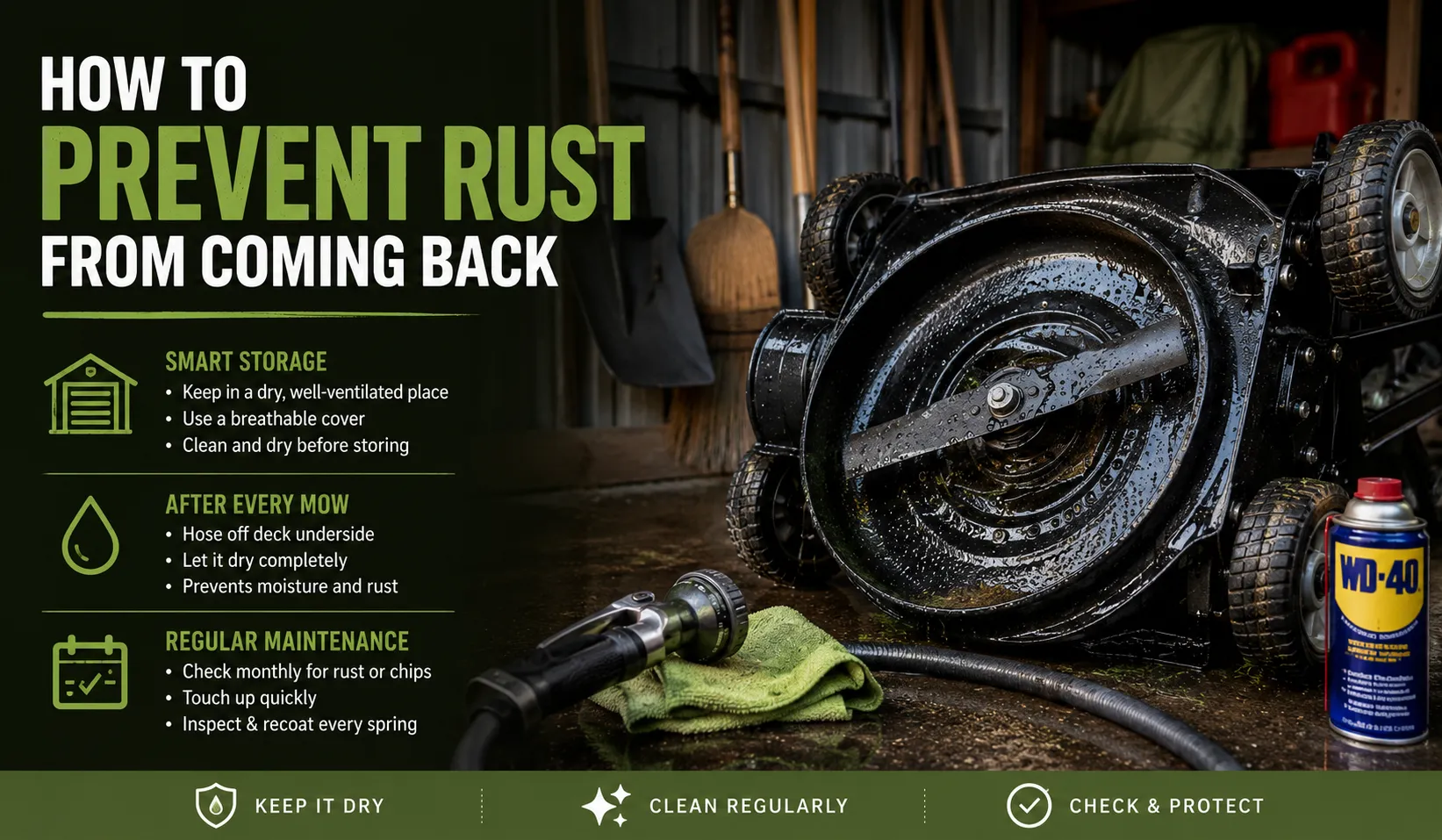
My Final Recommendation
After years of dealing with this in different parts of the country, my honest take is this: the wire brush and naval jelly combination handles 90% of rust problems most homeowners will see. For the deck, the sanding disc plus rust-inhibiting primer is the most reliable long-term fix I’ve found. The extra hour spent on primer pays off for two to three seasons.
On blades, replace rather than repair if you’re unsure. A $20 blade from Home Depot installed in 15 minutes beats spending 45 minutes cleaning a blade that still doesn’t cut cleanly. I’ve kept blades too long before and paid for it with a patchy, torn-looking lawn through June.
The one thing I’d tell anyone in a high-humidity climate – coastal Carolina, the Gulf, the Pacific Northwest – is that prevention matters more than removal. An annual inspection and recoat keeps you out of a half-day rust removal job. A little WD-40 in October is worth far more than a wire brush in April.
Rust Removal Methods: Pros and Cons
| Method | Pros | Cons | Best Use Case |
|---|---|---|---|
| Wire brush | Cheap, no chemicals, immediate results | Labor-intensive, can miss tight spots | Light rust on flat deck surfaces |
| Chemical rust remover (naval jelly) | Works in tight spots, low effort | Requires rinsing, slow on heavy rust | Blades, edges, detailed areas |
| Sanding disc | Fast on large areas, smooth finish | Needs drill, throws rust dust | Large deck surface before priming |
| Rust converter | Bonds with rust, paintable surface | Doesn’t remove rust, not for blades | Heavy deck rust where removal isn’t possible |
Frequently Asked Questions About Removing Rust From Lawn Mower Decks and Blades
How do I remove rust from a lawn mower deck at home?
Disconnect the spark plug, scrape off loose rust, apply naval jelly or use a wire brush, sand the surface smooth, then apply rust-inhibiting primer and two coats of high-temp deck paint. The full process takes 2-3 hours including drying time.
Is it worth removing rust from an old mower, or should I buy a new one?
If the metal is solid with no holes and the engine runs well, rust removal is worth it. Deck replacements cost $80-$200. A new paint job costs under $30. Only replace the mower if the engine has problems or the deck has rusted through.
What is the best product to remove rust from lawn mower blades?
Naval jelly (available at Home Depot for around $8) is the most effective and lowest-effort option for blades. Apply it, let it sit 15 minutes, scrub with a stiff brush, rinse, and dry immediately. Follow up with sharpening.
How do I stop my lawn mower deck from rusting again?
Apply rust-inhibiting primer after any rust removal and repaint bare spots every spring. Clean grass clippings off the deck after every mow, and store the mower under a breathable cover in a dry space. A coat of WD-40 on the underside before winter storage adds an extra layer of protection.
Can I use WD-40 to remove rust from my mower?
WD-40 can loosen surface rust and is good for protecting clean metal, but it’s not a true rust remover. For actual rust removal, use naval jelly, a chemical rust converter, or mechanical methods like a wire brush or sanding disc. Use WD-40 after cleaning as a protective coat.
How often should I check my mower deck for rust?
In humid or coastal climates, inspect every 3 months. In moderate climates, once a year in spring is usually enough. Any time you see paint chipping or bare metal, address it immediately – that’s where rust starts.
Do I need to sharpen the blade after removing rust from it?
Yes. The abrasive process of rust removal dulls the blade edge. A sharp blade cuts cleanly and is easier on your lawn. Sharpen with a flat file or drill-mounted sharpening kit at a 30-45 degree angle following the factory bevel, or take it to a small engine shop.