
Quick Overview
- Skipping winter prep is the single most common reason gas mowers fail to start in spring – old fuel gums up the carburetor in as little as 30 days.
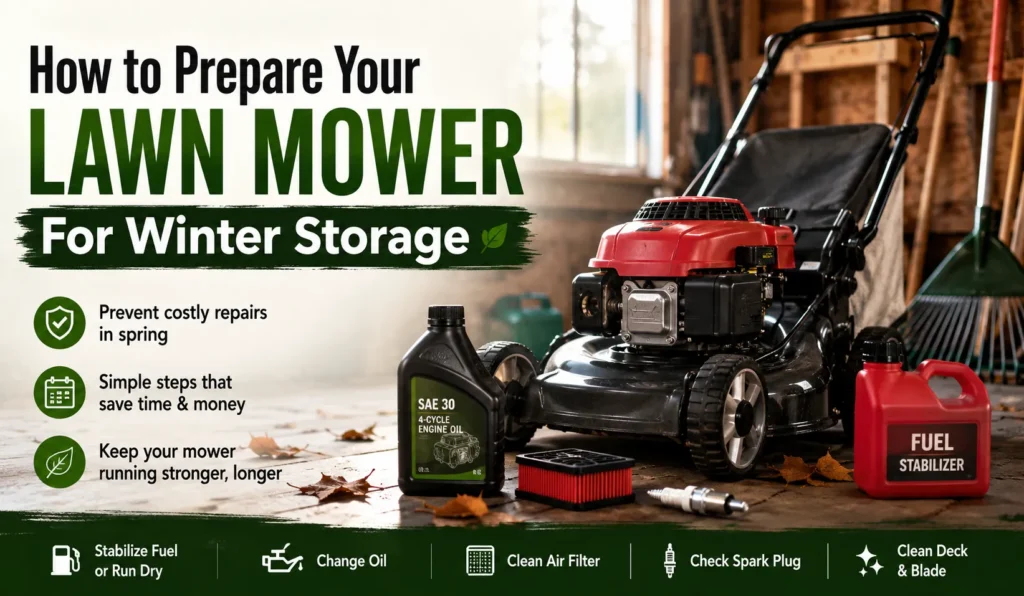
- Gas mowers need fuel treatment or a dry tank, fresh oil, a clean air filter, and a checked spark plug before storage.
- Battery mowers need a 40-60% charge level and indoor storage above freezing – lithium-ion cells degrade fast in a cold garage.
- Most homeowners skip cleaning under the deck; that caked-on grass and moisture is what causes rust over winter.
- Good prep takes 45-90 minutes once a year and can add years to a mower’s lifespan.
Three springs ago, I pulled my Honda HRX217 out of my Minnesota garage, turned the key, and got nothing but a wheeze and a smell like varnish. That’s the smell of old gasoline that sat in a carburetor all winter and turned into a sticky paste. The repair bill was $140. The mechanic told me it was entirely preventable. He was right.
Knowing how to prepare your lawn mower for winter storage is one of those things you only learn the hard way, or from someone who already did. This guide is for homeowners with a gas mower, a battery mower, or both – heading into their last cut of the season and wanting to make sure the mower comes back to life in spring without drama.
I’ve stored mowers in a drafty Chicago garage, a damp Oregon shed, and a Georgia carport where “winter” barely drops below 50. The right approach varies a bit depending on where you live. I’ll cover all of it.
Why Winter Prep Actually Matters (I Learned the Hard Way)
Most homeowners treat the last mow of the season like any other – finish the lawn, push the mower into the shed, call it done. That works fine until it doesn’t.
What Happens When You Skip It
Old gasoline is the main villain for gas mowers. After about 30 days, ethanol-blended fuel (which is nearly every pump gas in the US) starts to separate and degrade. By spring, it leaves behind a sticky residue that clogs the carburetor jets and fuel passages. A clogged carburetor means a mower that won’t start, runs rough, or surges.
Beyond fuel, moisture is the other problem. Grass clippings packed under the deck hold moisture against the metal all winter. That’s how decks rust from the inside out. Same issue applies to blades left dirty – they dull faster and can pit or corrode by March.
Battery mowers have a different failure mode. Lithium-ion batteries stored at very low charge, or exposed to freezing temperatures repeatedly, lose permanent capacity. A battery that was 5 amp-hours in October can measure 3.8 amp-hours by April. That lost capacity never comes back.
Gas vs. Battery Mowers – Different Problems, Different Fixes
The risks are different enough that I think of them as two separate machines.
Gas mowers fail because of chemistry – fuel going stale, oil breaking down, rubber gaskets drying out. The fixes are mostly about draining, cleaning, and protecting surfaces.
Battery mowers fail because of physics – lithium-ion cells lose capacity when stored discharged or in extreme cold. The fixes are mostly about charge management and temperature control.
Both types benefit from a clean deck and a dry storage environment. That part is the same regardless of what powers them.
Step-by-Step: How to Winterize a Gas Lawn Mower
Work through these steps in order. Each one takes 5-20 minutes. The whole process should run about 60-90 minutes the first time you do it, less once you know the routine.
Run It Dry or Use Fuel Stabilizer?
You have two legitimate options, and both work. The wrong choice is doing neither.
Option 1: Fuel stabilizer. Add a product like STA-BIL 360 or Sea Foam to a nearly-full tank, run the mower for 2-3 minutes to circulate the treated fuel through the carburetor, then store it. A full tank leaves less air space for moisture to condense inside. Stabilizer treats are good for up to 12 months (STA-BIL, 2024).
Option 2: Run the tank dry. Run the mower until it sputters and stops, then use the fuel shutoff valve (if your mower has one) to let the carburetor drain completely. This is cleaner long-term but takes more time, and you need to run the engine outdoors with ventilation.
I prefer stabilizer for mowers I’ll use again within 8 months. For anything sitting through a full 9-12 month off-season, I run it dry.
Whatever you do, don’t leave untreated fuel sitting in the tank. That’s the one thing that consistently wrecks carburetors.
Change the Oil Before You Store It
This step surprises people. Most assume you change oil in spring, not fall. But used engine oil contains combustion byproducts – acids, moisture, and carbon particles. Leaving that inside the engine all winter accelerates wear on the cylinder walls and bearings.
Drain the old oil while the engine is still warm from the last run – warm oil flows out faster and carries more contaminants with it. Add fresh SAE 30 or 10W-30 per your owner’s manual. It takes about 15 minutes total.
Brands like Honda and Toro recommend this in their own winterizing guides. It’s not overkill – it’s maintenance.
Clean or Replace the Air Filter
A dirty air filter going into storage isn’t a crisis, but it can attract mice (seriously – they love dusty paper filters as nesting material). Pull the filter out, tap it against your hand to knock out loose debris, and hold it up to light. If you can’t see light through it, replace it. Paper filters run $5-12 at any hardware store.
Foam filters can be washed with dish soap, dried fully, and lightly oiled with engine oil before reinstalling.
Inspect and Replace the Spark Plug
Pull the spark plug with a socket wrench. Look at the tip. A tan or light gray tip is normal. Black and sooty means the engine is running rich. White or blistered means it’s running hot or lean.
If the plug is black, replace it before storage. If it looks normal, you can reinstall it – but gap it correctly first (check your manual, usually 0.030″). New plugs are $3-8 and eliminate one more possible spring failure point.
I keep a spare plug rubber-banded to the mower’s handle. It’s saved me twice.
Sharpen and Clean the Blade
Dull blades tear grass instead of cutting it, making lawns more vulnerable to disease in spring. Late fall is actually the best time to sharpen because you have all winter before you need the mower again.
Remove the blade (disconnect the spark plug wire first), sharpen it with a file or angle grinder, and balance it on a nail. If one side drops, grind a little more off the heavy side. An unbalanced blade vibrates and damages the spindle over time.
While the blade is off, clean the underside of the deck. More on that in the cleaning section below.
Gas Mower Winterization Checklist
| Task | Why It Matters | How Often |
|---|---|---|
| Add fuel stabilizer or drain tank | Prevents carburetor gumming | Every winter |
| Change engine oil | Removes acidic used oil before it damages internals | Every winter (or every 50 hours) |
| Clean or replace air filter | Prevents debris buildup and pests | Every winter |
| Check/replace spark plug | Ensures reliable cold-weather startup in spring | Every 1-2 years |
| Sharpen and balance blade | Prevents spring scalping and spindle damage | Every year |
| Clean under the deck | Prevents rust and buildup | Every winter |
| Spray exposed metal with WD-40 | Blocks moisture from settling on bare metal | Every winter |
| Store in dry, sheltered location | Prevents rust and freeze-thaw damage | Every winter |
Step-by-Step: How to Store a Battery-Powered Lawn Mower for Winter
Battery mower storage is simpler in some ways and more specific in others. The machine has no fuel, oil, or carburetor to worry about. But the battery is expensive ($100-300 to replace) and sensitive to both charge level and temperature.
EGO, Ryobi, Greenworks, and Makita all publish storage guidelines for their battery systems. The core advice is consistent across brands.
The Right Battery Charge Level for Long-Term Storage
Store lithium-ion batteries at 40-60% charge. Not dead. Not fully charged.
A battery stored at 0% can fall into a deep discharge state that makes it difficult or impossible to recharge. A battery stored at 100% keeps the cells under constant stress, which accelerates capacity loss over months. The 40-60% range is the voltage sweet spot where lithium-ion chemistry is most stable (Battery University, 2023).
Check your mower’s battery indicator before storing it. Run it down a bit if it’s fully charged, or top it up slightly if it’s nearly empty. Then pull the battery out of the mower and store it separately.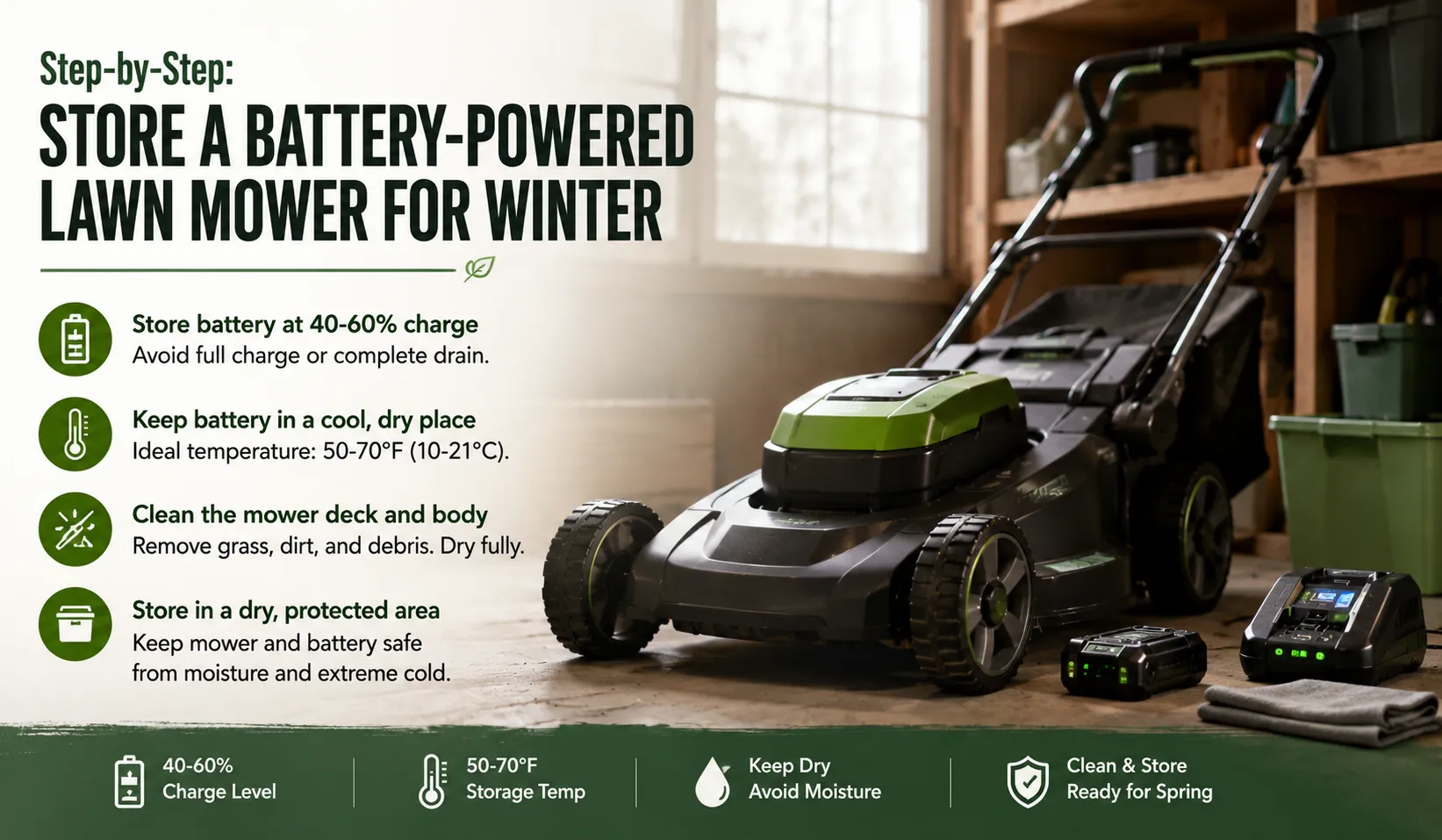
Where to Store the Battery (Temperature Matters)
Keep the battery in a temperature range of 50-70°F if possible. A heated basement, a utility room, or an indoor closet all work well.
A Minnesota garage in January can hit -20°F. At those temperatures, lithium-ion cells lose temporary capacity and can suffer permanent damage if cycled (charged or discharged) while frozen. Even a Georgia garage can see freezing nights in January and February – don’t count on mild winters to protect the battery.
My EGO batteries spend October through March in a box in my basement. Takes 30 seconds to bring them inside, and it’s saved me battery replacements more than once.
Cleaning the Deck and Body Before Storing
Even without oil or fuel concerns, battery mowers need the same deck cleaning as gas mowers. Wet grass under a plastic deck can mold and breed bacteria – and it attracts mice just like it does on gas mowers.
Wipe down the body with a damp cloth. Dry it fully before putting it away.
Battery Mower Storage Checklist
| Task | Why It Matters | How Often |
|---|---|---|
| Set battery to 40-60% charge | Prevents deep discharge or cell stress | Every winter |
| Remove battery and store indoors | Prevents cold damage to lithium-ion cells | Every winter |
| Clean under the deck | Prevents mold, rust, and pests | Every winter |
| Sharpen the blade | Same blade wear as gas mowers | Every year |
| Wipe down body and discharge ports | Keeps contacts clean, prevents corrosion | Every winter |
| Store mower body in dry location | Prevents moisture damage to motor and wiring | Every winter |
Cleaning Your Mower the Right Way Before Storage
Cleaning is the step most people rush or skip entirely. It’s also the step that matters most for preventing rust over the off-season.
Give yourself 20-30 minutes for this. Do it before any other winterizing step so the deck is clear when you’re working on the blade.
Under the Deck – the Part Everyone Ignores
Flip the mower on its side (gas mowers: tilt with the carburetor side up to prevent oil getting into the air filter). What you’ll find under there is probably unpleasant – a thick layer of compacted grass, dried mud, and sometimes small rocks caked onto the metal.
That layer holds moisture against the deck all winter. On steel decks, that means rust. On aluminum decks, it means oxidation and pitting.
Scrape the buildup out with a plastic scraper or a stiff-bristled brush. A garden hose works fine to rinse, but only if you dry the deck thoroughly afterward. Let it air-dry, then spray the clean metal with WD-40 or a silicone-based protectant to block moisture.
I do this after the last fall cut every year. The first time I did it on a mower I’d owned for three years, what came out from under that deck was genuinely embarrassing.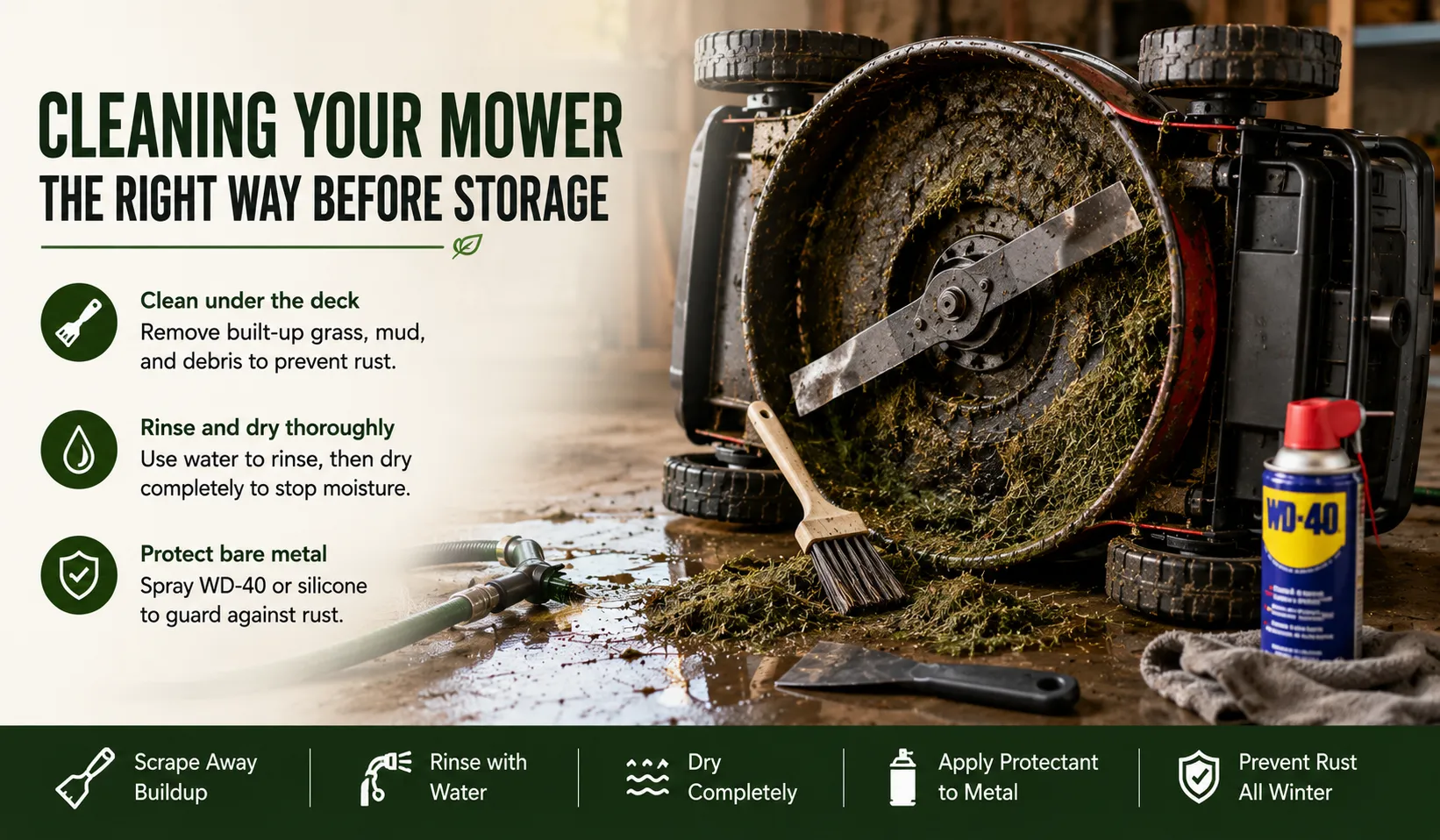
The Right Tools and Products to Use
- Plastic scraper – safe on painted and aluminum decks, won’t scratch
- Stiff nylon brush – good for loosening dry clippings
- Garden hose – fine for rinsing, just dry fully afterward
- WD-40 or Fluid Film – apply to clean bare metal to block rust
- Dry cloth or compressed air – to dry hard-to-reach areas
That’s really all you need. You don’t need specialty products or degreasers for a standard end-of-season clean.
What Not to Do (Pressure Washers, I’m Looking at You)
Don’t pressure wash a lawn mower. The force strips grease from bearings and wheel axles, pushes water into the engine through the air filter, and can damage electrical components on battery mowers.
I made this mistake once on a Toro push mower. The bearing on the left rear wheel seized the following spring. Direct cause-and-effect.
A garden hose on a low setting is the most aggressive tool you need. Rinse, dry, protect. That’s it.
Where to Store Your Lawn Mower for Winter
Where you store the mower matters almost as much as how you prep it. A well-winterized mower stored in a wet, unventilated space can still rust and degrade.
Garage vs. Shed vs. Outdoor Cover
An attached, heated garage is the best option – temperature stays above freezing, humidity is controlled, and the mower is out of weather entirely. If you’re in Chicago or Minneapolis and your garage is heated even partially, that’s where the mower should be.
An unheated garage or shed is second-best. It won’t see rain or snow directly, and even without heat, temperatures inside a shed are usually warmer than outside by 10-15 degrees. Humidity can be an issue if the shed isn’t sealed well – a moisture absorber (like DampRid) helps.
An outdoor cover is the last resort. Breathable covers (like those made by Classic Accessories or Greenworks) are better than plastic tarps because they allow moisture to escape instead of trapping it. Plastic tarps create a humid microclimate underneath, which accelerates rust. If you have no choice but to store the mower outside, use a breathable cover and set the mower on a wooden pallet to keep it off the ground.
Climate and Humidity Considerations by Region
In the Pacific Northwest – Oregon, Washington – the issue isn’t cold, it’s moisture. Coastal humidity is high even in winter, and sheds in Portland or Seattle can stay damp for months. A good cover, moisture absorbers, and a clean dry deck matter more here than they do in drier climates.
In the Southeast – Georgia, Alabama, the Carolinas – winters are mild, but you can still see freezing nights in January. Battery storage indoors still applies. Gas mowers fare better here than anywhere else in the country; the carburetor concerns are lower when winter is short.
In the Upper Midwest – Minnesota, Wisconsin, the Dakotas – hard freezes start in October and can last through April. Fuel stabilizer, indoor battery storage, and keeping the gas tank protected are all non-negotiable here. This is the climate that punishes shortcuts the hardest.
Storage Location Comparison
| Location | Pros | Cons | Best For |
|---|---|---|---|
| Heated garage | Stable temperature and humidity, easy access | Requires garage space | All mower types, cold climates |
| Unheated garage or shed | Protected from weather, better than outdoors | Can be damp, may freeze | Most US climates, gas mowers |
| Outdoor breathable cover | No space needed | Humidity risk, UV exposure, no temperature control | Mild climates only, short off-seasons |
| Basement | Ideal temperature (50-70°F) for batteries | Limited space, must carry battery down | Battery storage only |
Common Winterizing Mistakes I See Every Year
After talking to neighbors, reading forums, and making a few of these myself, the same errors show up over and over. Here are the three that cause the most damage.
Leaving Old Gas in the Tank
This is the mistake that causes 80% of spring startup failures. Untreated ethanol-blended fuel starts degrading in 30 days. By March, it’s a varnish. That varnish coats the carburetor needle, jets, and float bowl, making the engine start poorly or not at all.
The fix takes five minutes: add stabilizer before the last mow of the season, or run the engine dry afterward. Either works. Neither isn’t an option.
Storing a Dirty Deck
Grass clippings are mostly water. Pack them under a steel deck and leave them for four months, and you’ll find rust spots when you flip the mower over in spring. On a new mower, that’s frustrating. On a mower that’s already a few years old, it can spread fast enough to compromise the deck’s structure.
Ten minutes of scraping and rinsing in October prevents a real problem in April.
Forgetting to Disconnect or Charge the Battery
On battery mowers, leaving the battery in the machine all winter in a cold garage is a reliable way to shorten its life. Lithium-ion cells that sit discharged in freezing temperatures lose capacity permanently – it’s a chemical process that doesn’t reverse.
Pull the battery, check the charge level, adjust to 40-60%, and bring it inside. Takes two minutes. Saves $150-300 in battery replacement costs.
Getting Your Mower Ready Again in Spring
When the forsythia blooms in my yard, I know it’s about time to bring the mower back out. Here’s how I approach the first startup of the season.
Start by checking the oil level before you do anything else. Oil can slowly seep past seals over a long winter, and running a gas mower dry even for 30 seconds can score the cylinder wall. Top it up if it’s low. Check the air filter too – if you left a slightly dirty one in last fall, replace it now before the season starts.
If you used a fuel stabilizer, the tank should still have good gas in it. Add a small amount of fresh fuel to dilute what’s been sitting, and give the primer bulb a few pumps before you pull the cord. If you ran it dry last fall, add fresh fuel now. The carburetor should be clean and ready to go.
A mower that was properly winterized almost always starts on the first or second pull. That moment – after a long winter, a clean spark plug, treated fuel, and fresh oil – when the engine fires up immediately and runs smooth – that’s a genuinely satisfying feeling. It means the work you did in October paid off exactly the way it was supposed to.
For battery mowers, bring the battery in from storage a day before you need the mower, let it reach room temperature (important if your basement is cold), then charge it to 100% before the first mow. Check the blade for any edge damage over winter, give the deck a quick inspection, and you’re ready.
The honest truth is that most mower problems aren’t mechanical failures – they’re the result of skipping 60 minutes of fall prep. Good winter storage costs almost nothing and adds real years to a machine that, depending on the brand, runs $300-1,500 to replace.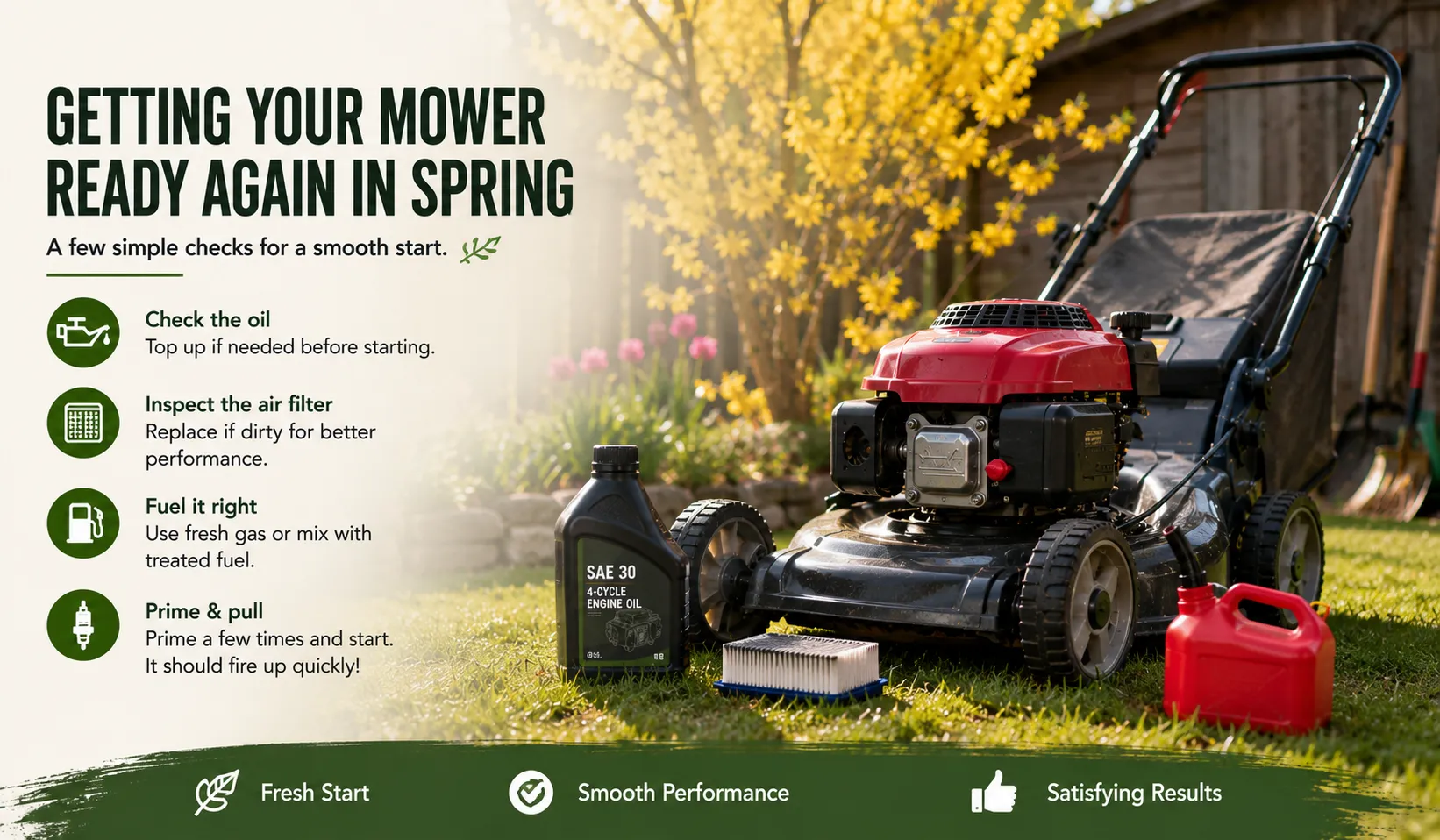
Winter Storage Pros and Cons: Full Prep vs. Skipping It
| Factor | Full Prep | Skipping Prep |
|---|---|---|
| Time cost in fall | 60-90 minutes | 0 minutes |
| Spring startup reliability | High – first or second pull | Low to moderate – may need troubleshooting or repairs |
| Carburetor risk (gas) | Minimal | High after 90+ days with untreated fuel |
| Battery capacity loss | Minimal with proper charge and temp | Moderate to severe in cold storage |
| Rust and deck damage | Prevented by cleaning | Likely after one or more winters |
| Repair costs | Near zero | $50-300 for carburetor cleaning, battery replacement, or deck treatment |
| Mower lifespan impact | Extended by 2-4 years on average | Shortened, especially in cold or humid climates |
Frequently Asked Questions About Lawn Mower Winter Storage
Do I have to drain the gas from my lawn mower before winter storage?
You don’t have to drain it completely, but you do need to treat it. Add a fuel stabilizer like STA-BIL or Sea Foam to the tank and run the engine for 2-3 minutes to circulate the treated fuel. Alternatively, run the engine until the tank and carburetor are completely dry. Leaving untreated, ethanol-blended gasoline in the tank over winter causes carburetor deposits that make spring startup difficult or impossible.
What charge level should I store my battery mower battery at?
Store lithium-ion batteries at 40-60% charge (Battery University, 2023). A fully depleted battery risks deep discharge damage. A fully charged battery keeps cells under stress for months. Check the indicator before storing, adjust if needed, then remove the battery from the mower and store it somewhere that stays above freezing.
Can I store my lawn mower outside in winter?
You can, but it’s the least protective option. Use a breathable outdoor cover – not a plastic tarp – and place the mower on a wooden pallet to keep it off the ground. Plastic tarps trap moisture underneath, which causes rust. This method works reasonably well in mild climates like the Southeast. In cold, wet, or snowy climates, outdoor storage significantly increases the risk of rust and damage.
Do I need to change the oil before storing a gas mower?
Yes, and fall is actually the right time to do it, not spring. Used engine oil contains acids and combustion byproducts that corrode internal engine surfaces if left sitting for months. Drain the warm oil after the last mow, add fresh SAE 30 or 10W-30 per your owner’s manual, and the engine will stay in better condition through the off-season.
How do I know if my spark plug needs to be replaced before storage?
Pull the plug with a socket wrench and look at the electrode tip. Tan or light gray is normal – you can reinstall it. Black and sooty means the engine is running rich, and the plug should be replaced. Blistered or white means the engine is running hot. If the plug looks normal but has been in the mower for more than two years, replacing it is worthwhile. New plugs cost $3-8 and eliminate a common spring startup failure point.
Does a battery mower need the same deck cleaning as a gas mower?
Yes. Grass clippings hold moisture regardless of what powers the mower. Wet organic material under a deck – even a plastic one – causes rust on metal components, attracts pests, and can mold over winter. Scrape and rinse the underside of the deck before storage, dry it thoroughly, and the mower will come out of storage in much better shape.
How long can I store a lawn mower with fuel stabilizer?
Most fuel stabilizers are rated for up to 12 months (STA-BIL, 2024). For a standard 4-6 month winter storage period, stabilizer works reliably in most climates. For storage beyond 8 months, running the tank and carburetor dry is the safer choice to prevent any residue buildup.