
Quick Guide
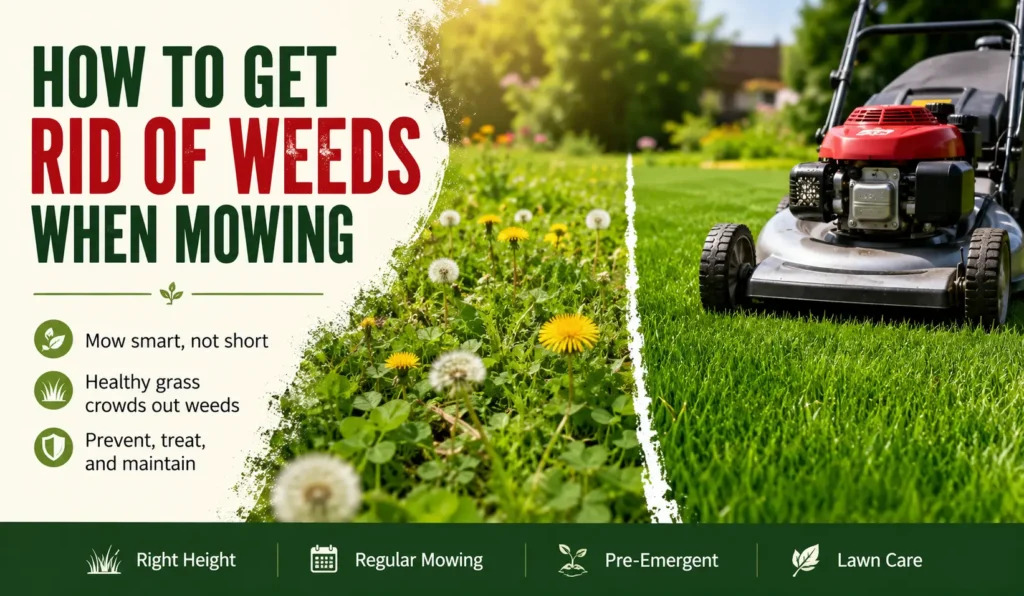
- Mowing alone does not kill weeds – it cuts them back temporarily while the root survives and regrows
- Cutting at the correct height (3-4 inches for most cool-season grasses) shades the soil surface and blocks weed seed germination
- Pre-emergent herbicide applied before soil hits 55°F stops crabgrass before it starts – this is the highest-return spring application you can make
- Dandelions, crabgrass, nutsedge, and clover each need different treatment; one approach does not work for all
- A dense, well-fed lawn is the best long-term weed control – weeds fill gaps, so eliminate the gaps
I remember standing in my backyard in central Florida, staring at a lawn that was more clover than grass. I had mowed it twice that week. The clover came right back every time. My neighbor, three houses down, had a yard that looked like a golf course fairway. I finally walked over and asked him what he was doing differently. He laughed and said, “You’re mowing it wrong.”
That was the moment I stopped treating lawn care as just cutting grass and started paying attention to why weeds keep winning when you fight them the wrong way.
This guide is for homeowners who mow regularly and still watch their yard fill up with dandelions, crabgrass, clover, or whatever weed has claimed the space. I’ve dealt with all of them – clover in Florida, crabgrass in a dry Texas summer, and dandelions taking over a Midwest backyard in a wet Minnesota spring. Here is what actually works when it comes to how to get rid of weeds when mowing.
Why Mowing Alone Won’t Kill Your Weeds
The root stays in the ground every time you mow. That is the core problem. Mowing removes top growth, but for most weeds, the root is what matters – and it regrows.
What Mowing Actually Does to Weeds
When you run a mower over a dandelion, you remove the flower and some leaf mass. But a dandelion taproot can reach 6-10 inches into the soil (Penn State Extension, 2022). The plant does not care. It regrows within days.
Some weeds handle mowing better than grass does. Clover, for example, grows in a low, spreading pattern. A standard mowing height barely touches it while cutting your turf grass normally. In my Florida yard, mowing twice a week made the clover problem worse. I was stressing the St. Augustine grass while the clover spread underneath.
The one case where mowing genuinely hurts a weed is when you cut before it seeds. A dandelion that never produces a seed head cannot spread to new areas. But that is damage control, not elimination.
The Real Reason Weeds Keep Coming Back
Weeds fill gaps. Every bare patch, thin area, or compacted spot in your lawn is an opening. Weed seeds can lie dormant in soil for years, waiting for light and the right conditions (University of Minnesota Extension, 2023).
When you mow too short, you stress your grass. Stressed grass grows slower, thins out, and leaves more openings. Weeds move in. Then you mow again and the cycle repeats.
The fix is not more mowing. It is changing what you do before, during, and after you mow.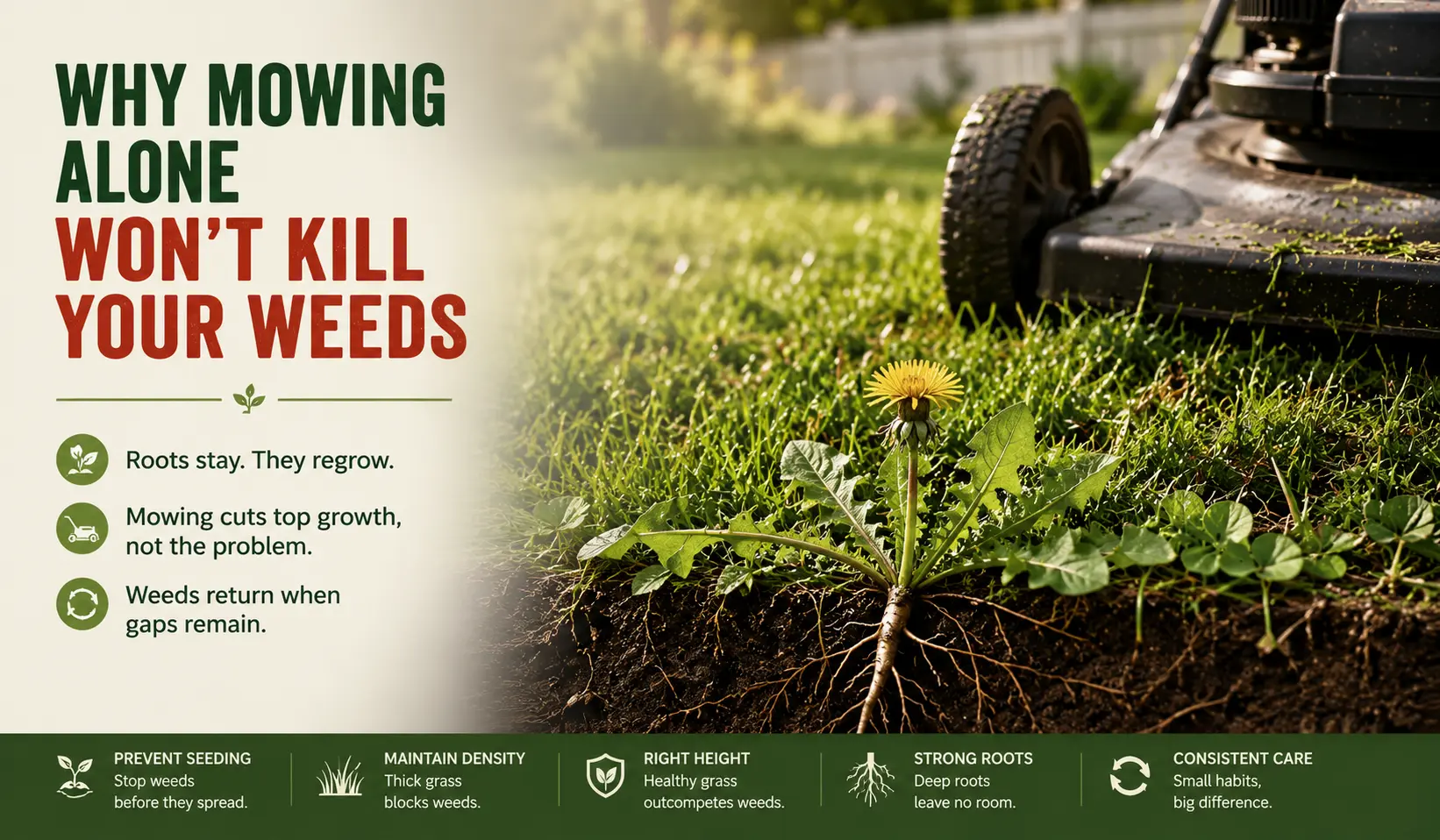
How Mowing Height Affects Weed Growth
Cutting at the right height is the single most effective cultural method for suppressing weeds. Taller grass shades the soil surface, which prevents many weed seeds from germinating in the first place.
The Right Cutting Height for Your Grass Type
Most homeowners cut too short. It is one of the most common lawn mistakes there is.
Cool-season grasses like Kentucky bluegrass and tall fescue – common across the Midwest and Northeast – need to be cut at 3-4 inches during the growing season. Warm-season grasses like Bermuda and Zoysia, common in the South, are cut shorter, typically 1-2 inches, because of how those grasses grow and spread.
Getting the height right for your specific grass type makes a real difference. During one hot Texas summer, I let my Bermuda grass creep down to half an inch because I thought shorter looked cleaner. Within six weeks, crabgrass had taken over two sections of the yard.
Why Scalping Your Lawn Invites More Weeds
Scalping – cutting grass too short – removes most of the leaf blade. That forces the grass to use stored energy reserves to recover instead of growing deeper roots.
Short grass also allows more sunlight to hit the soil surface. Crabgrass seeds, in particular, need sunlight at the soil surface to germinate (Purdue Extension, 2021). Keep grass tall enough to shade the soil and you block a significant amount of germination before it starts.
The One-Third Rule (And Why It Matters)
Never remove more than one-third of the grass blade in a single mow. If your target height is 3 inches, do not let the grass grow past 4.5 inches before cutting.
Cutting off more than a third shocks the plant. It slows root growth, weakens the grass, and creates the thinning conditions that let weeds in. In a Minnesota spring where grass grows fast, this means mowing every 5-6 days during peak growth. That is not convenient, but it works.
Recommended Mowing Heights by Grass Type
| Grass Type | Region | Mowing Height | Mowing Frequency (Growing Season) |
|---|---|---|---|
| Kentucky Bluegrass | Midwest, Northeast | 2.5-3.5 inches | Every 5-7 days |
| Tall Fescue | Transition Zone | 3-4 inches | Every 5-7 days |
| Bermuda | South, Southwest | 1-1.5 inches | Every 5-7 days |
| Zoysia | South, Southeast | 1-2 inches | Every 7-10 days |
| St. Augustine | Southeast, Florida | 3.5-4 inches | Every 7-10 days |
| Centipede | Southeast | 1.5-2 inches | Every 7-10 days |
Mowing Techniques That Help Suppress Weeds
How you mow – not just how often – can meaningfully reduce weed pressure over a full season.
Mowing Frequency and Weed Control
Consistent mowing at the correct height keeps grass dense. Dense grass physically crowds out weed seedlings before they can establish.
The problem with infrequent mowing is that you end up cutting more than one-third of the blade each time, which stresses the grass and lets weeds gain ground. Regular mowing at the right height creates a competitive advantage for your turf that compounds over the season.
Mulching Clippings vs. Bagging – Which Helps More?
Mulching wins in most situations. Grass clippings decompose quickly and return nitrogen to the soil – roughly 25% of the nitrogen your lawn needs annually, according to Texas A&M AgriLife Extension (2021). Healthy, well-fed grass grows thicker. Thicker grass suppresses weeds naturally.
The one time to bag clippings is when your lawn has heavy weed seed heads. If your yard is full of dandelions in seed, bagging prevents spreading those seeds back across the lawn when you mow. Once the weeds are under control, go back to mulching.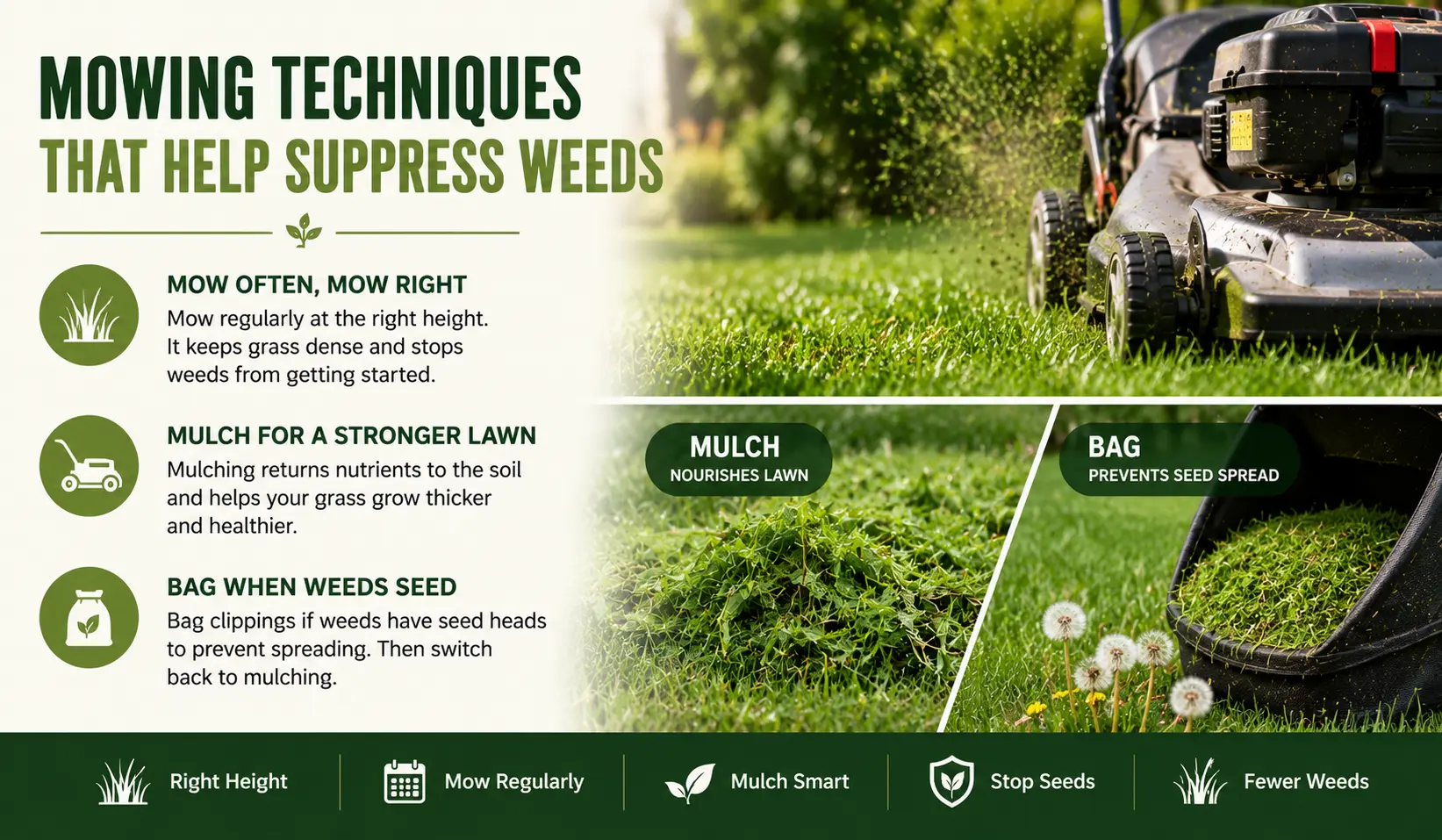
Mowing Direction and Pattern Changes
Changing your mowing direction each session helps grass stand upright instead of leaning one way. Upright grass grows more evenly and creates a denser canopy.
It also prevents soil compaction along the same tire tracks, which matters because compacted soil is poor for grass roots and fine for weeds. Plantain and knotweed specifically thrive in compacted areas.
Technique vs. Weed Suppression Effectiveness
| Mowing Technique | Weed Suppression Level | Notes |
|---|---|---|
| Correct mowing height | High | Most impactful single change |
| Consistent mowing frequency | Medium-High | Prevents weeds from seeding |
| Mulching clippings | Medium | Improves soil health over time |
| Bagging during weed seed season | Medium | Prevents seed spread |
| Rotating mowing patterns | Low-Medium | Reduces compaction, improves density |
| Mowing before weeds seed | Medium | Damage control, not elimination |
Combining Mowing With Other Weed Control Methods
Mowing is one piece of the system. It works best when you pair it with pre-emergent treatment, spot spraying, and filling in bare spots.
Pre-Emergent Herbicides and When to Apply Them
Pre-emergent herbicides stop weed seeds from germinating. They do not kill existing weeds. They form a barrier in the soil that prevents new seedlings from pushing through.
Timing is everything. For crabgrass in the South, apply pre-emergent when soil temperatures consistently hit 55°F – typically late February to early March in Georgia or Texas, and April in the Midwest (University of Georgia Extension, 2022). A useful natural timing indicator: apply when forsythia is blooming in your area. That coincides closely with the soil temperatures that trigger crabgrass germination.
One thing to remember: do not apply pre-emergent if you plan to overseed soon. It will block your grass seed from germinating too.
Post-Emergent Spot Treatment Around Mowing Days
Post-emergent herbicides kill weeds that are already growing. Spot treatment – applying directly to individual weeds – is more effective and less damaging to surrounding turf than broadcast spraying the whole lawn.
Apply post-emergent 2-3 days before mowing, not after. The weed needs leaf surface to absorb the herbicide. Mowing first removes that surface.
Overseeding Thin Patches After Mowing
Bare and thin areas are where weeds win. Overseeding fills those gaps with grass before weeds can claim them.
Mow the area short before overseeding so the seed makes contact with soil. Then core aerate if the soil is compacted. Spread seed, keep it moist, and do not apply pre-emergent in seeded areas – it will kill the new grass too.
Fall is the best time to overseed cool-season lawns. Spring works for warm-season grasses like Bermuda. I overseeded a thin stretch in my Minnesota backyard in early September two years running and by the following spring it was as dense as the rest of the yard, with no more dandelions in that section.
Hand-Pulling Before You Mow (When It’s Worth It)
Hand-pulling is worth the effort for a small number of large-rooted weeds like dandelions, especially before they seed. After rain, when soil is loose, a dandelion puller or flat-head screwdriver gets the taproot out cleanly. You feel the snap when it releases.
It is not worth it for widespread infestations or for weeds like nutsedge that reproduce from underground tubers. You pull one plant and leave behind ten potential new ones.
Weed Control Methods Compared
| Method | Best For | Timing | Difficulty |
|---|---|---|---|
| Pre-emergent herbicide | Annual weeds (crabgrass, henbit) | Before germination | Low |
| Post-emergent spot spray | Broadleaf weeds (dandelions, clover) | During growing season | Low |
| Hand-pulling | Small infestations, deep taproots | After rain | Medium |
| Overseeding | Filling bare spots | Fall (cool-season), Spring (warm-season) | Medium |
| Correct mowing height | Long-term prevention | Ongoing | Low |
| Core aeration | Compacted lawns | Fall (cool-season) | Medium-High |
Weeds That Need More Than Mowing to Beat
Some weeds are completely unaffected by your mower. These are the ones that need targeted treatment.
Dandelions
Dandelions are broadleaf weeds with deep taproots. Mowing removes the flower and slows seed spreading, but the plant regrows from the root every single time.
The most effective treatment is a broadleaf post-emergent like 2,4-D applied in fall, when the plant actively moves energy down into its roots. Fall treatment reaches and kills the root. Spring treatment often just burns the top growth while the root survives. Hand-pulling works if you get the full taproot – leave even an inch and it regrows.
Crabgrass
Crabgrass is a warm-season annual grass that germinates in spring when soil temperatures rise. It dies in fall but drops hundreds of seeds before it does.
Pre-emergent applied at the right soil temperature is the primary control. If crabgrass has already established, a post-emergent containing quinclorac can reduce it (University of California Agriculture, 2020). Mowing does not fix a crabgrass problem – it spreads seeds across the lawn every time the mower passes over a mature plant.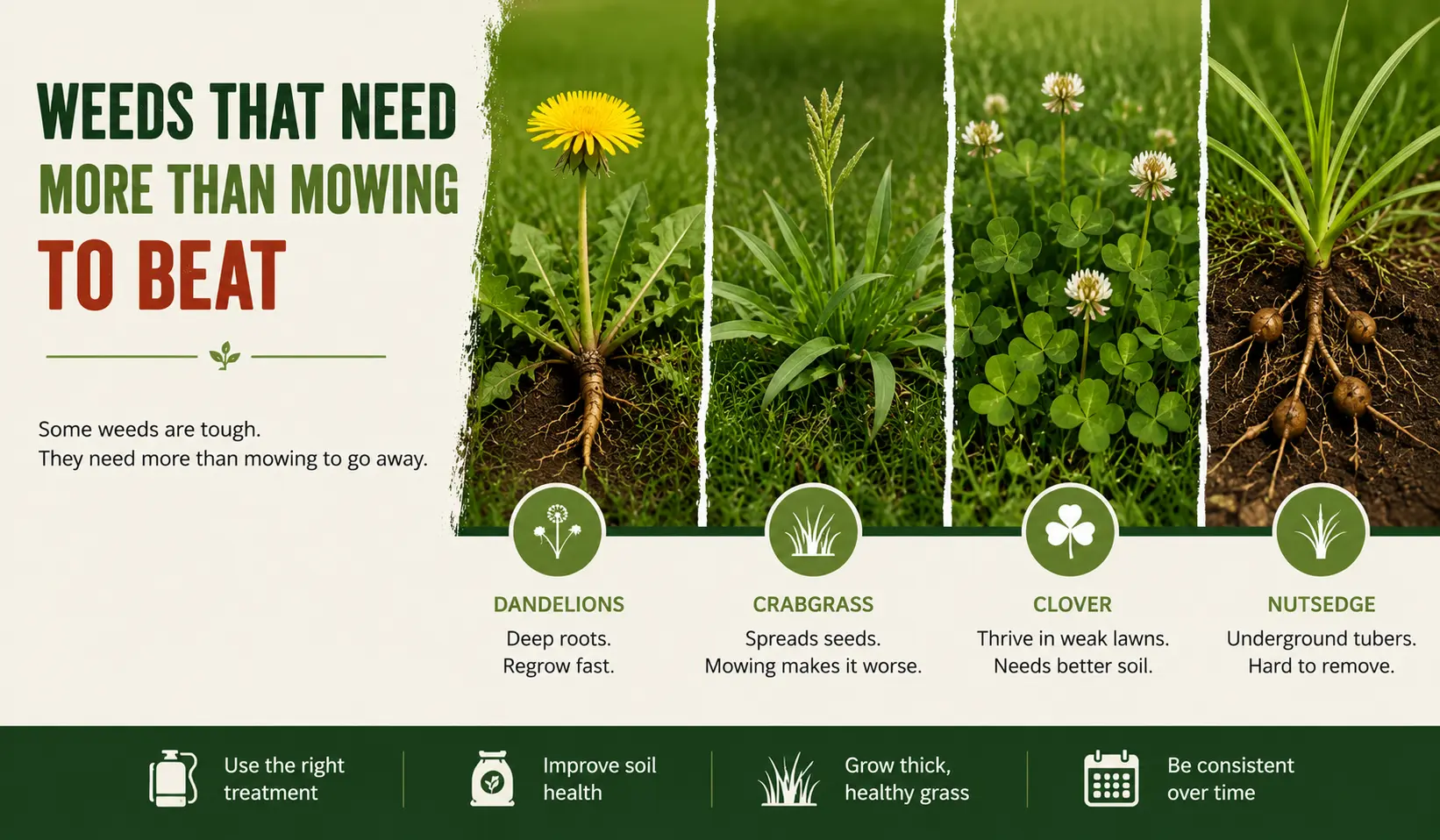
Clover
Clover is a perennial broadleaf weed that spreads by seed and by creeping stems. My Florida yard had it everywhere because the lawn was thin and the soil was nitrogen-poor. Clover fixes its own nitrogen from the air, so it thrives exactly where grass is already struggling.
The fix has two parts: a broadleaf post-emergent like triclopyr, and improving the lawn’s nitrogen levels so grass grows dense enough to crowd clover out. Mowing St. Augustine at 3.5-4 inches helps too, since taller grass starts to shade out low-growing clover over time.
Nutsedge
Nutsedge is often mistaken for grass. It grows faster than turf, stands noticeably taller a day after mowing, and has a triangular stem if you roll it between your fingers. The real problem is underground: it produces small tubers called nutlets that can stay dormant in soil for years (NC State Extension, 2021).
Pulling nutsedge makes it worse. Disturbing the roots releases more tubers. Use a nutsedge-specific herbicide like halosulfuron. Multiple treatments over two seasons are usually needed to get it under control.
Common Weeds, Best Removal Method, and Difficulty Level
| Weed | Best Removal Method | Does Mowing Help? | Difficulty Level |
|---|---|---|---|
| Dandelion | Fall broadleaf post-emergent or hand-pull | Slightly (prevents seeding) | Medium |
| Crabgrass | Spring pre-emergent + quinclorac | No – spreads seeds | Hard |
| Clover | Broadleaf post-emergent + overseeding | No | Medium |
| Nutsedge | Halosulfuron herbicide | No | Hard |
| Chickweed | Pre-emergent + broadleaf post-emergent | Slightly | Easy-Medium |
| Plantain | Broadleaf post-emergent | Slightly | Medium |
Seasonal Weed Management Around Your Mowing Schedule
Timing your lawn care tasks to the seasons makes every other effort more effective.
Spring (When Weeds Appear Fast – and What to Do)
Spring is when most homeowners get overwhelmed. Weeds emerge quickly, the lawn looks patchy after winter, and it all seems to happen at once.
Apply pre-emergent before soil temperatures hit 55°F. For most of the Midwest and Northeast, that window is mid-March to early April. Do not skip this – it is the single highest-return application you can make all year.
Start mowing at the correct height as soon as grass begins growing. Do not scalp the lawn for that “first mow cleanup.” That opens the door for every weed seed waiting in the soil.
Summer (Keeping Up Without Scalding Your Lawn)
In summer heat, mowing frequency matters more. Grass grows fast during mild periods and slows sharply during drought or prolonged heat.
Never mow drought-stressed grass short. If your lawn is dormant and browning from heat, leave it alone. Mowing dormant grass too short weakens the crowns and slows recovery when rain returns.
During one particularly brutal Texas summer, I raised my Bermuda mowing height by half an inch during the hottest weeks. The lawn stayed denser through the heat and the crabgrass had noticeably less room to spread.
Fall (The Best Time to Prepare for Next Year)
Fall is the most productive season for cool-season lawn care. Grass roots grow actively when air temperatures drop, making overseeding and aeration far more effective than at any other time of year.
Treat broadleaf weeds with post-emergent in early fall when daytime temperatures are still above 60°F. Apply a pre-emergent in late fall to block winter annuals like henbit and annual bluegrass.
Keep mowing at the correct height until grass stops growing. Do not leave tall grass over winter – it mats down and creates conditions for snow mold and fungal problems.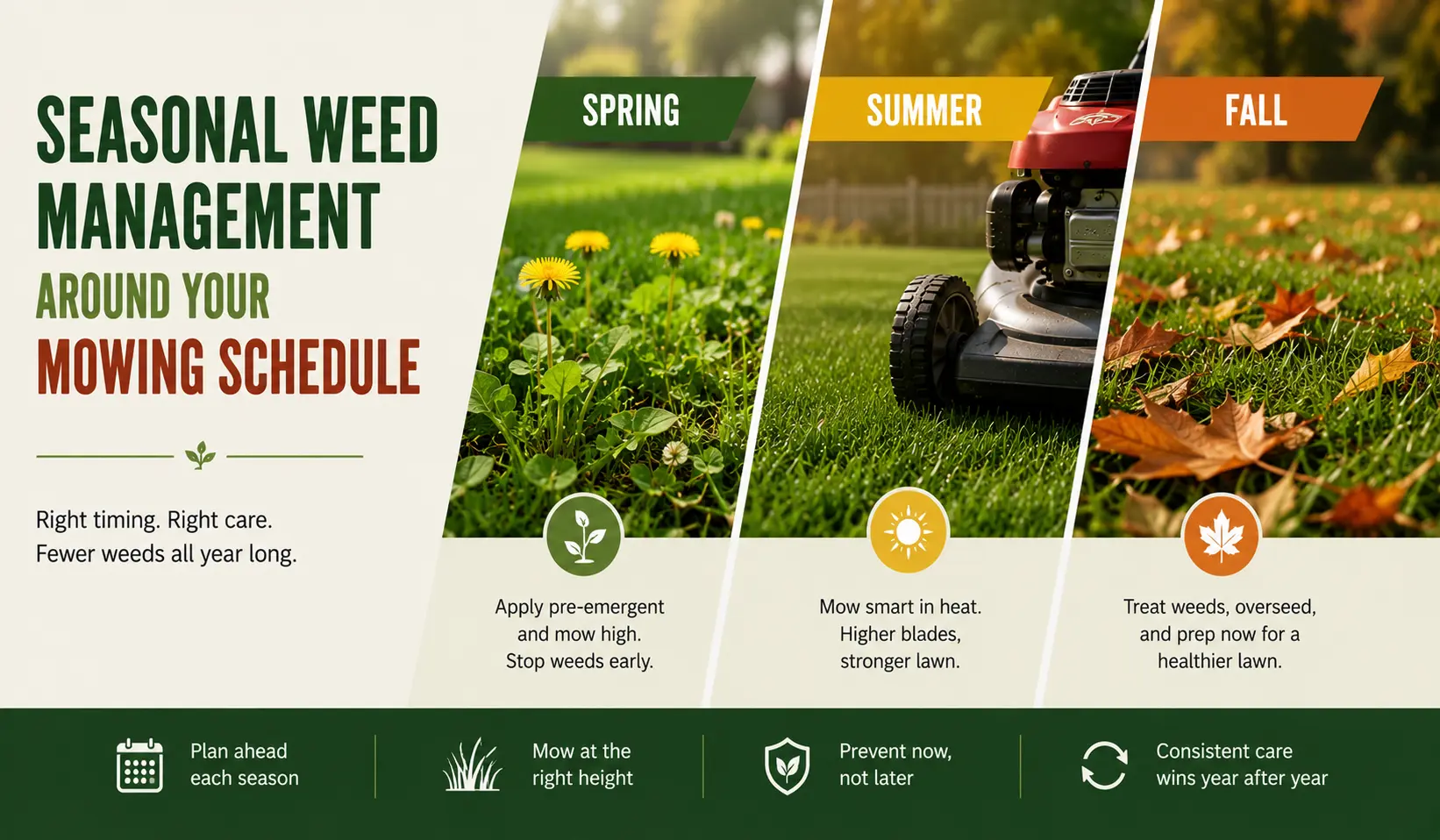
Common Mowing Mistakes That Make Weeds Worse
Mowing With a Dull Blade
A dull mower blade tears grass instead of cutting it cleanly. Torn grass tips turn brown, stress the plant, and create entry points for disease. You can see the difference: a sharp cut leaves the lawn looking green and clean, while a dull cut leaves it looking grey and ragged within a day.
Sharpen your blade at least twice per season – once in spring and once mid-summer. If you mow over rocky or sandy areas, more often. It is a 20-minute job that makes a visible difference.
Mowing When the Lawn Is Wet
Wet grass clumps together and clogs the mower deck. Those clumps left on the lawn smother the turf underneath, leaving dead patches that become bare spots, which become weed spots.
Wet conditions also compact the soil under mower tires more than dry conditions do. The musty smell of mowing wet clippings is a reliable cue that you are not doing your lawn any favors. If you can wait a day, wait.
My Honest Final Take
After dealing with weed problems across different yards and different climates, here is what I have actually learned: most weed problems are lawn health problems in disguise. A thick, dense, properly fed lawn leaves almost no room for weeds to get started. When weeds take over, they are filling space that grass cannot hold because of poor mowing habits, low soil health, or the wrong grass type for the climate.
Mowing at the right height consistently is the cheapest and most impactful change most homeowners can make. Add pre-emergent at the right time each spring and you block the majority of annual weed problems before they start. After that, it is targeted spot treatment for whatever gets through.
What is not worth the effort: broadcast spraying the whole lawn with herbicide every season. It damages grass, harms soil biology, and does not fix the underlying reason weeds are winning. Fix the lawn first, and weed pressure drops on its own.
There is no instant fix. The lawns I am most satisfied with took two to three seasons of consistent work to get right. But they stay right with much less effort once that foundation is in place.
Weed Control Approaches: Pros and Cons
| Approach | Pros | Cons |
|---|---|---|
| Correct mowing height | Free, no chemicals, long-term benefit | Results are slow; requires consistency |
| Pre-emergent herbicide | Stops annual weeds before they start | Timing-dependent; blocks overseeding |
| Post-emergent spot spray | Targeted, fast on broadleaf weeds | Does not fix root cause; can stress nearby turf |
| Hand-pulling | No chemicals; effective for large taproots | Labor-intensive; does not work for all weeds |
| Overseeding | Fills gaps permanently; reduces future pressure | Takes time; does not work during weed season |
| Core aeration | Improves soil health and grass root depth | Needs equipment; timing-dependent |
Frequently Asked Questions About Getting Rid of Weeds When Mowing
Does mowing kill weeds?
Mowing does not kill weeds. It cuts the above-ground growth back, which can slow spreading and prevent some species from seeding. But the root stays alive and the plant regrows. To kill weeds, you need herbicide, manual removal, or a lawn dense enough to outcompete them.
What mowing height prevents weeds best?
Taller grass suppresses weeds better than short grass because it shades the soil surface and blocks weed seed germination. For cool-season grasses like tall fescue and Kentucky bluegrass, 3-4 inches is effective. For warm-season grasses like Bermuda, 1-1.5 inches is the standard.
Should I bag or mulch clippings when I have weeds?
Bag clippings when weeds are actively producing seed heads, so you avoid spreading seeds across the lawn. In all other conditions, mulching returns nitrogen to the soil, improves grass health over time, and reduces weed pressure long-term.
When should I apply pre-emergent herbicide?
Apply pre-emergent before weed seeds germinate. For crabgrass, that means applying when soil temperature reaches 55°F – typically late February to early March in the South and April in the Midwest. Forsythia bloom is a reliable natural timing indicator in most regions.
Can I overseed and use pre-emergent at the same time?
No. Pre-emergent stops all seed germination, including grass seed. If you are overseeding to fill bare spots, skip pre-emergent in those areas. Apply it after the new grass has established, usually after two to three mowings.
Why does my lawn look worse right after I mow?
Brown or ragged tips after mowing almost always mean a dull blade. A dull blade tears the grass instead of cutting it, and the torn tips dry out and turn brown within a day. Sharpen your blade at least twice per mowing season and the lawn will look noticeably greener immediately after cutting.
How long does it take to get a weed-free lawn?
Realistically, two to three seasons of consistent mowing at the right height, pre-emergent applications, and overseeding thin spots. There is no one-season fix for a heavily weedy lawn. The goal in year one is progress – less weed pressure and denser grass. Full results take time.