
Key Takeaways
- The best grass type for low-maintenance lawns depends on your climate zone more than anything else.
- Bermuda grass is the top pick for most US homeowners in warm regions – it tolerates drought, recovers from heavy use, and needs less water than most alternatives.
- Buffalo grass is the best choice for hot, dry climates like Arizona and West Texas, requiring as little as 0.5 inches of water per week once established (University of Nebraska Extension, 2022).
- Tall Fescue is the most forgiving cool-season option for states like Ohio, Minnesota, and the Pacific Northwest.
- Zoysia, Centipede, and Fine Fescue round out this list for specific climates and conditions.
My neighbor in Atlanta has the best-looking lawn on the street. Every summer, while I was hauling the hose around on Saturday mornings, his yard just sat there looking green and full. I finally asked him what he was doing. His answer: nothing. He planted Zoysia three years ago and largely walked away from it.
That conversation sent me down a rabbit hole. Over the past several years, I’ve grown, tested, and killed grass across three different climates – a backyard in suburban Atlanta, a front yard in Tucson, and a rental property I managed in Wisconsin. I’ve made expensive mistakes and stumbled onto a few things that actually work.
This guide is for busy homeowners, first-timers, and anyone in a drought-prone area who is tired of babying a lawn that fights them every summer. The focus is on the best grass types for low-maintenance lawns – meaning lower water bills, fewer mowing sessions, and less chemical dependency, without turning your yard into a dust patch.
Why Choosing the Right Grass Changes Everything
The type of grass you plant determines how much work you’ll do for the next decade. Get it right once, and maintenance becomes genuinely light. Get it wrong, and no amount of fertilizing or watering will fix it.
The Hidden Cost of High-Maintenance Grass
Kentucky Bluegrass looks beautiful in seed catalog photos. In Wisconsin, it also needs about 1.5 to 2 inches of water per week during summer, regular overseeding, and fungicide applications to prevent dollar spot and rust (Purdue Extension, 2021). In a dry year, that water bill adds up fast.
I ran rough numbers on my Wisconsin property one summer: I was spending close to $180 in extra water costs from June through August just keeping the Bluegrass alive. That doesn’t count the fertilizer or the Saturday afternoons.
High-maintenance grasses aren’t bad grass. They’re just grass that needs the right conditions and consistent attention. If you have neither, you’ll end up with a lawn that looks half-dead by August and costs you money year-round.
What “Low-Maintenance” Actually Means in Real Life
Low-maintenance does not mean no maintenance. Every grass type on this list still needs mowing, some fertilization, and occasional overseeding. What makes them low-maintenance is the margin for error.
A low-maintenance grass can go two or three weeks without rain and bounce back. It doesn’t need aeration every fall to stay healthy. It tolerates neglect during a busy month without dying in patches.
The other thing people miss: “low-maintenance” is always relative to your specific climate. Buffalo grass in Tucson is genuinely effortless. Buffalo grass in Atlanta would be a disaster. Matching the grass to your conditions is the first step.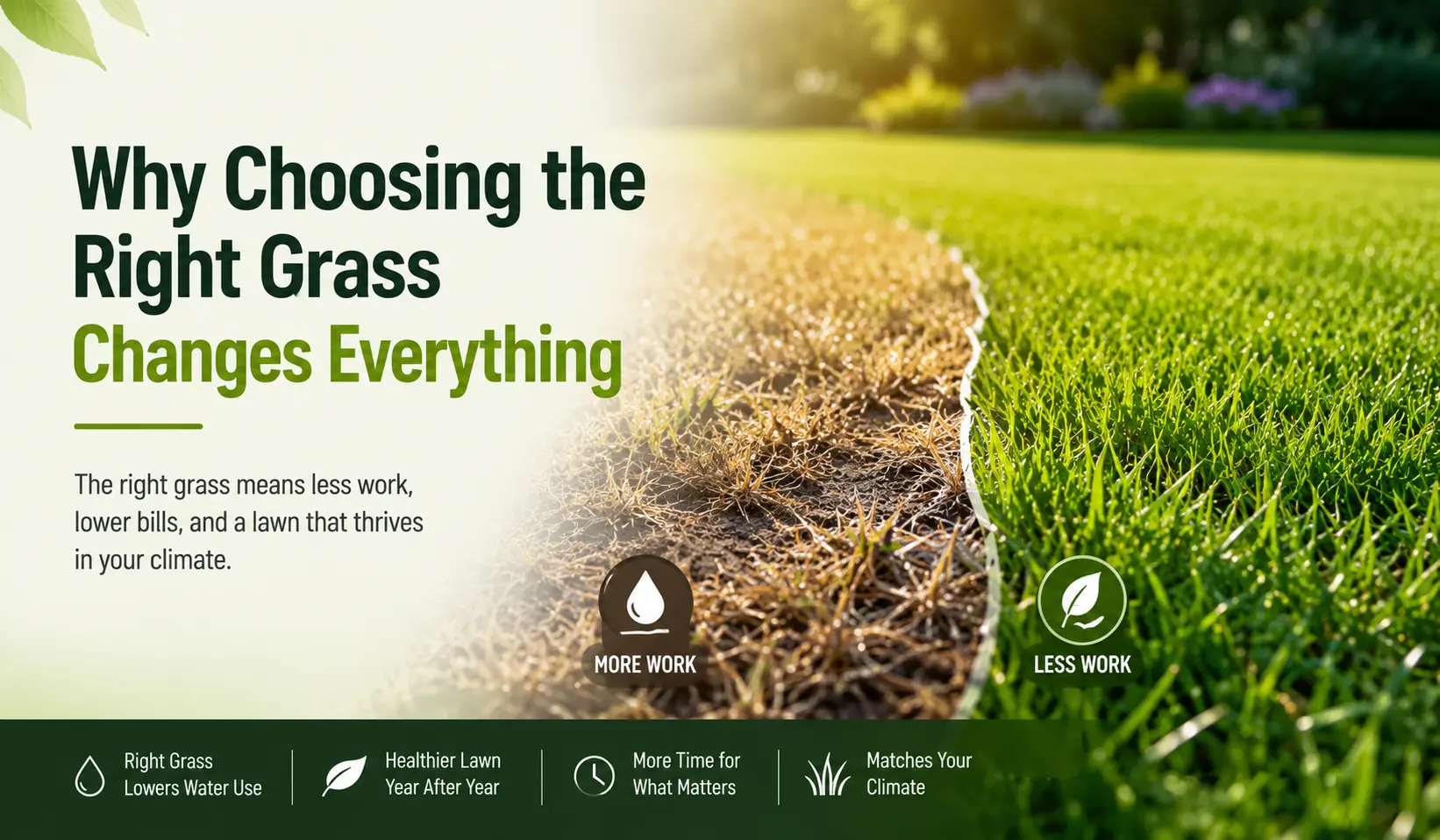
What to Look for Before You Choose a Grass Type
Before picking a variety, you need honest answers to five questions about your yard and your region. This section walks through each one.
Your Climate Zone and Rainfall Patterns
The USDA Plant Hardiness Zone map is a good starting point, but for grass selection, what matters more is average annual rainfall and summer heat. Warm-season grasses (Bermuda, Zoysia, St. Augustine, Buffalo, Centipede) thrive in zones 7-10. Cool-season grasses (Tall Fescue, Fine Fescue, Kentucky Bluegrass, Perennial Ryegrass) do best in zones 4-7.
The transition zone – a band running roughly from Northern California through Kansas, Virginia, and into the Carolinas – is the hardest area to manage. Neither grass family is truly at home there. Tall Fescue is usually the most reliable option in that band.
Sun Exposure and Soil Type
Most warm-season grasses need 6-8 hours of direct sunlight per day. Fine Fescue is the notable exception – it handles as little as 4 hours of sun.
Soil type matters for drainage. Centipede grass performs poorly in alkaline soil (high pH). Bermuda struggles in dense clay without aeration. Before planting anything, get a basic soil test – they run about $15 through your local Cooperative Extension office and tell you pH and nutrient levels.
How Much Foot Traffic Your Lawn Gets
If you have kids or dogs, traffic tolerance is non-negotiable. Bermuda and Zoysia are the most traffic-tolerant warm-season grasses. Tall Fescue handles foot traffic reasonably well among cool-season options.
Centipede and St. Augustine are more fragile under heavy use. Fine Fescue should not be planted in any area that sees consistent foot traffic.
Water Requirements and Drought Tolerance
This is where most people underestimate the difference between grass types. Drought tolerance is not just about surviving a dry week – it’s about how quickly a grass goes dormant, how well it recovers, and whether it comes back green or comes back dead.
Buffalo grass, once established, can survive on natural rainfall alone in much of the central US. Bermuda enters dormancy quickly during drought but recovers fast once water returns. Kentucky Bluegrass turns brown but typically recovers – it just looks bad while dormant.
Selection Criteria at a Glance
| Criteria | Why It Matters for Low Maintenance |
|---|---|
| Climate zone (warm vs. cool season) | Wrong zone = constant struggle regardless of care |
| Drought tolerance | Lower water need = lower cost and effort |
| Mowing frequency | Some grasses need cutting every 5 days in peak season |
| Shade tolerance | Shaded areas need specific varieties or you’ll get bare patches |
| Traffic tolerance | Light-traffic grasses thin out fast in active yards |
| Establishment time | Some grasses take 2 growing seasons to fill in properly |
The Best Grass Types for Low-Maintenance Lawns I’ve Grown and Tested
These are the grass types I’ve personally grown, managed, or closely observed across different US climates. Each one has real trade-offs I’ll give you straight.
Best Overall: Bermuda Grass
Bermuda grass is the most practical choice for most warm-climate US homeowners who want a low-maintenance lawn that still looks presentable. It spreads through both stolons (above-ground runners) and rhizomes (below-ground stems), which means it fills in gaps quickly and repairs itself after damage.
In my Atlanta backyard, Bermuda needed watering about once a week during dry stretches, compared to twice a week for the Tall Fescue I tried first. Mowing drops to every 10-14 days once the peak summer heat settles in.
The real weakness: Bermuda goes dormant in winter and turns brown. If you’re in zone 7 or cooler, you’ll have a tan lawn from November through March. Many homeowners in the transition zone overseed with Perennial Ryegrass each fall to maintain green color through winter.
- Mowing frequency: Every 7-14 days in peak season
- Water needs: 1-1.25 inches per week (less once established)
- USDA zones: 7-10
- Best seed brand for budget planting: Scotts Turf Builder Bermuda Grass
Best for Hot, Dry Climates: Buffalo Grass
Buffalo grass is native to the Great Plains and is the most drought-resistant turf grass available for US homeowners. Once fully established – typically after one full growing season – it can survive on as little as 0.5 to 0.75 inches of water per week through rainfall alone in most of the central and southwestern US (University of Nebraska Extension, 2022).
In Tucson, I watched a Buffalo grass lawn go through a stretch of six weeks with no irrigation and barely any rain. It went dormant and turned a straw color. Two weeks after the first real rain, it was green again.
The trade-off is appearance. Buffalo grass has a finer, softer texture than Bermuda and a naturally bluish-green color. Some people love it; others find it looks thin. It also spreads slowly, so establishment takes patience – expect 1.5 to 2 growing seasons for full coverage from seed.
- Mowing frequency: Every 2-3 weeks (it grows slowly)
- Water needs: 0.5-0.75 inches per week once established
- USDA zones: 3-9 (best in 5-8)
- Best seed brand: Pennington Buffalo Grass Seed
Best for Humid Southern Lawns: Zoysia Grass
Zoysia is what my Atlanta neighbor planted. After watching his lawn through three summers, I started recommending it to anyone in the humid South asking about low-maintenance options.
Zoysia spreads via stolons and rhizomes, forming a thick, dense turf that naturally crowds out most weeds. That density is its biggest advantage – you spend almost nothing on herbicides once it’s established. It also handles the Southern heat better than Tall Fescue and requires less water than St. Augustine.
The establishment timeline is the biggest warning I give people: Zoysia is slow. If you plant from plugs or sod, expect at least one full growing season before it looks full. From seed, count on 2 years. I’ve seen people pull out Zoysia plugs after 8 weeks because “it wasn’t working” – it was working, it just takes time.
Zoysia also goes dormant and turns brown in winter, like Bermuda. In Atlanta, that’s roughly December through February.
- Mowing frequency: Every 7-14 days in peak season
- Water needs: 0.5-1 inch per week
- USDA zones: 6-10
- Weakness: Very slow establishment; turns brown in winter
Best for Cool-Season Regions: Tall Fescue
Tall Fescue is the most forgiving cool-season grass available, and for homeowners in Ohio, Pennsylvania, the Midwest, and the Pacific Northwest, it’s usually the right starting point.
Unlike Kentucky Bluegrass, Tall Fescue stays green through mild winters and doesn’t need as much supplemental watering during summer. It’s drought-tolerant for a cool-season grass – its deep root system helps it pull moisture from lower soil layers during dry stretches.
In Wisconsin, I switched a struggling Kentucky Bluegrass area over to Tall Fescue using Jonathan Green’s Black Beauty blend. The difference in summer performance was clear. The Fescue held its color through a dry July stretch that turned the Bluegrass section tan.
One real weakness: Tall Fescue doesn’t spread by stolons or rhizomes. When it dies in patches, those patches stay bare until you reseed. Annual overseeding in fall is part of the maintenance routine.
- Mowing frequency: Every 7-10 days in spring and fall, less in summer
- Water needs: 1-1.5 inches per week (less once deep roots establish)
- USDA zones: 4-7 (transition zone and north)
- Best seed brand: Jonathan Green Black Beauty Ultra Tall Fescue
Best for Shady Yards: Fine Fescue
Fine Fescue is the only grass on this list that actually thrives under tree canopy. It handles as few as 4 hours of direct sunlight and is the standard recommendation for wooded lots in the Northeast and Pacific Northwest.
There are several Fine Fescue species – Creeping Red Fescue, Chewings Fescue, Hard Fescue, and Sheep Fescue. Most shade mixes sold at hardware stores combine two or three of these. For low-maintenance purposes, a mix is better than a single species.
Fine Fescue needs almost no fertilizer – heavy nitrogen applications actually harm it. It also has genuinely low water requirements compared to other cool-season options.
The significant trade-off: Fine Fescue can’t handle foot traffic. It’s a lawn you look at, not a lawn you use. If kids or dogs will be on it, expect thinning within one season.
- Mowing frequency: Every 10-14 days
- Water needs: 0.75-1 inch per week
- USDA zones: 3-7
- Weakness: Very poor traffic tolerance
Best Budget-Friendly Option: Centipede Grass
Centipede grass earns its spot on this list because of how little it demands once established. It’s called “the lazy man’s grass” across the Gulf Coast states for a reason. It needs minimal fertilization – in fact, over-fertilizing Centipede with nitrogen causes a problem called “Centipede decline” that can kill the lawn.
Seed and sod are widely available at stores like Home Depot and Lowe’s across the Southeast, and per-square-foot costs for sod are generally lower than Zoysia.
The biggest limitation is its sensitivity to alkaline soil. Centipede prefers a soil pH of 5.0 to 6.0. Anything above 7.0 will cause iron deficiency and yellowing. A soil test before planting is not optional with Centipede – it’s essential.
- Mowing frequency: Every 7-14 days
- Water needs: 1 inch per week
- USDA zones: 7-9
- Weakness: Requires acidic soil; poor cold tolerance
Full Comparison Table
| Grass Type | Climate Zone | Drought Tolerance | Mowing Frequency | Foot Traffic | Establishment Time |
|---|---|---|---|---|---|
| Bermuda | 7-10 | High | Every 7-14 days | Excellent | 3-6 months |
| Buffalo | 3-9 (best 5-8) | Very High | Every 2-3 weeks | Moderate | 12-18 months |
| Zoysia | 6-10 | High | Every 7-14 days | Good | 12-24 months |
| Tall Fescue | 4-7 | Moderate | Every 7-10 days | Moderate | 4-8 weeks |
| Fine Fescue | 3-7 | Moderate | Every 10-14 days | Poor | 4-8 weeks |
| Centipede | 7-9 | Moderate | Every 7-14 days | Moderate | 6-12 months |
How These Grasses Hold Up in Real Conditions
Climate generalizations only go so far. Here’s how these grasses actually perform in specific US regions, based on what I’ve seen and what Cooperative Extension research confirms.
Hot and Humid Climates: Florida, Georgia, Gulf Coast
Bermuda, Zoysia, St. Augustine, and Centipede are all viable here. St. Augustine is the most shade-tolerant of the warm-season grasses and dominates Florida yards for that reason. Zoysia is the best all-around pick for homeowners who want low water use and weed resistance. Centipede is the lowest-fertilizer option for acidic-soil areas.
Cool-season grasses don’t work long-term in this region. I tried Tall Fescue in Atlanta before switching to Bermuda. By July, the Fescue needed twice-weekly watering and was still showing heat stress. It survived but never thrived.
Dry and Arid Regions: Arizona, Nevada, West Texas
Buffalo grass and Bermuda are the primary low-maintenance options here. Buffalo is the clear winner for true low-water situations. Bermuda handles the heat well but needs irrigation in Phoenix or Tucson unless you accept summer dormancy.
Zoysia performs in the lower desert but needs supplemental water during the hottest months. Fine Fescue and Centipede are not suited for this region.
One thing I learned in Tucson: no grass looks great through a Phoenix summer without water. Setting realistic expectations – and being willing to let a lawn go dormant – is part of low-maintenance thinking in arid climates.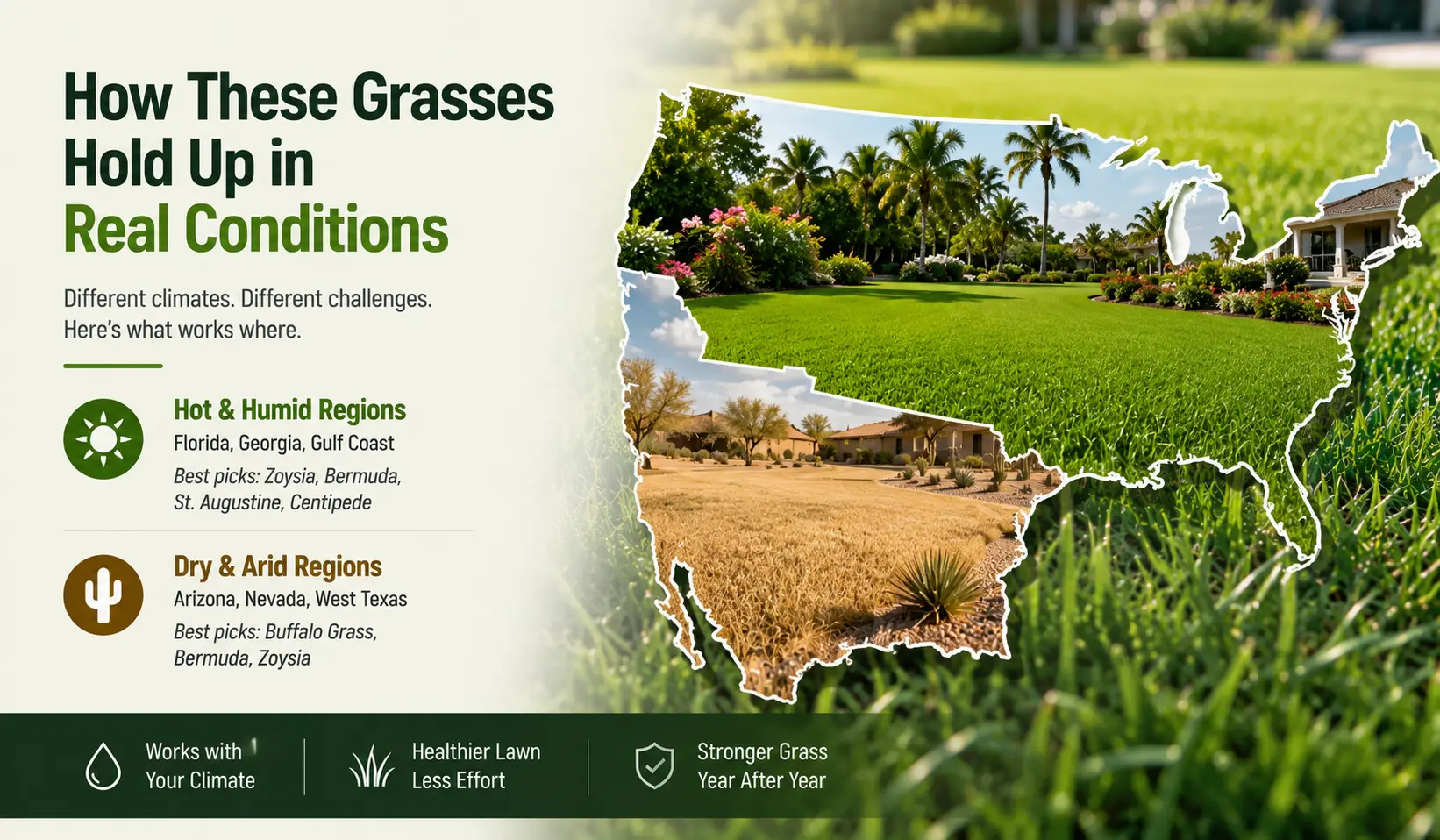
Cool Seasons and Frost: Minnesota, Ohio, Pacific Northwest
Tall Fescue is the workhorse here. Fine Fescue fills shade areas. Kentucky Bluegrass is beautiful but demands more water and more disease management.
Spring and fall are the high-growth seasons for cool-season grasses. That’s when they need the most mowing and when overseeding makes the biggest difference. Summer is the stress period – not from cold, but from heat and drought.
In the Pacific Northwest, the mild, wet winters mean cool-season grasses can stay green year-round. That’s a rare advantage. Tall Fescue and Fine Fescue both perform well there with almost no supplemental irrigation.
Regional Performance Comparison
| Grass Type | Hot & Humid (GA, FL) | Dry & Arid (AZ, NV) | Cool Season (MN, OH, PNW) |
|---|---|---|---|
| Bermuda | Excellent | Good (needs irrigation) | Not recommended |
| Buffalo | Not recommended | Excellent | Moderate (zones 5-6 only) |
| Zoysia | Excellent | Moderate | Not recommended |
| Tall Fescue | Poor | Not recommended | Excellent |
| Fine Fescue | Not recommended | Not recommended | Excellent (shade only) |
| Centipede | Excellent | Not recommended | Not recommended |
Common Mistakes People Make When Choosing Grass
Most lawn failures aren’t about technique. They’re about choosing the wrong grass from the start.
Planting the Wrong Grass for Your Climate Zone
This is the most expensive mistake I see. Someone in North Carolina sees a beautiful Zoysia lawn in a magazine photo taken in Georgia, buys sod, plants it in a shaded yard with clay soil, and can’t understand why it dies.
Zoysia needs sun. Clay soil needs amendment. Georgia is zone 8; parts of North Carolina are zone 6. All three factors matter.
Before buying anything, check the USDA Plant Hardiness Zone for your specific address (available at planthardiness.ars.usda.gov), get a soil test, and map out how many hours of direct sun your yard actually receives. Those three data points eliminate most of the guesswork.
Underestimating Establishment Time and Cost
Bermuda seed planted in May won’t be a full lawn by July. Zoysia plugs won’t fill in by fall. Every low-maintenance grass on this list takes one to two full growing seasons to establish properly.
During establishment, the grass needs more care than it will once mature – more watering, more protection from heavy traffic, sometimes starter fertilizer. The “low maintenance” payoff comes after establishment, not during it.
Sod speeds things up significantly but costs 2-5x more than seed. For most homeowners, seed is fine if they can protect the area for 6-8 weeks during germination. For high-traffic areas or if you need coverage fast, the sod premium is worth it.
My Final Recommendation
If I had to give one piece of advice to someone starting from scratch, it’s this: match your grass to your climate first, your soil second, and your aesthetic preferences last. That order matters. The most beautiful grass cultivar won’t save you from planting a warm-season grass in Minnesota.
For most US homeowners in the South and Southeast – the biggest grass-buying market in the country – Zoysia is the long-game choice. It takes patience to establish, but once it’s in, the weed suppression alone saves dozens of hours a year. If you’re in a hurry or on a tighter budget, Bermuda sod from a local supplier will give you a functional, low-maintenance lawn faster and cheaper.
For anyone in the arid Southwest, Buffalo grass is worth the slow establishment timeline. I’ve seen homeowners in Tucson eliminate irrigation almost entirely after two seasons. In a region where water costs are a real concern, that’s not a small thing. In cool-season climates, stop fighting for Kentucky Bluegrass and switch to Tall Fescue – specifically a named variety like Jonathan Green Black Beauty or Scotts Turf Builder Tall Fescue Mix. The performance difference in a dry summer is significant.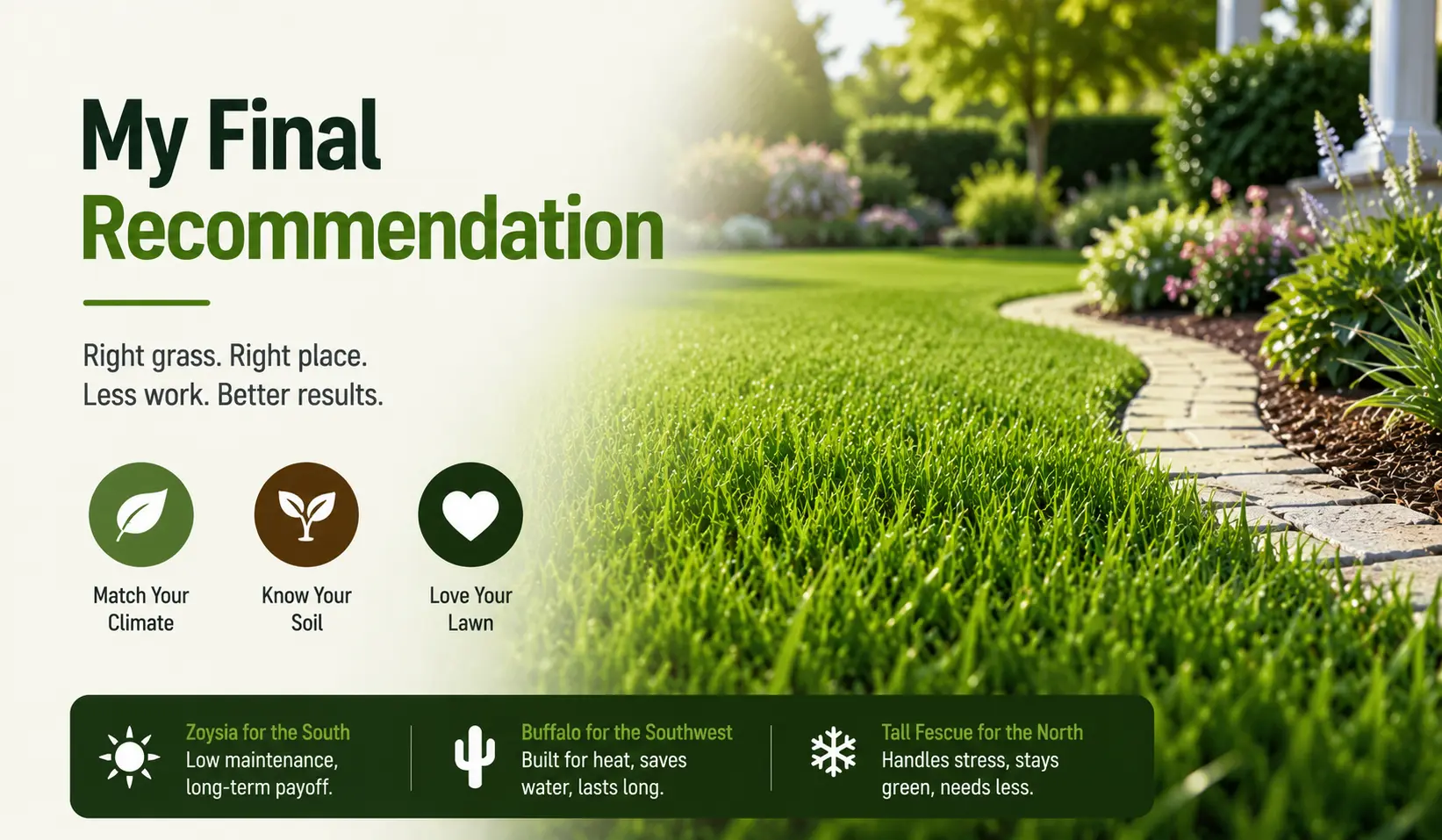
Pros and Cons Summary
| Grass Type | Pros | Cons |
|---|---|---|
| Bermuda | Drought-tolerant, fast recovery, high traffic tolerance, widely available | Brown in winter, needs full sun, can invade garden beds |
| Buffalo | Extremely low water needs, very slow growth (minimal mowing) | Slow to establish, limited availability, goes dormant in drought |
| Zoysia | Dense weed resistance, good drought tolerance, handles shade better than Bermuda | Very slow establishment, brown in winter, expensive sod |
| Tall Fescue | Stays green in mild winters, tolerates shade and foot traffic | Doesn’t self-repair (needs overseeding), can look coarse |
| Fine Fescue | Best shade tolerance, very low fertilizer needs, fine texture | Cannot handle foot traffic, not heat-tolerant |
| Centipede | Very low fertilizer needs, widely available, low cost | Sensitive to alkaline soil, poor cold tolerance, slow to recover from damage |
Frequently Asked Questions About Low-Maintenance Grass Types
What is the most low-maintenance grass for a warm climate?
Bermuda grass is the most practical low-maintenance option for warm climates across zones 7-10. It tolerates drought, recovers quickly from heavy use, and needs significantly less water than alternatives like St. Augustine or Kentucky Bluegrass. For the driest climates in the Southwest, Buffalo grass requires even less water once established.
What grass type stays green year-round without much effort?
No grass type stays green year-round in every US climate. In mild, wet climates like the Pacific Northwest, Tall Fescue and Fine Fescue stay green through winter with little effort. In warm climates, warm-season grasses like Bermuda and Zoysia go dormant and turn brown in winter unless overseeded with a cool-season grass like Perennial Ryegrass.
How long does it take a low-maintenance grass to establish?
Establishment time varies significantly by type. Tall Fescue and Fine Fescue establish in 4-8 weeks from seed under good conditions. Bermuda from seed takes 3-6 months to fill in fully. Zoysia from plugs can take 12-24 months to achieve full coverage. Sod cuts establishment time to 2-6 weeks for most varieties, but costs more upfront.
What grass type needs the least watering?
Buffalo grass needs the least supplemental irrigation of any common US lawn grass. Once fully established – which takes 12-18 months from seed – it can survive on natural rainfall alone in most of the central US, including the Great Plains and parts of the Southwest. The University of Nebraska Extension reports that established Buffalo grass can survive on 0.5 to 0.75 inches of water per week (University of Nebraska Extension, 2022).
What is the difference between warm-season and cool-season grass?
Warm-season grasses (Bermuda, Zoysia, St. Augustine, Buffalo, Centipede) grow most actively during summer heat, go dormant in winter, and are best suited for USDA zones 7-10. Cool-season grasses (Tall Fescue, Fine Fescue, Kentucky Bluegrass, Perennial Ryegrass) grow most actively in spring and fall, tolerate frost, and are best suited for zones 3-7. Planting the wrong category for your zone is the most common and costly mistake in lawn selection.
Can I overseed a warm-season grass to keep it green in winter?
Yes. Overseeding Bermuda or Zoysia with Perennial Ryegrass in early fall (when soil temperatures drop below 70°F) is common practice across the Southeast and transition zone. The Ryegrass stays green through winter while the warm-season grass is dormant, then the warm-season grass comes back in spring. It adds some maintenance cost and effort but solves the winter brown problem.
Is Zoysia worth the extra cost compared to Bermuda?
For most homeowners in zones 7-9, yes – if you’re willing to wait for establishment. Zoysia’s weed-suppressing density means significantly less herbicide spending over time. It also handles shade better than Bermuda and requires slightly less mowing. The trade-off is higher upfront cost (Zoysia sod typically runs 20-40% more than Bermuda sod) and a slower establishment period.