
At a Glance
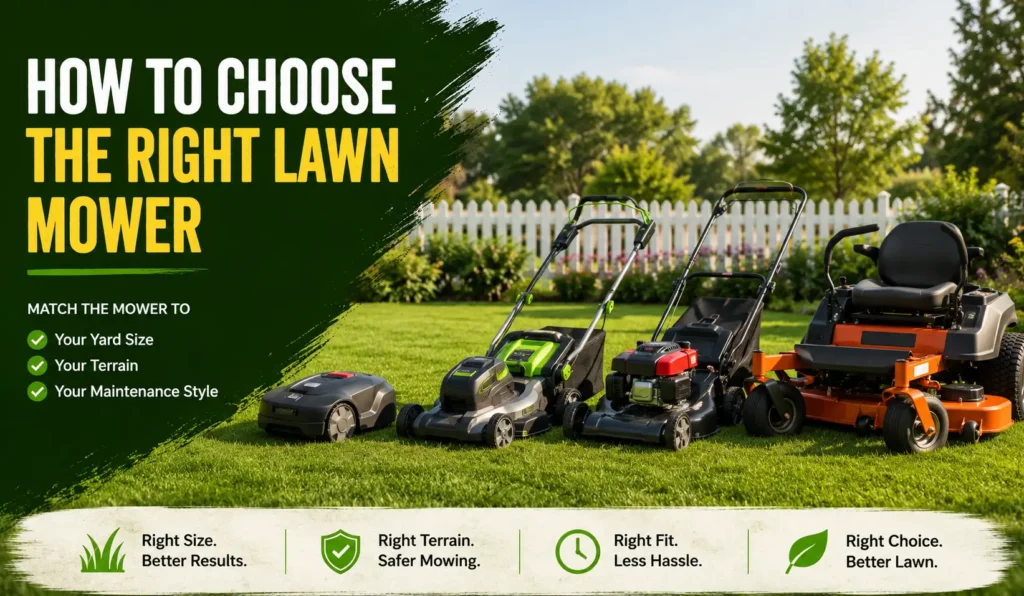
- The right mower depends on three things: yard size, terrain, and how much maintenance you’re willing to do – not brand or price alone.
- Yards under 1/4 acre do well with a battery-powered push or self-propelled mower; anything over 1/2 acre usually calls for a riding mower.
- Battery mowers (EGO, Greenworks) now match gas performance for most suburban yards, with far less upkeep.
- Robotic mowers work best on flat, obstacle-free lawns – they’re not a universal fix.
- The most common mistake is buying too much mower, or the wrong type entirely, based on a store display and a price tag.
Why Choosing the Wrong Mower Is Such a Common Mistake
Most people buy the wrong mower. Not because they’re uninformed – because the store isn’t set up to help them make a good decision.
I’ve watched it happen hundreds of times. Someone walks into a Home Depot or Lowe’s, gets a little overwhelmed by the floor models, gravitates toward the biggest one that fits the budget, and wheels it out. Six months later, they’re either cursing the thing or it’s collecting dust in the garage.
The “Biggest Is Best” Trap
A zero-turn riding mower looks impressive. It cuts fast, it’s comfortable, and if you have two acres of flat Kentucky Bluegrass, it’s genuinely the right tool.
But if you have a quarter-acre suburban lot in Atlanta with tight corners, a flower bed, and a swing set to navigate? That zero-turn will spend more time in reverse than moving forward. You’ll spend twice as long as you would with a self-propelled walk-behind, and you’ll have a $3,000 machine sitting in a one-car garage.
Bigger is not better. The right size is better.
Matching the Mower to the Yard, Not the Price Tag
Here’s the frame I give everyone before they shop: your yard is the product spec. The mower has to fit the yard – not the other way around.
Before you compare brands or horsepower ratings, you need to know four things: how big your yard is, how flat it is, what kind of grass you’re growing, and how much time you want to spend on upkeep. Once you have those answers, the mower choice is almost obvious.
Step One – Know Your Yard Before You Shop
The biggest favor you can do yourself is spend 20 minutes studying your own lawn before you spend a single minute on a product page.
Yard Size: The Single Most Important Factor
Yard size drives the mower category more than any other variable. Here’s how I break it down:
| Yard Size | Recommended Category |
|---|---|
| Under 1/4 acre | Push or self-propelled walk-behind |
| 1/4 to 1/2 acre | Self-propelled or a compact riding mower |
| 1/2 to 1 acre | Riding mower or large self-propelled |
| Over 1 acre | Riding mower or zero-turn |
A standard suburban lot runs about 1/5 to 1/4 acre of actual mowable lawn (after the house, driveway, and landscaping). If you’re not sure, pace it out or check your property survey. Most people overestimate their yard size, which pushes them toward bigger equipment than they need.
Terrain and Slope: Flat, Hilly, or Rocky?
Flat ground gives you the most options. Slopes change everything.
On anything steeper than a 15-degree incline – which you can roughly judge by whether the ground feels like walking uphill – a riding mower becomes a safety issue. Manufacturers are clear about this in their specs, and it’s not fine print worth skipping.
For sloped yards, a self-propelled walk-behind with rear-wheel drive handles hills far better than front-wheel drive. Rocky or rooted terrain? You want adjustable cutting height and a solid metal deck, not a lightweight plastic one that cracks on impact.
Out in Phoenix, the rocky hardpan and desert scrub mix creates a different challenge than a soft suburban lawn in suburban Atlanta. You need a mower that won’t die on you mid-season because a chunk of caliche caught the blade.
Grass Type and Thickness
Grass type matters more than most buyers realize.
Bermuda grass and Zoysia – common across the Southeast and Gulf Coast – are dense and low-growing. They need a mower that cuts cleanly at 1 to 3 inches without stressing the plant. St. Augustine, which dominates coastal Florida and Houston suburbs, is thick and spreads fast. It needs a sharp blade and enough power to push through growth after a week of rain.
Up in the Midwest and Upper Plains, Kentucky Bluegrass and Tall Fescue grow in cooler seasons and have a different cutting rhythm – spring and fall are intense, summer slows down. A less aggressive mower with good mulching capability works well there.
If your grass is thick, dense, or tends to get long between cuts, don’t underestimate the power you need. Battery mowers handle most grass types well now, but a 40V mower on overgrown St. Augustine in August is going to struggle.
The Four Main Types of Lawn Mowers Explained
Once you know your yard, choosing a mower type becomes a process of elimination, not a guessing game. There are four main categories, each with a clear use case.
Push Mowers (Manual and Gas)
A push mower does exactly what it sounds like – you supply the forward motion. You push, the blade spins, the grass gets cut.
Manual reel mowers (the old-style push-with-no-engine type) are great for very small, flat lawns with thin, fine grass. They’re quiet, require almost no maintenance, and cost almost nothing. But if your lawn is bigger than about 2,000 square feet or your grass is thick, a reel mower becomes more workout than lawn care.
Gas push mowers are a step up – they power the blade, but you still walk the full distance. They’re cheap to buy, and they cut hard enough for most grass types. The trade-off is maintenance: oil changes, air filter checks, carburetor issues after sitting over winter. If you’ve ever pulled a cord 12 times and gotten nothing, you know what I mean.
Best for: Small, flat yards. Low budgets. People who don’t mind a bit of physical effort.
Self-Propelled Mowers
A self-propelled mower drives itself forward. You guide it, but you’re not pushing dead weight across your yard.
This is the category most suburban homeowners should start with. Front-wheel drive is cheaper and fine for flat ground. Rear-wheel drive – worth the extra $50 to $100 – handles slopes and uneven terrain much better because the drive wheels don’t lift when you raise the front for a bump.
The difference between pushing and self-propelled is pronounced once your yard is over 5,000 square feet. An hour of pushing on flat Atlanta clay in July is a very different experience than walking behind a mower that’s doing the work.
Best for: Yards from 1/4 to 1/2 acre. Moderate slopes. Homeowners who want efficiency without buying a rider.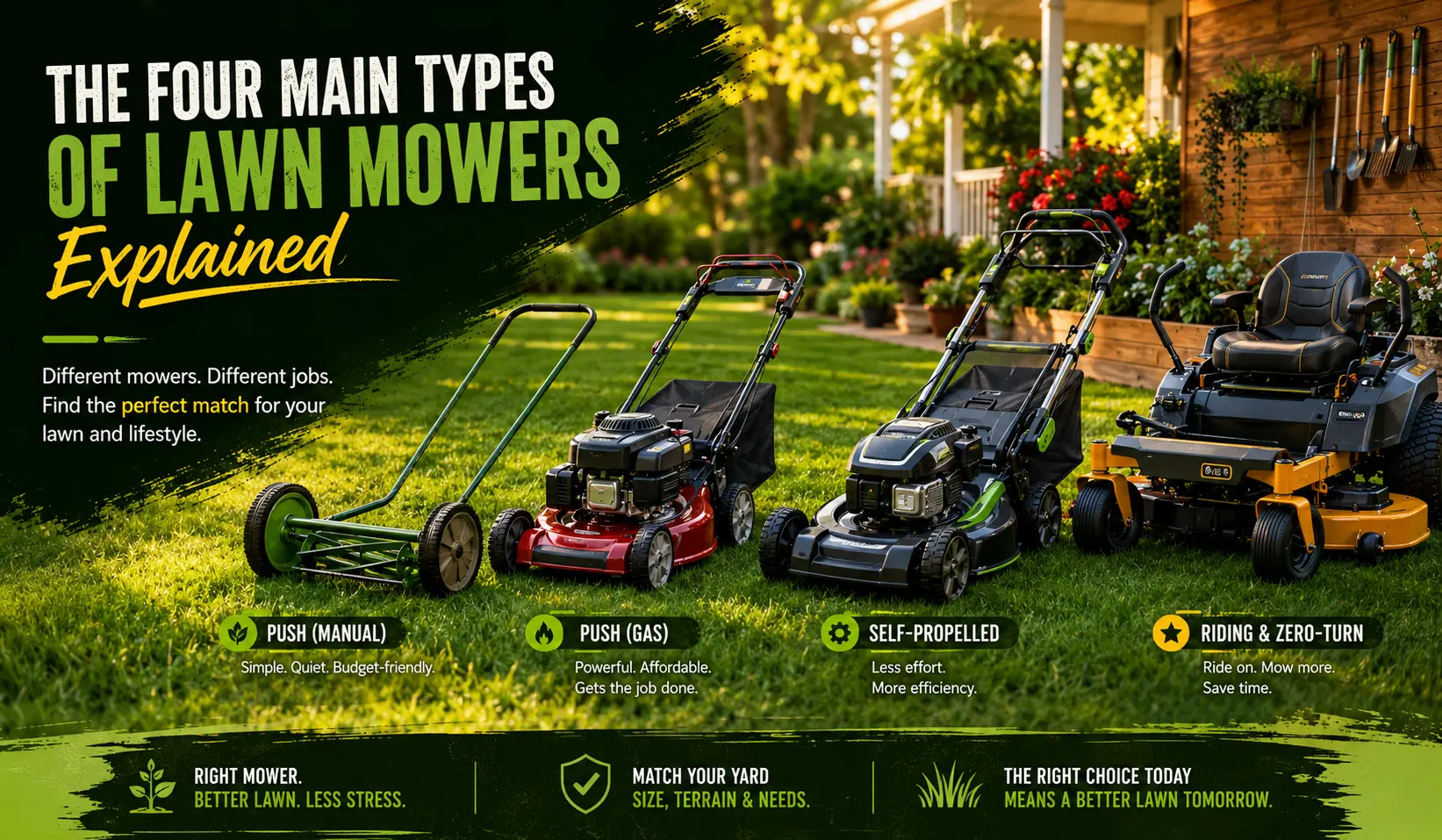
Riding Mowers and Zero-Turn Mowers
Riding mowers let you sit. That’s the point.
Standard riding mowers steer like a car – front wheels turn. They’re slower and less nimble than zero-turns but easier to operate and often cheaper. Good for 1/2 acre and up with straightforward layouts.
Zero-turn mowers steer by controlling each rear wheel independently, which lets them spin in place and cut tight lines without leaving uncut strips. They’re faster and more precise – but they cost more, take practice to operate, and are genuinely dangerous on anything beyond a gentle slope.
If you have a large, mostly flat yard with few obstacles, a zero-turn earns its price. If your yard has hills, tight spaces, or garden beds you’re weaving around, a standard rider is the better call.
Best for: Yards over 1/2 acre, flat to gently rolling terrain.
Robotic Mowers
Robotic mowers operate like Roomba vacuums – they navigate the yard on their own, cutting a little each day, and return to their dock to charge.
They produce a very consistent, fine cut because they run frequently. The lawn stays short without you doing anything after setup.
The setup is where the friction is. You have to bury a perimeter wire (or set virtual boundaries on newer models) to contain the robot. Obstacles like garden hoses, kids’ toys, or garden beds confuse them. And they don’t handle slopes well above about 20 percent gradient.
Husqvarna’s Automower line and Worx Landroid are the two worth looking at. Expect to spend $700 to $3,000 depending on yard size coverage. For a flat, clean, open lawn, they’re genuinely excellent. For anything complicated, they’re more hassle than they’re worth.
Best for: Flat, obstacle-free yards where consistent, low-maintenance cutting is the priority.
Mower Types at a Glance
| Type | Yard Size | Terrain | Cost Range | Best For |
|---|---|---|---|---|
| Push (gas) | Under 1/4 acre | Flat | $200-$400 | Budget buyers, small lawns |
| Self-propelled | 1/4 to 1/2 acre | Flat to moderate slope | $300-$700 | Most suburban homeowners |
| Riding mower | 1/2 to 2 acres | Flat to gentle slope | $1,200-$3,500 | Larger lots, limited physical effort |
| Zero-turn | 1 acre and up | Flat | $2,500-$7,000+ | Speed and precision on large open yards |
| Robotic | Up to 1 acre | Flat, obstacle-free | $700-$3,000 | Low-maintenance, hands-off cutting |
Gas vs. Battery vs. Electric – Which Power Source Is Right for You?
Power source is the second biggest decision after mower type. Each has real trade-offs that affect your day-to-day experience more than the spec sheet suggests.
Gas-Powered: Power, but at a Cost
Gas mowers give you unlimited runtime – fill the tank, keep going. They handle thick, wet, overgrown grass better than most battery options. For rural Minnesota, where the spring flush of grass comes fast and heavy, gas still makes sense.
The cost is in ownership, not purchase price. Gas mowers need oil changes every season, new air filters, fresh spark plugs, and stabilizer in the tank if you’re storing them over winter. If you skip the stabilizer, the carb gums up. If the carb gums up, you’re looking at a $60 repair or a shop visit.
They’re also loud. A gas mower at 95 decibels on a quiet suburban street at 7 a.m. is not a neighborly move.
Battery-Powered: The Quiet Revolution
Battery mowers have genuinely closed the gap with gas for most residential yards. A 56V or 60V lithium-ion mower from EGO or Greenworks handles 1/3 to 1/2 acre on a single charge without issue, cuts through most grass types cleanly, and starts every single time with a button press.
The main limitation is runtime. A standard 7.5 amp-hour battery gives you about 45 to 60 minutes of cutting time depending on grass thickness. If your yard is large or the grass is dense and wet, you might need a second battery or a mid-session charge.
Battery mowers also benefit from brushless motor technology – quieter, more efficient, longer motor life than brushed alternatives. If you’re comparing battery models, brushless is worth paying for.
One practical upside that doesn’t get enough attention: if you already own tools from a platform like EGO or Ryobi, your mower battery is interchangeable with your blower, trimmer, and chainsaw. That ecosystem value adds up.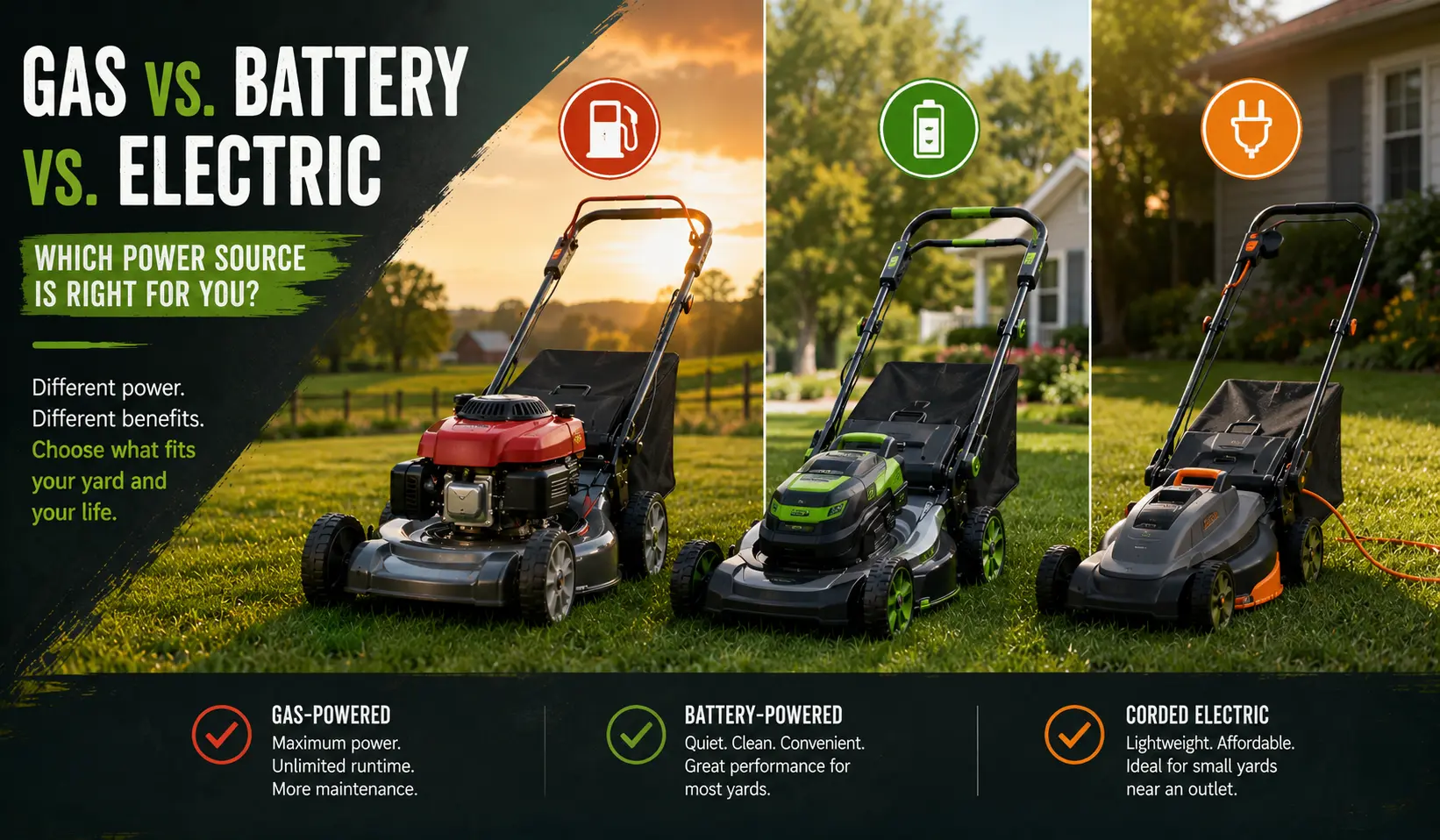
Corded Electric: Best for Tiny Yards Only
Corded electric mowers are cheap, light, and always have power. They’re also tethered to a 50-foot extension cord, which means you’re constantly managing the cord around the yard, and you cannot go more than 100 feet from an outlet.
For a small urban backyard under 1,500 square feet with no obstacles? A corded electric mower is perfectly fine. For anything bigger, the cord is more frustrating than the savings are worth.
Power Source Comparison
| Power Source | Runtime | Maintenance | Noise Level | Best For |
|---|---|---|---|---|
| Gas | Unlimited (fill tank) | High (seasonal service) | Loud (~95 dB) | Large yards, thick grass, rural use |
| Battery (56V+) | 45-60 min per charge | Low (no oil, no filter) | Quiet (~75 dB) | Most suburban yards up to 1/2 acre |
| Corded electric | Unlimited (near outlet) | Very low | Quiet | Tiny yards, urban gardens |
The Specs That Actually Matter (And the Ones You Can Ignore)
Spec sheets are designed to look impressive. Most of the numbers don’t affect your experience as much as the marketing implies. Here’s what genuinely matters.
Cutting Width and Deck Size
Cutting width determines how wide a strip the mower cuts in each pass. A 21-inch deck cuts a 21-inch strip. Simple.
Wider decks finish yards faster but maneuver less easily around obstacles. For a typical suburban lot with garden beds and trees to navigate, 20 to 22 inches is the practical sweet spot. Go wider only if you have a large, open lawn with few obstacles.
Cutting Height Adjustment
The ability to adjust cutting height matters more than most buyers think. Different grass types need different heights – Bermuda grass thrives cut short at 1 to 1.5 inches; Tall Fescue prefers 3 to 4 inches.
A single-lever height adjustment that changes all four wheels at once is far more convenient than individual wheel adjustments. It’s a small feature that you’ll use every season as the weather changes.
Drive System and Wheel Size
For self-propelled mowers, rear-wheel drive handles uneven terrain and slopes better than front-wheel drive. Front-wheel drive is cheaper and adequate for flat, smooth lawns.
Larger rear wheels roll over roots, edging lips, and rough ground more smoothly than small wheels. If your yard has any texture to it, larger wheels reduce vibration through the handle.
Bagging, Mulching, and Side Discharge
Most mowers offer three discharge options: bag clippings, mulch them back into the lawn, or discharge them to the side.
Mulching is the better choice for lawn health when grass is cut regularly and not overly long. Grass clippings decompose quickly and return nitrogen to the soil (Purdue Extension, 2023). Side discharge is useful for very tall grass that would clog a mulching system. Bagging gives a clean look but sends that free fertilizer to the landfill.
If a mower advertises “3-in-1” capability, it handles all three. That’s the configuration worth buying.
Noise Level and Vibration
Noise matters if you have close neighbors or mow early in the morning. Gas mowers typically run 90 to 95 decibels – sustained exposure requires ear protection. Battery mowers run around 75 decibels, roughly equivalent to a normal conversation.
Vibration through the handle is a fatigue factor on long mowing sessions. Anti-vibration handles are worth noting if you’re mowing more than 30 minutes at a stretch.
Top Brands Worth Knowing – And What They’re Best For
You don’t need to memorize every brand, but knowing who makes what saves you from buying a replacement battery that doesn’t exist or a mower with no dealer within 50 miles.
EGO, Greenworks, Ryobi, HART (Battery)
EGO is currently the benchmark for battery-powered lawn equipment. Their 56V platform is mature, widely available, and the performance at the top of the line genuinely replaces gas for most users. Batteries are interchangeable across their tool ecosystem.
Greenworks offers solid performance at a lower price point. Good for homeowners who want battery performance without the EGO premium.
Ryobi’s 40V platform is widely available at Home Depot and offers good value for smaller yards. Their ecosystem is broad – great if you already own Ryobi tools.
HART is Walmart’s house brand, built by the same manufacturer as some Ryobi products. Acceptable for light-duty use; limited parts availability long-term.
Honda, Toro, Husqvarna (Gas)
Honda’s HRX series is the standard for gas walk-behind mowers. The engines start reliably, the build quality is above average, and they hold resale value. More expensive upfront, but lower total cost of ownership.
Toro makes solid self-propelled mowers with a long service history. Their Personal Pace drive system adjusts speed to how fast you walk, which is genuinely useful on uneven terrain.
Husqvarna dominates the riding mower and zero-turn category for residential use. Their mid-range riders are well-built and widely serviced. For a large suburban or semi-rural lot, Husqvarna is where I’d start looking.
Husqvarna, Worx (Robotic)
Husqvarna Automower is the category leader in robotic mowers. Long track record, wide model range from small yards to large estates. The newer models use GPS and app control without perimeter wire.
Worx Landroid is the accessible alternative – lower cost, decent performance on simple flat yards. Setup is straightforward. Fewer model options but a solid entry point.
Brand Comparison by Use Case
| Use Case | Brand to Start With |
|---|---|
| Battery, best performance | EGO |
| Battery, best value | Greenworks or Ryobi |
| Gas, walk-behind | Honda HRX |
| Gas, riding mower | Husqvarna |
| Robotic, premium | Husqvarna Automower |
| Robotic, budget | Worx Landroid |
How Climate and Region Should Affect Your Decision
Where you live shapes what your mower goes through. The same machine that works perfectly in Ohio will struggle in August in South Carolina.
Hot and Humid Regions (Southeast, Gulf Coast)
Heat and humidity are hard on batteries. In sustained 95-degree Georgia summers, battery runtime drops noticeably – sometimes 15 to 20 percent shorter than the spec sheet claims. Plan for that.
Grass in the Southeast grows fast in summer and needs frequent cutting. If you’re on Bermuda or St. Augustine, you’re mowing weekly from April through October. A self-propelled mower with a strong brushless motor and at least a 7.5 Ah battery handles this well. Gas is reliable here too, but the maintenance load in a humid climate is real – metal parts rust, air filters clog with pollen.
Dry and Rocky Terrain (Southwest, Mountain States)
In Phoenix, Tucson, or up in the Colorado foothills, you’re often dealing with thin, patchy grass, gravel, and hard soil. Blade strikes on rocks are a regular event.
Look for a metal deck, not plastic. A steel deck handles a rock strike that would crack a cheaper housing. Also look for adjustable blade height – desert landscapes often mix grass and hardpan, and you’ll need to raise the deck quickly.
For desert grass like Buffalo Grass or drought-tolerant Zoysia blends, you’re not mowing as often as Gulf Coast homeowners. A battery mower handles the lighter cutting schedule well.
Thick Turf and Cold Springs (Midwest, Upper Plains)
The Midwest spring flush – when Kentucky Bluegrass and Tall Fescue come up fast after snowmelt – means the first three or four cuts of the season are through thick, wet grass.
Wet grass clumps. It clogs mulching systems and reduces battery runtime fast. Gas mowers handle the spring workload with less complaint than most battery options. If you’re in Minnesota or Iowa and mowing an acre of Bluegrass in May, gas or a large-capacity battery (10 Ah or higher) makes more sense than a standard battery setup.
Common Buying Mistakes I See All the Time
These are the mistakes that generate regret, and most of them are completely avoidable.
Skipping the Runtime and Charging Time Math
Battery mower packages advertise runtime numbers under ideal conditions – flat ground, dry grass, moderate thickness. Real-world runtime is shorter.
Before buying a battery mower, calculate your actual mowing time for your yard. Walk it once with a stopwatch. If it takes you 50 minutes and the battery claims 45 minutes, you’ll need a second battery or a mid-mow charge break.
Also check charging time. Some 56V batteries take 90 minutes to fully recharge. If you start with a half-charged battery and run out mid-yard, that’s a frustrating break in your afternoon.
Forgetting About Storage and Maintenance
A 42-inch riding mower needs real storage space. If your garage is full, you need a shed – and a good one. A lawn mower stored through a Minnesota winter in a damp, uninsulated space is going to have problems.
Battery mowers store indoors easily and the batteries last longer when kept at room temperature. Gas mowers stored without fuel stabilizer will have carburetor issues by spring. These aren’t scare stories – they’re the most common repair calls I’ve seen.
Buying Without Checking Warranty and Parts Availability
A mower is only as good as the service behind it. Before buying any brand, check: Is there a dealer within a reasonable distance? Are replacement blades and belts available at local retailers or at least online with fast shipping?
Off-brand riding mowers at a low price point can be impossible to find parts for after two seasons. Honda, Toro, and Husqvarna have wide service networks. Some budget brands do not.
Check the warranty length and what it covers. A 3-year warranty on the battery, 5 years on the deck – like EGO offers – is meaningful. A 90-day warranty on everything should give you pause.
My Final Recommendation
There’s no single best mower. Anyone who tells you otherwise is selling something.
If I had to walk a typical suburban homeowner through the decision, I’d ask them three questions: How big is your lawn? How much time do you want to spend on maintenance? And do you care about noise?
For most people on a quarter-acre suburban lot – which covers the majority of homeowners reading this – a self-propelled battery mower in the 56V or 60V range from EGO or Greenworks will do the job well, start every time, and save you the annual gas mower service headache. Spend the extra $50 to $100 on rear-wheel drive. Get the 7.5 Ah battery minimum, or the larger 10 Ah if your grass runs thick.
If you have half an acre or more, start looking at compact riding mowers seriously. The time savings on a 45-minute mow versus a 90-minute walk-behind adds up fast over a season. And if your yard is large, flat, and you want maximum efficiency, a zero-turn from Husqvarna is worth the investment.
The buyer’s remorse I see most often comes from people who bought down to a price and spent a full season fighting a machine that wasn’t right for their yard. Buy the right tool for your specific situation, and it pays for itself in frustration you never have.
Pros and Cons by Mower Type
| Mower Type | Pros | Cons |
|---|---|---|
| Push mower (gas) | Low upfront cost, cuts well in small spaces | Physically tiring, requires seasonal maintenance, no speed control |
| Self-propelled | Less effort, handles slopes, wide power source options | Higher cost than push, gas models need maintenance |
| Riding mower | Covers large areas fast, comfortable for long sessions | Expensive, needs storage space, not suitable for slopes |
| Robotic mower | Fully automated, consistent cut, no effort once set up | High setup complexity, struggles with obstacles and slopes, costly |
Frequently Asked Questions About Choosing a Lawn Mower
What type of lawn mower is best for a quarter-acre yard?
A self-propelled battery mower in the 56V to 60V range handles a quarter-acre yard well in a single charge. Rear-wheel drive is worth the small extra cost if your yard has any slope or uneven ground. EGO and Greenworks are the two brands with the strongest performance at this yard size.
How much should I spend on a lawn mower?
For a quality self-propelled battery mower, budget $400 to $650. For a gas self-propelled mower from a reliable brand like Honda or Toro, budget $400 to $600. Compact riding mowers start around $1,200 to $1,500. Avoid the very cheapest options in any category – they tend to have short lifespans and limited parts availability.
Is a battery mower as powerful as a gas mower?
For most residential yards up to about half an acre, yes – current 56V and 60V battery mowers cut through normal grass with comparable performance to mid-range gas mowers. The difference shows up in very thick, wet, or overgrown grass where gas still has an edge. Battery mowers are quieter, require less maintenance, and are easier to start.
Can I use a riding mower on a sloped yard?
Most riding mower manufacturers recommend against use on slopes steeper than 15 degrees for standard riders, and steeper than 10 degrees for zero-turn mowers. On steep slopes, a rear-wheel drive self-propelled walk-behind is safer and more controllable. Always check your specific mower’s maximum slope rating in the manual.
How often do I need to service a lawn mower?
Gas mowers need an oil change, air filter check, and spark plug replacement every season – or every 50 hours of use, whichever comes first. Battery mowers need almost no scheduled maintenance: keep the underside of the deck clean, sharpen or replace the blade annually, and store the battery indoors in winter. The service gap between gas and battery is one of the strongest arguments for battery for most homeowners.
What is the difference between a zero-turn mower and a standard riding mower?
A standard riding mower steers with a front-wheel turning mechanism, similar to a car. A zero-turn mower uses independent rear-wheel control to spin in place, allowing it to cut tight lines with no uncut strips. Zero-turns are faster and more maneuverable on large open areas but cost more, require more operator skill, and are less safe on slopes compared to standard riders.