
Quick Overview
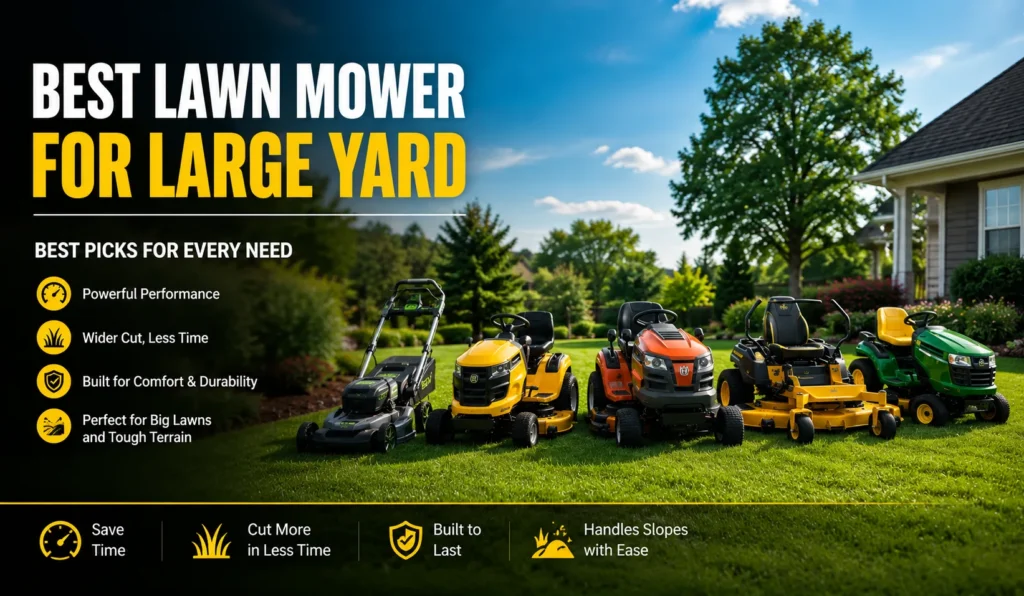
- The best lawn mower for a large yard overall is the Husqvarna TS 354XD – a 46″ riding tractor that handles 1-2 acre lots without overheating or stalling on thick Southern grass
- Best zero-turn for speed on flat ground: Cub Cadet Ultima ZT1 50 cuts a full acre in under 35 minutes
- Best for slopes and uneven ground: John Deere E170 – rated to 20 degrees, safer than any zero-turn on grades
- Best budget pick under $2,000: Cub Cadet XT1 LT42 works well on half-acre to 1-acre lots with average grass
- Best battery option: EGO Power+ Z6 delivers 2-2.5 hours of runtime per charge – enough for most 1-acre residential lots
It was mid-July in Georgia. Ninety-five degrees, humidity thick enough to chew, and I had half an acre of Bermuda grass still standing. My 21″ walk-behind sputtered out near the back fence. It just stopped – motor too hot, probably too old for the job it was never built to do. I stood there in the full afternoon sun, sweating through my shirt, staring at a half-finished lawn.
That was the last time I used the wrong mower on a large yard.
Since then I’ve put real hours on riding tractors, zero-turns, and wide-deck walk-behinds across properties from suburban Atlanta to a 2-acre lot outside San Antonio to a wide-open field in central Iowa. This guide is for homeowners with yards of half an acre or more who keep buying the wrong machine and wondering why the job feels so much harder than it should.
I’ll walk you through what to look for, which models I’d actually buy, and where each one falls short. No sugarcoating. Every mower on this list has at least one real weakness.
Why Your Yard Size Changes Everything
Yard size doesn’t just affect how long the job takes. It changes which engine, deck width, and drive system you need – and what breaks down first if you get it wrong.
The Half-Acre Threshold – When a Regular Mower Just Won’t Cut It
A standard 21″ walk-behind covers about 400 square feet per pass. Half an acre is 21,780 square feet. Do that math and you’re looking at 90 minutes or more of sustained pushing in summer heat – that’s before obstacles, terrain changes, or the inevitable restart after a stall.
A 42″ riding tractor covers the same half-acre in around 30-35 minutes at a comfortable ground speed. That’s not a small difference. Over a full mowing season of 20-25 cuts, that gap becomes hours.
The walk-behind also runs harder on large lots. Engines designed for 30-minute sessions that regularly run 90 minutes overheat, wear faster, and break sooner. Half an acre is the practical cutoff where a riding mower or wide-deck machine stops being a luxury and starts being the sensible choice.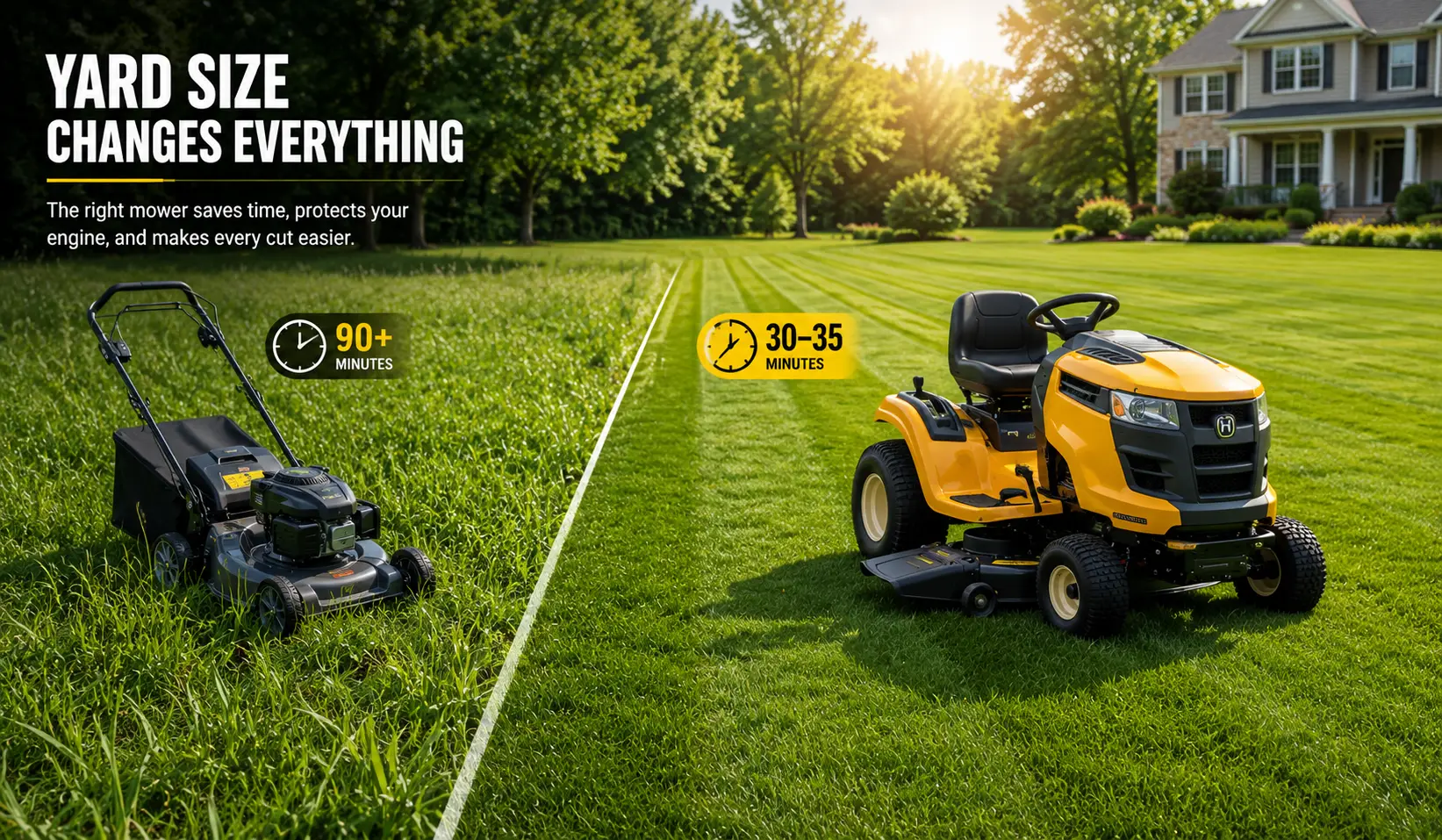
How Yard Size Affects Engine Power, Deck Width, and Fatigue
Engine displacement – measured in cubic centimeters (cc) – tells you more than horsepower ratings do. Manufacturers sometimes overstate HP on lower-end models. A 725cc engine will outwork a 452cc engine in sustained cutting conditions, regardless of what the label claims.
For 1-acre lots: target at least 20 HP and 500+ cc. For 2+ acres: 22-24 HP and 650+ cc handles thick grass in summer heat without laboring.
Deck width cuts total mow time directly. Every extra inch of cutting width shaves real minutes per session. On a 2-acre property, the difference between a 42″ and a 54″ deck is roughly 20 minutes per cut. Over a season, that matters.
Physical fatigue matters on large lots too. After 45 minutes pushing a walk-behind in Texas summer heat, your pace slows, your lines wander, and your judgment drops. A riding mower removes almost all of that physical load.
What to Look for Before You Buy
Before I get into specific models, here are the things that actually separate a good large-yard mower from one you’ll regret within a season.
Engine Power – Horsepower, CC Ratings, and Voltage Explained Simply
For gas mowers, focus on cc displacement over the HP number on the box. For most 1-acre residential properties: aim for 20+ HP with 500+ cc. For 2+ acres or dense grass types like Bermuda or Zoysia: go 22-24 HP with 700+ cc.
For battery mowers, voltage and amp-hours replace cc. For large yards, you need at least 56V with 7.5Ah+ batteries per charge cycle. Dual or quad-battery systems are worth the premium on anything over 1 acre – single-battery mowers run short.
Cutting Deck Width and Why It Matters on Large Properties
Deck width is the single biggest factor in how long you spend mowing. Here’s a rough estimate for a flat, clear 1-acre lot at average ground speed:
- 30″ walk-behind: 90-110 minutes
- 42″ riding mower: 40-50 minutes
- 52″ zero-turn: 25-35 minutes
If your yard has a lot of trees and tight spots, a very wide deck creates its own problems – more passes to get around each obstacle. For open lots, go as wide as your layout allows.
Riding Mowers vs. Zero-Turn vs. Wide-Deck Walk-Behinds
Riding tractors use a steering wheel and front-axle turning. They handle slopes and rough terrain better than zero-turns, are easier to learn, and feel more forgiving if you’re new to large mowers.
Zero-turn mowers use lap bars to control two separate rear wheel motors. They turn on a dime and reduce mow time significantly on open, flat ground. The trade-off: they struggle on slopes above 15 degrees and take a few sessions to drive confidently.
Wide-deck walk-behinds (30″ and up) sit between those two worlds. Slower than riding mowers but better for tight spots, slopes, and obstacle-heavy yards. The right tool for lots under an acre with lots of landscaping.
Terrain and Slope Handling
Slope rating is one of the most ignored specs on the sticker – and one of the most important. Zero-turn mowers typically rate safe to 15 degrees. Riding tractors handle up to 20 degrees. Above that, you’re looking at a walk-behind or a machine built specifically for slope work.
If more than 20% of your yard is on a grade, a zero-turn is the wrong machine. I ran a zero-turn on a hilly Tennessee property with a consistent 17-degree side slope. On a dewy morning, the rear tires started sliding. Nothing dangerous – but I parked it and finished with the riding tractor. That kind of discovery is better to make before you buy.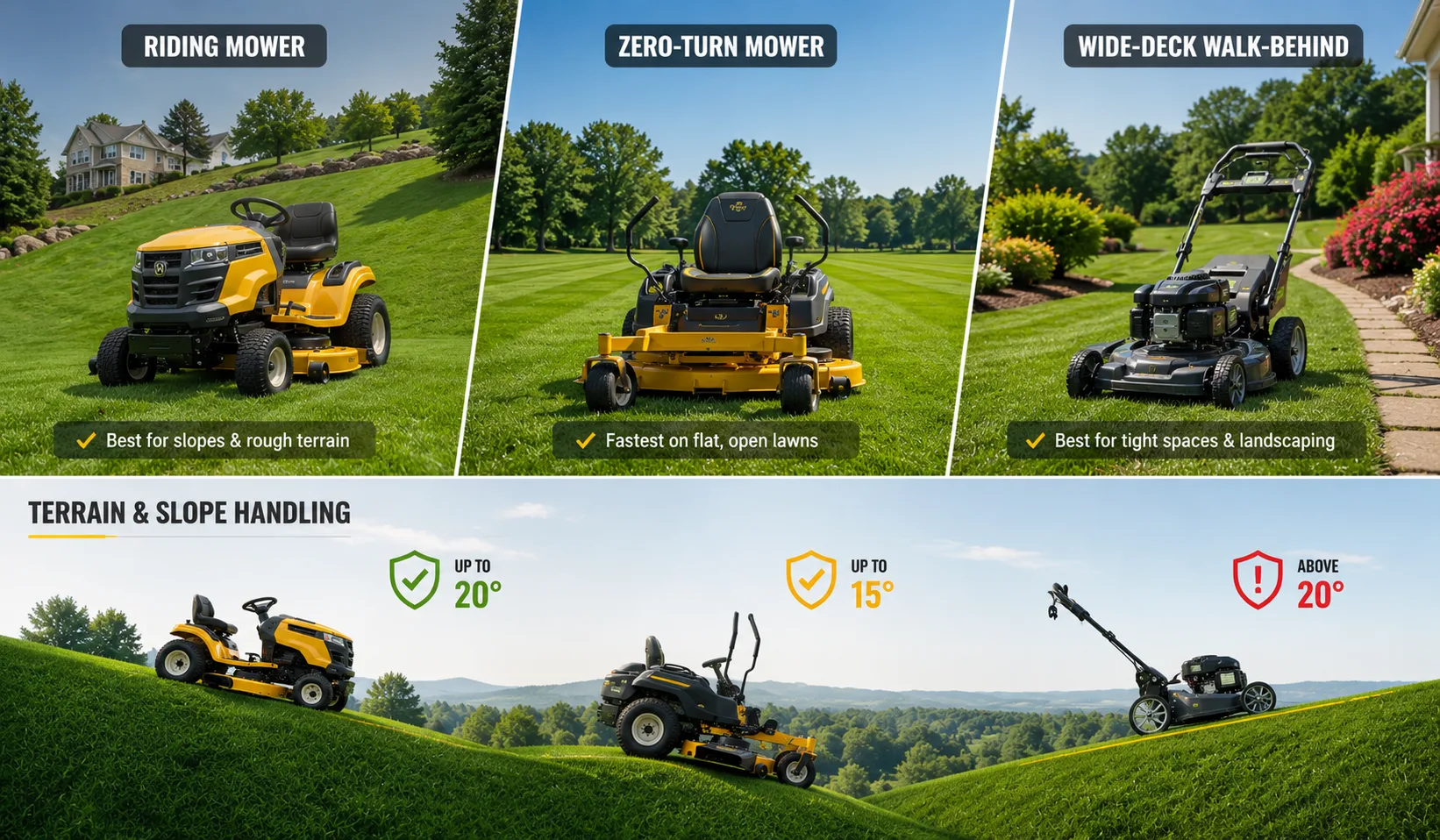
Bagging, Mulching, and Side Discharge Options
Most large-yard mowers support all three. Side discharge is fastest for tall or heavy grass – the clippings spread as you cut, no stopping to empty bags. Mulching returns nutrients to the lawn and works well for regular maintenance cuts on Bermuda and Zoysia. Bagging gives the cleanest finish but means stopping every 15-20 minutes on a large lot to empty.
For anything over an acre, side discharge or mulching saves the most time. Use bagging for the last cut before a big event, not every session.
Compression Table – Feature Comparison Across Mower Types
| Feature | Riding Tractor | Zero-Turn | Wide-Deck Walk-Behind |
|---|---|---|---|
| Best for | 1-2 acres, mixed terrain | 1-3 acres, flat/gentle grade | 0.5-1 acre, obstacle-heavy |
| Typical deck width | 42″-54″ | 42″-60″ | 28″-33″ |
| Slope rating | Up to 20 degrees | Up to 15 degrees | Up to 20 degrees |
| Learning curve | Low | Medium | Low |
| Approx. price range | $1,700-$4,000 | $2,500-$5,500 | $600-$1,200 |
| Mow time (1 acre, flat) | 40-50 min | 25-35 min | 80-100 min |
The Best Lawn Mowers for Large Yards I’ve Tested
Here are the six machines I’d recommend for large properties – in the order I’d point someone toward depending on their yard.
Best Overall for 1-2 Acre Yards: Husqvarna TS 354XD
The Husqvarna TS 354XD is the best all-around riding tractor for most large-yard homeowners. It runs a 24 HP Kawasaki FR Series engine (726cc), cuts a 46″ path, and handles Georgia heat and thick St. Augustine grass without complaint.
The hydrostatic transmission is smooth – no gear changes, no clunky shifting mid-turn. On a 1.5-acre lot in suburban Atlanta with dense St. Augustine, it cut clean in a single pass. No re-runs, no clumping.
Where it falls short: The turning radius is wider than a zero-turn. On a lot with lots of trees or garden beds, plan for extra cleanup passes at the edges. At around $3,200, it’s also not a budget buy.
Specs: 24 HP Kawasaki FR726V | 46″ deck | Hydrostatic transmission | 3.5-gallon fuel tank | Cutting height 1.5″-4″
Best Zero-Turn Mower: Cub Cadet Ultima ZT1 50
The Cub Cadet Ultima ZT1 50 is the fastest mower on this list for open, flat lots. The 50″ fabricated steel deck and 24 HP Kohler 7000 Series engine (725cc) move through grass at a pace that makes other mowers feel slow. On a 2-acre Iowa field, I finished under 40 minutes.
Lap bar steering is responsive without being twitchy. The cut quality on dry Bermuda grass was clean and even across the full deck width.
Where it falls short: On a Georgia yard with a consistent 14-degree side slope, the rear tires lost grip on dewy mornings – not dangerous, but uncomfortable. Zero-turns belong on flat or nearly flat ground. Also, first-time zero-turn users typically need 2-3 sessions before the lap bar control feels natural.
Specs: 24 HP Kohler 7000 | 50″ fabricated deck | Dual hydrostatic drive | 3-gallon fuel tank | Cutting height 1.5″-4.5″ | Rated to 15 degrees slope
Best Riding Mower for Slopes and Uneven Ground: John Deere E170
The John Deere E170 is the right call when your yard has grades, dips, or rough patches. The 24 HP V-Twin Briggs & Stratton engine (724cc) with full-pressure lubrication handles sustained hill work without the heat-related power loss I’ve seen on lower-displacement machines.
Front-axle steering and heavier rear weight distribution keep the E170 planted on slopes where zero-turns start to wander. I ran it on the same hilly Tennessee property where the zero-turn gave me trouble – it handled every grade without drama. The steering wheel gives a more intuitive connection to the terrain than lap bars do on uneven ground.
Where it falls short: Slower than a zero-turn on flat open lots. On a 2-acre field, expect 50-55 minutes vs. 35 for a 50″ zero-turn. The fuel tank is also smaller than the Husqvarna – 2.4 gallons means a refill stop on larger properties.
Specs: 24 HP Briggs & Stratton 44S977 | 48″ deck | Pedal-operated hydrostatic | 2.4-gallon fuel tank | Cutting height 1″-4″ | Rated to 20 degrees slope
Best Wide-Deck Self-Propelled Walk-Behind: Toro TimeMaster 30″
The Toro TimeMaster 30″ is the best walk-behind for large yards where precision around obstacles matters more than pure speed. The 223cc Briggs & Stratton engine handles thick turf without bogging, and the 30″ deck covers about 40% more ground per pass than a standard 21″ mower.
The Personal Pace drive system adjusts ground speed to how fast you walk – no lever to hold, no adjusting when you slow down around a tree. On a heavily landscaped half-acre in suburban Atlanta with irregular beds and mature trees, it got into spots a riding mower couldn’t reach cleanly.
Where it falls short: At 116 lbs, it’s a heavy machine. On a full open acre, your legs feel it by the 45-minute mark. This machine makes sense for yards with a lot of obstacles – not for wide-open fields where a riding mower would cover the same ground in half the time and half the effort.
Specs: 223cc Briggs & Stratton | 30″ deck | Personal Pace self-propelled drive | 3-in-1 bagging, mulching, side discharge | Cutting height 1.25″-4.25″
Best Budget Pick for Large Yards: Cub Cadet XT1 LT42
The Cub Cadet XT1 LT42 is the best option under $2,000 for half-acre to 1-acre lots with standard residential grass. The 18 HP Kohler 5400 Series engine (452cc) handles average turf conditions without problems, and parts are easy to find at Home Depot and Lowe’s nationwide.
For a first riding mower on a modest lot, it’s a reliable, straightforward machine. The hydrostatic transmission is simple to operate, and the 42″ deck gets the job done without drama on typical grass.
Where it falls short: The 452cc engine shows strain on thick Bermuda or Zoysia in high summer. On a Texas lot with uncut Bermuda after two weeks of heavy rain, I had to drop ground speed by about 30% to avoid clogging – and still got some uneven patches on the densest sections. If your grass is aggressive or your summers are intense, step up to the XT2 or save for the Husqvarna. The 1.8-gallon fuel tank also runs short on lots over an acre.
Specs: 18 HP Kohler 5400 Series | 42″ deck | Hydrostatic transmission | 1.8-gallon fuel tank | Cutting height 1.5″-4″
Best Battery-Powered Option for Large Yards: EGO Power+ Z6 (ZT4204L)
The EGO Power+ Z6 is the most capable battery mower I’ve tested for residential large yards. It runs four 56V arc lithium batteries simultaneously, outputs what EGO rates as the equivalent of 22 HP, and cuts a 42″ swath. Runtime lands at about 2-2.5 hours per full charge – enough for most 1-acre lots in a single session.
On a quiet suburban lot near Phoenix where the HOA has noise restrictions on weekend mornings, this machine was a genuine solution. Near-silent operation, no fumes, and the cut quality matched gas zero-turns on dry Arizona turf. Charge time on all four batteries is around 90 minutes with EGO’s rapid charger.
Where it falls short: At around $4,999, it costs more than a solid gas zero-turn. On anything over 1.5 acres, you may need a second charge mid-session. Battery temperature on consecutive hot-day charges should be managed – park in shade between sessions if you’re doing a large property in direct sun.
Specs: 4x 56V arc lithium (224V combined) | 42″ zero-turn deck | Estimated 2-2.5 hr runtime | ~90-min rapid charge | Cutting height 1.5″-4.5″
Compression Table – Side-by-Side Model Comparison
| Model | Type | Engine/Power | Deck Width | Best For | Approx. Price |
|---|---|---|---|---|---|
| Husqvarna TS 354XD | Riding tractor | 24 HP Kawasaki 726cc | 46″ | 1-2 acres, all-around | ~$3,200 |
| Cub Cadet Ultima ZT1 50 | Zero-turn | 24 HP Kohler 725cc | 50″ | Flat lots 1-2 acres | ~$2,800 |
| John Deere E170 | Riding tractor | 24 HP Briggs 724cc | 48″ | Slopes, uneven terrain | ~$2,800 |
| Toro TimeMaster 30″ | Walk-behind | 223cc Briggs | 30″ | Obstacle-heavy 0.5-1 acre | ~$900 |
| Cub Cadet XT1 LT42 | Riding tractor | 18 HP Kohler 452cc | 42″ | Budget 0.5-1 acre | ~$1,700 |
| EGO Power+ Z6 ZT4204L | Battery zero-turn | 4x 56V (224V) | 42″ | Quiet, low-maintenance 1-acre | ~$4,999 |
How These Mowers Perform in Real Conditions
Specs on a data sheet don’t tell the full story. Climate, grass type, and terrain change how every one of these machines actually behaves.
Hot, Humid Climates – Georgia, Texas, and the Deep South
Southern summers push mower engines harder than anywhere else. Sustained cutting at 95°F with 80%+ humidity is where lower-displacement engines start to strain.
On a 1.5-acre Atlanta-area lot in July, the Husqvarna TS 354XD and John Deere E170 both ran clean for back-to-back sessions with no heat-related slowdown. The Cub Cadet XT1 LT42 showed noticeable power loss on the second consecutive session cutting thick St. Augustine in full afternoon sun.
The EGO Z6 held up better than I expected in Phoenix heat. Battery temperature stayed within operating range. I’d still recommend parking in shade between sessions on very hot days, and charging in a cool garage rather than the open driveway.
Wide Open and Dry – Midwest Plains and Southwest Properties
Flat, dry conditions are where zero-turns are at their best. On a 2-acre field outside Des Moines, Iowa, the Cub Cadet Ultima ZT1 50 finished the job faster than any other machine I’ve tested at that scale. Even terrain, no obstacles – the lap bars barely got tested.
Dry conditions in the Southwest create different problems. Dust and dry grass put extra load on air filters. On a dry Arizona lot, I clean the air filter every two sessions rather than following the standard 25-hour interval the manual suggests. Skip that and power starts dropping mid-cut.
Thick, Dense Grass – Bermuda, Zoysia, and St. Augustine on Large Lots
Bermuda, Zoysia, and St. Augustine are the real stress tests for large-yard mowers. They’re dense, low-cut, and demanding on blades and engines alike.
On a 2-acre Texas property with Bermuda, the Husqvarna TS 354XD and Cub Cadet Ultima ZT1 50 both handled it at full ground speed. The John Deere E170 cut cleanly at about 85% speed. The Cub Cadet XT1 LT42 needed to slow to around 70% on the thickest patches to avoid clogging the discharge.
One note on Zoysia specifically: blade sharpness matters more than brand. Dull blades on any mower tear Zoysia rather than cut it – you’ll see brown-tipped grass within two days. Sharpen blades every 20-25 hours of use on Zoysia lawns.
Compression Table – Climate and Grass Type Performance Ratings
| Model | Georgia/Texas Heat | Flat Midwest/Dry | Thick Bermuda/Zoysia |
|---|---|---|---|
| Husqvarna TS 354XD | Excellent | Good | Excellent |
| Cub Cadet Ultima ZT1 50 | Good | Excellent | Very Good |
| John Deere E170 | Very Good | Good | Very Good |
| Toro TimeMaster 30″ | Good | Good | Good |
| Cub Cadet XT1 LT42 | Fair (heat stress) | Good | Fair (reduced speed needed) |
| EGO Power+ Z6 | Good (shade charge) | Very Good | Good |
Common Mistakes People Make When Buying for Large Yards
These patterns come up repeatedly. Some I made myself before I knew better.
Underestimating the Deck Size You Actually Need
The most common mistake is buying a 42″ tractor for a 2-acre lot. It will do the job – but it’ll take 30-40 extra minutes per session compared to a 50″ machine. Over a 20-cut mowing season, that’s 10-13 hours of extra work.
A practical guideline: for every full acre, step up 4″ of deck width beyond the 42″ baseline. A 1-acre lot works well with a 42-46″ deck. A 2-acre lot earns a 50-54″ deck. The price difference between those tiers is real, but so is the time savings over years of use.
Ignoring Fuel Tank Capacity or Battery Runtime Per Charge
The Cub Cadet XT1 LT42 has a 1.8-gallon fuel tank. At normal ground speed, that covers around 1.5 acres before needing a refill. On a flat lot under an acre, fine. On a 2-acre property, you’re stopping mid-job.
For battery mowers, check actual runtime under real cutting load – not just the spec sheet. EGO’s Z6 claims 2+ hours, and my experience matches that on standard residential grass. Dense, thick grass shortens that window. Know your grass before you commit to a battery machine for a large lot.
Choosing Speed Over Maneuverability Around Obstacles
A zero-turn covers open ground fast. On a lot with 20 or more trees, raised beds, or a fence running close to the house, that speed is irrelevant if you’re spending half your time making extra passes around each obstacle.
I tested a zero-turn on a heavily landscaped Georgia backyard – mature oaks, rose beds along the fence, a curved concrete path. It was quick on the three large open sections and a mess everywhere else. The riding tractor finished the whole job in less total time because of how much less cleanup it needed.
Match the mower to your actual yard layout, not just the square footage.
My Final Recommendation
For most large-yard homeowners with 1-2 acres of mixed terrain and standard residential grass, I’d buy the Husqvarna TS 354XD. The 24 HP Kawasaki engine handles heat without strain, the hydrostatic transmission is dead simple to operate, and the 46″ deck keeps mow times reasonable without being too wide for tighter sections of the yard. I’ve used this machine in Georgia August heat and on a dry Texas lot in June, and it’s never given me a reason to second-guess it.
If your property is flat and mostly open – think a 1.5-2 acre Midwest lot with few obstacles – the Cub Cadet Ultima ZT1 50 will save you meaningful time every single session. The speed on flat terrain is real, the Kohler engine is reliable, and the cut quality on dry grass is excellent. On that kind of property, there’s no reason to leave 10-15 minutes per cut on the table.
If slopes are your main concern, skip the zero-turn entirely and get the John Deere E170. It costs about the same as the Cub Cadet ZT, handles grades better than any other machine on this list, and is more forgiving to learn. On hilly ground, front-axle steering and higher rear weight distribution win every time.
Pros and Cons Table
| Model | Pros | Cons | Best For | Approx. Price Range |
|---|---|---|---|---|
| Husqvarna TS 354XD | Powerful Kawasaki engine, smooth hydrostatic drive, handles all grass types well | Wider turning radius than zero-turns, higher price | 1-2 acres, all climates, mixed terrain | ~$3,000-$3,400 |
| Cub Cadet Ultima ZT1 50 | Fastest mow times on flat lots, fabricated steel deck, strong Kohler engine | Not safe on slopes over 15 degrees, learning curve for new users | 1-3 acre flat or gently graded lots | ~$2,600-$3,000 |
| John Deere E170 | Best slope handling on this list, reliable engine, easier to learn | Slower than zero-turn on flat ground, smaller fuel tank | Hilly yards, 1-2 acres | ~$2,600-$2,900 |
| Toro TimeMaster 30″ | Best at navigating tight obstacles, Personal Pace drive, strong engine for its size | Slow on open lots, heavy at 116 lbs, tiring over 1 acre | 0.5-1 acre with lots of landscaping | ~$850-$950 |
| Cub Cadet XT1 LT42 | Affordable, widely available parts, fine on average residential grass | Underpowered on thick Bermuda/Zoysia, small fuel tank | 0.5-1 acre, budget buyers | ~$1,600-$1,800 |
| EGO Power+ Z6 ZT4204L | Near-silent operation, no fumes or oil changes, fast charge time | Very high upfront cost, limited runtime over 1.5 acres | HOA neighborhoods, low-maintenance 1-acre lots | ~$4,700-$5,200 |
Frequently Asked Questions About the Best Lawn Mower for Large Yards
What is the best lawn mower for a large yard?
The Husqvarna TS 354XD is the best all-around riding mower for large yards of 1-2 acres. It runs a 24 HP Kawasaki engine (726cc), cuts a 46″ path, and handles heat and thick grass types without power loss or overheating. For flat open lots over 1.5 acres where speed is the priority, the Cub Cadet Ultima ZT1 50 covers ground faster.
At what yard size should I switch from a walk-behind to a riding mower?
Switch at half an acre or more. A standard 21″ walk-behind takes around 90 minutes on half an acre. A 42″ riding mower does the same job in 30-35 minutes. Beyond the time savings, the physical toll of pushing a walk-behind on anything over 0.5 acres makes a riding machine the practical choice for regular use.
Are zero-turn mowers safe on slopes?
Most zero-turn mowers are rated safe to 15 degrees of slope. Above that – especially on wet or dewy grass – rear traction becomes unreliable. If more than 20% of your yard is on a grade, a riding tractor like the John Deere E170 (rated to 20 degrees) is the safer and more stable option.
How long does a riding mower take to cut 1 acre?
A riding mower with a 42″ deck covers a flat, open acre in about 45-50 minutes at average ground speed. A zero-turn with a 50″ deck cuts the same acre in 25-35 minutes. Obstacles, slopes, and dense grass all add time to either estimate.
Is a battery mower good enough for a large yard?
Yes, with the right model. The EGO Power+ Z6 handles up to 1 acre per charge under standard conditions, with 2-2.5 hours of runtime. Above 1.5 acres, expect a mid-session charging stop. Battery mowers work best for homeowners who prioritize low noise and minimal maintenance, and who have manageable – not excessive – lots.
What engine size do I need for 2 acres of grass?
For 2 acres, aim for at least 22 HP and 600+ cc of engine displacement. A 24 HP engine in the 720-726cc range handles sustained cutting on thick grass – Bermuda, Zoysia, St. Augustine – through full mowing sessions in hot conditions without significant power loss.