
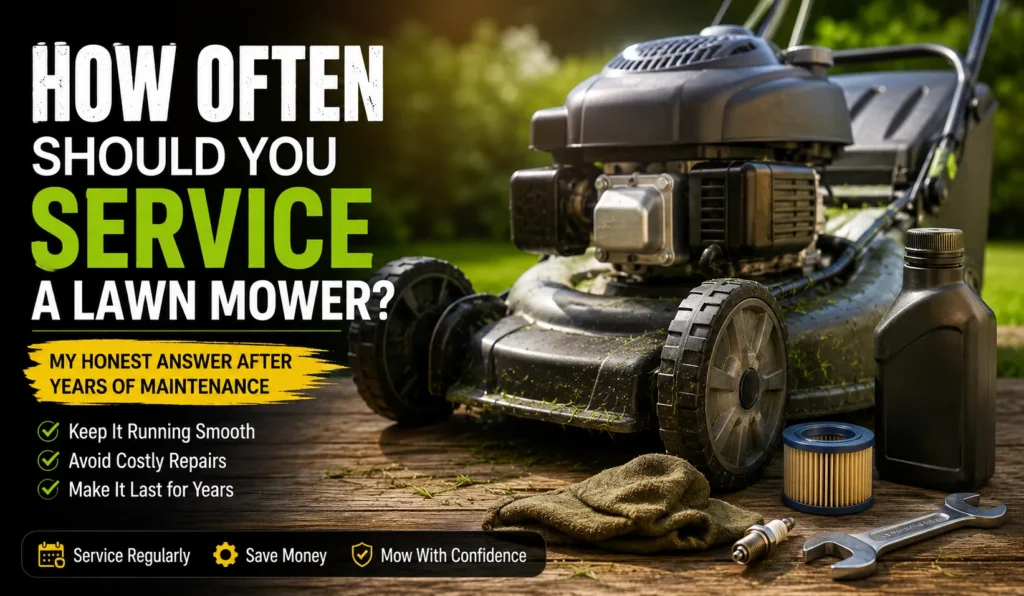
Quick Overview
- Service a gas mower every 25 hours of use, or once a season at minimum.
- Change the oil once a year. Clean the air filter every few mows.
- Sharpen the blade twice a season.
- Battery mowers need way less work. No oil. No spark plug. Just check the battery and clean the deck.
- Skip service, and you’ll pay for it later. I know. I did.
My mower would not start. It was the first warm Saturday of spring. My neighbor was already mowing his lawn, and the smell of fresh-cut grass drifted over the fence.
I pulled the cord ten times. Nothing. I pulled it again. Still nothing.
Then I smelled it. Old gas. Stale, sour, like varnish. I had let it sit in the tank all winter.
That’s the day I learned how often should you service a lawn mower actually matters. Not in theory. In real, sweaty, frustrated practice.
This guide is for anyone who owns a mower and wants it to start on the first pull. I’ll walk you through what I’ve learned after years of doing this myself, including the mistakes.
Why Regular Mower Servicing Actually Matters
Regular servicing keeps your mower starting fast and cutting clean. Skip it, and small problems turn into expensive ones.
A mower is a simple machine. But simple machines still need oil, clean air, and a sharp blade to run right. Ignore any one of those, and the engine works harder than it should.
What Happens When You Skip Maintenance
Skipped maintenance shows up as hard starts, rough idling, and uneven grass cuts. It creeps up slowly, so you barely notice until it’s bad.
Old oil turns thick and dark. It stops protecting the engine parts that need it most. Dirty air filters choke the engine, so it runs rich and sluggish. A dull blade tears grass instead of cutting it, leaving your lawn looking ragged and brown at the tips.
I learned this the hard way. I mowed with a dull blade for two full seasons before I noticed my grass looked stressed after every cut. A quick blade sharpening fixed it in ten minutes.
Gas Mowers vs. Battery Mowers: Different Service Needs
Gas mowers need far more attention than battery mowers. Gas engines have oil, filters, spark plugs, and fuel systems. All of that needs regular checks.
Battery mowers strip most of that away. No oil to change. No spark plug to swap. No carburetor to gum up over winter. You still need to sharpen the blade and keep the deck clean, but the engine side of maintenance mostly disappears.
I switched to an EGO battery mower two years ago. My maintenance routine dropped from an hour a month to about ten minutes.
How Often to Service a Lawn Mower (By Task)
Different parts of your mower wear out at different rates. Some need attention every few mows. Others only need a yearly check.
Oil Changes and Fuel System
Change the oil in a gas mower once a year, or every 25 hours of use. Check the fuel system at the same time.
Old oil breaks down and loses its ability to protect the engine. Most homeowners mow for 25 to 35 hours a season, so once a year lines up well for most yards.
Fuel matters too. Gas goes bad within 30 days if left untreated. Add a fuel stabilizer if you plan to store the mower for more than a month. This is the exact mistake that left me pulling a dead cord that Saturday morning.
Air Filter Cleaning and Replacement
Clean the air filter every 25 hours, and replace it once a year. Check it more often if you mow in dusty or dry conditions.
A dirty air filter is one of the easiest fixes with the biggest payoff. Paper filters should be replaced, not washed. Foam filters can be washed in warm soapy water, dried fully, then lightly oiled before reinstalling.
If you mow in a dusty yard, like a lot of homes do in Phoenix summers, check the filter every few weeks instead of waiting for the season’s end.
Blade Sharpening and Balancing
Sharpen your mower blade twice a season, once in spring and once mid-summer. A sharp blade cuts grass clean instead of tearing it.
A torn blade of grass turns brown at the tip within a day or two. That brown, ragged look across your whole lawn almost always means a dull blade, not a lawn disease.
Balance the blade after sharpening. An unbalanced blade vibrates the whole mower, which wears out the engine bearings faster than it should.
Spark Plug Checks
Check the spark plug once a year and replace it if it’s worn, cracked, or covered in heavy carbon buildup. A healthy spark plug starts the engine faster and burns fuel more efficiently.
A spark plug costs a few dollars. Swapping it takes five minutes. It’s one of the cheapest fixes that makes the biggest difference in how easily your mower starts.
Battery and Charger Care (for Electric Mowers)
Charge your mower battery fully after each use, and store it at room temperature. Most lithium batteries last 500 to 1,000 charge cycles before they lose real capacity.
Avoid leaving the battery on the charger for days at a time. Avoid storing it in a hot garage over summer or a freezing shed over winter. Extreme heat is the fastest way to shorten a battery’s lifespan.
I keep my EGO battery in the house over winter, not the garage. It’s a small habit that keeps the battery healthy year after year.
Comparison Table for Service Intervals
| Task | Gas Mower | Battery Mower |
|---|---|---|
| Oil change | Once a year | Not applicable |
| Air filter | Every 25 hours | Not applicable |
| Blade sharpening | Twice a season | Twice a season |
| Spark plug | Once a year | Not applicable |
| Battery care | Not applicable | Every charge cycle |
Seasonal Servicing Schedule
Your mower needs different attention depending on the time of year. Spring wakes it up. Summer keeps it running. Fall puts it to bed.
Spring Start-Up Checklist
Start spring by changing the oil, checking the spark plug, and sharpening the blade. This sets the mower up for the whole season ahead.
Also check the air filter and clean off any dust from winter storage. If you drained the gas in fall like you should have, add fresh fuel now.
In Minnesota, where winters run long and cold, this spring wake-up is the single most important service of the year. Skip it, and you’re pulling a dead cord like I did.
Mid-Season Maintenance
Check the air filter and blade sharpness every month during peak mowing season. Grass grows fastest in late spring and early summer, so your mower works hardest then too.
Look for grass clippings clogging the underside of the deck. Built-up clippings block airflow and cause the mower to cut unevenly.
End-of-Season Storage Prep
Before winter storage, drain the gas or add a fuel stabilizer, clean the deck, and change the oil one last time. This step prevents the exact problem that ruined my first mowing day of spring.
For battery mowers, remove the battery and store it indoors at room temperature. Don’t leave it in a cold garage all winter.
Comparison Table
| Season | Gas Mower Task | Battery Mower Task |
|---|---|---|
| Spring | Oil change, spark plug check, blade sharpening | Blade sharpening, battery check |
| Summer | Air filter check, deck cleaning | Deck cleaning |
| Fall | Fuel stabilizer or gas drain, final oil check | Remove battery for storage |
How Climate and Usage Affect Service Frequency
Climate changes how often you need to service your mower. Heat, dust, and thick grass all add wear faster than normal.
Hot and Humid Climates (Florida, Texas, Southeast)
In hot, humid climates, check the oil and air filter more often, since heat breaks down oil faster and humidity clogs filters with damp debris. Mow more frequently too, since grass grows year-round in warm states like Florida.
A friend in Tampa mows almost every week, even in December. His mower needs an oil check every six months instead of once a year.
Dry and Dusty Terrain (Southwest, Arizona)
In dry, dusty regions like Arizona, clean the air filter every two to three weeks instead of waiting a full season. Dust clogs filters fast in desert climates.
Blade wear is also faster in sandy soil, since fine grit works its way into the cutting edge over time.
Thick Grass and Frequent Mowing (Midwest Lawns)
Thick, fast-growing lawns need blade sharpening more often, sometimes every four to six weeks during peak growth. Midwest lawns often grow this way in late spring.
Heavier grass also means more clippings building up under the deck, so clean it out more frequently during those peak weeks.
Comparison Table
| Condition | Extra Service Needed |
|---|---|
| Hot, humid climates | Oil and filter checks every 6 months |
| Dry, dusty terrain | Air filter cleaning every 2-3 weeks |
| Thick, fast-growing grass | Blade sharpening every 4-6 weeks |
Common Mistakes People Make With Mower Maintenance
Most mower problems trace back to a handful of repeated mistakes. I’ve made most of these myself over the years.
Ignoring Small Warning Signs
A hard start, a rough idle, or a slight vibration are all early warnings. Ignore them, and small issues turn into full repairs.
I ignored a slight vibration for weeks before I realized my blade was bent from hitting a rock. That small vibration would have taken ten minutes to fix early on. Instead, it wore down a bearing and cost me a real repair bill.
Using the Wrong Oil or Fuel
Using the wrong oil weight or old gas is one of the most common and most damaging mistakes. Always check your owner’s manual for the correct oil type, and never use gas older than 30 days without a stabilizer.
Ethanol-blended gas, common at most gas stations, breaks down faster than pure gasoline. If your mower sits for more than a few weeks, that gas is already starting to degrade.
DIY Servicing vs. Professional Tune-Up Table
| Task | DIY Friendly? | Professional Recommended? |
|---|---|---|
| Oil change | Yes, easy | Not needed |
| Air filter cleaning | Yes, easy | Not needed |
| Blade sharpening | Yes, with a file or grinder | Optional, for balance precision |
| Spark plug replacement | Yes, easy | Not needed |
| Carburetor cleaning | Only if experienced | Recommended for beginners |
| Engine won’t start after DIY checks | Not recommended | Recommended |
My Final Recommendation
After years of doing this myself, here’s my honest take. Gas mowers need real, regular attention. Oil, filter, blade, spark plug. Do all four once a year at minimum, and check the filter and blade more often if you mow a lot.
Battery mowers are a different story. I switched to one specifically because I got tired of the gas mower routine, and I don’t regret it. Less maintenance, no gas smell, no dead cord on a Saturday morning.
Whichever one you own, don’t wait for it to fail before you check on it. A little bit of care each season saves you from the frustration I felt that spring morning, standing in my yard, pulling a cord that would not start while my neighbor’s mower hummed along next door.