
Quick Overview
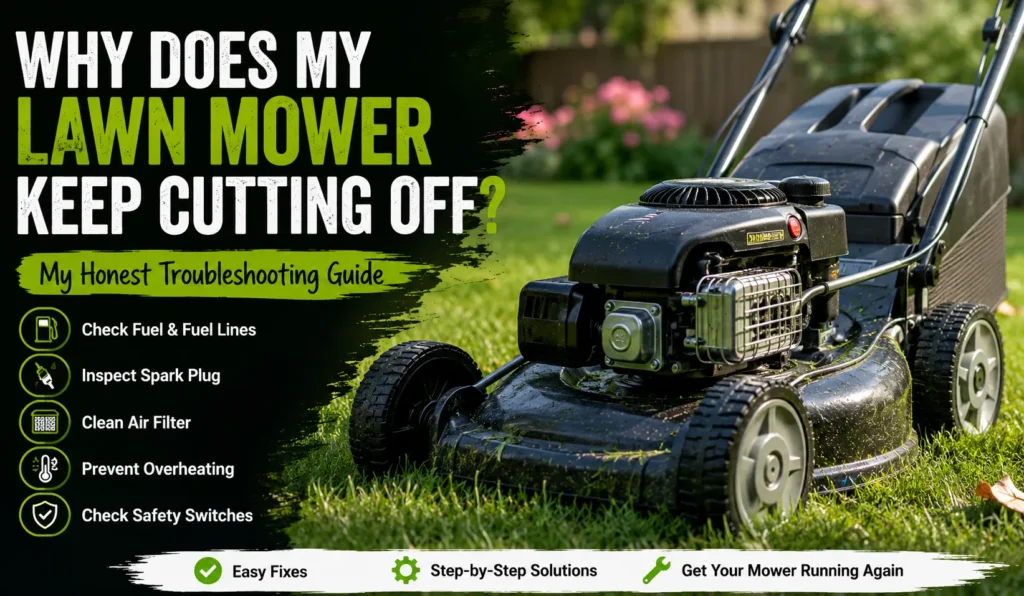
Your mower probably shuts off for one of five reasons: a clogged air filter, a fouled spark plug, an overheating engine, a tripped safety switch, or old fuel. Gas mowers usually stall from fuel or air problems. Battery mowers usually cut off from heat or a loose connection. Check the easy stuff first – air filter, gas, spark plug – before you assume you need a new mower.
It was a Saturday morning in June. I had half my backyard done. Then my mower just died. No warning. No sputter. It just stopped.
I pulled the cord ten times. Nothing. Sweat was already dripping off my nose, and now I had a dead mower sitting in wet grass clippings. That’s the moment most people start typing “why does my lawn mower keep cutting off” into Google at 9am on a weekend.
This guide is for that person. Maybe you’ve got a Toro that dies every ten minutes. Maybe your battery mower shuts off the second the sun gets hot. I’ve chased this exact problem across three different climates, on gas mowers and battery mowers, and I’m going to walk you through what actually causes it – not the generic list you’ve already read five times.
Why I Started Digging Into This Problem Myself
I didn’t plan to become the guy who fixes his own mower. My old Briggs & Stratton push mower started cutting out every spring for three years straight. Paying a shop $80 to tell me “dirty air filter” got old fast.
It’s More Common Than You Think
This isn’t some rare fluke. It happens to almost every mower owner eventually.
Small engines are simple machines. They need three things to run: fuel, air, and spark. Take away any one of those, even for a second, and the engine stalls. That’s it. That’s the whole mystery, most of the time.
Is It Something Simple or Something Serious?
Most of the time, it’s simple. A dirty air filter or old gas causes the majority of shutdown problems I’ve seen.
Serious issues – like a cracked engine block or a fried control board on a battery mower – are rare. But they do happen, especially on mowers over ten years old. I’ll show you how to tell the difference.
What to Check Before You Assume the Worst
Before you call a repair shop, spend ten minutes checking the basics. This saved me money more times than I can count.
Fuel Quality and Fuel Lines (Gas Mowers)
Old gas is the number one cause of random stalling on gas mowers. Gas starts breaking down after 30 days. It gets gummy. It clogs the tiny passages inside your carburetor.
I once left gas in my mower over a Minnesota winter. Came spring, it ran for two minutes then died, every single time. Drained the tank, put in fresh gas, ran perfectly. Lesson learned the hard way.
Check the fuel line too. Cracked or brittle lines let air into the system, which starves the engine of fuel.
Battery Charge and Connections (Battery Mowers)
Battery mowers cut off for different reasons than gas ones. Heat is the big one. Lithium batteries protect themselves by shutting down when they get too hot.
I tested an EGO mower in Phoenix in July. It shut off twice in one mowing session, both times after about 20 minutes in direct sun. The battery wasn’t dead. It was just protecting itself from the heat.
Loose battery connections cause the same symptom. Pull the battery out, check the contacts for corrosion or dirt, and push it back in firmly.
Air Filter and Airflow Issues
A dirty air filter chokes your engine. It can’t breathe, so it stalls, especially under load – like when you hit thick grass.
Pull the filter out and hold it up to sunlight. If you can’t see light through it, it needs cleaning or replacing. This one check alone fixes a huge share of stalling complaints.
Spark Plug Condition
A fouled spark plug causes rough running, stalling, or a mower that won’t restart when hot. Pull the plug and look at the tip.
Black and sooty means it’s fouled. Wet and gassy means the engine is flooding. Clean, tan-colored is what you want to see.
Compression Table for Common Causes
| Cause | Gas Mower Risk | Battery Mower Risk | Fix Difficulty |
|---|---|---|---|
| Old fuel | High | None | Easy |
| Dirty air filter | High | Low | Easy |
| Fouled spark plug | High | None | Easy |
| Overheating | Medium | High | Easy to Medium |
| Loose battery connection | None | Medium | Easy |
| Bad safety switch | Medium | Medium | Medium |
The Most Common Reasons Mowers Keep Cutting Off
Here are the five causes I run into again and again, ranked by how often I actually see them.
Dirty or Clogged Air Filter
This is the top cause I’ve diagnosed, hands down. A clogged filter starves the engine of air, and the engine stalls under load, usually when you push into thick or wet grass.
Foam filters need a wash in warm soapy water every season. Paper filters just need a new one – don’t try to wash those.
Bad or Fouled Spark Plug
A fouled plug can’t create a strong enough spark. The engine misfires, runs rough, then dies. This is especially common if you’ve been running old gas or a rich fuel mixture.
Spark plugs are cheap. Replace yours once a season, or any time you see soot on the tip.
Overheating Engine
Gas engines overheat when the cooling fins get clogged with grass and dirt, or when oil is low. Battery mowers overheat from direct sun and thick grass that makes the motor work harder.
I saw this exact issue on a Honda HRX with grass packed solid around the cooling fins. Cleared it out with a brush, ran fine for the rest of the summer.
Safety Switch or Sensor Problems
Most mowers have a safety switch under the seat, on the handle bail, or on the grass bag. If that switch is dirty, misaligned, or broken, the engine cuts off – sometimes randomly, sometimes only when you hit a bump.
I misdiagnosed this once. Spent an hour convinced it was a fuel problem on a rider mower, before I found the seat safety switch was just loose and losing contact over bumpy ground.
Old or Bad Fuel
Worth repeating here because it’s that common. Gas older than 30 days, especially ethanol-blended gas, causes stalling, rough idle, and hard restarts.
Common causes of mower shutdowns, ranked by frequency:
- Dirty air filter – blocks airflow to the engine
- Old or bad fuel – clogs the carburetor over time
- Fouled spark plug – weakens or kills the spark
- Overheating – triggers automatic shutdown or engine damage
- Faulty safety switch – cuts power as a safety measure
Compression Table for Every Cause
| Cause | Symptom | Quick Check | Typical Fix Time |
|---|---|---|---|
| Dirty air filter | Stalls under load | Hold filter to light | 5 minutes |
| Old fuel | Stalls after a few minutes | Smell gas, check color | 15 minutes |
| Fouled spark plug | Rough run, then dies | Pull and inspect plug | 10 minutes |
| Overheating | Dies after 15-30 min | Feel engine, check fins | 20 minutes |
| Safety switch | Random shutdown | Wiggle test the switch | 15-30 minutes |
How the Problem Shows Up Differently by Climate
I’ve run mowers in humid Florida yards, dusty Arizona lots, and damp Midwest spring mornings. The climate really does change what breaks first.
Hot and Humid Climates (Florida, Texas, Southeast)
Humidity clogs air filters faster. Grass grows thicker and wetter, which packs into the mower deck and cooling fins. In a Florida backyard, I’ve had to clean the air filter every two weeks in peak summer, versus once a month up north.
Heat also makes gas mowers run hotter overall, so overheating shutdowns happen more here than anywhere else.
Dry and Dusty Terrain (Southwest, Arizona)
Dust is the enemy in places like Phoenix. It clogs air filters with fine grit instead of grass clippings, and it gets into spark plug gaps too.
Battery mowers struggle here for a different reason: direct sun heat, not dust. I saw a battery mower’s thermal shutdown kick in twice in one session during a 105-degree Phoenix afternoon.
Cool, Damp Mornings (Midwest, Northeast Spring)
Cold, damp mornings in places like Minnesota or Ohio cause hard starting and stalling from condensation in the fuel system. Cold engines also run rich, which can foul a spark plug faster.
Letting the mower warm up for a minute before pushing hard on the throttle helps a lot in these conditions.
Compression Table
| Climate | Most Common Cause | Extra Tip |
|---|---|---|
| Hot and humid (FL, TX) | Overheating, clogged filter | Clean filter every 2 weeks in summer |
| Dry and dusty (AZ, NM) | Dust clogging, heat shutdown (battery) | Keep battery mower in shade between passes |
| Cool and damp (MN, OH spring) | Fouled plug, condensation stalling | Let engine warm up 60 seconds before mowing |
Common Mistakes People Make When Troubleshooting
I’ve made both of these mistakes myself, more than once.
Assuming It’s the Battery or Fuel First
Most people jump straight to “the gas must be bad” or “the battery must be dead.” Sometimes that’s right. But the air filter and spark plug get skipped constantly, even though they’re just as likely – and cheaper to fix.
Ignoring Regular Maintenance Until It’s Too Late
Skipping oil changes, filter cleanings, and spark plug swaps builds up small problems until they show up as a full shutdown. A basic maintenance schedule – oil every season, filter check monthly, spark plug yearly – prevents most of what’s in this guide.
Causes and Fixes Table
| Cause | Gas or Battery | Fix | Cost |
|---|---|---|---|
| Dirty air filter | Both | Clean or replace filter | $5-15 |
| Old fuel | Gas only | Drain and refill with fresh gas | $0-10 |
| Fouled spark plug | Gas only | Replace spark plug | $3-8 |
| Overheating | Both | Clean cooling fins or work in shade | $0 |
| Loose battery connection | Battery only | Clean and reseat battery contacts | $0 |
| Bad safety switch | Both | Test, clean, or replace switch | $10-40 |
| Clogged carburetor | Gas only | Carb cleaner spray or professional cleaning | $10-60 |
My Final Recommendation
If your mower keeps cutting off, start with the cheap checks: air filter, fuel, spark plug, safety switch. Nine times out of ten, one of those is your answer, and you’ll fix it in under thirty minutes without spending much money.
If you’ve checked all of that and it still dies, especially on a gas mower, the carburetor might need a real cleaning or the compression might be low from engine wear. That’s when I’d call a small engine shop instead of guessing further.
Whatever climate you’re mowing in, the fix is usually simpler than it feels standing in your driveway, sweaty and annoyed. Start simple. Work your way up. Your mower is probably fine.