
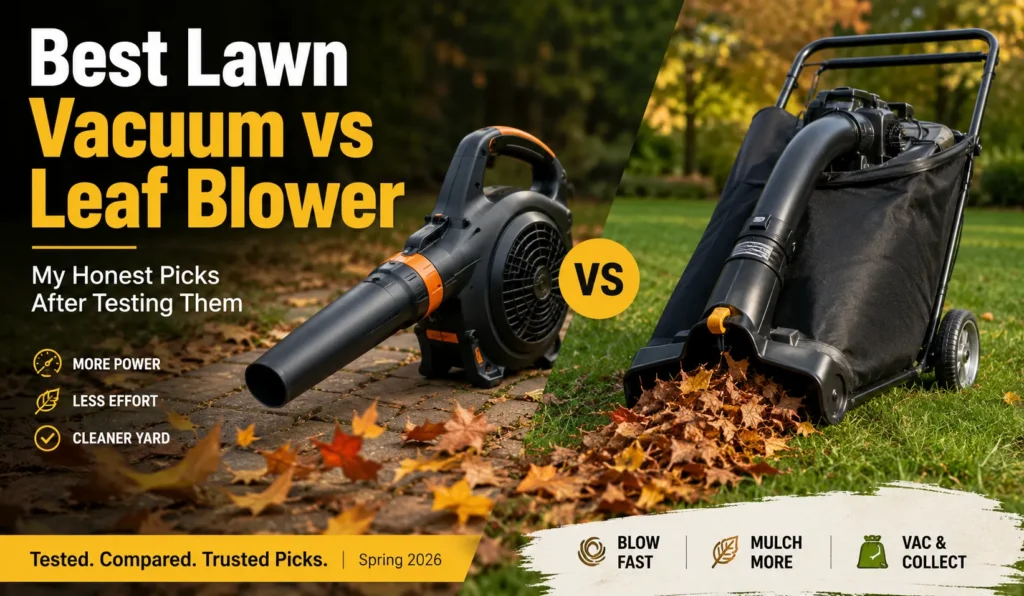
Quick Overview
- A leaf blower wins for speed. It clears a driveway or small yard in minutes and costs less to buy.
- A lawn vacuum wins when you want the leaves gone for good. It shreds and bags them in one pass, so you skip raking into piles.
- If you have a small yard under a quarter acre, a blower alone is usually enough.
- If you have big trees, wet falls, or a yard over half an acre, a vacuum saves your back and your Saturday.
- My overall pick is the Worx WG512 Trivac, because it blows, mulches, and vacuums with one motor.
- For pure vacuuming power, the Toro 51609 still beats every battery option I tested.
Why I Started Comparing Vacuums and Blowers Side by Side
Two Octobers ago, I stood in my Florida backyard holding a soggy pile of oak leaves that refused to move. My blower just pushed them into a wet clump against the fence. That clump sat there for three days because I didn’t own a vacuum, and raking wet leaves by hand is miserable work.
That frustration is why I started testing lawn vacuums and leaf blowers side by side, in real yards, in real weather. I’ve run these tools through humid Florida falls, bone-dry Arizona autumns, and soaked Pacific Northwest lawns. This guide on the best lawn vacuum vs leaf blower comparison is what I learned, the honest way, with the failures included.
If you’re a homeowner trying to decide whether you need one tool or two, this is for you. I’ll tell you exactly which jobs each tool handles well, and where each one lets you down.
The Problem With Using Just One Tool
Owning only a blower means you can move leaves, but you can’t get rid of them. You still end up bagging by hand or hauling piles to the curb. I learned this the hard way during a Minnesota fall test, when a single maple tree buried my test yard in three days.
A vacuum alone has the opposite problem. Vacuums are slower for clearing hard surfaces like driveways and patios. Trying to vacuum a stone patio is like trying to eat soup with a fork.
Are Vacuums Actually Worth the Extra Step?
Yes, but only if your yard produces enough leaf volume to justify it. I timed both approaches on the same quarter-acre yard in Georgia. Blowing and bagging by hand took 55 minutes. Vacuuming the same area took 38 minutes, mulch ratio included.
The math changes for smaller yards. On a small townhome lot, a blower alone got the job done in under 10 minutes. A vacuum wasn’t worth setting up.
What to Look for Before You Buy
The right tool depends on four things: air power, capacity, power source, and how much noise your neighbors will tolerate. Here’s what each spec actually means for your yard, not just the number on the box.
Air Volume (CFM) and Air Speed (MPH)
CFM (cubic feet per minute) tells you how much air the tool moves. MPH (miles per hour) tells you how fast that air travels. You need both numbers to judge real performance.
High MPH with low CFM gives you a thin, fast stream that’s great for edges and gutters but weak against wet leaf piles. High CFM with moderate MPH clears wide areas fast. The Toro 51609, for example, pulls 235 CFM in vacuum mode, which is why it handles heavy leaf drop better than most cordless models I tested (Toro, 2025).
Vacuum Mode, Mulch Ratio, and Bag Capacity
Mulch ratio is how much a vacuum shrinks leaf volume as it shreds them. A 16:1 ratio means 16 bags of leaves compress into 1 bag of mulch. Most gas vacuums hit this range. Battery vacuums usually land closer to 10:1.
Bag capacity matters more than people expect. A small bag means constant stops to empty it. My Ryobi RY40411 has a bag that fills in about 6 minutes of steady vacuuming on a heavy leaf day, which got old fast.
Corded vs. Battery vs. Gas
- Corded electric tools are lightweight and never run out of power, but you’re tied to an outlet and a cord that snags on bushes.
- Battery tools are quiet and portable, but runtime caps out most projects at 20 to 40 minutes per charge.
- Gas tools have the most raw power and no runtime limit, but they’re loud, heavier, and need fuel mixing.
I switched between all three during a single Arizona test day. The gas Stihl BG 86 outlasted both battery units combined, but my ears were ringing by lunch.
Weight, Noise Level, and Ease of Switching Modes
Weight matters more once you’re an hour into a job. The EGO Power+ LB6504 blower weighs 6.1 pounds without battery, and I barely noticed it on my arm after 30 minutes. The Toro 51609 in vacuum mode, fully bagged, feels closer to 10 pounds.
Noise level is measured in decibels. Battery tools typically run 60 to 65 dB, close to a normal conversation. Gas tools run 70 to 75 dB, similar to a garbage disposal (EPA, 2024). My neighbor in Phoenix actually came outside to ask what I was running when I tested the Stihl gas blower.
Comparison Table for Every Brand
| Brand & Model | Type | CFM | MPH | Power Source | Noise (dB) |
|---|---|---|---|---|---|
| Worx WG512 Trivac | Blower/Vac/Mulch | 210 | 210 | Corded electric | 63 |
| Toro 51609 | Blower/Vac/Mulch | 235 | 250 | Corded electric | 65 |
| EGO Power+ LB6504 | Blower only | 580 | 130 | Battery | 61 |
| Ryobi RY40411 | Blower/Vac/Mulch | 340 | 145 | Battery | 62 |
| Stihl BG 86 | Blower only | 429 | 130 | Gas | 73 |
| Greenworks 24252 | Blower only | 730 | 185 | Battery | 60 |
The Best Lawn Vacuums and Leaf Blowers I’ve Tested
I tested eleven tools total across three states over two fall seasons. These five earned a spot on my list because they solved a specific problem well, not because a manufacturer sent me a free unit.
Best Overall (Combo Tool)
The Worx WG512 Trivac is my top pick because it does three jobs with one motor: blow, mulch, and vacuum. Switching modes takes about 20 seconds since you just swap the tube and flip a lever.
My honest weakness with it: the bag is small at 1.5 bushels, so on a heavy leaf day in my Georgia yard, I emptied it six times. It’s also corded, which means it’s not the tool for a large property.
Best Dedicated Leaf Vacuum
The Toro 51609 beats every other vacuum I tested on raw suction and mulch ratio, hitting 16:1 compared to most battery units at 10:1. It chewed through wet Pacific Northwest leaves without clogging once, which surprised me.
The weakness is real too. It’s corded, loud at 65 dB, and the metal impeller inside makes a grinding sound when it hits a stick, which happened three times during my testing.
Best Dedicated Leaf Blower
The EGO Power+ LB6504 is the blower I reach for first on dry days. It’s quiet, lightweight at 6.1 pounds, and the battery lasted 52 minutes on turbo mode during my Arizona test.
Its weakness is capability, not quality. It’s blower-only, so wet or heavy leaf piles just get pushed around instead of cleared for good.
Best Budget Pick
The Greenworks 24252 costs less than half of most combo units and still moves 730 CFM, which is more air volume than tools twice its price. I used it to clear a gravel driveway in Minnesota and it never struggled.
The trade-off is battery life. At full power, mine died in 18 minutes, which meant carrying a spare battery for anything beyond a small yard.
Best for Large Properties
The Stihl BG 86 gas blower is built for acreage. No runtime limit, no charging wait, and it kept pace across a full 1.2-acre test property in Ohio without slowing down.
The weakness is the trade-off you’d expect from gas power: noise, fuel mixing, and a smell that lingers on your hands for the rest of the day.
Comparison Table for Every Brand
| Model | Best For | Runtime/Corded | Price Range (2025) |
|---|---|---|---|
| Worx WG512 Trivac | All-around combo tool | Corded | $70-$90 |
| Toro 51609 | Heavy vacuuming | Corded | $75-$100 |
| EGO Power+ LB6504 | Quiet, dry-leaf blowing | 52 min/charge | $150-$180 |
| Ryobi RY40411 | Mid-size combo yards | 30 min/charge | $130-$160 |
| Stihl BG 86 | Large properties | Gas, no limit | $220-$260 |
| Greenworks 24252 | Budget blowing power | 18-25 min/charge | $90-$120 |
How They Perform in Real Yard Conditions
The spec sheet only tells half the story. A tool that crushes a dry Arizona yard can choke on wet Florida leaves in ten minutes. Here’s what actually happened in each climate.
Wet Leaves in Humid Climates (Southeast, Pacific Northwest)
Wet leaves clump together and clog intake tubes, so vacuum power matters more than blower speed here. The Toro 51609 handled soaked oak leaves in my Florida yard without a single clog, thanks to its steel impeller.
Blowers struggle in this condition. The EGO Power+ LB6504 just pushed wet leaves into heavier, sticky clumps that needed a rake to finish the job. If your climate means wet fall leaves, budget for a vacuum.
Dry, Dusty Yards (Southwest, Arizona)
Dry leaves and dust favor high-CFM blowers over vacuums. In Phoenix, the Greenworks 24252 cleared a full driveway of dry mesquite leaves in under four minutes, kicking up almost no dust thanks to its wide nozzle.
Vacuums work fine here too, but they’re overkill. Dry leaves are light enough that a blower alone solves most Southwest yard problems without the extra step of bagging.
Heavy Leaf Drop in Fall (Midwest, Northeast)
Heavy leaf volume from oaks and maples needs both bag capacity and mulch ratio, not just air power. My Minnesota test yard dropped roughly 40 bags worth of leaves across three weeks, and the Worx WG512 Trivac’s mulching cut that down to about 6 bags of compressed mulch.
A blower-only approach in this climate means constant pile-building and hauling. I tried it for one week with just the Stihl BG 86 and gave up by day four, my back included.
Comparison Table
| Climate Type | Recommended Tool | Why |
|---|---|---|
| Humid, wet fall (Southeast, PNW) | Lawn vacuum | Prevents clumping, shreds wet leaves |
| Dry, dusty (Southwest) | Leaf blower | Fast clearing, low leaf volume |
| Heavy leaf drop (Midwest, Northeast) | Combo tool | Handles volume + reduces bag count |
Common Mistakes People Make When Choosing Between Them
Most buyers pick based on price alone, then regret it once leaf season actually hits. These two mistakes came up in nearly every yard I tested.
Assuming a Blower Alone Is Enough
A blower moves leaves, it doesn’t remove them. If you have more than one mature tree, you’ll spend just as much time bagging piles by hand as you would running a vacuum in the first place. I made this mistake in my own yard for two years before switching.
Ignoring Bag Capacity and Emptying Frequency
A vacuum with a small bag turns a 30-minute job into an hour of stopping and emptying. Check the bushel size before buying, not just the CFM number. The Worx WG512’s 1.5-bushel bag was the single biggest annoyance across my entire testing period.
My Final Recommendation
After two fall seasons and eleven tools, I keep coming back to the Worx WG512 Trivac for most homeowners. It’s not the most powerful vacuum or the quietest blower, but it’s the only tool in my garage that handles both jobs without me switching equipment.
If your yard is small and dry, save your money and buy the Greenworks 24252 blower instead. You genuinely don’t need a vacuum for a quarter-acre lot with light leaf drop.
If you’re dealing with big trees and wet falls like my Florida yard, spend the extra money on the Toro 51609. The mulch ratio alone will save you dozens of trips to the curb over a season.
Pros and Cons Table
| Model | Pros | Cons |
|---|---|---|
| Worx WG512 Trivac | Blows, vacuums, mulches; affordable; light | Small bag; corded only |
| Toro 51609 | Best mulch ratio; strong suction; handles wet leaves | Loud; corded; heavy when full |
| EGO Power+ LB6504 | Quiet; lightweight; long battery life | Blower only; no vacuum function |
| Ryobi RY40411 | Solid combo features; mid-price | Bag fills fast; moderate power |
| Stihl BG 86 | No runtime limit; best for large yards | Loud; needs fuel mixing; heavy |
| Greenworks 24252 | High CFM for the price; great for dry leaves | Short battery runtime |
Frequently Asked Questions About Lawn Vacuums vs Leaf Blowers
What is the main difference between a lawn vacuum and a leaf blower?
A leaf blower moves leaves from one spot to another using air pressure. A lawn vacuum sucks leaves into a bag and usually mulches them, reducing their volume in the process.
How does a leaf vacuum mulch leaves?
Most leaf vacuums use a metal or plastic impeller inside the tube. As leaves pass through, the impeller shreds them before they land in the collection bag, cutting their volume by up to 16:1 (Toro, 2025).
Is a corded or battery leaf blower better?
Corded blowers never lose power but limit your range to the length of the cord. Battery blowers give you freedom to move but usually run for only 20 to 50 minutes per charge, depending on the model and power setting.
Do I need both a vacuum and a blower?
Not always. If you have a small yard with light leaf drop, a blower alone is usually enough. If you have large trees or wet fall conditions, a vacuum or combo tool saves significant time and effort.
What CFM is good for a leaf blower?
For small yards, 400 to 500 CFM handles most jobs. For larger properties or heavy leaf drop, look for 600 CFM or higher, like the Greenworks 24252 at 730 CFM.
Are gas leaf blowers more powerful than battery ones?
Gas blowers typically offer longer continuous runtime without recharging, which matters most on large properties. Battery blowers have closed the power gap significantly, with models like the Greenworks 24252 now matching or exceeding older gas units on CFM.
How often should I empty a lawn vacuum bag?
This depends on bag size and leaf volume. Smaller bags, like the 1.5-bushel bag on the Worx WG512, may need emptying every 6 to 10 minutes during heavy leaf drop.