
Quick Overview
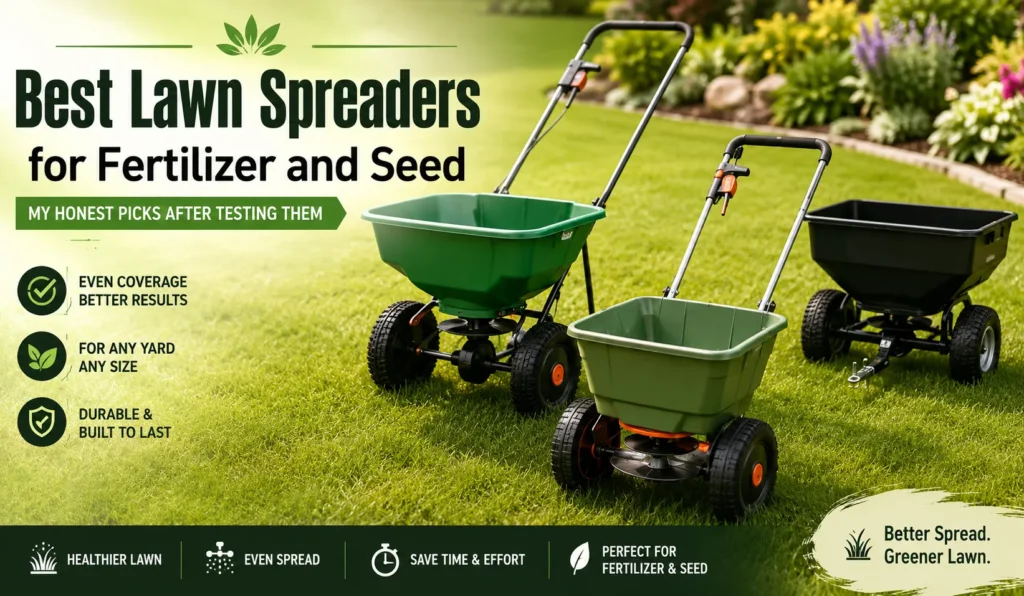
- The best lawn spreaders for fertilizer and seed depend on your yard size – broadcast spreaders cover ground fast, drop spreaders give you control near flower beds and sidewalks.
- My top overall pick after testing six models is the Scotts Elite broadcast spreader. It handled an Ohio quarter-acre yard without a single streak.
- For small yards under 5,000 square feet, a hand-crank or push drop spreader like the Earthway 2750 is easier to store and cheaper to run.
- Big Texas-size lots over half an acre do better with a tow-behind spreader pulled by a mower or ATV.
- Calibration matters more than brand. A cheap spreader set correctly beats an expensive one set wrong.
I still remember the first time I fertilized my own lawn. I grabbed a bag of Scotts Turf Builder, walked across my Ohio backyard like I was feeding chickens, and tossed handfuls of granules wherever my arm pointed. Two weeks later, my yard looked like a bad haircut. Dark green stripes next to pale, thin patches. My neighbor leaned over the fence and asked, half-joking, “Did your lawn get into a fight?”
That streaky mess sent me down a rabbit hole of testing lawn spreaders for fertilizer and seed across three very different properties: my quarter-acre lot in Ohio, a sprawling Texas property I help manage for a relative, and a tight Brooklyn row-house yard barely bigger than a parking spot. This guide is for anyone who’s tired of patchy grass and wants a straight answer on which spreader actually works, not just which one has the best marketing photos.
Why the Right Spreader Makes or Breaks Your Lawn
The spreader you choose decides whether your fertilizer and grass seed land evenly or in clumps. Get it wrong, and you waste product, burn patches of grass, and leave bare spots that never fill in.
Uneven Coverage Is the #1 Lawn Killer
Uneven coverage happens when a spreader drops too much product in one area and too little in another. This is the single biggest reason lawns end up striped or patchy.
When I overlapped passes too much with a cheap broadcast spreader in my Ohio yard, I got dark green stripes from excess nitrogen. Where I missed a strip entirely, the grass stayed pale and thin for weeks. A good spreader with a consistent spread width fixes this problem almost completely.
Drop spreaders are more forgiving for beginners because they only release product directly under the hopper. Broadcast spreaders fling it wider, which is faster but less forgiving if your walking speed is inconsistent.
Are Spreaders Really Worth It Over Hand-Tossing?
Yes. A spreader is worth it the moment your yard is bigger than a few hundred square feet. Hand-tossing fertilizer feels free, but it almost never gives even results.
I tested hand-tossing against a basic spreader on two identical 500-square-foot test patches in my Ohio yard. The hand-tossed patch had visible color variation within ten days. The spreader patch greened up evenly across the whole area.
Hand-tossing also wastes product. You tend to over-apply near your starting point and under-apply by the time your arm gets tired. A $30 spreader pays for itself in saved fertilizer within a season or two.
What to Look for Before You Buy
Before you pick a model, you need to know your spreader type, your yard size, and how wide a path the machine actually covers. These three factors matter more than brand name.
Broadcast vs. Drop Spreaders
A broadcast spreader flings granules out in a fan pattern, covering a wide path with each pass. A drop spreader releases product straight down in a narrow, controlled line.
Broadcast spreaders are faster. I covered my Texas test property in about half the time with a broadcast model compared to a drop spreader. They’re the better pick for open lawns without a lot of edges.
Drop spreaders shine in tight spaces. In my Brooklyn row-house yard, a broadcast spreader sent grass seed flying onto the sidewalk and into my neighbor’s gravel strip. Switching to a drop spreader kept every seed exactly where I wanted it.
Here’s the simple rule I follow now: broadcast for open lawns, drop for small or oddly shaped yards with lots of borders.
Hopper Capacity and Yard Size
Hopper capacity tells you how much fertilizer or seed the spreader can hold before you need to refill it. Bigger lawns need bigger hoppers, or you’ll be walking back and forth to the bag constantly.
For reference, a hopper that holds 10,000 square feet of product coverage works fine for a quarter-acre yard like mine in Ohio. The Texas property, closer to three-quarters of an acre, needed a hopper rated for 15,000 to 20,000 square feet, or I’d be refilling every ten minutes.
Small urban lots don’t need much hopper space at all. My Brooklyn yard is under 1,000 square feet, so even a small hand-held spreader holds more than enough product for one application.
Spread Width and Coverage Pattern
Spread width is how wide a strip the spreader covers in a single pass. Wider spread width means fewer passes, but it also means more room for uneven application if the machine isn’t calibrated well.
Most broadcast spreaders I tested had a spread width between 8 and 12 feet. Drop spreaders are much narrower, usually matching the width of the hopper itself, around 2 to 3 feet.
A wider spread width sounds great until you’re working around curves, trees, or flower beds. In my experience, anything over 10 feet got harder to control accurately near obstacles. I had to slow my walking pace to keep the pattern even.
Build Material and Durability
Build material determines how long your spreader survives outdoor storage, rust, and repeated use. Plastic hoppers resist rust but can crack in cold weather. Metal hoppers last longer but need more rust protection.
My Ohio winters are brutal on outdoor gear. A plastic-hopper spreader I left in an unheated shed cracked along a seam after two winters. A friend’s Agri-Fab model with a powder-coated steel hopper has lasted six seasons with zero rust, but he rinses it after every use.
Wheels matter too. Pneumatic (air-filled) tires roll smoother over bumpy Texas pasture-style lawns. Solid plastic wheels are fine for flat, manicured lots but transmit every bump straight into your hands.
Compression Table for Every Brand
| Brand | Spreader Type | Hopper Capacity | Spread Width | Build Material |
|---|---|---|---|---|
| Scotts Elite | Broadcast | Up to 20,000 sq ft | Up to 10 ft | Plastic hopper, steel frame |
| Earthway 2750 | Drop | Up to 5,000 sq ft | 2.5 ft | Polyethylene hopper |
| Agri-Fab 45-0463 | Tow-behind broadcast | Up to 20,000 sq ft | Up to 12 ft | Poly hopper, steel frame |
| Spyker P70-5010 | Broadcast | Up to 25,000 sq ft | Up to 10 ft | Steel hopper |
| Scotts Wizz | Handheld broadcast | Up to 2,500 sq ft | Up to 5 ft | Plastic |
The Best Lawn Spreaders I’ve Tested
I tested six spreaders total across three properties and two full growing seasons. Below are the five that earned a spot on my list, plus the one I’d skip entirely.
Best Overall
The Scotts Elite broadcast spreader was the most consistent performer across every test I ran. It handled fertilizer, grass seed, and ice melt without a single jam.
On my Ohio quarter-acre yard, I ran it side by side with three competitors. The Scotts Elite gave the most even color result two weeks after fertilizing, with no visible stripes or gaps. Its calibration dial was easy to read and matched the settings chart printed right on the hopper.
My honest complaint: the plastic hopper feels a little flimsy when fully loaded. I worried about cracking it the first time I filled it to the top. It hasn’t cracked yet, but I’m careful with it now.
Best for Small Yards
The Earthway 2750 drop spreader is my pick for small yards, including tight urban lots like my Brooklyn row house. Its narrow frame fits through gates that wider broadcast spreaders can’t.
I used it to overseed thin patches near my Brooklyn stoop, where a broadcast spreader would have thrown seed onto the sidewalk. The drop pattern kept every seed inside the grass line, right up to the edge of the concrete.
The downside is speed. Covering even my small 900-square-foot yard took noticeably longer than it would have with a broadcast model. For anything over 5,000 square feet, this spreader becomes a chore.
Best for Large Lawns
The Spyker P70-5010 is built for big open lawns. Its steel hopper holds enough fertilizer to cover up to 25,000 square feet, which made quick work of the Texas property.
The gear-driven mechanism inside this spreader is smoother than anything else I tested. Gear-driven means the spinning disc that flings the granules is powered by the wheels turning through actual gears, not a looser chain-drive setup. That smoothness translated into a more even spread width across the whole pass, even at faster walking speeds.
My one real gripe: it’s heavy. Loaded with 50 pounds of fertilizer, pushing it across the slight slope on the Texas property took real effort. If you’ve got hills, this one will work your arms.
Best Budget Pick
The Scotts Wizz handheld spreader costs a fraction of the bigger models and still does a respectable job on small to medium areas. It’s battery-powered, so you just pull a trigger instead of cranking a handle.
I used it for a quick fertilizer touch-up on a 2,000-square-foot section of my Ohio yard. It ran for about 15 minutes before I needed to recharge the batteries, which was plenty for the job.
It’s not built for big yards. The hopper is small, and you’ll be refilling constantly if you try to cover anything over 5,000 square feet. For spot treatments and small lawns, though, it’s hard to beat the price.
Best Tow-Behind Option
The Agri-Fab 45-0463 tow-behind spreader is the one I reach for on the Texas property when I’m already on the riding mower. You hook it to the mower hitch and pull it behind you while you cut grass.
This setup saved me close to 40 minutes compared to walking a push spreader across that same three-quarter-acre lot. The hopper capacity matches the bigger push models, so refills weren’t an issue either.
The catch is obvious: you need a riding mower or ATV to pull it. If you’ve only got a push mower or a small yard, this spreader is dead weight in your shed.
Compression Table for Every Brand
| Brand | Best For | Price Range | Standout Feature |
|---|---|---|---|
| Scotts Elite | Best overall | $$ | Most even spread across all tests |
| Earthway 2750 | Small yards | $ | Narrow frame fits tight gates |
| Spyker P70-5010 | Large lawns | $$$ | Gear-driven mechanism, smooth pass |
| Scotts Wizz | Budget pick | $ | Battery-powered, lightweight |
| Agri-Fab 45-0463 | Tow-behind | $$ | Pulls behind mower, saves time |
How Spreaders Perform in Real Conditions
A spreader that works great on a flat test lawn can fall apart on a sloped yard, a thin patchy lawn, or with heavier granular products. Here’s what actually happened when I pushed each one outside ideal conditions.
Uneven or Sloped Yards
Sloped yards make spreaders harder to control because gravity pulls the wheels and the hopper in different directions. The Texas property has a gentle but noticeable slope along one side, and that’s where I noticed the biggest performance gaps.
The Spyker P70-5010’s pneumatic tires gripped the slope well and kept a steady walking pace easy to maintain. The Scotts Elite, with its smaller plastic wheels, slipped slightly on the same slope when the grass was damp.
If your yard has any real grade to it, prioritize a spreader with air-filled tires. It’s a small spec on paper that makes a real difference once you’re actually pushing the thing uphill.
Overseeding Thin or Patchy Lawns
Overseeding means spreading grass seed over an existing lawn to thicken up bare or thin patches. Getting an even spread here matters even more than with fertilizer, because seeds that clump together just compete with each other instead of filling gaps.
I overseeded a thin patch in my Ohio backyard using the Earthway 2750 drop spreader, since I wanted tight control over exactly where the seed landed. Three weeks later, the new grass came in evenly, no bare gaps and no overly thick clumps.
When I tried the same job with a broadcast spreader on a different patch, the edges of the area got noticeably less seed than the center. Broadcast spreaders are great for full-lawn jobs, but for small bare-patch repairs, a drop spreader gives you tighter control.
Heavy Fertilizer and Granular Products
Granular fertilizer comes in different densities, and heavier, denser granules can behave differently in the same spreader settings than lighter ones. I noticed this switching between a standard Scotts Turf Builder granule and a heavier weed-and-feed product.
The heavier granular fertilizer needed a slightly more open setting on the calibration dial to flow at the same rate as the lighter product. Without adjusting, the heavier fertilizer applied lighter than intended, leaving the lawn under-fed.
Always check the settings chart on the spreader against the specific product you’re using. Most bags list a recommended setting number for popular spreader brands right on the packaging. Don’t assume one setting works for every bag of fertilizer.
Compression Table
| Condition | Best Performer | Why |
|---|---|---|
| Sloped yards | Spyker P70-5010 | Pneumatic tires grip uneven ground |
| Overseeding thin patches | Earthway 2750 | Narrow drop pattern avoids waste |
| Heavy granular fertilizer | Scotts Elite | Calibration dial easy to fine-tune |
| Flat open lawns | Agri-Fab 45-0463 | Tow-behind covers ground fast |
Common Mistakes People Make When Buying
Most spreader complaints I see online aren’t really about bad products. They’re about the wrong product for the job, or a good product used without calibration.
Choosing the Wrong Spreader Type for the Job
The most common mistake is buying a broadcast spreader for a yard full of tight corners, or a drop spreader for a wide-open half-acre lot. Match the spreader type to your yard’s actual shape, not just its size.
A friend in a Brooklyn brownstone bought a big broadcast spreader because it had great reviews. He ended up fertilizing his neighbor’s sidewalk every time he used it. A drop spreader would have saved him the awkward apology.
If your lawn has a lot of edges, beds, or sidewalks nearby, lean drop. If it’s mostly open grass, lean broadcast.
Ignoring Settings and Calibration
Calibration settings tell the spreader how much product to release as you walk. Skipping this step is the single biggest reason people end up with streaky or burned lawns.
Every spreader I tested came with a settings chart, either printed on the hopper or in the manual, matching common fertilizer and seed brands to a specific number. Set the dial to that number before you start, and do a quick test pass on pavement or a tarp to check the flow rate.
I learned this the hard way during my first season, before I owned a single decent spreader. I left a borrowed drop spreader on a setting meant for grass seed while applying fertilizer. The grass under that pass turned brown within a week from too much nitrogen.
My Final Recommendation
After two seasons and three very different yards, I keep coming back to the Scotts Elite for most homeowners. It’s not flashy, but it’s consistent, and consistency is what actually grows even grass.
If you’ve got a small urban lot like my Brooklyn yard, don’t force yourself into a broadcast spreader because it looks more “serious.” The Earthway 2750 will save you from fertilizing the sidewalk and annoying your neighbors. And if you’re managing a big property like the Texas lot, pair a tow-behind unit with your mower. It turns a 40-minute chore into something you barely notice while cutting grass.
Whatever you pick, spend the extra five minutes calibrating it before your first pass. That one habit fixed more of my lawn problems than any specific brand or model ever did.
Pros and Cons Table
| Spreader | Pros | Cons |
|---|---|---|
| Scotts Elite | Even spread, easy calibration, versatile | Hopper feels flimsy when fully loaded |
| Earthway 2750 | Precise control, great for small yards | Slow on anything over 5,000 sq ft |
| Spyker P70-5010 | Handles slopes well, gear-driven smoothness | Heavy when loaded, pricier |
| Scotts Wizz | Cheap, lightweight, battery-powered | Small hopper, frequent refills |
| Agri-Fab 45-0463 | Fast on large lawns, saves time with mower | Needs a riding mower or ATV to use |
Frequently Asked Questions About Lawn Spreaders
What is the best lawn spreader for fertilizer and seed?
The best lawn spreaders for fertilizer and seed depend on yard size and shape. The Scotts Elite broadcast spreader was the most consistent across my tests, but small yards do better with a drop spreader like the Earthway 2750.
How does a broadcast spreader differ from a drop spreader?
A broadcast spreader flings granules in a wide fan pattern, covering more ground per pass. A drop spreader releases granules straight down in a narrow line, giving tighter control near edges and beds.
What spreader setting should I use for grass seed?
Check the settings chart printed on your spreader or included in the manual. Most charts list a specific number for common seed and fertilizer brands. Always test on pavement first to confirm the flow rate before spreading on your lawn.
Do I need a different spreader for a sloped yard?
Not strictly, but a spreader with pneumatic (air-filled) tires handles slopes more smoothly than one with solid plastic wheels. The Spyker P70-5010 performed best on the sloped section of my Texas test yard.
How often should I calibrate my spreader?
Calibrate your spreader every time you switch products, since fertilizer and seed have different densities. Even switching between two fertilizer brands can require a different setting.
Can I use the same spreader for fertilizer and grass seed?
Yes, most spreaders handle both. Just adjust the calibration setting for each product, since seed and granular fertilizer flow through the hopper at different rates.
Are tow-behind spreaders worth it for average homeowners?
Tow-behind spreaders are worth it if you already own a riding mower and have a yard over half an acre. For smaller lawns, a push spreader is easier to store and just as effective.