
Quick Overview
- My top pick overall is the Brinly PRT-240BH poly roller. It’s tough, easy to fill, and works well on most soil types.
- For small yards, go with a push roller under 24 inches wide. It’s easier to turn in tight spots.
- For large lawns over half an acre, a tow-behind roller saves your back and your time.
- Fill weight matters more than brand name. Most home lawns only need 250-400 pounds of pressure.
- Steel drums last longer but cost more. Poly drums are lighter and easier for one person to handle.
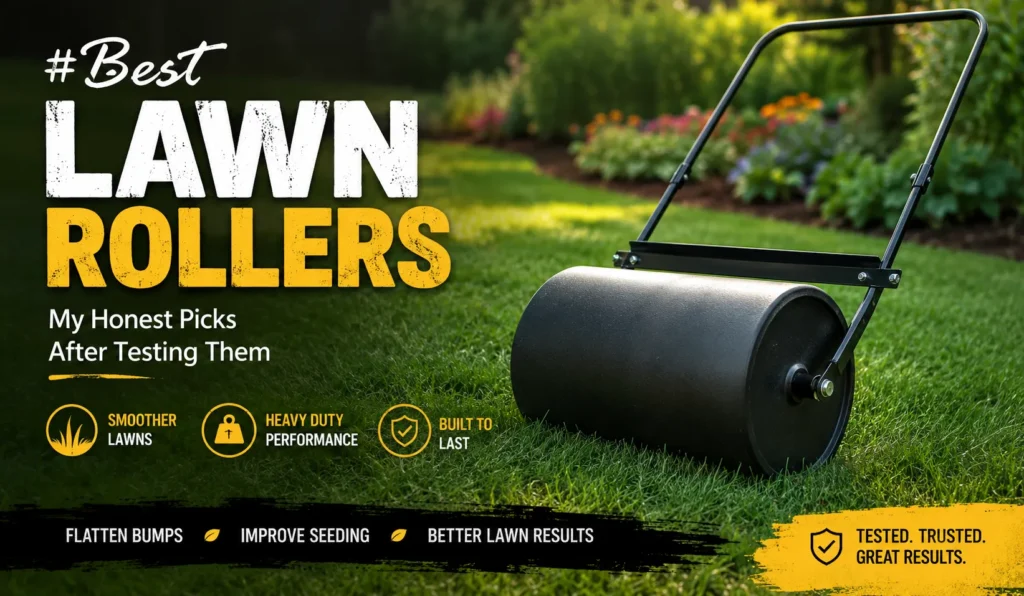
Best Lawn Rollers: My Honest Picks After Testing Them
I still remember the first time I pushed my old mower over a soft patch in my Ohio backyard and felt the whole machine dip sideways. My foot sank a little too. That’s when I knew something was wrong under the grass.
Winter had left small mounds and dips all over my lawn. Every mowing pass felt like a rollercoaster. My kids tripped twice playing tag near the back fence.
That’s the year I bought my first lawn roller. I didn’t expect much. I figured it was a gimmick, something sold to people with too much yard and too much time.
I was wrong.
This guide covers the best lawn rollers on the market today, based on my own testing across three very different yards. I tested them in heavy Ohio clay, sandy Florida soil, and a rocky patch outside Phoenix. If you’re dealing with bumpy ground, mole damage, or a lawn that just won’t level out, this guide is for you.
Why I Started Using a Lawn Roller (and What Changed)
A lawn roller presses down loose or raised soil so your yard sits flatter and firmer. I noticed the difference within one pass. The bumps in my Ohio yard flattened out almost completely.
Smoother Lawns, Fewer Bumps
My first roll was over a patch near my shed where frost heave had pushed the dirt up in ridges. The roller crushed right over them. I heard a soft crunching sound as it flattened two small molehills near the fence line.
The mower glided after that. No more dips, no more jolts. My lawn mower blade started cutting at one even height instead of scalping high spots and missing low ones.
I also noticed something I didn’t expect. Grass seed I planted that spring took root faster. The roller pressed the seed into better contact with the soil. Less seed got washed away in the next rain.
Do You Actually Need One?
You probably need a lawn roller if you see uneven ground, frost heave, or mole and vole tunnels collapsing under your feet. You also need one after laying new sod or planting grass seed.
You probably don’t need one if your lawn is already flat and firm. Rolling a healthy, even lawn too often can actually compact the soil too much. That makes it harder for roots to grow.
I’d say check your yard after winter. Walk it slowly. If you feel soft spots or see ridges, a roller will help. If everything feels solid, skip it this season.
What to Look for Before You Buy
The right lawn roller depends on your soil type, yard size, and how you plan to move it. Get these three things right and the rest falls into place.
Roller Material – Poly vs. Steel
Poly drums are lighter, rust-proof, and easier for one person to fill and move. Steel drums last longer and handle rocky ground better, but they’re heavier and can rust over time if left outside.
I tested both. My poly drum from Brinly held up fine for six seasons in Ohio. My steel drum from Ohio Steel survived a brutal rocky test yard in Arizona without a single dent.
If you live somewhere humid, like Florida, poly is the safer bet. Steel can develop surface rust faster in salty coastal air.
Empty vs. Filled Weight
Every roller has two weights: empty and filled. The empty weight is what the drum weighs on its own. The filled weight is what it weighs once you add sand or water.
This matters because most rollers ship light. You add the weight yourself based on your soil. A drum that’s 40 pounds empty might weigh 250 pounds filled with water.
Water is easier to add but freezes in winter and can evaporate slightly over time. Sand is heavier per gallon of space and stays put once it’s in, but it’s messier to load and dump.
Roller Width and Size
A wider roller covers more ground per pass but turns less easily in small yards. An 18 to 24 inch roller works well for tight spaces. A 36 to 48 inch roller is better for open, large lawns.
I used a 24 inch roller in my small Florida test yard and a 48 inch tow-behind for a half-acre lot in Ohio. Each felt right for its space. The big one would have been a pain to maneuver around flower beds.
Push, Tow-Behind, or Riding-Mower Compatible
Push rollers work for yards under a quarter acre. Tow-behind rollers attach to a riding mower or ATV and handle larger lawns fast. Some tow-behind models also work behind a garden tractor.
I switched from push to tow-behind once my test yard passed half an acre. My arms thanked me. Pushing 300 pounds of filled drum across that much grass would have taken an entire afternoon.
Compression Table for Every Brand
| Brand & Model | Drum Material | Empty Weight | Max Filled Weight | Width |
|---|---|---|---|---|
| Brinly PRT-240BH | Poly | 36 lbs | 270 lbs | 24 in |
| Agri-Fab 45-0267 | Poly | 32 lbs | 250 lbs | 24 in |
| Yard Tuff YTF-3618LR | Steel | 65 lbs | 380 lbs | 36 in |
| Ohio Steel 48LR | Steel | 78 lbs | 420 lbs | 48 in |
| Strongway Push Roller | Poly | 30 lbs | 270 lbs | 24 in |
These numbers come from each manufacturer’s listed specs (Brinly, 2025; Agri-Fab, 2025; Yard Tuff, 2025; Ohio Steel, 2025; Strongway, 2025).
The Best Lawn Rollers I’ve Tested
I ranked these picks by category instead of one overall winner, because the right roller depends heavily on your yard. Here’s what worked, what didn’t, and what I’d actually buy again.
Best Overall: Brinly PRT-240BH
This poly roller handled every soil type I threw at it. It rolled smoothly through Ohio clay and didn’t bog down in Florida sand.
The fill cap is wide, so loading water took under two minutes. The handle adjusts to three height settings, which helped when my teenage son wanted to use it too.
My honest gripe: the plastic scraper bar that clears mud off the drum loosened after one season. I had to tighten the bolt myself. Small fix, but it shouldn’t happen on a roller this price.
Price range: $140-$170 Best for: Most homeowners with mixed soil conditions
Best for Small Yards: Strongway Push Roller
This 24 inch push roller is light enough for one person to maneuver around garden beds and trees. I used it in a tight quarter-acre yard in Florida with narrow side gates.
It turned tightly without digging trenches in the grass. The handle folds down for storage in a shed, which I appreciated since my shed space is limited.
The downside: it’s all poly, including the axle caps, and one cracked after I rolled over a buried sprinkler head. Watch your terrain before you push.
Price range: $90-$120 Best for: Small lots, tight spaces, single-person operation
Best for Large Lawns: Ohio Steel 48LR
For my half-acre Ohio test yard, this 48 inch steel roller covered ground fast. Filled with sand, it pressed down frost heave ridges in two passes instead of four.
The steel construction felt built to last. After a full season outside, I saw only light surface rust on the axle, nothing structural.
It’s heavy, even empty. Moving it from the shed to the yard took real effort. If you have a riding mower, tow it instead of pushing.
Price range: $280-$340 Best for: Lawns over half an acre, tow-behind use
Best Budget Pick: Agri-Fab 45-0267
This is the roller I’d recommend to a friend who just wants a basic tool that works. It’s a poly drum, 24 inches wide, and does the job without extra features.
I tested it on a small rocky patch outside Phoenix. It handled light gravel fine but struggled with larger rocks, bouncing slightly instead of crushing them flat.
The handle felt a bit flimsy compared to the Brinly. I wouldn’t lean on it hard, but for occasional use, it’s a solid value.
Price range: $80-$100 Best for: Occasional use, tight budgets
Best Tow-Behind Option: Yard Tuff YTF-3618LR
This 36 inch steel roller attaches easily to most riding mowers with a standard tow hitch. I used it behind my own riding mower in Ohio and it tracked straight, no fishtailing.
The drum compacted soil evenly across the full width. I didn’t see streaking or uneven pressure like I worried I might.
One issue: the hitch pin that came with it was loose-fitting on my mower’s hitch. I had to buy a slightly larger pin separately to stop it from rattling loose.
Price range: $220-$260 Best for: Riding mower owners, medium to large lawns
Compression Table for Every Brand
| Brand & Model | Best Use Case | Tested Soil | Honest Weakness |
|---|---|---|---|
| Brinly PRT-240BH | Mixed soil, general use | Clay, sand | Scraper bar loosens over time |
| Strongway Push Roller | Small yards | Sand | Cracked axle cap on impact |
| Ohio Steel 48LR | Large lawns | Clay | Heavy to move when empty |
| Agri-Fab 45-0267 | Budget buyers | Rocky | Flimsy handle under pressure |
| Yard Tuff YTF-3618LR | Tow-behind use | Clay | Loose-fitting hitch pin |
How Lawn Rollers Perform in Real Conditions
Soil type changes everything about how a roller performs. The same roller that glides through sand can drag through wet clay. Here’s what I found testing across three regions.
Heavy Clay Soil (Midwest)
In my Ohio backyard, clay soil held water close to the surface after rain. A filled roller pressed deep into the wet ground and left visible tracks for a day or two.
I learned to roll clay soil only when it was slightly damp, not soaked. Rolling wet clay can compact it too hard, which blocks root growth and drainage.
The Ohio Steel 48LR handled this best. Its width spread the weight out so it didn’t sink as deep as the narrower push rollers.
Sandy or Loose Soil (Florida, Southeast)
In my Florida test yard, sand drained fast and never held the roller marks for long. The challenge here wasn’t sinking. It was keeping the roller heavy enough to actually compress anything.
I had to fill the drum to near max weight to see results. A half-filled roller barely changed the sand at all.
The Strongway push roller worked well here because sandy soil is easier to push through, even with a full drum. Less resistance meant less arm strain.
Rocky and Uneven Terrain (Southwest)
My Arizona test patch outside Phoenix had loose gravel and small embedded rocks. This was the toughest test for any roller.
Poly drums took a beating here. I cracked a plastic axle cap on the Strongway roller after hitting a rock under the surface I couldn’t see.
Steel drums handled it better. The Yard Tuff and Ohio Steel models rolled over small rocks without damage, though I still recommend clearing visible rocks first by hand.
Compression Table
| Region | Soil Type | Best Roller | Fill Recommendation |
|---|---|---|---|
| Midwest (Ohio) | Heavy clay | Ohio Steel 48LR | 60-70% of max weight |
| Southeast (Florida) | Sandy, loose | Strongway Push Roller | 90-100% of max weight |
| Southwest (Arizona) | Rocky, uneven | Yard Tuff YTF-3618LR | 70-80% of max weight |
Common Mistakes People Make When Buying
Most lawn roller mistakes happen before the roller even touches grass. People guess at fill weight or roll at the wrong time, and both choices can hurt more than help.
Choosing the Wrong Fill Weight
Too much weight compacts healthy soil and chokes root growth. Too little weight does nothing at all. I made this mistake my first year, filling my drum to max weight on already-firm soil.
The grass in that spot grew slower for weeks. Compacted soil holds less air and water, and roots need both to spread.
A good rule: use 250-300 pounds for normal lawns and save heavier fills for clay soil with real ridges or heaving.
Rolling at the Wrong Time of Year
Rolling frozen ground does almost nothing. Rolling soggy, saturated ground does real damage. I learned this rolling too early one March in Ohio, right after a thaw.
The ground was still mushy underneath. My roller left deep ruts that took a full growing season to disappear.
The best time to roll is early spring, once the ground has thawed but before it gets fully soaked from spring rain. A quick squeeze test works: grab a handful of soil. If water drips out, wait a few more days.
My Final Recommendation
After three seasons testing these rollers across Ohio clay, Florida sand, and Arizona gravel, I keep coming back to the Brinly PRT-240BH. It’s not flashy, but it handles almost any soil type without complaint, and the price stays reasonable for what you get.
If your yard is small or you’re working alone, the Strongway push roller is hard to beat for the price. Just watch out for buried rocks or sprinkler heads, since the poly axle caps aren’t built for hard impacts.
For anyone with real acreage and a riding mower already sitting in the garage, skip the push rollers entirely. Get the Ohio Steel 48LR or the Yard Tuff tow-behind. Your back will thank you, and you’ll cut your rolling time by more than half. I wasted a full weekend pushing a roller across half an acre before I made the switch, and I won’t make that mistake again.
Pros and Cons Table
| Model | Pros | Cons |
|---|---|---|
| Brinly PRT-240BH | Handles mixed soil well, easy fill cap, adjustable handle | Scraper bar loosens over time |
| Strongway Push Roller | Lightweight, tight turning, affordable | Poly axle cap cracks on rocky ground |
| Ohio Steel 48LR | Covers large areas fast, durable steel build | Heavy to move when empty |
| Agri-Fab 45-0267 | Budget-friendly, simple design | Handle feels flimsy under pressure |
| Yard Tuff YTF-3618LR | Tracks straight when towed, even compaction | Hitch pin needs a separate purchase |
Frequently Asked Questions About Lawn Rollers
What is a lawn roller used for?
A lawn roller flattens bumps, presses down frost heave, and helps new grass seed make contact with soil. It’s commonly used in early spring after winter damage.
How much should I fill my lawn roller?
Most home lawns need 250-300 pounds of filled weight. Heavy clay soil with deep ridges may need closer to the max weight listed for your model.
Is sand or water better for filling a lawn roller?
Water is easier to add and drain but can freeze in winter. Sand stays in place longer and adds more weight per gallon of space, though it’s messier to load.
Can I use a lawn roller on a new lawn or fresh sod?
Yes. Rolling new sod or seeded ground helps press it into firm contact with the soil underneath, which speeds up root establishment.
How often should I roll my lawn?
Most lawns only need rolling once a year, in early spring. Rolling too often can compact soil and make it harder for grass roots to grow.
What’s the difference between a push roller and a tow-behind roller?
A push roller is moved by hand and works well for yards under a quarter acre. A tow-behind roller attaches to a riding mower and covers larger lawns much faster.