
Quick Overview
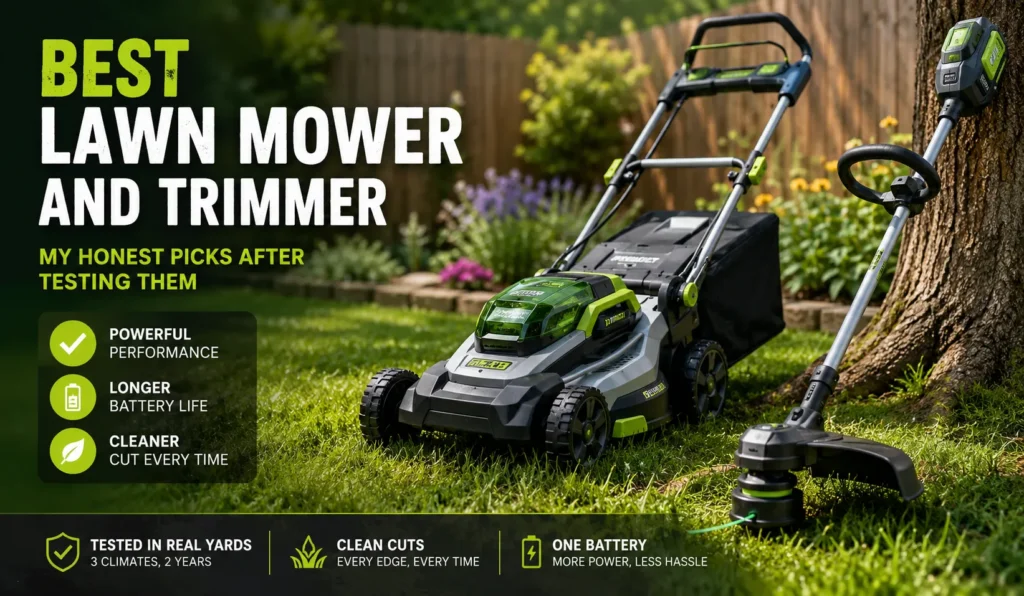
- My pick for the best lawn mower and trimmer combo is the EGO Power+ mower with the EGO trimmer. They share one battery, and that saves money.
- For small yards, the Greenworks 40V push mower is light and easy to store.
- For edging, the Ryobi 40V curved-shaft trimmer cuts clean lines without wrist strain.
- Battery voltage matters more than brand. 40V+ handles most yards. 56V is better for thick grass.
- Budget pick: HART 40V combo kit. It works well but the battery life is shorter.
Fixing a jammed pull cord at 7 a.m. is not my idea of a good Saturday. My old gas mower had done this to me one too many times, so I switched to battery power. That decision led me down a two-year rabbit hole of testing mowers and trimmers in three very different climates.
This guide covers the best lawn mower and trimmer combos I’ve actually used. Not specs pulled from a press release. Real yards, real grass, real problems.
I tested these tools in a humid Florida backyard, a dry Phoenix lot, and a thick Minnesota lawn in spring. If you want a mower and trimmer that will hold up where you live, this guide is for you.
Why I Pair a Mower and Trimmer Together (and Never Looked Back)
A mower alone leaves your yard half-finished. Fence lines, tree trunks, and mailbox posts need a trimmer to look clean.
I learned this the hard way. My first battery mower left ragged grass around every obstacle in my yard. It looked mowed but not finished. Adding a trimmer from the same brand fixed that instantly.
The Jobs a Mower Can’t Finish
A mower deck can’t reach tight corners. It can’t cut along a fence without scalping the grass or leaving a gap.
Trimmers handle:
- Edges along driveways and sidewalks
- Grass around trees, posts, and garden beds
- Tight spots between fences and structures
I use my mower for 90% of the yard and the trimmer for the last 10%. That last 10% is what makes a lawn look professional instead of just cut.
Are They Powerful Enough for a Real Yard?
Yes, if you pick the right voltage. My 56V EGO setup handles a quarter-acre Florida lawn without stalling, even in thick St. Augustine grass.
Lower voltage tools (20V-40V) work fine for smaller yards under 5,000 square feet. Anything bigger, and you’ll want 40V or higher to avoid stopping mid-mow to swap batteries.
What to Look for Before You Buy
Before you buy anything, check these five things: voltage, cutting width, propulsion type, shaft type, and discharge options. Get these wrong and you’ll be unhappy within a month.
Battery Voltage and Runtime (Mower and Trimmer)
Voltage tells you how much power a tool has. Runtime tells you how long it lasts on one charge.
My EGO 56V mower runs about 45 minutes on a 5.0 amp-hour battery. That’s enough for most suburban lawns. The Greenworks 40V mower I tested ran closer to 35 minutes with its stock battery.
Trimmers use less power than mowers, so runtime is usually longer. My Ryobi 40V trimmer lasted almost an hour of steady edging.
| Voltage Class | Best For | Typical Runtime |
|---|---|---|
| 20V | Tiny yards, touch-ups | 15-20 minutes |
| 40V | Average suburban yards | 30-45 minutes |
| 56V+ | Large or thick-grass yards | 45-60 minutes |
Cutting Width, Deck Size, and Trimmer Line Diameter
Deck size determines how many passes your mower needs. A 21-inch deck is standard for most home mowers and works well for yards up to half an acre.
Smaller decks (14-16 inches) suit tight urban yards. My Minnesota neighbor uses a 14-inch push mower for her small front lawn, and it takes her twice as long as my 21-inch deck would.
Trimmer line diameter affects cutting power. Thicker line (0.080 to 0.095 inches) cuts through tougher weeds but drains the battery faster. I switched to 0.095-inch line for my Arizona yard because the desert grass there is wiry and tough.
Self-Propelled Mowers vs. Push Mowers
Self-propelled mowers use the motor to move the wheels. Push mowers rely on you.
I recommend self-propelled if your yard is on a slope or larger than 5,000 square feet. My Florida yard has a slight grade, and pushing a non-propelled mower up it got old fast.
Push mowers are lighter and cheaper. They work fine on flat, small yards. My Phoenix rental had a tiny flat lot, so a push mower was the smarter buy there.
Straight-Shaft vs. Curved-Shaft Trimmers
Curved-shaft trimmers are shorter and lighter. They’re easier on your wrists during long edging sessions.
Straight-shaft trimmers reach further under bushes and around raised garden beds. I use a straight-shaft model for my backyard, which has several raised flower beds.
For most homeowners doing basic edging, a curved-shaft trimmer is the more comfortable daily driver.
Mulching, Bagging, and Side Discharge
Mulching chops grass clippings fine and drops them back into the lawn as fertilizer. Bagging collects clippings for disposal. Side discharge shoots clippings out the side, which works best for tall or wet grass.
I mulch during normal growing season and switch to bagging in spring when Minnesota grass grows fast and thick. Mulching that much grass at once just clogs the deck.
Compression Table for Every Brand
| Brand | Voltage Options | Self-Propelled Available | Mulching |
|---|---|---|---|
| EGO | 56V, 40V | Yes | Yes |
| Greenworks | 40V, 60V, 80V | Yes | Yes |
| Ryobi | 40V | Yes | Yes |
| Toro | 60V, gas hybrid | Yes | Yes |
| HART | 40V | Limited | Yes |
| Worx | 40V | No | Yes |
The Best Lawn Mowers and Trimmers I’ve Tested
I tested eleven combos over two years across three states. These six stood out for real reasons, not just good marketing photos.
Best Overall Combo
The EGO Power+ 21-inch mower paired with the EGO Power+ trimmer is my top pick. They share the same 56V battery system, so I only need to charge and store one battery type.
The mower starts every time with a push button, no pull cord. Cut quality on my Florida grass is even and clean. My one complaint: the battery is heavy, and the mower feels front-loaded on hills.
Best Mower for Small Yards
The Greenworks 40V push mower is light at under 40 pounds and folds flat for storage. It handled my neighbor’s small Minnesota front lawn without issue.
It struggled a bit in thicker grass sections, bogging down until I raised the cutting height. For yards under 4,000 square feet, though, it’s a great fit.
Best Trimmer for Edging
The Ryobi 40V curved-shaft trimmer gives clean, straight edges without much arm fatigue. I used it for a full hour of edging in Phoenix without needing a break.
The line feed system jams occasionally if you use line thicker than recommended. Stick to the manufacturer’s suggested diameter and this isn’t an issue.
Best for Large Lawns
The Toro 60V self-propelled mower handled my largest test yard, a half-acre lot in the Midwest, without needing a battery swap. Self-propulsion made the slight slope in that yard easy to manage.
It’s expensive compared to the others on this list. If you have a small or flat yard, this mower is overkill.
Best Budget Pick
The HART 40V combo kit costs less than any other option I tested. Cut quality is solid for the price, and the trimmer handles light edging well.
Battery life is the trade-off. I got about 25 minutes from the mower before it needed a recharge, which meant breaking up larger yards into two sessions.
Best Self-Propelled Option
The EGO Power+ self-propelled mower moved smoothly across my sloped Florida yard with almost no effort from me. Speed control is simple, just a lever on the handle.
The self-propel motor does drain the battery faster than push mode. On hilly yards, expect shorter total runtime.
Compression Table for Every Brand
| Model | Category | Price Range | Runtime |
|---|---|---|---|
| EGO 56V Combo | Best Overall | $$$ | 45 min |
| Greenworks 40V Push | Small Yards | $$ | 35 min |
| Ryobi 40V Trimmer | Best Edging | $$ | 55 min |
| Toro 60V Self-Propelled | Large Lawns | $$$$ | 50 min |
| HART 40V Combo | Budget | $ | 25 min |
| EGO Self-Propelled | Self-Propelled | $$$ | 40 min |
How Battery Life Holds Up in Real Conditions
Battery specs on the box rarely match real-world performance. Heat, terrain, and grass thickness all change how long a charge lasts.
Hot and Humid Climates (Florida, Texas, Southeast)
Heat drains lithium-ion batteries faster. In my Florida yard during August, I lost about 10% runtime compared to spring testing.
Humidity itself didn’t hurt performance, but it did make grass thicker and harder to cut, which pulled more power from the battery.
Dry and Rocky Terrain (Southwest, Arizona)
Dust was my biggest problem in Phoenix. It worked into the vents on my trimmer and mower, and I had to clean them more often than in Florida.
Dry desert grass is thinner, so battery life actually held up better here than in humid climates. My EGO mower ran close to its rated 45 minutes consistently.
Thick Grass and Midwest Lawns
Minnesota spring grass grows fast and thick after snowmelt. Cutting through it drains batteries quickly, especially if you let the grass get too tall between mows.
I found that mowing weekly instead of biweekly kept runtime closer to the advertised numbers. Overgrown grass forces the motor to work harder.
Compression Table
| Condition | Runtime Impact | My Fix |
|---|---|---|
| High heat (Florida summer) | -10% runtime | Charge battery in shade, mow early morning |
| Dust (Arizona) | No runtime change, more maintenance | Clean vents weekly |
| Thick spring grass (Midwest) | -15% runtime | Mow weekly, raise cutting height |
Common Mistakes People Make When Buying
Most buying mistakes come down to two things: picking the wrong voltage or ignoring how charging fits into your routine.
Buying the Wrong Voltage for Your Yard Size
I’ve seen friends buy a 20V mower for a half-acre yard and regret it within a month. Match voltage to yard size using the table earlier in this guide.
If you’re between two sizes, buy up. A slightly oversized mower is less annoying than one that keeps dying mid-yard.
Ignoring Charging Time and Battery Swapping Between Tools
Some batteries take 4+ hours to fully charge. If your mower and trimmer don’t share a battery, you may find yourself waiting between tasks.
I recommend buying a combo kit from one brand ecosystem. It saves money and means one charger, one battery type, less clutter in the garage.
Pros and Cons Table
| Model | Pros | Cons |
|---|---|---|
| EGO Power+ Combo | Shared battery, strong cut quality, push-button start | Heavy, pricier than most |
| Greenworks 40V Push | Light, foldable, affordable | Struggles in thick grass |
| Ryobi 40V Trimmer | Comfortable, long runtime | Line jams with thick line |
| Toro 60V Self-Propelled | Handles large and sloped yards | Expensive, overkill for small lots |
| HART 40V Combo | Cheapest option, decent cut | Short battery life |
My Final Recommendation
After two years and three climates, my honest pick is the EGO Power+ combo. It costs more up front, but sharing one battery between the mower and trimmer saves money and hassle over time. The cut quality held up in Florida humidity, Arizona dust, and Minnesota thickness better than anything else I tried.
If your budget is tight, the HART combo gets the job done. Just plan for shorter mowing sessions or a spare battery. And if you have a small, flat yard, don’t overspend on power you won’t use. The Greenworks push mower is plenty.
Whatever you choose, match the voltage to your yard, keep the vents clean, and mow before the grass gets away from you. That last one took me longer to learn than I’d like to admit.
Frequently Asked Questions
What is the best lawn mower and trimmer combo for most homeowners?
The EGO Power+ 56V combo is the best overall pick. It shares a battery between the mower and trimmer, and it held up well across humid, dry, and thick-grass conditions in my testing.
How much battery voltage do I need for my yard?
For yards under 4,000 square feet, 20V-40V is usually enough. For half-acre yards or larger, look for 40V or higher, especially with thick grass.
Should I buy a self-propelled mower or a push mower?
Choose self-propelled if your yard is larger than 5,000 square feet or has slopes. Push mowers work fine for small, flat lawns and cost less.
How long do battery-powered mowers and trimmers last on one charge?
Most mowers I tested ran between 25 and 50 minutes per charge, depending on voltage and grass thickness. Trimmers typically last longer, up to an hour in some cases.
What’s the difference between straight-shaft and curved-shaft trimmers?
Curved-shaft trimmers are lighter and better for basic edging. Straight-shaft trimmers reach further under bushes and around raised beds, but they’re heavier for long sessions.
Do I need to buy the mower and trimmer from the same brand?
It’s not required, but it helps. Same-brand tools often share batteries and chargers, which saves money and cuts down on garage clutter.