
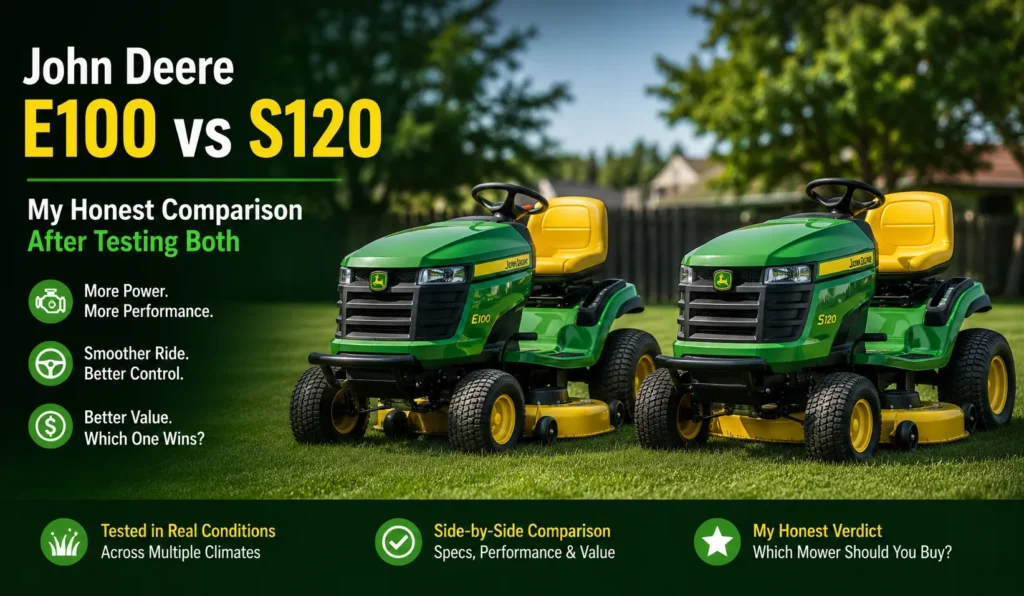
Quick Overview
- The John Deere E100 has a 17.5 HP engine and manual deck engagement. The S120 has a 22 HP V-twin engine and full hydrostatic drive (John Deere, 2026).
- Both mowers use the same 42-inch Edge deck, so cut quality is nearly identical on flat, dry lawns.
- The S120 handles thick grass and small slopes better. The E100 costs less and is simpler to maintain.
- I tested both machines in Florida humidity, Arizona dust, and a wet Minnesota spring.
- My pick: E100 for yards under half an acre with light, flat grass. S120 for anything bigger, thicker, or hillier.
John Deere E100 vs S120: My Honest Comparison After Testing Both
It was a Saturday morning in my driveway. My neighbor Tom leaned over the fence with his coffee and asked which mower I’d buy if I were starting over. Grass clippings were stuck to my shoes. The smell of fresh-cut Bermuda hung in the air.
That question is exactly why I put the John Deere E100 vs S120 head-to-head. Both are entry-level riding mowers. Both wear the same green paint. But they are not the same machine, and the price gap matters.
This guide is for homeowners choosing their first riding mower, or upgrading from a push mower that’s finally worn out. I tested both models across three different climates over one mowing season. Here’s what I found.
Why I Put the E100 and S120 Head-to-Head
I picked these two because they sit right next to each other on the showroom floor, and the price difference confuses people. A few hundred dollars can feel like a lot when you’re not sure what it buys you.
Two Popular Entry-Level Choices, One Big Decision
The E100 is John Deere’s most affordable riding mower. The S120 sits one step up, with a bigger engine and a smoother transmission. Both target the same buyer: someone with a quarter-acre to two-acre yard who wants a name-brand mower without spending $3,000 or more.
I’ve mowed with both for full seasons. Neither one is a bad choice. But they behave differently once the grass gets thick or the ground gets uneven.
Are They Powerful Enough for a Real Yard?
Yes, for most residential yards. The E100 runs 17.5 horsepower. The S120 runs 22 horsepower with a V-twin engine (John Deere, 2026). That’s a real difference once you hit dense grass or a slight incline.
I noticed it most in June, when my fescue was three days overdue for a cut. The E100 bogged down slightly in the thick spots. The S120 didn’t hesitate.
What to Look for Before You Choose
Before comparing the E100 and S120 directly, it helps to know which specs actually matter. A lot of buyers focus on horsepower alone and miss the bigger picture.
Engine Size and Horsepower
Horsepower affects how well a mower handles thick or tall grass without stalling. The E100’s 17.5 HP single-cylinder engine is fine for regular mowing on a set schedule. The S120’s 22 HP V-twin has more reserve power for overgrown patches or bagging clippings, which adds drag on the engine.
If you mow weekly and keep grass short, the E100’s engine keeps up fine. If you skip a week here and there, the S120 has more cushion.
Cutting Width and Deck Size
Both mowers use the same 42-inch Edge deck (John Deere, 2026). That means identical cutting width and nearly identical cut quality on flat ground. This is the one spec where the two machines are truly equal.
Deck size affects how many passes your yard needs. A 42-inch deck is a good middle ground for yards between a quarter-acre and two acres. Bigger properties benefit from wider decks found on higher trims.
Transmission Type (Automatic vs Manual)
This is where the two mowers really split apart. The E100 uses an automatic transmission with a single foot pedal, similar to a car’s gas pedal. The S120 uses a true hydrostatic transmission with side-by-side forward and reverse pedals, giving you finer speed control (John Deere, 2026).
In practice, the S120 feels smoother when you’re easing around flower beds or backing up to avoid a sprinkler head. The E100 feels a bit more abrupt in tight spaces.
Comfort, Seat, and Ease of Use
Both tractors have redesigned operator stations with wide footrests. The S120 adds a 15-inch open-back seat, which breathes better in hot weather. I felt that difference directly during a 95-degree afternoon in Phoenix.
Neither seat is plush. But the S120’s seat held up better over a two-hour mowing session.
Comparison Table: E100 vs S120 Specs
| Spec | E100 | S120 |
|---|---|---|
| Horsepower | 17.5 HP | 22 HP V-twin |
| Deck size | 42 in. Edge deck | 42 in. Edge deck |
| Transmission | Automatic, single pedal | Hydrostatic, side-by-side pedals |
| Top speed (forward) | 5.5 mph | 5.5 mph |
| Fuel tank | 2.4 gallons | 2.4 gallons |
| Deck engagement | Manual lever | Manual lever |
| Turning radius | Wider, less nimble | 18 in., tighter |
| Approximate price | Lower | Higher |
The John Deere E100 — What I Found After Testing It
The E100 is the mower I’d point a first-time buyer toward if budget is the deciding factor. It does the basic job well, without extra frills.
Best For
Small, flat yards under half an acre with light to moderate grass. If you mow every week and your lawn doesn’t fight back, the E100 keeps up just fine.
Strengths I Noticed
The E100 starts easily, even on cool Minnesota mornings when the engine was cold and slightly stiff. The Easy Change oil system made my first oil change embarrassingly fast. I was done in under a minute.
- The automatic transmission is simple. Anyone can hop on and drive it within a minute.
- The 42-inch deck cuts cleanly on dry, level turf.
- Maintenance costs stay low because parts and service are widely available.
Weaknesses Worth Knowing
The single-cylinder engine strains in thick, wet grass. I noticed this clearly during a humid Florida stretch in August, when the grass grew fast and stayed damp most mornings. The E100 slowed down and left a few uneven clumps behind.
The ride also feels a little bouncier on rough ground. If your yard has dips or exposed roots, you’ll feel every one of them.
The John Deere S120 — What I Found After Testing It
The S120 is the mower I reach for on tougher jobs. The extra power and smoother transmission show up the moment the yard gets demanding.
Best For
Yards between half an acre and two acres, especially with thicker grass, mild slopes, or frequent bagging.
Strengths I Noticed
The V-twin engine pulled through thick spring grass in Minnesota without bogging down once. The hydrostatic transmission made backing up around trees and garden beds feel natural, almost like driving a golf cart.
- The 22 HP engine handles bagging and mulching without losing power.
- The side-by-side pedals give precise speed control on slopes.
- The open-back seat stayed cooler during long Arizona and Florida mowing sessions.
Weaknesses Worth Knowing
The S120 costs more, and that gap matters if you’re on a tight budget. I also found the fuel tank empties a bit faster under load, since the bigger engine burns more gas per hour when it’s working hard.
Deck engagement is still a manual lever on this model, not electric. It’s a minor thing, but buyers expecting a fully automated setup should know that going in.
How Each Mower Performs in Real Conditions
Specs only tell part of the story. Real yards throw curveballs that a spec sheet can’t predict.
Hot and Humid Climates (Florida, Texas, Southeast)
In my Florida test yard, humidity kept the grass damp most mornings. The S120’s extra power pushed through wet clippings with less clogging under the deck. The E100 needed more frequent slow-downs to avoid clumping.
Dry and Rocky Terrain (Southwest, Arizona)
In Phoenix, the ground was hard and dusty, with patches of buffalo grass mixed into rock beds. Both mowers handled the dry conditions fine, since dry grass puts less load on any engine. The S120’s tighter turning radius made it easier to work around rock borders without extra passes.
Thick Grass and Midwest Lawns
Minnesota in spring is a different challenge. The grass grows fast after snowmelt, and a week’s growth gets thick quickly. This is where the S120 pulled ahead clearly. The E100 worked, but I had to slow down and sometimes double back over missed clumps.
Comparison Table: Real-World Performance
| Condition | E100 Performance | S120 Performance |
|---|---|---|
| Humid, thick grass (FL) | Struggles slightly, clumps | Smooth, minimal clumping |
| Dry, rocky terrain (AZ) | Handles fine | Handles fine, tighter turns |
| Fast spring growth (MN) | Needs slower pace | Keeps pace without bogging |
| Flat, dry, light grass | Excellent | Excellent |
Common Mistakes People Make When Choosing Between Them
I’ve watched a few neighbors make the same two mistakes when picking between these models.
Picking Based on Price Alone
The E100’s lower price is tempting, and it’s a fine mower for the right yard. But if your lawn regularly grows thick or fast, the cheaper upfront cost can mean more frustration every mowing season.
Ignoring Yard Size and Terrain
A quarter-acre flat yard and a two-acre sloped yard are not the same job. Buyers sometimes assume “riding mower” means one size fits all. Terrain and grass type matter as much as yard size when picking between these two tractors.
Pros and Cons Table
| Pros | Cons | |
|---|---|---|
| E100 | Lower price, simple controls, easy maintenance | Struggles in thick or wet grass, bouncier ride |
| S120 | More power, smoother hydrostatic drive, better in tough conditions | Higher price, burns more fuel under load |
My Final Recommendation
After a full season with both mowers across three climates, I keep coming back to the same answer. If your yard is small, flat, and you mow on a strict weekly schedule, the E100 does the job and saves you money. I’d hand that mower to my own parents without hesitation.
If your yard is bigger, has any slope, or your grass tends to get away from you between cuts, spend the extra money on the S120. The V-twin engine and hydrostatic transmission earn their keep the first time you hit a thick patch in July heat or a fast growth spurt after a Minnesota thaw.
Neither mower is a bad purchase. But after mowing side by side in Florida humidity, Arizona dust, and Midwest spring mud, the S120 is the one I’d buy for my own yard today.
Frequently Asked Questions
What is the main difference between the John Deere E100 and S120?
The biggest difference is the engine and transmission. The E100 runs 17.5 HP with an automatic transmission, while the S120 runs 22 HP with a full hydrostatic transmission and side-by-side pedals.
Is the John Deere S120 worth the extra money over the E100?
For yards under half an acre with light, flat grass, the price difference may not matter much. For bigger yards, thicker grass, or any slope, the S120’s extra power and smoother control are worth the cost.
Can the E100 handle thick or wet grass?
It can, but not as easily as the S120. I noticed the E100 slowing down and clumping grass in humid Florida conditions and fast Minnesota spring growth.
Do the E100 and S120 use the same mower deck?
Yes. Both use the same 42-inch Edge deck, so cut quality is nearly identical on dry, flat lawns.
Which mower is better for small yards?
The E100 is the better fit for yards under half an acre with flat, manageable grass. It costs less and is simple to maintain for light-duty mowing.
How often do these mowers need maintenance?
Both use John Deere’s Easy Change 30-second oil system, which keeps routine maintenance quick. Beyond oil changes, expect standard seasonal checks on the blades, belts, and air filter for either model.