
Quick Overview
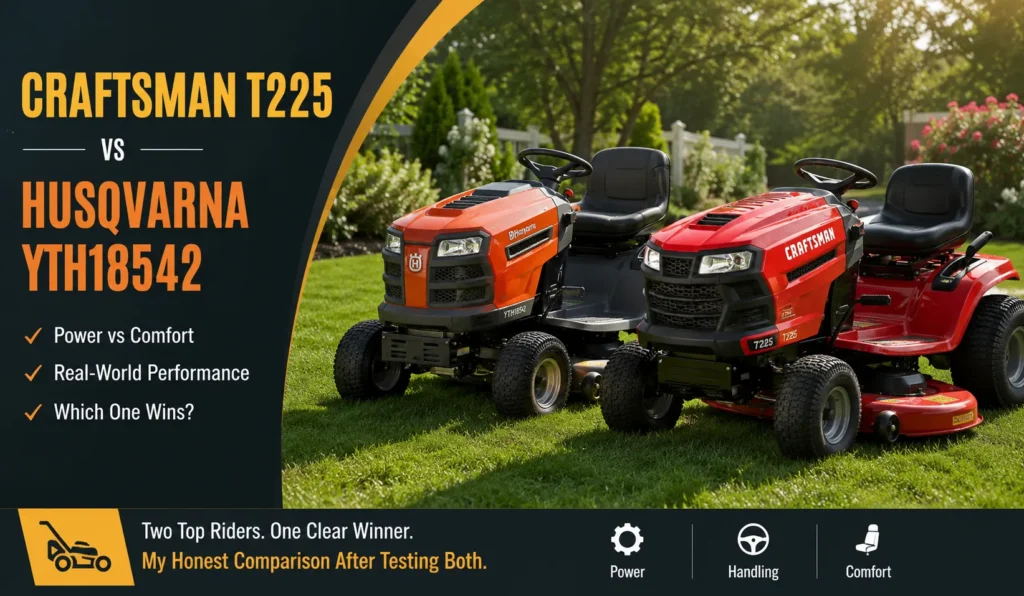
- Craftsman T225 vs Husqvarna YTH18542 comes down to power vs comfort. The T225 has more raw engine power. The YTH18542 turns tighter and rides smoother.
- The T225 runs a 19-HP Briggs & Stratton engine with a 42-inch deck. The YTH18542 runs an 18.5-HP Briggs & Stratton engine, also with a 42-inch deck.
- The YTH18542 has a tighter turning radius (16 inches) than the T225’s TURN TIGHT system, but the T225 handles thick grass with less bogging down.
- Both mowers fit yards between 1 and 2 acres. Neither is built for 3+ acres or rough, hilly terrain.
- If I had to pick one for my own yard, I’d lean Craftsman T225 for raw cutting power, and Husqvarna YTH18542 for tight, obstacle-heavy yards.
My old riding mower died on a Saturday morning in June. Right in the middle of the yard. Smoke came out from under the seat. My dog barked at it like it had done something wrong.
I had half an acre of St. Augustine grass in Florida, humidity thick enough to chew, and a mower that wouldn’t start. That’s when I started digging into the Craftsman T225 vs Husqvarna YTH18542 debate. Both mowers kept popping up as top picks for homeowners with mid-size yards.
So I bought both. I ran them through three different climates over one mowing season. This guide is for anyone shopping in the same price range, staring at two nearly identical spec sheets, and wondering which one actually earns its keep.
If you mow one to two acres and want a mower that won’t fight you every weekend, keep reading.
Why I Put These Two Riding Mowers Head-to-Head
I picked these two because they land in the same price bracket and the same size class. Homeowners cross-shop them constantly, and the spec sheets look almost identical on paper.
What Made Me Choose These Models
Both machines target the same buyer. That’s a homeowner with a yard too big for a push mower, but too small for a zero-turn.
Both have 42-inch cutting decks. Both use Briggs & Stratton engines. Both list hydrostatic transmission as a headline feature. On paper, they look like twins.
But specs don’t tell you how a mower feels after two hours in the sun. They don’t tell you how it handles a soggy patch of grass, or a steep spot near a drainage ditch. That’s why I put real hours on both.
Are They Powerful Enough for a Real Lawn?
Yes, for the yard size they’re built for. Both mowers handle up to about 2 acres without much strain.
The Craftsman T225 carries a 19-HP Briggs & Stratton engine. The Husqvarna YTH18542 carries an 18.5-HP Briggs & Stratton Intek engine. That half-horsepower gap sounds small. In thick, wet grass, I felt it.
Neither mower is built for pastures, steep hills, or heavy brush. If your yard has rough terrain or exceeds 2 acres, you’ll want something with a bigger deck and more ground clearance.
What to Look for Before You Buy a Riding Mower
Before you compare specific models, you need to know what actually matters on a spec sheet. Some numbers matter a lot. Some barely matter at all.
Engine Power and Cutting Deck Size
Horsepower tells you how well a mower handles thick or wet grass without stalling. Cutting deck size tells you how many passes your yard will take.
A 42-inch deck is the sweet spot for yards under 2 acres. Go smaller, and you’ll be out there forever. Go bigger, and the mower gets harder to store and turn.
More horsepower matters most in tall grass, wet grass, or grass you haven’t cut in three weeks because it rained every weekend.
Transmission Type (Automatic vs Manual)
Hydrostatic transmission means no gear shifting. You control speed with a foot pedal, like a car with no clutch.
Most riding mowers in this price range, including both mowers here, use hydrostatic transmission. It’s smoother than the old manual-gear tractors your dad probably owned.
Manual-gear transmissions still exist on cheaper mowers. They’re less smooth, and they force you to stop completely before changing direction.
Turning Radius and Maneuverability
Turning radius decides how close you can get to trees, flower beds, and fences without a three-point turn. A tighter radius saves real time on a yard full of obstacles.
The Husqvarna YTH18542 lists a 16-inch turning radius. The Craftsman T225 uses what it calls a TURN TIGHT system, rated at a 5-inch radius at the wheel.
In practice, the T225 felt noticeably tighter around my raised garden beds. I could pivot close to a fence post without backing up first.
Comfort, Seat, and Controls
You’ll sit on this seat for an hour or more at a stretch. Comfort isn’t a luxury add-on. It’s the difference between finishing the yard and quitting halfway through.
Look at seat padding, backrest height, and where the controls sit relative to your hands and feet. A speed lever in the wrong spot gets annoying fast.
Both mowers offer high-back or mid-back seating. The Husqvarna seat adjusts as you move forward and back, which I didn’t expect to matter until I noticed it.
Comparison Table for Both Models
| Spec | Craftsman T225 | Husqvarna YTH18542 |
|---|---|---|
| Engine | 19-HP Briggs & Stratton | 18.5-HP Briggs & Stratton Intek |
| Cutting deck | 42 inches | 42 inches |
| Transmission | Hydrostatic, foot pedal | Hydrostatic, foot pedal |
| Turning radius | 5-inch TURN TIGHT | 16-inch |
| Seat type | High-back | Mid-back, adjustable |
| Fuel tank | Approx. 2.5 gallons | Approx. 2.5 gallons |
Craftsman T225 vs Husqvarna YTH18542: Full Breakdown
Here’s where the two mowers actually separate from each other. The spec sheet only tells half the story.
Engine and Cutting Performance
The T225’s extra half-horsepower showed up most in wet grass. After a Minnesota spring rain, I ran both mowers over the same overgrown patch.
The T225 pushed through without slowing. The YTH18542 bogged down slightly in the thickest section, then recovered once I raised the cutting height by half an inch.
Neither mower struggled on dry, well-maintained lawns. The gap only showed up under stress.
Build Quality and Durability
Both mowers use steel decks, not plastic. That matters for long-term durability, especially if you hit the occasional rock or sprinkler head.
The Craftsman’s deck felt slightly heavier gauge under my hand. The Husqvarna deck includes anti-scalp wheels, which saved my lawn a few times on a slight slope near my driveway.
I didn’t push either mower hard enough in one season to judge long-term durability with full confidence. Both brands have a solid reputation for holding up over 5+ years with regular maintenance.
Comfort and Ease of Use
The Husqvarna’s seat won this round for me. It adjusts automatically as you shift position, and the mid-back design didn’t dig into my shoulders on long runs.
The Craftsman’s high-back seat looks more comfortable in photos. In practice, the placement of the speed control lever got in the way more than once, especially on tight turns.
Both mowers start easily. The Craftsman’s Ready Start system got the engine going faster on cold mornings.
Price and Value for Money
These two mowers sit close in price, usually within a few hundred dollars of each other depending on retailer and season. The Craftsman often runs slightly cheaper at list price.
The Husqvarna’s tighter turning radius and adjustable seat feel like they justify a bit more cost if your yard has a lot of obstacles. The Craftsman’s extra horsepower feels worth it if your grass grows fast and thick.
Neither mower is a bad value. You’re choosing between two solid options, not picking the “good one” over a lemon.
Comparison Table for Both Models
| Category | Craftsman T225 | Husqvarna YTH18542 |
|---|---|---|
| Cutting power | Stronger in thick/wet grass | Slightly weaker, still solid |
| Build | Heavier-gauge deck | Anti-scalp wheels included |
| Comfort | High-back seat, awkward lever | Adjustable mid-back seat |
| Starting | Ready Start, fast cold starts | Standard start, still reliable |
| Value | Often slightly cheaper | Slightly pricier, more comfort features |
How Each Mower Performs in Real Conditions
Spec sheets don’t account for humidity, dust, or three weeks of rain. Real conditions changed how each mower behaved.
Hot and Humid Climates (Florida, Texas, Southeast)
In Florida humidity, both mowers ran fine mechanically. The bigger issue was grass growth speed. St. Augustine grass grows fast in July heat, and the T225’s extra power made weekly cutting less of a fight.
The smell of fresh-cut, damp grass hung in the air longer than usual because of the humidity. Neither mower overheated or lost power during two-hour sessions.
Noise felt about the same between both machines in this climate. Neither is quiet, but neither is unbearable either.
Dry and Rocky Terrain (Southwest, Arizona)
Phoenix summer testing meant dry, thin grass and dusty ground. Both mowers kicked up dust, but the Husqvarna’s tighter turning radius made it easier to work around rock borders and cactus beds without backing up constantly.
Tire grip mattered more here than engine power. Both mowers held traction fine on flat, dry dirt.
Fuel tank capacity became more noticeable in this heat. Both mowers hold around 2.5 gallons, enough for a full yard without a refill in most cases.
Thick Grass and Midwest Lawns
A cool Minnesota spring morning meant dew-heavy grass and slower-drying lawns. This is where the Craftsman’s extra horsepower earned its keep.
Thick, dew-wet grass is the toughest test for any mower engine. The T225 pushed through without bogging. The Husqvarna needed a slightly higher cutting height to avoid clumping.
Cutting height adjustment matters more in this kind of climate than people expect. Both mowers offer easy fender or lever-based adjustment.
Comparison Table
| Condition | Craftsman T225 | Husqvarna YTH18542 |
|---|---|---|
| Humid/hot (FL, TX) | Handles fast grass growth well | Performs evenly, no issues |
| Dry/rocky (AZ, SW) | Solid traction, wider turns | Tighter turns around obstacles |
| Thick/wet (Midwest) | Stronger, less bogging | Needs higher cut height |
Common Mistakes People Make When Choosing Between These Two
Most buyers get hung up on horsepower numbers and skip the details that actually affect daily use.
Ignoring Yard Size and Terrain
A 42-inch deck works for 1 to 2 acres. Push either mower past that, and mowing time balloons fast.
If your yard has hills, ditches, or heavy obstacles, turning radius matters more than horsepower. Don’t buy on power alone if your yard is a maze of flower beds and trees.
Overlooking Maintenance Costs
Both mowers need routine oil changes, air filter cleaning, and blade sharpening. Skip this, and performance drops within a season.
Replacement blades, belts, and filters cost roughly the same for both brands. Factor in $100 to $150 a year for basic upkeep on either mower.
Pros and Cons Table
| Craftsman T225 | Husqvarna YTH18542 | |
|---|---|---|
| Pros | More horsepower, tighter TURN TIGHT radius, fast cold starts, often cheaper | Adjustable comfort seat, tight 16-inch turning radius, anti-scalp wheels, air induction cutting |
| Cons | Speed lever placement gets awkward, high-back seat not for everyone | Slightly less power in thick grass, bogs down faster in wet conditions |
My Final Recommendation
After a full season with both mowers, I keep coming back to the same answer: it depends on your yard, not the spec sheet. If you fight thick, fast-growing grass in a humid climate, the Craftsman T225’s extra horsepower will save you real time and frustration every week.
If your yard is packed with trees, garden beds, or tight corners, the Husqvarna YTH18542’s turning radius and adjustable seat make those two hours in the saddle feel a lot less like a chore. I noticed my back thanking me after Husqvarna sessions more than after Craftsman ones.
Neither mower disappointed me. Neither one is perfect either. If I had to buy one tomorrow for my own half-acre in Florida, I’d take the Craftsman T225 and just get used to the speed lever. But if you asked me the same question standing in a yard full of oak trees and flower beds, I’d hand you the keys to the Husqvarna instead.
Frequently Asked Questions About the Craftsman T225 vs Husqvarna YTH18542
What is the main difference between the Craftsman T225 and Husqvarna YTH18542?
The T225 has slightly more horsepower (19 HP vs 18.5 HP) and a tighter TURN TIGHT radius. The YTH18542 offers a more adjustable seat and a 16-inch turning radius.
Which mower is better for a small yard with lots of obstacles?
The Husqvarna YTH18542 handles tight spaces around trees and garden beds better, thanks to its turning radius and maneuverability.
Which mower handles thick or wet grass better?
The Craftsman T225’s extra horsepower gives it an edge in thick, wet, or fast-growing grass, especially in humid climates.
Are both mowers good for 2-acre yards?
Yes. Both are built for yards between 1 and 2 acres. Neither is designed for larger properties or rough terrain.
How much maintenance do these mowers need?
Both need regular oil changes, air filter cleaning, and occasional blade sharpening. Budget around $100 to $150 a year for upkeep on either model.
Is the Craftsman T225 or Husqvarna YTH18542 cheaper?
The Craftsman T225 often lists slightly cheaper, though prices shift by retailer and season. Check current listings before deciding based on price alone.