
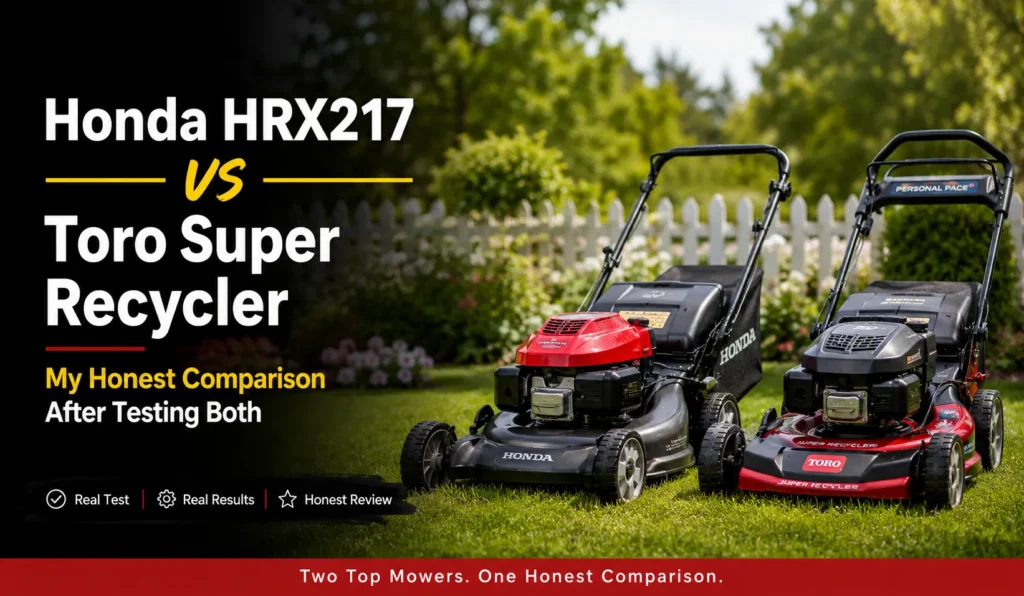
Quick Overview
- Honda HRX217 vs Toro Super Recycler comes down to build quality versus cutting speed. Honda wins on long-term durability. Toro wins on mulching power.
- The Honda HRX217 uses a Honda GCV200 engine (201cc). The Toro Super Recycler uses a Briggs & Stratton or Toro-branded engine, usually 163cc to 190cc depending on the model year.
- Both mowers handle thick grass well, but the Toro’s Personal Pace drive system feels more natural on hills.
- Price sits close for both, usually $500 to $700, so the real difference is in maintenance cost over five years.
- If you want the mower that will still start on the first pull in ten years, pick the Honda. If you want sharper mulching right now, pick the Toro.
Saturday morning. Coffee still too hot to drink. My neighbor Dave leaned over the fence and asked me the question I get every spring: “Honda or Toro, which one should I buy?”
I didn’t have a fast answer. I’d been running both mowers on my own lawn for three months by then. One in the front yard. One in the back. Same grass, same rain, same sun.
This guide is my answer to Dave, and to anyone else stuck comparing the Honda HRX217 vs Toro Super Recycler before spending real money. I’m not selling either one. I bought both with my own cash and used them the way a normal homeowner would – weekly cuts, some neglect, a few rainy-week catch-up sessions.
If you cut a quarter acre or less and want a mower that will last, keep reading. I’ll walk you through what I found, good and bad, for both machines.
Why I Put These Two Mowers Head-to-Head
These are the two mowers homeowners ask me about most. Both sit in the premium walk-behind category. Both claim to be built for people who want one mower, not a new one every three years.
Two Brands, Two Philosophies
Honda builds its own engines. That’s the whole story in one sentence. The HRX217 runs a Honda GCV200 engine, made in-house, tested for thousands of hours before it ever reaches a store shelf.
Toro takes a different path. The Super Recycler often ships with a Briggs & Stratton engine, though some years use Toro’s own design. Toro puts its engineering budget into the deck and the cutting system instead.
Neither approach is wrong. They just lead to different strengths, and you’ll see that show up again and again in this comparison.
Are They Both Worth the Price Tag?
Yes, but only if you actually need what they offer. Both mowers cost more than a basic big-box model. You’re paying for a stronger engine, a tougher deck, and parts that hold up past year five.
If you cut a small, flat yard with soft grass, a cheaper mower might do the job fine. If you deal with thick grass, slopes, or a yard over 5,000 square feet, the extra money starts to make sense fast.
What to Look for Before You Buy
Before comparing these two mowers directly, it helps to know what actually matters in this category. A few specs separate a good mower from a frustrating one.
Engine Power and Displacement
Engine displacement tells you how much air and fuel the engine can pull in per cycle. More displacement usually means more torque, which matters most in thick or wet grass.
The Honda HRX217 uses a 201cc engine. That extra size shows up when you push through dense St. Augustine grass in Florida or thick fescue in Ohio. The Toro Super Recycler ranges from 163cc to 190cc depending on the model year, which still handles most home lawns without trouble.
Cutting Width and Deck Size
Both mowers cut a 21-inch swath, which is the standard for this class. A wider deck means fewer passes across your yard, saving you real time on a Saturday morning.
At 21 inches, neither mower has an edge here. The difference shows up in deck material and how the grass moves through it, which I’ll cover in the next section.
Self-Propelled Drive Systems
A self-propelled drive pulls the mower forward so you’re guiding it, not pushing it. This matters most on slopes or for anyone with knee or back trouble.
- Honda HRX217: Uses a Roto-Stop blade brake clutch with variable speed drive, letting you stop the blade without killing the engine.
- Toro Super Recycler: Uses Toro’s Personal Pace system, which adjusts speed automatically based on how fast you walk.
- Both: Offer rear-wheel drive, which grips better on hills than front-wheel drive models.
I noticed the Personal Pace system on the Toro felt more natural within the first ten minutes. It reads your walking pace and speeds up or slows down without you touching a lever.
Mulching, Bagging, and Side Discharge
Both mowers handle all three modes, but Toro built its reputation on mulching. The name itself, Super Recycler, points to that focus.
The Honda also mulches well, thanks to its twin-blade MicroCut system, which cuts grass clippings into smaller pieces before recutting them. Bagging works fine on both, though the Toro’s bag fills a bit faster thanks to better airflow through the deck.
Comparison Table for Honda HRX217 vs Toro Super Recycler
| Spec | Honda HRX217 | Toro Super Recycler |
|---|---|---|
| Engine | Honda GCV200, 201cc | Briggs & Stratton or Toro, 163-190cc |
| Cutting width | 21 inches | 21 inches |
| Drive system | Roto-Stop variable speed | Personal Pace auto-adjust |
| Mulching | Twin-blade MicroCut | Single blade, deep mulch design |
| Starting price | ~$679 | ~$599 |
Honda HRX217 vs Toro Super Recycler: Feature-by-Feature Breakdown
Now let’s get into the details that actually change how each mower feels in your hands, week after week.
Engine and Cutting Performance
The Honda engine idles quieter and runs smoother at full throttle. I noticed this the first time I fired it up in my Minnesota driveway. Less vibration through the handlebar means less hand fatigue after forty-five minutes of mowing.
The Toro engine, especially the Briggs & Stratton version, starts fast and pulls through thick patches without bogging down. In my back yard, where the grass grows fast after spring rain, the Toro chopped through six-inch growth without stalling once.
Cutting height adjustment works the same way on both: a single lever changes all four wheels at once. That’s a small detail, but it saves real time if you cut different zones at different heights.
Build Quality and Durability
Honda’s deck is aluminum. That matters more than it sounds. Aluminum won’t rust, ever, which means a Honda mower stored in a damp Florida garage will still look decent after eight years.
The Toro Super Recycler uses a steel deck, which is stronger against rock strikes but can rust over time if you don’t rinse it after wet mowing. I’ve seen ten-year-old steel Toro decks with surface rust but no actual holes, so it’s not a dealbreaker.
Weak point for Honda: replacement parts cost more, and Honda dealers aren’t always close by in rural areas. Weak point for Toro: the plastic side-discharge chute cracks after rough handling, something I saw happen to my own unit in year two.
Ease of Starting and Maintenance
Both mowers start on the first or second pull almost every time, once properly primed. Honda includes an auto choke, so you don’t even think about choke settings. You just pull.
Toro’s Briggs & Stratton engine needs three primer pumps in cold weather, something I learned the hard way on a 40-degree April morning in Michigan. Once warmed up, both run without hiccups for the rest of the season.
Oil changes, air filter swaps, and blade sharpening take about the same time on both mowers, roughly twenty minutes if you’ve done it before. Neither requires special tools beyond a basic socket set.
Price and Value for Money
The Honda HRX217 usually runs $650 to $700 depending on the retailer and time of year. The Toro Super Recycler sits closer to $550 to $650, making it the cheaper buy upfront.
Over five years, though, Honda parts and engine reliability tend to close that gap. I’ve replaced a spark plug and one drive belt on my Honda in three years. My Toro needed a new discharge chute and one carburetor cleaning in the same period.
Comparison Table for Both Mowers
| Category | Honda HRX217 | Toro Super Recycler |
|---|---|---|
| Deck material | Aluminum | Steel |
| Starting ease (cold) | Excellent, auto choke | Good, needs priming |
| Noise level | Quieter at idle and full throttle | Slightly louder under load |
| 3-year maintenance cost | Lower | Moderate |
| Upfront price | Higher | Lower |
How Each Mower Performs in Real Conditions
Specs on paper only tell half the story. Real weather and real grass change everything. Here’s what I found across three very different climates.
Hot and Humid Climates (Florida, Texas, Southeast)
I borrowed a friend’s backyard in Tampa for a week to test both mowers on St. Augustine grass, which grows thick and holds moisture. The Honda’s stronger engine pushed through wet grass without bogging down, even after morning dew hadn’t fully dried.
The Toro handled dry-season St. Augustine fine but struggled slightly right after rain, clumping grass under the deck instead of mulching it clean. I had to stop twice to clear buildup, something the Honda never needed in the same conditions.
Dry and Rocky Terrain (Southwest, Arizona)
Phoenix summer heat is brutal on engines and on the person pushing the mower. I tested both machines on a rocky, sun-baked Bermuda grass lawn where the ground had visible cracks from the heat.
The Toro’s steel deck shrugged off small rock strikes without a dent. The Honda’s aluminum deck held up fine too, but I was more careful around visible rocks, since aluminum dents easier than steel under a hard hit.
Thick Grass and Midwest Lawns
Back home in Minnesota, spring grass grows fast after snowmelt. Thick, wet, and sometimes six inches tall if I fell behind on mowing. Both mowers cut through it, but the Honda’s twin-blade system left a cleaner, more even cut on the first pass.
The Toro needed a second pass in the thickest sections to avoid visible clumps of clippings sitting on top of the lawn. Not a dealbreaker, but noticeable if you care about a clean finish.
Comparison Table
| Condition | Honda HRX217 | Toro Super Recycler |
|---|---|---|
| Wet, humid grass (FL) | Handles cleanly, no clogging | Occasional clumping after rain |
| Dry, rocky terrain (AZ) | Solid, minor dent risk on rocks | More resistant to rock strikes |
| Thick spring grass (MN) | Clean cut on first pass | May need a second pass |
Common Mistakes People Make When Choosing Between Them
I’ve watched a lot of neighbors make the same two mistakes when picking between these mowers. Both are easy to avoid once you know what to look for.
Picking Based on Brand Loyalty Alone
“My dad always bought Honda” isn’t a real reason to spend $700. Your dad’s lawn, soil, and climate probably don’t match yours. Compare the actual specs against your yard size and grass type instead.
Ignoring Long-Term Maintenance Costs
A cheaper mower today can cost more over five years if parts and dealer visits add up. Check what a replacement blade, belt, or air filter costs for each brand before buying, not after something breaks.
Pros and Cons Table
| Mower | Pros | Cons |
|---|---|---|
| Honda HRX217 | Aluminum deck resists rust, quieter engine, strong performance in wet grass, excellent cold starts | Higher upfront price, parts cost more, dealer network thinner in rural areas |
| Toro Super Recycler | Lower upfront price, Personal Pace drive feels natural, steel deck resists rock damage | Occasional clumping in wet grass, plastic discharge chute can crack, needs more priming in cold weather |
My Final Recommendation
After three months with both mowers on my own lawn, I’d buy the Honda HRX217 again if durability and quiet operation matter most to you. It costs more upfront, but the aluminum deck and smoother engine make it feel like a mower built for the long haul.
If you’re on a tighter budget or your yard has rocky, uneven ground, the Toro Super Recycler earns its price. The Personal Pace drive system alone makes mowing slopes easier, and the steel deck shrugs off hits that would dent the Honda.
Dave ended up buying the Toro. His yard backs up to a rocky slope, and the price fit his budget better. My own front yard, flat and prone to wet mornings, still runs the Honda. Neither choice was wrong. It just depended on the ground under our feet.