
Quick Overview
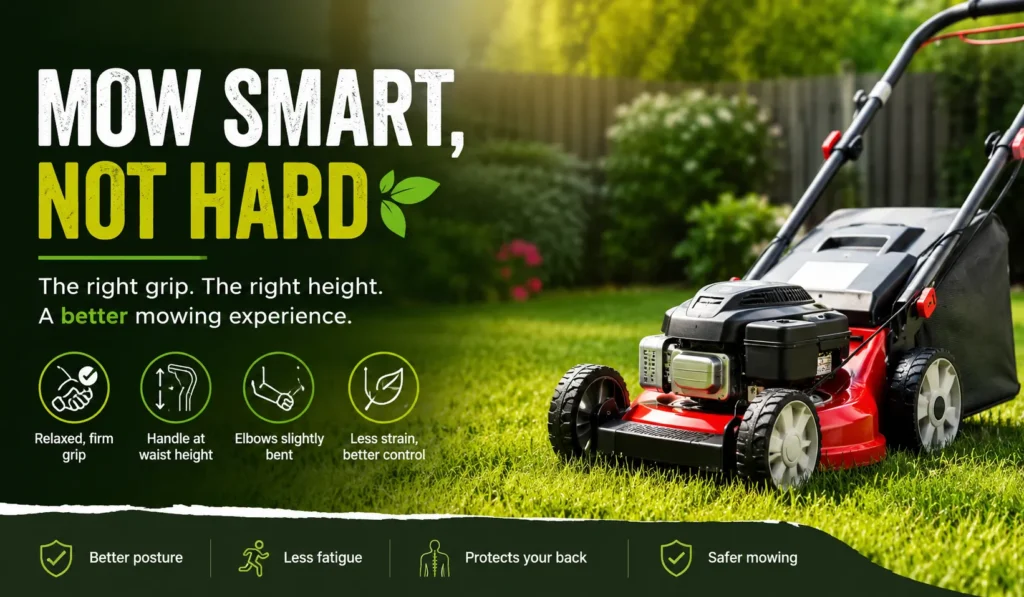
- The correct way to hold a lawn mower handle is with a relaxed, firm grip – palms facing down, thumbs wrapped under, elbows slightly bent at about 15-20 degrees.
- Handle height matters as much as grip: for most adults, the handle should sit at hip-to-waist height so your arms hang almost straight down with a slight bend.
- A wrong grip – too tight, too low, or with locked elbows – causes wrist fatigue, lower back pain, and reduced control within one mowing session.
- Self-propelled mowers require a lighter guiding grip than push mowers; you’re steering, not pulling.
- Most mowing injuries and aches come from bad posture and poor grip, not from the mower itself.
Why Handle Grip Matters More Than You Think
Most people grab a mower handle the same way they’d grab a shopping cart. That’s the first mistake.
A mower handle is different. It vibrates. It pulls. It needs to stay on a straight line across uneven ground. How you hold it determines how your back, wrists, and shoulders feel an hour later – and how safely the machine behaves if it hits a root or a wet patch.
The Posture Problem Most Mowers Never Fix
Stand behind any random person mowing their lawn and you’ll see the same thing: shoulders hunched forward, back bent at the waist, arms reaching out like they’re pushing a broken grocery cart uphill.
That position puts your lower back under constant compression. After 20 minutes on a Midwest lawn in July, that compression becomes a dull ache. After 45 minutes, it becomes a reason to stop.
The fix is not a new mower. It’s posture. And posture starts with how you hold the handle.
How a Wrong Grip Leads to Fatigue, Pain, and Loss of Control
When you grip the handle too tight, your forearm muscles stay contracted the whole time. The mower vibrates – most gas and battery models vibrate at a frequency that compounds muscle fatigue fast. After 30 minutes of a tight grip, your hands start to tingle. After 45, your wrists ache.
A tense grip also travels up the arm. Tight forearms mean tight shoulders. Tight shoulders mean you start hunching. Hunching means your back compensates. It’s a chain reaction that starts with your fingers.
Beyond fatigue, a tight grip reduces your ability to respond. When the mower kicks sideways on a root or dips into a soft patch, your tense muscles can’t absorb or redirect that movement smoothly. You fight the mower instead of guiding it.
Understanding Your Lawn Mower Handle
Before getting into hand position, it helps to know what you’re actually holding. Handles vary more than most people realize.
Two design families cover nearly every walk-behind mower on the market. How you hold the handle changes depending on which one you’re using.
Fixed Handle vs. Adjustable Handle
A fixed handle is set at one height from the factory. Many budget push mowers – including some entry-level Ryobi and HART models – come with a fixed handle. You work with what you get.
An adjustable handle lets you set the height in notches, usually three to five positions. Most mid-range and higher mowers from EGO, Honda, and Greenworks include this. If yours adjusts, use that feature. It matters more than almost any other setup step.
Bail Bar, Dead Man Switch, and Safety Levers Explained
The bail bar is the curved metal bar you squeeze against the handle to keep the mower running. It’s also called the operator presence control or dead man switch. Release it and the blade stops – usually within three seconds.
This bar is part of what you hold. A lot of beginners try to white-knuckle both the handle and the bail bar as one combined death grip. That’s not how it works.
The bail bar gets a light, steady squeeze from your fingers. The handle itself gets a separate, controlled grip from your palms. Think of them as two different jobs for your hands.
Some mowers also have a separate blade-engage lever or a speed selector on self-propelled models. Get familiar with where those sit before you start moving.
Self-Propelled vs. Push – How Handle Use Differs
On a push mower, your arms do the work. You generate the forward force. That means your grip needs to be firm enough to drive the mower and maintain direction.
On a self-propelled mower, the rear or front wheels drive the machine. Your job is to guide it, not push it. The grip you need is lighter. Think of it like holding a leash on a dog that’s already walking – you’re steering, not carrying.
A lot of people who switch from a push to a self-propelled mower keep their old push-mower grip. That leads to over-gripping, which causes all the fatigue problems described above.
Handle Types by Mower Category
| Mower Type | Handle Style | Grip Required | Key Consideration |
|---|---|---|---|
| Basic push mower | Usually fixed | Moderate, active | Arms do all forward work |
| Self-propelled | Usually adjustable | Light, guiding | Engagement lever changes grip slightly |
| Honda HRX/HRN | Adjustable, padded | Light to moderate | Cruise control reduces grip demand |
| EGO battery mowers | Adjustable | Light to moderate | Less vibration than gas |
| Ryobi budget models | Often fixed | Moderate | May require body positioning to compensate |
| Greenworks self-propelled | Adjustable | Light | Speed dial changes how much you lean in |
How to Hold a Lawn Mower Handle – Step by Step
Here’s the correct grip, broken down in the order you apply it. This is the part most people never get shown.
The Correct Hand Position
Place both hands on the top bar of the handle, roughly shoulder-width apart. Palms face down. Thumbs wrap under the bar – not over it, not alongside it.
Your palms rest on top of the bar with a light downward contact. The fingers curl under to secure the grip. This is called a pronated grip, and it naturally keeps your elbows from flaring out.
Do not wrap your hands so far around that your knuckles point straight up. That creates tension in the wrist that travels up the arm.
How Much Grip Pressure to Use
This is where most people go wrong.
On a scale from 1 to 10, most first-timers grip at a 7 or 8. The right pressure for flat terrain is a 3 or 4 – firm enough that the handle doesn’t move in your hand, loose enough that someone could pull the handle away without much effort.
A useful test: can you wiggle your fingers slightly while still holding on? If yes, your grip is about right. If your fingers feel locked, loosen up.
On slopes or when the mower starts to pull sideways, you’ll naturally move toward a 5 or 6. That’s fine. Just return to the lighter grip when the terrain flattens out.
Arm, Elbow, and Shoulder Alignment
Elbows should be slightly bent – not locked straight, not bent to 90 degrees. Somewhere around 15 to 20 degrees of bend is the target. This position lets your arms absorb vibration instead of transmitting it into your shoulders.
Keep your elbows close to your body. If your elbows are flaring out to the sides, your shoulders are working harder than they need to.
Shoulders stay low and relaxed. If your shoulders are creeping up toward your ears, shake them out and reset. Elevated shoulders mean tension, and tension compounds into pain fast in warm weather.
Where to Place Your Body Relative to the Mower
Stand behind the mower – not beside it, not crouched over it. Your feet should be about shoulder-width apart, with one foot slightly ahead of the other for stability.
You should be close enough to the handle that your arms aren’t reaching forward to grab it. If you’re stretching toward the handle, that’s a sign the handle is too low or you’re standing too far back.
Your chest should be roughly over your hips, not pitched forward. Think of a relaxed standing posture, not a sprint-start crouch.
Common Grip Mistakes vs. Correct Technique
| Mistake | What Happens | Correct Approach |
|---|---|---|
| Grip pressure 7-10 out of 10 | Hand tingling, wrist fatigue within 20 min | Grip at 3-4 on flat ground |
| Locked straight elbows | Vibration goes directly into shoulders | Maintain 15-20 degree elbow bend |
| Reaching forward for handle | Back bends, core disengages | Adjust handle height or step closer |
| Palms facing up (supinated grip) | Wrist twists under load | Keep palms facing down |
| Squeezing bail bar too hard | Finger fatigue, palm blisters | Light, steady finger pressure on bail bar only |
| Gripping handle and bail bar as one | Confused muscle engagement | Treat each as a separate contact point |
Adjusting Handle Height for Your Body
Handle height is the most ignored setting on any adjustable mower. Most people set it once when they unbox the mower and never touch it again. That’s a mistake.
Why Handle Height Changes Everything
If the handle is too low, you have to bend at the waist to reach it. That puts your lower back under load from the first step and keeps it there for the whole mow.
If the handle is too high, your arms rise above waist level and your shoulders take on extra work. You also lose leverage, which makes steering harder.
At the right height, your arms hang almost straight down with just that slight elbow bend. The mower feels like it’s attached to your hands, not something you’re reaching for.
How to Find Your Ideal Handle Height
Stand in your normal mowing posture – relaxed, upright, feet shoulder-width apart. Let your arms hang naturally at your sides.
Now raise your hands to the angle you’d use to hold something at a slight downward push. That’s roughly where your hands should meet the handle. Set the handle to that height.
A common reference point: the handle should sit between your hip bone and your belly button. Most adults land in that range. Taller people go higher in that range; shorter people go lower.
Adjusting for Shorter or Taller Users
Teenagers mowing for the first time often get the handle set for the adult who usually runs the mower. A 5’3″ teenager using a handle set for a 5’10” adult is essentially mowing on tiptoe. Lower it two notches and reassess.
Older adults tend to benefit from a slightly higher handle setting. It reduces the need to lean forward, which protects the lower back during longer sessions.
Very tall adults – over 6’2″ – frequently find that even the highest handle setting isn’t quite enough. In that case, consciously straightening your posture and keeping your core engaged compensates for what the handle can’t reach.
Recommended Handle Heights by User Height
| User Height | Handle Position | Notes |
|---|---|---|
| Under 5’2″ | Lowest or second-lowest notch | Avoid reaching up to handle |
| 5’2″ – 5’7″ | Middle notch | Standard starting point |
| 5’7″ – 5’11” | Middle to upper notch | Adjust based on arm length |
| 6’0″ – 6’2″ | Highest notch | May still need to engage core more |
| Over 6’2″ | Highest notch + conscious upright posture | Consider mowers with extended handles |
How Grip Changes in Different Mowing Conditions
The grip that works on a flat, dry lawn in April is not the grip you want on a wet slope in August. Conditions change what your hands and body need to do.
Mowing on Slopes and Hills
On a slope, grip pressure should increase to a 5 or 6. The mower wants to drift downhill – especially a heavier self-propelled model. Your grip needs to be deliberate enough to maintain the line without letting the mower slide sideways.
Mow across a slope, not straight up or down it. Going straight up a steep hill means fighting gravity on the way back. Going straight down means the mower can accelerate into you.
On a slope, widen your stance slightly. Your downhill foot provides your anchor. Keep your uphill arm slightly higher than your downhill arm to stay parallel to the grade.
In Phoenix backyards with rock-hard slopes, or on Texas lawns with berms and swales, grip pressure and foot placement are the two things keeping you and the mower moving predictably.
Mowing in Wet Grass or Slippery Conditions
Wet grass reduces friction between your shoes and the ground. It also clogs the deck more, which can cause the mower to feel sluggish or pull unexpectedly.
In wet conditions, increase your grip to a 5. Keep your feet further apart for balance. Move more slowly and make deliberate turns.
If the handle is wet, the mower can slip in your grip. Some mowers have rubberized grips that help here. If yours don’t, a pair of light work gloves solves this problem.
Mowing Thick, Overgrown Grass
Overgrown grass creates more resistance. The deck can bog down, or the mower might slow and lurch. This is when your grip needs to communicate with the machine – feeling for changes in load and adjusting pace to match.
Keep your grip at a 5-6 in heavy grass. Slow down. Don’t push the mower faster than the blade can handle the material – you’ll feel the engine or motor start to struggle before that happens.
Short, overlapping passes beat one hard push through thick growth every time.
Grip Technique by Terrain Type
| Terrain | Grip Pressure (1-10) | Key Adjustment | Watch For |
|---|---|---|---|
| Flat, dry lawn | 3-4 | Standard elbow bend, relaxed shoulders | Wrist tension creeping up over time |
| Gentle slope | 5 | Widen stance, anchor downhill foot | Mower drifting downhill |
| Steep slope | 6 | Mow across, not up/down | Losing footing on wet grass |
| Wet conditions | 5 | Slower pace, gloves if needed | Handle slipping in palm |
| Thick/overgrown | 5-6 | Shorter passes, let blade do the work | Engine/motor bogging under load |
| Hard dry soil with rocks | 4-5 | Stay alert, ready to guide | Sudden directional change on impact |
Common Mistakes People Make Holding the Handle
These are the three errors I see the most. They’re also the easiest to fix once you know what to look for.
Gripping Too Tight (and Why It Wears You Out)
This is the most common mistake, especially with beginners and anyone who grew up watching someone else white-knuckle a mower through tall grass.
A tight grip doesn’t make the mower go straighter or work better. It just exhausts your hands and wrists faster. After a full lawn on a hot day, that tight grip leaves your forearms feeling like they ran a race.
The fix is simple: consciously drop your grip pressure every five minutes. Set a mental reminder. Your hands will naturally creep back toward tension – especially on rough ground or when you’re focusing on keeping a straight line. Notice it and release.
Leaning Forward or Hunching Over the Mower
This one usually starts because the handle is set too low. The forward lean feels normal – like you’re “getting into it.” In reality, your spine is under load from the first pass.
If you catch yourself with your chin in front of your toes, stop. Straighten up. Raise the handle if possible. Take a breath and reset your posture before continuing.
A 14-year-old mowing a Minnesota lawn for the first time will almost always hunch forward. It’s the instinctive posture of uncertainty. Showing them the upright stance before they start is five minutes that saves them 20 minutes of back soreness.
Ignoring Handle Height Adjustment
Skipping handle adjustment is like wearing shoes two sizes off and deciding to live with it. The mower will work regardless. But you’ll pay for it with your body.
Every time a new person uses the mower, height should be reset for them. Every time you do a long session after a break, check the setting. Handles can vibrate loose over a season and drop a notch without you noticing.
My Final Recommendation
After showing dozens of people how to properly hold a mower handle – teenagers, 70-year-olds, people who had been mowing for 20 years the wrong way – the change that makes the most immediate difference is always the same: loosen your grip and straighten your back.
Those two things cost nothing. They require no new equipment. They take about five seconds to adjust. And the difference shows up within one pass across the lawn.
The second thing I’d tell anyone: adjust the handle height before you start mowing, not after you’ve already got a sore back. Take 30 seconds to set it at hip height with a slight elbow bend, and your whole experience changes.
Most people never get taught any of this. You just get handed the mower and sent outside. So the bar is low. A few small corrections to how you hold a lawn mower handle can turn mowing from something that wrecks your afternoon into something that’s just done and done well.
Correct Grip vs. Common Incorrect Grip: Trade-Offs
| Factor | Correct Grip | Common Incorrect Grip |
|---|---|---|
| Grip pressure | 3-4 out of 10 on flat ground | 7-8 out of 10, constant |
| Elbow position | Slightly bent (15-20 degrees) | Locked straight or over-bent |
| Shoulder position | Low, relaxed | Elevated, tensed |
| Body posture | Upright, slight forward lean from ankles | Hunched at waist, chin forward |
| Bail bar contact | Light squeeze with fingers | Squeezed with entire hand at same pressure as handle |
| Mowing fatigue | Low to moderate after full session | High, starts within 20-30 minutes |
| Back impact | Minimal if handle height is correct | Lower back compression throughout session |
| Steering control | Good – relaxed grip responds to terrain | Reduced – tense grip fights terrain instead of reading it |
| Vibration absorption | Arms absorb vibration at elbow bend | Vibration transfers directly to shoulders |
| Recovery time after mowing | 0-1 hours | Several hours; sometimes next-day soreness |
Frequently Asked Questions About Holding a Lawn Mower Handle
What is the correct way to hold a lawn mower handle?
Place both hands shoulder-width apart on the top bar with palms facing down and thumbs wrapped under. Keep your grip at a 3-4 out of 10 on flat ground – firm but not tight. Elbows stay slightly bent at about 15-20 degrees, and shoulders stay low and relaxed.
How high should a lawn mower handle be set?
For most adults, the handle should sit between hip height and belly-button height. A quick way to check: stand upright behind the mower and let your arms hang naturally. The handle should meet your hands with just a slight bend at the elbow. No reaching up, no reaching forward.
Why do my hands hurt after mowing?
Hand pain after mowing usually comes from gripping too tight, which tires out the forearm muscles and puts stress on the wrist. Mower vibration compounds this fast. Try consciously relaxing your grip to about half the pressure you normally use. If your mower has worn or hard rubber grips, replacing them can also help reduce transmitted vibration.
Is there a difference in how you hold a self-propelled mower vs. a push mower?
Yes. With a push mower, your arms generate the forward force, so you need a moderately firm grip. With a self-propelled mower, the wheels drive the machine and you’re just steering. Use a noticeably lighter grip on a self-propelled model – maybe a 3 out of 10 on flat ground – and let the mower move itself.
How should I hold the mower handle on a slope?
On a slope, increase your grip to a 5 or 6 out of 10. Widen your stance, with your downhill foot slightly ahead. Mow across the slope rather than straight up or down. Keep your uphill arm slightly higher than your downhill arm to stay parallel to the grade. Move at a controlled pace – don’t let the mower pull you downhill.
Should I wear gloves when mowing?
Gloves help in two situations: wet conditions (where a wet handle can slip) and long mowing sessions (where vibration and friction cause blisters). A light pair of work gloves with a gripped palm is usually enough. Thick gloves can reduce your sense of how hard you’re gripping, so avoid anything too padded.
Can the wrong grip cause back pain?
Yes, directly. A wrong grip usually goes with wrong posture – hunching forward, reaching too far out for the handle, or bending at the waist. Those positions put the lower back under sustained compression. Over a 45-minute mowing session, that becomes real pain. Fixing your grip starts with fixing handle height, which fixes your posture, which protects your back.