
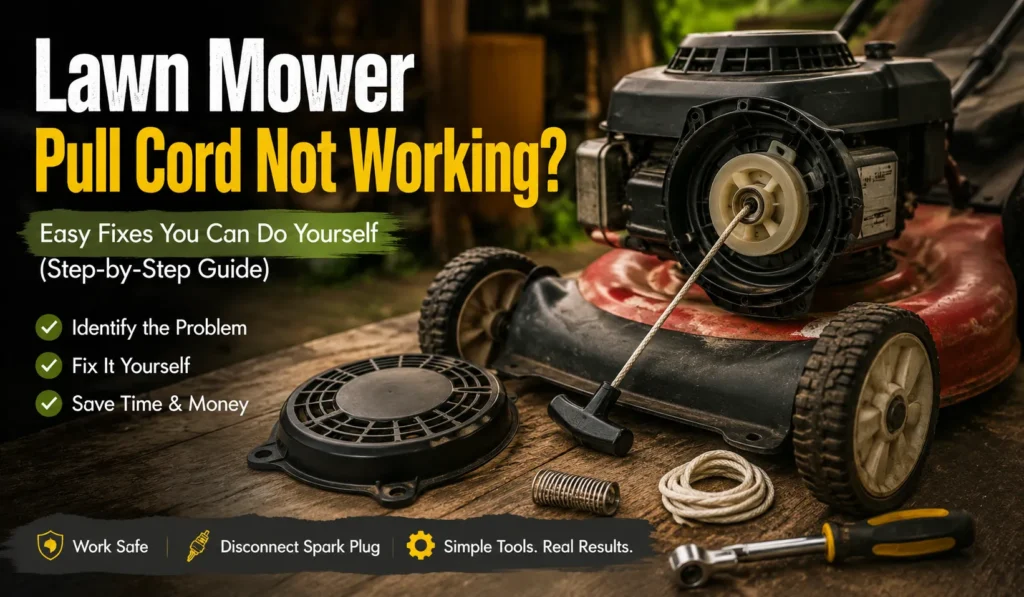
Quick Overview
- A lawn mower pull cord not working usually points to one of three things: a jammed cord, a broken recoil spring, or a seized engine.
- Most pull cord problems cost under $15 to fix yourself with basic tools.
- Always disconnect the spark plug wire before reaching inside the mower housing.
- If the cord pulls but the engine won’t catch, the pull cord itself is probably fine – the problem is elsewhere.
- This guide walks total beginners through diagnosis and repair, step by step.
It’s Saturday morning. The grass is already ankle-deep. You grab the pull cord, give it a yank – and nothing happens. Maybe it snaps back hard and won’t budge. Maybe it goes completely limp. Maybe it came out three inches and just stopped.
If your lawn mower pull cord not working just ruined your weekend plans, you’re in the right place.
I’ve fixed pull cord problems on Honda GCV160s, Briggs & Stratton 550EX engines, Toro Recyclers, and beat-up Troy-Bilts that hadn’t seen a repair shop in a decade. I’ve done it in a Florida garage in July heat, with sweat dripping onto the housing. I’ve done it in a Minnesota shed in March with stiff fingers and a flashlight clamped under my chin.
This guide is for people who have never opened up a mower before. If you can use a screwdriver and follow steps in order, you can do this.
Why Pull Cords Fail – And Why It’s Usually a Simple Fix
Pull cord problems look scary from the outside. They’re not. In most cases, the cord itself is fine. Something small has gone wrong with the mechanism around it.
There are three failure types, and each one feels different in your hand.
The Cord Is Stuck or Won’t Pull At All
This is the one that makes people panic. You reach for the cord and it won’t move. It feels locked.
The most common cause: the blade hit something and the engine locked up. When a mower runs over a hidden stump or a thick root, the sudden stop can jam the flywheel. The cord connects to that flywheel through the recoil starter. If the flywheel can’t turn, neither can your cord.
The second cause is a seized engine – oil ran out, metal overheated, and now internal parts are welded together by heat. This is the bad version. You’ll know because the mower has felt wrong for a while.
Before assuming the worst, tip the mower back and look under the deck. Check if something is wrapped around the blade shaft. Grass clumps, wire, plastic bags – these jam the blade and make the cord feel stuck. Clear the obstruction first. Try the cord again. Half the time, that’s the whole fix.
The Cord Pulls But the Engine Won’t Catch
Good news: your pull cord is probably working fine. The recoil starter is doing its job.
The problem is somewhere else – spark plug, fuel, air filter, or primer bulb. A pull cord delivers rotation to the engine. If the engine isn’t firing from that rotation, the cord is not the issue.
Check these before you touch the recoil starter:
- Is there fresh gas in the tank? Gas older than 30 days can go stale and won’t combust.
- Did you press the primer bulb 3 times before pulling?
- Is the spark plug wire connected?
- Has the spark plug been replaced in the last two seasons?
If yes to all of these and it still won’t start, then you have a carburetor or ignition problem – not a pull cord problem.
The Cord Came Out and Won’t Retract
You pulled the cord and it just… kept going. Now it’s hanging out like a limp noodle and won’t spring back in.
This means the rewind spring broke or lost tension. The spring sits inside the recoil starter housing. It’s coiled tight and it’s what pulls the cord back in after each yank.
Springs wear out. They also lose tension if someone pulled the cord all the way out and let it snap back hard repeatedly. That’s a fast way to kill a rewind spring.
The fix is rewinding or replacing the spring inside the starter housing. It sounds intimidating. It isn’t, if you go slow.
Tools You’ll Need Before You Start
Don’t start disassembly without the right tools in front of you. Stopping mid-job to hunt for a wrench is how small parts get lost on a garage floor.
Basic Tools for Any Pull Cord Job
You probably own most of these already.
- Flathead screwdriver (medium size)
- Phillips head screwdriver
- Needle-nose pliers
- Socket wrench set (3/8″ drive, metric and standard)
- Work gloves – the recoil spring edge is sharp
- Safety glasses
- A clean flat surface to work on
You do not need a torque wrench. You do not need specialty tools. If you have those five items above, you can handle 90% of pull cord repairs.
Replacement Parts and Where to Buy Them in the US
Before you order anything, find your mower’s model number. It’s on a sticker on the deck or engine block – usually near the gas cap or on the side of the engine. Write it down.
Parts you may need:
- Replacement starter rope (pull cord): $4-$8 at Home Depot or Amazon
- Recoil starter assembly (full replacement): $12-$30 depending on engine brand
- Rewind spring: $6-$12, available at Ace Hardware or Amazon
Briggs & Stratton, Honda, and Toro all sell OEM parts through their websites. If you’d rather see the part in person before buying, Ace Hardware locations often stock small engine parts better than Home Depot.
Amazon works well if you have the model number and part number. Search “[your engine brand] + [engine model number] + recoil starter” and check the compatibility list before ordering.
Compression Table: Tools, Estimated Cost, and Where to Find Them
| Tool or Part | Estimated Cost | Where to Buy |
|---|---|---|
| Starter rope (cord) | $4-$8 | Home Depot, Amazon |
| Full recoil starter assembly | $12-$30 | Amazon, Ace Hardware, OEM website |
| Rewind spring only | $6-$12 | Ace Hardware, Amazon |
| Socket wrench set | $20-$35 (if needed) | Home Depot, Walmart |
| Work gloves | $5-$10 | Any hardware store |
| Safety glasses | $4-$8 | Any hardware store |
How to Diagnose Your Pull Cord Problem
A correct diagnosis saves you an hour of unnecessary work. Spend five minutes here first.
Is the Cord Broken or Just Stuck?
Pull the cord slowly and look at what happens.
If it won’t move at all: something is blocking rotation. Go under the deck and check the blade.
If it moves a little then stops: the recoil starter spring may be jammed, or there’s debris inside the housing.
If it pulls out but won’t retract: the rewind spring is broken or has lost tension.
If the cord itself is frayed, knotted, or snapped off: you need a new rope. The rest of the mechanism may be fine.
Checking the Recoil Starter Assembly
The recoil starter is the plastic housing the cord comes out of, mounted on top of the engine. On most walk-behind mowers, it’s held in place by 3 to 4 bolts.
To inspect it:
- Disconnect the spark plug wire first. Pull the rubber cap off the plug. Do not skip this step.
- Remove the bolts holding the recoil starter housing to the engine.
- Lift the housing off carefully. The cord is still attached inside, so set it down gently.
- Look inside. Is the spring visible and intact? Is the cord tangled around the spool? Is there debris clogging the mechanism?
If the spring looks broken (it will be sitting loose or bent at an odd angle), you need a new spring or a new full assembly. If the cord is tangled, you can often free it with needle-nose pliers.
When the Engine Is the Real Problem, Not the Cord
This is where honesty matters. Sometimes the pull cord feels like the problem, but the engine is what’s actually failed.
Signs the engine is the real issue:
- The cord pulls freely but feels like there’s no resistance at all. Normal engines have slight resistance from compression. No resistance means a valve problem or a blown head gasket.
- The cord is completely locked and won’t move even after you’ve cleared the blade. This can mean a seized engine.
- You hear a grinding or scraping sound when you pull.
A seized engine means the internal parts have fused from heat. This happens when the oil runs dry. If you can’t remember the last time you checked the oil, check it now. Pull the dipstick and look. If it’s below the low mark or looks black and gritty, the engine may be done.
I’ve seen this happen on a 6-year-old Husqvarna that the owner had never once changed the oil on. The pull cord felt locked tight. The cord was fine. The engine was gone.
Compression Table: Symptom, Likely Cause, Difficulty Level
| Symptom | Likely Cause | DIY Difficulty |
|---|---|---|
| Cord won’t move at all | Blade obstruction, seized engine | Beginner (if obstruction) / Call a shop (if seized) |
| Cord moves a little then stops | Jammed recoil starter, broken spring | Beginner to Intermediate |
| Cord pulls but won’t retract | Broken or weak rewind spring | Intermediate |
| Cord pulls freely, engine won’t fire | Not a cord problem – check spark/fuel | Beginner |
| Cord is frayed or snapped | Worn rope | Beginner |
| Grinding sound when pulling | Internal engine damage | Call a shop |
Step-by-Step Fix for Each Pull Cord Problem
Work through only the section that matches your diagnosis. You don’t need to read all three.
How to Fix a Stuck or Jammed Pull Cord
Step 1: Disconnect the spark plug wire. Wrap the rubber cap in a rag and secure it away from the plug so it can’t accidentally contact metal.
Step 2: Tip the mower on its side. Keep the air filter side up to prevent oil from flooding the carburetor. Look under the deck at the blade and shaft.
Step 3: Put on gloves. Blade edges are sharp even on a dull mower. Remove any grass, wire, rope, or debris wrapped around the blade shaft. Use needle-nose pliers for anything tight.
Step 4: Set the mower upright. Try the cord again – slow, not hard.
If it now pulls: you found your problem. The blade obstruction was jamming the whole system.
If it still won’t move: remove the recoil starter housing (3-4 bolts on top of the engine). Look inside for a jammed spring or tangled cord. Free anything caught with pliers, working slowly so the spring doesn’t snap loose.
How to Rewind a Cord That Won’t Retract
This job requires patience. The rewind spring holds tension, and you need to load that tension back in without letting it uncoil all at once.
Step 1: Remove the recoil starter housing from the engine.
Step 2: Look at the spool the cord wraps around. Note which direction it winds – clockwise or counterclockwise. Take a photo with your phone before you touch anything.
Step 3: If the spring is intact but loose: hold the spool steady and rotate it slowly in the winding direction (check your photo) until you feel tension build. Three to four full rotations is typical. Too few and the cord won’t retract. Too many and you risk breaking the spring.
Step 4: Hold tension on the spool with one hand. Thread the cord back through the hole in the housing with the other. Pull enough cord out to tie a knot at the handle end.
Step 5: Let the spool rotate slowly, feeding the cord back in. Don’t let it snap.
Step 6: Pull the cord out a few times to test. It should retract cleanly each time.
If the spring is broken – sitting in pieces or bent at a hard angle – you need a replacement. At this point, buying a full replacement recoil starter assembly is often faster and cheaper than sourcing just the spring.
How to Replace a Broken Pull Cord Yourself
This is the most straightforward fix. You’re just swapping the rope.
Step 1: Remove the recoil starter housing.
Step 2: Pull the old cord off the spool. Note the length and thickness before you throw it out – your replacement should match. Standard starter rope sizes are #3 (3/32″), #4 (1/8″), and #4.5 (9/64″). Most walk-behind mowers use #3 or #4.
Step 3: Cut the new rope to the same length as the old one (or 4-5 feet if the old cord is gone).
Step 4: Melt the ends slightly with a lighter to prevent fraying. Let them cool for 10 seconds.
Step 5: Thread the rope through the spool hole and tie a firm knot on the inside of the spool. Pull the knot tight into its notch.
Step 6: Wind the rope around the spool in the correct direction (check your photo from earlier).
Step 7: Thread the free end through the housing exit hole and attach your handle.
Step 8: Test the pull and retraction before bolting the housing back on.
Compression Table: Fix Type, Time Required, Skill Level
| Fix Type | Time Required | Skill Level | Parts Cost |
|---|---|---|---|
| Clear blade obstruction | 5-10 minutes | Beginner | $0 |
| Rewind a loose spring | 20-30 minutes | Intermediate | $0 |
| Replace broken spring | 30-45 minutes | Intermediate | $6-$12 |
| Replace starter rope only | 20-30 minutes | Beginner | $4-$8 |
| Replace full recoil starter assembly | 30-45 minutes | Beginner to Intermediate | $12-$30 |
How Different Conditions Affect Pull Cord Problems
Climate matters more than most people think. Where you live changes how your mower ages and which problems show up first.
Hot and Humid Climates (Florida, Texas, Southeast)
In a Florida garage in July, the air is already 90 degrees before you open the door. Heat softens plastic starter rope over time – it gets slightly sticky and can bind in the housing.
Humidity is the bigger issue. Moisture gets into the recoil starter housing and starts to rust the rewind spring from the inside. The spring looks fine until it snaps on a random Tuesday.
Prevention: At the end of mowing season, spray a light coat of WD-40 into the recoil housing, then pull the cord a few times to distribute it. Store the mower in a spot with airflow, not sealed tight against a wall.
Cold Starts in Midwest Winters and Early Spring
In a Minnesota shed in March, everything is stiff. The rewind spring loses flexibility in cold temperatures and can crack when you yank the cord hard on the first pull of spring.
The bigger cold-weather problem: old fuel. Gas that sat all winter has partially evaporated and leaves a gummy residue in the carburetor. This makes the engine resist starting, so people pull the cord harder and harder – and snap it.
Prevention: Add fuel stabilizer to the tank before storing for winter (Briggs & Stratton and STA-BIL are both widely available at Home Depot). In spring, pull slowly and steadily for the first 3 pulls – don’t rip it.
Dusty and Dry Conditions (Arizona, Southwest)
Phoenix backyard dust finds its way into every gap in the engine housing. Fine particles collect inside the recoil starter and act like sandpaper on the rope and spool.
In dry climates, starter ropes also dry out and get brittle faster than in humid regions. A rope that looks fine in August can crack by October in Arizona.
Prevention: After every 10 mowing sessions, remove the air filter and tap it clean. Blow compressed air into the recoil housing to clear dust. Replace the starter rope every 2 seasons rather than waiting for it to break.
Compression Table: Climate, Common Issue, Prevention Tip
| Climate | Most Common Pull Cord Issue | Best Prevention |
|---|---|---|
| Hot and humid (Florida, Texas) | Rusted rewind spring, sticky cord | WD-40 in housing, good airflow storage |
| Cold starts (Midwest, Northeast) | Cracked spring, snapped cord from hard yanking | Fuel stabilizer, gentle first pulls in spring |
| Dusty and dry (Arizona, Southwest) | Abraded rope, dusty spool | Compressed air cleaning, replace rope every 2 seasons |
| Moderate (Pacific Northwest) | Moisture from rain storage | Cover or store mower indoors between uses |
Common Beginner Mistakes to Avoid
Most repairs go wrong in the same few ways. Here’s what I’ve seen beginners do – and what happens when they do it.
Pulling Too Hard and Snapping the Cord
This one is almost universal. The cord feels stuck, so people pull harder. Then harder. Then they hear a snap.
The snap is usually the cord breaking – but sometimes it’s the rewind spring. A broken spring is a bigger repair than a stuck cord ever was.
If the cord won’t move: stop pulling. Diagnose first. A stuck cord always has a cause. Clear the cause, and the cord will move without force.
The only time you need serious pulling force is a healthy engine on a cold morning. Even then, firm and steady beats hard and fast every time.
Skipping the Safety Check Before You Reach Inside
This one matters more than any of the mechanical steps.
Always disconnect the spark plug wire before putting your hands near the blade, inside the housing, or anywhere the engine could fire unexpectedly. A mower engine can kick over from compression alone if the blade moves. It doesn’t need the key. It doesn’t need you to pull the cord.
Pull the rubber cap off the spark plug. Set it somewhere it won’t bounce back against the plug on its own. Then work.
I’ve seen people skip this because they’re in a hurry or because the mower “isn’t running anyway.” A non-running engine can still move. Don’t skip the safety check.
My Final Advice
Most pull cord problems are $0 fixes or under $30 in parts. If you’ve read this far and the diagnosis matched one of the three main failure types – blocked blade, weak spring, broken cord – you can fix this yourself in under an hour. The first time always takes longer. The second time takes 20 minutes.
Be honest with yourself about what you’re looking at, though. If the engine pulled hard for weeks before the cord problem appeared, or if the oil looked black when you checked it, the pull cord may just be the symptom of a deeper problem. Take it to a small engine shop. A reputable shop charges $40-$80 for diagnosis, and they’ll tell you straight if the engine is done. That conversation is worth the cost before you spend money on parts.
The one situation where DIY reliably makes things worse: a jammed recoil spring that you let uncoil all at once. If the spool spins free while you’re holding it, that spring will coil up your fingers fast. Gloves are not optional on this job. If the spring looks damaged or you’re not sure how to hold tension on it, buy a replacement full assembly and skip the spring surgery. It’s $15 and it comes pre-wound.
DIY Fix vs. Taking It to a Shop
| Factor | DIY Fix | Small Engine Shop |
|---|---|---|
| Cost | $0-$30 in parts | $40-$120 labor + parts |
| Time | 30-90 minutes | Drop off + wait 1-5 days |
| Tools needed | Basic screwdrivers, socket set | None – they have everything |
| Skill required | Beginner to Intermediate | None from you |
| Best for | Clear obstruction, cord replacement, spring rewind | Seized engine, internal damage, when diagnosis is unclear |
| Risk of making it worse | Low if you follow steps | None |
| Satisfaction after | High | Lower, but the mower works |
Frequently Asked Questions About Lawn Mower Pull Cord Problems
What does it mean when a lawn mower pull cord won’t pull at all?
It usually means something is blocking the blade or the internal flywheel from rotating. Start by checking under the deck for debris wrapped around the blade shaft. Clear it, then try the cord again. If it’s still locked, the engine may be seized – check your oil level before going further.
How much does it cost to replace a lawn mower pull cord?
The rope itself costs $4-$8 at Home Depot, Ace Hardware, or Amazon. If you need a full replacement recoil starter assembly, expect to pay $12-$30 depending on your engine brand. A small engine shop will charge $40-$80 in labor plus parts to do it for you.
Can I mow without fixing the pull cord first?
No. If the pull cord isn’t working, the mower won’t start. There’s no workaround for a broken recoil starter – it’s the only way to turn the engine over on a manual-start mower.
How do I know if my rewind spring is broken?
Pull the cord out fully and release it. If the cord doesn’t retract (spring back in), the rewind spring has broken or lost tension. You’ll also sometimes see the cord hang loosely with no resistance at all. Removing the recoil starter housing and looking inside will confirm it – a broken spring will be sitting loose or visibly bent out of shape.
Is it safe to fix a lawn mower pull cord myself?
Yes, for most repairs. The main safety rule: disconnect the spark plug wire before reaching inside or near the blade. With that done, replacing a cord or rewinding a spring carries very low risk. The one exception is a fully unwound recoil spring – it can snap open fast and cut your hand. Wear gloves and work slowly, or buy a pre-assembled replacement unit instead.
What’s the difference between a pull cord and a recoil starter?
The pull cord is the rope you grab with your hand. The recoil starter (also called the rewind starter) is the full assembly the cord connects to – including the housing, spool, and spring. When people say “the pull cord is broken,” they sometimes mean just the rope, and sometimes the whole assembly. The section above on diagnosis will help you figure out which one applies to your mower.
When should I replace the whole recoil starter instead of just the rope?
Replace the full assembly when the rewind spring is broken, the spool is cracked, or when the repair parts cost more than a replacement unit. A new recoil starter assembly for most Briggs & Stratton or Honda engines runs $12-$25 on Amazon and installs in about 30 minutes. For anything older or less common, check with Ace Hardware or your engine brand’s parts website.